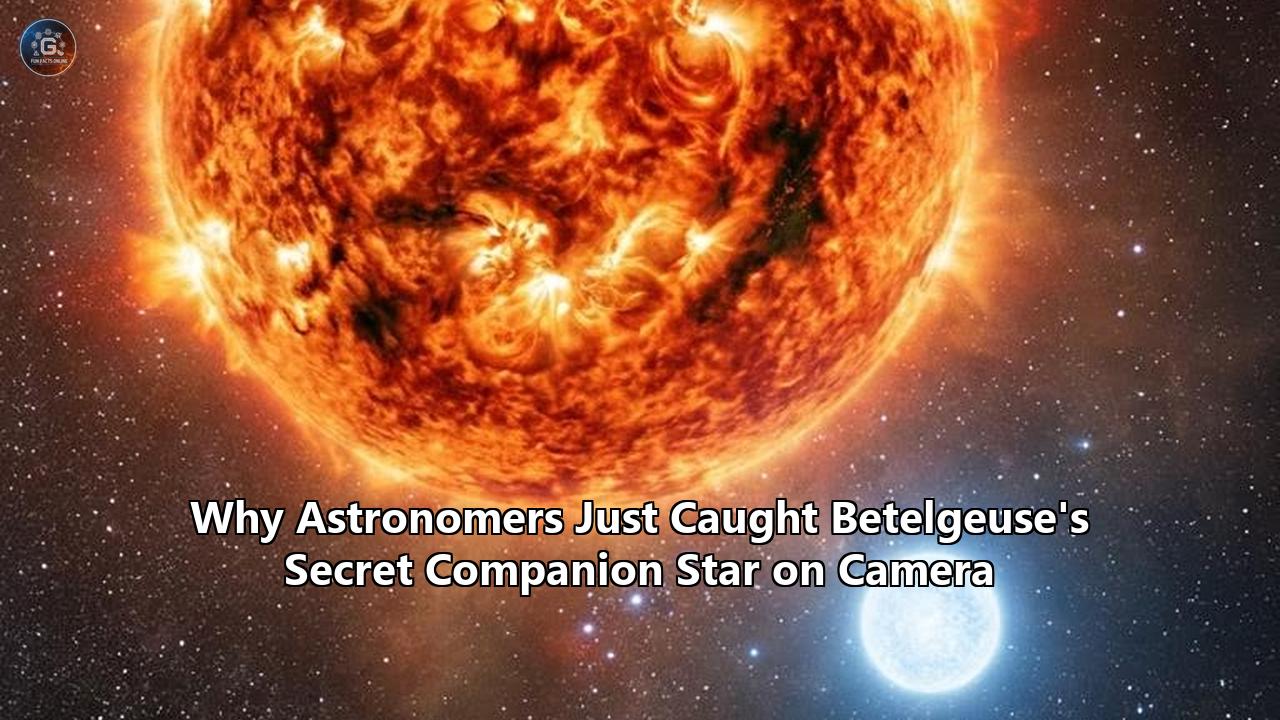
When astrophysicist Miguel Montargès opened the newly processed image files on his computer at the Observatoire de Paris, he did something scientists rarely admit to in formal research papers. "I jumped from my chair when I saw the processed images," Montargès recalled. On the monitor, situated just past the glaring edge of the red supergiant Betelgeuse, sat a distinct, isolated pinprick of light.
For more than a century, astronomers had suspected that the famous shoulder of Orion was not a solitary titan, but half of a binary system. On July 28, 2026, an international research team led by Montargès published the definitive evidence in Astronomy & Astrophysics: the first direct optical image of the elusive Betelgeuse companion star.
Captured using the SPHERE (Spectro-Polarimetric High-contrast Exoplanet REsearch) instrument mounted on the European Southern Observatory’s Very Large Telescope (VLT) in Chile’s Atacama Desert, the observation resolves one of the longest-standing cold cases in observational astrophysics. The detected object—officially designated Alpha Orionis B and informally dubbed "Siwarha" (Arabic for "Her Bracelet")—was caught at a separation of just 52 milliarcseconds from the main star. That translates in real terms to roughly 8.8 astronomical units (AU), placing the smaller star slightly closer to Betelgeuse than Saturn is to our Sun.
"This is the conclusion of a century-long quest," Montargès said. "We have shown that Betelgeuse is not single; it is accompanied by a faint stellar companion."
Behind this historic image lies a high-stakes convergence of historical celestial tracking, supercomputer modeling, and high-contrast imaging techniques originally engineered to find tiny exoplanets. The discovery does more than confirm a faint dot on a sensor: it fundamentally rewrites what we know about how massive stars age, lose mass, and prepare for their eventual supernova explosions.
The Physics of the Unseen: Why Imaging Alpha Orionis B Was Considered Nearly Impossible
To understand why capturing the Betelgeuse companion star took over 100 years, one must appreciate the sheer observational nightmare that Alpha Orionis presents to high-contrast astronomy.
Betelgeuse is a cosmic behemoth. Located approximately 650 to 700 light-years from Earth, it is a red supergiant bloated to more than 1,000 times the radius of the Sun. If placed at the center of our solar system, its outer edge would swallow Mercury, Venus, Earth, Mars, and extend past the orbit of Jupiter. Emitting over 100,000 times the luminosity of the Sun, Betelgeuse dominates its local patch of sky with blinding brightness.
Trying to image a faint, normal-sized star orbiting closely around such a giant is the optical equivalent of trying to spot a firefly hovering inches away from a stadium floodlight—while both are situated inside a fog bank 700 light-years away.
                                [ Betelgeuse System Scale ]

      Outer Atmosphere & Dust Envelope (~15-20 AU Radius)
     . . . . . . . . . . . . . . . . . . . . . . . . . . . . . . . .
    .                                                               .
   .        +-----------------------------------------------+        .
  .         |               BETELGEUSE (A)                  |         .
 .          |   Bloated Red Supergiant Radius ~ 4.5 AU      |          .
.           |   Luminosity ~ 100,000x Sun                   |           .
 .          +-----------------------------------------------+          .
  .                                 |                                 .
   .                                | 8.8 AU (~52 milliarcseconds)   .
    .                               v                               .
     . . . . . . . . . . . . .  [Siwarha / B]  . . . . . . . . . . . .
                                (2.6-3.1 M_sun)
The difficulty is compounding:
- Extreme Contrast Ratio: Betelgeuse is hundreds of thousands of times brighter in optical wavelengths than a main-sequence companion star. The brightness differential overwhelms CCD and CMOS detectors instantly, filling sensor pixels with scattered starlight (diffraction spikes and halo glare).
- Tiny Angular Separation: At a distance of nearly 700 light-years, an orbital radius of 8 to 9 AU subtends an angle of barely 0.052 arcseconds (52 milliarcseconds) on the sky. This sits right at the physical diffraction limit of even 8-meter-class ground-based optical telescopes.
- The Circumstellar Dust Shroud: Betelgeuse continuously ejects massive quantities of gas and heavy dust grains through vast stellar winds and giant surface convection plumes. This creates a thick, asymmetrical dust shell around the system that scatters optical light, creating a noisy, chaotic background that easily masks faint stellar sources.
Previous attempts using space assets like the Hubble Space Telescope and the Chandra X-ray Observatory failed to unequivocally isolate the companion. Hubble’s UV aperture lacked the angular resolution required to disentangle a 52-milliarcsecond separation from Betelgeuse’s extended outer atmosphere, while Chandra’s X-ray searches yielded non-detections because the secondary star was not emitting sufficient high-energy coronal X-rays to stand out against the background noise.
It became clear that imaging the companion star would require an unprecedented alignment of precise theoretical modeling and next-generation adaptive optics.
The Theoretical Detective Work: How Goldberg, MacLeod, and Plummer Solved the Math First
Long before the VLT fired its mirrors at Betelgeuse in December 2024, astronomers knew something was tugging on the giant star.
The story begins in 1908, when English astronomer Henry Cozier Plummer analyzed visual brightness observations of Betelgeuse and noticed a secondary, long-term cycle operating beneath the star's main variations. Plummer suggested that the gravitational pull of an unseen binary partner was pulling Betelgeuse back and forth.
However, throughout the mid-to-late 20th century, astrophysics shifted focus. Scientists discovered that red supergiants are violent, pulsating engines. Betelgeuse expands and contracts on a primary pulsation cycle of roughly 400 days, with secondary harmonic pulsations at 200 and 230 days. As surface convection cells the size of the inner solar system boiled and sloshed, astronomers assumed these internal dynamics accounted for all light variations, and Plummer's binary hypothesis was shelved as an unnecessary complication.
Yet one signal refused to go away: a long secondary period (LSP) of roughly 2,170 days—about 5.9 years.
                     [ Betelgeuse Light-Curve Periods ]

       Relative Amplitudes & Timescales

       [400 Days]  ===> Fundamental Radial Pulsation (Internal Expansion)
       [230 Days]  ===> First Overtone Pulsation Mode

       [2,170 Days] ===> Long Secondary Period (LSP)
                         (Cause: Orbital Motion of Companion Star)
Roughly 25 to 30 percent of all red supergiants display these mysterious Long Secondary Periods. For decades, theories ranged from giant non-radial gravity modes to massive magnetic dust-generating cycles. But in late 2024, two independent research groups published back-to-back theoretical breakthroughs that forced the astronomical community to reconsider.
A team led by Jared Goldberg at the Flatiron Institute’s Center for Computational Astrophysics re-analyzed precision astrometric data from the European Space Agency's Gaia satellite alongside high-precision radial velocity measurements spanning two decades. Goldberg’s team tested every single leading physical mechanism for the 2,170-day LSP. One by one, the physics broke down—except for one model. The wobbles in Betelgeuse's position and speed were consistent with a low-mass companion star pulling on Betelgeuse as it moved along its orbit.
Concurrently, Morgan MacLeod and his team at the Harvard-Smithsonian Center for Astrophysics analyzed a century-long photometric dataset dating back to 1896. MacLeod showed that the 5.9-year cycle had remained remarkably stable in phase and amplitude for over 128 years. Internal convective churn or magnetic cycles in a chaotic supergiant cannot maintain phase coherence over a century; only orbital mechanics can.
"If the star is real, it's kind of hidden right there in plain sight," MacLeod noted at the time.
Crucially, both teams performed orbital mechanics simulations that generated a specific prediction: the Betelgeuse companion star was traversing an elliptical orbit and would reach its maximum angular elongation—its furthest apparent distance from Betelgeuse as seen from Earth—in December 2024.
That prediction created an urgent window of opportunity. If ground-based observers did not capture the star in late 2024, the companion would swing back toward Betelgeuse's blazingly bright disc, becoming invisible to terrestrial instruments for years to come.
The Breakthrough Mechanics: SPHERE, ZIMPOL, and Extreme Adaptive Optics
With the orbital clock ticking down, Miguel Montargès and his team secured observing time on ESO’s Very Large Telescope in Chile. The tool chosen for the job was SPHERE, specifically its Zurich IMaging POLarimeter (ZIMPOL) subsystem.
                     [ SPHERE-ZIMPOL Imaging Pipeline ]

    +-------------------+      Extreme Adaptive Optics      +-------------------+
    | Raw Light from    |  =============================>  | Real-Time Mirror  |
    | VLT Telescope     |    Corrects Atmospheric Blur      | Deformations      |
    +-------------------+                                   +-------------------+
                                                                      |
                                                                      v
    +-------------------+      Differential Polarimetry     +-------------------+
    | Starlight         |  <=============================  | ZIMPOL Optical    |
    | Subtraction (ADI) |     Isolates Stellar Light vs     | Sensor Array      |
    +-------------------+        Scattered Dust Light       +-------------------+
              |
              v
    +-------------------------------------------------------------------+
    | REVEALED SOURCE: Betelgeuse B (Siwarha) at ~52 mas separation    |
    +-------------------------------------------------------------------+
ZIMPOL is an instrument designed for extreme high-contrast imaging, traditionally utilized to search for faint gas-giant exoplanets around nearby stars. To pull Betelgeuse B out of the supergiant's overwhelming glare, the team had to combine three distinct technical capabilities:
1. Extreme Adaptive Optics (SAXO)
Ground-based optical astronomy is normally blurred by Earth’s turbulent atmosphere. SPHERE utilizes the SAXO adaptive optics system, which uses a deformable mirror with over 1,300 actuators moving thousands of times per second. This system measures atmospheric distortion in real-time and flexes the mirror to cancel out turbulence, allowing the VLT to operate near its theoretical diffraction limit.
2. High-Contrast Polarimetric Differential Imaging
ZIMPOL splits incoming light into two perpendicular linear polarization states simultaneously. Starlight reflected off dust grains in Betelgeuse's atmosphere is highly polarized, whereas direct thermal and nuclear light emitted from a stellar photosphere is unpolarized. By subtracting the polarized dust signal from the total light, astronomers can effectively "peel back" the thick dust shroud surrounding the star.
3. Exoplanetary Point Spread Function (PSF) Subtraction
Even with adaptive optics, light from Betelgeuse spreads across the sensor in complex diffraction patterns known as the Point Spread Function (PSF). Because Betelgeuse is so bright, these halo patterns easily drown out nearby faint targets.
The team applied post-processing algorithms adapted from exoplanet direct-imaging campaigns, including Angular Differential Imaging (ADI) and Reference Differential Imaging (RDI). By tracking how the sky rotates relative to the telescope optics over several hours, the algorithms can distinguish static telescope artifacts from true astronomical sources. The light profile of Betelgeuse was computationally modeled, scaled, and subtracted from the raw frame pixel by pixel.
Observations were taken on the nights of December 3 and December 6, 2024. What followed was a painstaking, multi-month data reduction pipeline to ensure that the faint spot left behind was a physical star rather than a digital artifact, a convective feature on Betelgeuse’s surface, or a random background star.
"Honestly, I thought we did not have the sensitivity to detect Betelgeuse B as it was predicted," Montargès admitted. "Because it is more massive than predicted, we see it!"
The Big Mass Surprise: Rethinking Betelgeuse B
The direct imaging data contained a major surprise that caught theorists off guard.
Prior to the SPHERE observations, theoretical models calculated by MacLeod and Goldberg assumed that the Betelgeuse companion star was a low-mass main-sequence dwarf star, likely between 0.6 and 1.5 solar masses ($M_\odot$). A star of that modest mass would emit very little optical light, rendering it right at the absolute limit of detection—or slightly below it.
However, the light flux measured by SPHERE-ZIMPOL showed a source significantly brighter than predicted.
By analyzing the optical magnitude and colors of the isolated point source—and assuming the companion formed at the same time as Betelgeuse from the same natal molecular cloud roughly 8 to 10 million years ago—Montargès’ team determined that Betelgeuse B has a mass between 2.6 and 3.1 solar masses ($M_\odot$).
| Property | Early Theoretical Predictions (2024) | VLT/SPHERE Direct Imaging Results (2026) |
|---|---|---|
| Mass Range | 0.6 – 1.5 Solar Masses ($M_\odot$) | 2.6 – 3.1 Solar Masses ($M_\odot$) |
| Spectral Class | K or M Dwarf | Late B or Early A Main-Sequence Star |
| Separation | ~50 - 55 milliarcseconds | 52.32 ± 0.18 milliarcseconds (~8.8 AU) |
| Orbital Period | ~2,110 – 2,170 Days (~5.8 – 5.9 Years) | Consistent with ~2,200 Days |
| Detection Method | Astrometric / Photometric Modeling | Direct High-Contrast Optical Imaging |
This larger mass turns Betelgeuse B from a modest dwarf into a bright, young B-type or A-type main-sequence star. This extra mass explains why SPHERE was able to catch it so clearly: the star emits far more photons than a sub-solar dwarf, allowing its light signal to rise above the residual speckle noise of Betelgeuse's halo.
"The fact that we can still discover a nearby companion, more massive and brighter than the sun, around such a well-studied star is remarkable," Montargès said.
This revised mass also raises compelling questions about the formation history of the Betelgeuse system. Massive stars are almost always born in multiple-star systems. Finding a 3-solar-mass star orbiting a primary that started its life around 15 to 20 solar masses fits neatly into current stellar population models, but its current orbit—just 8.8 AU away from a star whose outer layers extend to 4.5 AU—indicates a complex history of tidal dynamics.
The "Dust Snowplow" Mechanism: How Betelgeuse B Shapes Its Giant Host
One of the most persistent mysteries surrounding Betelgeuse was how a companion star could cause a 6-year dip and rise in brightness without physically eclipsing the giant star itself.
If Betelgeuse B were simply passing directly in front of Betelgeuse, its tiny disc (a few times larger than the Sun) would block less than 0.001 percent of Betelgeuse's light—an imperceptible fraction impossible to detect from Earth. Yet the Long Secondary Period shows brightness variations of up to 10 to 15 percent.
The answer lies in an hydrodynamic mechanism known as the "dust snowplow" effect or anti-eclipse.
                        [ The Anti-Eclipse Mechanism ]

     [Position A: Far Side of Orbit]         [Position B: Companion Transiting in Front]

         Thick Dust Shroud Blocks                 Companion's Gravity & Plasma Wake
             Betelgeuse Light                      Clears Corridor / Snowplows Dust

            . . . * . . .                              . . . . . . . . .
          .  :  :  :  :   .                          .    \   |   /    .
         .  : [Betelgeuse] .                        .   [Betelgeuse]    .
          .  :  :  :  :   .                          .    /   |   \    .
            . . . . . . .                              . . . . . . . . .
                   ^                                          ^
                   |                                          |
             [Siwarha / B]                              [Siwarha / B]
            (Dust Accumulated)                      (Clear Viewing Corridor)

         ===> DIMMER TO EARTH                      ===> BRIGHTER TO EARTH
Betelgeuse constantly sheds mass, forming a thick, opaque envelope of circumstellar dust. As Betelgeuse B orbits at a distance of ~8.8 AU, it doesn't travel through empty vacuum; it plows directly through the dense, gas-rich extended atmosphere and dust envelope of its giant host.
- Gravitational & Hydrodynamic Wake: As the companion moves through the extended atmosphere, its gravity acts like a gravitational whisk or snowplow. It attracts local gas and dust, clearing out a hollowed-out channel or "corridor" behind it.
- Dust Modulation: When Betelgeuse B swings around to the side of its orbit facing Earth, this cleared-out channel aligns with our line of sight. With the obstructing dust cleared away, more direct starlight from Betelgeuse escapes into space toward Earth, causing Betelgeuse to appear brighter.
- The Anti-Eclipse: Conversely, when the companion orbits to the far side of Betelgeuse, the dust accumulates across our line of sight, dimming the system. The companion does not cause a traditional eclipse by blocking light; rather, its motion modulates the dust density along our line of sight.
This mechanism was corroborated in early 2026 by ultraviolet and optical spectroscopic observations using the Hubble Space Telescope, led by Andrea Dupree of the Harvard-Smithsonian Center for Astrophysics. Dupree’s team tracked shifts in the velocity of ionized gas in Betelgeuse's chromosphere, detecting a massive plasma wake dragging behind Betelgeuse B.
"What we learn from these latest results is that Siwarha seems to 'stir up' Betelgeuse's extended atmosphere as it orbits, leaving a wake that impacts what we see from Betelgeuse itself," explained co-author Morgan MacLeod. "This wake is evidence of Siwarha's presence and it's also a trace of how such a small companion is able to affect what we see of Betelgeuse."
This finding also offers context for the famous "Great Dimming" of 2019–2020, when Betelgeuse unexpectedly lost over two-thirds of its brightness. While that event was primarily caused by a massive surface mass ejection that cooled into a dark dust cloud, scientists now suspect that Betelgeuse B's orbital position helped shape how that ejected dust cloud evolved and dispersed across the system.
Inside the Naming Debates and Community Dynamics
Beyond the complex data processing pipelines, the discovery of the Betelgeuse companion star triggered a lighthearted debate within the astronomical community over nomenclature and scientific proof.
When theoretical papers first proposed the object, informal nicknames circulated rapidly. Observers quickly dubbed the object "Betelbuddy," a playful reference to its role as the giant star's sidekick.
However, when Montargès’ observational team submitted their discovery paper, they formally proposed a name grounded in stellar history and culture: Siwarha.
The primary star's name, Betelgeuse, is derived from the mistranslated Arabic phrase Yad al-Jawza, meaning "the Hand of the Giant" (referring to the ancient Arabic constellation of Orion/Al-Jawza). In their paper, the authors noted:
"Given that Alpha Ori B orbits the hand of the giant, we suggest that the companion star be named Siwarha, or 'Her Bracelet.'"
                     [ Cultural & Scientific Nomenclature ]

       Historical Name:      Yad al-Jawza (Arabic: "Hand of the Giant")
                                       |
                                       v
       Primary Supergiant:   Betelgeuse (Alpha Orionis A)
                                       |
                                       v
       Companion Star:       Alpha Orionis B
                             - Informal: "Betelbuddy" / "Otho"
                             - Formal Proposal: "Siwarha" ("Her Bracelet")
The discovery also highlights the differing criteria for confirmation among astronomers. In mid-2025, a team led by Steve Howell at NASA Ames Research Center reported a tentative 1.5-sigma optical signal using the 'Alopeke speckle imager on the Gemini North telescope in Hawaiʻi. While suggestive, the low signal-to-noise ratio left room for skepticism. The new VLT/SPHERE image provides a far clearer, higher-contrast detection.
Despite the clear visual evidence, lead author Miguel Montargès maintains rigorous scientific caution. Because the team has only imaged the companion at a single point in its orbit (one epoch), he officially refers to the source as a "companion candidate" until a second epoch can prove its orbital movement around Betelgeuse.
"To be certain that the companion is really there, we still need to observe it in one year on the other side of the star," Montargès noted, "but there is very little space left for doubt."
Others in the field are ready to declare the search complete. "Miguel, he's very conservative. He keeps calling it a candidate," said collaborator Andrea Dupree. "But some of us are more uninhibited. We say it's really there."
Cosmic Doom: The Ticking Clock of an Inevitable Merger
Now that the existence and mass of the Betelgeuse companion star are established, astrophysicists are running orbital simulations to project the long-term fate of the system. The results reveal a dynamic binary system heading toward an inevitable, violent collision.
Because Betelgeuse B orbits so close to its supergiant host (~8.8 AU), its path cuts directly through the thin outer envelope of Betelgeuse’s atmosphere. This causes a phenomenon known as hydrodynamic drag or tidal friction.
                     [ Timeline of the Betelgeuse System ]

    PRESENT DAY
    ==========> Betelgeuse B orbits at ~8.8 AU, plowing through extended gas/dust.
                Tidal interactions torque the supergiant's outer layers.

    NEXT 10,000 YEARS (Scenario A: Common Envelope & Merger)
    ==========> Orbital drag continuously decays Siwarha's orbit.
                Betelgeuse expands further, completely engulfing Siwarha.
                Result: Stellar merger, spinning up Betelgeuse's rotation.

    ANYTIME NEXT 100,000 YEARS (Scenario B: Supernova Detonation)
    ==========> Betelgeuse's iron core collapses; star explodes as Type II Supernova.
                Shockwave strips Siwarha's outer envelope, kicking it into deep space.
As the 3-solar-mass companion plows through the dense gas shed by Betelgeuse, it loses kinetic energy. Bit by bit, its orbit is spiraling inward. At the same time, as Betelgeuse continues to evolve toward the end of its life, its outer envelope will swell even larger.
Computer models simulated by Goldberg and MacLeod suggest two possible endgame scenarios for Siwarha:
Scenario 1: The Common Envelope Merger (~10,000 Years)
If Betelgeuse does not explode first, orbital drag will pull Betelgeuse B inward until it plunges into the outer layers of the supergiant. This initiates a "common envelope" phase, where Siwarha spirals deep inside Betelgeuse's core. The drag will transfer angular momentum to Betelgeuse, causing the giant star to spin up rapidly before completely swallowing its companion whole. This mechanism could explain why Betelgeuse is already rotating faster than isolated red supergiant theories predict.
"Betelgeuse and its buddy will hug eternally," Jared Goldberg remarked during the theoretical modeling phase.
Scenario 2: Supernova Blast Shockwave (Anytime in the next 100,000 Years)
If Betelgeuse reaches iron core collapse and explodes as a Type II-P supernova before swallowing its companion, Siwarha will face an extreme environment. The expanding supernova shockwave—traveling at thousands of kilometers per second—will slam directly into the 3-solar-mass star at a distance of under 10 AU.
While the shockwave will strip away Siwarha's outer hydrogen envelope, the companion star's dense core is expected to survive. Unbound from Betelgeuse’s gravitational grip, Siwarha would be flung out into interstellar space as a high-velocity "runaway star," traveling through the Milky Way at hundreds of kilometers per second.
What Happens Next: The 2027 Orbit Verification and Beyond
The direct imaging of Betelgeuse B marks a turning point in stellar astrophysics, but the observational campaign is far from over.
To confirm the orbit and eliminate any lingering doubts, astronomers are preparing for the next critical milestone in late 2027. According to orbital models, by November or December 2027, Betelgeuse B will reach its second point of maximum elongation on the opposite side of Betelgeuse.
                          [ The 2024–2027 Orbital Path ]

                             Late 2027 Target Window
                           (Maximum Elongation - West)
                                      [X]
                                       |
                                       |
                                . . . . . . .
                              .               .
                             .  [BETELGEUSE]   .
                              .               .
                                . . . . . . .
                                       |
                                       |
                                      [X]
                             December 2024 Image
                           (Maximum Elongation - East)
                           [VLT/SPHERE Direct Detection]
A second detection at this predicted position will allow astronomers to:
- Precise-fit the full 3D orbital parameters (inclination, eccentricity, and semimajor axis).
- Refine the exact masses of both stars through Kepler’s Third Law, offering a direct measurement of Betelgeuse’s mass.
- Analyze the companion’s spectrum directly using integral field spectrographs, pinpointing its chemical composition, surface temperature, and age.
Beyond Orion, this success opens up an entirely new avenue of study across the galaxy. Because roughly 25 to 30 percent of all red supergiants exhibit Long Secondary Periods, astronomers now suspect that a large fraction of these massive stars harbour hidden, dust-clearing companions. Instruments like SPHERE on the VLT, the upcoming Extremely Large Telescope (ELT) in Chile, and the James Webb Space Telescope (JWST) will now turn their focus to other bloated supergiants across the Milky Way.
By applying planet-hunting post-processing algorithms to massive stellar systems, astronomers have turned a century of theoretical speculation into concrete visual proof. Betelgeuse is no longer a solitary giant waiting to explode in isolation; it is a dynamic, interacting binary system, dancing with a secret partner that has finally been caught on camera.
Reference:
- https://boingboing.net/2026/07/28/supergiant-betelgeuses-smaller-companion-star-imaged.html
- https://earthsky.org/space/has-the-betelgeuse-companion-star-been-imaged/
- https://www.sci.news/astronomy/direct-image-betelgeuse-b-14951.html
- https://mashable.com/article/betelgeuse-companion-direct-detection-image
- https://www.sciencenews.org/article/new-images-betelgeuse-star
- https://www.astronomy.com/science/betelgeuse-may-have-a-betelbuddy/
- https://www.space.com/astronomy/stars/betelgeuse-betelgeuse-astronomers-capture-clearest-image-yet-of-famous-stars-elusive-companion
- https://www.techexplorist.com/astronomers-finally-find-strong-evidence-betelgeuse-alone/103628/
- https://krdo.com/cnn-other/2026/01/20/invisible-companion-leaves-evidence-trail-around-supergiant-star-betelgeuse/
- https://today.rtl.lu/news/science-and-environment/first-image-taken-of-betelgeuses-elusive-companion-star-1511952101
- https://www.zmescience.com/space/betelgeuse-companion-star/
- https://www.sciencenews.org/article/betelgeuse-hidden-companion-star
- https://www.eso.org/public/archives/releases/sciencepapers/eso2611/eso2611a.pdf