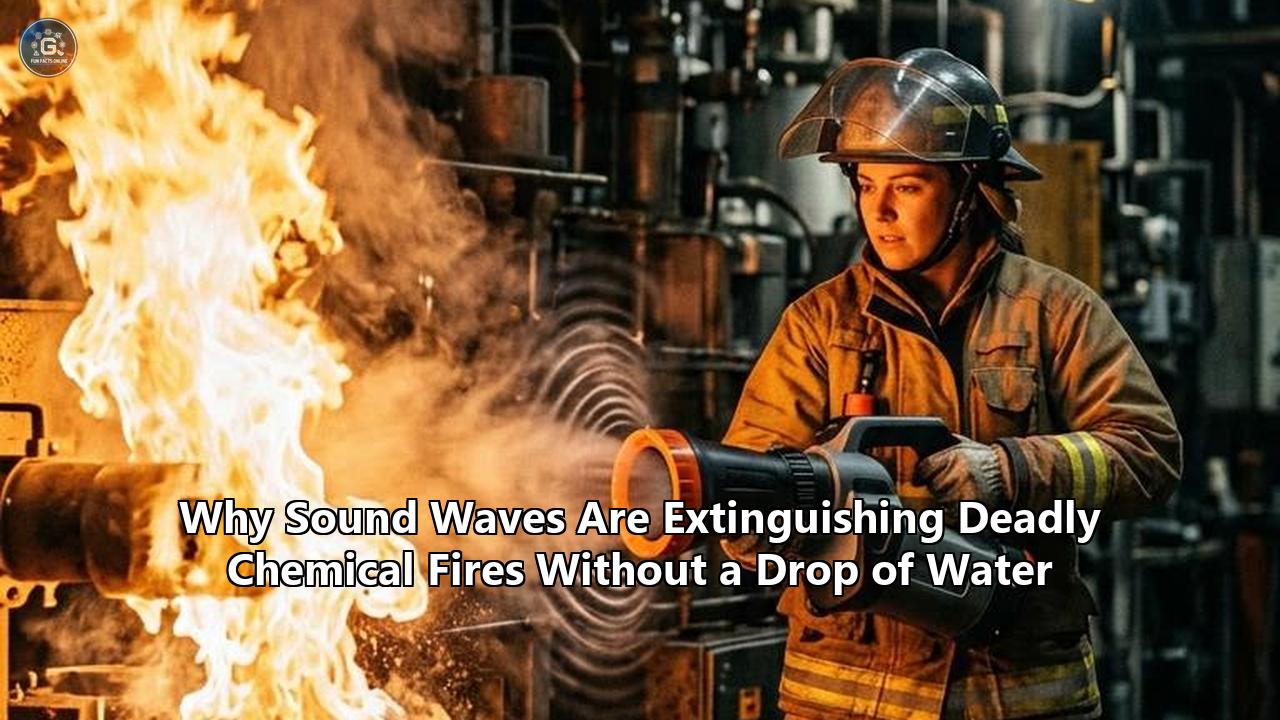
Inside a reinforced test cell at a specialized industrial safety testing complex in Southern California, an open steel tank containing 50 gallons of heptane and industrial solvents is ignited. Within seconds, the liquid pool surges into a roaring Class B chemical fire, its core temperature exceeding 1,100 degrees Celsius and radiating thick plumes of toxic soot.
Instead of triggering an overhead deluge of hundreds of gallons of water or unleashing a blanket of fluorochemical smothering foam, the facility operators activate a bank of specialized low-frequency acoustic transducers mounted on an articulated gantry.
A resonant hum at 42 Hertz throbs through the concrete walls. There is no moisture, no powder, and no chemical dispersal. Within 800 milliseconds, the roaring hydrocarbon flame stretches violently, detaches from the surface of the liquid pool, and simply ceases to exist. The solvent pool beneath sits entirely undisturbed, clear, and cold.
This successful high-volume industrial trial marks a turning point in fire science: the transition of acoustic flame suppression from an academic curiosum into a viable defensive platform for high-risk chemical, energy storage, and industrial facilities. As municipal fire departments—including California’s San Bernardino County Fire Protection District—and industrial safety consortia evaluate field-scale sonic suppression systems, the technology is stepping directly into a high-stakes operational vacuum.
The timing is critical. Industrial facilities and municipal fire services are navigating an unprecedented regulatory squeeze. Environmental protection agencies across North America and the European Union have accelerated mandatory bans on legacy Aqueous Film-Forming Foams (AFFF) due to persistent per- and polyfluoroalkyl substances (PFAS). Concurrently, the global buildout of utility-scale lithium-ion battery storage and advanced chemical manufacturing has created fire hazards where traditional water deployment ranges from ineffective to catastrophic.
Behind the headlines that frame acoustic firefighting as a physics novelty lies a sophisticated convergence of combustion kinetics, fluid mechanics, and acoustic beamforming. Understanding why low-frequency sound waves can dismantle a volatile chemical inferno without a single drop of water requires looking into the microscopic dynamics of the flame front itself.
+-----------------------------------------------------------------------------+
|               THE ACOUSTIC FLAME EXTINCTION MECHANISM                       |
+-----------------------------------------------------------------------------+
|                                                                             |
|      Acoustic Wave Direction --->                                           |
|                                                                             |
|      [Sub-Bass / Infrasound Source (30–60 Hz)]                              |
|           |                                                                 |
|           v                                                                 |
|   (((( HIGH-AMPLITUDE ACOUSTIC PRESSURE PULSES ))))                         |
|           |                                                                 |
|           +---> 1. Induces High Flame Strain Rate (Exceeds Kappa Critical)  |
|           |                                                                 |
|           +---> 2. Creates Acoustic Streaming & Boundary Layer Shearing    |
|           |                                                                 |
|           +---> 3. Disrupts Thermal Feedback Loop to Liquid Fuel Pool       |
|           |                                                                 |
|           +---> 4. Drops Damköhler Number Below Critical Threshold (Da < 1) |
|           |                                                                 |
|           v                                                                 |
|   [FLAME FRONT DETACHES, COOLS CONVECTIVELY, AND SUFFOCATES INSTANTLY]      |
|                                                                             |
+-----------------------------------------------------------------------------+
The Micro-Physics of Acoustic Extinction: Breaking the Reaction Zone
To understand how acoustic energy suppresses combustion, one must discard the elementary school concept of the fire triangle and examine the non-equilibrium aerothermochemistry of a diffusion flame.
Combustion is not a static state of matter; it is a self-sustaining chemical reaction zone that exists only when fuel vapor and oxidizer mix within precise stoichiometric ratios, maintain a specific thermal boundary layer, and preserve a critical chemical reaction rate. When sound waves interact with this interface, they destabilize each of these parameters simultaneously.
                     FLAME CROSS-SECTION UNDER ACOUSTIC EXCITATION

           Without Acoustic Field                  With Acoustic Field (30–60 Hz)
       =============================            ===================================

                  (Flame)                                     (Dispersed)
                    / \                                        ~ ~ ~ ~ ~
                   /   \                                      ~ Convective ~
                  /     \                                    ~   Cooling   ~
                 /  Hot  \                                    ~ ~ ~ ~ ~ ~ ~
                / Reaction\                                 -----------------  <-- Flame Detaches
               /   Zone    \                                  Sheared Boundary
              /-------------\                                    Layer
             / Thermal Layer \                              -----------------
            +-----------------+                            +-----------------+
            | Liquid Chemical |                            | Liquid Chemical |
            |    Fuel Pool    |                            |    Fuel Pool    |
            +-----------------+                            +-----------------+
            [Continuous Pyrolysis]                         [Pyrolysis Quenched]
1. Acoustic Streaming and Boundary Layer Shearing
Sound in air is a longitudinal mechanical wave composed of alternating high-pressure compressions and low-pressure rarefactions. In linear acoustics, air molecules merely oscillate about their equilibrium positions without bulk translation. However, when acoustic energy reaches extreme sound pressure levels (SPL)—typically between 120 and 145 decibels (dB)—non-linear gas-dynamic effects take over.
At these intensities, the wave generates a secondary, steady flow known as acoustic streaming. As the sound wave impinges on the base of a chemical fire, the oscillatory velocity of the gas molecules couples with the ambient boundary layer.
This acoustic boundary layer develops steep velocity gradients that exert continuous shear stresses on the flame sheet. Rather than gently buffeting the flame, the sound field strips away the thin insulating layer of stagnant hot gas that envelopes the combustion interface.
2. The Critical Flame Strain Rate ($\kappa$)
In fluid combustion mechanics, flame stretch is quantified by the flame strain rate, denoted by the Greek letter kappa ($\kappa$):
$$\kappa = -\mathbf{n} \cdot (\nabla \mathbf{u}) \cdot \mathbf{n} + \nabla_t \cdot \mathbf{u}_t$$
Where:
- $\mathbf{n}$ is the unit normal vector to the flame surface,
- $\mathbf{u}$ is the gas velocity vector field,
- $\nabla_t \cdot \mathbf{u}_t$ represents the tangential divergence of velocity along the flame front.
For a chemical flame to remain attached to its fuel source, the local strain rate must remain below a critical threshold ($\kappa_{\text{ext}}$).
When high-amplitude acoustic waves strike the flame zone, the rapid back-and-forth particle displacement introduces severe local velocity gradients. The instantaneous strain rate surges past the chemical limit.
Under this extreme strain, the flame sheet is stretched laterally until it thins past the physical limit required for continuous molecular radical diffusion. The flame literally tears apart in mid-air.
3. Decoupling the Thermal Feedback Loop
In liquid chemical fires (such as heptane, acetone, ethanol, or transformer oils), the liquid itself does not burn. Combustion occurs exclusively in the vapor phase above the liquid pool.
The fire sustains itself through a radiative and convective thermal feedback loop: heat generated in the flame zone radiates downward into the liquid surface, raising the fuel to its boiling point and generating a continuous stream of flammable vapor (pyrolysis).
Acoustic disturbance interrupts this thermal feedback loop:
- By forcing cold ambient air across the fuel-air interface via acoustic streaming, the system dramatically increases the local convective heat transfer coefficient.
- The heat from the flame is swept away into the surrounding atmosphere faster than it can radiate down to the pool.
- The surface temperature of the liquid chemical falls below its flash point, shutting off the supply of vaporized fuel and starving the combustion zone.
4. Damköhler Number Collapse
Combustion scientists track flame stability using the dimensionless Damköhler number ($Da$), defined as the ratio of characteristic fluid mixing time ($\tau_{\text{flow}}$) to characteristic chemical reaction time ($\tau_{\text{chem}}$):
$$Da = \frac{\tau_{\text{flow}}}{\tau_{\text{chem}}}$$
For combustion to proceed, $Da$ must be greater than 1 ($Da > 1$), meaning the chemical reaction occurs faster than the physical flow can disperse the reacting species and heat.
Low-frequency acoustic waves dramatically compress the hydrodynamic timescale ($\tau_{\text{flow}}$) by introducing high-frequency velocity fluctuations. At the same time, the convective cooling effect broadens the chemical kinetics timescale ($\tau_{\text{chem}}$) by slowing down radical generation.
The moment $Da$ drops below unity ($Da < 1$), the chemical kinetics can no longer outrun the hydrodynamic dispersion. The self-propagating chain reactions of intermediate radicals—such as hydroxyl ($\mathrm{OH^\bullet}$), hydrogen ($\mathrm{H^\bullet}$), and oxygen ($\mathrm{O^\bullet}$)—collapse, and the flame extinguishes instantly.
                      DAMKÖHLER NUMBER (Da) EQUILIBRIUM

  STABLE COMBUSTION (Da > 1)                ACOUSTIC EXTINCTION (Da < 1)
  --------------------------                ----------------------------
  Flow Time (Tau_flow) is LONG              Flow Time (Tau_flow) is SHORT
  (Gentle natural buoyancy)                 (Acoustic velocity shearing)
             vs.                                       vs.
  Reaction Time (Tau_chem) is SHORT         Reaction Time (Tau_chem) is LONG
  (Hot, concentrated radicals)              (Convective cooling & dilution)
             |                                         |
             v                                         v
   Self-Sustaining Inferno                   Instant Radical Extinction
Why Water and Traditional Suppressants Fail in Complex Chemical Environments
To understand the operational push behind using acoustic systems for fire protection, one must examine the catastrophic failure modes of traditional water and foam suppressants in modern chemical and industrial environments.
For more than a century, municipal and industrial firefighting doctrine has relied on water as the universal heat sink. Water possesses a massive specific heat capacity ($4.184\text{ J/g}\cdot^\circ\text{C}$) and an exceptionally high latent heat of vaporization ($2,260\text{ kJ/kg}$). When deployed on Class A combustibles (wood, paper, textiles), water absorbs vast quantities of thermal energy as it transitions to steam, rapidly cooling the fuel below its ignition temperature.
However, when applied to industrial chemical hazards, hazardous solvent spills, and modern energy storage systems, water undergoes radical phase transformations and chemical interactions that turn a localized fire into a major disaster.
+-----------------------------------------------------------------------------+
|               TRADITIONAL AGENT LIMITATIONS IN ADVANCED FIRES               |
+-----------------------------------------------------------------------------+
| Agent Type     | Primary Failure Mechanism      | Secondary Hazard          |
+----------------+--------------------------------+---------------------------+
| Water Deluge   | Density mismatch / Steam       | Boilover fireballs,       |
|                | expansion (1,700:1 ratio)      | toxic runoff pollution    |
+----------------+--------------------------------+---------------------------+
| Halon / HFCs   | High Global Warming Potential, | Phase-out under Montreal/ |
|                | Montreal Protocol phase-down   | AIM Act mandates          |
+----------------+--------------------------------+---------------------------+
| PFAS Foams     | Environmental persistence,     | Drinking water toxicity,  |
| (AFFF)         | bioaccumulation, cancer risk   | total regulatory bans     |
+----------------+--------------------------------+---------------------------+
| Dry Chemical   | Destructive abrasive residues, | Immediate equipment ruin, |
|                | short discharge duration       | zero post-fire visibility |
+----------------+--------------------------------+---------------------------+
The Fluid Physics of the Chemical Boilover
Most liquid hydrocarbons—including crude oil, gasoline, diesel, heptane, and industrial solvents—have specific gravities significantly lower than that of water (typically between 0.68 and 0.85).
When water is sprayed onto a burning pool of hydrocarbon fuel:
- Density Settling: The denser water droplets do not rest on top of the burning fuel. Instead, they sink rapidly through the burning surface layer toward the bottom of the container or pool.
- Superheating at the Boundary: As the water droplets pass through the intense thermal layer beneath the burning slick, they are heated far above their normal boiling point ($100^\circ\text{C}$) under localized hydrostatic pressure.
- Explosive Steam Expansion: The moment this superheated water flashes into steam, it expands by approximately 1,700 times its liquid volume.
- Violent Slopover/Boilover: This sudden volume expansion acts as a piston, violently ejecting the burning hydrocarbon layer into the air. The fuel atomizes into millions of aerosolized droplets that react instantaneously with atmospheric oxygen, creating an expanding fireball that can incinerate surrounding infrastructure and personnel.
                           THE BOILOVER MECHANISM

       Step 1: Water Deposition            Step 2: Superheating & Flash
    =============================        =================================
             ||   ||  (Water Spray)
             \/   \/                                 (MASSIVE EXPANSION)
      +~~~~~~~~~~~~~~~~~+ < Burning Fuel             /\   /\   /\   /\
      |~ ~ ~ ~ ~ ~ ~ ~ ~|   (Sp. Gr. 0.75)          /  \ /  \ /  \ /  \
      +-----------------+                          ( BURNING HYDROCARBON )
      | o   o   o   o   | <-- Sinking Droplets     (     FIREBALL        )
      |   o   o   o     |                          \  / \  / \  / \  /
      +-----------------+                           \/   \/   \/   \/
      |=================| <-- Boiling Water       +-----------------+
      |  Water Layer    |     Layer (100°C+)      |  Steam Piston   |
      +-----------------+                         +-----------------+
The PFAS Foam Ban and the Extinguishing Agent Void
To suppress hydrocarbon pool fires without triggering boilovers, the chemical industry and military developed Aqueous Film-Forming Foam (AFFF) in the 1960s. AFFF formulations rely on fluorocarbon surfactants containing per- and polyfluoroalkyl substances (PFAS). These fluorinated surfactants dramatically lower the surface tension of water, allowing the aqueous foam to float across the lower-density hydrocarbon surface, creating a vapor-sealing barrier that smothers the flame.
However, the carbon-fluorine bonds that make PFAS so thermally resilient also make them virtually indestructible in the natural environment. Over decades of training exercises and emergency responses, PFAS from firefighting foams infiltrated municipal aquifers, agricultural soils, and biological food chains worldwide.
Toxicological studies linking trace PFAS exposure to endocrine disruption, immune system suppression, and multiple cancers have triggered an aggressive global regulatory rollback:
- The U.S. Department of Defense was federally mandated under the National Defense Authorization Act (NDAA) to phase out fluorinated firefighting foams on military installations.
- The U.S. Environmental Protection Agency (EPA) designated key PFAS chemicals (PFOA and PFOS) as hazardous substances under the Comprehensive Environmental Response, Compensation, and Liability Act (CERCLA).
- The European Chemicals Agency (ECHA) proposed comprehensive restrictions across the European Union prohibiting the manufacturing, placing on the market, and use of PFAS in firefighting foams.
Fluorine-Free Foams (F3) have emerged as alternatives, but they exhibit significantly higher viscosities, lower foam expansion ratios, and reduced resistance to fuel burnback. In high-density industrial chemical plants, semiconductor fabrication cleanrooms, and automated logistics warehouses, operators are seeking suppression methods that rely on pure physics rather than chemical consumable agents.
The Thermal Runaway Threat in Battery Storage
The global transition toward battery energy storage systems (BESS) has introduced a chemical fire hazard that confounds conventional suppression strategies.
When a lithium-ion cell suffers mechanical damage, manufacturing defects, or electrical overstress, it enters thermal runaway. The internal separator degrades, causing direct internal short circuits. The cathode decomposes exothermically, releasing pure oxygen inside the sealed cell.
This internal oxygen release drives the combustion of volatile organic carbonate electrolytes (such as ethylene carbonate and dimethyl carbonate) without needing atmospheric air.
Applying water to a compromised battery rack introduces severe secondary risks:
- Hydrofluoric Acid Generation: The fluorinated lithium salt electrolyte (predominantly lithium hexafluorophosphate, $\mathrm{LiPF_6}$) reacts violently with water to form anhydrous hydrogen fluoride ($\mathrm{HF}$) and hydrofluoric acid:
$$\mathrm{LiPF_6 + H_2O \to LiF + POF_3 + 2 HF}$$
$$\mathrm{POF_3 + H_2O \to POF_2(OH) + HF}$$
- Hydrogen Gas Explosion: The contact of water with hot metallic components and lithium compounds generates pure hydrogen gas ($\mathrm{H_2}$), turning enclosed battery enclosures into potential thermobaric explosive hazards.
- Electrical Arc Faults: The conductivity of contaminated fire runoff water bridges high-voltage DC busbars (often operating at 1,000 to 1,500 Volts DC), triggering explosive cascading arc flashes that ignite adjacent racks.
Sound waves fire extinguishing technology circumvents these chemical traps entirely. Because acoustic waves interact purely with the physical gas-dynamic boundaries of the flame sheet, they deposit zero moisture, generate zero chemical runoff, and do not provide the reactant molecules required for secondary toxic acid generation.
Frequency Tuning and the Geometry of Sound: Why 30 to 60 Hertz Is the Sweet Spot
One of the most persistent misconceptions surrounding acoustic firefighting is that volume alone determines success. Early experiments attempting to use high-frequency sirens or white-noise generators at 130 dB consistently failed to extinguish even modest pilot flames.
The determining variable in sonic fire suppression is not merely the sound pressure level, but the precise coupling of acoustic wavelength to the physical dimensions and fluid mechanics of the flame.
===============================================================================
                     ACOUSTIC SPECTRUM FIRE INTERACTION
===============================================================================

  FREQUENCY BAND        PHYSICAL INTERACTION WITH FLAME FRONT
  --------------------  -------------------------------------------------------
  > 1,000 Hz            * Rapid acoustic dissipation via viscous air damping.
  (High Audible)        * Flame tip exhibits micro-vibrations without detachment.
                        * Particle displacement amplitude is microscopic (microns).
                        * Net flame strain rate remains near zero. Extinction fails.
  --------------------  -------------------------------------------------------
  100 Hz – 1,000 Hz     * Flame surface oscillates visibly; modest lateral spread.
  (Mid Audible)         * Acoustic boundary layer is partially perturbed.
                        * Extinction requires unachievable SPL (>155 dB).
  --------------------  -------------------------------------------------------
  30 Hz – 60 Hz         * OPTIMAL EXTINCTION WINDOW (The Sub-Bass "Pocket").
  (Low Bass /           * Particle displacement reaches macro-scale (millimeters).
   Infrasound)          * Fluid displacement directly matches flame base diameter.
                        * Induces peak convective shear and boundary layer blow-off.
                        * Rapid flame detachment and extinction at 120–140 dB.
  --------------------  -------------------------------------------------------
  < 20 Hz               * Large atmospheric air movement, but wavelength exceeds
  (Pure Infrasound)       the structural dimensions of target industrial fires.
                        * Requires massive transducer displacement; lower efficiency.
===============================================================================
The Physics of Particle Displacement vs. Sound Frequency
Sound waves are characterized by two distinct metrics:
- Acoustic Pressure ($p$): The local deviation from ambient atmospheric pressure, measured in Pascals ($\text{Pa}$) or decibels sound pressure level ($\text{dB SPL}$).
- Acoustic Particle Velocity ($u$) and Particle Displacement ($\xi$): The physical distance individual air molecules travel back and forth as the pressure wave passes.
The relationship between particle displacement ($\xi$), acoustic particle velocity ($u$), and frequency ($f$) in an acoustic medium is defined by:
$$\xi = \frac{u}{2\pi f} = \frac{p}{2\pi f \cdot \rho_0 c}$$
Where:
- $\rho_0$ is the density of air ($\approx 1.2\text{ kg/m}^3$),
- $c$ is the speed of sound in air ($\approx 343\text{ m/s}$ at $20^\circ\text{C}$).
This equation reveals the fundamental physics governing sound waves fire extinguishing technology.
Because frequency ($f$) sits in the denominator, the physical displacement of air molecules ($\xi$) is inversely proportional to the sound frequency for any given sound pressure level.
At a high frequency of 10,000 Hz, an acoustic wave at 120 dB produces a microscopic particle displacement measured in fractions of a micrometer. The air molecules vibrate with immense speed, but their physical spatial stroke is too minute to disrupt the bulk fluid motion of a rising thermal plume. The flame merely perceives this as high-frequency acoustic noise; the thermal boundary layer remains intact.
Conversely, when the frequency is dropped into the sub-bass and infrasonic realm between 30 and 60 Hz, the physical displacement of the air molecules expands by hundreds of times, reaching macroscopic strokes on the order of several millimeters to centimeters.
At this spatial scale, the acoustic displacement directly matches the physical thickness of the flame's reaction zone and fuel boundary layer. The air column vibrates with enough physical travel to displace the combustion zone from the fuel surface.
                     PARTICLE DISPLACEMENT COMPARISON

   High Frequency (10,000 Hz @ 120 dB)       Low Frequency (40 Hz @ 120 dB)
   -----------------------------------       ------------------------------
   Displacement: ~ 0.0001 mm                 Displacement: ~ 2.5 mm

   |·| (Microscopic oscillation;              |<========================>|
        flame unaffected)                    (Macroscopic air piston displacement;
                                              shears flame base instantly)
Acoustic Collimation and Toroidal Vortex Generation
A major engineering challenge in scaling acoustic fire suppression is the inverse-square law. In open three-dimensional space, an unconstrained point sound source radiates energy spherically. The acoustic intensity ($I$) falls off rapidly with distance ($r$):
$$I \propto \frac{1}{r^2}$$
If a transducer emits 140 dB at a distance of 10 centimeters, the sound pressure drops dramatically across several meters, falling below the critical threshold needed to maintain the required flame strain rate.
To overcome this geometric dissipation, modern sonic firefighting architectures do not rely on bare speaker cones. Instead, they incorporate acoustic collimators and non-linear vortex nozzles.
                     ACOUSTIC COLLIMATOR NOZZLE GEOMETRY

   +-----------------------------------------------------------------+
   | Transducer / Driver Assembly                                    |
   |                                                                 |
   |  [===]  <-- High-Excursion Voice Coil                           |
   |   | |                                                           |
   |   | |=====\                                                     |
   |   | |      \                                                    |
   |   | |       \   Tuned Resonant Cavity                           |
   |   | |        +-------------------------------+  Nozzle Orifice  |
   |   | |        |                               |=====\            |
   |   | |        |   Wavefront Collimation       |      \  Acoustic |
   |   | |        |                               |       )  Vortex  |
   |   | |        |                               |======/    Rings  |
   |   | |        +-------------------------------+                  |
   |   | |       /                                                   |
   |   | |======/                                                    |
   +-----------------------------------------------------------------+
The collimator functions as an acoustic wave guide, converting the spherical wave front into a planar, highly directional acoustic beam.
When the low-frequency acoustic wave is forced through a specifically tapered aperture, fluid dynamic separation occurs at the sharp lip of the nozzle orifice. The acoustic cycle alternates between high-velocity expulsion and low-velocity ingestion:
- During the forward compression stroke, high-velocity air is ejected through the orifice, shedding a concentrated, self-reinforcing toroidal vortex ring.
- During the backward rarefaction stroke, ambient air is drawn in from the lateral sides rather than from the forward trajectory.
These coherent acoustic vortex rings maintain their rotational energy and momentum over extended distances, transporting both the acoustic pressure wave and a localized jet of high-shear fluid velocity directly into the heart of the chemical fire without suffering standard spherical divergence.
The Engineering Anatomy: Hardware Architecture of an Industrial Sonic Extinguisher
Transitioning acoustic suppression from laboratory demonstration tables into industrial hardware has required mechanical, electrical, and materials engineering to build systems that operate reliably under extreme ambient temperatures, hazardous atmospheres, and severe acoustic stresses.
+-----------------------------------------------------------------------------+
|         INDUSTRIAL ACOUSTIC FIRE SUPPRESSION SYSTEM ARCHITECTURE            |
+-----------------------------------------------------------------------------+
|                                                                             |
|  +-----------------------+       +---------------------------------------+  |
|  | SENSOR / OPTICAL RACK | ----> | FAST DSP / CONTROL UNIT               |  |
|  | Dual IR / UV Flame    |       | Real-time frequency sweep generation  |  |
|  | Spectrometry Arrays   |       | Dynamic phase-angle beam steering     |  |
|  +-----------------------+       +---------------------------------------+  |
|                                                      |                      |
|                                                      v                      |
|                                  +---------------------------------------+  |
|                                  | HIGH-EFFICIENCY GaN CLASS-D AMPLIFIERS|  |
|                                  | Ultra-fast transient response         |  |
|                                  | High-amperage low-impedance delivery  |  |
|                                  +---------------------------------------+  |
|                                                      |                      |
|                                                      v                      |
|                                  +---------------------------------------+  |
|                                  | TRANSDUCER & EMITTER ARRAY            |  |
|                                  | * High-excursion Neodymium drivers    |  |
|                                  | * Carbon-fiber composite diaphragms   |  |
|                                  | * Tuned Helmholtz collimator horns    |  |
|                                  | * Phase-matched directional matrix    |  |
|                                  +---------------------------------------+  |
|                                                                             |
+-----------------------------------------------------------------------------+
1. Transducer and Actuator Mechanics
Standard consumer or commercial subwoofers fail within minutes under industrial suppression duty cycles. The acoustic power required to achieve a localized 135–145 dB sound field at target ranges demands massive volumetric displacement from the transducer driver.
Industrial sonic fire suppression units employ specialized low-frequency electromagnetic transducers engineered with:
- Extended Linear Excursion ($X_{\max}$): Drivers feature voice-coil winding depths and dual-spider suspension systems capable of peak-to-peak linear travel exceeding 35 to 50 millimeters without mechanical bottoming or thermal clipping.
- Carbon-Fiber/Kevlar Composite Diaphragms: Paper and polypropylene cones deform under high acoustic backpressure, introducing chaotic harmonic distortion that bleeds energy away from the fundamental 30–60 Hz suppression frequency. Diaphragms are pressed from high-modulus, resin-impregnated woven carbon fibers to maintain true pistonic motion under multi-kilowatt dynamic loading.
- Neodymium-Iron-Boron (NdFeB) Motor Structures: Grade N52H neodymium magnets generate magnetic flux densities inside the voice-coil gap greater than 1.4 Tesla, ensuring the motor force factor ($Bl$) remains linear across the entire displacement envelope.
2. High-Current Class-D Amplification and Power Density
Generating high acoustic power in sub-bass regimes requires robust electrical power delivery. Industrial installations utilize modular Class-D switching amplifiers based on Gallium Nitride (GaN) power field-effect transistors (FETs).
GaN semiconductors switch orders of magnitude faster than legacy silicon MOSFETs, operating at efficiencies exceeding 96%. This high efficiency is essential for enclosed industrial installations:
- It minimizes thermal dissipation within the electronics enclosures.
- It enables instantaneous delivery of multi-kilowatt electrical bursts (1,000 to 5,000 Watts RMS per transducer channel) directly to low-impedance voice coils (1 to 2 Ohms).
- Integrated supercapacitor banks support the high current draw required for rapid acoustic ignition suppression without causing voltage drops across facility electrical buses.
3. Automated Sensing, Dynamic Phasing, and Beamforming
Fixed single-driver configurations are limited to static defensive envelopes. Advanced industrial installations deploy phased arrays of acoustic transducers controlled by high-speed digital signal processors (DSP).
                      ACOUSTIC PHASED-ARRAY BEAM STEERING

     Transducer Array Elements              Acoustic Wavefront Interference
     -------------------------              --------------------------------

     [ Driver 1 ] --- Phase: 0 deg   \
                                       ===\
     [ Driver 2 ] --- Phase: 15 deg  ----->  (((( CONCENTRATED ACOUSTIC ))))
                                       ===/           BEAM FOCUS
     [ Driver 3 ] --- Phase: 30 deg  /                    |
                                                          v
                                                  [ TARGET CHEMICAL ]
                                                  [  FIRE HAZARD    ]
When multi-spectrum infrared (IR3) and ultraviolet (UV) optical flame sensors detect a chemical fire outbreak:
- The sensor array calculates the exact three-dimensional spatial coordinates and growth rate of the fire within milliseconds.
- The central DSP unit calculates the precise phase delay ($\Delta \phi$) required for each individual transducer in the array:
$$\Delta \phi_n = \frac{2\pi f}{c} \cdot d_n \sin(\theta)$$
Where $d_n$ is the spatial offset of the $n$-th driver and $\theta$ is the target azimuth angle.
- Constructive wave interference concentrates the acoustic energy into a tight, steerable beam, magnifying the sound pressure level at the fire zone while maintaining safe acoustic levels in surrounding personnel zones.
- The DSP automatically initiates a swept-frequency routine (e.g., oscillating between 38 Hz and 52 Hz over 200-millisecond intervals) to prevent standing wave nulls from forming in complex geometries, ensuring continuous high flame strain rates across the entire fuel surface.
The Latent Heat Dilemma: Resolving the Re-Ignition Problem
Despite the fluid dynamic efficacy of acoustic flame suppression, chemical and safety engineers have raised a valid thermodynamic critique: sound waves do not carry away latent heat.
When water is deployed onto an ordinary Class A fire, it absorbs heat directly through phase transformation, dropping the physical temperature of the solid fuel well below its critical autoignition threshold ($T_{\text{auto}}$).
An acoustic wave, by contrast, operates almost entirely via gas-dynamic decoupling, shear extinction, and convective radical dilution. If a large industrial chemical pool or metal substrate has been burning for several minutes before acoustic intervention, the physical liquid and its containment vessel may remain superheated above the chemical's autoignition temperature.
===============================================================================
                     THE RE-IGNITION RISK PROFILE
===============================================================================

   Acoustic Blast Fired                 Acoustic Field Ceases
   --------------------                 ---------------------
   * Flame detached.                    * Ambient air rushes back in.
   * Damköhler number < 1.              * Superheated container wall remains
   * Active combustion halts.             above Autoignition Temp (T_auto).
                                        * Flammable vapor re-accumulates.
                                                  |
                                                  v
                                        [ INSTANT RE-IGNITION ]
                                        (Thermal flashover occurs)
===============================================================================
If the acoustic field is abruptly terminated while the chemical fuel remains above $T_{\text{auto}}$, flammable vapor will instantly re-mix with ambient oxygen, resulting in a flash fire that reignites the pool.
Engineering teams and research laboratories are addressing this thermal inertia barrier through three distinct operational protocols:
+-----------------------------------------------------------------------------+
|                ANTI-REIGNITION PROTOCOLS & INTEGRATION                      |
+-----------------------------------------------------------------------------+
| Method                       | Mechanism of Action                          |
+------------------------------+----------------------------------------------+
| 1. Continuous Low-Power      | Maintains low-intensity acoustic agitation   |
|    "Holding" Mode            | after flame blow-off; prevents boundary      |
|                              | layer formation while fuel cools naturally.  |
+------------------------------+----------------------------------------------+
| 2. Hybrid Micro-Aerosol      | Couples sound field with microscopic water   |
|    Injection                 | mist (<10 microns); sound shatters droplets  |
|                              | for 100% vaporization without pool runoff.   |
+------------------------------+----------------------------------------------+
| 3. Swept-Frequency Boundary  | Continuously sweeps 30–60 Hz to disrupt      |
|    Layer Evacuation          | stagnant vapor clouds; sweeps flammable      |
|                              | gases toward thermal extraction ventilation. |
+------------------------------+----------------------------------------------+
1. The Low-Power Acoustic Holding Cycle
Rather than terminating the sound field the moment visual combustion ceases, the system transitions into an extended, lower-amplitude "holding pattern."
By maintaining a localized sound pressure level of approximately 115–120 dB across the surface of the hot liquid, the acoustic stream continues to stir and dilute the evolving fuel vapor with ambient air.
This acoustic dilution keeps the local fuel-to-air concentration strictly below the Lower Explosive Limit (LEL) while natural convective airflow cools the metal walls of the containment vessel below the autoignition threshold.
2. Acoustic Atomization and Hybrid Micro-Misting
In extreme high-heat scenarios, pure acoustic energy is paired with micro-volume water misting systems.
Standard water mist nozzles often struggle to penetrate the violent upward thermal updrafts of industrial fires because the small water droplets lack sufficient mass and momentum.
When a low-frequency acoustic beam is coupled with an ultra-fine water mist (droplet diameters $< 10\ \mu\text{m}$):
- The high acoustic particle acceleration shatters the mist into sub-micron droplets, expanding the liquid's surface-area-to-volume ratio by thousands of times.
- The acoustic wave drives the microscopic mist directly into the boundary layer at the base of the fire.
- The water droplets flash into steam instantly in the air, extracting thermal energy via latent heat of vaporization without settling into the liquid hydrocarbon or chemical solvent below.
This hybrid approach achieves total thermal cooling using less than 1% of the water volume required by a traditional deluge sprinkler, eliminating the risk of pool boilovers and toxic liquid runoff.
Industrial and High-Consequence Deployment Scenarios
The unique characteristics of acoustic suppression—zero water, zero chemicals, zero mechanical residue, and instantaneous remote actuation—make it uniquely suited for several mission-critical industries where traditional firefighting methods cause severe secondary damage.
+-----------------------------------------------------------------------------+
|                     TARGET INDUSTRIAL SECTORS                               |
+-----------------------------------------------------------------------------+
|                                                                             |
|   +-----------------------------------+ +-------------------------------+   |
|   | SEMICONDUCTOR CLEANROOMS          | | UTILITY-SCALE BATTERY STORAGE |   |
|   | * Zero chemical contamination     | | * No water-induced HF acid    |   |
|   | * No toxic corrosive residue      | | * Zero electrical arc paths   |   |
|   | * Preserves multi-million $ tools | | * Instant module containment  |   |
|   +-----------------------------------+ +-------------------------------+   |
|                                                                             |
|   +-----------------------------------+ +-------------------------------+   |
|   | AEROSPACE & MICROGRAVITY          | | HYPERSCALE DATA CENTERS       |   |
|   | * Operates without gravity flows  | | * Zero liquid server damage   |   |
|   | * No toxic atmosphere poisoning   | | * Continuous uptime preserved |   |
|   | * Low mass payload footprint      | | * Eliminates Halon/HFC gases  |   |
|   +-----------------------------------+ +-------------------------------+   |
|                                                                             |
+-----------------------------------------------------------------------------+
1. Semiconductor Cleanrooms and Photolithography Bays
Advanced semiconductor fabrication plants (fabs) house some of the most expensive and chemically sensitive manufacturing environments on Earth. A single Extreme Ultraviolet (EUV) photolithography machine can cost upwards of $200 million, operating inside ISO Class 1 cleanroom environments where even microscopic airborne particulates destroy entire silicon wafer runs.
These fabrication tools utilize volatile solvents, specialized pyrophoric precursors (such as silane), and flammable resists. If a fire breaks out:
- Activating a traditional overhead water sprinkler system or dry chemical extinguisher instantly totals every piece of advanced optical and electronic equipment in the bay.
- Cleanroom decontamination and tool recalibration can shut down production for months, costing billions of dollars in lost semiconductor output.
Acoustic arrays mounted within the cleanroom ceiling plenum can pinpoint and extinguish localized solvent flare-ups within seconds, leaving no chemical residues, no particulate contamination, and no liquid pooling.
2. Hyperscale Data Centers and AI Server Clusters
The explosion of artificial intelligence compute clusters has driven server rack power densities from 10 kilowatts per rack to over 100 kilowatts per rack, accompanied by a shift toward direct-to-chip liquid cooling loops utilizing dielectric fluids and synthetic hydrocarbons.
Traditional gaseous fire suppression systems (such as FM-200, Novec 1230 / FK-5-1-12, or inert gas blends) face increasing constraints:
- Chemical agents are subject to severe production phase-downs under the American Innovation and Manufacturing (AIM) Act and global PFAS phase-outs.
- Inert gas systems require the rapid pressurization of sealed server halls, risking structural damage to building envelopes and bursting delicate hard-drive seals due to high acoustic noise spikes from high-pressure discharge nozzles.
Acoustic systems offer non-destructive containment designed specifically for open-architecture server facilities, delivering targeted flame suppression without depleting breathable oxygen for on-site personnel.
          DATA CENTER SUPPRESSION METHOD COMPARISON MATRIX

  CRITERIA            WATER SPRINKLERS   HALOCARBON GASES   ACOUSTIC SUPPRESSION
  ------------------  -----------------  -----------------  --------------------
  Equipment Survival  Zero (Total Ruin)  High               100% (No Residue)
  Environmental Risk  Contaminated Water High GWP / PFAS    Zero (Pure Physics)
  Oxygen Depletion    None               None / Low         Zero (Air Untouched)
  Recharge Cost       Low                Very High ($10k+)  Zero (Electrical)
  Post-Fire Cleanup   Days to Weeks      Hours              Zero Seconds
3. Spaceflight Systems and Microgravity Habitats
Fire is one of the most terrifying hazards in crewed spaceflight. In microgravity environments (such as the International Space Station or future lunar base habitats), combustion dynamics change fundamentally:
- Without gravity, natural thermal buoyancy does not exist. Hot gases do not rise, and cold air does not sink.
- Flames form spherical, slow-burning diffusion domes that can linger undetected behind equipment racks.
Fighting a fire inside a sealed spacecraft presents severe challenges:
- Discharging a standard carbon dioxide or fine-powder extinguisher contaminates the closed environmental life-support system (ECLSS), clogging air-scrubbing filters and filling the cabin with unbreathable particles that cannot settle out due to weightlessness.
- Water cannot be directed reliably; it forms unconstrained floating liquid spheres that cause short-circuits across exposed avionics panels.
Sound waves, however, propagate through cabin atmospheres regardless of gravity. Acoustic transducers can be permanently integrated into avionics racks and ventilation ducts, providing automated, chemical-free fire suppression that leaves the crew's breathable life-support envelope completely uncompromised.
Human Safety, Occupational Noise Standards, and Containment Physics
Deploying acoustic fields capable of tearing chemical flames apart requires careful management of physical acoustic energy. Sustained sound pressure levels between 130 and 145 dB represent extreme acoustic energy densities that pose risks to human physiology if unmanaged.
===============================================================================
                     ACOUSTIC EXPOSURE & PHYSIOLOGICAL DATA
===============================================================================

  SPL (dB)  PHYSICAL ANALOGUE               HUMAN PHYSIOLOGICAL RESPONSE
  --------  ------------------------------  -----------------------------------
  85 dB     Heavy city traffic; OSHA limit  Safe for 8-hour continuous exposure.
  110 dB    Rock concert; chainsaw          Discomfort; hearing damage in mins.
  120 dB    Threshold of physical pain      Immediate auditory fatigue.
  130 dB    Jet engine at 50 meters         Vibration of chest wall; nausea.
  140 dB    Industrial acoustic fire blast  Resonance of internal organs/cavity.
  160 dB    Stun grenade; acoustic trauma   Instant eardrum perforation.
===============================================================================
Physiological Mechanisms of Infrasound Exposure
The human auditory system is comparatively insensitive to low-frequency sound (as defined by standard A-weighting curves), but the human body acts as a mechanical resonator to physical pressure oscillations:
- The Thoracic-Abdomen Resonance Band: The human chest wall and abdominal cavity exhibit natural mechanical resonant frequencies in the 4 to 8 Hz and 40 to 60 Hz ranges. Exposure to non-directional, high-power sub-bass waves at levels above 135 dB can induce mechanical vibration of the diaphragm, causing dizziness, nausea, disorientation, and respiratory flutter.
- Acoustic Cavitation: In extreme acoustic fields exceeding 160 dB, rapid pressure differentials can cause micro-mechanical damage to alveolar tissues in the lungs and middle-ear membranes.
Engineering Safety Controls
To prevent occupational hazards to facility workers and first responders, industrial installations deploy multiple defensive layers:
+-----------------------------------------------------------------------------+
|                     PERSONNEL PROTECTION MECHANISMS                         |
+-----------------------------------------------------------------------------+
|                                                                             |
|  [ PRE-DISCHARGE WARNING STROBE & AUDIBLE WARNING (1.5-SEC INTERLOCK) ]     |
|                                     |                                       |
|                                     v                                       |
|  [ PHASED-ARRAY ACOUSTIC BEAMFORMING: FOCUS ENERGY ON FLAME CORE ONLY ]     |
|                                     |                                       |
|                                     v                                       |
|  [ ACTIVE NOISE CANCELLATION (ANC) ZONES AT ESCAPE CORRIDORS & EXITS ]      |
|                                     |                                       |
|                                     v                                       |
|  [ FAST ULTRASONIC CUT-OFF UPON WORKER OPTICAL INTERFERENCE TRACKING ]      |
|                                                                             |
+-----------------------------------------------------------------------------+- Active Destructive Interference Zones: In large facilities, auxiliary transducer arrays are driven out of phase ($180^\circ$ phase shift) along personnel walkways and emergency exit paths. This creates destructive interference zones where acoustic waves cancel each other out, dropping sound pressure levels in escape routes to completely safe thresholds ($<85\text{ dB}$) while the fire zone receives the full 140 dB suppressive blast.
- Autonomous Enclosure Actuation: Primary applications target enclosed, uncrewed, or automated hazardous zones—such as battery energy storage enclosures, enclosed turbine housings, chemical storage vaults, and robotic manufacturing cells—where humans are not present during initial suppression cycles.
- Pulsed Millisecond Bursts: Acoustic systems do not require continuous minutes of sound. Extinction occurs within a few acoustic cycles (typically 400 to 1,200 milliseconds). These micro-bursts extinguish the flame before prolonged acoustic energy can accumulate in the surrounding workspace.
Regulatory Pathways, Industrial Standards, and the Road Ahead
For sound waves fire extinguishing platforms to achieve widespread commercial adoption across manufacturing, aerospace, and civil defense sectors, the technology must navigate rigorous testing standards and regulatory frameworks.
                      THE REGULATORY CERTIFICATION ROADMAP

   [ ACADEMIC / LAB PROOFS ] ---> [ FULL-SCALE HAZARD TESTING ] ---> [ NFPA / UL STANDARDIZATION ]
   * DARPA IFS Program            * Class B Pan Fires (Heptane)     * NFPA 770 / NFPA 2001
   * GMU Prototypes               * Battery Thermal Runaway         * UL 2166 Clean Agent
   * Published Fluid Models       * Industrial Pilot Trials           Equivalency Matrices
The Standardization Framework
Fire safety systems must comply with rigorous design, testing, and maintenance standards established by organizations such as the National Fire Protection Association (NFPA), Underwriters Laboratories (UL), and FM Global:
- NFPA Clean Agent Equivalency: Acoustic suppression systems are currently being evaluated within emerging framework committees addressing non-chemical clean suppression technologies. Performance criteria center on the speed of flame extinction, stability of post-fire atmospheres, and elimination of reignition potential.
- UL Testing Protocols: Industrial units must pass standardized Class B fire pan extinction tests (UL 711 standards), proving repeatable suppression of flammable liquid pool fires under varying ambient temperatures, crosswind drafts, and fuel depths.
Scalability Limits and Hybrid Integration
Acoustic fire suppression is not a universal replacement for all firefighting operations. Physical acoustic constraints define clear boundaries for its operational application:
+-----------------------------------------------------------------------------+
|                     APPLICATION FEASIBILITY MATRIX                          |
+-----------------------------------------------------------------------------+
| HIGHLY FEASIBLE (Immediate Value)   | INFEASIBLE (Physical Constraints)     |
+-------------------------------------+---------------------------------------+
| * Enclosed Battery Storage (BESS)   | * Wildland-Urban Interface mega-fires |
| * Chemical & Solvent Mixing Bays    | * Open-air atmospheric refinery fires |
| * Semiconductor Cleanrooms          | * Deep-seated Class A timber/coal     |
| * Server Halls & Data Centers       | * Unconfined structural multi-story   |
| * Aerospace & Space Station Cabins  |   building collapses                  |
+-------------------------------------+---------------------------------------+
Acoustic systems cannot extinguish open-air forest fires stretching across miles of terrain; the acoustic energy requirements to generate an outdoor 135 dB sound field across square kilometers would require unfeasible power grids.
The immediate future of acoustic firefighting lies in targeted, high-value, enclosed industrial hazards. As chemical safety standards eliminate toxic fluorochemical foams and the world electrifies around dense lithium-ion infrastructure, the ability to extinguish deadly chemical fires without a single drop of water is moving from laboratory curiosity into frontline defensive reality. By leveraging the fundamental physics of fluid dynamics, boundary layer shear, and acoustic resonance, sound waves are proving that sometimes the cleanest way to kill a fire is simply to blow it away with pure sound.
Reference:
- https://www.facebook.com/TheSunMen/videos/firefighters-put-out-flames-with-sound-wave-technology-firefighter-soundwave-tec/1068092212620878/
- https://www.sunnyskyz.com/good-news/6147/This-New-Technology-Uses-Sound-Waves-To-Put-Out-Fires-In-Seconds
- https://community.element14.com/technologies/industrial-automation-space/b/blog/posts/this-device-could-put-out-fires-using-nothing-but-low-frequency-sound-waves
- https://www.mdpi.com/2571-6255/9/1/3
- https://pmc.ncbi.nlm.nih.gov/articles/PMC8277839/
- https://tmfcr.cz/38/pdf/12-xiong21b.pdf
- https://www.mdpi.com/2076-3417/14/19/8872
- https://www.researchgate.net/publication/341330176_Extinguishing_the_dripping_flame_by_acoustic_wave
- https://www.cnet.com/tech/computing/engineering-students-extinguish-fire-with-sound/
- https://incompliancemag.com/students-invent-device-using-low-frequency-sounds-waves-to-extinguish-fire/
- https://www.emergent.tech/blog/sound-waves-to-put-out-fire
- https://www.facebook.com/Themech.mind/videos/engineering-students-from-a-government-polytechnic-institute-have-developed-a-pr/27730867419835070/
- https://www.facebook.com/ABC7/videos/high-tech-home-defense-system-fights-fire-with-sound-waves/1765957520698720/