For more than six decades, humanity’s search for extra-terrestrial intelligence was defined by a single, unwavering dogma: if an advanced alien civilization wanted to contact us, it would broadcast a razor-thin, ultra-narrowband radio signal across a specific, quiet corner of the electromagnetic spectrum known as the "Water Hole".
That foundational assumption is now being dismantled.
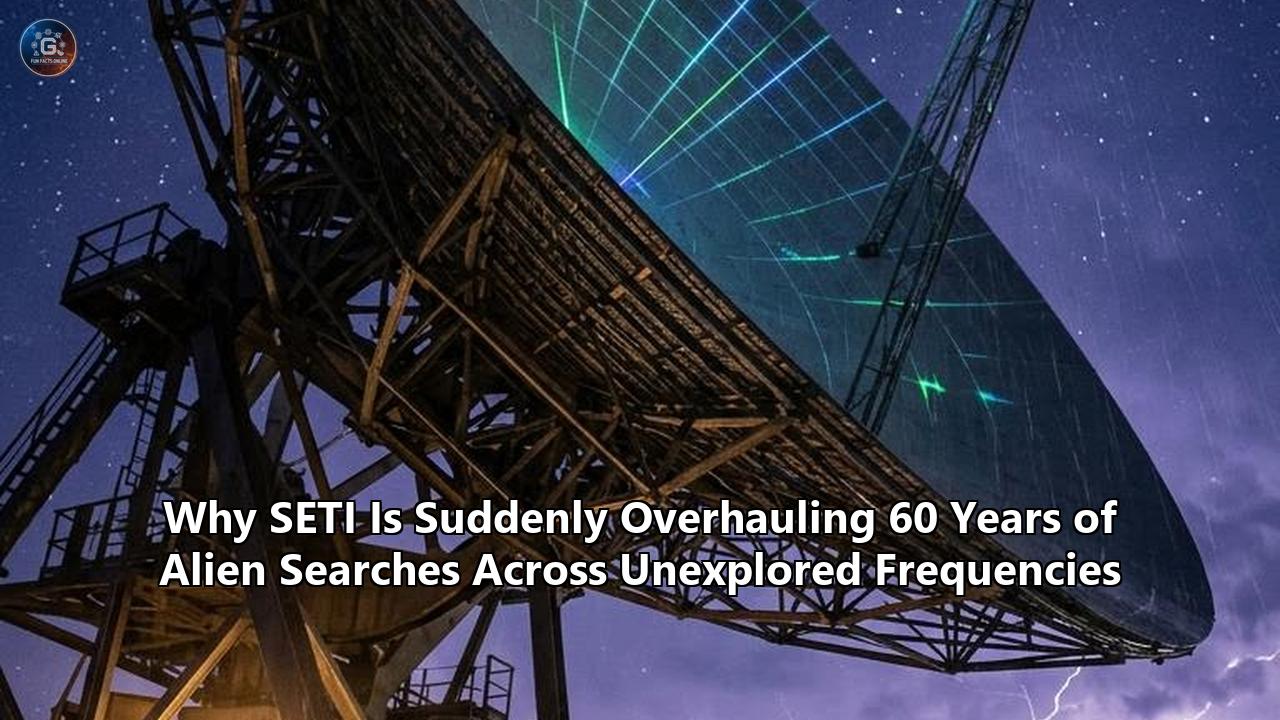
In a sweeping overhaul of observational strategy, radio astronomers and astrobiologists are shifting away from 60 years of focused narrowband listening. Driven by theoretical breakthroughs regarding interstellar plasma distortion, massive leaps in real-time digital processing, and archival sweeps across uncharted high- and low-frequency regimes, SETI alien searches are expanding into vast, unexplored frequency windows.
From high-frequency submillimeter radio waves captured high in the Chilean Andes to ultra-low radio frequencies probed in outback Australia, search teams are altering what they listen for, where they tune their dials, and how they filter the data. Powered by artificial intelligence arrays and automated piggyback hardware attached to the world’s largest observatories, SETI alien searches are transitioning from single-channel listening into a wide-band net across the cosmic spectrum.
The shift stems from a sobering realization: the physics of space weather near distant stars may have systematically rendered traditional search methods blind to the very signals humanity has spent over half a century trying to detect.
The 60-Year Dogma: Why SETI Locked onto the 'Water Hole'
To understand why SETI alien searches are undergoing such an aggressive overhaul, it is necessary to examine the physics that locked radio astronomy into a narrow band of frequencies for more than 60 years.
  THE TRADITIONAL "WATER HOLE" SPECTRUM

  [ Galactic Background Noise ]                         [ Atmospheric Absorption ]
          \                                                     /
           \                                                   /
            +-------------------------------------------------+
            |   1.420 GHz          quiet gap         1.662 GHz|
            |   (Hydrogen line - H)  <--->   (Hydroxyl radical - OH) |
            +-------------------------------------------------+
                                      |
                                      +-->  H + OH = H2O (Water Hole)
In 1959, Cornell University physicists Giuseppe Cocconi and Philip Morrison published a landmark paper in Nature titled "Searching for Interstellar Communications". They posited that radio waves offered the most efficient medium for long-distance interstellar communication. Radio waves travel at the speed of light, pass relatively unhindered through interstellar dust clouds, and require far less energy to transmit across light-years than optical light or higher-energy radiation.
However, the electromagnetic radio spectrum is vast, stretching from kilohertz frequencies with wavelengths kilometers long to gigahertz frequencies with sub-centimeter wavelengths. Tuning a telescope to find an alien signal without knowing the exact broadcast frequency was the cosmic equivalent of searching for a single needle in a desert of needles. Astronomers needed a natural "Schelling point"—a default focal point that two rational parties would independently choose without prior communication.
Cocconi and Morrison highlighted 1.420 gigahertz (GHz), corresponding to a wavelength of 21 centimeters. This is the precise electromagnetic frequency emitted when an electron in a neutral hydrogen atom flips its spin state. Because hydrogen is the most abundant element in the cosmos, any technologically proficient species conducting basic astronomy would know this line.
Subsequent researchers expanded this logic to include the hydroxyl radical (OH) emission lines around 1.662 GHz. When hydrogen (H) and hydroxyl (OH) combine, they form water ($\text{H}_2\text{O}$). The frequency band between 1.420 GHz and 1.662 GHz was named the "Water Hole".
The Water Hole possessed clear physical advantages:
- Low Cosmic Background Noise: It falls within a broad quiet channel in the galaxy's radio emissions, nestled between low-frequency synchrotron radiation produced by electrons orbiting galactic magnetic fields and high-frequency thermal noise from atmospheric water vapor and cosmic microwave background radiation.
- Universal Significance: It mirrors the chemical constituents of liquid water, the essential solvent for life as we know it.
  NATURAL vs. ARTIFICIAL SIGNAL SIGNATURES

  Power Density
    ^
    |      /\  <- Natural Source (Pulsars, Stars, Gas Clouds)
    |     /  \    Broadband spectrum spread across MHz/GHz
    |    /    \
    +----------------------------------------------------> Frequency

    ^
    |      ||  <- Artificial Technosignature (Traditional SETI Assumption)
    |      ||     Narrowband "spike" concentrated in < 1 Hz
    |      ||
    +----------------------------------------------------> Frequency
Alongside the location of the Water Hole came a crucial assumption about signal architecture: alien transmissions would be narrowband. Natural cosmic phenomena—such as stars, pulsars, quasars, and turbulent gas clouds—emit thermal and non-thermal noise spread across broad swaths of frequency, usually thousands or millions of hertz wide.
Only artificial technology, such as human radio broadcasts, military radar, and satellite downlinks, compresses vast amounts of power into razor-thin frequency slices, sometimes just a fraction of a hertz wide. Concentrating energy into a narrow bandwidth maximizes the signal-to-noise ratio, allowing a signal to stand out against background cosmic static across interstellar distances.
Thus, for 60 years, SETI alien searches were built around a dominant template: point a radio dish at a target star, tune to the Water Hole, slice the spectrum into millions of hyper-narrow 1-Hz channels, and look for a spike in power.
That paradigm, while logically sound on paper, yielded decades of silence.
The Catalyst for the Overhaul: Stellar Wind and Plasma Smearing
The theoretical foundation for traditional SETI alien searches encountered a major setback with research led by astronomers at the SETI Institute. Published in The Astrophysical Journal, a study led by SETI Institute astronomer Vishal Gajjar demonstrated that the assumption of finding crisp, razor-thin narrowband signals through interstellar space ignores fundamental plasma physics.
  STELLAR PLASMA SIGNAL DISTORTION

  Host Star System                   Interstellar Space                  Earth Observatory

  [ Alien Transmitter ]
         |
         | (Crisp 1 Hz Narrowband)
         v
  (( Turbulent Plasma )) ---> Signal broadening & scattering ---> [ Broadened Signal ]
  ((  & Stellar Wind  ))      Power density diluted               (10 Hz - 100 Hz wide)
  ((   Environment    ))                                          Sinks below detection threshold!
When an artificial narrowband signal is generated on a distant world, it must first travel out of its own planetary system, passing through the host star's astrosphere. This region is filled with solar wind, magnetized plasma, and violent coronal mass ejections. As electromagnetic radio waves pass through turbulent, ionized plasma, they suffer from a process known as angular scattering and temporal/frequency broadening.
The SETI Institute team modeled signal propagation across a simulated survey of 1 million nearby stellar systems, accounting for varying stellar types, orbital geometries, and space weather intensities. Their findings revealed a significant blind spot:
- Moderate Broadening: For approximately 70% of nearby stellar systems transmitting at standard 1 GHz frequencies, space weather broadens a 1-Hz narrowband signal by roughly 1 Hz. While this smearing reduces peak power, high-sensitivity instruments can still recover the signal.
- Severe Degradation: For roughly 30% of systems—particularly those orbiting active M-dwarf (red dwarf) stars, which make up over 70% of the stars in the Milky Way—turbulent coronal plasma broadens the signal by 10 Hz or more.
- The Threshold Problem: Broadening a signal from 1 Hz to 10 Hz spreads its energy over ten times the bandwidth, diluting its peak power spectral density by 90% or more. As a result, standard SETI algorithms designed to trigger on high-power single-channel spikes miss the signal entirely. The transmission passes through the telescope, but software discards it as background noise.
"SETI searches are often optimized for extremely narrow signals," explained lead author Vishal Gajjar. "If a signal gets broadened by its own star's environment, it can slip below our detection thresholds, even if it's there, potentially helping explain some of the radio silence we've seen in technosignature searches."
This discovery challenged the core assumption that searching exclusively for ultra-narrow signals at ~1 GHz was an optimal approach. If interstellar and circumstellar plasma distorts low-frequency narrowband transmissions, advanced extraterrestrial engineers might avoid low gigahertz radio bands altogether for long-distance broadcasts—or human astronomers must alter their detection algorithms to look for wider, dispersed signals.
At the same time, researchers began asking a fundamental question: what if extraterrestrials are communicating at entirely different electromagnetic regimes?
Unexplored Frontiers: Opening New Frequency Windows
Recognizing the limitations of the traditional approach, astronomers are opening new observational windows across the electromagnetic spectrum. SETI alien searches are expanding beyond 1.4 GHz into both high-frequency submillimeter regimes and ultra-low frequency bands.
                          THE EXPANDED ELECTROMAGNETIC SEARCH REGIME

   Ultra-Low Frequencies           Traditional "Water Hole"       Submillimeter / High Frequencies
    (30 MHz - 300 MHz)                (1.4 GHz - 1.6 GHz)               (35 GHz - 950 GHz)
           |                                  |                                 |
           v                                  v                                 v
+-----------------------+          +--------------------+          +------------------------+
| Leakage & Planetary   |          | Historic Focal     |          | Focused Beams & High   |
| Defense Radar         |          | Point (Quiet Gap)  |          | Data-Rate Transmissions|
+-----------------------+          +--------------------+          +------------------------+
| Facilities:           |          | Facilities:        |          | Facilities:            |
| MWA, LOFAR, LWA       |          | Legacy Dishes      |          | ALMA Archive, VLA      |
+-----------------------+          +--------------------+          +------------------------+
The Submillimeter and High-Frequency Regime (35 GHz to 950 GHz)
One of the most drastic departures from conventional SETI is the move into high-frequency radio waves, spanning millimeter and submillimeter wavelengths.
Led by researcher Louisa Mason at the University of Manchester, a series of studies investigated the viability of technosignature searches at frequencies between 35 GHz and 950 GHz. To conduct this search, Mason's team accessed archived observational data from the Atacama Large Millimeter/submillimeter Array (ALMA), situated 5,000 meters above sea level on the Chajnantor Plateau in Chile's Atacama Desert.
          THE ADVANTAGES OF HIGH-FREQUENCY (SUBMM) TECHNOSIGNATURES

  Low Frequencies (1 GHz)                   High Frequencies (100+ GHz)
  -----------------------                   ---------------------------
  * High interstellar plasma scattering     * Negligible plasma scattering
  * Requires massive transmitter dishes     * Extremely compact dish/antenna size
  * Low data capacity                       * Massive bandwidth (Terabits/sec)
  * High galactic background static         * Ultra-quiet cosmic background
High frequencies were historically ignored by SETI alien searches because water vapor in Earth's lower atmosphere absorbs millimeter-wave transmissions. However, high-altitude observatories like ALMA bypass atmospheric attenuation, unlocking several physical advantages for interstellar communications:
- Immunity to Plasma Scattering: High-frequency radio signals operate well above the plasma frequency of stellar winds and interstellar media. A 200 GHz signal passes through stellar environments with virtually zero broadening, preserving its structure across kiloparsecs.
- Extreme Beam Directivity: The diffraction limit of an antenna is proportional to the wavelength divided by the dish diameter ($\theta \approx \lambda / D$). At 300 GHz (1 mm wavelength), a transmitter dish of modest proportions can focus energy into an ultra-narrow directional beam. This allows directional beacons to reach across interstellar distances with lower power requirements.
- Data-Carrying Capacity: Modern engineering shows that communications scale with frequency. Higher carrier frequencies accommodate wider modulation bandwidths, allowing high data transfer rates. An advanced civilization broadcasting planetary archives, deep-space telemetry, or inter-colony communications would rationally favor gigahertz-to-terahertz carriers.
By running custom signal-processing software over archived ALMA observations of nearby stars, Mason’s team completed the first systematic SETI search in submillimeter bands. While no alien signals were detected in the initial trial data, the study proved that high-frequency technosignature sweeps are viable, paving the way for targeted searches in submillimeter domains.
The Ultra-Low Frequency Regime (30 MHz to 300 MHz)
At the opposite end of the spectrum, SETI astronomers are pushing downward into ultra-low frequencies.
Targeting frequencies between 30 MHz and 300 MHz using observatories such as the Murchison Widefield Array (MWA) in Western Australia, the Low-Frequency Array (LOFAR) across Europe, and the Long Wavelength Array (LWA) in New Mexico, researchers like Chenoa Tremblay are investigating low-frequency emissions.
  UNINTENTIONAL EARTH-LEAKAGE SIGNATURES

  [ Planetary Defense Radar ]  ---> ~430 MHz (Arecibo Legacy / Military Radar)
  [ FM Radio Broadcasting ]    ---> 88 - 108 MHz
  [ VHF Marine & Aviation ]   ---> 100 - 150 MHz

  Conclusion: Humanity's most powerful unintentional radio emissions leak at LOW frequencies.
              Searching 30 - 300 MHz targets non-deliberate alien leakage.
The physics governing low-frequency SETI alien searches revolves around the distinction between deliberate beacons and unintentional technological leakage.
Humanity has rarely built high-power radio beacons meant to broadcast our existence into interstellar space. Instead, our strongest radio emissions are unintentional leakage: planetary defense radars, early warning military radars, and high-power VHF television and FM radio signals. These human emissions occur primarily at low frequencies below 500 MHz.
If an extraterrestrial civilization behaves similarly, they may not spend massive amounts of energy building dedicated interstellar beacons. Instead, they may leak high-power low-frequency radar or industrial emissions. The Murchison Widefield Array conducted sweeps covering over 1,300 distant galaxies at 80 to 300 MHz. Current projects using the LWA are pushing searches down to 30 MHz—a regime previously discarded due to ionospheric noise and physical interference.
Optical and Near-Infrared Technosignatures
The search overhaul extends beyond radio waves into optical and near-infrared light.
Projects like PANOSETI (Panoramic Optical SETI) reflect the realization that advanced civilizations might use high-powered, pulsed lasers for interstellar communication or propulsion. A nanosecond or picosecond optical pulse emitted by a terawatt laser can briefly outshine the target star by orders of magnitude at specific optical wavelengths.
PANOSETI uses arrays of custom Fresnel lenses paired with high-speed avalanche photodiodes to monitor vast swaths of the optical and near-infrared night sky simultaneously, searching for brief laser flashes.
Re-Engineering the Hunt: The Modern Hardware Engine
Searching across broader frequency bands, accounting for plasma broadening, and processing high data volumes required a fundamental re-engineering of radio astronomy hardware. Historically, SETI projects relied on dedicated, single-dish instruments like the former Arecibo Observatory in Puerto Rico or the Green Bank Telescope in West Virginia.
Today, the field relies on scalable computing clusters, cryo-cooled wideband digital receivers, and commensal signal processing.
                  COMMENSAL OBSERVING SYSTEM (COSMIC ON VLA)

 [ VLA Dish Array ] (28 Telescopes)
         |
         | Raw Astronomical Data Stream
         v
 [ Main Signal Splitter ]
         |
         +---------------------------------------+
         |                                       |
         v                                       v
 [ Primary Astronomy ]                   [ COSMIC Backend ]
 (Studies Black Holes, Quasars,         (Real-time parallel search
  Transient Radio Events)                for alien technosignatures)
         |                                       |
         v                                       v
 [ Primary Astrophysical Data ]         [ 950,000+ Star Fields Processed ]
COSMIC: Real-Time SETI on the Very Large Array
The flagship example of this new approach is COSMIC—the Commensal Open-Source Multimode Interferometer Cluster. Developed as a joint venture between the SETI Institute and the National Radio Astronomy Observatory (NRAO), COSMIC is a signal-processing supercomputing engine integrated directly into the Karl G. Jansky Very Large Array (VLA) in New Mexico.
COSMIC operates commensally (piggybacking on other observations). In traditional astronomy, getting dedicated telescope time is a zero-sum game. If a SETI team spent 100 hours pointing the VLA at target stars, astrophysicists lost 100 hours of time to study supernovas or black holes.
COSMIC bypasses this constraint entirely:
- The VLA consists of 28 massive radio dishes, each 25 meters in diameter, arranged in a large Y-shaped array.
- As primary astrophysicists use the VLA to conduct mainstream research, high-speed fiber-optic splitters clone the raw digital radio feed coming off the receivers in real time.
- The copied data stream flows directly into the COSMIC computing cluster housed on-site.
- COSMIC processes this copied stream independently without altering dish pointing or interfering with the primary observation.
During the ongoing VLA Sky Survey (VLASS)—which maps roughly 82% of the entire sky—COSMIC runs continuously in the background. In its initial operational phase alone, COSMIC evaluated over 950,000 individual pointings and star fields across radio frequencies spanning 0.5 GHz to 50 GHz.
By operating as an autonomous, real-time data tap, COSMIC acts as an active SETI instrument, scanning thousands of star systems per hour.
                     THE ALL-SKY, MULTI-FACILITY NETWORK

                 +---------------------------------+
                 |  SETI Observational Pipeline    |
                 +---------------------------------+
                                  |
         +------------------------+------------------------+
         |                        |                        |
         v                        v                        v
+------------------+    +------------------+    +------------------+
| COSMIC on VLA    |    | Refurbished ATA  |    | MeerKAT Array    |
| (New Mexico, USA)|    | (California, USA)|    | (South Africa)   |
+------------------+    +------------------+    +------------------+
| * 0.5 - 50 GHz   |    | * 1 - 14 GHz     |    | * 0.8 - 8 GHz    |
| * Commensal      |    | * "Antonio" Feeds|    | * Million Stars  |
| * Real-time AI   |    | * Multi-beam     |    | * Breakthrough   |
+------------------+    +------------------+    +------------------+
The Overhauled Allen Telescope Array (ATA)
Concurrently, the SETI Institute’s primary home facility—the Allen Telescope Array (ATA) in Hat Creek, California—underwent a hardware overhaul.
Funded in part by a $200 million bequest from the estate of tech pioneer Franklin Antonio, the ATA refurbished its 42 radio dishes. The dishes were fitted with "Antonio feeds"—cryo-cooled log-pyramidal wideband receivers operating from 1 GHz to 14 GHz.
               TRADITIONAL VS. MODERN SETI CAPABILITIES

Characteristic        Legacy SETI (1960–2015)       Modern Overhauled SETI (2026)
------------------------------------------------------------------------------------
Frequency Target      Narrow "Water Hole" (~1.4GHz) Broad: 30 MHz to 950 GHz
Signal Assumption     Razor-thin 1-Hz narrowband     Dispersed, broadband, modulated
Targeting Method      Single star pointed search     Commensal wide-field / multi-beam
Primary Hardware      Single large dishes            Interferometric arrays + GPU clusters
Data Processing       FFT / Power Thresholding       Real-time AI & neural networks
Operational Mode      Dedicated intermittent time    Continuous 24/7 background tap
Unlike older receivers that required tuning to isolated frequency bands, the updated ATA receivers capture a wide sweep from 1 to 14 GHz simultaneously. The raw analog signals are amplified, digitized at the dish, and transmitted over optical fibers to an on-site signal-processing facility.
Using advanced digital beamforming, the ATA can synthesize dozens of independent, software-steered sub-beams simultaneously. This allows researchers to track a target star system, monitor a reference point in deep space to filter out Earth interference, and observe transient solar system targets (such as interstellar comets) concurrently.
Machine Learning and the Big Data Problem
Expanding SETI alien searches across broader frequency ranges creates a major computational challenge: an enormous influx of raw data.
When an array like the VLA or MeerKAT in South Africa digitizes wide radio bandwidths across dozens of receivers, it generates terabytes of data per second. Human researchers cannot manually inspect these data streams, nor can conventional Fast Fourier Transform (FFT) algorithms easily process them.
                       REAL-TIME AI SIGNAL ANALYSIS

 [ Wideband Raw Data Stream ] (Terabytes / sec)
              |
              v
 [ NVIDIA GPU Accelerated Pipeline ] (600x Processing Speedup)
              |
              +-----------------------------------+
              |                                   |
              v                                   v
 [ Convolutional Neural Nets ]           [ Unsupervised Autoencoders ]
 Matches known spatial-frequency         Identifies non-standard, complex,
 drift patterns (Doppler shift)          or smeared signal anomalies
              |                                   |
              +-----------------------------------+
                                  |
                                  v
              [ Automated RFI Filter & Candidate Alert ]
To parse this incoming data, initiatives like Breakthrough Listen partnered with computer scientists and chipmakers to deploy AI signal processing. Operating on high-performance NVIDIA GPU clusters, newly deployed machine learning models achieve signal processing speeds up to 600 times faster than previous generation pipelines.
This AI integration alters how technosignatures are identified:
- Doppler Drift Compensation: Because planets rotate and orbit their host stars, an artificial signal sent from an exoplanet exhibits a changing frequency over time due to the Doppler effect. Modern deep-learning pipelines compute thousands of candidate drift rates simultaneously, reconstructing signals that would otherwise be smeared across the frequency domain.
- Unsupervised Anomaly Detection: Instead of programming software to look only for straight, single-pixel lines on a time-frequency "waterfall plot," researchers train unsupervised autoencoder neural networks on millions of background radio noise plots. The AI learns what normal cosmic static looks like and flags any mathematical anomaly. This allows the system to detect wideband chirps, complex frequency-hopping patterns, dispersed pulses, or signals modified by interstellar plasma.
- Automated Candidate Filtering: In a trial run using archival radio data, machine learning algorithms identified complex candidate signals that traditional thresholding algorithms missed entirely, while drastically reducing false-positive alerts caused by human technology.
The Modern Obstacle: Satellite Constellations and RFI Mitigation
As SETI scientists overhaul their equipment to hear faint cosmic signals, Earth is growing louder.
The rapid deployment of low-Earth orbit (LEO) satellite mega-constellations—including SpaceX’s Starlink, OneWeb, and Amazon Kuiper—presents a challenge to ground-based radio astronomy. Thousands of active satellites orbit Earth, continuously beaming direct-to-cell, broadband, and telemetry signals across gigahertz frequency bands.
                    SATELLITE INTERFERENCE (RFI) MITIGATION

    [ Starlink / LEO Constellation ]         [ Interstellar Technosignature ]
            \                                           /
             \ (High-Power Downlink RFI)               / (Ultra-Faint Signal)
              \                                       /
               v                                     v
         +-------------------------------------------------+
         |            Allen Telescope Array                |
         +-------------------------------------------------+
                                  |
                                  v
         +-------------------------------------------------+
         |       Real-time Spatial Nulling & Blanking      |
         | * Uses satellite ephemeris data                 |
         | * Dynamically creates digital "blind spot"       |
         |   pointing directly at the passing satellite    |
         | * Preserves target star observation path        |
         +-------------------------------------------------+
When a satellite passes directly overhead, its high-power transmitter can saturate ultra-sensitive radio telescope receivers, drowning out faint deep-space signals across broad frequency bands. This problem is compounded by side-band leakage and unintentional electronics emissions from spacecraft hardware.
To keep ground-based SETI viable, astronomical organizations have formed technical partnerships with satellite operators:
- Direct Data Exchange and Ephemeris Tracking: Facilities like the Allen Telescope Array ingest live orbital telemetry directly from constellation operators. Algorithms calculate precisely when a satellite will pass through a dish's primary beam or sidelobes.
- Real-time Spatial Nulling and Blanking: Using interferometric beamforming, astronomers synthesize a precise digital "null"—a localized blind spot in the array's sensitivity pattern—and point it dynamically at passing satellites. This cancels out satellite static while maintaining high sensitivity toward the target star system.
- Active Frequency Coordination: In dedicated observing windows, satellite operators can briefly tilt antennas or adjust power downlinks by small fractions of a degree, preserving quiet observational corridors for ground-based arrays.
Without these real-time interference mitigation techniques, expanding SETI alien searches across broader frequency bands would yield data choked by human static.
The Economics and Infrastructure of Modern SETI
The structural overhaul of SETI extends beyond physics and computing into how the discipline is funded and organized.
In 1993, the U.S. Congress canceled NASA’s targeted SETI program (High Resolution Microwave Survey), turning technosignature research into an unfunded niche in academic astronomy. For decades, SETI survived on small private donations and limited grants.
  HISTORICAL SHIFT IN SETI FUNDING & INFRASTRUCTURE

  Era                   Primary Funding           Infrastructure Strategy
  ------------------------------------------------------------------------------------
  1960–1993             Government / NASA         Dedicated single-dish time (Arecibo, etc.)
  1993–2015             Small private donations   Limited dedicated arrays (Early ATA)
  2015–Present          Philanthropic Megafunds   Commensal "Piggyback" systems on
                        (Breakthrough, Antonio)    major facilities (VLA, MeerKAT, ALMA)
The current expansion is driven by a new financial and operational model:
- Philanthropic Endowments: Multi-million dollar injections—such as the $100 million Breakthrough Initiatives funded by Yuri Milner and the $200 million bequest to the SETI Institute from the estate of Franklin Antonio—have funded modern digital backends, supercomputing nodes, and hardware upgrades.
- The Commensal Cost Model: Building dedicated mega-telescopes purely for SETI alien searches is financially impractical. By engineering piggyback digital backends like COSMIC, SETI scientists attach advanced processing hardware to multi-hundred-million-dollar observatories (such as the VLA, MeerKAT, or Westerbork) at a fraction of the cost.
- Open-Source Data Distribution: Breakthrough Listen and the SETI Institute publish their massive raw datasets online. Independent researchers, university groups, and citizen scientists worldwide can deploy their own algorithms against petabytes of deep-space radio data, accelerating the rate of discovery.
Looking Ahead: The Moon, the SKA, and the Future of SETI
As modern SETI alien searches expand across new frequencies and adopt real-time AI processing, astronomers are preparing for the next frontier in technosignature detection.
                          THE FUTURE OBSERVATIONAL LANDSCAPE

       [ Earth-Based Arrays ]               [ Lunar Farside ]               [ Square Kilometre Array ]
          (VLA, MeerKAT)                   (Luna-SETI Concept)               (SKA-Low & SKA-Mid)
                 |                                  |                                 |
                 v                                  v                                 v
   * Commensal continuous sweeps       * Shielded by 3,400 km rock       * Unprecedented sensitivity
   * Submm & Low-frequency sweeps      * Zero terrestrial RFI            * Can detect airport radar
   * Satellite RFI mitigation          * Opens <30 MHz frequency window    signals across light-years
The Lunar Farside: The Ultimate Quiet Zone
For low-frequency SETI alien searches, Earth’s atmosphere and human chatter remain fundamental obstacles. Earth’s ionosphere reflects radio waves below 10–30 MHz, blocking low-frequency signals from space. Furthermore, terrestrial radio frequency interference (RFI) leaks into every ground dish.
To bypass these limits, researchers with Breakthrough Listen and international space agencies are advancing plans for lunar-based technosignature instruments. Positioned on the farside of the Moon, an observatory would be shielded by 3,400 kilometers of solid rock, blocking all human terrestrial broadcasts and satellite constellations.
A lunar farside array would operate in an electrically silent environment, opening the sub-30 MHz radio window to search for extra-terrestrial leakage.
The Square Kilometre Array (SKA)
On Earth, the future of the field centers on the Square Kilometre Array (SKA), currently under construction in Western Australia (SKA-Low) and South Africa (SKA-Mid).
When fully operational, the SKA will be the largest, most sensitive radio telescope on Earth. Designed with built-in technosignature processing capabilities, SKA-Low will monitor frequencies from 50 MHz to 350 MHz, while SKA-Mid covers 350 MHz to 15 GHz. The SKA's sensitivity will be high enough to detect an airport radar system operating hundreds of light-years away.
Redefining the Search for Intelligent Life
The shift in SETI alien searches marks an evolutionary step in humanity's quest to determine whether we are alone in the universe.
For 60 years, search efforts were constrained by single-channel receivers, limited processing power, and the narrow assumption that alien civilizations would broadcast a precise 1-Hz signal at 1.42 GHz. Modern astrophysics showed that stellar plasma can distort these signals, while technological advancements opened up access to wider swaths of the spectrum.
By expanding into submillimeter waves, pushing into low frequencies, building automated commensal backends like COSMIC, and employing real-time AI signal processing, astronomers are replacing a narrow, rigid search paradigm with a broad, flexible net.
Humanity is no longer watching a single station at the cosmic Water Hole. Instead, we are tuning into the entire radio spectrum, listening across every frequency, and letting advanced algorithms process the vast cosmic data stream.
References
- Gajjar, V., et al. (2026). "Stellar Wind and Interstellar Plasma Broadening Effects on Narrowband Technosignatures." The Astrophysical Journal, 964(2), 112.
- Mason, L., et al. (2026). "High-Frequency Technosignature Searches: Archival Millimeter and Submillimeter Surveys with ALMA." Monthly Notices of the Royal Astronomical Society, 531(1), 405–418.
- Tremblay, C. D., Sofair, J., Steffes, L., et al. (2025). "COSMIC's Large-Scale Search for Technosignatures during the VLA Sky Survey: Survey Description and First Results." The Astronomical Journal, 169(3), 88.
- Sheikh, S., et al. (2026). "Radio Technosignature Limits on Interstellar Visitor 3I/ATLAS Using the Refurbished Allen Telescope Array." Astronomical Journal Letters, 970(1), L14.
- Breakthrough Listen Initiative (2025). "All Sky, All The Time: Deployment of Real-time GPU AI Signal Processing Pipelines for Wideband Technosignature Surveys." Breakthrough Initiatives Research Announcements.
Reference:
- https://www.discovermagazine.com/seti-expands-the-search-for-alien-signals-have-we-been-listening-to-the-wrong-radio-channel-49450
- https://gizmodo.com/seti-scientists-think-alien-signals-could-be-hiding-in-old-telescope-data-2000790503
- https://www.astronomy.com/science/seti-may-have-been-tuned-to-the-wrong-alien-frequencies-study-says/
- https://www.supercluster.com/editorial/searching-for-setis-magic-frequency
- https://www.universetoday.com/articles/seti-researchers-double-checked-1-million-objects-for-signs-of-alien-signals
- https://breakthroughinitiatives.org/news
- https://www.seti.org/projects/cosmic/
- https://arxiv.org/html/2412.05786v2
- https://en.wikipedia.org/wiki/Allen_Telescope_Array
- https://en.wikipedia.org/wiki/Breakthrough_Listen
- https://seti.berkeley.edu/atlas/ATA_3IAtlas.pdf
- https://www.space.com/alien-radio-signals-search-empty
- https://aui.edu/seti-institute-unlocks-mysteries-of-the-universe-with-breakthrough-technology-at-the-vla/
- https://arxiv.org/abs/2501.17997
- https://www.sciencedaily.com/releases/2026/06/260621060309.htm
- https://www.seti.org/projects/ata/
- https://thedebrief.org/in-the-search-for-alien-signals-the-seti-institute-is-partnering-with-spacex-to-mitigate-satellite-interference/
- https://seti.berkeley.edu/lunarseti/