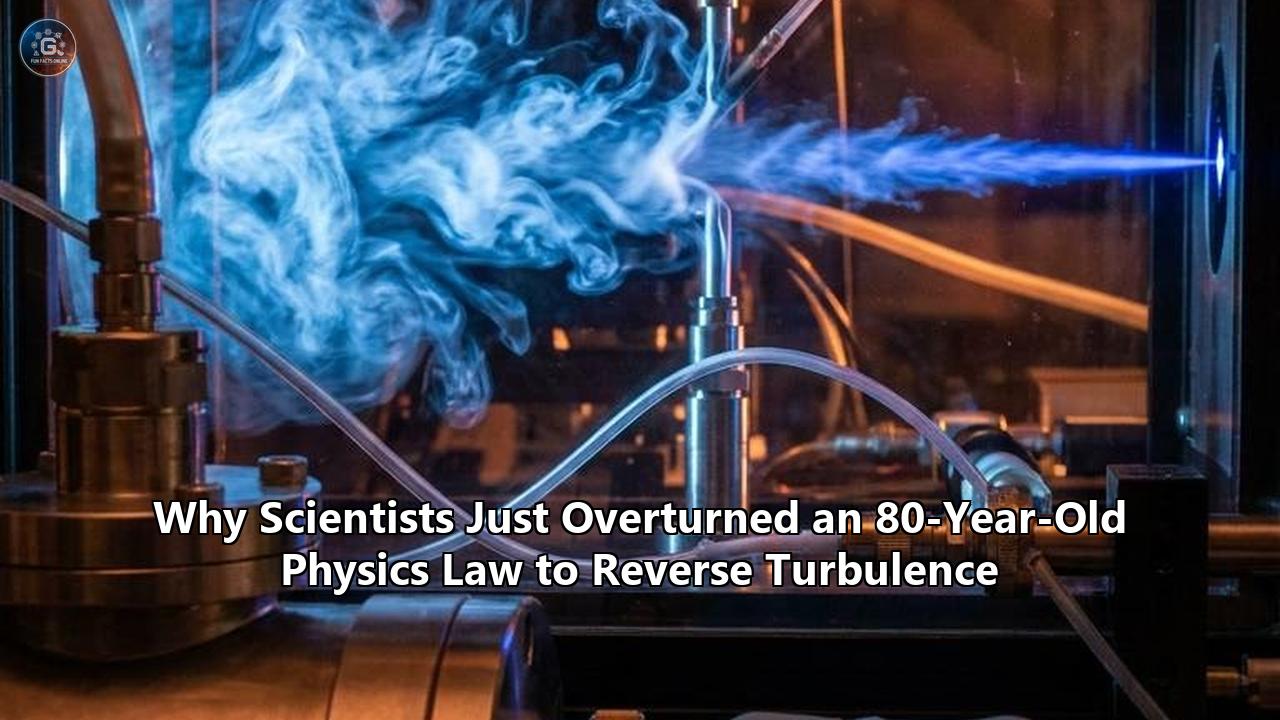
For decades, the chaotic churning of fluids was believed to follow a set of immutable, one-way laws of nature. Whether watching smoke twist from a chimney, observing waves crashing along a shoreline, or feeling a passenger aircraft shake in the upper atmosphere, scientists lived by a fundamental fluid dynamics rule established in 1941: in three-dimensional systems, turbulent energy cascades irreversibly downward, with large eddies fracturing into smaller and smaller swirls until they finally vanish as heat.
In June 2026, a research paper published in Science Advances sent shockwaves through the physics community. A collaborative team of researchers from the University of Pittsburgh and the University of Turin in Italy demonstrated, through physical experiments and high-fidelity computer simulations, that this eighty-year-old law is not absolute. By utilizing a sophisticated mathematical framework based on tensor geometry, the team successfully manipulated, steered, and reversed the direction of turbulent energy flow on demand within the same physical medium.
The work, led by Assistant Professor Lei Fang of the University of Pittsburgh's Swanson School of Engineering, along with his PhD student Xinyu Si and Italian collaborators Filippo De Lillo and Guido Boffetta, represents a monumental leap in the study of fluid mechanics. By decoupling the direction of the turbulent energy cascade from the physical dimensions of the fluid’s container, this discovery has laid the foundation for a new domain of research: reverse turbulence physics.
The implications of this breakthrough stretch far beyond theoretical mathematics. By learning to steer the energy of chaotic flows, scientists and engineers may soon have the tools to actively disperse coastal wastewater, prevent the spread of oceanborne pollutants, optimize global climate models, and develop microfluidic medical devices capable of rapidly mixing fluids at scales where turbulence was once thought physically impossible.
Kolmogorov’s Legacy: The Immutable Cascade of Turbulence
To understand why this development has disrupted fluid mechanics, one must first look back to the dark days of World War II, when the Soviet mathematician and physicist Andrey Kolmogorov formulated the statistical framework that would govern turbulence research for the next eighty-five years.
Turbulence is often described as the great unsolved mystery of classical physics. It is a state of fluid motion characterized by chaotic, non-linear, and highly sensitive changes in pressure and velocity. While regular, smooth "laminar" flow is easy to predict using classical equations, turbulent flow becomes a wild, multi-scale tangle of swirling structures known as eddies.
In 1941, Kolmogorov published a series of papers that brought mathematical order to this chaos, a framework known today as "K41". Kolmogorov posited that while individual turbulent fluctuations are chaotic, the statistical behavior of turbulence is remarkably universal.
The Richardson-Kolmogorov Cascade
Kolmogorov formalized a concept first visualized by the English meteorologist Lewis Fry Richardson, who famously summarized it in a playful rhyme:
Big whirls have little whirls that feed on their velocity,
And little whirls have lesser whirls and so on to viscosity.
This process is known as the forward energy cascade. In three-dimensional environments, such as the open ocean or the Earth’s atmosphere, kinetic energy is injected into a fluid at macroscopic scales—for instance, by planetary winds or massive ocean currents. This energy creates large-scale vortices. These massive eddies are inherently unstable. They warp, stretch, and break apart into smaller eddies, transferring their kinetic energy down the scale ladder.
This downward journey of energy continues through what Kolmogorov called the inertial subrange—a band of scales where the fluid's inertia dominates over its viscosity. Eventually, the eddies reach the Kolmogorov microscale, a tiny threshold where the fluid’s internal friction (viscosity) takes over, converting the remaining kinetic energy into thermal energy (heat).
Kolmogorov’s crowning achievement was the formulation of the $-5/3$ Power Law:
$$E(k) = C_K \varepsilon^{2/3} k^{-5/3}$$
Here, $E(k)$ represents the energy spectral density at a given wavenumber $k$ (which is inversely proportional to the eddy size), $C_K$ is a universal constant, and $\varepsilon$ is the rate of energy dissipation. For nearly a century, this power law served as a pillar of fluid mechanics, proving incredibly reliable for calculating drag on aircraft, predicting weather patterns, and modeling stellar atmospheres.
The Two-Dimensional Twist
In 1967, the American physicist Robert Kraichnan introduced a fascinating twist to this established picture. Kraichnan analyzed what happens when a turbulent fluid is restricted to a strictly two-dimensional plane, such as a very thin layer of water or a highly stratified atmospheric boundary layer.
Kraichnan discovered that in two dimensions, the physical conservation laws change dramatically. In addition to conserving kinetic energy, a 2D fluid also conserves enstrophy—a quantity related to the square of the fluid’s vorticity (the rotational spin of the eddies).
Because of this dual conservation requirement, energy cannot cascade forward to smaller scales in 2D. Instead, the system undergoes an inverse energy cascade. Energy injected at small scales actually flows upward, feeding into larger and larger structures. This is why small, swirling disturbances in a thin layer of water eventually merge to form massive, stable, long-lived vortices—a classic real-world example being Jupiter's Great Red Spot or massive terrestrial cyclones. Meanwhile, enstrophy is forced to cascade forward to the smaller scales.
For decades, the fluid dynamics community accepted this division as an absolute, geometric destiny:
- 3D space: Energy flows from large to small (forward cascade).
- 2D space: Energy flows from small to large (inverse cascade).
The direction of the cascade was believed to be locked entirely by the physical dimensions of the fluid's environment. You could not have a net forward energy cascade in a 2D sheet, nor could you easily coax a net inverse cascade out of a deep 3D tank, unless you fundamentally altered the physical boundaries of the container.
The Physics of Reversal: How Tensor Geometry Decoupled Cascade from Dimension
The team at the University of Pittsburgh and the University of Turin refused to accept that spatial dimensionality was an inescapable prison for fluid energy. They realized that while the overall spatial dimension of a system provides statistical constraints, the local, step-by-step mechanism of energy transfer between scales is essentially a mechanical process of work and deformation.
To bridge the gap between abstract fluid scale-spaces and concrete mechanical work, Assistant Professor Lei Fang recast the energy flux equations.
"To understand this abstract concept at different scales," Fang explained, "I recast the energy flux process into a mechanical process based on Navier-Stokes equations. And since this is a mechanical process, I could try to reverse it by changing the geometry between displacement and force."
Recasting the Mathematics of Flow
In classical fluid mechanics, the movement of a fluid is governed by the legendary Navier-Stokes equations, a set of partial differential equations formulated in the 19th century. Under this mathematical regime, the transfer of kinetic energy across different scales of motion is represented by an energy flux term, $\Pi$.
In a turbulent flow, we can separate the velocity field into large-scale "filtered" motions and small-scale "subgrid-scale" fluctuations. When these scales interact, they exert forces on each other. The small-scale turbulent fluctuations exert a collective stress on the larger-scale flow, described by the subgrid-scale (SGS) stress tensor, $\tau_{ij}$.
At the same time, the large-scale flow undergoes deformation, which is mathematically described by the strain-rate tensor, $S_{ij}$.
Both $\tau_{ij}$ and $S_{ij}$ are second-order tensors—mathematical objects that describe not just a magnitude and a single direction, but how forces and deformations align across multiple spatial coordinates simultaneously.
The rate of local kinetic energy transfer between these scales, the spectral energy flux $\Pi$, is proportional to the inner product (the mathematical contraction) of these two tensors:
$$\Pi \propto -\tau_{ij} S_{ij}$$
In mechanical terms, this equation is strikingly elegant: it is the fluid equivalent of the classical work equation ($W = F \cdot d$, or Work equals Force times Displacement). The stress tensor $\tau_{ij}$ acts as the internal "force" or stress squeezing the fluid elements, while the strain-rate tensor $S_{ij}$ represents the resulting "displacement" or rate of deformation.
Controlling Tensor Alignment
This mathematical formulation led to a pivotal insight: the direction and efficiency of the energy cascade depend on the geometric alignment between the stress and strain-rate tensors.
Because tensors are multi-dimensional, they possess orientation. They have principal axes (eigenvectors) along which the primary stresses and deformations occur.
- If the principal axes of the stress tensor $\tau_{ij}$ are aligned in a cooperative configuration with the strain-rate tensor $S_{ij}$, the inner product is positive. The small-scale eddies do positive work on the large-scale flow, or vice versa, causing energy to flow predictably in one direction.
- If, however, the tensors are misaligned, rotated, or deliberately forced into an uncooperative orientation, the sign of the inner product flips. The local work becomes negative.
By developing a geometric framework based on this tensor alignment, Fang and his colleagues discovered that the direction of energy transfer is not an unyielding physical law. Instead, it is highly mutable. If they could control the spatial arrangement of the forces stirring a fluid, they could deliberately change the angle between the stress and strain-rate tensors.
This theoretical framework demonstrated that with the correct forcing geometry, one could achieve reverse turbulence physics: driving a net forward energy cascade in a shallow, two-dimensional fluid layer, or forcing a net inverse energy cascade in a deeper, three-dimensional system. The shape of the container, long considered the ultimate arbiter of fluid behavior, was no longer destiny.
The Electromagnetic Lab: Driving Water with Magnets and RodS
To prove that this tensor-alignment theory was more than just elegant equations on a blackboard, Lei Fang and PhD student Xinyu Si constructed a highly specialized experimental apparatus at the University of Pittsburgh.
+-------------------------------------------------------------+
|               THIN-LAYER APPARATUS SCHEMATIC                 |
+-------------------------------------------------------------+
|                                                             |
|   [================= Electrodes (AC/DC) =================]  |
|                                                             |
|   +-----------------------------------------------------+   |
|   |  ~~~~~~~~~~~~~~~~~ Salt Water Layer ~~~~~~~~~~~~~~  |   |
|   |                                                     |   |
|   |    (•)   (•)   (•)   [Rod Array]   (•)   (•)   (•)    |   |
|   |   Perturbations forcing specific tensor geometries  |   |
|   |                                                     |   |
|   +-----------------------------------------------------+   |
|                                                             |
|   [======= NdFeB Permanent Magnet Array (B-Field) =======]  |
|                                                             |
+-------------------------------------------------------------+
|   * Laser sheet illuminates suspended fluorescent tracers  |
|   * High-speed CMOS cameras record localized fluid velocity  |
+-------------------------------------------------------------+
The team’s goal was to construct a highly controlled, quasi-two-dimensional fluid system and show that they could drive energy either forward or backward through the scales simply by tuning the geometric alignment of the forcing elements.
The Thin-Layer Electrolyte Setup
The experimental rig consisted of a shallow, rectangular tank containing a thin layer of an electrically conducting fluid (a saltwater electrolyte solution).
Beneath the tank, the researchers positioned an array of powerful neodymium-iron-boron (NdFeB) permanent magnets. By passing an electrical current through the electrolyte layer in the presence of this structured, horizontal magnetic field, they generated precise, localized Lorentz forces ($\mathbf{F} = \mathbf{J} \times \mathbf{B}$). These electromagnetic forces drove a highly stable, organized, two-dimensional background shear flow.
To perturb this background flow and introduce turbulence, the researchers installed a custom-milled array of physical rods that dipped into the thin layer of water.
This is where the magic of tensor geometry was put to the test. In a traditional setup, stirring a fluid with random forces yields the standard dimensionally dictated cascade. In this experiment, however, the researchers carefully arranged the spatial geometry of the magnetic fields and the physical rod array. By adjusting the spatial positioning, spacing, and angles of these boundary disturbances, they could systematically control the orientation of the stress tensor relative to the background strain-rate tensor.
Visualizing the Cascade
To observe and measure the resulting fluid dynamics, the team suspended thousands of microscopic, fluorescent tracer particles within the water layer. They illuminated the tank with a thin, horizontal laser sheet and recorded the movement of the particles using high-speed, high-resolution CMOS cameras.
Using advanced Particle Image Velocimetry (PIV) algorithms, they analyzed the recorded video frames to reconstruct the precise, instantaneous velocity field of the fluid at every single pixel. From these velocity maps, they calculated the localized stresses, strain rates, and—most importantly—the net spectral energy flux across different scales.
The results were a triumph for the new theory. By altering the spatial arrangement of the forcing elements, the team successfully switched the direction of the energy cascade in the exact same apparatus:
- When the forcing stress and the rate of strain were aligned in an uncooperative tensor configuration, the fluid exhibited a highly efficient inverse energy cascade, with small eddies merging to feed larger structures, matching Kraichnan's classic 2D predictions.
- By simply adjusting the forcing geometry to enforce a cooperative alignment, the team forced the energy cascade to run the "wrong" way—producing a net forward energy cascade in a thin fluid sheet where it was previously believed to be physically impossible.
To ensure the validity of these observations, the physical laboratory measurements were compared against massive, high-fidelity Direct Numerical Simulations (DNS) of the 2D Navier-Stokes equations. The computational simulations perfectly reproduced the experimental transition, confirming that the physical fluid was behaving precisely as the tensor geometry equations predicted.
Biogenic Turbulence: Swarms of Tiny Swimmers Stirring the Ocean
To appreciate how Assistant Professor Lei Fang arrived at this tensor-alignment breakthrough, one must look at his broader body of research, which lies at the fascinating intersection of fluid mechanics, biology, and environmental engineering.
For years, oceanographers and climate scientists have debated a highly controversial concept known as biogenic mixing—the idea that marine organisms, through their collective swimming, can generate enough physical turbulence to stir the oceans and influence global climate patterns.
While it is obvious that massive marine animals like blue whales or schools of tuna can generate localized wake currents, the impact of smaller, microscopic organisms remained deeply mysterious. Could swarms of tiny zooplankton, copepods, or krill—each measuring only a millimeter or two—collectively generate enough kinetic energy to mix deep water columns and redistribute vital nutrients?
How Small Is Too Small?
To answer this, Fang received a prestigious grant from the National Science Foundation (NSF) to study the minimum swimmer size required to generate sustained biogenic turbulence.
+-------------------------------------------------------------+
|               BIOGENIC TURBULENCE CASCADE FLOW               |
+-------------------------------------------------------------+
|                                                             |
|   [ Individual Swimmer Scale: ~1 millimeter ]               |
|   - Generates localized, micro-scale viscous shear stress   |
|                                                             |
|                          |                                  |
|                          v (Collective Swarming Alignment)  |
|                                                             |
|   [ Tensor Geometry Alignment of Swarm ]                     |
|   - Swimmers align their thrust with background strain rate |
|                                                             |
|                          |                                  |
|                          v (Inverse Energy Cascade)         |
|                                                             |
|   [ Aggregation Scale Eddies: Decimeters to Meters ]        |
|   - Kinetic energy flows upward to form larger vortices     |
|   - Active biogenic mixing of nutrients and heat            |
|                                                             |
+-------------------------------------------------------------+
When a single zooplankter swims, the Reynolds number of its motion is extremely low—meaning that viscous forces heavily dominate over inertia, and any small swirl it creates is instantly snuffed out by the water's stickiness. Under classical physics, a solitary microscopic swimmer cannot generate sustained turbulence.
However, marine organisms rarely travel alone. They migrate in massive, dense, highly synchronized swarms containing billions of individuals. Fang and his team realized that during collective migration, these active particles act as a distributed network of localized, directionally biased stress sources moving through a background fluid.
By applying their tensor-geometry framework to active matter, the researchers discovered that the swarming behavior of tiny swimmers acts as a natural forcing mechanism that aligns self-propelled stress tensors with the background fluid's strain-rate tensors.
When these active swimmers coordinate their movements, they do negative work on the fluid's small-scale structures. This triggers a localized inverse energy cascade, allowing the tiny kinetic disturbances of individual millimeter-scale swimmers to flow upward through the scale ladder. The energy coalesces to form decimeter- or meter-scale eddies—large, stable vortices capable of actively mixing ocean water, distributing heat, and circulating nutrients across deep water columns.
This discovery bridged the gap between microscopic biology and macroscopic geophysics. It proved that collective biological behavior could effectively harness reverse turbulence physics to punch far above its weight class, fundamentally altering how we must model ocean ecosystems and global carbon cycles.
Applications at the Macro Scale: Steering Ocean Currents and Controlling Pollution
The ability to control and reverse the direction of turbulent energy cascades is not merely an academic curiosity; it provides environmental engineers with an entirely new toolkit for managing the Earth’s most vital fluid systems.
One of the most immediate and profound applications of this research lies in coastal management and the mitigation of marine pollution.
Dismantling Ocean Transport Barriers
When municipal wastewater, agricultural runoff, or industrial contaminants are discharged into coastal waters, their dispersal is largely governed by invisible, highly complex boundaries known as ocean transport barriers. These barriers are formed by coherent, chaotic turbulent structures in the coastal currents, acting as fluid "walls" that trap pollutants and push them along delicate shorelines rather than letting them safely dilute in the deep ocean.
Historically, trying to influence or disrupt these transport barriers was considered an exercise in futility. The sheer kinetic energy of coastal ocean currents is so vast that any human effort to redirect them would require building massive, economically and ecologically disastrous concrete seawalls or breakwaters spanning kilometers.
+-------------------------------------------------------------+
|               COASTAL STEERING OF POLLUTANT PLUMES          |
+-------------------------------------------------------------+
|                                                             |
|   [ Shoreline / Wastewater Source ]                         |
|         |                                                   |
|         v (Contaminant Plume)                               |
|   ~~~~~~~~~~~~~~~~~~~~~~~~~~~~~~~~~~~~~~~~~~~~~~~~~~~~~~~   |
|                                                             |
|   =======================================================   |
|   [ Invisible Ocean Transport Barrier (Kilometer-Scale) ]   |
|   Traps pollutants along the coastline                      |
|   =======================================================   |
|                                                             |
|                o   o   o   o   o                            |
|         [ 10-Meter Physical Boundary Array ]                |
|         Perturbs localized tensor geometry                  |
|                                                             |
|                          |                                  |
|                          v (Reverse Turbulence Cascade)     |
|                                                             |
|   ~~~~~~~~~~~~~~~~~~~~~~~~~~~~~~~~~~~~~~~~~~~~~~~~~~~~~~~   |
|   [ Disrupted Transport Barrier / Safe Deep-Sea Dilution ]  |
|                                                             |
+-------------------------------------------------------------+
The tensor geometry framework changes the scale of this intervention entirely.
"Through this theoretical framework, we found that we can use small physical boundaries up to ten meters (about 33 feet) to perturb ocean transport barriers that span kilometers," Fang noted. "It is possible to change the direction of the energy flux, which can improve how wastewater or other contaminants along a coastline are dispersed."
By placing relatively small, strategically shaped physical structures—such as arrays of pylons, floating barriers, or underwater fins—near coastal outlets, engineers can force local currents to interact with these boundaries in a highly specific geometric fashion.
By aligning the resulting stress and strain tensors, these small 10-meter boundaries can trigger a localized cascade reversal. This reversal disrupts the kilometer-scale transport barriers, effectively "opening the gates" of the coastal fluid walls and allowing municipal wastewater or accidental oil spills to be safely directed away from fragile estuaries and public beaches, facilitating rapid, harmless dilution in the open ocean.
Enhancing Climate Forecasts
Furthermore, this research is poised to significantly improve the accuracy of global climate simulations.
Modern climate models rely heavily on parameterized equations to estimate how energy, heat, and carbon dioxide move between the atmosphere and the ocean surface. A major source of uncertainty in these models is the boundary layers—the thin, highly stratified zones where the atmosphere meets the sea, and where turbulence behaves in a complex, quasi-two-dimensional manner.
As global climate change alters terrestrial wind patterns and shifts major ocean currents, the mechanical forces acting on the planetary boundary layers are shifting as well.
"As climate change alters wind patterns and ocean flows, wind stress and currents could change the direction of energy flux," Fang explained. "Understanding the forces that create this change can lead to more accurate models."
By integrating the tensor geometry framework into large-scale oceanographic models—such as the Regional Ocean Modeling System (ROMS)—scientists can more accurately simulate how wind shear and surface currents interact. This will allow models to dynamically predict when and where turbulent energy will cascade forward or reverse, leading to far more precise forecasts of global heat distribution, ocean warming, and extreme weather events.
Applications at the Micro Scale: Overcoming the Laminar Bottleneck in Medicine
While the macro-scale implications of reverse turbulence physics could protect coastal ecosystems and improve climate models, the micro-scale applications of this breakthrough are set to reshape clinical medicine, pharmaceutical manufacturing, and chemical synthesis.
The Tyranny of Low Reynolds Numbers
In the rapidly growing field of microfluidics—which powers "lab-on-a-chip" devices used for rapid DNA sequencing, point-of-care medical diagnostics, and precise chemical synthesis—engineers work with fluids flowing through channels that are less than one millimeter wide.
At these incredibly tiny scales, fluid behavior is dominated by a harsh physical reality: the Reynolds number ($Re$) is extremely low, often much less than one.
$$\text{Re} = \frac{\rho U L}{\mu}$$
Where $\rho$ is fluid density, $U$ is velocity, $L$ is the characteristic length scale (channel width), and $\mu$ is dynamic viscosity. Because $L$ is so small, viscous forces completely overwhelm the fluid’s inertia.
At low Reynolds numbers, turbulence is physically impossible under classical assumptions. The flow is strictly laminar—meaning that the fluid moves in smooth, parallel, non-mixing sheets, like a deck of playing cards sliding past one another.
This creates what engineers call the "laminar mixing bottleneck." Because there are no turbulent eddies to churn and mix different fluid streams, any mixing in a microfluidic channel must rely entirely on molecular diffusion—an agonizingly slow process where molecules drift passively across the fluid boundaries.
For medical diagnostics that require mixing a patient's blood sample with a chemical reagent to detect a disease, this slow diffusion rate means tests can take hours, requiring longer channels and larger, more expensive diagnostic chips.
+-------------------------------------------------------------+
|               LAMINAR VS. TENSOR-ALIGNED MICROFLOW          |
+-------------------------------------------------------------+
|                                                             |
|   [ TRADITIONAL LAMINAR FLOW (Low Re) ]                     |
|   =======================================================   |
|   ---> Fluid A (Sample)  |                                  |
|   -----------------------|   Passive, slow diffusion only   |
|   ---> Fluid B (Reagent) |                                  |
|   =======================================================   |
|                                                             |
|   [ TENSOR-ALIGNED MIXER (Reverse Turbulence Physics) ]      |
|   =======================================================   |
|   --> Fluid A \  S_ij  / \  S_ij  / \  S_ij  / \            |
|   -------------\______/   \______/   \______/   \------>     |
|   --> Fluid B  / \     \  / \     \  / \     \  /            |
|               /   \tau  \/   \tau  \/   \tau  \/             |
|                Active "Low-Re Turbulence" Churning          |
|   =======================================================   |
+-------------------------------------------------------------+
Churning the Unmixable
The tensor geometry framework developed by the Pitt and Turin teams offers an ingenious escape from this physical bottleneck.
"In microfluidic flows of less than one millimeter, where the viscosity of a liquid makes mixing difficult because there is little to no turbulence," Fang noted, "we could align the forces and displacement to generate weak 'low Reynolds number turbulence,' which could speed up mixing of agents."
By fabricating microchannels with highly specific, geometrically optimized micro-grooves, posts, or acoustic transducers, engineers can manipulate the local strain-rate tensor $S_{ij}$ of the flowing sample. Simultaneously, they can apply localized, directionally biased stress perturbations—using micro-magnetic fields or high-frequency acoustic waves—to control the stress tensor $\tau_{ij}$.
By ensuring that these micro-forces are aligned to optimize the tensor inner product, researchers can trigger a localized, low-Reynolds-number version of an energy cascade. Instead of smooth, parallel laminar sheets, the fluid is coaxed into a state of active, weak chaotic churning.
This "synthetic micro-turbulence" dramatically accelerates the mixing of biochemical agents, reducing diagnostic processing times from hours to fractions of a second. This could pave the way for next-generation, handheld diagnostic devices capable of instantly analyzing a single drop of blood for cancer biomarkers, viral pathogens, or genetic disorders right at a patient's bedside.
Challenges and Critiques: The Frontiers of 3D Flow
As with any major scientific milestone that challenges a decades-old consensus, the work of the Pitt and Turin teams has been met with both excitement and rigorous scientific scrutiny.
The primary critique raised by traditional fluid physicists centers on the physical boundaries of their experimental demonstration. The team’s laboratory proof was conducted within a highly controlled, electromagnetically driven, quasi-two-dimensional thin layer of water.
The leap from a pristine laboratory tray containing a few millimeters of saltwater to the messy, fully three-dimensional, high-Reynolds-number turbulence of an atmospheric storm or a deep ocean current is massive.
The 3D Vortex Stretching Obstacle
In a fully three-dimensional turbulent flow, the physical mechanisms of energy transfer are vastly more complex due to a phenomenon known as vortex stretching.
+-------------------------------------------------------------+
|               VORTEX STRETCHING IN 3D TURBULENCE            |
+-------------------------------------------------------------+
|                                                             |
|         ( O )  <-- Large-Scale Vortex                       |
|           |                                                 |
|           |  Velocity gradients stretch the vortex          |
|           v  along its rotational axis                      |
|                                                             |
|         ( o )  <-- Radius decreases (Conservation of        |
|           |        Angular Momentum)                        |
|           |                                                 |
|           v                                                 |
|         ( . )  <-- Rotational speed increases rapidly       |
|                Kinetic energy concentrates at small scale   |
|                                                             |
+-------------------------------------------------------------+
|  * This process acts as a massive physical drain,           |
|    naturally driving energy down to the viscous scale       |
+-------------------------------------------------------------+
When a three-dimensional fluid flows, velocity gradients stretch the spinning vortex filaments along their rotational axes. Because of the conservation of angular momentum (similar to an ice skater pulling in their arms to spin faster), this stretching decreases the radius of the vortex while dramatically increasing its rotational speed.
This process of vortex stretching acts as a massive, natural sink that draws energy down to smaller and smaller scales, reinforcing the forward energy cascade. In a strictly two-dimensional flow, vortex stretching is physically impossible because the fluid is restricted to a flat plane and cannot be stretched along the third dimension.
Skeptics argue that while manipulating the tensor geometry in a 2D thin-layer setup is a beautiful demonstration of mathematical control, the relentless power of 3D vortex stretching might quickly overwhelm any engineered tensor alignments in deep-water or atmospheric settings.
Scaling Up the Equations
Lei Fang and his collaborators are well aware of this challenge, but they remain highly optimistic. They emphasize that the underlying physics of their tensor-geometry framework is not mathematically restricted to two dimensions.
"We showed that we could produce turbulent flows that either exhibit forward or inverse energy flux," Fang asserted. "Our framework extends to the 3D scale as well."
In three dimensions, the subgrid-scale stress tensor $\tau_{ij}$ and the strain-rate tensor $S_{ij}$ are still second-order, symmetric tensors with three principal eigenvalues and eigenvectors. While the math becomes significantly more complex, the fundamental principle remains identical: the local energy transfer rate is still dictated by the inner product $-\tau_{ij} S_{ij}$.
The team is currently working on extending their laboratory experiments to three-dimensional chambers. This involves using advanced 3D volumetric Particle Tracking Velocimetry (3D-PTV) systems—which employ multiple synchronized cameras and tomographic laser illumination to track the motion of tracer particles in a three-dimensional volume of water.
By designing 3D forcing mechanisms, such as arrays of oscillating grids or multi-directional electromagnetic stirrers, they aim to demonstrate that they can selectively suppress vortex stretching and force a net inverse energy cascade in a fully three-dimensional fluid.
A New Era for Fluid Mechanics: What to Watch For Next
The overturning of Kolmogorov’s eighty-year-old assumption marks the beginning of an exciting, active era in fluid mechanics. For nearly a century, humanity’s relationship with turbulence was entirely passive: we built faster computers to better predict weather, designed aerodynamic shapes to minimize drag, and simply endured the bumpy rides of atmospheric flights.
Now, by utilizing reverse turbulence physics, we are transitioning from passive observers of chaos to active designers of flow.
In the coming years, several key milestones will determine how rapidly this discovery transforms our physical world:
- Exascale Supercomputing Simulations: To map out the incredibly complex tensor alignments required for 3D turbulence control, researchers will need to leverage the power of exascale supercomputers. These massive simulations will help design the precise geometry of physical boundaries needed for real-world coastal engineering.
- The Millennium Prize Connection: The Navier-Stokes existence and smoothness problem remains one of the seven unsolved Millennium Prize Problems in mathematics, carrying a $1 million reward. By providing a brand-new geometric framework for analyzing the localized mechanics of scale-to-scale energy transfer, this research could offer mathematicians fresh tools to finally crack the global regularity of these elusive equations.
- Active Metamaterials: Look for the development of smart, active fluid metamaterials—surfaces covered in micro-actuators that can dynamically sense the local strain-rate tensor of a passing fluid and instantly adjust their physical shape to reverse or suppress the energy cascade. Such materials could enable aircraft to actively eliminate aerodynamic drag or prevent turbulent boundary layer separation, drastically reducing fuel consumption.
- Handheld Diagnostic Rollouts: In the medical space, keep an eye out for clinical trials of next-generation microfluidic diagnostic chips utilizing tensor-aligned mixing channels. These chips could make rapid, ultra-precise genetic and viral testing widely accessible in remote, resource-limited clinics worldwide.
The boundaries of classical physics are rarely redrawn so clearly. By proving that the direction of chaotic energy is a variable we can steer rather than an immutable law we must obey, Lei Fang and his colleagues have opened a window into a future where the wild, untamed forces of nature can be guided, reversed, and ultimately mastered.
Reference:
- https://www.sciencedaily.com/releases/2026/06/260602021655.htm
- https://www.martincid.com/science/turbulence-energy-flux-reversed-tensor-geometry-2/
- https://pmc.ncbi.nlm.nih.gov/articles/PMC12293106/
- https://news.engineering.pitt.edu/pitt-researchers-rewire-the-energy-pathways-of-turbulence/
- https://inkorr.com/en/fiziki-sprostuvali-teoriu-kolmogorova-pro-peredacu-energii-329678
- https://scitechdaily.com/new-discovery-challenges-80-year-old-theory-about-turbulence/
- https://nps.edu/-/nps-study-leads-to-turbulence-for-kolmogorov-s-power-constant
- https://pmc.ncbi.nlm.nih.gov/articles/PMC12948999/
- https://www.youtube.com/watch?v=S3i6tJ4XNqA
- https://www.reddit.com/r/askscience/comments/1535lyo/what_did_richard_feynman_mean_when_he_said/
- https://www.cambridge.org/core/journals/journal-of-fluid-mechanics/article/abs/physical-mechanism-of-the-inverse-energy-cascade-of-twodimensional-turbulence-a-numerical-investigation/718D91590F575CD1AA3AFA71E3C7E6CB
- https://www.leifang.org/publications
- https://arxiv.org/html/2411.15581v1
- https://www.sciencedaily.com/releases/2026/06/260602021655.htm
- https://www.researchgate.net/profile/Richard-Stevens/publication/220544138_Flow_Reversals_in_Thermally_Driven_Turbulence/links/02bfe5123f69c61bab000000/Flow-Reversals-in-Thermally-Driven-Turbulence.pdf
- https://news.engineering.pitt.edu/tiny-swimmers-big-impact-pitt-professor-wins-nsf-grant-to-study-ocean-mixing/
- https://www.engineering.pitt.edu/people/faculty/lei-fang/
- https://www.eurekalert.org/news-releases/1060491