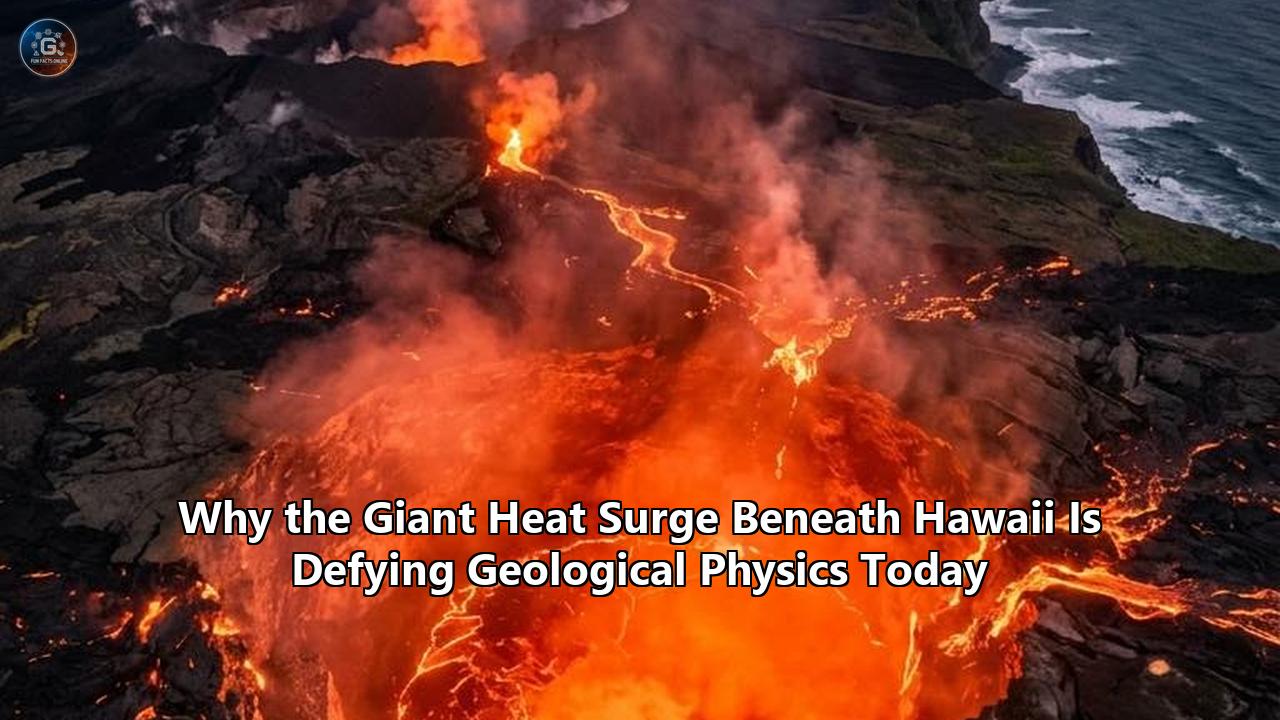
A groundbreaking geophysics study published in Earth and Planetary Science Letters has upended five decades of planetary science, revealing that the mantle plume feeding Hawaii’s volcanic chain has been steadily warming rather than cooling over the past 47 million years.
A research team led by Earth scientists at the University of Hawaiʻi at Mānoa discovered that the mantle beneath the Hawaiian hotspot has surged in temperature by approximately 250°C (480°F) across its recorded history. Rather than dissipating its internal thermal energy over geological time—as classic thermodynamic models dictate—the plume has experienced two massive, discrete thermal spikes. The first of these historical pulses built the largest single shield volcano on Earth, while the second continues to fuel the hyperactive volcanic chain visible today.
The discovery directly contradicts the foundational assumption of hotspot theory: that deep mantle plumes act like dying embers, beginning at peak temperatures during their initial surfacing event and gradually cooling as they lose thermal energy to the surrounding upper mantle and lithosphere.
“It was a major surprise to find such a strong, direct correlation between mantle temperatures and volcano size,” said Dr. Michael O. Garcia, Emeritus Professor of Earth Sciences at the UH Mānoa School of Ocean and Earth Science and Technology (SOEST) and lead author of the study. “Other potential explanations simply failed to explain the data”.
The findings resolve a long-standing mystery regarding why individual volcanoes along the 3,500-kilometer (2,180-mile) Hawaiian Ridge vary in volume by up to 100-fold. By demonstrating that temperature surges deep inside Earth dictate the massive output of molten rock, the study provides a new lens through which scientists view planet-scale convective heat transfer, mantle plume longevity, and core-mantle boundary dynamics.
The Physics Paradox: Why Mantle Hotspots Weren't Supposed to Work This Way
For more than half a century, geophysicists operated under a unified paradigm regarding ocean island basalt hotspots. First conceptualized by John Tuzo Wilson in 1963 and expanded by W. Jason Morgan in 1971, the plume model explains chains of intraplate volcanoes as the surface expression of a narrow column of buoyant, hot rock rising from deep within Earth’s mantle as the overriding tectonic plate slowly drifts overhead.
In classical mantle dynamics, a plume is generated when a thermal boundary layer—most notably the D'' layer at the core-mantle boundary roughly 2,900 kilometers (1,800 miles) beneath the surface—becomes unstable. As a massive "plume head" separates from this boundary layer and forces its way through the mantle, it brings an initial wave of intense heat. Once the head erupts at the surface, it leaves behind a narrower "plume tail" or conduit that supplies magma to the surface for millions of years.
Standard thermodynamic logic dictates that this rising conduit must undergo steady thermal degradation over tens of millions of years due to several physical processes:
- Conductive Heat Dissipation: As the warm plume rises through cooler ambient mantle rock, heat naturally diffuses outward into the surrounding upper and lower mantle.
- Adiabatic Expansion: Molten and solid mantle rock expands as overburden pressure decreases during ascent, a process that naturally lowers the internal temperature of the ascending mass.
- Boundary Layer Depletion: The localized accumulation of ultra-hot thermal material at the base of the mantle is finite; as it drains upward, the thermal contrast between the plume and the background mantle should diminish over time.
Because of these thermal losses, mantle plume potential temperature ($T_p$) was assumed to reach its absolute peak during the early stages of a hotspot's lifecycle and decay progressively thereafter.
Classic Hotspot Cooling Model (Legacy Assumption)
Deep Thermal Core --> Initial Hot Plume Head --> Surface Burst --> Conduit Cools Over Time

Observed Hawaiian Plume Dynamics (2026 Discovery)
Deep Thermal Accumulation --> Secular Heating (+250°C) --> Discrete Heat Pulses --> Surging Magmatism
The UH Mānoa study thoroughly dismantles this cooling decay assumption for Hawaii. The empirical geochemical record shows that when the Pacific Plate first began passing over the Hawaiian hotspot roughly 47 million years ago—forming the northwesternmost underwater structures of the Hawaiian Ridge—the mantle plume's potential temperature was significantly cooler than it is today.
Over the subsequent 47 million years, instead of cooling by several hundred degrees, the mantle plume warmed by roughly 250°C (480°F). This discovery forces geophysicists to fundamentally re-evaluate the thermodynamic models that govern planetary heat loss and convective flow in the deep mantle.
Decoding the Hawaii Heat Surge: A Story of Two Thermal Pulses
The comprehensive thermal profile compiled by the research team reveals that this 250°C temperature increase was not a smooth, linear ramp. Instead, overall baseline heating was interrupted by two distinct mega-pulses of intense thermal output.
The discovery of these thermal pulses provides the missing physical mechanism needed to explain the enormous disparities in volcanic scale along the Hawaiian-Emperor chain. While the chain contains 65 distinct volcanic structures spread across 3,500 kilometers of the Pacific floor, the volume of lava extruded by these volcanoes varies dramatically. Some volcanoes produced modest submarine mounds, while others grew into the largest mountain structures on the planet.
                     HAWAIIAN PLUME THERMAL TIMELINE

Mantle Temp (°C)
  ^
  |                                                  [SURGE 2: Present Day]
  |                                                  Main Hawaiian Islands
  |                                                  (Mauna Loa / Kīlauea)
  |                              [SURGE 1]                   /---\
  |                             Pūhāhonu                    /     \
  |                              /---\                     /       \
  |                             /     \                   /         \
  |              Baseline      /       \                 /           \
  |              Warming      /         \               /             \
  |               /----------/           \-------------/               \
  +--------------/-------------------------------------------------------> Time
  47 Ma        30 Ma           20 Ma      14 Ma        6 Ma             0 Ma
Pulse 1: The Pūhāhonu Mega-Surge (14 to 20 Million Years Ago)
The first major Hawaii heat surge occurred between 14 and 20 million years ago, centered deep beneath the Central Pacific. This spike in mantle temperature triggered a period of hyper-melting that constructed Pūhāhonu, a shield volcano whose remnants today poke above sea level as tiny, solitary rock peaks known as Gardner Pinnacles.
For decades, geologists assumed Mauna Loa was the undisputed heavy-weight champion of Earth's volcanoes. However, high-resolution bathymetric and gravity mapping conducted in 2020 revealed that Pūhāhonu contains approximately 148,000 cubic kilometers of basalt—more than double the total volume of Mauna Loa.
The new geothermometry data demonstrates that Pūhāhonu’s colossal size was directly caused by an unprecedented thermal pulse. During this surge, mantle potential temperatures spiked far above the regional baseline, producing exceptionally high degrees of partial melting in the upwelling mantle column. The resulting magmas were richer in magnesium and significantly hotter than baseline basaltic melts, pouring onto the seafloor at unprecedented rates to construct a mountain structure roughly 275 miles long and 56 miles wide.
Pulse 2: The Modern Archipelago Surge (0 to 6 Million Years Ago)
Following the decay of the Pūhāhonu thermal pulse, mantle temperatures dropped slightly but maintained a higher baseline than in the preceding era. Then, beginning roughly 6 million years ago, the second massive Hawaii heat surge initiated—a thermal event that continues to operate directly beneath the Main Hawaiian Islands today.
This ongoing thermal surge is directly responsible for building the prominent islands populated today: Kauaʻi, Oʻahu, Molokaʻi, Lānaʻi, Maui, and Hawaiʻi Island. As the Pacific Plate carried the ocean crust over this high-temperature zone, the increased plume temperature drove vast volumes of magma into the crust, fueling rapid, overlapping shield-building phases.
On the Big Island of Hawaiʻi, this surge is manifesting in real time. Active eruptive centers like Mauna Loa and Kīlauea—as well as the submarine volcano Kamaʻehuakanaloa (formerly Lōʻihi)—are being fed by some of the hottest, most buoyant mantle melt generated anywhere in the ocean basins today.
Geochemical Forensics: How Olivine Crystals Unlocked Deep Mantle Thermometry
To measure the temperature of rock that melted tens of kilometers beneath the ocean floor up to 47 million years ago, Dr. Garcia’s team could not rely on indirect surface observations. Instead, they developed an innovative geochemical "geothermometer" focused on olivine crystals preserved inside primitive basaltic lavas collected from 16 volcanoes along the Hawaiian Ridge.
Olivine—a magnesium-iron silicate mineral $(\text{Mg}, \text{Fe})_2\text{SiO}_4$—is typically the very first mineral to crystallize as a hot basaltic magma begins to cool. Crucially, the chemical exchange of magnesium ($\text{Mg}$) and iron ($\text{Fe}$) between an olivine crystal and its surrounding liquid magma is strictly controlled by thermodynamic laws and is highly sensitive to ambient temperature.
       MANTLE MELTING GEOTHERMOMETRY WORKFLOW

[Deep Mantle Plume Upwelling]
             |
             v  (Partial Melting at High Temp)
[Primary Magma Generation]
             |
             v  (Ascent & Initial Cooling)
[Olivine Phenocryst Crystallization]
    *(Traps Mg/Fe, Ni, & Mn Partition Ratios)*
             |
             v  (Eruption & Quenching on Ocean Floor)
[Basaltic Pillow Lavas & Picrites]
             |
             v  (SOEST Sampling & Microprobe Analysis)
[Geothermometer Calculation of Original Mantle Potential Temp (Tp)]
By measuring the composition of the most primitive olivine phenocrysts (those with the highest magnesium numbers, or $\text{Mg}\# = [\text{Mg} / (\text{Mg} + \text{Fe}^{2+})]$) alongside minor trace elements like nickel ($\text{Ni}$) and manganese ($\text{Mn}$), the researchers reconstructed the composition and temperature of the original, un-evolved "parental" magma at the exact moment it separated from its solid mantle source.
Testing the Four Competing Hypotheses
Prior to this study, geologists debated four primary mechanisms to explain why lava production along the Hawaiian Ridge fluctuates so wildly. The UH Mānoa research team systematically tested all four against their empirical geochemical dataset:
| Hypothesis | Proposed Mechanism | Study Findings & Verdict |
|---|---|---|
| 1. Lithospheric Thickness | Thinner tectonic plate allows higher decompression melting; thicker plate caps upwelling. | REJECTED: Lithospheric age and thickness across the Pacific Plate vary smoothly and do not correlate with the dramatic 100-fold spikes in volcano volume. |
| 2. Mantle Source Composition | Variations in mantle fertility (e.g., presence of recycled oceanic crust/eclogite) increase melt volume without temperature changes. | REJECTED: Isotopic trace element signatures confirm composition varies, but compositional shifts alone cannot produce the massive volume spikes without high thermal anomalies. |
| 3. Tectonic Plate Velocity | Slower plate motion allows heat to concentrate in one spot longer, building larger volcanoes. | REJECTED: Reconstructions of Pacific Plate motion vectors show relatively uniform plate speeds during major volcanic volume surges. |
| 4. Plume Temperature Shifts | Temporal fluctuations in deep thermal energy alter the rate and extent of mantle decompression melting. | CONFIRMED: Statistical regressions demonstrate a direct, robust correlation between calculated mantle potential temperatures ($T_p$) and erupted volcano volumes. |
"It was a major surprise to find such a strong, direct correlation between mantle temperatures and volcano size," noted Dr. Garcia. The mathematical models confirmed that temperature is the dominant control knob governing Hawaiian volcanism. When the plume heats up, mantle melting efficiency expands exponentially, inundating the Pacific crust with basalt; when temperature decreases, magma production drops off rapidly.
The Deep-Earth Engine: Iron Blobs, LLLVPs, and Core-Mantle Boundary Physics
The realization that a deep mantle plume can warm up over tens of millions of years forces physicists to address a fundamental question: Where is this extra heat coming from, and how is it stored deep inside Earth?
The answer lies 2,900 kilometers beneath our feet at the core-mantle boundary (CMB)—a chaotic, extreme thermal transition zone where solid silicate rock meets the molten iron outer core.
CORE-MANTLE BOUNDARY THERMAL ENGINE MECHANISM

  [Upper Mantle / Oceanic Crust]
              ^
              |  Ascending Thermal Plume Conduits
              |
  [Lower Mantle (~2,900 km Depth)]
  +--------------------------------------------------+
  |                                                  |
  |      Thermal Accumulation Zone                   |
  |    (Dense, Iron-Rich LLLVP / Thermo-Chemical Pile)|
  |      +------------------------------------+      |
  |      | Heat conducted from Outer Core     |      |
  |      | trapped due to high density        |      |
  |      +------------------------------------+      |
  |                        ^                         |
  +------------------------|-------------------------+
  [Liquid Outer Core (Extremely Hot Metallic Layer)]
Geophysicists utilizing advanced seismic tomography—which measures the speed of earthquake waves traveling through Earth's interior—have long identified two massive, continent-sized structures resting on the core-mantle boundary. Known as Large Low-Velocity Provinces (LLVPs or LLLVPs), these structures sit beneath Africa and the Central Pacific. Seismic waves pass through these zones at significantly reduced speeds, indicating that they are both hotter and compositionally distinct from the surrounding mantle.
The Thermo-Chemical Anchor and "Lava Lamp" Dynamics
For years, scientists debated whether these subterranean features were soft, partially melted "goo" or dense, solid thermochemical piles. Seismic shear-wave ($S$-wave) and compressional-wave ($P$-wave) data reveal that the deep structure beneath Hawaii is actually a dense, iron-rich solid mantle structure.
Because these mantle structures are heavily enriched in iron, they possess a higher intrinsic density than the surrounding lower mantle. This extra mass anchors them to the core-mantle boundary, preventing them from easily rising.
This creates a high-capacity thermal reservoir that operates much like a giant planetary lava lamp:
- Thermal Trapping: The iron-rich structure acts as a thermal sponge, absorbing vast amounts of heat conducted directly out of Earth's scorching metallic outer core.
- Density Overcoming: Because the structure is so dense, it does not immediately rise upon warming. Heat continues to accumulate inside the mass for millions of years, progressively raising its internal temperature.
- Surging Instability: Eventually, the extreme thermal expansion of the material reduces its net density enough to overcome its chemical weight. A massive, super-heated parcel of thermal material detaches or feeds an intense thermal pulse upward into the expanding plume tail.
- Secular Lateral Drifting: Recent global geodynamic models suggest that dense, hot material within the lowermost mantle slowly drifts horizontally across the core-mantle boundary. As warmer, more iron-rich regions of this deep reservoir slide beneath the base of the Hawaiian plume conduit, the plume draws from an increasingly hot thermal source.
This thermo-chemical insulating effect explains how a plume can experience secular heating over 47 million years. The deep Hawaiian root is not drawing from an open, uninsulated conduit; it is being fed by a dynamic, heat-accumulating engine at the base of the mantle.
Mantle Transition Zone Anomalies: Seismic Corroboration
The geochemical proof of an escalating Hawaii heat surge is reinforced by independent geophysical studies of Earth's mantle transition zone. Located between 410 and 660 kilometers beneath the surface, the transition zone is defined by two major seismic velocity discontinuities caused by phase transformations in olivine minerals:
- The 410-km Discontinuity: Olivine transforms into a denser crystal structure called wadsleyite.
- The 660-km Discontinuity: Ringwoodite breaks down into bridgmanite and ferropericlase.
Because the mineral phase transitions occurring at these depths are sensitive to temperature, the vertical thickness of the mantle transition zone serves as an internal deep-Earth thermometer. High thermal anomalies shift the 410-km boundary deeper and push the 660-km boundary shallower, measurably thinning the overall transition zone.
MANTLE TRANSITION ZONE THERMAL DEFLECTION

Normal Mantle                         Thermal Plume Zone (Hotter)
------------------ 410 km ----------   ----------------------------
                                            \  (Pushed Deeper)
   Standard MTZ                              \--------------------
    Thickness                                   THINNED TRANSITION
   (~250 km)                                           ZONE
                                             /--------------------
------------------ 660 km ----------        /  (Pushed Shallower)
                                      ----------------------------
Seismic imaging utilizing inverse scattering of SS-waves has identified a massive thermal anomaly ranging between 800 and 2,000 kilometers wide deep in the transition zone beneath and west of Hawaii. The magnitude of this temperature spike ($\Delta T_{\text{max}}$) is estimated at 300 to 400 Kelvin above the ambient mantle.
Crucially, the sheer lateral width of this subterranean thermal anomaly indicates that hot material rising from the lower mantle does not simply shoot straight up through a thin pipe. Instead, ultra-hot plume material accumulates near the base of the transition zone, forming a subterranean reservoir of thermal energy before pinching off into localized, buoyant conduits that feed active surface volcanoes.
This deep physical pooling explains why surface heat surges manifest in multi-million-year pulses. Thermal energy builds up beneath the transition zone until hydraulic and thermal buoyancy thresholds are breached, sending a wave of superheated mantle ascending toward the Hawaiian crust.
Case Studies in Volcanic Gigantism: Pūhāhonu vs. Mauna Loa
To appreciate the real-world scale of these deep-earth thermal pulses, it helps to compare the two monster shield volcanoes built by the first and second historical heat surges.
VOLCANIC VOLUME COMPARISON (CUBIC KILOMETERS)

Pūhāhonu (Surge 1 Peak)
[############################################################] 148,000 km³

Mauna Loa (Surge 2 Current)
[#############################] 74,000 km³

Tamu Massif (Non-Plume/Rift)
[#################################################] 120,000 km³
Pūhāhonu: The Thermal Titan of the Northwestern Ridge
Located roughly 620 miles northwest of Honolulu, Pūhāhonu appears to human eyes as two barren, uninhabited rocks protruding less than 17 meters (52 feet) above the ocean surface. Beneath the ocean surface, however, sits a massive geological structure.
- Total Volume: ~148,000 km³ (including massive crustal sag underneath the weight)
- Thermal Engine: Formed during the peak of the first Hawaii heat surge (~14–20 Ma).
- Geochemical Signature: Contains the highest-temperature primary magmas recorded anywhere along the Hawaiian Ridge, enriched in magnesium and generated by extreme degrees of mantle decompression melting.
When the first thermal pulse hit its peak, the temperature of the mantle upwelling was high enough to melt a larger fraction of the solid mantle than at any other point in the hotspot's recent history. This created an immense flow of fluid magma that built a shallow-sloped, incredibly dense shield volcano that pushed the Pacific lithosphere down under its sheer weight.
Mauna Loa and Kīlauea: Active Giants of the Modern Surge
While Pūhāhonu holds the record for absolute volume, the modern Big Island volcanoes are being constructed during the second ongoing thermal pulse.
- Mauna Loa Volume: ~74,000 km³
- Combined Island Mass: The Big Island of Hawaiʻi consists of five overlapping shields (Kohala, Mauna Kea, Hualālai, Mauna Loa, and Kīlauea) sitting atop the youngest, hottest segment of the plume track.
- Current Eruptive Dynamics: In June 2026, dramatic lava fountaining within Halemaʻumaʻu crater at Kīlauea’s summit launched molten streams over 1,200 feet into the air—a vivid display of the continuous, high-volume supply of magma driven by deep thermal upwelling.
   GEOLOGICAL PROFILES OF HAWAII'S TWO MEGA-SURGE SHIELDS

   PŪHĀHONU (Northwestern Ridge)            MAUNA LOA / KĪLAUEA (Main Islands)
   Age: 14-20 Million Years                  Age: 0-1 Million Years to Present
   Mantle Potential Temp: Extreme Peak       Mantle Potential Temp: Escalating High
   Volume: ~148,000 km³                      Volume: ~74,000 km³ (Mauna Loa alone)
   Status: Extinct, Subsided                 Status: Highly Active
The geochemical analysis shows that the primary magmas feeding Mauna Loa and Kīlauea today are warmer and more primitive than those that formed Kauaʻi and Oʻahu several million years ago. The second thermal surge is currently in its active, high-temperature phase.
Implications for Global Geodynamics and Planetary Physics
The realization that the Hawaiian mantle plume is warming up and undergoing erratic thermal surges forces geophysicists to rethink several fundamental tenets of Earth history and planetary evolution.
1. Planetary Thermal Cooling Models Must Be Revised
Earth scientists have long modeled the planet as a simple, smoothly cooling heat engine, steadily losing primeval thermal energy left over from planetary accretion and core differentiation, supplemented by radioactive decay of isotopes ($^{238}\text{U}$, $^{235}\text{U}$, $^{232}\text{Th}$, and $^{40}\text{K}$).
If major core-mantle boundary plumes can systematically increase in temperature by 250°C over 47 million years, planetary thermal heat loss is far more localized, episodic, and complex than global convective cooling models account for. Heat exchange across the core-mantle boundary is not steady; it fluctuates in massive, long-period thermal cycles driven by thermo-chemical boundary layer dynamics.
2. Re-Evaluating Global Hotspots
Hawaii is the world’s quintessential hotspot, serving as the benchmark laboratory for plume theory. The confirmation of secular heating and thermal surges beneath Hawaii immediately raises questions about other major hotspot tracks globally:
- Iceland Hotspot: Is the North Atlantic plume warming or cooling as it interacts with the Mid-Atlantic Ridge?
- Galápagos & Réunion: Do volume variations along these oceanic island chains reflect past thermal surges rather than tectonic plate fluctuations?
- Yellowstone Supervolcano: Does the continental plume powering Yellowstone experience localized thermal spikes capable of altering super-eruption frequencies?
Geochemists are already applying the new olivine geothermometer developed by Dr. Garcia’s team to archival rock samples from these global volcanic tracks to determine whether secular heating is a universal feature of deep mantle plumes.
                GLOBAL PLUME GEOTHERMOMETRY COMPARISON

Hotspot System        Classic Model Assumption       New 2026 Research Insight
----------------------------------------------------------------------------------
Hawaii                Decaying / Cooling             Secular Heating (+250°C), 2 Surges
Iceland               Steady-State / Cooling         Under Active Re-evaluation
Galápagos             Decaying / Cooling             Under Active Re-evaluation
Yellowstone           Decaying / Cooling             Under Active Re-evaluation
Volcanic Hazard Horizons: Geological vs. Human Timescales
When news of a deep-Earth thermal surge breaks, a common concern is whether this discovery portends an imminent volcanic disaster or catastrophic explosive eruption for the state of Hawaii.
It is vital to distinguish between geological timescales and human/civil planning timescales:
- Geological Timescale (Millions of Years): The Hawaii heat surge describes thermal trends operating across tens of millions of years. The second thermal surge began roughly 6 million years ago and is continuing on its multi-million-year arc.
- Human/Civil Timescale (Days to Decades): Day-to-day volcanic eruptions at Kīlauea or Mauna Loa are governed by shallow magmatic mechanics—reservoir inflation, dike intrusions, conduit geometry, and localized gas vesiculation.
       TIMESCALE DISTINCTION IN VOLCANIC MECHANICS

   GEOLOGICAL TIMESCALE                        HUMAN / CIVIL TIMESCALE
   (Millions of Years)                         (Hours to Decades)

   * Mantle Plume Potential Temp (Tp)   * Shallow Reservoir Pressurization
   * LLLVP Core-Mantle Heat Exchange    * Dike Intrusion & Fissure Propagation
   * Deep Transition Zone Pooling      * Summit Inflation / Deflation Cycles
   * Island-Scale Shield Construction   * Localized Lava Flow Hazards
While a warmer plume means high baseline rates of magma generation beneath the Pacific Plate, it does not mean Hawaii’s shield volcanoes will suddenly shift from their characteristic effusive (lava-flowing) eruptive styles to catastrophic explosive super-eruptions. Hawaiian magmas are low in silica ($\text{SiO}_2$), making them fluid and allowing dissolved gases to escape easily without generating large explosive pressures.
However, the confirmation that the current plume is operating in a high-temperature, surge-fed state reinforces what volcanologists at the USGS Hawaiian Volcano Observatory (HVO) already know: the Hawaiian hotspot is one of the most productive magma factories on Earth, capable of sustaining prolonged, continuous eruptions across multiple vents for decades to come.
The Frontier of Deep-Earth Exploration
The discovery that the hotspot beneath Hawaii is getting hotter turns a long-held geological theory on its head and opens new avenues for deep-Earth research. To fully decode the underground mechanics driving this planetary phenomenon, scientists are preparing a new generation of observational campaigns:
1. High-Density Ocean-Bottom Seismometers (OBS)
Researchers are designing marine geophysical deployments to surround the Hawaiian Ridge with dense networks of ocean-bottom seismometers. These instruments will map the fine-scale geometry of the plume conduit as it passes through the mantle transition zone down to the core-mantle boundary.
2. High-Pressure Diamond Anvil Experiments
Geochemists are utilizing laser-heated diamond anvil cells to subject synthetic olivine and pyroxene mixtures to the extreme pressures (~135 GPa) and temperatures (>3,000°C) found at the base of the lower mantle. These experiments aim to replicate how iron-dense thermo-chemical structures absorb and release thermal energy over deep-time cycles.
3. Integrated Computational Convection Models
Using supercomputers, geophysicists are building 3D fluid-dynamic simulations that merge seismic tomography, geochemical geothermometry, and variable-density thermodynamic equations. These models aim to predict the future thermal lifespan of the Hawaiian plume and determine when the current heat surge might peak.
Fifty years after the hotspot hypothesis was first proposed, Hawaii continues to redefine our understanding of the planet. The realization that an active mantle plume can warm up over tens of millions of years demonstrates that deep inside Earth, thermal dynamics remain far more dynamic, energetic, and unpredictable than science ever imagined.
References
- Garcia, M. O., Putirka, K. D., Tree, J. P., & Jicha, B. R. (2026). Taking the temperature of the Hawaiian plume using multiple geochemical approaches: Evidence for secular heating from 47 Ma to present. Earth and Planetary Science Letters.
- Cao, A., et al. (2011). Seismic imaging of mantle transition zone anomalies and thermal structure beneath Hawaii. Science / ResearchGate.
- U.S. Geological Survey (USGS) Hawaiian Volcano Observatory (HVO). Volcanic Anomaly & Infrared Infrared-Sensor Surveys of Kilauea and Mauna Loa. USGS Bulletin Reports.
- University of Hawaiʻi at Mānoa School of Ocean and Earth Science and Technology (SOEST). (2026). Research Communications on Hawaiian Mantle Plume Geothermometry.
Reference:
- https://scitechdaily.com/the-hotspot-beneath-hawaii-is-getting-hotter-defying-a-long-held-geological-theory/
- https://www.earth.com/news/hawaiis-volcanic-hotspot-has-been-heating-up-for-millions-of-years/
- https://www.soest.hawaii.edu/soestwp/announce/news/hawaiian-hotspot-is-getting-hotter/
- https://www.youtube.com/watch?v=KpN5YbesNig
- https://bigislandnow.com/2026/07/21/new-study-reveals-hawaiian-mantle-plume-temperature-rise-over-47-million-years/
- https://pubmed.ncbi.nlm.nih.gov/21617072/
- https://www.researchgate.net/publication/51169479_Seismic_Imaging_of_Transition_Zone_Discontinuities_Suggests_Hot_Mantle_West_of_Hawaii
- https://pubs.usgs.gov/of/1982/0127/report.pdf
- https://pubs.usgs.gov/publication/70010744
- https://www.hawaii.edu/news/2026/07/16/hawaii-mantle-plume/