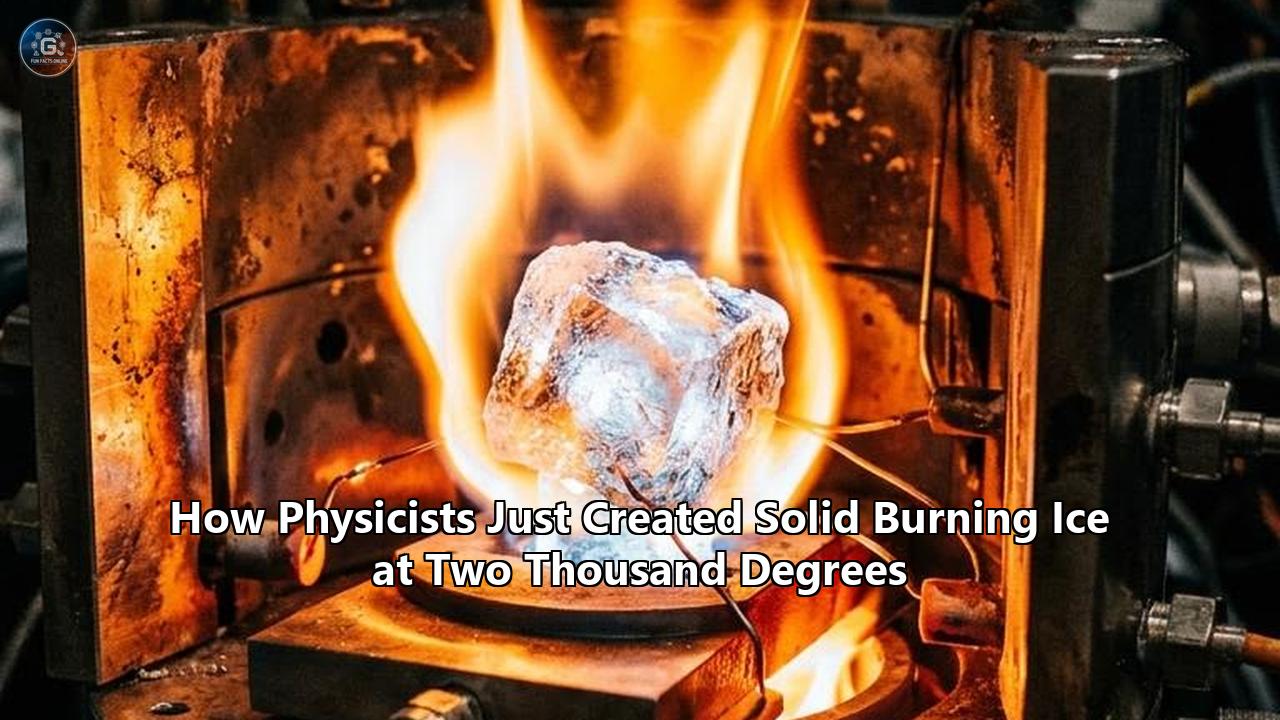
Physicists at the European Synchrotron Radiation Facility (ESRF) in Grenoble, working alongside researchers from the French Alternative Energies and Atomic Energy Commission (CEA), Sorbonne University, and the French National Centre for Scientific Research (CNRS), have compressed water to 2.3 million times Earth’s atmospheric sea-level pressure (230 gigapascals) and heated it beyond 2,630 Kelvin (2,357 degrees Celsius). Under these thermal and baric extremes—hotter than the melting point of structural steel—the water did not vaporize into steam or disperse into an unconfined plasma. It froze into a dense, solid, electrically conductive state known as superionic ice.
The investigation, published in Physical Review Letters by lead author Alexis Forestier and CEA project leader Gunnar Weck, reveals a previously unconfirmed hexagonal close-packed (hcp) crystal lattice of oxygen atoms in water subjected to planetary core conditions. By trapping a 12-micrometer speck of pure liquid water between micro-machined diamond tips and energizing it with double-sided infrared lasers, the team captured direct X-ray diffraction patterns of the phase transition in real time.
This laboratory synthesis provides direct empirical constraints on water ice at multi-megabar pressures, challenging long-standing dynamic laser-shock experiments and computational models. Understanding these core superionic ice properties directly addresses the planetary dynamo puzzles posed by the Voyager 2 spacecraft when it measured the lopsided, non-axisymmetric magnetic fields of Uranus and Neptune nearly four decades ago.
  LIQUID WATER                    DYNAMIC LASER SHOCK                  STATIC LH-DAC (FORESTIER ET AL.)
[Ambient P & T]                [Omega / NIF / LCLS Platform]                  [ESRF ID27 Beamline]
       │                                     │                                         │
       ▼                                     ▼                                         ▼
  H2O Molecules                 Gigawatt Laser Ablation                    Mechanical Diamond Screws
 Covalent & H-Bonds             Nanosecond Transient Shock                 Continuous Megabar Force
   O-H: 0.96 Å                  Reverberating Hugoniot Wave                Boron-Doped Diamond Oven
       │                                     │                                         │
       │                                     ▼                                         ▼
       │                          FACE-CENTERED CUBIC (FCC)                 HEXAGONAL CLOSE-PACKED (HCP)
       │                             Ice XVIII Lattice                          Newly Resolved Phase
       │                        Protons Diffuse Isotropically              Protons Diffuse Anisotropically
       │                                     │                                         │
       └─────────────────────────────────────┴─────────────────────────────────────────┘
                                             │
                                             ▼
                             SUPERIONIC ICE STATE (>2,000 K, >200 GPa)
                             • Oxygen: Frozen Solid Sublattice
                             • Hydrogen: Liquid-Like Protonic River
                             • Optical: Absorptive, Opaque, Pitch-Black
                             • Electrical: Protonic Conductor (~10 S/cm)
The Dual Nature of Superheated Ice: Rigid Cages and Protonic Oceans
Superionic ice is not merely ordinary freezer ice subjected to high pressure. Ice cubes at ambient conditions consist of hexagonal crystals (Ice Ih) held together by hydrogen bonds, where each oxygen atom covalently binds two hydrogens and weakly attracts two others in an open, low-density lattice.
When compressed past 2 gigapascals (GPa) at room temperature, water packs into dense cubic forms such as Ice VI and Ice VII, where hydrogen atoms remain bound to specific oxygen neighbors.
Normal Ice (Ice Ih, VII, X):
  [H] - [O] - [H] · · · [O]       Fixed oxygen positions; localized hydrogen bonds.
         |             |          Electrically insulating, optically transparent.
        [H]           [H]

Superionic Ice (Ice XVIII, HCP Phase):
  ( O ) ─── ( O ) ─── ( O )       Solid oxygen crystalline framework (FCC / HCP).
    │   H⁺    │   H⁺    │
  ( O ) ─── ( O ) ─── ( O )       Delocalized protons (H⁺) flood interstitial voids.
    │   H⁺    │   H⁺    │         Simultaneous solid lattice and liquid ionic fluid.
  ( O ) ─── ( O ) ─── ( O )       Optically black, high protonic electrical conductivity.
Pushing pressure beyond 100 GPa and temperatures above 2,000 Kelvin radically restructures the molecular architecture. The thermal kinetic energy delivered by laser photons overwhelms the directional covalent bonds of the water molecule, while the crushing compressive mechanical force prevents the oxygen atoms from separating into a gas.
The oxygen atoms lock into an immovable, solid crystalline framework. The hydrogen nuclei (protons), stripped of their localized electron clouds, break loose from their parent atoms. These protons cascade across interstitial vacancies within the oxygen lattice, diffusing as a fluid stream of subatomic particles.
Superionic ice acts simultaneously as a rigid solid and a liquid. Its mechanical strength and elastic shear modulus are governed by the oxygen lattice, allowing the material to resist shear stresses and hold a defined crystalline shape. Its electrical characteristics mirror those of a molten, highly conductive electrolyte. Protons flow through the crystal lattice at speeds rivaling water molecules in boiling water, yielding an ionic electrical conductivity in excess of 10 to 100 Siemens per centimeter.
The optical properties change just as dramatically. Under these conditions, the bandgap between occupied and unoccupied electronic states collapses. Ambient water is transparent, but superionic ice becomes dark and opaque. It absorbs incoming optical radiation, taking on the physical appearance of a dense, glowing charcoal crystal.
A central marker observed by the ESRF and CEA researchers was a sharp anomaly in thermal volume expansion. At 191 GPa, as the sample was heated past 1,700 Kelvin, the crystal lattice expanded at a rate far exceeding standard anharmonic lattice vibrations. This expansion spike confirmed the onset of the superionic state. The protons had shifted from vibrating around localized sites into a collective state, pushing outward against the oxygen lattice walls as they achieved mobility.
Competing Experimental Methodologies: Nanosecond Shockwaves vs. Diamond Anvil Micro-Ovens
Reaching multi-megabar pressures and temperatures in excess of 2,000 Kelvin requires pushing laboratory equipment to physical breaking points. For decades, the high-pressure community has been split between two competing technological philosophies: dynamic laser-driven shock compression and static laser-heated diamond anvil cells (LH-DAC).
Each technique handles the trade-offs of the laws of thermodynamics differently.
┌──────────────────────────────┬────────────────────────────────────┬────────────────────────────────────┐
│ Parameter / Dimension        │ Dynamic Laser Shock Compression    │ Static Laser-Heated DAC (Micro-Oven)│
├──────────────────────────────┼────────────────────────────────────┼────────────────────────────────────┤
│ Observation Window           │ 1 to 10 nanoseconds                │ Milliseconds to continuous seconds │
│ Diagnostic Probes            │ Flash X-ray free-electron lasers   │ Synchrotron hard X-ray micro-beams │
│ Pressure Range Achieved      │ 100 to >500 GPa                    │ 10 to 230 GPa                      │
│ Thermodynamic State          │ Non-equilibrium / Shock Hugoniot   │ Hydrostatic / Thermal equilibrium  │
│ Temperature Gradient         │ Steep transient shock waves        │ Homogeneous via BdD absorption     │
│ Sample Survivability         │ Destructive (single-shot target)   │ Reversible / Metastable recovery   │
│ Structural Identification    │ Face-centered cubic (FCC, Ice XVIII)│ Hexagonal close-packed (HCP) & FCC │
└──────────────────────────────┴────────────────────────────────────┴────────────────────────────────────┘
The Dynamic Laser Shock Compression Approach
Dynamic shock physics was long the only method capable of crossing the threshold into the multi-megabar, multi-thousand-Kelvin regime. Pioneered at facilities such as the Omega Laser Facility at the University of Rochester, the National Ignition Facility (NIF) at Lawrence Livermore National Laboratory (LLNL), and the Linac Coherent Light Source (LCLS) at SLAC National Accelerator Laboratory, this approach relies on brute kinetic force.
In a typical dynamic experiment—such as those executed by Marius Millot and Federica Coppari—physicists load water between thin diamond or sapphire windows, often pre-compressing the fluid to 2.5 GPa to turn it into room-temperature Ice VII. Multi-kilojoule laser beams then strike an ablator material, converting its surface into an expanding plasma.
The rocket-like blowoff launches strong shockwaves directly into the ice. These reverberating pressure waves compress the sample to 100–400 GPa while shock-heating it to 3,000–5,000 Kelvin.
The primary advantage of dynamic compression is its reach. Shocks achieve pressures far beyond the shear strength limits of solid diamond, bypassing the mechanical deformation that destroys physical anvils. The entire experiment completes in a few nanoseconds, well before the sample can chemically react with or degrade its surrounding container.
The trade-offs, however, are severe:
- Transient Durations: The target is held at target pressure and temperature for only 1 to 5 nanoseconds before rarefaction waves tear the assembly apart.
- Thermodynamic Pathing: Shock compression naturally drives materials along the Hugoniot curve, an equation-of-state path where intense mechanical shock irreversibly generates heat. Keeping the sample cool enough to remain inside the solid superionic phase rather than melting into a dense liquid requires pulse-shaping and pre-compression steps.
- Diagnostic Limitations: Researchers must synchronize their measurements with sub-nanosecond flash X-ray pulses generated by synchronized laser-plasmas or free-electron lasers. Capturing faint structural transitions during these brief windows requires deconvolving signal noise from hydrodynamic shock fronts and rapidly decaying pressure gradients.
Through dynamic compression, LLNL and Rochester scientists first proved that water adopts an FCC oxygen sublattice at high temperatures, naming it Ice XVIII. The short observation times left open questions about whether this FCC lattice was a stable equilibrium phase or a short-lived transient state caused by the fast shock wave.
The Static Laser-Heated Diamond Anvil Cell (LH-DAC) Approach
Static diamond anvil cells work in the opposite regime. Instead of using shock waves, the sample is held in place between the flat polished tips (culets) of two single-crystal diamonds mounted in a beryllium-copper or tungsten carbide frame. Mechanical screws or gas-driven membranes force the diamonds together, applying static pressure to a metal gasket chamber holding the sample.
Once compressed, focused infrared laser beams pass through the transparent diamond anvils, heating the sample from one or both sides. Static LH-DAC experiments allow scientists to hold extreme pressures indefinitely, probing the sample with monochromatic synchrotron X-ray beams over seconds or minutes.
This extended observation time allows researchers to map phase boundaries with fine temperature resolution, track continuous lattice expansion, and determine the onset of superionicity under equilibrium conditions.
The trade-offs of the static approach have historically limited its operational range:
- Diamond Anvil Failure: Diamond is the hardest known natural bulk material, but its yield strength degrades at extreme temperatures. Above 150 GPa and 2,000 Kelvin, diamond tips often crack, fracture, or convert to graphite.
- Chemical Contamination: At high temperatures, superheated water becomes a reactive chemical solvent. Protons migrate through the crystal, degrading rhenium or tungsten gaskets and reacting directly with the carbon in the diamond anvils.
- Steep Thermal Gradients: Because diamonds are efficient thermal conductors, heat introduced by lasers rapidly bleeds out through the anvils. In standard configurations, the core of a water sample could register at 2,500 Kelvin while the edges touching the diamond dropped below 500 Kelvin. This variation produced overlapping X-ray diffraction rings from several distinct phases at once, obscuring the phase boundary.
STANDARD STATIC LH-DAC                       FORESTIER BORON-DOPED MICRO-OVEN
─────────────────────                       ─────────────────────────────────
   Diamond Anvil                                      Diamond Anvil
         │                                                  │
         ▼                                                  ▼
┌──────────────────┐                               ┌──────────────────┐
│  Cold Diamond    │                               │  Cold Diamond    │
│  (Heat Sink)     │                               │  (Heat Sink)     │
└────────┬─────────┘                               └────────┬─────────┘
         │                                                  │
 ┌───────┴────────┐                                 ┌───────┴────────┐
 │ T ~ 500 K      │ ◄── Steep                       │ BdD Micro-Disc │ ◄── Absorbs Laser
 │                │     Thermal                     ├────────────────┤     Uniform Heat
 │ T ~ 2,500 K    │     Gradient                    │ Ice Sample (T) │     Homogeneous
 │                │                                 ├────────────────┤     Direct Heating
 │ T ~ 500 K      │                                 │ BdD Micro-Disc │
 └───────┬────────┘                                 └───────┬────────┘
         │                                                  │
┌────────┴─────────┐                               ┌────────┴─────────┐
│  Cold Diamond    │                               │  Cold Diamond    │
└──────────────────┘                               └──────────────────┘
Result: Overlapping X-ray rings                    Result: Sharp single-phase diffraction
The Boron-Doped Diamond Breakthrough at ESRF
The experiment by Forestier, Weck, and their team overcame these static limitations through sample-chamber engineering.
Operating at the ID27 high-pressure beamline at the ESRF, the team built a micro-oven inside the gasket cavity. They encapsulated the water sample within facing cupped disks made of boron-doped diamond (BdD). Boron atoms embedded in the diamond lattice absorb the 1,064-nanometer wavelength of the heating lasers.
Instead of firing the lasers directly into transparent water—which requires absorbing chemical dopants that contaminate the sample—the twin lasers heated the surrounding boron-doped diamond micro-capsules. The micro-oven converted the incoming laser energy into a uniform thermal bath, transferring heat into the water through conduction.
This micro-oven design minimized thermal gradients across the 12-micrometer sample chamber. Paired with the ESRF's Extremely Brilliant Source (EBS)—which provides an X-ray beam focused down to less than one micrometer—the team collected clear, unambiguous diffraction rings from tiny volumes of uniform material. This allowed them to measure clear phase boundaries up to 230 GPa and 2,630 Kelvin.
Crystallographic Rivalry: FCC vs. BCC vs. HCP Oxygen Lattices
The debate over the atomic geometry of superionic water has divided the high-pressure physics community for over a decade. The primary point of contention is how the oxygen sublattice organizes itself while the protons drift freely around it.
Body-Centered Cubic (BCC)      Face-Centered Cubic (FCC)      Hexagonal Close-Packed (HCP)
        Ice XX                         Ice XVIII                        New Phase
     Coordination: 8                Coordination: 12                 Coordination: 12
   Packing Ratio: 0.68            Packing Ratio: 0.74              Packing Ratio: 0.74
   Stacking: ABABAB...            Stacking: ABCABC...              Stacking: ABABAB...

       ┌───────┐                      ┌───────┐                        /\
       │ •   • │                      │ •   • │                       /  \
       │   •   │                      │   •   │                      / •  \
       │ •   • │                      │ •   • │                     /______\
       └───────┘                      └───────┘                    (Hexagonal)
Three competing structural geometries dominate the literature:
1. Body-Centered Cubic (BCC / Ice XX)
In early quantum mechanical models published in the late 1990s, scientists predicted that the oxygen framework would adopt a Body-Centered Cubic (BCC) symmetry. In this arrangement, oxygen atoms sit at the eight corners of a cube with a single oxygen placed at the center. This gives each oxygen eight nearest neighbors, with a packing efficiency of roughly 68 percent.
In late 2021, Vitali Prakapenka and Elena Bykova at the Advanced Photon Source (APS) at Argonne National Laboratory reported evidence for this BCC structure in static diamond anvil cells between 20 and 60 GPa at temperatures above 1,500 Kelvin, labeling it Ice XX. Proponents argued that BCC was the preferred high-temperature configuration because its large, open interstitial cavities provided pathways with low activation barriers for hopping protons.
2. Face-Centered Cubic (FCC / Ice XVIII)
Dynamic laser-compression experiments produced conflicting results. In work at the Omega Laser Facility and the National Ignition Facility, Marius Millot and colleagues observed that above 100 GPa, water crystallizes into a Face-Centered Cubic (FCC) lattice (Ice XVIII).
In an FCC configuration, oxygen atoms occupy the eight corners and the centers of all six cube faces. This configuration achieves close packing, with each atom surrounded by 12 nearest neighbors and a packing efficiency of 74 percent.
Dynamic shock researchers argued that multi-megabar pressures compress water so tightly that the looser BCC structure becomes energetically unfavorable. The system minimizes its free volume by forcing the oxygen ions into this dense, close-packed cubic geometry.
3. Hexagonal Close-Packed (HCP)
The latest findings from Forestier’s team show that the structural sequence does not end with Face-Centered Cubic. As static pressures mounted beyond 155 GPa at 2,000 Kelvin, synchrotron X-ray diffraction patterns revealed a mixture of FCC and a previously elusive hexagonal close-packed (hcp) crystal phase.
As the pressure was raised toward 219 and 230 GPa at 2,630 Kelvin, the FCC diffraction peaks faded while the HCP signature grew, indicating it had become the dominant solid phase.
The transition between FCC and HCP is subtle. Both arrangements share the same coordination number (12) and theoretical packing density (74 percent). The difference lies in how their close-packed two-dimensional atomic planes are stacked:
- FCC Stacking: Layers follow a three-step repeating pattern: ABCABCABC...
- HCP Stacking: Layers follow a two-step alternating pattern: ABABABAB...
Under millions of atmospheres of pressure, the electrostatic repulsion between positively charged, partially shielded oxygen cores alters the vibrational energy (entropy) of the lattice. This slight energetic shift makes the ABAB... stacking sequence more stable than ABCABC... at high temperatures.
This structural difference alters the material's bulk physical properties. In the cubic FCC phase, interstitial voids are isotropic, meaning protons diffuse through the lattice with equal speed in all spatial dimensions.
In the hexagonal close-packed lattice, however, interstitial geometries depend on orientation. The distance between oxygen atoms along the hexagonal c-axis differs slightly from the spacing in the basal a-b plane.
Forestier’s measurements confirmed this directional behavior directly. As the HCP ice expanded thermally near 1,700 Kelvin, the expansion occurred mainly along a single crystallographic direction. This observation indicates that proton mobility is anisotropic, channeling electrical currents more freely along designated planes within the crystal structure.
Empirical Reality vs. In Silico Modeling: Quantum Tunneling and Finite-Size Effects
The experimental discovery of the HCP phase highlights a long-standing challenge in computational condensed matter physics: predicting high-pressure phase diagrams directly from fundamental quantum mechanics.
For decades, theorists have modeled extreme water using three primary computational techniques:
┌─────────────────────────────────┬─────────────────────────────────┬─────────────────────────────────┐
│ Computational Methodology       │ Core Strengths                  │ Critical Trade-offs & Biases    │
├─────────────────────────────────┼─────────────────────────────────┼─────────────────────────────────┤
│ Density Functional Theory (DFT) │ Ab initio, parameter-free;      │ Underestimates electronic band- │
│ Molecular Dynamics (DFT-MD)     │ models electron clouds directly │ gaps; neglects proton tunneling │
├─────────────────────────────────┼─────────────────────────────────┼─────────────────────────────────┤
│ Path-Integral Molecular         │ Quantifies nuclear quantum      │ Computationally demanding;      │
│ Dynamics (PIMD)                 │ effects and proton delocalization│ restricted to small atom counts │
├─────────────────────────────────┼─────────────────────────────────┼─────────────────────────────────┤
│ Machine-Learned Neural Network  │ Simulates tens of thousands of  │ Accuracy depends on training    │
│ Potentials (MLMD)               │ atoms over long time scales     │ data; misses unmodeled phases   │
└─────────────────────────────────┴─────────────────────────────────┴─────────────────────────────────┘
The earliest computer simulations of superionic water, conducted by Pierfranco Demontis in 1988 and refined by Carlo Cavazzoni in 1999, relied on standard Density Functional Theory Molecular Dynamics (DFT-MD). While these models successfully predicted that water would eventually enter a superionic state, they regularly miscalculated the exact pressure and temperature thresholds for the transition.
Traditional DFT treats atomic nuclei as classical point particles governed by Newtonian mechanics, tracking only the quantum states of their surrounding electrons. This classical approximation works well for heavy elements like iron or nickel, but it struggles with hydrogen.
The hydrogen nucleus is a single, light proton. Under multi-megabar compression, the distances between adjacent oxygen atoms shrink to less than 2.4 angstroms. At these tiny separations, the quantum de Broglie wavelength of the proton approaches the width of the energy barrier separating neighboring potential wells.
Protons do not need to absorb enough thermal energy to climb over the potential barrier; they can tunnel straight through it via Nuclear Quantum Effects (NQEs). As a result, classical simulations systematically underestimate proton diffusion rates and overestimate the temperatures needed to trigger superionicity.
To address this, modern computational groups use Path-Integral Molecular Dynamics (PIMD), which represents each proton as a quantum-mechanical ring polymer of multiple beads. While PIMD models nuclear tunneling accurately, its high computational cost limits simulations to systems of a few hundred atoms running over tens of picoseconds.
These spatial constraints introduce finite-size effects. A simulation cell containing only 200 water molecules cannot easily accommodate the long-wavelength lattice distortions or stacking-fault shifts needed to capture transitions from FCC (ABCABC...) to HCP (ABAB...) packing. As a result, simulations often trap the oxygen sublattice in cubic symmetry, missing the hexagonal close-packed state observed at the ESRF beamline.
Recent attempts to scale up simulations using Machine-Learned Neural Network Potentials (MLMD) can track tens of thousands of atoms over nanosecond time scales. However, these machine-learning architectures are only as reliable as their training databases. If their baseline DFT calculations do not include the subtle free-energy differences between dense HCP and FCC stackings, the neural network will simply reproduce the cubic bias of its training data.
The static measurements by Forestier's team provide the empirical boundary data needed to recalibrate these quantum simulations, anchoring computational models to verified laboratory results.
Planetary Geophysics: Resolving the 40-Year Voyager 2 Dynamo Enigma
The discovery of stable, anisotropic superionic ice solves one of planetary science's oldest observational puzzles: the strange magnetic fields of Uranus and Neptune.
When NASA’s Voyager 2 spacecraft visited Uranus in January 1986 and Neptune in August 1989, its magnetometers returned data that diverged from planetary dynamo theory.
EARTH'S AXISYMMETRIC DIPOLE DYNAMO           URANUS / NEPTUNE MULTIPOLAR DYNAMO
──────────────────────────────────           ──────────────────────────────────
         Rotation Axis                                Rotation Axis
              │                                            │
         ┌────┴────┐                                       │    Magnetic Axis
         │  /\     │                                  ┌────┼────/───┐
         │ /  \    │                                  │    │   /    │
         │ \  /    │ Magnetic Axis                    │  ┌─┴──/─┐   │  Tilted 59°
         │  \/     │ (Tilted 11°)                     │  │   /  │   │  Highly Off-Center
         └────┬────┘                                  │  │  /   │   │  Convective Shell
              │                                       │  └─/────┘   │
              │                                       │   / │       │  Stable Superionic
                                                      └──/──┼───────┘  Mantle
                                                        /   │
                                                       /    │
Deep, fully convective iron core generates   Fluid thin shell dynamo over a solid,
a centered, dipolar magnetic field.          electrically conductive superionic mantle.
The magnetic fields of Earth, Jupiter, and Saturn are largely dipolar and align closely with their rotational axes (Earth's magnetic dipole is tilted by roughly 11 degrees).
Voyager 2 revealed that Uranus and Neptune feature multipolar, asymmetrical magnetic fields with steep tilts:
- Uranus: The magnetic dipole is tilted 59 degrees away from the planetary rotation axis and offset from the planet’s physical center by a third of its radius.
- Neptune: The magnetic dipole is tilted 47 degrees and shifted from the planetary center by over 13,000 kilometers.
Traditional planetary models could not explain these geometries. If these ice giants were composed of a deep, fully convective ocean of fluid ionic water surrounding a rocky core, thermal convection across the planet would generate a stable, centrally aligned dipole field, similar to Earth’s liquid-iron outer core.
If their interiors were entirely frozen into an insulating, standard solid ice, they would produce no global intrinsic magnetic field at all.
URANUS & NEPTUNE INTERIOR STRATIFICATION
═══════════════════════════════════════════════════════════════
  Outer Shell: Molecular H2, He, and CH4 gas atmosphere
───────────────────────────────────────────────────────────────
  Thin Outer Mantle: Supercritical fluid (H2O, NH3, CH4)
  • Convecting, fluid ionic conductor
  • Host of the thin-shell dynamo that creates multipolar fields
───────────────────────────────────────────────────────────────
  Deep Mantle: Solid Superionic Ice (HCP & FCC Phases)
  • Electrically conductive via mobile proton sea (H⁺)
  • Mechanically rigid oxygen crystal lattice suppresses bulk convection
  • Prevents deep dipolar dynamo formation
───────────────────────────────────────────────────────────────
  Planetary Core: Dense silicate rock, iron-nickel alloy
═══════════════════════════════════════════════════════════════
The confirmation of superionic ice resolves this contradiction. Under the pressures and temperatures of Uranus and Neptune's deep mantles—reaching 200 to 600 GPa and 2,000 to 5,000 Kelvin—water cannot remain a free-flowing liquid. Instead, it solidifies into superionic ice.
This material state reshapes how planetary interiors are understood:
- Suppression of Deep Thermal Convection: Because the oxygen atoms are locked into a solid crystalline lattice, the superionic mantle cannot easily undergo fluid thermal convection. This prevents a standard, core-driven dynamo from developing across the deep interior.
- The Thin-Shell Dynamo: Convection is confined to a thin, fluid layer of liquid ionic water floating above the rigid superionic mantle. Dynamo simulations show that thin, fluid convective shells naturally produce lopsided, non-axisymmetric, multipolar magnetic fields that match Voyager 2’s data.
- Anisotropic Planetary Heat Flow: The discovery of the hexagonal close-packed (HCP) structure adds another variable. Because HCP ice conducts heat and moves protons preferentially along certain crystallographic axes, heat flow out of the planetary core is non-uniform. This directional heat flow creates uneven thermal pockets at the base of the fluid layer, driving the asymmetric magnetic fields seen today.
Technical Comparative Matrix: Evaluating Approaches to Extreme-State Matter
Studying matter at planetary interior conditions requires weighing significant experimental and physical trade-offs.
The matrix below contrasts the operational profiles of the primary methods used to evaluate superionic ice properties across high-energy-density physics:
┌─────────────────────────┬─────────────────────────┬─────────────────────────┬─────────────────────────┐
│ Evaluation Metric       │ Dynamic Laser Shock     │ Static LH-DAC           │ In Silico Quantum       │
│                         │ Compression (Omega/NIF) │ (ESRF ID27 Micro-Oven)  │ Simulations (DFT/PIMD)  │
├─────────────────────────┼─────────────────────────┼─────────────────────────┼─────────────────────────┤
│ Maximum Reachable       │ Extreme                 │ High                    │ Unlimited               │
│ Pressure                │ (Exceeds 500–1,000 GPa) │ (Currently 230–250 GPa) │ (Constrained only by    │
│                         │                         │                         │ compute budgets)        │
├─────────────────────────┼─────────────────────────┼─────────────────────────┼─────────────────────────┤
│ Duration of Stable P-T  │ Fleeting                │ Extended                │ Extended                │
│ State                   │ (1 to 10 nanoseconds)   │ (Minutes to hours)      │ (Picoseconds to ns)     │
├─────────────────────────┼─────────────────────────┼─────────────────────────┼─────────────────────────┤
│ Thermal Homogeneity     │ Moderate to Poor        │ High                    │ Absolute                │
│                         │ (Shock front gradients) │ (Eliminated via BdD)    │ (Thermostat controlled) │
├─────────────────────────┼─────────────────────────┼─────────────────────────┼─────────────────────────┤
│ Crystallographic        │ Moderate                │ Very High               │ High                    │
│ Precision               │ (Diffuse flash rings)   │ (Sharp sub-micron XRD)  │ (Direct atomic coords)  │
├─────────────────────────┼─────────────────────────┼─────────────────────────┼─────────────────────────┤
│ Primary Structural      │ Face-Centered Cubic     │ Hexagonal Close-Packed  │ Body-Centered Cubic     │
│ Conclusion              │ (Ice XVIII)             │ (HCP Transition)        │ (Historical bias)       │
├─────────────────────────┼─────────────────────────┼─────────────────────────┼─────────────────────────┤
│ Chemical Containment    │ Excellent               │ Challenging             │ Absolute                │
│                         │ (Over before diffusion) │ (Diamond/Gasket risks)  │ (Closed boundary box)   │
├─────────────────────────┼─────────────────────────┼─────────────────────────┼─────────────────────────┤
│ Transport Measurements  │ Optical reflectivity    │ Thermal expansion,      │ Protonic diffusion      │
│                         │ and pyrometry           │ volume discontinuity    │ coefficients (D_H)      │
└─────────────────────────┴─────────────────────────┴─────────────────────────┴─────────────────────────┘
Static diamond anvil cells equipped with boron-doped micro-ovens provide the high structural precision needed to identify subtle lattice transitions. Dynamic laser facilities, conversely, remain necessary for exploring deeper regimes that exceed the mechanical limits of solid diamond.
Together, these complementary techniques yield a more complete picture of the phase diagram than either could achieve alone.
Research Trajectories and Upcoming Milestones
The identification of HCP superionic ice at 230 GPa sets the stage for a new phase of research into matter under planetary-scale extremes. Several upcoming experimental and astronomical campaigns are positioned to expand on these findings:
2026-2027: Pulsed Dynamic DACs
• Piezoelectric-driven rapid compression
• Bridges the gap between static seconds and shock nanoseconds
• Maps kinetic transition rates between FCC and HCP lattices
         │
         ▼
2027-2028: Multi-Megabar In Situ Protonic Impedance
• Direct micro-electrode lithography inside the diamond chamber
• Direct electrical conductivity measurements (S/cm) past 200 GPa
• Validates predicted protonic transport mechanisms
         │
         ▼
2029+: Next-Generation Planetary Missions & Exoplanet Surveys
• Proposed NASA Uranus Orbiter and Probe (UOP)
• High-precision atmospheric and magnetospheric field measurements
• JWST & Ariel transmission spectroscopy of sub-Neptune exoplanets- Dynamic Diamond Anvil Cells (dDAC): Researchers are deploying fast piezo-electric actuators capable of compressing diamond anvils within microseconds to milliseconds. This technique bridges the gap between static experiments (seconds) and laser shocks (nanoseconds), allowing physicists to measure the kinetic growth rates of HCP crystals as they nucleate from FCC phases.
- In Situ High-Pressure Impedance Spectroscopy: While optical reflectivity and X-ray volume expansions point to mobile protons, direct electrical impedance measurements at 200 GPa remain challenging. Research teams are developing lithographic techniques to deposit micro-electrical leads directly onto the diamond culet face, aiming to measure the ionic conductivity of superionic ice directly under static multi-megabar loads.
- Ternary "Planetary Ice" Mixtures: Planetary interiors are not made of pure water. Uranus and Neptune contain chemical mixtures of water, ammonia (NH3), and methane (CH4). Research groups at the ESRF, DESY (Deutsches Elektronen-Synchrotron), and the Advanced Light Source are beginning to compress ternary H2O-NH3-CH4 cocktails to evaluate whether mixed superionic compounds form at lower pressures than pure water.
- Direct Space Exploration: The confirmation of superionic mantle architectures provides a theoretical framework for the proposed Uranus Orbiter and Probe (UOP) mission, prioritized by the National Academies’ Planetary Science Decadal Survey. When a future probe orbits Uranus, its magnetometers will construct high-resolution magnetic induction maps that can directly constrain the depth and conductivity of its internal superionic mantle.
These combined laboratory developments have made one point clear: water is far more structurally complex than its simple molecular formula suggests. When compressed by millions of atmospheres and heated to thousands of degrees, it sheds its ordinary behavior to exist simultaneously as a rigid solid and a conductive liquid.
As diamond anvil cells push to deeper pressures and synchrotrons deliver finer, more intense probes, physicists are steadily filling in the phase diagram of water. In doing so, they are building a clearer picture of the physics governing the interiors of water-rich worlds across the galaxy.
Reference:
- https://www.esrf.fr/home/news/general/content-news/general/new-clues-about-superionic-ice-possibly-present-in-giant-planets.html
- https://www.sciencealert.com/scientists-create-a-new-form-of-ice-at-more-than-2000-c
- https://www.zmescience.com/science/news-science/superionic-ice-2000-deg-c/
- https://ground.news/article/extreme-pressure-experiment-reveals-a-strange-new-ice-phase_a03485
- https://www.sci.news/physics/superionic-ice-05705.html
- https://www.hajim.rochester.edu/optics/news-events/colloquia/archives/2019/2019-12-02_federica_coppari.html
- https://physicstoday.aip.org/news/superionic-ice-observed-at-extreme-pressure-and-temperature
- https://www.researchgate.net/publication/322937873_Experimental_evidence_for_superionic_water_ice_using_shock_compression
- https://pubmed.ncbi.nlm.nih.gov/40053960/
- https://www.llnl.gov/article/45336/giant-lasers-crystallize-water-shockwaves-revealing-atomic-structure-superionic-ice
- https://www.researchgate.net/publication/389243837_X-Ray_Signature_of_the_Superionic_Transition_in_Warm_Dense_fcc_Water_Ice
- https://www.anl.gov/article/scientists-find-strange-black-superionic-ice-that-could-exist-inside-other-planets
- https://www.zmescience.com/science/news-science/superionic-ice-2000-deg-c/
- https://www.sciencealert.com/scientists-create-a-new-form-of-ice-at-more-than-2000-c
- https://pubs.rsc.org/en/content/articlelanding/2026/ra/d6ra00258g
- https://www.sciencealert.com/scientists-create-a-new-form-of-ice-at-more-than-2000-c