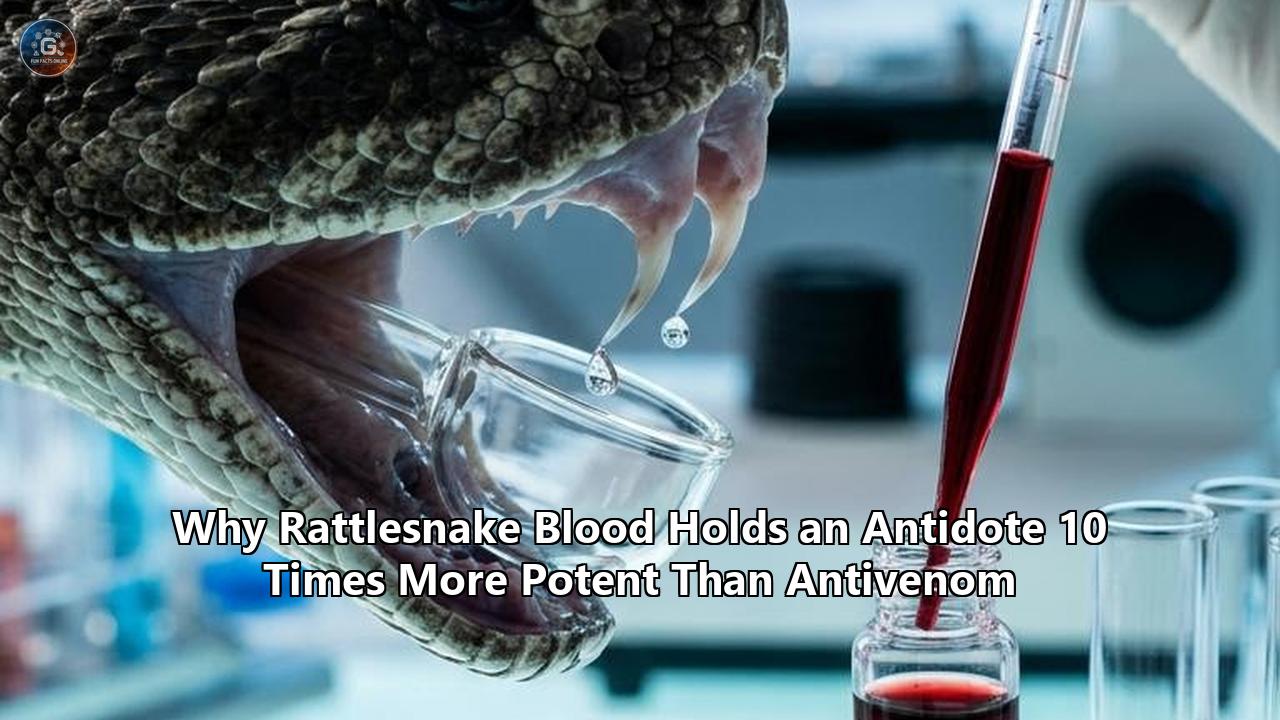
Inside a high-containment laboratory at the University of Maryland, researchers have cracked a physiological mystery that puzzled naturalists for more than a century: why venomous pit vipers do not succumb when struck by their own species. In a study published in the Proceedings of the National Academy of Sciences, an evolutionary biology team led by Sean B. Carroll, in collaboration with the National Natural Toxins Research Center at Texas A&M University–Kingsville, revealed that the Western diamondback rattlesnake (Crotalus atrox) carries a suite of defensive proteins in its bloodstream capable of neutralizing venom lethality.
The findings go beyond basic reptilian biology. When isolated and combined in precise ratios, these endogenous serum proteins neutralize viper venom with roughly ten times the potency by weight of the standard commercial antivenom stocked in emergency rooms.
"This is one of those great stories when nature has already solved a problem we've been grappling with for decades," said Carroll, a distinguished university professor of biology at Maryland. "We've known from anecdotes for 100 years that vipers tend to be resistant to their own venom. But for a long time, nobody knew what exactly was circulating in their blood that protected them".
The discovery offers a fresh path forward for treating one of the world's most destructive, underfunded health emergencies. Conventional treatments rely on an antibody extraction technique developed in the 1890s—a method that requires injecting horses or sheep with sublethal venom doses, harvesting their plasma, and purifying animal antibodies. The resulting drugs are expensive, prone to triggering acute allergic shock, and often require upwards of twenty vials to stabilize a single patient.
By deciphering how rattlesnake blood disables venom at the molecular level, Carroll’s team has assembled a blueprint for an entirely synthetic, recombinant therapy. The work traces an evolutionary arms race spanning 50 million years, exposes why earlier single-molecule cures failed in animal models, and outlines how snakes engineer an antidote far more refined than anything human pharmaceutical manufacturing has managed to date.
Standard Antivenom vs. Rattlesnake Serum Inhibitors
─────────────────────────────────────────────────────────────────────────────
Feature                Equine/Ovine Antivenom       Rattlesnake FETUA Cocktail
─────────────────────────────────────────────────────────────────────────────
Origin                 Horse/Sheep blood serum      Western diamondback serum
Target Specificity     Low (~10-20% active anti-    High (evolved direct zinc-
                       bodies to critical toxins)   cleft catalytic blockers)
Relative Potency       Baseline (1x)                ~10x higher by protein weight
Production Method      Live animal farming,         Recombinant cell expression
                       repetitive venom milking     (bioreactor-scalable)
Adverse Effect Risk    Serum sickness, anaphylaxis  Low (free of foreign mammal
                       from foreign animal serum    immunoglobulins)
Mechanism of Action    Polyclonal antibody-antigen  Non-antibody competitive
                       aggregation                  enzyme active-site arrest
─────────────────────────────────────────────────────────────────────────────
The Biological Paradox in the Desert Brush
To understand why the discovery matters, one must first look at what happens when a Western diamondback rattlesnake strikes.
Crotalus atrox venom is not a single chemical; it is a predatory cocktail containing up to a hundred different proteins, enzymes, and toxic peptides. The most destructive among them are snake venom metalloproteinases, known to toxicologists as SVMPs. These enzymes act like biological demolition crews. When injected into mammalian tissue, they chew through collagen, degrade vascular basement membranes, and dismantle capillary walls. Within minutes, red blood cells spill unchecked into surrounding muscle beds, blood pressure plummets, and systemic internal bleeding cascades into lethal hypovolemic shock.For a human hiker bitten in the scrublands of Arizona or northern Mexico, surviving an envenomation requires immediate medical transport, intensive fluid resuscitation, and rapid administration of antivenom to arrest the tissue dissolution.
Yet field herpetologists have routinely witnessed male Western diamondbacks violently wrestling over territory during the spring mating season, repeatedly striking one another in the neck, torso, and flanks. In snake handling centers, accidental self-envenomations occur when a serpent misdirects a strike during feeding. The animals rarely display local tissue death, and they almost never die from the bites.
For decades, venom researchers debated the mechanics of this shield. Did the snakes possess altered tissue receptors that toxins could not bind to? Did their muscular walls physically wall off injected toxins? Or did their circulatory systems carry an unmapped neutralizer?
Early 20th-century experiments confirmed that injecting raw rattlesnake serum into mice gave them modest protection against viper venom. But raw serum is messy, containing hundreds of distinct blood components, albumin, and clotting factors. Every attempt to isolate a single active "magic bullet" ran into dead ends or yielded inconsistent laboratory results.
The question remained unresolved: What specific molecular weapon allows a pit viper to survive its own hemorrhagic venom?
The Flaws of the 1890s Playbook
While the rattlesnake’s natural defense stayed hidden, medicine remained dependent on a manufacturing process that has changed remarkably little since French physician Albert Calmette first treated envenomated patients in colonial Indochina.
Today, drugs like CroFab (derived from sheep) and ANAVIP (derived from horses) are manufactured through an industrial animal-husbandry pipeline. Technicians handle live, venomous vipers to milk drops of liquid venom from their fangs into glass beakers. The venom is freeze-dried, blended, and injected in minute, escalating doses into livestock. Over several months, the animal's immune system mounts a response, producing polyclonal antibodies against the injected foreign proteins. Technicians then bleed the animals, separate the plasma, and deploy digestive enzymes like papain or pepsin to cleave off the "Fc" tail of the mammalian antibodies—leaving behind Fab or F(ab')2 fragments designed to bind snake venom proteins without prompting immediate rejection in humans.
The system saves lives, but it is deeply inefficient.
Only 10% to 20% of the antibodies in a commercial vial of antivenom typically bind to the actual lethal toxins in snake venom. The remaining 80% to 90% recognize harmless proteins, dead cellular debris, or background pathogens the host animal encountered out in the pasture. Because the concentration of therapeutic antibodies is so low, clinicians must flood the patient’s veins with massive quantities of foreign protein.
"You are essentially giving the patient a huge dose of horse or sheep protein just to deliver a tiny sliver of active antidote," says Dr. Elda Sánchez, a co-author of the study and director of the National Natural Toxins Research Center at Texas A&M University–Kingsville.
This high protein burden carries substantial clinical risk:
- Immediate hypersensitivity (anaphylaxis): Acute, life-threatening allergic reactions can occur within minutes of infusion, causing airway constriction and cardiovascular collapse.
- Delayed serum sickness: Days or weeks after hospital discharge, the human immune system recognizes foreign sheep or horse fragments, sparking fever, debilitating joint pain, rash, and kidney inflammation.
- Extreme financial expense: Because manufacturing requires dedicated ranches, specialized serpentariums, and cleanroom purification, commercial antivenom runs thousands of dollars per vial. In the United States, an envenomation treatment course routinely costs between $50,000 and $120,000.
- Cold-chain vulnerability: Animal-derived antivenoms require consistent refrigeration, making them notoriously difficult to store in remote agricultural clinics across sub-Saharan Africa, South Asia, and Latin America, where most snakebites occur.
The urgent search for a shelf-stable, highly concentrated alternative led Carroll’s team away from mammalian antibody farming and straight into the bloodstream of the reptile itself.
The False Dawn of FETUA-3
The investigative trail accelerated in 2022, when Carroll’s laboratory at the University of Maryland pulled a key thread from the Western diamondback’s genetic code.
By screening snake blood for molecules that could latch onto venom enzymes, the researchers identified a specific glycoprotein they named FETUA-3. The protein is an evolutionary relative of fetuin-A, an ancient glycoprotein found across vertebrates, including humans, where it typically regulates calcium metabolism and bone mineralization. In pit vipers, however, gene duplication events over tens of millions of years had altered the fetuin gene family, reshaping its copies into specialized toxin interceptors.
Initial bench tests with FETUA-3 looked remarkable. The single protein bound tightly to roughly twenty distinct snake venom metalloproteinases. In test tubes, it shut down the enzymatic degradation of collagen, the primary building block of human blood vessels.
Believing they had found the lone antidote, the team moved into preclinical animal models. They injected mice with lethal quantities of Western diamondback venom mixed with isolated FETUA-3.
The result was an unexpected failure.
The treated mice showed no localized bruising or skin necrosis around the injection site—confirming that the local tissue destruction was suppressed. But hours later, the animals died anyway. Autopsies revealed that internal bleeding, vascular collapse, and systemic organ failure were still occurring unchecked.
"That was a sobering moment in the lab," Carroll recalled. "We had a molecule that was demonstrably neutralizing metalloproteinase activity in the test tube, yet when put to the ultimate test in a living organism, the animals were still dying. It showed us that stopping venom lethality is far more complex than just turning off one class of enzyme. We were missing something critical".
The team was forced to step back and re-examine the crime scene: If FETUA-3 stopped the tissue necrosis but failed to halt death, how were wild rattlesnakes surviving the full, lethal spectrum of their own venom?
The Breakthrough: Cracking the Synergistic Shield
The investigative shift occurred when the researchers stopped looking for a solitary antidote and started mapping the entire genetic family of FETUA proteins.
Western diamondbacks do not produce just one fetuin variant; they express a cluster of five distinct FETUA genes in their liver, which steadily secrete protective proteins into their blood circulation. Carroll’s team mapped and synthesized four of these related molecules: FETUA-1, FETUA-2, FETUA-3, and FETUA-4.
The researchers isolated each protein and tested them individually against Crotalus atrox venom. The results revealed a deeply specialized division of labor:
- FETUA-1: Showed minimal interaction with venom toxins, functioning largely like ancestral mammalian fetuin-A.
- FETUA-2: Blocked specific, smaller metalloproteinases but struggled to halt broad hemorrhagic enzymes.
- FETUA-3: Strongly bound the larger, highly destructive P-III class metalloproteinases, suppressing tissue damage, but left smaller catalytic toxins unhindered.
- FETUA-4: Displayed moderate, targeted affinity for intermediate toxin classes.
Used in isolation, every single protein failed to prevent death. Venom metalloproteinases come in varied molecular shapes and functional sizes, classified by structural biochemists into P-I, P-II, and P-III classes. FETUA-3 was shutting down the heavy P-III enzymes that break down muscle beds, but the P-I enzymes were slipping past the barricade, attacking systemic clotting factors and inducing fatal internal bleeding.
The breakthrough came when the team began testing synergistic combinations.
Molecular Targets of Rattlesnake Serum FETUA Proteins
┌────────────────────────────────────────────────────────────────────────┐
│ Rattlesnake Blood Stream                                              │
│                                                                        │
│  [ FETUA-2 ]  ──────────► Targets P-I SVMP Toxins                     │
│                           (Arrests systemic coagulopathy & microvessel │
│                            perforation)                                │
│                                                                        │
│  [ FETUA-3 ]  ──────────► Targets P-III SVMP Toxins                   │
│                           (Arrests local tissue necrosis, large vessel │
│                            destruction & hemorrhage)                   │
│                                                                        │
│  [ FETUA-4 ]  ──────────► Broad-spectrum auxiliary binding            │
│                           (Seals catalytic clefts of intermediate      │
│                            enzymes)                                    │
│                                                                        │
│  RESULT: Complete enzymatic blockade across all SVMP classes          │
└────────────────────────────────────────────────────────────────────────┘
When the researchers blended FETUA-3 and FETUA-2 into a targeted cocktail, the survival curve transformed completely. Mice challenged with three times the standard lethal dose of Western diamondback venom experienced 100% survival. There were no signs of internal bleeding, no loss of vascular pressure, and zero tissue necrosis.
When they ran the comparative numbers against conventional medical treatments, the data was stark. The optimized cocktail neutralized venom lethality with approximately ten times greater potency per milligram of protein than commercial, sheep-derived CroFab.
Where an animal model required 100 micrograms of commercial antivenom to survive, just 10 micrograms of the natural protein cocktail accomplished the same therapeutic outcome.
The mechanics of this tenfold potency advantage boil down to molecular geometry. A standard sheep antibody is a clumsy, bulky tool. It binds via surface loops that recognize exterior ripples on a toxin’s surface, hoping to cluster enough antibodies around the toxin to precipitate it out of solution.
The rattlesnake’s serum proteins work differently. Over tens of millions of years of direct evolutionary pressure, FETUAs have been sculpted into molecular plugs that fit cleanly into the catalytic zinc-binding clefts of metalloproteinase enzymes. When a FETUA molecule engages an SVMP toxin, it inserts an inhibitory domain directly into the active catalytic site, turning off the enzyme’s destructive machinery like a key deadbolting a lock. Because every single molecule in the cocktail is targeted to an active site, there is no wasted mass, no irrelevant antibodies, and no therapeutic filler.
This precise biochemical strategy forms the core foundation of what clinicians are calling the next generation of rattlesnake blood antivenom design.
The 50-Million-Year Evolutionary Gauntlet
Once the team proved the cocktail worked against Western diamondback venom, they confronted a second major question: Was this defense mechanism an isolated quirk of Crotalus atrox, or had evolution forged a broader biological shield?
Venom changes rapidly across snake populations. A therapy designed strictly for a Western diamondback in Texas is often useless against an Eastern diamondback in Florida, let alone a pit viper in Costa Rica or a true viper in Asia. If this natural defense was hyper-specific to the Western diamondback, its clinical value would be limited to a small corner of North America.
To test the boundaries of the defense, Carroll and Sánchez subjected the rattlesnake proteins to a cross-species trial, exposing them to venoms from snakes separated by deep evolutionary time.
First, they challenged the cocktail with venom from the Eastern diamondback rattlesnake (Crotalus adamanteus). While closely related, the two species diverged millions of years ago and wield distinct toxin profiles. The Western diamondback proteins neutralized the Eastern diamondback venom, though it required altering the ratio of FETUA-2 to FETUA-3 to account for differences in enzyme concentrations.
Next, they broadened the challenge to true vipers and pit vipers found on the other side of the planet.
They tested the cocktail against the venom of the jararaca (Bothrops jararaca), the notorious South American pit viper responsible for thousands of severe bites across Brazil, as well as several Asian viper species. Astonishingly, the rattlesnake serum proteins shut down the metalloproteinases and prevented death across multiple species that parted ways from a common ancestor up to 50 million years ago.
"The fact that parts of these inhibitors have been conserved over 50 million years of snake evolution tells you just how real a risk this is for these animals," Carroll noted during the release of the study. "Evolution hit on an extraordinarily effective defense early on, and preserved the key motifs because the snakes couldn't afford to lose them".
Yet the investigative trail also documented where the shield broke down.
When the researchers tested the protein cocktail against the African puff adder (Bitis arietans)—a heavy-bodied, Old World viper responsible for widespread fatalities across sub-Saharan Africa—the rattlesnake proteins failed to neutralize the venom.
A closer biochemical analysis explained why: Puff adder venom does not rely primarily on the specific SVMP subclasses that North American pit vipers use. Instead, Bitis arietans relies heavily on a lethal mix of snake venom serine proteases, cytotoxic non-enzymatic proteins, and divergent metalloproteinases with catalytic clefts shaped differently than those of rattlesnakes. The North American rattlesnake blood antivenom molecules could not seat themselves inside the puff adder’s enzymes, and the protective effect vanished.
This boundary line delivered an essential insight. Nature’s antidote is not a single, universal panacea. Rather, it is a modular, evolutionary template. The Western diamondback carries the code to neutralize its ancestral lineage; other snakes across the globe, including African and Asian vipers, likely harbor their own corresponding serum inhibitors tailored to their regional venom architectures.
Dismantling an Overlooked Global Crisis
The medical necessity for an alternative to animal-derived serum is acute. In 2017, the World Health Organization officially designated snakebite envenomation as a Priority Category A Neglected Tropical Disease.
Every year, between 1.8 and 2.7 million people are envenomated. An estimated 80,000 to 140,000 die, while another 400,000 suffer permanent physical disabilities, including amputations, chronic kidney failure, and extensive tissue disfigurement. The vast majority of victims are subsistence agricultural workers, herders, and children living in impoverished rural communities across the global south.
Global Burden of Snakebite Envenomation (Annual Estimates)
─────────────────────────────────────────────────────────────────────────────
Clinical Outcome       Estimated Numbers          Most Affected Populations
─────────────────────────────────────────────────────────────────────────────
Total Envenomations    1,800,000 – 2,700,000      Agricultural workers, rural
Fatalities             80,000 – 140,000           South Asia, Sub-Saharan
Permanent Disabilities 400,000+                   Africa, Latin America
─────────────────────────────────────────────────────────────────────────────
In places like rural India, Nigeria, or Papua New Guinea, conventional antivenom systems fail at almost every stage of logistics:
- The Cost Barrier: A standard course of equine antivenom can exceed the annual income of an entire farming household, driving families into debt.
- The Cold-Chain Failure: Because horse-derived immunoglobulins denature rapidly in tropical heat, broken refrigeration chains during transport routinely render entire shipments biologically inert before they reach village clinics.
- Lack of Intensive Care Infrastructure: In small rural health posts without mechanical ventilators or emergency epinephrine, clinicians are often afraid to administer high-protein animal antivenom because treating the inevitable anaphylaxis is impossible without advanced life support.
This is where the rattlesnake blood antivenom model could alter the economics of tropical medicine.
Unlike whole animal antibodies, which must be extracted from living herds, the genes encoding rattlesnake FETUA proteins can be inserted into recombinant expression systems. Biomanufacturing facilities can grow the proteins inside industrial bioreactors using engineered yeast or Chinese hamster ovary (CHO) cell lines—the same scalable, sterile fermentation systems used to manufacture insulin and therapeutic monoclonal antibodies.
"We could make train cars-worth of this stuff," Carroll pointed out.
A recombinant, fermentation-based antivenom provides key structural advantages:
- Purity and consistency: Eliminates batch-to-batch variation caused by differences in how individual horses or sheep respond to venom injections.
- Elimination of animal farming: Removes the need to maintain hundreds of captive, venom-milked snakes and large herds of donor livestock.
- Hypoallergenic safety profile: Highly purified, targeted enzyme inhibitors reduce foreign protein mass by roughly 90%, sharply lowering the risk of anaphylaxis and serum sickness.
- Thermal stability: Engineered humanized or truncated variants can be optimized for room-temperature or freeze-dried field stability, removing the cold-chain barrier.
The Hurdles: What It Takes to Reach an Emergency Room
Despite the promise of the Maryland and Texas A&M-Kingsville findings, translational pharmacologists caution that several major technical barriers stand between successful mouse trials and a vial on an ambulance shelf.
The Pharmacokinetic Half-Life Dilemma
In a healthy rattlesnake, FETUA proteins circulate continuously, providing a baseline immune shield that immediately absorbs venom toxins the instant a bite occurs.
In a human snakebite victim, however, the dynamic is reversed. The venom is already spreading through the lymphatic system and bloodstream before the patient ever reaches a hospital. Therapeutic proteins injected into human veins must survive long enough to hunt down and clear toxins without being degraded by human hepatic enzymes or filtered out through the kidneys.
Furthermore, because native snake proteins are still foreign to human biology, repeated injections of wild-type FETUAs could eventually prompt an anti-drug antibody (ADA) immune reaction. To overcome this, researchers will likely need to "humanize" the FETUA scaffold—retaining the precise snake-derived amino acids that plug the toxic catalytic zinc clefts while swapping out the surrounding framework for human fetuin-A sequences to trick the human immune system into recognizing the drug as self.
The True Rescue Test
In the initial PNAS study, researchers largely proved efficacy using co-incubation and immediate-challenge protocols—mixing venom with the protein inhibitors shortly before or concurrently with administration to test biochemical neutralization.
The critical next investigative step involves true rescue experiments: injecting laboratory animals with lethal venom, waiting 30, 60, or 120 minutes until systemic hemorrhage begins, and then administering the inhibitor cocktail to see if it can reverse established damage.
"Treating a patient two hours after a bite is an entirely different pharmacological challenge than neutralizing venom in a syringe," explains Dr. Bryan Fry, a venom biochemist at the University of Queensland who was not involved in the original study. "Metalloproteinases act fast. They rip up capillary walls immediately. Halting the enzyme stops further destruction, but you also have to give the patient’s vascular system time to recover before they bleed out internally."
The Three-Front War
Finally, metalloproteinases represent only one of the three major lethal toxin families found across the snake kingdom.
Viper venoms rely on a lethal triangle:
- Snake Venom Metalloproteinases (SVMPs): Hemorrhage, tissue degradation, and vascular collapse.
- Phospholipase A2 (PLA2) neurotoxins and myotoxins: Muscle necrosis and respiratory paralysis.
- Snake Venom Serine Proteases (SVSPs): Severe consumption coagulopathy and defibrinogenation.
The FETUA cocktail thoroughly neutralizes SVMPs, but it leaves PLA2 and serine protease toxins untouched. To build a universal, recombinant viper treatment, researchers cannot rely on FETUA alone. They must map the corresponding endogenous inhibitors that snakes use to neutralize their own PLA2 and serine protease toxins, assembling a multi-target cocktail capable of disabling all three prongs simultaneously.
Carroll’s laboratory has already begun expanding its search. "We're getting remarkably close to having effective solutions for the three major toxin families in vipers," Carroll stated. "The ingredients are there in the snakes. We just have to keep testing various mixtures".
The Roadmap to Clinical Deployment
┌────────────────────────────────────────────────────────────────────────┐
│ Phase 1: Target Discovery (Completed)                                  │
│ Identification of FETUA family in Western diamondback rattlesnakes     │
│ Proof of synergistic SVMP neutralization (PNAS, 2026)                  │
└───────────────────────────────────┬────────────────────────────────────┘
                                    ▼
┌────────────────────────────────────────────────────────────────────────┐
│ Phase 2: In Vivo Rescue Validation (Current Stage)                     │
│ Post-envenomation rescue trials (30-120 min post-strike in mice)       │
│ Pharmacokinetic half-life and biodistribution profiling                │
└───────────────────────────────────┬────────────────────────────────────┘
                                    ▼
┌────────────────────────────────────────────────────────────────────────┐
│ Phase 3: Protein Humanization & Multi-Toxin Cocktailing                │
│ Engineering chimeric human-snake FETUA scaffolds                       │
│ Co-formulation with PLA2 and serine protease inhibitors                │
└───────────────────────────────────┬────────────────────────────────────┘
                                    ▼
┌────────────────────────────────────────────────────────────────────────┐
│ Phase 4: Veterinary Clinical Trials                                    │
│ Field-testing recombinant formulations in canine pit viper             │
│ envenomations across Texas and the American Southwest                  │
└───────────────────────────────────┬────────────────────────────────────┘
                                    ▼
┌────────────────────────────────────────────────────────────────────────┐
│ Phase 5: Human Clinical Trials & Global Deployment                     │
│ Phase I-III safety, efficacy, and regulatory authorization             │
│ Scaled production via industrial bioreactors for global distribution   │
└────────────────────────────────────────────────────────────────────────┘
What Happens Next: The Canine Bridge and Human Trials
The first real-world proving ground for rattlesnake blood antivenom will not be a human trauma center, but a veterinary clinic.
In states like Texas, Arizona, and California, tens of thousands of domestic dogs are struck by Western diamondbacks every year. Veterinary antivenom is often scarce and financially out of reach for pet owners, with costs running $800 to $1,500 per vial.
Because canine physiology responds to viper metalloproteinases in a manner nearly identical to humans—displaying severe local edema, rapid consumptive coagulopathy, and hypovolemic shock—veterinary medicine provides an ideal intermediate proving ground. Carroll’s research consortium is currently laying the groundwork for veterinary trials in the American Southwest. Successful trials in domestic dogs would validate the safety and rescue efficacy of the recombinant cocktail in large, living mammals, clearing a path for human Phase I safety trials.
At the same time, structural biologists are feeding the crystal structures of FETUA-2 and FETUA-3 into machine-learning platforms to see if the active binding loops can be engineered into ultra-stable, miniature peptide mimetics. If successful, researchers could synthesize small-molecule or peptide-based inhibitors that require no cold chain whatsoever, maintaining chemical stability in ambient desert temperatures up to 120°F (49°C).
For over a century, medicine treated snake venom as a problem that could only be answered by turning to horses and sheep. The latest evidence confirms that human science was looking in the wrong barn.
The Western diamondback rattlesnake, co-evolving alongside its own toxic payload across millions of years, had already engineered the molecular antidote. By abandoning foreign mammalian antibodies and following the snake's evolutionary blueprint, medicine is finally on the verge of turning nature’s deadliest weapon against itself.
Reference:
- https://connectsci.au/news/news-parent/9847/Antivenom-from-rattlesnakes-is-10x-stronger-than
- https://scitechdaily.com/new-antivenom-strategy-is-10-times-more-potent-than-a-current-treatment/
- https://www.thecooldown.com/green-tech/rattlesnake-antivenom-research-maryland-proteins/
- https://pubmed.ncbi.nlm.nih.gov/42525530/
- https://www.eurasiareview.com/29072026-scientists-discover-an-antidote-to-lethal-snake-bites-that-comes-straight-from-the-source/
- https://studyfinds.com/rattlesnake-blood-hold-key-antivenom/
- https://www.sciencedaily.com/releases/2026/09/260907201605.htm
- https://pmc.ncbi.nlm.nih.gov/articles/PMC9907073/
- https://www.pnas.org/doi/10.1073/pnas.2612168123
- https://poisoncontrol.utah.edu/news/2024/04/antivenom-rattlesnake-envenomation
- https://www.facebook.com/physorg/posts/in-lab-tests-combined-rattlesnake-blood-proteins-were-about-10-times-more-potent/1525976356224414/
- https://fenado.ai/articles/university-of-maryland-researchers-develop-antivenom-using-proteins-from-snake-blood-10-times-more-potent