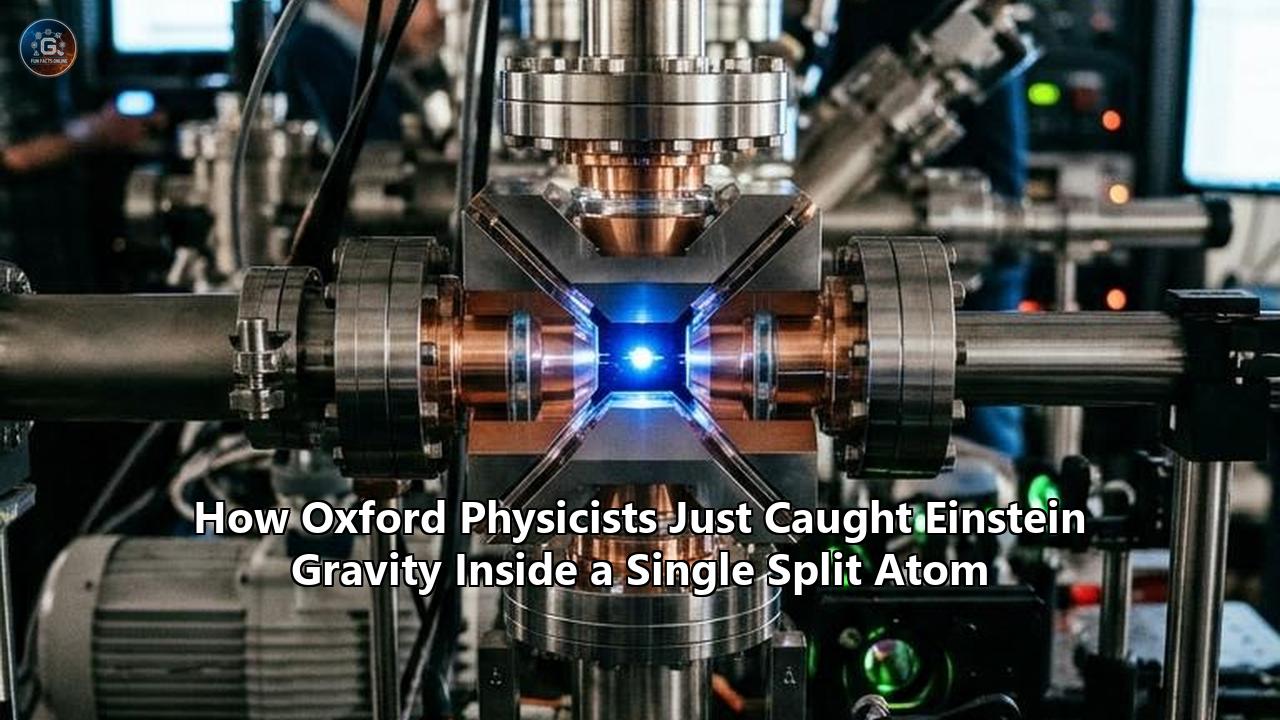
On September 2, 2026, an international research team led by the University of Oxford, Ben-Gurion University of the Negev, and the University of Ulm published a landmark study in Science Advances resolving an experimental standoff that has puzzled quantum theorists for decades. Operating an inverted microchip apparatus known as the Quantum Galileo Interferometer (QGI), the researchers successfully split single rubidium-87 atoms into quantum superpositions where one half of each atom fell under Earth’s gravitational field while the other half was magnetically levitated in place.
When the two halves of the atomic matter wave were reunited after dropping for fractions of a millisecond, the team detected a phase shift that matched the exact mathematical formulation derived from general relativity.
The paper, titled "Observation of the quantum phase of free fall and the consistency with the equivalence principle," bears an author list that reads like a registry of physics icons. It unites Nobel laureate Sir Roger Penrose and quantum information pioneer Vlatko Vedral from Oxford’s Department of Physics, theoretical physicist Wolfgang P. Schleich from Ulm, and lead experimentalist Ron Folman alongside doctoral researcher Or Dobkowski at Ben-Gurion University.
The technical achievement provides the first direct laboratory confirmation that Einstein’s Equivalence Principle—the geometric premise that local free fall eliminates the physical manifestations of gravity—governs the internal phase of a quantum wavefunction traversing two distinct paths of motion simultaneously.
Popular coverage quickly heralded the experiment as the unification of quantum mechanics and general relativity. That characterization misses the entire point of what happened in the Negev basement.
The researchers did not build a theory of quantum gravity, nor did they prove that the gravitational field itself is quantized. What they achieved is something far more technically exacting: they established an unambiguous experimental benchmark proving that standard quantum mechanics does not fail when forced to interact with Einsteinian spacetime curvature at the single-particle scale. Behind the public celebration lies a long-standing intellectual battle over the survival of quantum mechanics, a 30-year theoretical controversy over whether atom interferometers can measure gravitational effects, and a painstaking race against electromagnetic noise.
                [ Inverted Atom Chip Surface ]
             (Au micro-wires carry DC currents)
                            │
       113 µm clearance     ▼
    ─────────────────────────────────────────────
          ● Bose-Einstein Condensate (~20,000 87Rb atoms)
                            │
              Microwave π/2 pulse applied
                            │
             ┌──────────────┴──────────────┐
             │                             │
             ▼                             ▼
    Levitated Reference Arm        Ballistic Free-Fall Arm
    |F=2, m_F=1>                  |F=1, m_F=0>
    Magnetic upward force cancels g  Unaffected by magnetic field
    Held motionless in Lab Frame   Free fall along geodesic
    (Non-inertial terrestrial)    (Locally inertial Einsteinian)
             │                             │
             │       t ≤ 2.4 ms drop       │
             └──────────────┬──────────────┘
                            │
               Recombination π/2 pulse
                            ▼
              [ Spatial Interference Pattern ]
         Phase shift Δφ ∝ (m · g² · t³) / ħ
Probing Einstein Gravity in Atoms at the Single-Particle Frontier
For over a century, general relativity and quantum mechanics have operated as parallel empires. General relativity describes spacetime as a smooth, dynamic, four-dimensional pseudo-Riemannian manifold whose curvature is dictated by energy and momentum. Quantum mechanics describes nature as discrete, probabilistic, and structured by linear superpositions of wavefunctions across Hilbert spaces.
Because both frameworks function flawlessly within their respective regimes—cosmic scale for relativity, subatomic scale for quantum mechanics—identifying empirical tests where their fundamental principles overlap has proven notoriously difficult.
The central point of intersection is Einstein’s Equivalence Principle (EEP). Formulated in 1907 as what Albert Einstein called the "happiest thought" of his life, the principle asserts that the local physical effects of a uniform gravitational field are completely indistinguishable from the effects of uniform acceleration. A person locked inside a windowless elevator in deep space accelerating at 9.8 meters per second squared experiences the identical physics of a person standing at rest in a laboratory on Earth's surface. Conversely, an observer in free fall—dropping freely under gravity—feels no gravitational force locally; their reference frame is strictly inertial.
Evaluating the subtle signatures of Einstein gravity in atoms requires isolating how this principle behaves when the object in free fall is no longer a classical ball of mass, but a coherent matter wave split into multiple paths.
"The principle says that acceleration and gravity cannot be distinguished locally," Vedral explained shortly after the publication. "Two different accelerations can be superposed, zero acceleration and the Earth's gravitational acceleration, and the resulting quantum interference measured".
Prior to this experiment, physicists had measured atomic free fall in tall atomic fountains, such as Stanford University’s 10-meter vacuum tower, and tested the weak equivalence principle by comparing the fall rates of different atomic species, like rubidium-85 versus rubidium-87. Yet those historic tests interrogated systems where both quantum paths were in ballistic flight. They did not isolate the specific quantum phase accumulated exclusively by the act of free fall against a static terrestrial observer.
The Oxford-led team achieved that isolation by splitting the atom's reality: forcing one half of a wave packet to feel the full physical pull of Earth's gravity in genuine free fall, while forcing the other half to remain locked in the non-inertial terrestrial frame of the laboratory.
Inside the Negev Basement: The Mechanics of the Atom Chip
The actual hardware that made the measurement possible does not resemble the gargantuan vacuum towers of large-scale laser interferometers. It is housed inside an ultra-high vacuum chamber at Ben-Gurion University in the Negev desert, relying on a silicon-based microdevice known as an atom chip.
The experiment begins by cooling a gas of rubidium-87 ($^{87}\text{Rb}$) atoms. Rubidium is an alkali metal chosen because its electronic structure allows efficient laser cooling via closed optical transitions on the $D_2$ line (780 nanometers). Using a two-dimensional magneto-optical trap (2D MOT), atoms are captured from a thermal vapor and pushed through a differential pumping aperture into the primary science chamber. There, a 3D MOT collects the cloud, followed by optical molasses and compressed-trap stages that shed atomic momentum.
+-------------------------------------------------------------------------+
|                  THE ATOM CHIP GEOMETRY & FIELD TRAPPING                 |
|                                                                         |
|  [Substrate: Etched Silicon with Gold Traces]                           |
|       Wire 1 (I_1)        Wire 2 (I_2)        Wire 3 (I_3)             |
|          ───────             ───────             ───────                |
|             ▲                   │                   ▲                   |
|             │                   ▼                   │                   |
|                                                                         |
|                       Magnetic Trap Quadrupole Center                   |
|                                     x                                   |
|                         113 µm below chip surface                       |
|                                                                         |
|  Gravitational Pull (g)                                                 |
|  ═════════════════════> ↓                                              |
|                                                                         |
|  Magnetic Force on |1>: F_mag = ∇(μ · B) ═════════════════════> ↑       |
|  Net Force on |1>:      F_net = F_mag - m_Rb·g = 0 (Static Arm)         |
|  Net Force on |2>:      F_net = 0 - m_Rb·g = -m_Rb·g (Free-Fall Arm)    |
+-------------------------------------------------------------------------+
Next, the atoms are loaded onto the atom chip. The chip is mounted completely upside down inside the vacuum cell. On its surface are micro-fabricated gold conductors with widths measured in microns, capable of carrying direct currents on the order of several amperes. These currents create strong magnetic fields with steep spatial gradients ($\partial B / \partial z$) localized within a fraction of a millimeter beneath the surface.
The cloud of roughly 20,000 atoms is held suspended just 113 micrometers beneath the chip's surface. The researchers then drive forced radio-frequency evaporative cooling, stripping away the highest-energy atoms until the remaining ensemble dips to an ultracold temperature of approximately 3 nanokelvin.
At 3 nanokelvin, the atoms cross the critical phase transition into a Bose-Einstein Condensate (BEC). The individual atomic wave packets expand, coalesce, and drop into the ground quantum state of the magnetic trap, behaving as a single macroscopic quantum wave.
The team intentionally diluted the sample density. In a dense BEC, non-linear atom-atom scattering interactions (described by the Gross-Pitaevskii equation via the s-wave scattering length $a_s$) create internal mean-field energy shifts that produce unwanted systematic phase noise. By keeping the cloud dilute, every rubidium atom within the ensemble experiences identical single-particle dynamics.
Splitting an Atom Without Destroying It
The central challenge of the Quantum Galileo Interferometer is forcing one half of the atomic wavefunction to fall while preventing the other half from moving. In typical atom optics, spatial splitting is performed with lasers: a retro-reflected laser beam imparts two photon recoils ($2\hbar k$) to part of the atomic wave, physically kicking it away.
The Oxford-Ben-Gurion-Ulm collaboration discarded laser beam-splitters entirely. Optical beams carry spontaneous emission risks and wavefront distortions that wash out faint gravitational signatures. Instead, they designed an all-magnetic, chip-scale quantum beam splitter using internal atomic hyperfine Zeeman states.
    5S_1/2 Ground State Manifold of Rubidium-87

    F = 2 Level: ───────────────────────────────
                 m_F = +2
                 m_F = +1  <--- |1> (Levitated State, μ > 0)
                 m_F =  0
                 m_F = -1
                 m_F = -2

           ▲
           │ Microwave Pulse (~6.8 GHz)
           ▼

    F = 1 Level: ───────────────────────────────
                 m_F = -1
                 m_F =  0  <--- |2> (Free-Fall State, μ ≈ 0)
                 m_F = +1
The ground electronic state of $^{87}\text{Rb}$ ($5S_{1/2}$) possesses two hyperfine manifolds: $F = 1$ and $F = 2$, split by a clock frequency of approximately 6.834 gigahertz. Each manifold is further split into magnetic sub-levels ($m_F$) by the external magnetic field according to the Zeeman effect:
$$\Delta E = g_F \mu_B m_F B$$
Where:
- $g_F$ is the hyperfine Landé g-factor
- $\mu_B$ is the Bohr magneton
- $m_F$ is the magnetic quantum number
- $B$ is the local magnetic field strength
The experimental team targeted two specific states:
- The Reference State ($|1\rangle$): The $|F=2, m_F=1\rangle$ state, which possesses a positive magnetic dipole moment ($\mu > 0$). When placed within an inverted magnetic gradient, it feels a strong upward magnetic force:
$$\mathbf{F}_{\text{mag}} = \nabla(\boldsymbol{\mu} \cdot \mathbf{B})$$
The researchers calibrated the electric currents flowing through the chip’s gold micro-wires to make this upward magnetic force balance Earth’s gravitational force ($m_{\text{Rb}} g$) to exceptional precision. The net vertical acceleration on this component of the wave packet was zero. It remained stationary relative to the laboratory floor.
- The Ballistic State ($|2\rangle$): The $|F=1, m_F=0\rangle$ state. Because $m_F=0$, its first-order Zeeman shift is zero. It is virtually immune to the chip's magnetic field gradients. Deprived of upward magnetic support, this state experiences pure unencumbered gravity: it enters free fall along a gravitational geodesic.
To execute the experiment, the team fired a resonant microwave $\pi/2$ pulse into the vacuum cell. This pulse drove a coherent transition, setting each atom into an equal quantum superposition:
$$|\Psi(0)\rangle = \frac{1}{\sqrt{2}} (|1\rangle + |2\rangle)$$
Immediately after the pulse, an initial magnetic gradient kick threw the ballistic arm $|2\rangle$ slightly upward. Once freed from the magnetic kick, state $|2\rangle$ transitioned into its magnetically insensitive profile and traced a classical parabolic arc—rising briefly, halting, and plunging downward under Earth’s gravitational acceleration $g$.
Meanwhile, just 113 micrometers away, the reference arm $|1\rangle$ remained suspended in mid-air under the continuous levitating magnetic field.
Trajectory Over Time:
Height (z)
  ▲
  │       Ballistic Arm |2> (Parabolic Free Fall)
  │            _ - - _
  │          /         \
  │        /             \
  │       /               \
  ├──────●─────────────────●─────── Reference Arm |1> (Levitated, z = const)
  │      t=0              t=T (Recombination)
  └─────────────────────────────────► Time (t)
The free fall was allowed to proceed for times ranging from $0.2$ milliseconds up to $2.4$ milliseconds. At the end of the trajectory, the team applied an identical microwave $\pi/2$ pulse, closing the interferometer loop and recombining the two quantum paths.
The experiment was run 633 consecutive times over 5.3 hours of automated continuous measurement. As the free-fall duration was incremented, the population ratio between the two internal states cycled repeatedly. The researchers recorded 13 full, unblemished interference fringes, measuring the phase drift of the falling matter wave directly from the sinusoidal population shifts.
Resolving the 30-Year Gravitational Redshift Debate
To grasp why the physics community reacted so strongly to this data, one must step into a bitter debate that has fractured atom interferometry since 2010. That year, physicists Holger Müller, Achim Peters, and Steven Chu published a paper in Nature asserting that standard light-pulse atom interferometers provided a high-precision measurement of the gravitational redshift (the slowing of clock rates caused by gravitational potential).
Müller, Peters, and Chu argued that an atom can be viewed as an internal quantum clock oscillating at the Compton frequency:
$$\omega_C = \frac{m c^2}{\hbar}$$
For a rubidium atom, this frequency is vast: roughly $3 \times 10^{25}$ radians per second. They contended that when an atom is separated vertically by laser pulses into two paths at heights $z_1$ and $z_2$, the upper path experiences a slightly weaker gravitational field and thus ticks faster due to Einstein's gravitational time dilation.
The theoretical establishment pushed back aggressively. Renowned theorists—including Peter Wolf, Luc Blanchet, Serge Reynaud, and Clifford Will—countered that Chu and his colleagues had misread their own equations.
In a standard light-pulse interferometer (a Mach-Zehnder configuration), the atoms are in free fall along both paths. According to the classical action of a particle in a uniform gravitational field:
$$S = \int (T - V) \, dt = \int \left( \frac{1}{2}m\dot{z}^2 - mgz \right) dt$$
When both paths are calculated in free fall, the phase difference accumulated along the trajectories precisely cancels out. The entire observable phase shift measured in a standard Mach-Zehnder fountain ($\Delta \phi = k_{\text{eff}} g T^2$) actually arises from the local phase of the laser light fields at the points where the photons interact with the falling atoms, not from a direct accumulation of gravitational redshift along the atomic trajectories. The critics argued that standard atom interferometry was merely measuring the classical ballistic acceleration of the atom against the laser retro-reflection mirror, testing the Equivalence Principle via kinematics, but revealing nothing about the internal proper-time gauge phase of free fall.
+-------------------------------------------------------------------------+
|                  THE INTERFEROMETRIC PHASE MECHANISMS                   |
|                                                                         |
|  Standard Mach-Zehnder Fountain:                                        |
|  Path 1: Free Fall (Inertial) ───┐                                      |
|                                  ├──> Trajectory Action Phase: Δφ = 0   |
|  Path 2: Free Fall (Inertial) ───┘    Interference Phase from LASER ONLY|
|                                                                         |
|  Quantum Galileo Interferometer:                                        |
|  Path 1: Levitated (Non-Inertial)┐                                      |
|                                  ├──> Direct Trajectory Action:         |
|  Path 2: Free Fall (Inertial) ───┘    Δφ ∝ (m · g² · t³) / ħ            |
|                                       Direct Free-Fall Gauge Phase!     |
+-------------------------------------------------------------------------+
The Quantum Galileo Interferometer breaks this cancellation entirely.
Because the reference arm $|1\rangle$ is anchored in the non-inertial frame of the laboratory via continuous magnetic levitation, its Lagrangian is fundamentally different from the freely falling arm $|2\rangle$. The reference arm is subject to a continuous upward mechanical potential that holds its vertical position constant:
$$\dot{z} = 0, \quad z(t) = 0$$
The falling arm, by contrast, follows the free-fall equation of motion:
$$\ddot{z} = -g$$
When the quantum mechanical action difference $\Delta S = S_{\text{fall}} - S_{\text{lev}}$ is evaluated between these two branches, the cancellation vanishes. The phase difference $\Delta \phi = \Delta S / \hbar$ exhibits a non-trivial cubic dependence on the interrogation time $t$:
$$\Delta \phi(t) \propto \frac{m_{\text{Rb}} \, g^2 \, t^3}{\hbar}$$
This phase is the quantum dynamical translation of the Galilean boost between the laboratory frame and the freely falling Einsteinian inertial frame.
By successfully detecting this cubic scaling across 633 runs, the Oxford-led collaboration experimentally proved that measuring Einstein gravity in atoms can be achieved directly along the matter-wave trajectories without depending on laser pulse grids. The atomic wave packet in free fall genuinely accumulates the proper-time phase dictated by general relativity, settling the long-running argument through direct physical measurement.
The Clash of Oxford Giants: Penrose vs. Vedral
While the experimental hardware operated in Israel, the conceptual engine was fueled by an intense, unspoken intellectual clash within Oxford’s physics department.
Sir Roger Penrose, who won the 2020 Nobel Prize in Physics for his work on black hole singularity theorems, is not an orthodox quantum theorist. For more than four decades, Penrose has argued that modern physics is fundamentally incomplete because it treats quantum mechanics as universally valid at all scales.
Under standard quantum theory, there is no physical mechanism to explain why macroscopic objects stop behaving like superpositions. Standard theory invokes the "Copenhagen interpretation" or "many-worlds," which Penrose rejects. Instead, he formulated the Diósi-Penrose model of gravitational objective reduction (OR).
                        PENROSE OBJECTIVE REDUCTION (OR)
    Two Superposed Spacetime Geometries:

    Path A Geometry:    ( ~ ~ ~ ~ ~ ~ ~ )  Spacetime metric g_μν(A)
                                           Mismatch generates
                                           ill-defined Killing vectors:
                                           ΔE = Gravitational Self-Energy
    Path B Geometry:    ( _ _ _ _ _ _ _ )  Spacetime metric g_μν(B)

    Spacetime Decay Rate:  τ ≈ ħ / ΔE

    If Mass m is small (Rubidium atom):
        ΔE ≈ 10^-44 Joules  ===>  τ ≈ Millions of years  ===>  Superposition HOLDS
    If Mass m is mesoscopic (Nanodiamond, 10^11 Da):
        ΔE ≈ 10^-20 Joules  ===>  τ ≈ 1 to 10 milliseconds ===> Superposition COLLAPSES!
Penrose’s thesis is rooted in the mathematical structure of general relativity. If a massive object is placed into a spatial superposition of two locations, the mass distributions produce two conflicting, superposed gravitational fields—effectively two divergent spacetime metrics, $g_{\mu\nu}^{(A)}$ and $g_{\mu\nu}^{(B)}$. In general relativity, time is defined along trajectories governed by the metric's timelike Killing vector field.
When the metrics disagree, there is no shared timelike Killing vector. Penrose shows that this creates an irreducible mathematical ambiguity in the definition of the quantum time-evolution operator:
$$\hat{U}(t) = \exp\left(-\frac{i\hat{H}t}{\hbar}\right)$$
This metric divergence acts as a gravitational instability with an energy uncertainty $E_\Delta$ equal to the gravitational self-energy of the difference between the two mass distributions. According to the Heisenberg uncertainty principle, this state cannot remain stable; spacetime resolves its geometric conflict by spontaneously forcing the wavefunction to collapse into a single classical reality within a characteristic decay lifetime:
$$\tau \approx \frac{\hbar}{E_\Delta}$$
Co-author Vlatko Vedral, working just corridors away at Oxford, stands in the diametrically opposite theoretical camp. Vedral, alongside Oxford theorist Chiara Marletto (also a co-author on the paper), is a champion of linear quantum mechanics and a pioneer of Constructor Theory.
Vedral argues that quantum mechanics will never break down. Rather than allowing gravity to destroy quantum superpositions, Vedral, Marletto, and Sougato Bose independently proposed the famous BMV (Bose-Marletto-Vedral) effect: an experimental protocol to prove that gravity itself must possess quantum states.
Under the BMV paradigm, if two adjacent, electrically shielded quantum masses are placed into spatial superpositions and become entangled purely via their mutual gravitational attraction, the gravitational field mediating that interaction must mathematically be quantized. A classical entity cannot create quantum entanglement.
                      THE THEORETICAL SPLIT AT OXFORD

      ┌──────────────────────────────────────────────────────┐
      │  Does the Quantum-Gravity Boundary favor QM or GR?   │
      └──────────────────────────┬───────────────────────────┘
                                 │
                 ┌───────────────┴───────────────┐
                 ▼                               ▼
    [ Sir Roger Penrose ]               [ Vlatko Vedral & Chiara Marletto ]
    * Theory: Objective Reduction (OR)  * Theory: Quantum Information / BMV
    * Gravitation is FUNDAMENTAL.       * Quantum Mechanics is UNIVERSAL.
    * Spacetime curvature DESTROYS      * Spacetime MUST BE QUANTIZED.
      quantum superpositions.           * Gravity can mediate entanglement.
    * Goal: Find where QM collapses.    * Goal: Prove gravity is quantum.
Why did these theoretical rivals join forces on the same atom-chip paper? Because both camps desperately needed empirical verification that Einstein gravity in atoms conforms to physical laws before scaling up to the masses where their theories diverge.
For a single rubidium atom ($m \approx 1.44 \times 10^{-25}\text{ kg}$), the gravitational self-energy $E_\Delta$ is approximately $10^{-44}$ joules. The resulting Penrose collapse time $\tau$ stretches across millions of years. The rubidium atom is therefore deeply insulated from Penrose collapse, allowing standard quantum phase evolution to be tested without interference from spontaneous decay.
"We have no consistent theory telling us why quantum physics should fail," Vedral remarked. "This experiment pushes quantum mechanics into one of its most intriguing frontiers, gravity, and shows that, once again, its predictions hold".
Yet Penrose signed the study precisely because the Quantum Galileo Interferometer establishes the operational baseline for the next stage of the research. If an experiment cannot track the quantum phase of a free-falling single atom, it has zero chance of detecting the delicate boundary where Penrose predicts reality collapses into classical form.
The Hidden Enemies: The Metrology of Surviving Near a Chip
While the theoretical models are elegant, executing the measurement required conquering physical noise sources that typically demolish quantum coherence.
Operating atoms a mere 113 micrometers away from a room-temperature or cryogenically stabilized metallic chip creates immense physical vulnerability. The proximity between the atomic wavefunction and the physical chip surface forces experimentalists to confront three lethal noise sources that popular coverage ignored:
+-------------------------------------------------------------------------+
|                  NEAR-FIELD INTERFERENCE MECHANISMS                     |
|                                                                         |
|  1. Casimir-Polder Force:                                               |
|     V_CP(z) ∝ - C_4 / z^4                                               |
|     Quantum vacuum fluctuations of the EM field couple to atom          |
|     dipoles; pulls the atomic cloud uncontrollably into the gold trace. |
|                                                                         |
|  2. Johnson-Nyquist Magnetic Noise:                                     |
|     Thermal Brownian motion of conduction electrons inside gold         |
|     conductors creates random, fluctuating micro-magnetic fields.       |
|     Leads directly to spatial and Zeeman dephasing (Spin Flips).        |
|                                                                         |
|  3. Patch Potentials (Stray Adsorbate Charges):                         |
|     Rubidium atoms periodically deposit onto the chip surface,          |
|     creating localized dipolar electrostatic fields that disrupt the    |
|     clean gravitational trajectory.                                     |
+-------------------------------------------------------------------------+
1. The Casimir-Polder Attraction
At distances below a few hundred micrometers, quantum vacuum fluctuations of the electromagnetic field induce dipole moments in neutral atoms, creating an attractive potential between the rubidium atoms and the dielectric surface. This Casimir-Polder potential scales steep and negative:
$$V_{\text{CP}}(z) \propto -\frac{C_4}{z^4}$$
If the atoms drift slightly closer to the chip surface than the calculated 113 micrometers, the Casimir-Polder pull rapidly overwhelms both the magnetic holding force and Earth’s gravity, physically slamming the atoms into the gold surface. The team had to calibrate their magnetic traps to maintain sub-micron vertical stability, keeping the cloud pinned within a safe corridor where the gravitational potential dominates over the surface potential.
2. Johnson-Nyquist Magnetic Noise
Because the gold conductors carry significant electric currents to maintain the magnetic gradient, thermal fluctuations of the conduction electrons inside the metal generate randomly fluctuating electromagnetic fields—a phenomenon identical to Johnson-Nyquist noise in resistors. At a distance of 113 micrometers, this thermal magnetic field jitter punches directly into the atomic spin states.
For the magnetically sensitive $|F=2, m_F=1\rangle$ reference state, this noise shifts the Zeeman levels unpredictably. If unmitigated, it creates phase jitter across runs, washing out the delicate fringe contrast. To prevent this, the team engineered ultra-low-noise current drivers, driven by high-capacity battery arrays, to ensure that current fluctuations did not wash out the quantum phase during the interrogation window.
3. Stray Patch Potentials
Rubidium is highly reactive. Over thousands of experimental runs, rogue rubidium atoms inevitably adsorb onto the vacuum face of the chip, creating microscopic rubidium clusters that produce non-uniform electrostatic patch fields. These stray electric fields exert Stark shifts ($-\frac{1}{2}\alpha E^2$) that distort atomic trajectories.
The Ben-Gurion team implemented extensive surface cleaning protocols and background compensation fields to verify that the phase drift observed was clean and cubic—a signature of gravitational free fall—rather than a spurious spatial electrostatic gradient.
                     NOISE BUDGET VS. SIGNAL

  Magnitude
    ▲
    │
    │  [Unchecked Thermal/Magnetic Noise] ===> Total Coherence Loss
    │                                          (Interference Washed Out)
    │  -------------------------------------------------------------
    │  [Battery Arrays + Shielding]       ===> Noise suppressed by ~40 dB
    │
    │  [Gravitational Signal Δφ]          ===> Clear Cubic Phase Emerges!
    │                                          (13 Fringes over 5.3 Hours)
    └───────────────────────────────────────────────────────────► Time (ms)
The Strategic Dimension: Cold Atoms in the Geopolitical Landscape
The execution of this experiment carries profound geopolitical implications that stretch far beyond university lecture halls. Atom interferometry has emerged as one of the most heavily funded strategic research vectors in quantum metrology.
The ability to operate atom interferometers on chips transforms laboratory demonstrations into practical quantum inertial navigation systems (Q-INS). Modern military navigation relies on GPS satellites, which are acutely vulnerable to spoofing, jamming, and anti-satellite kinetic operations. A nuclear submarine cruising deep beneath the Arctic ice cap or an intercontinental ballistic missile flying through an electronic warfare environment cannot use GPS.
               MILITARY & CIVILIAN SENSOR APPLICATION

  [Traditional Navigation]            [Quantum Atom-Chip Navigation]
  GPS Satellite Link: Vulnerable      Self-Contained Cold-Atom Vacuum Cell
       ▲                                   ┌──────────────────────┐
       │ Jammed!                           │ Real-time Cold Atom  │
       ▼                                   │ Inertial Measurement │
  Submarine Blinded                        │ (Q-INS)              │
                                           └──────────────────────┘
                                           Zero External Emissions
                                           Immune to Jamming & Spoofing
Current navigation relies on ring laser and fiber-optic gyroscopes, which experience drift rates that accumulate errors over days, forcing submarines to surface periodically to recalibrate.
A functioning chip-scale quantum interferometer capable of holding and dropping atoms simultaneously measures local acceleration ($g$) and gravity gradients with absolute precision. It continuously cross-references real-time gravitational field variations with pre-mapped undersea gravitational topography. By demonstrating that an atom chip can preserve phase coherence across hundreds of cycles without losing stability to thermal drift, the Oxford-Ben-Gurion platform directly demonstrates the technical viability of deploying field-ready quantum gravimeters and navigation systems.
Simultaneously, the UK’s central hub for this technology is expanding rapidly inside Oxford’s own Beecroft Building through the AION (Atom Interferometer Observatory and Network) project. AION is constructing a 10-meter vertical atom interferometer designed to probe mid-frequency gravitational waves (in the 0.01 to 10 Hertz band, where both LIGO and the future space mission LISA are insensitive) and conduct dedicated searches for ultra-light dark matter candidates, such as scalar dilaton fields.
The technical advances achieved in managing coherence in the Negev atom chip are being incorporated directly into AION’s cross-consortium roadmap.
What Happens Next: The Road to Nanodiamonds and the BMV Limit
Now that the Quantum Galileo Interferometer has mapped the behavior of Einstein gravity in atoms, the international team is turning to the primary objective behind their collaboration: testing heavier, mesoscopic objects.
Rubidium atoms have validated the technique, but they cannot arbitrate the battle between Roger Penrose and Vlatko Vedral. To witness either the Penrose collapse threshold or the BMV quantum-gravity entanglement witness, the mass of the superposed object must increase by millions of times.
                 THE MASS SCALING FRONTIER

  Mass Scale (kg)
    ▲
    │  10^-14 kg  ──► Mesoscopic Nanodiamonds (~10^11 Atoms)
    │                 * Penrose Collapse Time: τ ≈ Milliseconds!
    │                 * BMV Gravitational Entanglement Reachable!
    │                 [ THE EXPERIMENTAL TARGET: 2027-2030 ]
    │
    │  10^-20 kg  ──► High-Mass Polymers / Viruses
    │
    │  10^-25 kg  ──► Rubidium-87 Atom (Current Experiment: 1.44 × 10^-25 kg)
    │                 * Penrose Collapse Time: Millions of Years
    │                 * Clean Quantum Coherence Preserved!
    └─────────────────────────────────────────────────────────► Target Timeline
The next phase of the project, already in preparation at Ben-Gurion University, involves substituting cold rubidium gas with optically levitated nanodiamonds containing single Nitrogen-Vacancy (NV) centers. Nanodiamonds contain between $10^9$ and $10^{11}$ carbon atoms, bringing their mass into the range of picograms to femtograms.
At this mass scale, the gravitational self-energy of a spatial superposition separated by a few microns increases by more than 20 orders of magnitude. According to the Penrose-Diósi calculation:
$$\tau = \frac{\hbar}{E_\Delta}$$
For a nanodiamond split by its internal NV spin state, the collapse lifetime $\tau$ drops from millions of years down to fractions of a second.
If the Oxford-Ben-Gurion-Ulm team successfully splits an NV-center nanodiamond inside an upgraded Quantum Galileo Interferometer and the interference fringes vanish faster than environmental decoherence (such as background gas collisions and thermal blackbody radiation) can explain, it will represent the first direct physical evidence of Penrose's gravitational collapse mechanism.
If, however, the mesoscopic diamond retains its fringe contrast and matches standard quantum unitary evolution, it will conclusively eliminate the Penrose-Diósi hypothesis across that parameter space, clearing the runway for Vedral and Marletto's BMV gravitational entanglement experiment.
                      THE FORK IN THE ROAD

              Upgraded QGI with Nanodiamonds
                            │
             ┌──────────────┴──────────────┐
             ▼                             ▼
    [ Fringes Vanish Prematurely ]  [ Fringes Remain Robust ]
    * Objective Reduction Validated  * Objective Reduction Ruled Out
    * Penrose Wins Nobel #2          * Vedral & Marletto Validated
    * Spacetime Curvature breaks QM  * Quantum Mechanics holds firm
    * New Nonlinear Physics Needed   * Green Light for Gravitational
                                       Entanglement (BMV) Tests
The roadmap for tracking Einstein gravity in atoms across escalating mass scales has moved out of theoretical journals and into ultra-high vacuum hardware. By demonstrating that a single split atom can navigate free fall and terrestrial levitation while maintaining quantum coherence, the collaboration has proved that the border between quantum physics and general relativity is no longer beyond laboratory reach.
The experimental apparatus is constructed, the math has passed its first empirical test, and the hunt for the ultimate limits of reality has formally begun.
Reference:
- https://www.physics.ox.ac.uk/news/scientists-observe-einsteins-gravity-quantum-world
- http://www.sciencedaily.com/releases/2026/09/260907201552.htm
- https://www.ox.ac.uk/news/2026-08-28-scientists-observe-einsteins-gravity-in-the-quantum-world
- https://www.alphaxiv.org/abs/2502.14535
- https://economictimes.indiatimes.com/news/international/global-trends/scientists-made-gravity-act-on-an-atom-in-a-quantum-superposition-the-surprising-result-could-bring-einsteins-theory-and-quantum-physics-closer-together/articleshow/133939513.cms?from=mdr
- https://quantumzeitgeist.com/oxford-falling-atoms-gravity-works-quantum/
- https://www.researchgate.net/publication/413923942_Observation_of_the_quantum_phase_of_free_fall_and_the_consistency_with_the_equivalence_principle
- https://studyfinds.com/einsteins-gravity-passed-first-quantum-physics-exam/
- https://www.earth.com/science/einstein-equivalence-principle-quantum-atom/
- https://arxiv.org/html/1012.1194v3
- https://www.earth.com/science/einstein-equivalence-principle-quantum-atom/
- https://www.thebrighterside.news/post/a-falling-quantum-object-just-passed-a-century-old-test-of-einsteins-gravity/
- https://www.sciencealert.com/wild-experiment-reveals-quantum-objects-do-obey-gravity
- https://www.livescience.com/physics-mathematics/quantum-physics/there-is-no-conflict-between-quantum-physics-and-gravity-physicists-prove-einsteins-happiest-thought-holds-true-at-quantum-scales
- https://www.livescience.com/physics-mathematics/quantum-physics/there-is-no-conflict-between-quantum-physics-and-gravity-physicists-prove-einsteins-happiest-thought-holds-true-at-quantum-scales
- https://tut.az/en/this-is-interesting/an-experiment-confirmed-einsteins-theory
- https://www.ppd.stfc.ac.uk/experiment/aion/
- https://www.ox.ac.uk/news/2026-08-28-scientists-observe-einsteins-gravity-in-the-quantum-world
- https://studyfinds.com/einsteins-gravity-passed-first-quantum-physics-exam/
- https://www.sciencealert.com/wild-experiment-reveals-quantum-objects-do-obey-gravity
- https://www.ox.ac.uk/news/2026-06-17-oxford-researchers-contribute-to-major-advance-in-the-search-for-dark-matter-and
- https://www.physics.ox.ac.uk/events/alp-seminar-atom-interferometry-dark-matter-gravitational-waves-and-fine-structure-constant
- http://webs.ftmc.uam.es/juancarlos.cuevas/Teaching/Muller-Peters-Chu-Nature2010.pdf
- https://www.facebook.com/shawn.schiller.2025/videos/the-arithmetic-is-exact-the-connection-is-structural-the-mechanism-is-open-the-m/1552867210187417/
- https://elib.dlr.de/146290/1/PRXQuantum.2.040333.pdf
- https://baku.ws/en/this-is-interesting/an-experiment-confirmed-einsteins-theory