Inside an optics laboratory at the University of Amsterdam, a microscopic nozzle suspended inside a clear acrylic cylinder aimed downward at an empty metal stage. There were no cooling coils wrapped around the frame, no tanks of liquid nitrogen hissing in the corner, and no refrigeration compressors humming beneath the bench. The room was sitting at an ordinary 20 degrees Celsius.
The pump switched on. An invisible jet of pure room-temperature liquid water, just 16 micrometers across—roughly one-fifth the width of a human hair—shot out of the aperture. It did not puddle. It did not splatter. As the motorized stage moved, the water transformed instantly into rigid, translucent ice, rising into the air in a slender column.
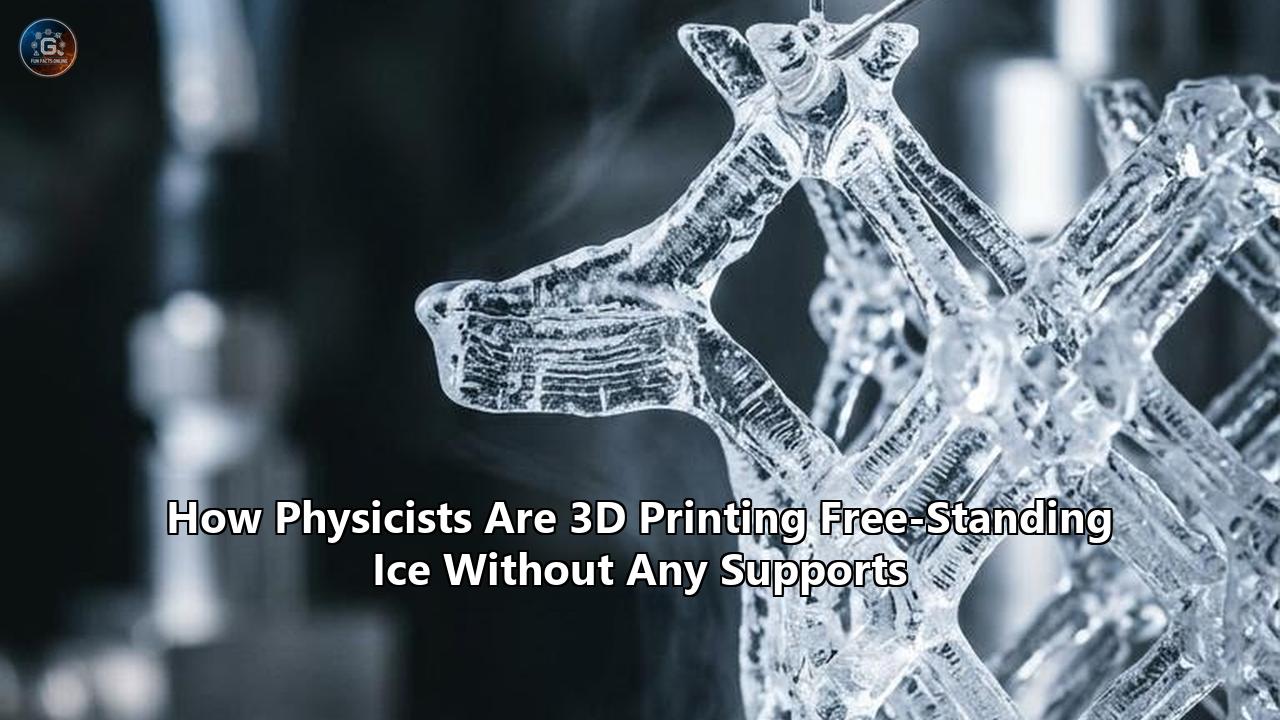
Then the printer did something that defies standard additive manufacturing: the nozzle began angling sideways, extruding an unsupported ice cantilever that stretched out over open air at a tilt of 48 degrees, then flattened out to an acute 14 degrees from the horizontal plane. It did not droop, slump, or collapse under its own weight. Within minutes, the system had completed the silhouette of a human face in profile, standing upright, hollow, and completely self-supporting.
The demonstration, published in the Proceedings of the National Academy of Sciences (PNAS) by physicists Menno Demmenie, Stefan Kooij, and Daniel Bonn, details an unexpected mechanical feat: building complex, free-standing, three-dimensional ice sculptures without sacrificial supports and without cryogenics.
By exploiting the violent thermodynamics of low-pressure evaporation, the team eliminated the need for external chilling systems entirely. Their process manufactures solid ice structures at speeds roughly 100 times faster than previous attempts, pointing toward a long-sought prize in biomedical engineering: the ability to cast intricate, residue-free vascular networks for artificial organs using nothing more toxic than melted water.
Yet unraveling how pure liquid water can freeze mid-air into stable overhangs required the Amsterdam physicists to decipher a delicate chain of thermodynamic and fluid mechanics puzzles, starting with a laboratory anomaly that was never supposed to happen.
The Forensic Trail: An Accidental Frost Inside an Empty Tube
The pathway leading to vacuum-assisted 3D printing ice began not as a manufacturing initiative, but as an attempt to solve an aerodynamic nuisance.
At the Van der Waals-Zeeman Institute, Daniel Bonn and his colleagues had been running fundamental fluid dynamics experiments to examine how high-speed micro-jets break up into droplets. In normal ambient air, aerodynamic drag exerts friction on microscale water streams, distorting their trajectory and disrupting optical measurements. To eliminate that drag, the researchers placed their nozzle inside a transparent vacuum chamber, pumped down the air, and fired the liquid.
When they peered through the observation port, the researchers noticed something peculiar. The water spray was not collecting at the bottom of the vessel as a liquid pool. Instead, the droplets were striking surfaces and instantly solidifying into mounds of hard, brittle frost.
“The idea behind 3D printing ice began almost by accident,” Bonn explained, reflecting on the initial experiments. “We were spraying water in vacuum to get rid of air drag, and noticed that the spray droplets froze. Putting a 3D printer in the vacuum chamber with the jet nozzle as the printing head allowed us to see what we could actually build with it”.
The observation was physically counterintuitive to anyone accustomed to everyday phase changes. Under standard conditions, turning water into ice demands massive heat extraction via refrigeration: circulating chlorofluorocarbons, dry ice baths, or cryogenic liquids like nitrogen or helium. The Amsterdam vacuum chamber possessed none of these. The ambient air inside the room was warm. The chamber walls were warm. The metal build plate was warm. Yet the moment liquid water was squirted into the low-pressure environment, it froze itself.
The researchers realized they had stumbled upon an extreme demonstration of evaporative cooling. While evaporation is familiar as the mechanism that cools human skin during perspiration, taking it into a near-vacuum accelerates the phase transition into a violent, self-refrigerating cycle. The team immediately pivoted, mounting the motion system of an open-source commercial 3D printer inside the acrylic vacuum vessel and linking its fluid line to an external high-performance liquid chromatography (HPLC) pump capable of delivering steady, pulse-free micro-flows.
The mechanical setup was inexpensive compared to industrial manufacturing hardware, but the physics governing the jet remained deeply unstable. If the pressure dropped too low, the water boiled violently inside the nozzle, clogging the orifice with instant ice plugs. If the pressure was too high, the jet remained liquid, splashing uselessly across the stage.
The investigative challenge shifted from pure physics to process control: finding the precise razor's edge where thermodynamics, fluid flow, and motion control met.
The Thermodynamics of Self-Refrigeration
To map out why water solidifies without a freezer, the team tracked the thermodynamic balance between two distinct phase transitions: vaporization and fusion.
Water’s behavior is governed by its phase diagram—the plot mapping temperature against pressure. At normal sea-level pressure (101.3 kilopascals, or 1 atmosphere), water boils at 100 degrees Celsius and freezes at zero. But follow the liquid-vapor saturation curve downward into low pressures, and the boiling point drops precipitously. Near the thermodynamic triple point—roughly 611 pascals (6.11 millibars) and 0.01 degrees Celsius—the distinctions between liquid, solid, and vapor converge.
When the Amsterdam team depressurized their chamber to a few millibars, liquid water placed into that environment became thermodynamically unstable. Molecules on the surface of the extruded 16-micrometer jet escaped into the gas phase at furious speeds, driven by the pressure differential.
Herein lies the physical engine of the process: latent heat.
- To break the hydrogen bonds holding liquid water together and transition into vapor, escaping molecules must absorb energy—the latent heat of vaporization ($L_v$), which hovers around 2.26 million joules per kilogram.
- By contrast, the latent heat of fusion ($L_f$)—the energy released when liquid water solidifies into ice—is significantly smaller: roughly 334,000 joules per kilogram.
Because of this nearly seven-fold disparity between the heat of vaporization and the heat of fusion, every gram of water that evaporates into the vacuum pulls enough thermal energy out of the remaining liquid to freeze approximately seven grams of water.
Thermodynamic Energy Balance of Evaporative Freezing:
═════════════════════════════════════════════════════════════════════
  Latent Heat of Vaporization (Lv): ~2,260 kJ/kg (Absorbs thermal energy)
  Latent Heat of Fusion       (Lf):   ~334 kJ/kg (Releases thermal energy)
  Ratio (Lv / Lf):                  ~6.77 : 1

  Result: Evaporating ~12–14% of the extruded liquid water carries
          away enough thermal energy to drive the remaining 86–88%
          below the freezing threshold.
═════════════════════════════════════════════════════════════════════
As the 16-micrometer stream emerged from the nozzle at velocities of several meters per second, its outer boundary layer vaporized instantaneously. The departing gas molecules stripped enthalpy from the core liquid so rapidly that its temperature dropped tens of degrees within milliseconds. By the time the stream reached the target stage—a travel distance of only a few millimeters—the core of the liquid was already deep in a supercooled state: chilled below 0 degrees Celsius, yet still temporarily fluid.
This resolved the energy question. The liquid acted as its own refrigerant, dispensing with external chillers entirely. But it introduced an even more confounding mechanical question.
If the liquid was supercooled before it struck the target, why didn't the jet freeze solid inside the nozzle tip, permanently jamming the printer? And why didn't the droplets freeze into irregular, detached beads like microscopic hail, ruining structural cohesion?
The Half-Second Mystery: High-Speed Optics and the Liquid Delay
To track the deposition interface at the microsecond level, Demmenie, Kooij, and Bonn directed high-speed optical microscopy at the contact zone where the water jet met the solid substrate.
What they recorded overturned their initial assumptions about the printing process. The droplets did not flash-freeze the instant they touched down. Instead, the high-speed footage revealed an essential pause: a persistent liquid lifetime of approximately 0.5 seconds.
Microscale Impact Dynamics (0.5-Second Window):
─────────────────────────────────────────────────────────────────
  [1] Jet Impact (t = 0 ms)
      Supercooled liquid stream (16 µm) hits previously deposited ice.
      Droplets do not solidify instantly.

  [2] Liquid Coalescence (t = 10 to 300 ms)
      Surface tension pulls adjacent liquid droplets into a continuous,
      smooth bead. Partial wetting prevents the water from cascading
      off the frozen edge.

  [3] Nucleation and Recalescence (t ≈ 500 ms)
      Ice crystal nucleation occurs at the solid interface.
      Crystallization sweeps rapidly across the liquid bead,
      solidifying it into rigid ice without losing geometric shape.
─────────────────────────────────────────────────────────────────
During this half-second window, multiple incoming droplets from the continuous jet impact the surface and coalesce. Surface tension acts as a stabilizing membrane, pulling the newly arrived liquid into a continuous, smooth bead.
Equally critical is the fluid dynamic phenomenon of partial wetting. Liquid water does not spread completely flat over ice; it forms a finite contact angle. Because the surface tension of the water bead is strong enough to resist gravitational slumping, and because the water only partially wets the ice beneath it, the fluid does not run down the sides of the structure. It sits perched at the summit of the growing ice column like a microscopic dewdrop.
Then, at roughly 500 milliseconds, recalescence occurs.
Recalescence is the abrupt release of latent heat that accompanies rapid crystal growth in an undercooled fluid. As ice nucleation points propagate upward from the underlying frozen lattice, crystallization sweeps through the coalesced liquid bead almost instantaneously. The temperature of the bead jumps briefly back to 0 degrees Celsius as latent heat is released, before the surrounding vacuum conditions immediately resume evaporative cooling, locking the newly added layer into a dense, solid crystalline matrix.
The 0.5-second delay provided the missing physical link. Without that window, droplets would freeze individually on contact, stacking into rough, porous, mechanically fragile clusters of ice grains. With the delay, the liquid had just enough time to form smooth, continuous boundaries, yet not enough time to drip away.
By adjusting the translation speed of the printer's XY stage to match this 500-millisecond crystallization cadence, the researchers realized they could dictate not only the height of the ice, but its precise trajectory through three-dimensional space.
Angled Growth: Overcoming the 45-Degree Threshold
In conventional fused deposition modeling (FDM) and stereolithography (SLA), gravity is an unforgiving adversary. When a standard 3D printer attempts to build a cantilever extending into empty space, any overhang exceeding roughly 45 degrees from the vertical axis tends to sag or fail unless a scaffolding of sacrificial support material is constructed beneath it. These supports waste resin, extend print times, and leave rough scars when manually broken or dissolved away.
When investigating 3D printing ice, the Amsterdam team discovered that their phase-change dynamics enabled structural vectoring that bypassed the 45-degree barrier entirely.
Kinematic Vectoring of Unsupported Ice Pillars:
═════════════════════════════════════════════════════════════════════
  Printhead Speed:  v_stage  (typically modulated around 20 mm/s)
  Freezing Delay:   t_freeze ≈ 0.5 seconds
  Nozzle Diameter:  d = 16 micrometers

  • Coincident Axis (v_stage = 0):
    → Droplet lands squarely on previous apex.
    → Column grows purely vertically (90° from surface).

  • Offset Vectoring (v_stage > 0):
    → Jet deposits supercooled droplet on the liquid shoulder of
      the preceding bead.
    → Capillary forces anchor the bead to the frozen rim.
    → Crystallization front chases the printhead offset.
    → Extreme cantilevers achieve stable angles down to 14°
      above the build plate without collapse.
═════════════════════════════════════════════════════════════════════
By varying the speed of the 3D printer’s horizontal axes while keeping the liquid extrusion rate constant, the researchers discovered they could smoothly steer the angle of the growing ice pillar.
If the nozzle remained stationary above a single spot, incoming droplets froze directly on top of one another, generating a straight vertical pillar. But when the printhead began translating horizontally across the build plate at controlled velocities (around 20 millimeters per second), the incoming supercooled jet struck the outer edge—the liquid shoulder—of the existing ice tip.
Because the liquid cap holds itself together via capillary cohesion for that crucial half-second, it clings to the frozen rim rather than detaching. Before gravity can pull the suspended liquid droplet downward, the freezing front advances into the newly deposited volume, anchoring it rigidly in place.
Using this kinematic vectoring, the Amsterdam physicists demonstrated that they could print continuous, slender pillars at severe inclinations. They printed pillars at 48 degrees, 30 degrees, and ultimately pushed the boundary down to 14 degrees relative to the flat build plate—a nearly horizontal shelf jutting directly into empty air with zero support beneath it.
To test the mechanical limits of these structures, Demmenie, Kooij, and Bonn printed intricate showcase pieces:
- The Miniature Christmas Tree: A multi-tiered, branching evergreen geometry measuring 8 centimeters tall and 6 centimeters across the base. Deposited layer-by-layer, it took 26 minutes to complete, requiring no refrigerated build plate, no chemical additives, and zero support scaffolding.
- The Upright Face Silhouette: A support-free, mid-air print outlining a human face in profile, with extreme overhanging curves tracing the nose, lips, and chin.
- Elastic Resonator Pillars: Slender, millimeter-scale vertical struts and zigzag formations. When the researchers physically shook the vacuum chamber, the ice pillars bent and oscillated elastically like tiny tuning forks without snapping, demonstrating that the rapid vacuum crystallization produces a cohesive, crack-free polycrystalline ice.
"The method can also be used to print small pillars of ice under an angle, simply by varying the speed of the 3D printer," the Amsterdam researchers reported in their PNAS findings. "This makes it possible to print profiles in ice that can have almost any shape and are strong enough that they don't need to be supported from below—in contrast to how ordinary 3D-printing works".
The Pittsburgh Precedent: Cryogenic Stages and Heavy Water
While the Amsterdam team achieved support-free ice structures using evaporative vacuum physics, their work sits alongside a parallel line of research conducted across the Atlantic at Carnegie Mellon University (CMU). The divergence between these two research groups highlights how different physical mechanisms can solve the same structural dilemma.
At CMU, mechanical engineering professors Burak Ozdoganlar and Philip LeDuc, along with researchers Akash Garg and Feimo Yang, pioneered an approach known as Freeform 3D Ice Printing (3D-ICE). Rather than operating inside a vacuum chamber, the Pittsburgh team developed a high-precision, atmospheric drop-on-demand system.
Comparison of Leading Support-Free Ice Printing Approaches:
═════════════════════════════════════════════════════════════════════════════════
Parameter              Carnegie Mellon University (3D-ICE)  University of Amsterdam
─────────────────────────────────────────────────────────────────────────────────
Primary Mechanism      Drop-on-demand onto chilled stage    Continuous jet via vacuum evaporative cooling
Operating Pressure     Atmospheric (101.3 kPa)              Near-vacuum (~6 mbar)
Cooling Method         Cryogenic platform (-35 °C)          Latent heat of vaporization (Self-cooling)
Material Variants      Deuterated water (D2O) & H2O         Pure deionized liquid water (H2O)
Nozzle Architecture    Piezoelectric inkjet (50 µm)         HPLC-fed micro-nozzle (16 µm)
Fabrication Speed      Baseline drop-on-demand rate         ~100x faster continuous deposition
Sacrificial Target     Microvascular networks for GelMA     Residue-free molds & space manufacturing
═════════════════════════════════════════════════════════════════════════════════
Instead of using a continuous micro-jet, the CMU system mounts a piezoelectric inkjet printhead that dispenses discrete, 50-micrometer-wide water droplets onto a custom-built copper build platform chilled to −35 degrees Celsius.
Ozdoganlar and LeDuc encountered their own fluid-phase paradox early in their research. If each droplet froze completely before the next one landed, the resulting ice structure suffered from severe layer lines, internal thermal stresses, and micro-fractures.
To solve this, CMU developed a dynamic known as the "sustained liquid cap" mode. By synchronizing the ejection frequency of the piezoelectric head with the multi-axis movement of the stage, the system deposits the next droplet onto the growing structure before the previous one has fully solidified.
“What makes our method different from other kinds of 3D printing is that instead of letting the water completely freeze while we're printing, we let it maintain a liquid phase on top,” explained CMU researcher Feimo Yang during presentations at the Biophysical Society. “This continuous process, which we call freeform, helps us to get a very smooth structure. We don't have a layering effect typical with many 3D printing methods”.
The CMU team uncovered another surprising physical lever: heavy water, or deuterium oxide ($D_2O$).
By substituting standard deionized water ($H_2O$) with heavy water—where hydrogen atoms are replaced by the heavier deuterium isotope—the researchers altered the physical constants of the printing fluid. Heavy water possesses a higher freezing point (3.82 degrees Celsius) and different viscosity and thermal conductivity profiles than light water. The subtle shift in crystallization kinetics gave the CMU team a wider thermal window to manipulate the sustained liquid cap, preventing catastrophic premature freezing and yielding glassy, ultra-smooth ice conduits.
Yet the CMU process comes with practical tradeoffs: it demands heavy refrigeration hardware to sustain a −35-degree build stage, and its drop-on-demand ejection operates at relatively conservative speeds.
When the Amsterdam team released their vacuum-assisted findings, they revealed that their evaporative approach could construct comparable support-free geometries roughly 100 times faster than CMU’s cryogenic method, all while using standard room-temperature water without isotopic substitution or external refrigeration.
Both groups, however, are chasing the exact same biomedical breakthrough.
The Cleanest Mold on Earth: Reconstructing Human Vasculature
Why are mechanical engineers and physicists expending years of effort to master the 3D printing of ice, an inherently ephemeral material that melts if someone leaves a door open?
The answer lies in one of the most frustrating bottlenecks in modern bioengineering: the challenge of manufacturing microvascular channels.
Currently, over 100,000 people in the United States alone are on waiting lists for organ transplants. While tissue engineers have learned how to grow sheets of skin, cartilage, and simple muscular patches in petri dishes, creating full-scale lab-grown organs—such as functional kidneys, livers, or hearts—remains stalled by a plumbing crisis.
Living biological cells cannot survive if they are situated more than 200 micrometers away from a oxygen-supplying blood vessel. Without an intricate, branching three-dimensional network of capillary conduits spanning from millimeter-wide arteries down to micrometer-wide capillaries, engineered tissue constructs suffocate and undergo necrotic decay from the inside out within hours.
Sacrificial Molding Comparison: Ice vs. Synthetic Sacrificial Resins
─────────────────────────────────────────────────────────────────────────────────
Problem Parameter      Polyvinyl Alcohol (PVA) / Wax        3D Printed Ice
─────────────────────────────────────────────────────────────────────────────────
Dissolution Method     Harsh chemical solvents or water     Simple ambient warming (Phase change)
Chemical Leaching      Leaves surfactant/solvent residues   Zero residue; 100% pure H2O
Matrix Mechanical      Swelling during dissolution can      Liquid evacuation via gentle
Stress                 tear delicate cellular scaffolds     microfluidic suction or sublimation
Cytocompatibility      Moderate to low; requires washing    Absolute; biologically benign
Internal Geometry      Prone to stepping artifacts          Glass-smooth walls down to capillary scale
─────────────────────────────────────────────────────────────────────────────────
For decades, engineers have tried to solve this by sacrificial casting. In this process, a printer builds a positive mold of the vascular network out of a temporary sacrificial material—such as polyvinyl alcohol (PVA), synthetic waxes, or carbohydrate sugars. A biocompatible hydrogel pre-seeded with living cells, such as gelatin methacryloyl (GelMA), is then poured over the mold and cross-linked using ultraviolet light. Once the structural matrix hardens, the internal sacrificial template is dissolved away, leaving behind hollow channels that function as artificial blood vessels.
In practice, existing sacrificial materials frequently fail:
- Synthetic polymers and waxes require organic solvents or prolonged chemical washing to clear the channels, leaving trace compounds that kill living cells.
- Water-soluble polymers like PVA swell as they dissolve, generating internal mechanical pressures that rupture delicate hydrogel matrices from within.
- Carbohydrate sugars can leave hypertonic solutions that damage the osmolarity of cellular environments.
Ice completely bypasses these failure points.
“When I first started my lab, I would never have imagined that we would be 3D printing ice, and using it to create tissues to help people,” said CMU’s Philip LeDuc, reflecting on the transition from fundamental mechanics to clinical trials. “Traditional additive manufacturing makes it difficult to print intricate internal features without sacrificing time, accuracy, and resources”.
Ice is chemically benign. It contains zero dopants, zero toxic resins, and zero binders.
When an intricate, branching ice scaffold printed via vacuum evaporation or cryogenic drop-on-demand is embedded inside a hydrogel matrix, evacuating the mold requires no chemical baths. The technician merely raises the chamber pressure and brings the temperature to room levels. The ice melts gently into clean, pure water, which is easily flushed out or absorbed by the surrounding biological scaffold.
In proof-of-concept tests conducted at Carnegie Mellon, researchers successfully cast microvascular networks using 3D printed ice molds, flushed the melted water, and seeded the hollow conduits with human endothelial cells—the specialized cells that line the interior of blood vessels. The endothelial cells attached smoothly to the pristine, mirror-like inner walls of the evacuated channels, surviving, multiplying, and forming functional endothelial monolayer barriers.
Beyond biological tissues, the same sacrificial ice molding provides an immediate solution for high-precision microfluidic devices, optical waveguide casting, and pneumatic channels for soft robotics—enabling internal channel architectures that cannot be machined using conventional computer numerical control (CNC) milling or standard lithography.
The Martian Chamber: Additive Manufacturing in Six Millibars
While biomedical laboratories represent the most urgent Earthbound use case, the Amsterdam vacuum breakthrough has triggered discussions in a completely different domain: planetary engineering and in-situ resource utilization (ISRU).
Building infrastructure on planetary bodies like Mars has long been constrained by the brutal economics of rocketry. Transporting structural building materials, specialized polymer resins, or heavy industrial curing machinery from Earth costs thousands of dollars per kilogram. For decades, space agencies have searched for construction methods that rely exclusively on indigenous resources: regolith, atmospheric gases, and local subsurface ice.
This is where the physics of the Amsterdam experiment intersect with planetary science.
The atmospheric surface pressure on Mars averages between 6 and 7 millibars—almost precisely the ambient pressure maintained inside Daniel Bonn’s laboratory vacuum chamber. Furthermore, Mars’s average surface temperature hovers around −60 degrees Celsius, dropping lower during polar nights.
Planetary Atmospheric Parameters vs. Amsterdam Vacuum Chamber:
═════════════════════════════════════════════════════════════════════
Environment                Ambient Pressure        Typical Temperature
─────────────────────────────────────────────────────────────────────
Earth Sea-Level            1,013 mbar              +15 °C to +25 °C
Amsterdam Vacuum Chamber   ~6 mbar                 +20 °C (Unchilled walls)
Martian Surface (Average)  ~6 to 7 mbar            -60 °C (Varies -125 °C to +20 °C)
═════════════════════════════════════════════════════════════════════
On Earth, physicists must use vacuum pumps and sealed acrylic chambers to manufacture the low-pressure conditions necessary to drive evaporative freezing without refrigeration.
On Mars, the entire planet is a natural vacuum chamber.
"The vacuum requirement opens possibilities beyond Earth," the Amsterdam researchers pointed out. "Mars has a surface pressure of 6 mbar, within the operating range. A similar 3D printer on Mars could print structures from local water ice using the same evaporative cooling principle, without importing cryogenic infrastructure".
Orbital surveys and ground-penetrating radar data from missions like NASA’s Mars Reconnaissance Orbiter have confirmed that vast sheets of relatively pure water ice lie buried just centimeters beneath the Martian dust across mid-to-high latitudes.
Under the Martian atmosphere, an autonomous rover equipped with a heated drill could melt subsurface ice into liquid water, feed that water into a micro-nozzle array, and direct the spray into the open Martian air. The ambient 6-millibar atmosphere would instantly pull latent heat from the stream through evaporative cooling, freezing the water into robust, free-standing structural arches, radiation shields, or temporary ice shelters without requiring any chemical cross-linkers, cement binders, or refrigeration plants brought from Earth.
The structures would remain stable indefinitely in the sub-zero polar regions, serving as protective domes against solar radiation and micrometeorites, and could eventually be melted back down into life-support water when no longer needed.
Technical Bottlenecks and Industrial Reality
Despite the elegance of support-free 3D printing ice, moving this laboratory phenomenon into standardized commercial manufacturing requires overcoming several stubborn physical hurdles.
The Sublimation Decay Problem
In a dry vacuum or an arid sub-zero environment, ice does not remain static. Through sublimation, water molecules transition directly from solid ice into water vapor, steadily eroding the outer surfaces of printed objects over time. In the Amsterdam chamber, if a delicate 16-micrometer feature is left sitting in low pressure for extended periods, it slowly thins and loses structural fidelity.
For tissue engineering, this requires rapid workflow integration: the moment an ice template is finished printing, the liquid hydrogel matrix must be introduced and cross-linked before sublimation degrades the sharp boundaries of the micro-channels.
Nozzle Freezing and Recalcitrant Phase Transitions
The physics that makes vacuum evaporative cooling so powerful also makes it temperamental. Extruding water through a 16-micrometer opening into a vacuum leaves almost no margin for error.
- If the fluid velocity slows even slightly, evaporative cooling climbs backwards into the nozzle orifice.
- The moment ice nucleates inside the channel, the printhead suffers an irreversible freeze-clog, requiring the chamber to be repressurized and heated to clear the line.
- To prevent this, the Amsterdam system requires precision HPLC pumps operating at continuous, stable pressures, limiting the ability to arbitrarily start and stop droplet deposition at will.
Primary Technical Obstacles in Supportless Ice Additive Manufacturing:
┌─────────────────────────┬─────────────────────────────────────────────────┐
│ Obstacle                │ Physical Cause & Impact                         │
├─────────────────────────┼─────────────────────────────────────────────────┤
│ Sublimation Erosion     │ Direct solid-to-vapor phase loss under vacuum;   │
│                         │ erodes microscale feature resolution over time. │
├─────────────────────────┼─────────────────────────────────────────────────┤
│ Micro-Nozzle Freeze-In  │ Evaporative front creeps into orifice if flow   │
│                         │ slows; causes catastrophic print failure.       │
├─────────────────────────┼─────────────────────────────────────────────────┤
│ Volumetric Scale Limits │ Ice is mechanically brittle; structural loads   │
│                         │ scale poorly without thick internal cores.      │
├─────────────────────────┼─────────────────────────────────────────────────┤
│ Hydrogel Viscosity Drag │ Pouring dense prepolymers over fragile ice      │
│                         │ overhangs can shear delicate structures.        │
└─────────────────────────┴─────────────────────────────────────────────────┘
The Scaling Hurdle
Currently, both the Amsterdam vacuum printer and CMU’s drop-on-demand platform produce microscale-to-millimeter-scale objects: miniature pine trees, figurines, thin cantilevers, and vascular matrices measuring a few centimeters across. Scaling the process up to fabricate whole-organ templates—such as a human kidney spanning 10 to 12 centimeters in all dimensions—will require multi-nozzle printhead arrays operating simultaneously.
Managing thermal gradients across a multi-nozzle vacuum array without creating disruptive vapor turbulence presents an unmapped fluid dynamics challenge. If dozens of micro-jets eject vapor into the chamber at once, the local pressure can spike unexpectedly, arresting evaporative cooling and causing the growing structure to liquefy and collapse.
What Comes Next
Teams across Europe and the United States are working to push support-free ice additive manufacturing out of the physics department and into clinical and industrial settings.
The immediate milestone on the research horizon is the integration of multi-material coaxial deposition. Researchers are investigating whether an inner core of pure water can be co-extruded inside an outer sheath of living cell-laden bio-ink. In such a system, the outer hydrogel sheath would cross-link instantly while the inner water core freezes via evaporative cooling to maintain internal lumen structural integrity, printing living, perfused conduits in a single pass.
Simultaneously, materials scientists are exploring how custom pressure cycles can control the internal crystalline morphology of printed ice. By fine-tuning the chamber pressure during deposition, it may become possible to toggle the ice between amorphous solid water (a glassy, non-crystalline state that prevents ice-crystal damage to nearby cells) and hexagonal crystalline ice, tailoring the mechanical stiffness of the template to match specific biological tissues.
Further along the evidence trail, aerospace engineers are examining partnerships with space agencies to test low-pressure ice deposition inside hyperbaric environmental chambers that simulate Martian atmospheric dust, low gravity, and solar radiation profiles.
What began as an unintended frost clinging to a vacuum nozzle in Amsterdam has peeled back decades-old assumptions about how phase transitions must be engineered. By forcing liquid water to act as its own refrigerant, physicists have turned an everyday substance into an agile structural medium—one that builds intricate forms out of empty space, holds its own weight at impossible angles, and vanishes back into pure liquid the moment its work is done.
Reference:
- https://engtechnica.com/3d-printing-with-ice-creates-self-supporting-complex-structures/
- https://www.zmescience.com/future/physicists-found-a-way-to-3d-print-ice-at-room-temperature-without-a-freezer/
- https://3dprinting.com/news/university-of-amsterdam-3d-prints-ice-structures-without-supports/
- https://www.pnas.org/doi/10.1073/pnas.2608173123
- https://pubmed.ncbi.nlm.nih.gov/42685083/
- https://www.pnas.org/doi/10.1073/pnas.2608173123
- https://communities.springernature.com/posts/3d-printing-of-ice-into-a-christmas-tree
- https://communities.springernature.com/posts/3d-printing-of-ice-into-a-christmas-tree
- https://iop.uva.nl/content/news/2026/08/printing-with-ice.html?origin=hqZwIY6%2FTt2p%2FbYjLQhlIg
- https://www.voxelmatters.com/amsterdam-researchers-print-angled-ice-structures-without-support-material/
- https://www.zmescience.com/future/physicists-found-a-way-to-3d-print-ice-at-room-temperature-without-a-freezer/
- https://engineering.cmu.edu/news-events/news/2024/07/15-3d-ice-printing.html
- https://pmc.ncbi.nlm.nih.gov/articles/PMC11287161/
- https://pubmed.ncbi.nlm.nih.gov/35794454/
- https://engineering.cmu.edu/news-events/news/2022/08/02-3d-ice.html
- https://www.biophysics.org/blog/3d-ice-printing-can-create-artificial-blood-vessels-in-engineered-tissue
- https://3dprinting.com/news/researchers-3d-print-micro-scale-structures-with-ice/
- https://www.fashion3d.com.au/blogs/news/ice-3d-printing-technology-can-print-any-ice-structure
- https://www.pnas.org/doi/10.1073/pnas.2322330121
- https://www.researchgate.net/publication/271548768_3D_ICE_printing_as_a_fabrication_technology_of_microfluidics_with_pre-sealed_reagents