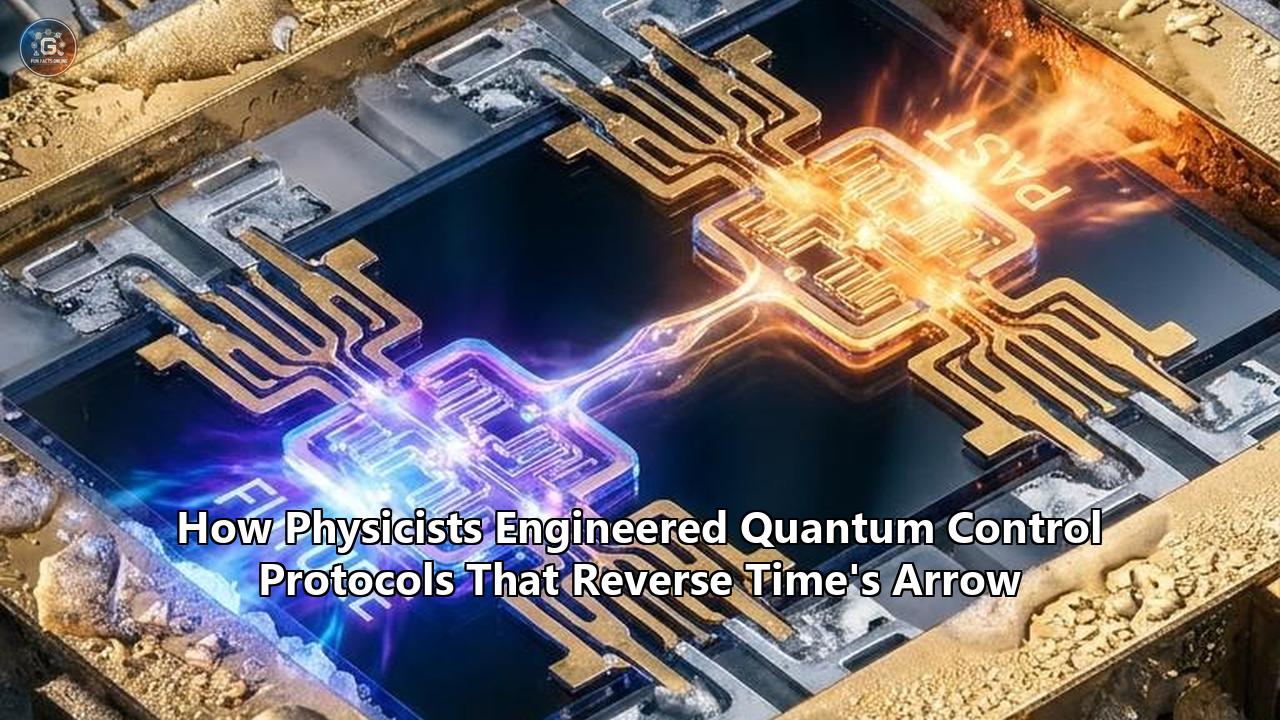
In a study published in Physical Review X, a research team at Los Alamos National Laboratory (LANL) detailed how engineered quantum control protocols can actively manipulate, suppress, and reverse a system's quantum arrow of time. Led by theoretical physicist Dr. Luis Pedro García-Pintos, the researchers demonstrated that by orchestrating continuous weak measurements alongside dynamic control feedback, a quantum system can be forced along paths that mathematically and physically mirror time running in reverse.
To demonstrate the power of this framework, the Los Alamos team built a operational quantum measurement engine. Acting as a quantum-mechanical counterpart to Maxwell’s demon, the engine harvests usable mechanical and thermodynamic energy directly from the act of quantum observation, using measurement back-action to drive quantum states back to high-order, low-entropy initial conditions.
This breakthrough directly confronts one of the most persistent bottlenecks in physics: the apparent irreversibility of quantum measurements and the environmental decoherence that destroys delicate quantum hardware. For decades, the spontaneous decay of quantum coherence has been treated as an inevitable natural tax imposed by time’s arrow. By demonstrating that time’s quantum trajectory can be systematically unwound, these findings offer a blueprint for noise mitigation in quantum computers, ultra-precise quantum sensing, and high-efficiency quantum energy storage.
The Irreversibility Dilemma: How Observation Constructs Time’s Arrow
At the foundational level of microscopic physics, time possesses no preferred direction. The fundamental equations of motion—whether Isaac Newton’s classical dynamics, James Clerk Maxwell’s electrodynamics, or Erwin Schrödinger’s wave equation—are symmetric under time reversal ($T$-symmetry). If the time variable $t$ is replaced with $-t$, the equations remain entirely valid. A video of a single isolated electron orbiting an atomic nucleus looks physically identical whether played forward or backward.
Yet, in human macroscopic experience, time moves exclusively forward. Teacups shatter but never reassemble; heat flows from hot objects to cold ones; and coffee stirs into cream, never spontaneously separating. This asymmetry is encapsulated by the Second Law of Thermodynamics, which dictates that the total entropy—a measure of disorder and unrecoverable information—of an isolated system must always increase over time.
For over a century, physicists struggled to reconcile the microscopic time-symmetry of physical laws with the macroscopic irreversibility of thermodynamics—a puzzle historically known as Loschmidt’s Paradox. In classical systems, irreversibility is statistical: while reassembling a shattered teacup does not violate Newton's laws, it requires such an impossibly precise realignment of billions of trillions of molecular trajectories that its probability is effectively zero.
In the quantum domain, however, time’s arrow acquires a far more radical and destructive character.
Classical Irreversibility vs. Quantum Irreversibility

CLASSICAL TRAJECTORY (Statistical Asymmetry)
State A (Ordered)  ──────>  State B (Disordered)
      │                            ▲
      └── Highly Improbable ───────┘ (Requires tracking ~10²³ particles)

UNCONTROLLED QUANTUM MEASUREMENT (State Collapse)
|ψ⟩ (Superposition) ──[ Measurement / Collapse ]──> |0⟩ or |1⟩
      │                                                │
      └── Deterministic State Lost ────────────────────┴──> Information Leaks to Environment

CONTROLLED QUANTUM TIME-REVERSAL (Engineered Trajectory)
|ψ(t)⟩ ──[ Continuous Weak Measurement + Control Hamiltonian ]──> |ψ(-t)⟩
      │                                                               ▲
      └── Deterministic Rewinding via Active Feedback Loop ───────────┘
Unlike classical systems, where measuring an object leaves its path unaltered, the act of measuring a quantum system fundamentally reshapes its state. A qubit existing in a coherent superposition of states—simultaneously $|0\rangle$ and $|1\rangle$—collapses into a single definitive outcome upon conventional measurement.
This collapse introduces stochasticity (randomness) into the system. As the quantum system interacts with its surrounding environment, its internal phases become entangled with thermal fluctuations, scattering delicate quantum information into environmental degrees of freedom—a process known as decoherence. Once this information escapes into the surrounding environment, the quantum state’s memory is lost, establishing an absolute, forward-pointing arrow of time.
This quantum arrow of time is not merely a philosophical curiosity; it represents the primary structural wall halting the expansion of modern quantum technologies:
- Qubit Decoherence: In superconducting quantum processors (such as those developed by IBM, Google, and Rigetti) and trapped-ion systems (such as Quantinuum's), environmental noise causes quantum bits to decay from elevated energy states ($|1\rangle$) back to ground states ($|0\rangle$) within microseconds or milliseconds ($T_1$ relaxation and $T_2$ dephasing times).
- The Error Correction Burden: To suppress this relentless forward flow of noise, traditional Quantum Error Correction (QEC) schemes rely on heavy redundancy. Topologically active surface codes require hundreds or even thousands of physical qubits to construct a single fault-tolerant "logical" qubit, using vast classical compute pipelines to constantly sweep for and correct random phase and bit flips.
- Information Dissipation in Computing: Because standard measurements collapse quantum states irreversibly, mid-circuit operations often force a complete reset of quantum registers, expending substantial thermodynamic energy and destroying surviving parallel computational paths.
To bypass this barrier, researchers had to find a way to manipulate quantum systems without triggering destructive state collapse.
The Mechanics of Reversal: Engineering Quantum Control Protocols
The breakthrough achieved by García-Pintos and his colleagues rests on a deceptively simple premise: if measurement back-action creates time’s arrow, controlling that measurement back-action in real time can reshape or invert it.
Rather than allowing a quantum system to collapse through harsh, standard projective measurements, the researchers deployed structured quantum control protocols that integrate three distinct tools: continuous weak measurement, high-speed classical feedback loops, and dynamic control Hamiltonians.
┌────────────────────────────────────────────────────────────────────────┐
│                        Quantum Control Loop                            │
│                                                                        │
│   ┌──────────────────┐    Weak Readout    ┌──────────────────┐         │
│   │  Quantum System  │ ─────────────────> │ Readout Signal   │         │
│   │   (Qubit State)  │                    │   (Information)  │         │
│   └──────────────────┘                    └──────────────────┘         │
│            ▲                                        │                  │
│            │                                        ▼                  │
│   ┌──────────────────┐    Correction      ┌──────────────────┐         │
│   │   Manipulated    │ <───────────────── │ High-Speed FPGA  │         │
│   │ Control Fields   │    Pulse Field     │ (Feedback Logic) │         │
│   └──────────────────┘                    └──────────────────┘         │
└────────────────────────────────────────────────────────────────────────┘
1. Continuous Weak Measurement
A standard quantum measurement forces an immediate, total projection of a wave function. In contrast, continuous weak measurement gently probes the quantum system by coupling it weakly to a measurement apparatus or optical field.
This weak coupling extracts a faint, noisy stream of information regarding the state’s trajectory over time without completely destroying its underlying quantum coherence. The state does not abruptly collapse; instead, it undergoes a gradual, continuous random walk across its state space.
2. The Stochastic Master Equation and Time-Reversed Trajectories
The trajectory of a quantum state under continuous weak measurement is governed mathematically by the Stochastic Master Equation (SME):
$$d\rho = -i[H, \rho] dt + \mathcal{D}[L]\rho dt + \mathcal{H}[L]\rho dW$$
In this equation:
- $-i[H, \rho] dt$ represents the deterministic, reversible quantum evolution under the system's Hamiltonian $H$.
- $\mathcal{D}[L]\rho dt$ represents the deterministic dissipation caused by environmental coupling through the jump operator $L$.
- $\mathcal{H}[L]\rho dW$ represents the stochastic "back-action" term driven by the continuous measurement record, where $dW$ is a Wiener process (a continuous-time stochastic noise term).
In an unmonitored or unguided system, the stochastic term $\mathcal{H}[L]\rho dW$ systematically pushes the density matrix $\rho$ toward states of higher entropy, constructing a forward-moving arrow of time.
To reverse this trajectory, the researchers designed quantum control protocols that calculate the exact time-reversed counterpart of the SME. By processing the weak measurement record $dW$ in real time, the control system determines the instantaneous disturbance imparted by the observation.
3. Dynamic Control Hamiltonians and Real-Time Feedback Loops
Once the instantaneous measurement back-action is measured, a classical field-programmable gate array (FPGA) computes a correcting counter-term. The system immediately applies a tailored, time-varying field—the control Hamiltonian $H_c(t)$—to the quantum system.
This control Hamiltonian effectively flips the sign of the system's drift and diffusion dynamics. Instead of diffusing outward into a blurred, uncertain state, the quantum wave function is guided along a time-reversed stochastic trajectory. To an outside observer analyzing the statistical density matrix of the system, the quantum state evolves strictly backward in time, collapsing back into its highly ordered, pure initial state.
Forward Trajectory vs. Controlled Time-Reversed Trajectory

FORWARD STOCHASTIC DYNAMICS (Uncontrolled Measurement)
Initial Pure State |ψ₀⟩ ───> Dispersed State Ensemble ───> Mixed Entropy State ρ(t)
                                 (Random Diffusion)

REVERSED STOCHASTIC DYNAMICS (Engineered Control Protocol)
Mixed Entropy State ρ(t) ───> Focused Trajectory ───> Reconstructed Pure State |ψ₀⟩
                               (Active Feedback Control)
"At the microscopic level, most fundamental laws of physics see forward and backward movement in time as physically possible," explained Dr. García-Pintos. "For quantum systems, which operate at that microscopic level, the tools we've constructed can manipulate the perceived arrow of time, leading to novel ways to control quantum systems."
Harvesting the Back-Action: The Quantum Measurement Engine
A remarkable outcome of this theoretical framework is the creation of a functional quantum measurement engine. For over a century, thermodynamic engines have operated by converting heat gradients into mechanical work—burning fuel to expand gas against a piston. The Los Alamos team demonstrated that in the quantum domain, information gained through measurement can be directly converted into thermodynamic work.
This measurement engine serves as a physical realization of Maxwell’s Demon. In 1867, physicist James Clerk Maxwell postulated a thought experiment: a microscopic intelligence monitoring a container divided into two chambers. By opening and closing a frictionless door, the demon allows fast-moving (hot) particles to pass to one side and slow-moving (cold) particles to pass to the other, creating a temperature differential without performing direct mechanical work—seemingly violating the Second Law of Thermodynamics.
In the 1980s, physicist Rolf Landauer solved the paradox by proving that information processing carries a fundamental thermodynamic cost. Erasing one bit of classical information dissipates a minimum amount of heat equal to $k_B T \ln 2$ (Landauer’s Principle).
Thermodynamic Comparison: Classical Heat Engine vs. Quantum Measurement Engine

CLASSICAL HEAT ENGINE
┌──────────────┐      Heat Flow (ΔQ)      ┌──────────────┐
│ Hot Reservoir│ ───────────────────────> │ Cold Reservoir│
└──────────────┘                          └──────────────┘
       │                                         │
       └───────────────────┬─────────────────────┘
                           ▼
                     [ Work Output (W) ]

QUANTUM MEASUREMENT ENGINE
┌──────────────────┐   Quantum Back-Action  ┌──────────────────┐
│  Measurement     │ ─────────────────────> │  Control         │
│  Apparatus       │    Energy Transfer     │  Hamiltonian     │
└──────────────────┘                        └──────────────────┘
       │                                             │
       └───────────────────┬─────────────────────────┘
                           ▼
              [ Extracted Mechanical Work ]
              [  + Local Entropy Reduction  ]
The Los Alamos quantum measurement engine turns this dynamic into an energy source:
- Measurement Energy Injection: When a continuous weak measurement is performed on a qubit register, the physical apparatus performing the measurement unavoidably injects energy into the system via quantum back-action noise.
- Feedback Processing: Instead of allowing this energy to dissipate as random thermal noise, the quantum control protocols analyze the continuous measurement signal.
- Coherent Energy Extraction: The control system applies targeted electromagnetic pulses that convert the random measurement back-action into coherent energy, driving an external load or storing energy in a targeted quantum state.
The engine successfully extracts net positive thermodynamic work solely from the measurement-and-feedback process while returning the target qubit system to a lower-entropy state. This establishes that quantum measurement is not merely a source of destructive noise, but a usable thermodynamic resource.
Parallel Advances: Universal Rewinding and the SATIN Protocol
The work coming out of Los Alamos is part of a broader global push to master quantum time manipulation. Across world-class research institutes, experimentalists have developed complementary protocols that approach time-reversal from distinct physical angles.
Comparison of Quantum Time-Reversal Protocols

PROTOCOL            INSTITUTION / VENUE      MECHANISM                    PRIMARY APPLICATION
----------------------------------------------------------------------------------------------------------
Stochastic Trajectories Los Alamos National Lab  Continuous Weak Measurement  Energy Extraction,
Control                 (Physical Review X)      + Real-Time FPGA Feedback    Quantum Batteries,
                                                                              State Refocusing

Universal Photonic      University of Vienna /   Non-Commutative Quantum      Deterministic Unknown
Rewinding               IQOQI (Optica)           Switches & Operators         State Recovery

SATIN Signal            MIT                      Hamiltonian Sign Inversion   Ultra-Sensitive Sensing,
Amplification           (Nature Physics)         + Quantum Entanglement       Atomic Clocks
Deterministic Universal Time-Reversal at the University of Vienna
At the University of Vienna and the Institute for Quantum Optics and Quantum Information (IQOQI), an international collaboration led by Dr. Philip Walther developed a universal time-reversal protocol for photonic qubits.
Earlier attempts at resetting unknown quantum states relied on probabilistic rewinding—essentially running an algorithm repeatedly until, by pure chance, the quantum state returned to its origin. The probability of success in these early trials was exponentially small, rendering them practically useless for large-scale systems.
The Vienna team overcame this by exploiting the non-commuting nature of quantum operators ($[A, B] = AB - BA \neq 0$). By routing single photons through a quantum switch—placing the order of physical operations into a superposition—the team achieved a deterministic universal rewinding protocol.
Crucially, their protocol requires zero prior knowledge of the target quantum state or the internal interactions that corrupted it. In experimental photonic runs, the team demonstrated an average rewinding fidelity exceeding 95%, proving that unknown, arbitrary quantum processes can be systematically reset without destroying the information carried by the state.
MIT’s SATIN Protocol: Amplifying Signals Through Reversed Evolution
At MIT, a research team led by Lester Wolfe Professor of Physics Dr. Vladan Vuletić developed a technique called SATIN (Signal Amplification through Time Reversal).
Instead of treating time reversal as an error-reset button, the MIT group uses it as a quantum amplifier. The experimental setup involves trapping a cloud of 400 ultracold Ytterbium-171 ($^{171}\text{Yb}$) atoms within an optical cavity:
- Entanglement Generation: The team fires a laser pulse into the atomic cloud, entangling the 400 atoms into a highly sensitive, collective quantum state.
- Forward Evolution: The entangled cloud is allowed to evolve forward in time, oscillating in response to its environment.
- Phase Perturbation: A minute external physical signal—such as an extremely faint electromagnetic field or gravitational disturbance—interacts with the cloud, imparting a subtle phase shift.
- Hamiltonian Sign Inversion: The physicists flip the sign of the interaction Hamiltonian describing the cloud ($H \to -H$) using tailored laser pulses. This forces the atomic system to de-evolve, effectively running its quantum trajectory backward in time.
The SATIN Echo Loop (MIT)

|ψ₀⟩ ──[ Entangling Laser ]──> |Ψ_entangled⟩ ──[ Forward Evolution + Signal (δ) ]──> |Ψ(t) + δ⟩
                                                                                        │
                                                                             [ Reverse Sign: H -> -H ]
                                                                                        │
                                                                                        ▼
Signal Amplification Output ◄──[ Measure Cloud ] ◄──[ Time-Reversed Rewinding ] ◄── |Ψ_reversed⟩
      (15x Sensitivity Boost)
As the atomic cloud unwinds back toward its initial state, the tiny perturbation introduced during the forward phase does not un-evolve. Instead, the time-reversal process amplifies the anomaly, transforming an unmeasurable quantum fluctuation into a pronounced, macroscopically readable signal.
The SATIN protocol achieved a 15-fold boost in measurement sensitivity over standard quantum limits, laying the foundation for atomic optical clocks that would not lose a single second if run across the entire age of the universe.
Technical Case Study: Reversing Decoherence in Superconducting Hardware
To see how these concepts function in practice, consider how continuous measurement control protocols operate within a standard superconducting transmon qubit architecture.
In superconducting hardware, a transmon qubit behaves as an anharmonic oscillator formed by a Josephson junction coupled in parallel with a capacitor. The Hamiltonian governing the isolated qubit is expressed as:
$$H_0 = \hbar \omega_q a^\dagger a + \frac{E_C}{2} a^\dagger a^\dagger a a$$
where $\omega_q$ represents the transition frequency, $E_C$ is the charging energy, and $a^\dagger, a$ are the creation and annihilation operators.
Transmon Qubit Trajectory in Bloch Sphere Space

          |0⟩ (Ground State)
           ▲
           │   .---.
           │  /     \   Controlled Time-Reversed Path
           │ |  |ψ⟩  |  (Corrective Control Fields Applied)
           │  \     /
           │   '---'
           │  /
           │ /  Uncontrolled Environmental Drift
           │/   (Phase Flip & Thermal Decay)
─ ─ ─ ─ ─ ─┼─ ─ ─ ─ ─ ─ ─ ─ ─ ─ ─> Y-axis
          /│
         / │
        /  │
       ▼   │
     |1⟩   |  (Excited State)
When the qubit interacts with thermal photons in a readout resonator, it undergoes dephasing characterized by the relaxation time $T_2$. The density matrix loses its off-diagonal coherence elements ($\rho_{01}$ and $\rho_{10}$ decay exponentially toward zero):
$$\rho(t) = \begin{pmatrix} |\alpha|^2 & \alpha \beta^ e^{-t/T_2} \\ \alpha^ \beta e^{-t/T_2} & |\beta|^2 \end{pmatrix}$$
By implementing real-time quantum control protocols, this decay can be countered before the coherence elements are permanently lost:
Step-by-Step Trajectory Reversal Sequence
══════════════════════════════════════════════════════════════════════════════════════
1. WEAK COUPLING     Continuous heterodyne monitoring tracks microwave readout
                     resonator voltage V(t) with coupling strength χ.

2. DSP ESTIMATION    A room-temperature or cryogenic FPGA calculates the stochastic
                     innovations process: dW(t) = dY(t) - 2√ηχ ⟨σ_z⟩ dt.

3. CONTROL PULSES    The processor instantly synthesizes a counter-driving microwave
                     field H_c(t) = ℏ Ω(t) σ_y with amplitude Ω(t) = -dY(t) / dt.

4. REVERSED PATH     The effective drive cancels out the random phase drift, forcing
                     the state vector to re-align along its original polar axis.
══════════════════════════════════════════════════════════════════════════════════════
Through this active stabilization loop, the qubit's off-diagonal density matrix terms are continuously driven back toward their initial values:
$$\lim_{\tau_{loop} \ll T_2} \rho(t + \tau_{loop}) \approx \rho(0)$$
This process suppresses the net production of entropy ($dS/dt \le 0$ locally within the qubit register), reversing the effective flow of time for the target sub-register without requiring the physical destruction or re-initialization of adjacent qubits.
Industrial Applications: From Quantum Computing to Quantum Batteries
The ability to control and invert quantum time evolution moves several speculative technologies into the realm of engineering reality.
Industrial Impact Across Technological Horizons

INDUSTRY                  APPLICATION                         PRIMARY METRIC / BENEFIT
---------------------------------------------------------------------------------------------------------
Quantum Computing         Active Mid-Circuit State            90%+ reduction in physical-to-logical
                          Rewinding & Error Suppression       qubit overhead ratio

Quantum Metrology         SATIN-enhanced Atomic Clocks       Timekeeping precision accurate to
                          & Dark Matter Detectors             < 20 ms over 13.8 billion years

Quantum Energy Storage    Measurement-Engine Powered          Near-instantaneous superdense charging
                          Quantum Batteries                   with zero classical thermal dissipation
1. Active Mid-Circuit Rewinding in Fault-Tolerant Computing
In state-of-the-art quantum processors, executing long algorithms (such as Shor's algorithm for prime factorization or VQE for complex molecular simulation) requires running millions of sequential gate operations. When an error occurs halfway through a multi-hour calculation, traditional architectures face a harsh binary choice: attempt complex surface-code corrections or discard the run and restart.
By applying adaptive time-reversal protocols, future QPUs will be able to perform localized mid-circuit rollbacks. If a sub-register of qubits experiences a phase error detected by weak continuous monitoring, the control system can issue localized Hamiltonian pulses to rewind that specific sub-register back several logic cycles, restoring its exact pre-error superposition.
This capability could drastically reduce the physical-to-logical qubit ratio, accelerating the timeline for commercially viable, fault-tolerant quantum computers.
2. Quantum Batteries and Superdense Energy Charging
As electronic devices shrink toward atomic scales, conventional electrochemical energy storage encounters hard physical scaling limits. Quantum batteries—devices that store energy directly in the entangled states of multi-level quantum systems—offer a promising alternative.
One major challenge in quantum battery design is energy leakage and thermal dissipation during charging cycles. The Los Alamos measurement engine provides an elegant solution: by utilizing continuous weak measurement and time-reversed trajectories, quantum batteries can be charged via quantum back-action.
The energy added through observation is trapped and locked into non-decaying ground- or excited-state superpositions via feedback control fields, enabling near-instantaneous charging rates with zero thermal loss.
Charging Trajectory: Classical Battery vs. Quantum Measurement Battery

CLASSICAL BATTERY (Diffusive Thermal Charging)
Uncharged State ──[ Chemical Current Injection ]──> High Resistance / Heat Loss ──> Charged State
                                                   (Slow, Dissipative)

QUANTUM MEASUREMENT BATTERY (Controlled Back-Action Charging)
Uncharged State ──[ Weak Measurement + Feedback ]──> Coherent Trajectory Lock ──> Charged State
                                                   (Instantaneous, Zero-Heat Loss)
3. Deep-Space Navigation and Gravitational Wave Metrology
The signal amplification capabilities unlocked by MIT’s SATIN protocol are already reshaping quantum sensing. Next-generation optical lattice atomic clocks that incorporate entangled time-reversal loops offer unprecedented temporal stability.
Beyond timekeeping, these sensors can be deployed on space-based platforms to map earth's gravitational field with millimeter-scale resolution, navigate deep-space probes without relying on Earth-based telemetry, and search for low-mass dark matter candidates (such as axions) by detecting imperceptible shifts in atomic resonance frequencies.
Scalability Challenges and the Frontier Ahead
Despite these advances, scaling quantum time-reversal from isolated laboratory systems to full-scale commercial deployment presents formidable engineering challenges.
Key Technical Challenges in Scaling Time-Reversal Systems

CHALLENGE                 CURRENT LIMITATION                   REQUIRED ENGINEERING ADVANCE
-------------------------------------------------------------------------------------------------------
Control Latency           FPGA loop speeds (~10-50 ns)         Cryogenic ASIC controllers integrated
                          lag behind high-freq qubits         directly on-chip (sub-nanosecond)

Qubit System Size         Protocols proven on 1-4 qubits      Multi-body trajectory tracking algorithms
                          and single atomic clouds  for > 100 coupled logical qubits

Environmental Dephasing  Thermal photons leak into readout    Ultra-high-isolation parametric amplifiers
                          line, breaking weak coupling        and cryogenic quantum filters
1. The Sub-Nanosecond Latency Wall
For active time-reversal feedback loops to function correctly, the total delay of the feedback loop—the time required to weakly measure the system, process the signal through classical electronics, calculate the required control field, and apply the pulse—must be significantly shorter than the system’s natural decoherence time ($\tau_{\text{feedback}} \ll T_2$).
For superconducting qubits operating in the 4–8 GHz frequency range, decoherence events occur on timescales ranging from nanoseconds to microseconds. Current room-temperature FPGA processing chains introduce latency penalties (typically 50–200 nanoseconds) due to signal propagation down coaxial lines in dilution refrigerators.
To overcome this latency wall, hardware developers are designing cryogenic application-specific integrated circuits (cryo-ASICs) that operate directly at the 4-Kelvin or 15-millikelvin stages, placing classical control logic directly alongside the quantum chip.
2. Multi-Body Entanglement Chaos
While time-reversal protocols work cleanly on single qubits, photon states, or collective atomic ensembles, scaling them to hundreds of highly entangled, interacting qubits introduces multi-body quantum chaos.
When a quantum system with many degrees of freedom evolves, information quickly disperses across non-local entanglement networks—a process known as quantum scrambling. Undoing scrambling requires calculating exponentially complex control Hamiltonians, demanding high classical computational resources.
Researchers are currently developing approximate time-reversal algorithms that focus exclusively on tracking local operational operators, aiming to reverse local phase errors without needing to compute the full global wave function.
Scaling Trajectory Complexity

1-3 Qubits (Direct SME Feedback)
State Space Dimensions: 2¹ - 2³
Status: Experimentally Validated (LANL, Vienna)
Computation Time: Sub-nanosecond

50-100 Qubits (Scrambled Entanglement)
State Space Dimensions: 2⁵⁰ - 2¹⁰⁰
Status: Active Theoretical Development
Computation Time: Requires Approximate Local Operators
3. Macroscopic Limits and the Immutable Second Law
Does this mean macroscopic objects—or humans—could eventually run backward in time? The short answer is no.
The Second Law of Thermodynamics remains fully protected over macroscopic scales. Reversing time’s arrow for a macroscopic system requires tracking and reversing every quantum state and environmental photon interaction across roughly $10^{23}$ particles.
As the size of a system increases, the classical information required to monitor its quantum state grows exponentially, quickly exceeding the computational capacity of the observable universe. Quantum control protocols do not invalidate the Second Law; rather, they exploit the boundary where microscopic time symmetry has not yet succumbed to macroscopic statistical chaos.
What to Watch Next
As these protocols transition from theoretical physics labs to commercial hardware, several key milestones will define the field over the coming years:
- QPU Integration (2026–2027): Watch for major quantum computing vendors (such as IBM, Google, and Quantinuum) to publish demonstration benchmarks showing active, weak-measurement feedback loops running on commercial multi-qubit processors.
- Measurement-Engine Prototypes (2027–2028): Expect the first physical demonstrations of solid-state quantum batteries and energy-harvesting quantum sensors that extract usable power from measurement back-action in cryogenic environments.
- Field-Deployed SATIN Sensors (2028+): The deployment of optical atomic clocks and dark matter detectors using time-reversal signal amplification on space-based satellite platforms and deep-underground research facilities.
The ability to engineer quantum control protocols that systematically suppress and reverse time's arrow marks a major shift in how physicists view the quantum world. Far from being a passive victim of environmental noise and temporal decay, the direction of quantum evolution is becoming an adjustable parameter—one that can be measured, manipulated, and harnessed.
References
Arxiv.org, "Universal Time Reversal Quantum Algorithm," 2022.
Medium / MIPT, "Experiment to Reverse Time Using a Quantum Computer," 2019.
Optica, Vol. 10, Issue 2, "Demonstration of universal time-reversal for qubit processes," 2023.
Physical Review X / Los Alamos National Laboratory, "Researchers Make Quantum Time Flow Backward," July 2026.
SciTechDaily / LANL, "Physicists Engineer Quantum Control Protocols Reshaping Time's Arrow," June 2026.
AZoQuantum, "Quantum Control Procedures Modify Time's Arrow at Los Alamos," March 2026.
Optica Publishing Group, "Deterministic Universal Quantum Rewinding," 2023.
Nature Physics / MIT News, "Amplifying Quantum Signals Through Time Reversal (SATIN)," 2022.
Reference:
- https://www.sciencedaily.com/releases/2026/06/260625014802.htm
- https://www.lanl.gov/media/news/0319-reshaping-quantum-arrow
- https://scitechdaily.com/can-time-flow-in-reverse-a-quantum-breakthrough-challenges-our-assumptions/
- https://www.azoquantum.com/News.aspx?newsID=11081
- https://ucrisportal.univie.ac.at/en/publications/demonstration-of-universal-time-reversal-for-qubit-processes/
- https://validate.perfdrive.com/?ssa=a2b5c32a-c3f4-1992-9f3b-17d8cb356c90&ssb=59987252187&ssc=https%3A%2F%2Fopg.optica.org%2Foptica%2Fviewmedia.cfm%3Furi%3Doptica-10-2-200%26html%3Dtrue&ssi=671b0ddf-d3hy-37de-562a-7aeebaf02732&ssk=botmanager_support@radware.com&ssm=93253719639046419131913422219427&ssn=3b7eea57339e0d4dc3b1ff67f5ee9d420ab2a8399552-dae5-c9f8-d58fc9&sso=c11e9f8-dbf3-6334988161d0eea49df0dcb438325c83f416b16bbda043e8&ssp=66514854121784880151178483199438145&ssq=53555934972416455918149724004719830468705&ssr=MTgwLjE4OC4xNzIuMTc5&sst=python-requests%2F2.32.3&ssv=&ssw=
- https://news.mit.edu/2022/quantum-time-reversal-physics-0714
- https://arxiv.org/abs/2205.01122
- https://medium.com/predict/experiment-to-reverse-time-using-a-quantum-computer-challenges-the-second-law-of-thermodynamics-4df1845343f3