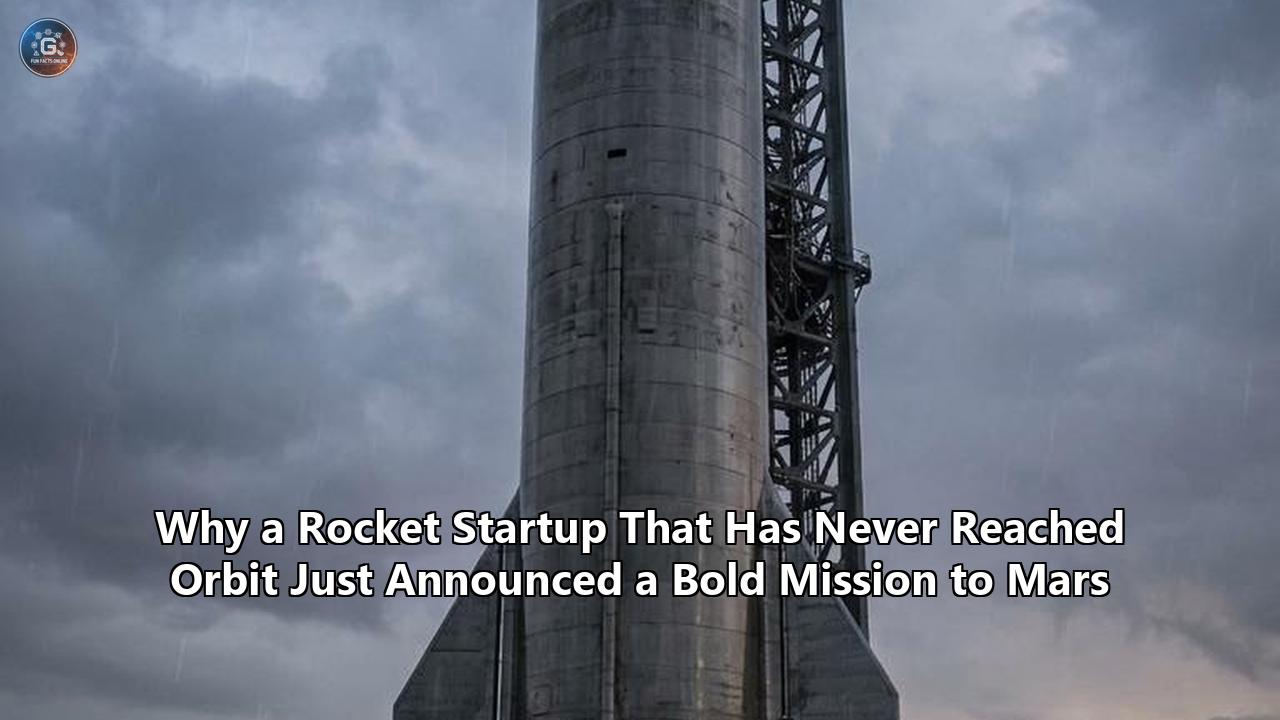
The announcement on June 17, 2026, sent a shockwave through the global aerospace community: NASA had officially selected Relativity Space to build, launch, and operate the Aeolus Mars orbiter mission. The spacecraft, scheduled for a high-stakes departure in 2028, is designed to study the Martian atmosphere with a suite of four advanced science instruments. On paper, it sounds like a standard public-private partnership. In practice, it represents one of the most audacious gambles in the history of planetary exploration.
Relativity Space has reached orbit exactly zero times.
The company’s sole flight experience resides in the March 2023 launch of its pathfinder rocket, the 3D-printed Terran 1, which suffered a second-stage engine failure and plunged into the Atlantic without achieving orbital insertion. Shortly after that failure, the company retired Terran 1 to focus entirely on its larger, medium-to-heavy-lift vehicle, the Terran R—a rocket that has yet to leave the drawing board and test stands. Yet, NASA has entrusted this young, unproven firm with an interplanetary mission to the Red Planet.
This dramatic development is not an isolated piece of corporate luck or an act of agency desperation. Instead, it serves as the ultimate case study for a tectonic shift occurring in the deep-tech ecosystem. By analyzing how a rocket startup that has never achieved orbit secured a Mars contract, we can extract critical principles of modern capital accumulation, sovereign risk hedging, and strategic positioning. The story of this rocket startup mars mission is a blueprint for how unproven deep-tech companies can leverage systemic industry dynamics to leapfrog established players and rewrite the rules of highly regulated, capital-intensive markets.
Anatomy of the Partnership: Inside the Aeolus Mission
To understand the strategic patterns at play, we must first break down the physical and financial architecture of the Aeolus mission itself.
The scientific core of the mission is the Aeolus payload. Designed, built, and integrated at NASA’s Ames Research Center in Silicon Valley, the suite consists of four specialized, highly integrated instruments designed to provide the first daily, global view of the Martian atmosphere:
- Doppler Wind and Temperature Sounder (DWTS-Ozone): Built in collaboration with GATS, this instrument will measure wind and temperature profiles from the Martian surface up to an altitude of roughly 37 miles (60 kilometers).
- Thermal Limb Sounder (TLS): Developed alongside Xiomas Technologies, the TLS maps vertical temperature structures while tracking Martian dust and water-ice clouds.
- Surface Radiometric Sensor Package (SuRSeP): This package measures the surface energy balance, tracking how the Martian ground absorbs, stores, and radiates solar heat.
- Wide-Field Context Camera (WFCC): A dedicated optical system designed to capture daily global images of Martian atmospheric and weather activity.
The scientific urgency of Aeolus cannot be overstated. By studying global winds, seasonal dust storms, and thermal profiles, NASA hopes to refine the atmospheric entry, descent, and landing models required for future robotic payloads and, eventually, crewed missions.
Yet the division of labor under the six-year reimbursable Space Act Agreement is highly asymmetric. While NASA provides the science instruments and manages the data-processing pipeline, Relativity Space is responsible for everything else: the spacecraft bus, the launch vehicle, the cruise phase, and deep-space mission operations.
                                  +------------------------------------+
                                  |     NASA AMES RESEARCH CENTER      |
                                  |  (Science Instruments & Data)      |
                                  +-----------------+------------------+
                                                    |
                                                    | Payload Delivery
                                                    v
+------------------------------------+    +----------------------------+
|        RELATIVITY SPACE            |--->|      AEOLUS SPACECRAFT     |
| (Terran R Rocket & Spacecraft Bus) |    | (Includes Relay Data Center)
+------------------------------------+    +-------------+--------------+
                                                        |
                                                        | Interplanetary Cruise
                                                        v
                                          +----------------------------+
                                          |        MARS ORBIT          |
                                          | (Scientific & Data Relay)  |
                                          +----------------------------+
To deliver this payload, Relativity plans to use its under-development Terran R launcher. Standing 284 feet tall with a 17.7-foot diameter, the rocket is powered by 13 gas-generator Aeon R engines on its first stage, burning liquid oxygen and liquid methane to generate approximately 3.5 million pounds of thrust.
Crucially, the mission features a secondary, highly commercial payload: what Relativity calls a "Relay Data Center". This is a server-class orbital computing cluster with mass storage, designed to run on-board artificial intelligence models and beam massive volumes of data back to Earth via high-bandwidth optical and radio links.
This hybrid architecture of cutting-edge government science and private infrastructure is backed by an unnamed philanthropic donor. It is a complex, high-risk machine. But the real lesson of the Aeolus deal lies in the strategic mechanisms that made it possible.
Lesson 1: The "Interplanetary Leapfrog" Strategy
In the traditional aerospace playbook, rocket startups follow a rigid, linear path to maturity. They begin with suborbital test flights, progress to small-satellite launches in Low Earth Orbit (LEO), attempt to secure medium-lift commercial contracts, and only then—after decades of proven reliability—do they dare to pitch for interplanetary missions.
This ladder is broken.
The LEO launch market has become a hyper-competitive, low-margin trap. Dominated by SpaceX’s highly optimized Falcon 9 cadence, any rocket startup attempting to compete purely on LEO delivery margins faces a brutal price-to-orbit war. Startups like Astra and ABL Space have foundered in the transition from prototypes to commercial LEO operations, starved of the immense capital required to achieve scale.
Relativity Space faced a similar existential cliff. By late 2024, the capital-intensive nature of developing the massive Terran R was colliding with a tightening venture capital market. The "3D-printed rocket" marketing hook that had propelled the company to a multibillion-dollar valuation during the cheap-money era was losing its luster.
The strategic pivot came when former Google CEO Eric Schmidt acquired a controlling interest in Relativity and took the helm as CEO in March 2025. Under Schmidt’s direction, the company executed what can be termed the Interplanetary Leapfrog. Instead of burning cash to prove themselves in the crowded LEO satellite delivery market, they leveraged a high-prestige, deep-space target to restructure their entire business model.
TRADITIONAL STRATEGY:
Suborbital Tests ---> LEO Launches ---> Constellation Cargo ---> Interplanetary
(High cost, low margin, brutal commodity competition at LEO)

INTERPLANETARY LEAPFROG STRATEGY:
Unflown Hardware ---> Interplanetary Prestigious Mission ---> Sovereign Alignment
(High risk, high prestige, avoids LEO price-war trap, attracts off-budget capital)
By aiming directly for Mars, Relativity achieved three immediate strategic advantages:
- Brand Differentiation: They escaped the comparison trap with other LEO small-to-medium launchers. They are no longer just another rocket startup trying to build a cheaper Falcon 9; they are an interplanetary logistics provider.
- Access to Off-Budget Capital: A mission to Mars holds a unique psychological allure for high-net-worth individuals. By positioning the company as an interplanetary platform, Schmidt unlocked philanthropic funding that would never have been available for a routine Starlink-style deployment.
- Forced Organizational Maturity: Nothing forces an engineering team to resolve bottlenecks faster than a fixed, interplanetary launch window. The laws of orbital mechanics dictate that the Earth-to-Mars transfer window opens only once every 26 months. Miss the 2028 window, and the project must wait until 2030. This unforgiving countdown strips away academic delays and forces rapid engineering pragmatism.
For deep-tech founders, the lesson is clear: When the immediate commercial market is commoditized or monopolized, the most viable path to survival is often to leapfrog to a high-prestige, high-complexity problem. By aiming further out, you can bypass the valuation death spiral of near-term markets and attract the sovereign and philanthropic capital reserved for era-defining achievements.
Lesson 2: Exploiting the Sovereign Hedge Against Monopoly
The second strategic principle exposed by the Aeolus mission is the "Sovereign Hedge." To understand why NASA would award an interplanetary contract to an unflown launch vehicle, one must understand the systemic anxiety gripping the halls of government space agencies.
SpaceX has achieved a near-monopoly on Western orbital launch capacity. In 2025, Elon Musk’s company completed 165 successful orbital missions, accounting for the vast majority of all payloads sent to orbit globally. For national space agencies, this absolute dependence on a single commercial provider is a critical vulnerability. A single systemic failure in the Falcon 9 fleet, or a geopolitical pivot by SpaceX's leadership, could halt Western access to space overnight.
Enter Jared Isaacman, who was confirmed as NASA Administrator in December 2025. Isaacman's perspective is uniquely dualistic. As a highly trained commercial astronaut who commanded SpaceX's Inspiration4 and Polaris Dawn missions, he has witnessed SpaceX's technical brilliance firsthand. But as the head of a sovereign space agency, he knows that a healthy, resilient space program cannot exist under a monopoly.
During an event at Relativity Space’s headquarters, Isaacman made NASA’s philosophy explicit, calling the partnership a "force multiplier for science". He added:
"By pairing NASA's world-class instruments with commercial innovation and investment, we can deliver more science, more often, and reduce the time it takes to get essential data into the hands of researchers preparing for future human missions to Mars."
                     +----------------------------+
                     |    SYSTEMIC RISK SHIFT     |
                     +--------------+-------------+
                                    |
            +-----------------------+-----------------------+
            |                                               |
            v                                               v
+-----------------------+                       +-----------------------+
|   THE SPACEX GOLIATH  |                       |  THE UNPROVEN STARTUP |
|   - 160+ launches/yr  |                       |  - Zero orbital flights|
|   - Monopolistic hold |                       |  - High execution risk|
|   - High-cost lock-in |                       |  - Systemic hedge     |
+-----------------------+                       +-----------------------+
            |                                               |
            v                                               v
  Sovereign Dependency                            Sovereign Incubation
 (Unacceptable long-term risk)                   (Actively funded to build market)
This points to a profound systemic principle: Sovereign buyers will actively fund and incubate unproven, high-risk competitors to prevent vendor lock-in.
If NASA only purchased launch services from companies with flawless flight histories, it would structurally guarantee that no new launch providers could ever emerge. To break this catch-22, the agency must accept what outside observers might call "reckless" or "unacceptable" technical risk.
For Relativity, this meant that their lack of an orbital flight record was not an automatic disqualifier. On the contrary, their status as a well-capitalized, technologically sophisticated alternative to SpaceX made them the perfect candidate for a sovereign hedge. NASA’s goal with Aeolus is not just to acquire atmospheric data; it is to force-mature the Terran R launch platform so that the United States has a second, deeply credible heavy-lift commercial path beyond Earth.
Deep-tech startups operating in markets dominated by a single giant should not despair of their lack of scale. Instead, they must position themselves as the necessary strategic alternative. The state, or large enterprise buyers, will often invest heavily in your development simply to ensure that the monopolist does not gain total pricing and operational control over their supply chain.
Lesson 3: Philanthropic Capital as an Off-Budget Accelerator
The financial underpinnings of the Aeolus mission reveal a third critical pattern: the integration of private philanthropy into planetary science.
Historically, exploring the solar system has been the exclusive domain of sovereign states. Robotic missions to Mars, Jupiter, or Saturn require hundreds of millions, often billions, of dollars of taxpayer capital, subject to the whims of congressional appropriations and political cycles. Startups could not participate because there is no immediate commercial return on investment (ROI) for measuring Martian wind speeds or mapping subsurface ice.
The Aeolus deal bypasses this entire constraint through a three-party, off-budget funding structure. Relativity Space has explicitly stated that the mission is being paid for "for a philanthropic customer," whose identity the company has declined to name.
                     +----------------------------+
                     |    PHILANTHROPIC DONOR     |
                     | (Provides Capex / Funding) |
                     +--------------+-------------+
                                    |
                                    v
+----------------------------+   Capital    +----------------------------+
|      RELATIVITY SPACE      |<-------------|        NASA AMES           |
| (Builds, Launches, Operates|              | (Provides Instruments,     |
|   Spacecraft & Rocket)     |              |  Data Pipelines & Science) |
+----------------------------+              +----------------------------+
            |                                               |
            +-----------------------+-----------------------+
                                    |
                                    v
                      +----------------------------+
                      |    HIGH-VALUE DISCOVERY    |
                      |  - Daily global Mars data  |
                      |  - Shared public knowledge |
                      +----------------------------+
Under this model, the economic equation of deep space exploration is completely transformed:
- For NASA: The agency receives high-value, critical scientific data without having to fund the massive capital expenditure (CAPEX) of a dedicated launch vehicle, spacecraft bus development, and cruise operations. They can dedicate their tightly constrained budget strictly to instrument design (Ames Research Center) and subsequent scientific analysis.
- For the Philanthropist: The donor achieves monumental, historical impact. Instead of funding another university laboratory or building a museum wing, their capital is directly responsible for humanity’s next major scientific leap at Mars.
- For Relativity Space: The company receives a fully funded, real-world development program. The philanthropic capital acts as non-dilutive R&D funding, allowing them to build out the interplanetary capabilities of the Terran R and its spacecraft bus while under the watchful, expert guidance of NASA's engineering teams.
This model demonstrates how deep-tech startups can solve the "valley of death" funding gap. When a technology is too early or capital-intensive for venture capital, and too unproven for standard government procurement, the key is to identify philanthropic partners who value prestige and long-term societal impact over immediate cash-on-cash returns. By wrapping a commercial development program in the mantle of high-prestige public science, startups can unlock massive, low-cost capital pools to finance their physical infrastructure.
The Technology Pivot: From 3D-Printing Hype to Pragmatic Engineering
To understand how Relativity Space positioned itself to execute this ambitious Mars mission, one must examine the profound internal engineering transformation the company underwent between 2023 and 2025.
When Relativity was founded in 2015, its core thesis was radical: 3D-print 95% of a rocket. Additive manufacturing was pitched as the ultimate disruptor that would eliminate traditional tooling, simplify supply chains, and allow a rocket to be printed from raw powder to launchpad in under 60 days.
This vision was tested with the Terran 1 launch in March 2023. While the rocket proved that a 3D-printed structure could survive the extreme aerodynamic and structural stresses of Max-Q (maximum dynamic pressure), it also exposed the physical limitations of the "print everything" dogma. Printing the massive, simple, straight-walled propellant tanks of a rocket is slow, expensive, and structurally inefficient. 3D printing is fantastic for complex, highly consolidated structures, but traditional metal-rolling and friction stir welding are vastly superior for simple cylinders.
                 RELATIVITY'S MANUFACTURING PIVOT (2023-2025)

     OLD PATH (Terran 1 Era)                 NEW PATH (Terran R/Aeolus Era)
  +---------------------------+          +---------------------------+
  |    PRINT EVERYTHING       |          |    HYBRID ENGINEERING     |
  |  - Fuselage: 3D Printed   |          |  - Fuselage: Rolled Al-Li |
  |  - Tanks: 3D Printed      |          |  - Tanks: Friction Stir   |
  |  - Engines: 3D Printed    |          |  - Engines: 3D Printed    |
  +-------------+-------------+          +-------------+-------------+
                |                                      |
                v                                      v
     Production Bottlenecks,                Rapid Production Cadence,
     Weight Penalties, Slow                 Optimized Structural Weight,
     Scaling to Heavy-Lift                  High-Performance Reusability
When Eric Schmidt took control of the company, he enforced a brutal, pragmatic reality check. The company officially abandoned the dogmatic pursuit of 3D printing the entire rocket fuselage. For the Terran R, the massive straight barrel tanks are now manufactured using high-strength aluminum-lithium alloys via traditional aerospace methods.
However, additive manufacturing was concentrated where it has the highest leverage: the propulsion systems. The 13 Aeon R engines powering the first stage of Terran R, and the single Aeon V vacuum engine on the second stage, remain heavily 3D-printed. These engines utilize advanced powder bed fusion and wire arc additive manufacturing to produce complex internal cooling channels and turbopump geometries that would be impossible to manufacture using traditional CNC machining.
Furthermore, the company deferred its initial plans for full, rapid second-stage reusability, focusing instead on first-stage reuse to ensure the rocket could get to the pad quickly.
This engineering pivot is a classic lesson in reconciling technology hype with physical and economic limits. Relativity did not abandon its core expertise in additive manufacturing; instead, it applied it pragmatically. By stripping 3D printing away from simple structures where it was causing bottlenecks, and focusing it on highly complex propulsion components, the company dramatically shortened the development timeline of Terran R. This newfound operational pragmatism is precisely what gave NASA the confidence to trust them with the Aeolus spacecraft.
The Risk Matrix: Why Mars is an Unforgiving Proving Ground
Despite the brilliant strategic alignment, the Aeolus mission remains a tightrope walk over an active volcano. Mars is historically known as the "ghoul of the solar system"—a graveyard for nearly half of the robotic missions sent there since the dawn of the space age.
For Relativity Space, the technical and operational risks are concentrated in three critical areas:
1. The Compressed Development Runway
The launch window for Mars opens in late 2028. This gives Relativity an incredibly tight timeline to accomplish several massive milestones:
- Complete the development and testing of the 13-engine Aeon R propulsion cluster.
- Conduct the maiden test flights of the Terran R rocket from Cape Canaveral.
- Design, build, and test an entirely new interplanetary spacecraft bus capable of surviving the deep-space radiation environment.
- Integrate NASA’s sensitive scientific instruments and complete vacuum chamber testing.
In the aerospace sector, first-generation orbital launchers almost always experience development delays. If Terran R’s debut slips from its target of late 2026/2027 into early 2028, the company will have virtually zero margins to clear the rocket for its first-ever interplanetary flight.
2. The Mechanics of Deep-Space Cruise and Orbit Insertion
Reaching Low Earth Orbit is technically challenging; reaching Mars is an order of magnitude more complex.
                                  +------------------------------------+
                                  |    TRANS-MARS INJECTION (TMI)      |
                                  | (Requires precise upper stage burn)|
                                  +-----------------+------------------+
                                                    |
                                                    v
                                  +------------------------------------+
                                  |        DEEP-SPACE CRUISE           |
                                  | (9-month radiation & thermal exposure)
                                  +-----------------+------------------+
                                                    |
                                                    v
                                  +------------------------------------+
                                  |       MARS ORBIT INSERTION         |
                                  | (Critical, autonomous engine burn) |
                                  +------------------------------------+
After escaping Earth's gravity, the upper stage of Terran R must execute a precise Trans-Mars Injection (TMI) burn. Once on its nine-month transit, the spacecraft bus must maintain thermal control, manage orientation, and survive solar radiation storms.
The ultimate test occurs at arrival: the Mars Orbit Insertion (MOI) maneuver. The spacecraft must autonomously fire its onboard propulsion system at a precise moment, decelerating just enough to be captured by Martian gravity. Fire too long or too short, and the spacecraft will either burn up in the thin Martian atmosphere or skip off into heliocentric space, lost forever. This is an operational domain where Relativity has zero heritage.
3. The Hardware-Software Integration
The Aeolus mission also has to integrate the traditional scientific software architectures of NASA Ames with Relativity’s commercial "Relay Data Center". Managing high-bandwidth optical laser communication across millions of miles of deep space, while maintaining server-class computing stability in a radiation-heavy orbit, is an unsolved problem for a vehicle of this class.
Extracting the Playbook: Three Golden Rules for Deep-Tech Startups
The strategic maneuvers that led to the Aeolus Mars mission offer a powerful set of lessons for founders, executives, and investors working in highly regulated, capital-intensive deep-tech sectors—whether in aerospace, quantum computing, fusion energy, or synthetic biology.
+-----------------------------------------------------------------------------------+
|                        THE NEW DEEP-TECH PLAYBOOK                                 |
+-----------------------------------------------------------------------------------+
|  RULE 1: THE PRESTIGE ARBITRAGE                                                   |
|  - Bypass low-margin commodity markets.                                           |
|  - Focus on a high-prestige, high-complexity problem.                             |
|  - Unlock philanthropic and non-dilutive capital.                                 |
+-----------------------------------------------------------------------------------+
|  RULE 2: THE SYSTEMIC COMPLEMENT                                                  |
|  - Avoid head-to-head competition with monopolistic giants.                        |
|  - Position your business as the necessary strategic alternative (sovereign hedge).|
|  - Let sovereign anxiety fund your technological maturity.                       |
+-----------------------------------------------------------------------------------+
|  RULE 3: PRAGMATIC RECONCILIATION                                                 |
|  - Discard dogmatic adherence to a single "revolutionary" technology.              |
|  - Use hybrid engineering: combine traditional methods with high-leverage tech.   |
|  - Solve for speed-to-market over ideological purity.                             |
+-----------------------------------------------------------------------------------+
Rule 1: Master the "Prestige Arbitrage"
When developing a breakthrough technology, do not let your startup get dragged into a price-war commodity market before your technology is mature. If Relativity had focused solely on offering the cheapest LEO satellite rides, they would have competed directly with SpaceX's marginal costs and gone bankrupt.
Instead, use the Prestige Arbitrage. Align your unproven physical capabilities with an inspirational, high-prestige goal (like Mars, deep-ocean exploration, or grid-scale fusion). This changes your capital structure, transforming you from a commodity supplier into an era-defining infrastructure platform, and unlocking off-budget philanthropic funding.
Rule 2: Position Yourself as the "Systemic Complement"
Every industry giant creates a shadow of systemic risk. The larger and more successful a company like SpaceX, TSMC, or Nvidia becomes, the more desperately their customers—and national governments—will look for a viable alternative to hedge their risk.
Do not try to destroy the giant; instead, position your startup as the necessary systemic alternative. Show the sovereign buyer that by backing you, they are purchasing long-term resilience and market health. If you align your survival with the strategic interests of national security or agency independence, you will find that sovereign buyers are willing to underwrite your technical development and accept unprecedented levels of execution risk.
Rule 3: Enforce Pragmatic Engineering Over Ideological Purity
The transition of Relativity from "the 3D-printing rocket company" to a pragmatic hybrid-manufacturing aerospace company is a masterclass in leadership.
Many deep-tech startups fail because they fall in love with their manufacturing process or their specific technical gimmick, rather than the product itself. If a traditional rolled-metal tank is faster, lighter, and cheaper to produce, discard the 3D-printer and use traditional tooling. Concentrate your proprietary, high-leverage technology (like advanced 3D-printed engine cooling channels) where it adds the absolute most performance value. Your goal is to get to the launchpad, not to prove an ideological point.
What to Watch Next
As we look toward the 2028 launch window, the path ahead for Relativity Space and NASA’s Aeolus mission is packed with highly visible milestones. The success or failure of this historic partnership will be determined by several key developments over the next 24 to 36 months:
- Terran R Engine Testing (2026): Watch for full-duration hot-fire tests of the Aeon R engine at NASA’s Stennis Space Center. Success here will prove the structural integrity of their high-pressure, 3D-printed methane propulsion systems.
- The Maiden Flight of Terran R (Late 2026/2027): This will be the defining technical milestone. The rocket must successfully clear Launch Complex 16 at Cape Canaveral, survive aerodynamic pressure, execute stage separation, and achieve orbital insertion.
- Spacecraft Bus Integration (2027): Relativity must reveal and test the physical spacecraft bus that will carry the Aeolus instruments. Watch for the integration of the "Relay Data Center" and vacuum-chamber environmental testing.
- The 2028 Launch Window: The ultimate moment of truth. If the rocket and spacecraft are on the pad and ready when the planetary transfer window opens, Relativity will have pulled off one of the greatest industrial accelerations in human history, positioning Eric Schmidt to directly challenge Elon Musk in the race to the Red Planet.
By embracing extreme technical risk, leveraging sovereign anxieties, and utilizing philanthropic capital, Relativity Space has managed to leapfrog the traditional trajectory of aerospace maturity. Whether Aeolus ultimately achieves a stable orbit around Mars or joins the long list of interplanetary shipwrecks, the strategic blueprint of this bold mission has already rewritten the playbook for how deep-tech startups can turn unproven capability into world-class opportunity.
Reference:
- https://startupfortune.com/nasas-bet-on-relativity-space-for-a-2028-mars-mission-is-either-visionary-or-a-warning-sign-about-spacex-dependency/
- https://hothardware.com/news/nasas-new-mars-partnership-sets-up-a-private-race-with-spacex
- https://spacedaily.com/sd-in-june-2026-relativity-space-the-rocket-company-eric-schmidt-took-over-in-2025-whose-one-rocket-has-never-reached-orbit-said-it-would-privately-build-and-fly-a-mars-orbiter-i/
- https://informat.ro/en/itc-knowledge/the-aeolus-project-nasa-collaborates-with-relativity-space-for-the-exploration-of-mars-126800
- https://www.nasa.gov/news-release/nasa-announces-public-private-partnership-to-advance-mars-science/
- https://www.primetimer.com/features/nasa-and-relativity-space-join-forces-to-launch-a-mars-science-mission-in-2028
- https://in.mashable.com/science/111216/nasa-ropes-google-co-founder-eric-schmidts-rocket-company-for-mission-mars-spacex-out
- https://spacedaily.com/sd-in-june-2026-relativity-space-the-rocket-company-eric-schmidt-took-over-in-2025-whose-one-rocket-has-never-reached-orbit-said-it-would-privately-build-and-fly-a-mars-orbiter-i/
- https://universemagazine.com/en/nasa-brings-in-a-private-company-for-a-scientific-mission-to-mars/
- https://americanbazaaronline.com/2026/06/18/nasa-selects-relativity-space-for-privately-funded-mars-science-mission-483092/
- https://www.autoevolution.com/news/nasas-next-mars-mission-depends-on-a-rocket-that-has-never-flown-271765.html
- https://thenextweb.com/news/nasa-relativity-space-eric-schmidt-mars-aeolus
- https://timesofindia.indiatimes.com/technology/tech-news/as-nasa-picks-former-google-ceo-eric-schmidts-rocket-company-for-mars-mission-some-analysts-see-it-as-a-risk/articleshow/131822147.cms
- https://aerospacetoday.net/revolutionizing-the-industry-relativity-space-leaves-dogma-behind-for-terran-r/
- https://www.futura-sciences.com/en/how-a-wild-startup-just-changed-space-forever-with-this-stunning-move_34029/
- https://spaceflightnow.com/2025/12/18/senate-confirms-jared-isaacman-as-15th-nasa-administrator/
- https://www.nasa.gov/people/jared-isaacman/
- https://www.space.com/space-exploration/us-senate-confirms-jared-isaacman-as-new-nasa-administrator
- https://spaceq.ca/private-industry-takes-the-wheel-for-new-nasa-mission-to-mars/
- https://www.reddit.com/r/SpaceXLounge/comments/p505ve/when_3d_printed_rockets/
- https://www.reddit.com/r/SpaceXMasterrace/comments/12jolxw/as_far_as_im_concerned_theyre_abandoning_reusable/
- https://www.autoevolution.com/news/nasa-tasks-space-company-with-a-single-failed-launch-with-sending-crucial-instruments-to-mars-271688.html
- https://www.tctmagazine.com/relativity-key-findings-terran-1-launch-shifts-focus-terran-r/
- https://en.wikipedia.org/wiki/Mars_Climate_Orbiter