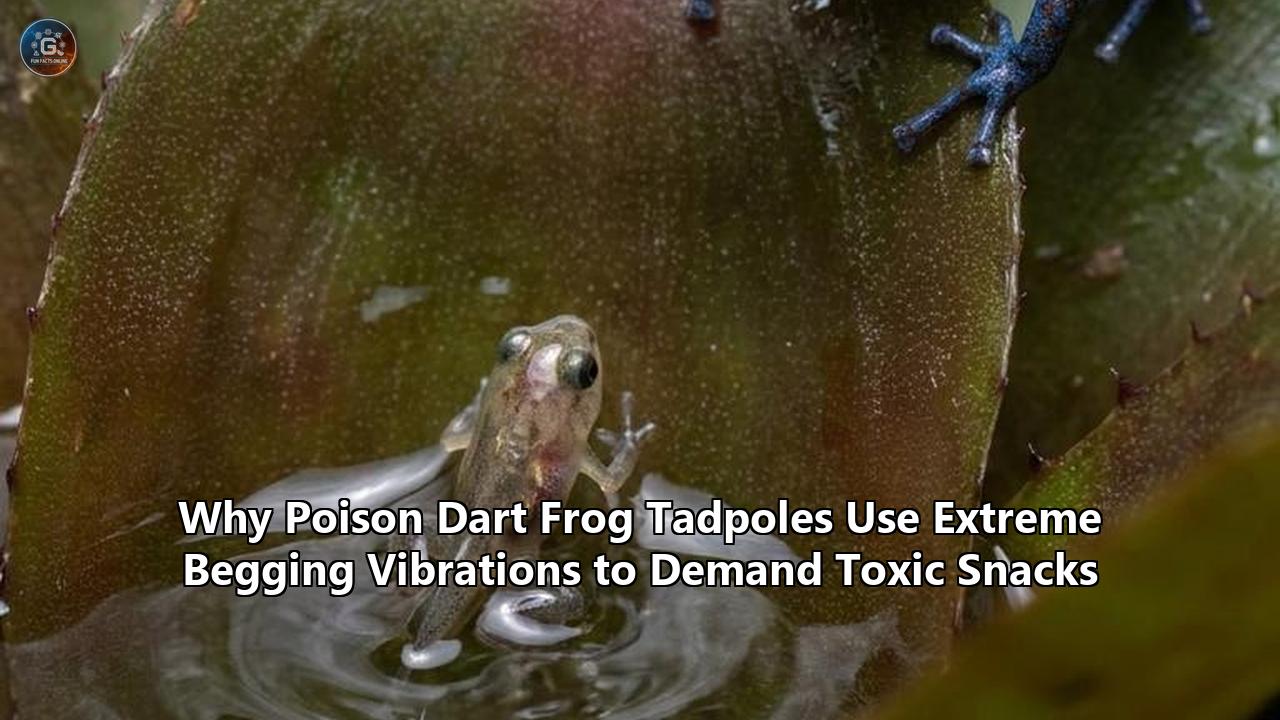
In the humid understory of the Central and South American rainforests, a biological negotiation is unfolding that upends long-held theories of animal communication and maternal care. Evolutionary biologists and neuroethologists studying the strawberry poison frog (Oophaga pumilio) and the mimic poison frog (Ranitomeya imitator) have mapped the mechanical, chemical, and neural feedback loops governing a survival strategy: the extreme, highly coordinated begging vibrations executed by developing larvae.
When a mother frog visits her offspring, isolated in a tiny, water-filled leaf axil high in the canopy, the larva does not merely wait to be fed. Instead, it undergoes a dramatic physical transformation. It stiffens its tail, positions its body at a precise angle of 45 degrees or greater relative to the mother, and begins to vibrate its entire body at high frequencies. This intense, frantic wiggling is not a simple plea for sustenance. It is an evolutionary demand for a highly specialized, unfertilized egg laden with lethal alkaloid toxins—a "toxic snack" that serves as both vital sustenance and a chemical shield.
This discovery exposes a complex web of parent-offspring conflict, transgenerational toxin transfer, and sensory integration. By unpacking the mechanical costs of this behavioral display and matching them with the chemical benefits of maternal egg provisioning, researchers are rewriting the rules of how animal families negotiate resources. This behavioral analysis explores the immediate ecological impacts, the sensory changes, and the long-term evolutionary consequences of this extreme biological transaction.
The Canopy Cradle: Anatomy of a High-Stakes Negotiation
To understand why poison dart frog tadpoles must beg so violently, one must first look at the extreme environments in which they are raised. Unlike most amphibians, which lay thousands of eggs in large, nutrient-rich bodies of water and abandon them to their fate, many dendrobatid poison frogs are dedicated parents. They lay small clutches of eggs in the terrestrial leaf litter. Once the eggs hatch, a parent—often the father, though sometimes the mother—transports the newly hatched larvae on their back, embarking on a vertical climb of up to several meters into the rainforest canopy.
[Forest Floor Clutch] ---> [Hatching] ---> [Parental Transport Up Canopy]
                                                      │
                                                      ▼
                                         [Single Tadpole in Bromeliad Axil]
                                                      │
                                                      ▼
                                       [Nutrient-Poor "Canopy Cradle"]
Their destination is a series of tiny, isolated micro-pools known as phytotelmata. These pools are formed by the tightly overlapping leaves of bromeliads and other epiphytic plants. To a young larva, a phytotelm is a double-edged sword:
- Safety from predators: It is far removed from the predatory fish, large beetles, and aggressive conspecifics that patrol large lakes and streams.
- Severe nutrient starvation: These tiny pools contain almost no organic matter, no algae, and no small invertebrates to feed upon.
In this watery prison, the larva is entirely dependent on its mother for survival. Every few days, the mother returns to each isolated pool to deliver a meal. Because she rears her concurrent offspring in physical isolation, she must make active, individual decisions about which pool to visit and how many resources to allocate.
When the mother arrives at the pool's edge, she does not automatically release an egg. She peers into the water, waiting for a signal. If the larva fails to perform its intense, vibratory begging display, she will climb out of the pool and leave, abandoning the offspring to starve.
This begging display is physically exhausting. Using high-speed video capture at 120 frames per second, researchers have measured the biomechanics of this behavior. The larva stiffens its muscular tail, aligns its body close to the mother's skin, and vibrates at rapid frequencies. This motion generates mechanical waves in the tiny water pool, stimulating the mother's skin and cloaca, which eventually triggers the hormonal cascade necessary for her to deposit an unfertilized, nutritive egg.
Who is Affected: The Tripartite Network of Mother, Offspring, and Predator
The consequences of this behavioral feedback loop ripple through every level of the micro-ecosystem, affecting three distinct biological players: the developing larvae, the provisioning mothers, and the canopy predators that patrol the bromeliads.
                 ┌──────────────────────────────────────┐
                 │       PROVISONING MOTHER             │
                 │ - Massive energetic investment       │
                 │ - Suppressed mating drive            │
                 └──────────────────┬───────────────────┘
                                    │  ▲
       Lays unfertilized,           │  │  Vibratory begging
       toxic trophic eggs           │  │  (Tactile stimulus)
                                    ▼  │
                 ┌──────────────────────────────────────┐
                 │       POISON DART FROG TADPOLE       │
                 │ - Locked in nutrient-poor pool       │
                 │ - Must beg to trigger feeding        │
                 └──────────────────┬───────────────────┘
                                    │  ▲
        Begging alerts              │  │  Toxins provide
        predators if mistimed       │  │  defense mechanism
                                    ▼  │
                 ┌──────────────────────────────────────┐
                 │       CANOPY PREDATORS               │
                 │ - Spiders, odonate naiads            │
                 │ - Deterred by acquired alkaloids     │
                 └──────────────────────────────────────┘
1. The Offspring: Negotiating the "Signal of Quality"
For the developing larva, the begging vibration is a vital survival mechanism. However, it is governed by a strict biological rule: the Signal of Quality.
Historically, evolutionary biologists operating under the "Signal of Need" model assumed that offspring begged hardest when they were closest to starvation—a dynamic commonly seen in nestling birds. But in poison dart frog tadpoles, the reality is the exact opposite.
Experiments led by Dr. Matthew Dugas and his colleagues revealed that food-deprived tadpoles actually decrease their begging effort, vibrating at lower frequencies and for shorter durations. Because the act of shaking their body at such high speeds is incredibly taxing, only the healthiest, most well-nourished larvae can maintain the high-frequency vibrations that mothers prefer.
This creates a harsh selective filter. A larva that falls behind in development or suffers from mild starvation loses the physical capacity to beg effectively. In response, the mother, detecting a weak or low-frequency vibration, will withhold her expensive trophic eggs, redirecting her resources to healthier siblings in other pools. The larva is locked in a high-stakes performance where a single slip in physical output can lead to abandonment and death.
2. The Mother: Balancing the Budget of Maternal Investment
For the adult female, producing and delivering trophic eggs is a massive physiological and reproductive investment. Unfertilized trophic eggs are not simply passive yolk sacks; they are complex biological packages enriched with proteins, lipids, and a suite of defensive lipophilic alkaloids.
To provide these, the mother must:
- Forage tirelessly: She must constantly hunt for toxic leaf-litter mites and formicine ants, which are the dietary source of her skin toxins.
- Navigate dangerous terrain: She must make frequent, exhausting journeys up and down the canopy, exposing herself to predators like birds, snakes, and large spiders.
- Forego reproduction: While she is actively provisioning a clutch of larvae, her mating drive is completely suppressed. In Oophaga pumilio, rearing larvae and mating are mutually exclusive behavioral states.
Because her reproductive output is capped by the survival of these few larvae, she cannot afford to waste her trophic eggs. She uses the larva's vibratory signal as an honest metric of its viability. If the larva vibrates vigorously, it signals that it has a high probability of surviving to metamorphosis, making it a worthy recipient of her precious metabolic resources.
3. The Predators: Navigating a Toxic Minefield
The third group affected by this transaction is the community of canopy predators. The water-filled leaf axils of bromeliads are not entirely safe. They are routinely invaded by predatory insects, such as odonate naiads (damselfly and dragonfly larvae), caddisfly larvae, and wandering spiders of the families Ctenidae and Trechaleidae.
These predators are highly sensitive to both water movements and chemical cues. A larva vibrating frantically in a tiny pool of water is essentially ringing a dinner bell. However, because the maternal eggs are laced with potent alkaloids like pumiliotoxin and histrionicotoxin, the larvae quickly become highly toxic to predators.
The acquisition of these "toxic snacks" fundamentally alters predator-prey dynamics in the canopy. Predators that attempt to consume a well-provisioned poison frog larva experience rapid neurological distress, muscle spasms, or death, teaching them to avoid these vibratory targets.
Conversely, if a larva has been unable to solicit eggs and lacks these chemical defenses, it remains highly palatable and vulnerable, making it easy prey for any invading predator.
What Changes: Upending Classic Models of Evolutionary Biology
The discovery of this intense vibratory dialogue has fundamentally shifted our understanding of parent-offspring communication, chemical ecology, and the neurological basis of parenting.
| Biological Dimension | Traditional Scientific Assumption | New Reality Uncovered in Poison Frogs |
|---|---|---|
| Begging Mechanism | Offspring beg hardest when closest to starvation (Signal of Need). | Offspring begging is an energetic luxury; starved larvae cannot sustain the vibrations (Signal of Quality). |
| Chemical Defenses | Amphibian larvae do not carry chemical defenses until they metamorphose and forage on land. | Mothers actively package diet-derived alkaloid toxins into unfertilized egg yolks, protecting larvae early in life. |
| Sensory Integration | Larvae rely on simple, single-modality cues (such as water motion) to recognize parents. | Larvae integrate complex visual, chemical, and tactile cues to verify parental identity before risking a begging display. |
| Neurological Homology | Parental brain structures in amphibians are primitive and unrelated to those of mammals. | Mothers use the same conserved brain regions (preoptic area, lateral septum) associated with nursing in mammals. |
The Death of the "Altruistic Mother" Model
For decades, classical models of parental care were built on the assumption that parents are programmed to preserve their offspring at all costs, especially when those offspring are in dire need. The poison frog study system destroys this romanticized view, replacing it with a cold, game-theoretic negotiation.
Because the mother has complete control over which pools she visits and which larvae she feeds, she operates as a selective filter. She actively practices maternal favoritism, rewarding the strongest, fastest-vibrating offspring with larger and more frequent toxic meals while allowing the weak to waste away. This confirms that offspring solicitation behavior can evolve not to signal hunger, but to advertise genetic and physical superiority.
Transgenerational Chemical Immunization
In the wider animal kingdom, defensive chemicals are rarely passed directly from parent to offspring post-birth. While many insects and some amphibians load their fertilized eggs with protective toxins prior to oviposition, these defenses typically dissipate as the embryo develops, leaving the hatchling defenseless.
The research surrounding poison dart frog tadpoles has demonstrated a rare case of active, post-hatch chemical defense provisioning. By packing her unfertilized trophic eggs with lipophilic alkaloids, the mother is essentially vaccinating her offspring against the local predator guild.
This is the first verified vertebrate system where maternal provisioning serves the dual purpose of primary nutrition and active chemical defense transfer throughout the larval stage.
Mother eats toxic mites/ants
  │
  ▼
Alkaloids sequestered in skin glands
  │
  ▼
Alkaloids transferred to internal oocytes & unfertilized eggs
  │
  ▼
Unfertilized eggs deposited in bromeliad pool
  │
  ▼
Tadpole consumes egg -> sequesters alkaloids in its own skin
The Common Architecture of the Parental Brain
On a neurobiological level, the study of these maternal interactions has revealed a deep, evolutionary homology across the vertebrate tree. Led by Dr. Lauren O’Connell at Stanford University, researchers mapped the brain activity of nursing poison frog mothers. They discovered that when a mother is stimulated by her offspring's vibrations and prepares to deposit a trophic egg, two specific brain regions light up with neural activity: the lateral septum and the preoptic area.
These are the exact same brain regions that regulate nursing, lactation, and maternal bonding in mammals, as well as parental behavior in birds and maternal mouth-brooding in fish. Despite millions of years of evolutionary divergence, nature has used the same basic neural circuit to construct the "maternal brain" across wildly different lineages. The frantic vibrations of a tiny tadpole high in a tropical tree axil are triggering the same ancient neurological machinery that drives a mammal to nurse her newborn.
Short-Term Consequences: The Immediate Balance Sheet of Survival
On a day-to-day basis, the decision to beg is a delicate calculation of energy expenditure, predator avoidance, and microhabitat coordination. The short-term consequences of this behavioral strategy are immediate and high-risk.
1. The Glycogen Drain: Energetic Bankruptcy
Vibrating at frequencies up to 120 times per second is one of the most metabolically expensive activities an amphibian larva can perform. It requires the rapid, sustained contraction of axial muscles and the constant consumption of glycogen reserves.
If a larva performs this display and successfully solicits a trophic egg, the metabolic payout is immense: a highly concentrated package of proteins and lipids that more than compensates for the energy lost during the dance.
However, if the mother is disturbed, fails to deposit an egg, or if the larva begs to a non-responsive visitor, the energetic cost is devastating. Larvae that are experimentally forced to beg without receiving food show immediate, drastic reductions in their somatic growth rates. Over the course of just a few days, repeated unsuccessful begging can drain a larva's energy reserves to the point of developmental arrest or starvation, creating a highly volatile physiological balance sheet.
2. The Multi-Sensory Security Check
Because begging is both energetically draining and highly conspicuous to predators, poison dart frog tadpoles cannot afford to make mistakes. If a visitor approaches their pool, they must determine its identity with absolute precision before initiating their vibration.
Research has shown that these larvae are master sensory integrators, relying on a complex, multimodal suite of cues to verify that the visitor is indeed their mother:
                     VISITOR APPROACHES POOL
                                │
         ┌──────────────────────┼──────────────────────┐
         ▼                      ▼                      ▼
    [Visual Cue]        [Chemical Cue]         [Tactile/Vibrational Cue]
(Detects shape & color)  (Detects adult skin)    (Detects footsteps/waves)
         │                      │                      │
         └──────────────────────┼──────────────────────┘
                                │
                                ▼
                   [All 3 Cues Match Mother?]
                                │
         ┌──────────────────────┴──────────────────────┐
         ▼ Yes                                         ▼ No
[Frantic Begging Vibration]                    [Freeze & Drop to Bottom]
 (Safe: Food & Toxin Payout)                     (Safe: Avoid Predation)
To test how these cues are prioritized, scientists exposed Oophaga pumilio larvae to isolated sensory inputs:
- Visual cues alone: When presented with the sight of an adult frog through a clear barrier, the larvae swam toward it but did not beg.
- Chemical cues alone: When exposed to water containing adult frog scent, the larvae showed increased activity but did not initiate vibrations.
- Tactile and vibrational cues alone: When the water was gently agitated to simulate a frog entering the pool, the larvae remained cautious.
Only when visual, chemical, and tactile cues were presented simultaneously did the larvae perform their extreme begging display. If any of these cues were missing—or if the cues matched a heterospecific frog or a predatory spider—the larvae did not beg. Instead, they froze, flattened themselves against the bottom of the leaf axil, and reduced their respiration rates to avoid detection.
This complex sensory filter ensures that the larva only rings the dinner bell when the provider is standing directly over the table.
3. The Threat of Accidental Cannibalism and Infanticide
Even within their own species, the canopy is a cutthroat environment. While parent-offspring communication is highly developed, adult frogs are not universally benevolent.
Under experimental conditions, researchers documented rare but chilling instances of accidental cannibalism. Unrelated adult frogs of both sexes, when encountering a foreign phytotelm containing a young, highly active larva, will sometimes capture and consume the larva.
Crucially, those larvae that begged most frantically to these unrelated adults were the most likely to be eaten. In the earliest stages of development, before the larva has acquired a sufficient payload of maternal toxins, its frantic vibrations make it a soft, defenseless target. This places a massive selective pressure on the larva's ability to discriminate between its mother and other conspecific adults.
Long-Term Consequences: Evolutionary Bottlenecks and Developmental Trajectories
While the immediate survival of the larva is the most obvious outcome of this vibratory begging, the long-term consequences shape the physical characteristics, evolutionary fitness, and ecological resilience of the entire species.
                  SUCCESSFUL TOXIC PROVISIONING
                                │
         ┌──────────────────────┴──────────────────────┐
         ▼                                             ▼
  [Developmental Outomes]                    [Defense Systems]
  - Larger size at metamorphosis             - High alkaloid skin concentration
  - Faster brain & neural growth             - Complete protection from predators
  - High post-metamorphic survival           - Clear aposematic warning coloration
         │                                             │
         └──────────────────────┬──────────────────────┘
                                │
                                ▼
                     [FIT, ADULT BREEDER]
1. The Metamorphosis Milestone: Size is Everything
In the world of amphibians, the transition from an aquatic larva to a terrestrial juvenile (metamorphosis) is a developmental bottleneck. For poison dart frog tadpoles, the quality and quantity of maternal care received during this window sets the trajectory for their entire adult life.
Because these larvae develop in highly confined, nutrient-poor phytotelmata, they have no alternative food sources. A larva that successfully solicits a steady diet of trophic eggs throughout its six-week development undergoes a rapid, robust metamorphosis. They emerge from the water significantly larger, with higher muscle mass, and carrying a fully loaded chemical defense system.
Conversely, those that receive poor or irregular provisioning suffer permanent developmental deficits. If a mother delivers fewer eggs—either because she is a poor forager or because the larva is a weak begger—the larva does not die immediately. Instead, it undergoes what biologists call "plastic developmental scaling." It simply metamorphoses into a much smaller, miniature version of a frog.
Crucially, these miniature frogs never truly catch up. They remain smaller throughout their adult lives, possess lower jumping endurance, have smaller home ranges, and suffer from significantly reduced reproductive success.
Furthermore, because they did not receive enough toxic eggs, they emerge onto the forest floor with low concentrations of protective alkaloids, making them highly vulnerable to predation during the critical juvenile phase when they are learning to hunt for themselves.
2. Neurological Trade-offs and the Cost of Artificial Diets
The long-term developmental programming of these frogs is tied directly to the quality of their larval diet. In a study published in the journal Developmental Neurobiology, researchers experimentally disentangled the roles of food quantity and food quality in poison frog larvae.
They reared two groups of larvae:
- Group A (Natural Diet): Provisioned with natural, nutrient-rich, toxic trophic eggs.
- Group B (Artificial Diet): Fed an artificial, high-protein, toxin-free diet (typically used in laboratory settings).
The results revealed a stark developmental trade-off. While the artificial diet, being high in raw calories, produced larger larvae, it severely stunted their brain development. Specifically, the larvae reared on the artificial diet had significantly reduced brain volumes in key regions, including those associated with social behavior, sensory integration, and the regulation of begging.
Furthermore, the researchers mapped the activity of urocortin-1 neurons in the midbrain. These neurons are responsible for regulating appetite and social food-solicitation behavior. In the larvae fed the natural diet of trophic eggs, these neural circuits developed normally, permitting highly coordinated, social begging behaviors.
In the artificially reared larvae, these circuits were profoundly disrupted. This reveals that the complex chemical cocktail contained within the mother's trophic eggs—beyond just raw calories—is biochemically required to program the neural circuitry of the offspring's brain. Without these natural "toxic snacks," the frogs are left neurologically compromised, unable to properly coordinate the complex social and survival behaviors required of them as adults.
3. Climate Change and Canopy Desiccation: A Fragile Bond
As we look to the future, the highly specialized relationship between the mother frog and her vibrating offspring faces a severe threat from global climate change. The Neotropical forests of Central and South America are experiencing rising temperatures, prolonged dry seasons, and unpredictable rainfall patterns.
For canopy-dwelling organisms, this is a crisis. Epiphytic bromeliads rely on regular rainfall to keep their leaf axils filled with water. As the forest canopy warms, these tiny micro-pools are the first to dry up, a process known as canopy desiccation.
               PROLONGED DRY SEASONS & RISING TEMPERATURES
                                │
                                ▼
                   [Canopy Pool Desiccation]
                                │
         ┌──────────────────────┴──────────────────────┐
         ▼                                             ▼
  [Impacts on Tadpoles]                      [Impacts on Mothers]
  - Shrunking nurseries                      - Must forage further for toxic prey
  - Rapidly rising water temperatures        - Dehydration limits canopy climbs
  - Severe crowding and cannibalism          - Reduced egg production rates
         │                                             │
         └──────────────────────┬──────────────────────┘
                                │
                                ▼
              [Breakdown of Toxic Provisioning Chain]
              - Larvae starve or lack chemical defenses
              - High juvenile and adult mortality rates
When a bromeliad pool begins to dry, the physical and chemical conditions within the nursery deteriorate rapidly:
- Crowding and Cannibalism: If water levels drop, larvae from different axils may find themselves crowded together, leading to fierce cannibalism.
- Temperature Stress: Shallow water heats up quickly, increasing the metabolic rate of the larva. This drastically spikes the energetic cost of its begging vibration, causing it to burn through its glycogen reserves even faster.
- Foraging Bottlenecks for Mothers: During dry spells, the forest-floor mites and ants that the mother frog relies on for her alkaloid toxins migrate deeper into the soil, making them harder to find.
If the mother cannot acquire toxins, she cannot package them into her trophic eggs, breaking the chain of transgenerational chemical defense.
Furthermore, as the mother becomes dehydrated, she reduces her exhausting trips up into the canopy to visit her offspring.
The delicate, high-energy dialogue between the vibrating larva and the provisioning mother is built on a foundation of stable canopy humidity. If that foundation crumbles, this extraordinary evolutionary adaptation could become a developmental trap, leading to widespread reproductive failure across these fragile rainforest lineages.
Future Research Horizons: The Unresolved Questions of 2026
As researchers push deeper into the sensory and molecular biology of these amphibians, several critical questions remain unanswered, serving as the frontier for the next generation of evolutionary research.
1. The Physics of the Lateral Line: Translating Waves to Brain Activity
While we know that poison dart frog tadpoles integrate visual, chemical, and tactile cues to identify their mothers, the precise mechanics of their tactile detection remain mysterious. Amphibian larvae possess a highly sensitive lateral line system—a series of mechanoreceptive neuromasts running along their head and body that detect minute water movements.
Researchers are currently working to map how these neuromasts are wired to the larval brain. When a mother frog steps into a bromeliad pool, her legs generate a unique vibrational "footprint" in the water.
Scientists want to know: can the larva distinguish the mechanical frequency of its mother's footsteps from the chaotic vibrations caused by a falling raindrop, a blowing wind, or an approaching predatory spider?
By using neural imaging to monitor brain activity in the larva's hindbrain while exposing it to simulated water waves, researchers hope to unlock the acoustic and mechanical filters of the canopy cradle.
2. The Biogeochemical Secret: Toxin Loading Without Self-Poisoning
Perhaps the most perplexing biological mystery is how the mother frog manages the transport of lethal alkaloids within her own body. The toxins she harvests from her diet—such as pumiliotoxins—are potent blockers of sodium and calcium channels, capable of causing cardiac arrest or paralysis in vertebrates.
Yet, the mother must:
- Store these toxins in her skin glands.
- Transport them through her bloodstream to her ovaries.
- Package them directly into the lipophilic yolk of her unfertilized eggs.
How does she do this without poisoning her own reproductive tissues, her developing eggs, or her own nervous system?
Scientists are hunting for specialized carrier proteins—molecular escorts that bind to the alkaloid molecules, rendering them biologically inert while they are in transit through the mother's body, and only releasing them once they are safely packaged inside the egg yolk.
Unlocking this biochemical pathway could have profound implications for human medicine, potentially offering new methods for delivering highly toxic chemotherapeutic drugs directly to target cells while protecting healthy tissues from collateral damage.
Conclusion: The Symphony of the Canopy
The frantic, high-frequency vibration of a poison dart frog larva in its bromeliad pool is far more than a simple reflex. It is a finely tuned, evolutionary masterpiece—a high-stakes behavioral performance that bridges the gap between nutrition, chemical defense, and neurobiology.
By demanding these "toxic snacks" through extreme physical effort, the larva secures its place in the canopy, transforming itself from a vulnerable, soft-bodied mouthful into a highly defended, chemically armed predator of the future forest floor.
As climate change and environmental degradation continue to reshape the tropical rainforests, understanding the intricate, multi-sensory dialogue between these devoted mothers and their demanding offspring is not just a triumph of basic science. It is a vital tool for conservationists, reminding us that in the web of life, even the smallest, most hidden interactions are bound together by a complex and beautiful evolutionary logic.
Reference:
- https://www.researchgate.net/publication/266888763_Behavioral_Ecology_of_Parental_Care_in_a_Dendrobatid_Frog_Oophaga_Pumilio
- https://pmc.ncbi.nlm.nih.gov/articles/PMC11981533/
- https://scholarship.miami.edu/esploro/outputs/doctoral/Behavioral-Ecology-of-Parental-Care-in/991031447678502976
- https://news.stanford.edu/stories/2019/11/motherly-poison-frogs-shed-light-maternal-brain
- https://pmc.ncbi.nlm.nih.gov/articles/PMC13191372/
- https://www.youtube.com/watch?v=ya39LqxuOpY
- https://www.adoptrainforest.com/strawberry-poison-dart-frog/
- https://cdn.environment.sa.gov.au/greenadelaide/images/Frogs-teacher-information-pack.pdf
- https://eartharchives.org/articles/mimic-poison-frog-tadpoles-wiggle-their-tails-to-beg-for-food/index.html
- https://academic.oup.com/jeb/article/30/5/1024/7381703
- https://www.researchgate.net/publication/242103278_Discrimination_of_offspring_by_indirect_recognition_in_an_egg-feeding_dendrobatid_frog_Oophaga_pumilio
- https://www.youtube.com/watch?v=5U0-vPX3L4c
- https://ufdcimages.uflib.ufl.edu/NC/FE/00/45/66/00001/Cruceanu_R.pdf
- https://www.researchgate.net/publication/257387846_To_beg_or_to_freeze_Multimodal_sensory_integration_directs_behavior_in_a_tadpole
- https://www.researchgate.net/publication/373944297_Adult_poison_frogs_can_capture_and_consume_aquatic_tadpoles
- https://www.ebsco.com/articles/zoology/dc9a2ed9-1c99-5592-9c7a-aa12f4046d0c/tadpole-plasticity-shapes-the-potential-benefits-of-egg-feeding-to-poison-frog-parents
- https://www.researchgate.net/publication/233513296_Female_activity_patterns_and_aggressiveness_in_the_strawberry_poison_frog_Dendrobates_pumilio_Anura_Dendrobatidae
- https://www.researchgate.net/publication/373937467_Mother_strawberry_poison_frogs_might_supplement_nutritive_eggs_with_secretory_provisioning
- https://www.thebhs.org/publications/the-herpetological-journal/volume-25-number-3-july-2015/789-09-diet-and-tadpole-transportation-in-the-poison-dart-frog-i-ameerega-trivittata-i-anura-dendrobatidae/file
- https://pmc.ncbi.nlm.nih.gov/articles/PMC13191372/
- https://www.researchgate.net/publication/266888763_Behavioral_Ecology_of_Parental_Care_in_a_Dendrobatid_Frog_Oophaga_Pumilio
- https://www.biorxiv.org/content/10.1101/653501v1.full-text
- https://en.wikipedia.org/wiki/Frog
- https://pmc.ncbi.nlm.nih.gov/articles/PMC13060187/
- https://www.researchgate.net/publication/380426022_Developments_in_the_study_of_poison_frog_evolutionary_ecology_I_social_interactions_life_history_and_habitat_use_across_space_and_ontogeny
- https://bioone.org/journals/herpetological-monographs/volume-34/issue-1/HERPMONOGRAPHS-D-19-00002.1/Developments-in-Amphibian-Parental-Care-Research--History-Present-Advances/10.1655/HERPMONOGRAPHS-D-19-00002.1.pdf