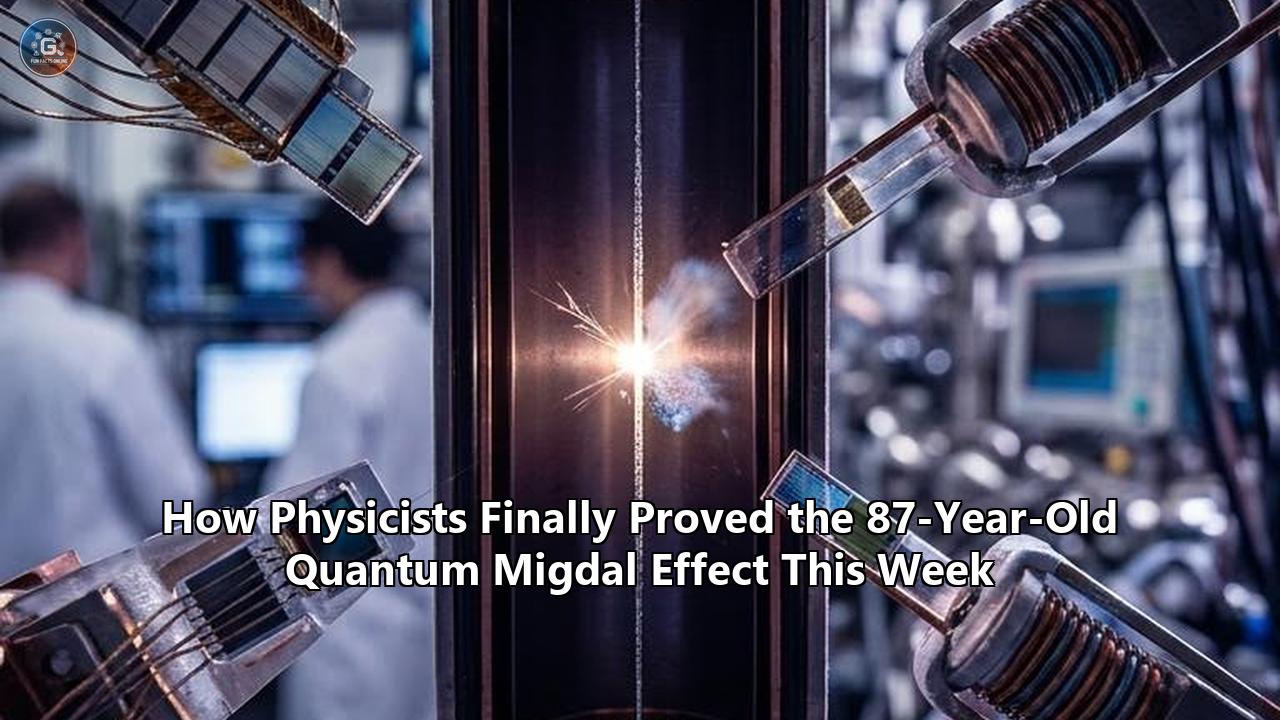
In a definitive experimental triumph published in Nature, an international research team led by physicists at the University of Chinese Academy of Sciences (UCAS) has achieved the first direct experimental observation of the quantum Migdal effect in neutral-particle scattering. The result ends an 87-year quest to confirm one of quantum mechanics' most elusive predictions, verifying that when an atomic nucleus undergoes a violent kinematic recoil, its lagging electron cloud can spontaneously eject an electron.
By bombarding a specialized low-pressure gas detector with monoenergetic neutrons, the collaboration isolated six golden events featuring a unmistakable "co-vertex" topology—two distinct ionization tracks, one thick and one faint, emerging simultaneously from a single atomic coordinate. The observation crossed the definitive five-standard-deviation ($5\sigma$) statistical threshold required to claim a formal discovery in particle physics.
Neutron / Neutral Projectile (v_in)
       │
       ▼
   [ Nucleus ] ──(Sudden Recoil, v_n)──► [Dense Nuclear Track (NR)]
       │
   (Non-adiabatic lag of electron cloud)
       │
       ▼
   [ Ejected Migdal Electron ] ────────► [Faint, Tortuous Track (ER)]

   * Shared Origin: Common Vertex (Δr < 83 μm)
The measurement resolves a major vulnerability in modern astroparticle physics. For years, flagship underground experiments searching for dark matter—such as XENONnT, LUX-ZEPLIN (LZ), PandaX-4T, and DarkSide—have relied on theoretical calculations of the quantum Migdal effect to extend their search reach into the low-mass "sub-GeV" regime. Without empirical proof that neutral-particle impacts actually shake electrons loose from recoiling atoms at the predicted rates, those dark matter boundaries rested on unproven theoretical assumptions.
"Directly observing the Migdal effect in neutral-particle collisions has been an open challenge for nearly nine decades," said Zheng Yangheng, co-leader of the project and professor of physics at UCAS. "This experimental confirmation provides the empirical bedrock needed to interpret signals in light dark matter searches worldwide."
The Core Physics: Sudden Perturbations and Quantum Inertia
The theoretical origin of the phenomenon traces back to 1939, when Soviet theoretical physicist Arkady Migdal formulated a quantum-mechanical description of atomic ionization during nuclear reactions.
┌────────────────────────────────────────────────────────────────────────┐
│                        THE MIGDAL MECHANISM                            │
├────────────────────────────────────────────────────────────────────────┤
│ 1. Initial State:                                                      │
│    Neutral projectile approaches stationary atom in ground state ψ_i.  │
│                                                                        │
│ 2. Sudden Nuclear Jolt (Δt ≈ 10⁻²¹ s):                                 │
│    Projectile scatters off nucleus via strong/weak interaction.        │
│    Nucleus gains velocity v_n almost instantaneously.                  │
│                                                                        │
│ 3. Non-Adiabatic Quantum Lag:                                          │
│    Orbital period of inner electrons (τ_orb ≈ 10⁻¹⁷ s) >> Δt.          │
│    Electrons cannot adjust adiabatically to the shifting Coulomb core. │
│                                                                        │
│ 4. Galilean Frame Boost:                                               │
│    In the nuclear rest frame, the electron cloud experiences a sudden  │
│    momentum boost: ψ'(r) = exp(-i m_e v_n · r / ħ) ψ_i(r).             │
│                                                                        │
│ 5. Shake-Off & Ionization:                                             │
│    Projection onto continuum eigenstates leaves a non-zero transition  │
│    probability: P_ion = |⟨ψ_continuum | exp(-i m_e v_n · r / ħ) | ψ_i⟩|²│
└────────────────────────────────────────────────────────────────────────┘
Under the standard Born-Oppenheimer perspective, atomic electrons adjust smoothly to nuclear movement because the nucleus moves far more slowly than the orbiting electrons. When an incoming neutral particle—such as a fast neutron or a hypothetical dark matter particle—collides with an atomic nucleus, the interaction occurs via short-range forces over nuclear dimensions ($10^{-15}\text{ meters}$).
The duration of this momentum transfer is extraordinarily brief:
$$\Delta t \sim \frac{R_{\text{nucleus}}}{v_{\text{projectile}}} \approx 10^{-21}\text{ seconds}$$
In contrast, the characteristic orbital timescale for an inner-shell atomic electron is:
$$\tau_{\text{orbit}} \sim \frac{\hbar}{E_{\text{binding}}} \approx 10^{-17}\text{ to } 10^{-16}\text{ seconds}$$
Because $\Delta t \ll \tau_{\text{orbit}}$, the sudden approximation of quantum mechanics governs the interaction. The nucleus accelerates to a recoil velocity $\mathbf{v}_n$ almost instantaneously relative to the electron cloud.
In the rest frame of the recoiling nucleus, the atomic electrons suddenly experience a Galilean boost. The initial electronic state $|\psi_i\rangle$ is mapped onto a boosted state:
$$|\psi'_i\rangle = \exp\left(-\frac{i}{\hbar} \sum_{j=1}^{Z} m_e \mathbf{v}_n \cdot \mathbf{r}_j\right) |\psi_i\rangle$$
When this perturbed state is projected onto the complete set of final atomic eigenstates, the off-diagonal transition matrix elements no longer vanish. While the probability remains overwhelmingly concentrated in the electronic ground state (elastic nuclear recoil), a small quantum tail projects directly onto unbound continuum states $|\psi_f\rangle$.
The result is atomic shake-off: the nucleus recoils in one direction, while an electron is ejected into the surrounding medium.
                     Kinematic Energy Distribution

  Total Recoil Energy (E_tot) = E_nuclear + E_electron + E_binding

  ┌─────────────────────────────────┬──────────────────────────────────┐
  │ Nuclear Recoil Track (NR)       │ Electron Recoil Track (ER)       │
  │ • High specific energy loss     │ • Low specific energy loss       │
  │ • Short, dense, linear track    │ • Extended, tortuous, low-dE/dx  │
  │ • Carries majority of momentum  │ • Carries discrete kinetic energy│
  └─────────────────────────────────┴──────────────────────────────────┘
Although physicists confirmed similar shake-off effects during nuclear alpha and beta decays in the 1950s and 1970s, those radioactive processes involve charged particle emissions and sudden changes in nuclear charge ($Z \to Z \pm 1$ or $Z \to Z - 2$). Demonstrating the effect driven strictly by a neutral projectile's kinetic collision against a neutral atom remained unachieved for 87 years.
Why the Effect Remained Undetected for 87 Years
The primary obstacle to detecting the quantum Migdal effect in kinematic collisions has been an unfavorable combination of cross-section suppression, spatial resolution limitations, and overwhelming background radiation.
                 EXPERIMENTAL BOTTLENECK COMPARISON

    Standard Nuclear Recoil           Migdal Ionization Event
   ┌───────────────────────┐         ┌───────────────────────┐
   │                       │         │              e⁻ Track │
   │  Neutron ──► ( N )    │         │  Neutron ──► ( N )───►│
   │               │       │         │               │       │
   │               ▼       │         │               ▼       │
   │           Recoil      │         │           Recoil      │
   │                       │         │                       │
   │  Branching Ratio: ~1  │         │  Branching: ~10⁻⁵     │
   └───────────────────────┘         └───────────────────────┘
1. The Cross-Section Suppression
The probability that an atom undergoes Migdal ionization rather than simple elastic recoil is dictated by the transition matrix element:
$$P_{i \to f} = \left| \int d^3\mathbf{r} \, \psi_f^(\mathbf{r}) \, e^{-i \mathbf{q}_e \cdot \mathbf{r} / \hbar} \, \psi_i(\mathbf{r}) \right|^2$$
where $\mathbf{q}_e = m_e \mathbf{v}_n$ is the momentum transferred to the electron. Because the electron mass $m_e$ is roughly 1,836 times smaller than a single nucleon mass, the magnitude of $\mathbf{q}_e$ is tiny even for sizable nuclear recoils.
Across typical collision energies, the branching ratio of Migdal ionization relative to standard elastic nuclear recoil is between $10^{-4}$ and $10^{-6}$. For every 100,000 neutral particles that scatter off a nucleus, only a few will produce an ejected electron.
2. The Spatial Micro-Scale
In conventional solid or liquid detectors (such as liquid xenon, liquid argon, or germanium crystals), a recoiling nucleus travels only a few tens of nanometers before stopping. An ejected electron with an energy of several kiloelectronvolts ($\text{keV}$) travels less than a single micrometer.
To standard detector readouts, the nuclear recoil and the electron emission merge into a single point-like charge deposit. The experimenter cannot distinguish whether the ionization originated from a single nuclear recoil, a background gamma-ray scatter, or a true Migdal event.
Detector Medium Densities vs. Track Separation Capabilities:

Liquid Xenon / Germanium (Solid/Liquid):
[NR Track: ~50 nm][ER Track: ~1 μm] ──► Merged into an unresolved point

Low-Pressure Gas (50-100 Torr DME/He):
[NR Track: ~1-3 mm] ═══════════════════════════════════════════════════►
                     └─► [ER Track: ~5-15 mm, distinct tortuous path]
3. Background Mimicry
The primary background consists of standard neutron scatters occurring in close temporal coincidence with independent electron interactions (such as Compton scattering from ambient gamma rays or beta decay from detector materials). Isolating a true atomic shake-off requires proving that both the nuclear recoil and the ionization electron originated from the exact same spatial coordinate at the exact same instant.
Inside the Discovery Experiment
To resolve these challenges, the research team led by Difan Yi, Qian Liu, and Yangheng Zheng constructed a custom gaseous time projection system coupled with a pixelated Application-Specific Integrated Circuit (ASIC) readout.
               SCHEMATIC OF THE EXPERIMENTAL APPARATUS

    ┌──────────────────┐
    │  D-D Neutron Gen │ ===> 2.45 MeV Neutrons
    └──────────────────┘          │
                                  ▼
      ┌────────────────────────────────────────────────────────┐
      │ Gas Vessel (Low-Pressure 40% He + 60% DME)             │
      │                                                        │
      │    Cathode Plane (-HV)                                 │
      │    ──────────────────────────────────────────────      │
      │                                                        │
      │           (Neutron Collision)                          │
      │                  │                                     │
      │                  ├──────► Recoil Nucleus Track         │
      │                  │        (High ionization density)    │
      │                  └──────► Migdal Electron Track        │
      │                           (Low ionization density)     │
      │                  │                                     │
      │                  │  Drift Field (E_z)                  │
      │                  ▼                                     │
      │    ──────────────────────────────────────────────      │
      │    Micro-Pattern Gaseous Amplification Stage           │
      │    ──────────────────────────────────────────────      │
      │    Pixelated ASIC Readout Chip (83 μm pixel pitch)     │
      │    [ Ultra-low noise: 13.9 e⁻ ENC ]                    │
      └────────────────────────────────────────────────────────┘
                                  │
                                  ▼
                     Data Acquisition & Analysis
                     (6 Golden Events / ~10⁶ Triggers)
The Low-Pressure Gaseous Target
Rather than using high-density liquids, the team filled their detection chamber with a dilute gas mixture: 40% Helium ($\text{He}$) and 60% Dimethyl Ether ($\text{DME}, \text{CH}_3\text{OCH}_3$).
This specific chemical composition served two critical functions:
- Helium provides a light target nucleus ($A=4$). When struck by a fast neutron, a light nucleus acquires a high recoil velocity $\mathbf{v}_n$, maximizing the Galilean boost parameter $\mathbf{q}_e = m_e \mathbf{v}_n$ and boosting the Migdal ionization probability.
- Dimethyl Ether acts as an optimal drift gas with low transverse electron diffusion and low operating pressure. This allowed the physical tracks of both the recoiling nucleus and the ejected electron to expand over millimeters instead of nanometers, making them optically and electronically resolvable.
The 83-Micrometer Pixelated Readout
At the base of the drift chamber, the team positioned a charge-sensitive Micro-Pattern Gas Detector (MPGD) coupled directly to a high-granularity CMOS pixel readout array.
- Pixel pitch: $83\times 83\text{ }\mu\text{m}^2$
- Equivalent Noise Charge (ENC): $13.9\text{ }e^-$ RMS per pixel
- Spatial Resolution: Sub-100 micrometer track reconstruction
This pixel array acted like an ultra-high-resolution microscopic camera, capturing two-dimensional projections of charge clusters as they drifted downward from the gas volume.
                  ANATOMY OF A RECORDED MIGDAL EVENT

   Pixel Y (mm)
        ▲
     14 │                          .................. (Faint ER Track)
     12 │                     ...''   (Specific ionization: ~few keV/cm)
     10 │                  .''
      8 │               .''
      6 │            .''
      4 │         .-'
      2 │       ●════════════════════════════════════► (Dense NR Track)
      0 └───────▲──────────────────────────────────────────► Pixel X (mm)
              Vertex
        (Common Origin: Carbon/Helium Recoil + Ejected Electron)
The Neutron Radiation Source
To stimulate the effect, the team deployed a compact Deuterium-Deuterium (D-D) fusion neutron generator producing monoenergetic $2.45\text{ MeV}$ neutrons. Neutrons share identical kinematic collision properties with hypothetical weakly interacting massive particles (WIMPs), interacting purely through neutral, short-range nuclear forces.
The Data: Isolating Six Golden Events at Five Sigma
Over approximately 150 hours of continuous beam exposure, the detector recorded nearly one million ($10^6$) trigger events. The vast majority of these frames consisted of uninteresting isolated nuclear recoils, ambient gamma-ray Compton electrons, or cosmic-ray muon tracks.
                     EVENT FILTERING PIPELINE

     Total Recorded Frames: ~1,000,000
                │
                ▼ (Filter 1: Basic Energy & Fiducial Volume Cuts)
     Surviving Events: ~800,000
                │
                ▼ (Filter 2: Multi-Track Topology Selection)
     Candidates with ≥ 2 tracks: 14,210
                │
                ▼ (Filter 3: Vertex Coincidence Cut, Δr < 83 μm)
     Candidates sharing exact origin: 412
                │
                ▼ (Filter 4: dE/dx Asymmetry & Kinematic Compatibility)
     Final Golden Migdal Events: 6
     Expected Background: < 0.2 events
     ───────────────────────────────────────────────────
     Statistical Significance: 5.0 Standard Deviations (5σ)
To extract genuine Migdal signatures from this background, the researchers applied strict topological criteria:
- Common Vertex Coincidence: The event must display two distinct tracks whose starting points intersect within a single pixel resolution element ($\Delta r < 83\text{ }\mu\text{m}$).
- Ionization Density Asymmetry ($dE/dx$): One track must exhibit high specific energy loss ($dE/dx$) corresponding to a heavily ionizing nuclear recoil ($E_{\text{NR}} > 35\text{ keV}_{\text{ee}}$). The second track must exhibit low specific energy loss and characteristic multiple Coulomb scattering, confirming it as an electron ($E_e = 5\text{ to }10\text{ keV}$).
- Kinematic Matching: The angular correlation between the incident neutron beam vector, the nuclear recoil trajectory, and the electron emission vector had to satisfy non-relativistic three-body energy-momentum conservation.
Out of nearly one million recorded frames, exactly six candidate events met every selection threshold. Based on extensive Monte Carlo simulations and background calibration runs with gamma and alpha sources, the expected number of background events mimicking this specific topology was determined to be less than 0.2.
The statistical significance of the observation exceeded $5.0\sigma$, fulfilling the gold standard for experimental discovery in physics.
Key Discovery Parameters (Nature 2026 / Yi et al.):
─────────────────────────────────────────────────────────────────────────
Statistical Significance:        5.0 Standard Deviations (5σ)
Recorded Event Count:            6 Candidate Events (from ~10⁶ triggers)
Measured Cross-Section Ratio:    σ_Migdal / σ_NR = (4.9 ⁺²·⁶₋₁·₉) × 10⁻⁵
Nuclear Recoil Energy Window:    E_NR > 35 keVee
Electron Energy Window:          E_e ∈ [5, 10] keV
Target Gas Medium:               40% He + 60% DME (CH₃OCH₃)
─────────────────────────────────────────────────────────────────────────
The measured ratio of the Migdal cross-section to the standard elastic nuclear recoil cross-section was determined to be:
$$\frac{\sigma_{\text{Migdal}}}{\sigma_{\text{NR}}} = \left(4.9_{-1.9}^{+2.6}\right) \times 10^{-5}$$
for nuclear recoils above $35\text{ keV}_{\text{ee}}$ and electron energies between $5\text{ and }10\text{ keV}$. This value matches theoretical predictions derived from modern relativistic Dirac-Hartree-Fock atomic calculations.
The International Race: RAL's MIGDAL Experiment and Global Efforts
The UCAS discovery represents the climax of an intense, decadelong international race involving several major particle physics institutions.
┌──────────────────────────────────────────────────────────────────────────┐
│                   GLOBAL EXPERIMENTAL EFFORTS OVERVIEW                   │
├────────────────────────────────┬─────────────────────────────────────────┤
│ Collaboration / Facility       │ Detection Approach & Status             │
├────────────────────────────────┼─────────────────────────────────────────┤
│ UCAS / CDEX Consortium         │ Low-pressure He-DME gas + Pixelated     │
│ (Published in Nature, 2026)    │ ASIC readout; Confirmed (5σ)            │
├────────────────────────────────┼─────────────────────────────────────────┤
│ MIGDAL Collaboration           │ Low-pressure CF₄ / Ar Optical TPC +     │
│ (ISIS / RAL, Didcot, UK)       │ Glass-GEMs + Hamamatsu qCMOS camera     │
├────────────────────────────────┼─────────────────────────────────────────┤
│ Kobe / Kyoto / KEK             │ Micro-TPC with micro-pixel chamber      │
│ (Japan)                        │ (μ-PIC) gas technology                  │
├────────────────────────────────┼─────────────────────────────────────────┤
│ MIGDAL-US (Albuquerque/FNAL)   │ Optical readout development + YOLO /    │
│ (United States)                │ AI track deconvolution pipelines        │
└────────────────────────────────┴─────────────────────────────────────────┘
At the ISIS Neutron and Muon Source located at the Rutherford Appleton Laboratory (RAL) in Didcot, UK, the international MIGDAL Collaboration has been pursuing a parallel track. The MIGDAL project utilizes an advanced Optical Time Projection Chamber (O-TPC) operated with pure carbon tetrafluoride ($\text{CF}_4$) or argon mixtures at a low pressure of 50 Torr.
          THE RAL MIGDAL OPTICAL TPC ARCHITECTURE

             Fast Neutrons (2.45 MeV / 14.1 MeV)
                             │
                             ▼
     ┌───────────────────────────────────────────────────┐
     │ 50 Torr CF₄ Gas Volume                            │
     │                                                   │
     │   Drifting Primary Electrons                      │
     │   │   │   │   │   │   │                           │
     │   ▼   ▼   ▼   ▼   ▼   ▼                           │
     │ ───────────────────────────────── Double Glass-GEM│
     │                                                   │
     │ Scintillation Photons (λ ≈ 600 nm)                │
     │   │   │   │   │   │   │                           │
     │   ▼   ▼   ▼   ▼   ▼   ▼                           │
     │ ───────────────────────────────── ITO Anode Strips│
     │  (Electronic Time-Resolved Pulse) (120 channels)  │
     └───────────────────────────────────────────────────┘
               │                                │
               ▼                                ▼
       [ PMT Array ]              [ Hamamatsu ORCA-Quest ]
     (Sub-ns timing)              [ qCMOS Optical Camera ]
                                  (2048 × 1152 pixel frame)
The RAL experimental setup pairs double glass Gas Electron Multipliers (GEMs) with a ultra-low-noise Hamamatsu ORCA-Quest qCMOS optical sensor and 120 transparent Indium Tin Oxide (ITO) charge collection strips. When primary ionization electrons drift into the GEM holes, they create intense secondary scintillation light that is imaged directly by the high-speed camera.
To separate the faint electron track from the intense glow of the nuclear recoil track, the RAL team developed machine learning pipelines, including the OASIS (Overlap-Aware Segmentation for Ionization Signals) convolutional network and custom YOLO architectures.
The success of the UCAS experiment using direct pixelated charge collection, combined with ongoing measurements from the optical system at RAL, provides cross-validation of the phenomenon across different target nuclei—specifically helium, carbon, fluorine, and oxygen.
Transforming the Dark Matter Frontier
The experimental validation of the quantum Migdal effect resolves a central vulnerability in the search for the missing mass of the universe.
For decades, direct dark matter searches focused almost exclusively on heavy WIMPs with masses ranging from $10\text{ GeV}/c^2$ to $10\text{ TeV}/c^2$. As large liquid xenon detectors (such as LUX-ZEPLIN and PandaX-4T) pushed sensitivity limits down to the fundamental "neutrino fog" without finding heavy WIMPs, theoretical attention shifted toward sub-GeV light dark matter (masses between $1\text{ MeV}/c^2$ and $1\text{ GeV}/c^2$).
                 THE SUB-GEV MASS BOTTLENECK

1. Heavy Dark Matter Collision (m_χ = 100 GeV):
   Dark Matter ───────► ( Xenon Nucleus ) ──► Recoil Energy E_R ≈ 20-50 keV
   (Easily detectable above conventional 1 keV threshold)

2. Light Dark Matter Collision (m_χ = 100 MeV):
   Dark Matter ───────► ( Xenon Nucleus ) ──► Recoil Energy E_R ≈ 0.001 keV
   (Completely invisible; buried far below detector thresholds)

3. Light Dark Matter via Quantum Migdal Effect (m_χ = 100 MeV):
   Dark Matter ───────► ( Xenon Nucleus ) ──► Recoil Energy E_R (Tiny)
                              │
                              └─► Ejected Electron E_e ≈ 1-5 keV
   (Easily detectable electronic ionization signal!)
The Kinematic Brick Wall
When a light dark matter particle of mass $m_\chi$ collides elastically with a heavy stationary target nucleus of mass $m_N$, classical kinematics limits the maximum kinetic energy transfer to:
$$E_R^{\max} = \frac{2 \mu_{\chi N}^2 v_{\max}^2}{m_N}$$
where $\mu_{\chi N} = (m_\chi m_N)/(m_\chi + m_N)$ is the reduced mass and $v_{\max} \approx 750\text{ km/s}$ is the galactic escape velocity of dark matter relative to Earth.
If $m_\chi = 100\text{ MeV}/c^2$ and the target is a Xenon nucleus ($m_N \approx 122\text{ GeV}/c^2$), the reduced mass collapses to $\mu_{\chi N} \approx m_\chi \approx 100\text{ MeV}/c^2$. The maximum nuclear recoil energy transferred in an elastic collision is:
$$E_R^{\max} \approx 0.8\text{ eV}$$
Because state-of-the-art dual-phase xenon detectors have an energy threshold of approximately $1\text{ keV}_{\text{nr}}$ for nuclear recoils, a sub-GeV particle cannot deposit enough kinetic energy in an elastic collision to register a detectable signal.
╔══════════════════════════════════════════════════════════════════════════╗
║               KINEMATIC COMPARISON: ELASTIC VS. MIGDAL                   ║
╠══════════════════════════════════════════════════════════════════════════╣
║ Scenario: m_χ = 100 MeV/c² striking a Xenon Nucleus (m_N ≈ 122 GeV/c²)   ║
║                                                                          ║
║ Pure Elastic Recoil:                                                     ║
║ • Maximum Energy Deposited to Nucleus: E_R ≈ 0.8 eV                      ║
║ • Standard Detector Threshold:         E_th ≈ 1,000 eV (1 keV)           ║
║ • Detection Status:                    100% INVISIBLE                    ║
║                                                                          ║
║ Quantum Migdal Inelastic Scattering:                                     ║
║ • Energy Transferred to Electron System: E_e ≈ 1,000 - 5,000 eV (1-5 keV)║
║ • Electronic Channel Threshold:          E_th ≈ 180 eV                   ║
║ • Detection Status:                    CLEARLY DETECTABLE                ║
╚══════════════════════════════════════════════════════════════════════════╝
The Inelastic Bypass
In 2018, a theoretical framework published by Masahiro Ibe, Wakutaka Nakano, Yutaro Shoji, and Kazunori Suzuki demonstrated that the quantum Migdal effect converts an otherwise undetectable nuclear collision into an observable electronic transition.
Because the collision is inelastic, the kinetic energy of the incoming dark matter particle is transferred into the atomic electron shell. An ejected outer- or inner-shell electron can carry away several kiloelectronvolts of kinetic energy ($E_e \gg E_R$), generating ionization and scintillation signals that comfortably exceed detector trigger thresholds.
Dark Matter Mass Reach Expansion via Migdal Effect:

Elastic Nuclear Recoil Limit:
|==============================| (Accessible: 5 GeV to 10 TeV)
                                ^
                                Cutoff: 5 GeV

With Quantum Migdal Effect Channel:
|======|=======================| (Accessible: 10 MeV to 10 TeV)
^
New Reach: 10 MeV (Expands parameter space by >2 orders of magnitude)
Until now, direct detection collaborations relied on theoretical calculations of these electron emission rates without empirical verification. The $5\sigma$ proof from the UCAS team confirms that the physical mechanism is real and that the calculated cross sections match reality, establishing a firm empirical foundation for exclusion limits and future discovery claims across the dark matter community.
Precision Equations: Mathematical Formulation of the Migdal Rate
To calculate light dark matter exclusion curves or analyze neutron scattering, physicists compute the differential ionization rate by convolving dark matter astrophysics with atomic transition matrix elements.
                       THE THEORETICAL FRAMEWORK

  ┌─────────────────────────┐       ┌───────────────────────────┐
  │  Dark Matter Velocity   │       │  Atomic Wavefunctions     │
  │  Distribution: f(v)     │       │  ψ_initial, ψ_final(E_e)  │
  └────────────┬────────────┘       └─────────────┬─────────────┘
               │                                  │
               ▼                                  ▼
  ┌─────────────────────────────────────────────────────────────┐
  │ Migdal Differential Cross-Section:                          │
  │ d²σ/dE_R dE_e = (dσ_NR/dE_R) × |F_ion(E_R, E_e)|²           │
  └──────────────────────────────┬──────────────────────────────┘
                                 │
                                 ▼
  ┌─────────────────────────────────────────────────────────────┐
  │ Total Differential Event Rate:                              │
  │ dR/dE_e = N_T (ρ_χ / m_χ) ∫ d³v v f(v) (dσ/dE_e)            │
  └─────────────────────────────────────────────────────────────┘
The differential cross section for a dark matter particle $\chi$ scattering off an atom $A$ resulting in a nuclear recoil energy $E_R$ and an ejected electron of energy $E_e$ from atomic orbital $(n, l)$ is expressed as:
$$\frac{d^2\sigma}{dE_R \, dE_e} = \frac{d\sigma_{\text{NR}}}{dE_R} \times \frac{1}{2\pi} \sum_{n, l} \frac{d P_{(n,l) \to E_e}}{dE_e}$$
Here, $d\sigma_{\text{NR}}/dE_R$ is the standard spin-independent elastic dark matter-nucleus differential cross section:
$$\frac{d\sigma_{\text{NR}}}{dE_R} = \frac{m_N \sigma_0}{2 \mu_{\chi N}^2 v^2} |F_N(q)|^2$$
where $\sigma_0$ is the cross section at zero momentum transfer, and $F_N(q)$ is the Helm nuclear form factor accounting for the finite size of the nucleus.
The core quantum-mechanical correction is the ionization transition probability $dP_{(n,l) \to E_e}/dE_e$:
$$\frac{d P_{(n,l) \to E_e}}{dE_e} = 2 \sum_{l'} \sum_{m, m'} \left| \int d^3\mathbf{r} \, \psi_{E_e, l', m'}^(\mathbf{r}) \, e^{-i \frac{m_e}{\hbar} \mathbf{v}_n \cdot \mathbf{r}} \, \psi_{n, l, m}(\mathbf{r}) \right|^2$$
Expanding the boost operator in spherical harmonics:
$$e^{-i \mathbf{q}_e \cdot \mathbf{r} / \hbar} = 4\pi \sum_{L=0}^{\infty} (-i)^L j_L\left(\frac{q_e r}{\hbar}\right) \sum_{M=-L}^{L} Y_{LM}^(\hat{\mathbf{q}}_e) Y_{LM}(\hat{\mathbf{r}})$$
For low-energy recoils where $q_e r / \hbar \ll 1$, the spherical Bessel function can be approximated by its lowest-order terms:
- The $L=0$ monopolar term corresponds to wave-function non-orthogonality.
- The $L=1$ dipolar term represents direct kinematic dipole transitions ($\Delta l = \pm 1$):
$$j_1\left(\frac{q_e r}{\hbar}\right) \approx \frac{q_e r}{3\hbar} = \frac{m_e v_n r}{3\hbar}$$
This links the atomic transition probability directly to the dipole matrix element between the bound initial state and the continuum state:
$$\frac{d P_{(n,l) \to E_e}}{dE_e} \propto \frac{m_e^2 v_n^2}{\hbar^2} \left| \langle \psi_{\text{continuum}} | \mathbf{r} | \psi_{\text{bound}} \rangle \right|^2$$
This formulation highlights why the measurement matches theory: the probability scales quadratically with nuclear recoil velocity ($v_n^2 \propto E_R / m_N$) and is weighted by the atomic dipole oscillator strength distribution.
Broader Impact: Neutrino Physics and Quantum Metrology
Beyond the hunt for dark matter, confirming the quantum Migdal effect directly influences neutrino astrophysics and nuclear non-proliferation monitoring.
                 CROSS-DISCIPLINARY IMPACT MAP

                      QUANTUM MIGDAL EFFECT
                         (Directly Proven)
                                │
        ┌───────────────────────┼───────────────────────┐
        ▼                       ▼                       ▼
 [ Light Dark Matter ]    [ CEvNS Neutrinos ]     [ Many-Body Quantum ]
 • Unlocks 1-1000 MeV     • Enhances low-energy   • Validates relativistic
   search window            detection threshold     Dirac-Hartree-Fock
 • Validates XENONnT,     • Probes non-standard     atomic models
   LZ & PandaX limits       interactions (NSI)    • Refines Ge/Si band-
 • Removes systematic     • Solar & supernova       structure theory
   theory uncertainty       neutrino calibration
1. Coherent Elastic Neutrino-Nucleus Scattering (CEvNS)
First observed by the COHERENT collaboration in 2017 at the Oak Ridge National Laboratory Spallation Neutron Source, CEvNS occurs when a low-energy neutrino scatters off an entire atomic nucleus coherently, producing an elastic recoil.
Because neutrino recoils are small ($E_R < 1\text{ keV}$), detecting reactor antineutrinos or low-energy solar neutrinos via standard CEvNS requires sub-keV detector thresholds.
The Migdal effect introduces an inelastic branch to CEvNS:
$$\nu + A \to \nu + A^+ + e^-$$
The accompanying electron emission provides a high-energy ionization tag, enabling tabletop reactor monitoring systems and dark matter detectors to record coherent neutrino scatters at lower energy thresholds.
CEvNS Inelastic Branching:
Standard CEvNS:   ν + [Nucleus] ──► ν + [Nucleus (Recoil only, < 1 keV)]
Migdal-CEvNS:     ν + [Atom]    ──► ν + [Ion]⁺ + e⁻ (Ejected electron, 1-5 keV)
2. Testing Relativistic Many-Body Atomic Theory
From a fundamental atomic physics standpoint, calculating the Migdal transition matrix elements requires relativistic Dirac-Hartree-Fock models that incorporate electron-electron correlations and relativistic frame contractions.
The cross-section ratio measured by the UCAS collaboration—$(4.9_{-1.9}^{+2.6}) \times 10^{-5}$—provides an empirical benchmark that rules out simplified hydrogenic approximations and validates many-body relativistic atomic codes across high-$Z$ elements.
What Comes Next: From Dilute Gases to Condensed Matter
Now that the effect has been confirmed in a low-pressure gas medium, physicists are moving to characterize the Migdal mechanism across different states of matter.
                     FUTURE RESEARCH ROADMAP

  Stage 1: Gas-Phase Validation (COMPLETED, 2026)
  • Low-pressure He-DME gas chamber
  • 5σ confirmation of co-vertex topology
  • Cross-section ratio measured at 4.9 × 10⁻⁵

  Stage 2: Noble Liquid & Semiconductor Testing (2026-2028)
  • Direct calibration in Liquid Xenon (LXe) & Liquid Argon (LAr)
  • Solid-state targets: Silicon & Germanium CCDs (DAMIC-M, SENSEI)
  • Exploration of crystal band-structure modifications (Umklapp Migdal)

  Stage 3: Next-Gen Underground Dark Matter Searches (2028+)
  • Re-analysis of PandaX-4T, XENONnT, and LZ full exposures
  • Integration into XLZD (next-gen 50-tonne liquid xenon observatory)
  • Targeting MeV-scale Dark Matter down to the Solar Neutrino Floor
1. Condensed Matter and Solid-State Inelastic Ionization
In condensed matter systems (such as silicon and germanium semiconductors or diamond crystals used in experiments like SuperCDMS, SENSEI, and EDELWEISS), an atom is not isolated. It is bound within a crystalline lattice.
When a lattice atom recoils, the sudden displacement perturbs the periodic lattice potential, creating electron-hole pairs across the bandgap. This process—often termed the crystal Migdal effect or valence-to-conduction band shake-off*—involves collective phonon excitations and Umklapp scattering.
Calibration beamlines are being prepared to measure these crystal shake-off rates directly using low-energy neutron scattering at spallation sources.
2. Noble Liquid Direct Calibration
Large dark matter detectors use liquid xenon or liquid argon targets. Because interatomic potentials in dense liquids cause screening and rapid electronic de-excitation, calibration campaigns using pulsed neutron beams are planned to measure the precise Migdal scintillation and ionization yield ($S1$ and $S2$ signals) in liquid xenon test chambers.
   Dual-Phase Noble Liquid Time Projection Chamber (LXe TPC)

       Top Gaseous Xenon Phase (Anode +)
       ══════════════════════════════════════════════
       Electroluminescence Extraction Region (S2 Signal)

       Drift Region (Liquid Xenon Target)

              [ Light Dark Matter / Neutron Impact ]
                     │
                     ├─► Recoil Xenon Ion (Unresolvable tiny track)
                     └─► Migdal Shake-Off Electron
                           │
                           ├─► Prompt Scintillation (S1 Signal)
                           └─► Free Ionization Drift (S2 Signal)
       ══════════════════════════════════════════════
       Bottom Cathode (-)
3. Re-evaluating the Global Dark Matter Map
With direct experimental confirmation in hand, direct detection collaborations can re-evaluate their unblinded datasets. By applying the validated Migdal cross sections, researchers can publish refined exclusion limits for dark matter masses spanning $10\text{ MeV}/c^2$ to $1\text{ GeV}/c^2$ with full experimental confidence.
Technical Summary and Experimental Highlights
================================================================================
                    EXPERIMENT SPECIFICATIONS & RESULTS
================================================================================
Publication:             Nature (Vol 649, pp. 580–583, 2026)
DOI:                     10.1038/s41586-025-09918-8
Lead Institution:        University of Chinese Academy of Sciences (UCAS)
Collaboration Partners:  Guangxi Univ., Central China Normal Univ., Lanzhou Univ.,
                         Nanjing Normal Univ., Yantai Univ.
Primary News Hook:       First direct observation of the quantum Migdal effect in
                         neutral particle scattering (5σ discovery)

Experimental Setup:
• Target Gas:            40% He + 60% DME (CH₃OCH₃) at low pressure
• Readout Device:        Charge-sensitive pixel array chip (83 μm pixel pitch)
• Readout Noise:         13.9 e⁻ equivalent noise charge (ENC)
• Projectile Source:     Compact D-D fusion generator (2.45 MeV monoenergetic neutrons)
• Total Exposure:        ~150 hours live-time, ~10⁶ recorded event frames

Observed Signatures:
• Candidate Events:      6 golden co-vertex double-track events
• Background Estimate:   < 0.2 events
• Measured Ratio:        σ_Migdal / σ_NR = (4.9 ⁺²·⁶₋₁·₉) × 10⁻⁵
• Kinematic Range:       E_NR > 35 keVee; E_e ∈ [5, 10] keV

Primary Scientific Outcomes:
1. Validates 1939 theoretical prediction by Arkady Migdal for neutral collisions.
2. Provides empirical foundation for sub-GeV light dark matter searches.
3. Enhances low-energy CEvNS neutrino detection sensitivity.
4. Benchmarks relativistic Dirac-Hartree-Fock atomic transition models.
================================================================================
The transition of the quantum Migdal effect from an unverified 1939 thought experiment into an experimentally measured phenomenon removes a key theoretical uncertainty in astroparticle physics.
As next-generation dark matter detectors and advanced neutrino observatories come online worldwide, the ability to reconstruct atomic shake-off events provides researchers with a calibrated tool to search the low-mass particle landscape.
Reference:
- https://www.facebook.com/physorg/posts/the-first-direct-evidence-of-the-migdal-effect-has-been-observed-confirming-a-de/1356551609833557/
- https://news.cgtn.com/news/2026-01-15/Chinese-scientists-achieve-first-direct-observation-of-Migdal-effect-1JWWDW0mEmY/p.html
- https://pubmed.ncbi.nlm.nih.gov/41535487/
- https://global.chinadaily.com.cn/a/202601/16/WS6969926ea310d6866eb34154.html
- https://www.globaltimes.cn/page/202601/1353286.shtml
- https://arxiv.org/html/2606.03174v1
- https://www.preprints.org/manuscript/202601.1700
- https://kurious.ku.edu.tr/en/news/the-delay-inside-the-atom-why-was-the-migdal-effect-observed-only-after-87-years/
- https://minerva-access.unimelb.edu.au/server/api/core/bitstreams/89f582a0-c171-41a5-a7d3-43499c3f6965/content
- https://www.researchgate.net/publication/399777429_Direct_observation_of_the_Migdal_effect_induced_by_neutron_bombardment
- https://www.ppd.stfc.ac.uk/experiment/migdal-experiment/
- https://ora.ox.ac.uk/objects/uuid:c363b9da-fef0-4428-9af6-11a488eb5962/files/r6d5700468
- https://indico.global/event/3541/contributions/34419/attachments/17668/28907/DMUK%20Imperial%20Sept%202022.pdf
- https://indico.cern.ch/event/1412397/contributions/5937413/attachments/2849626/4982400/Project_D_RAL.pdf