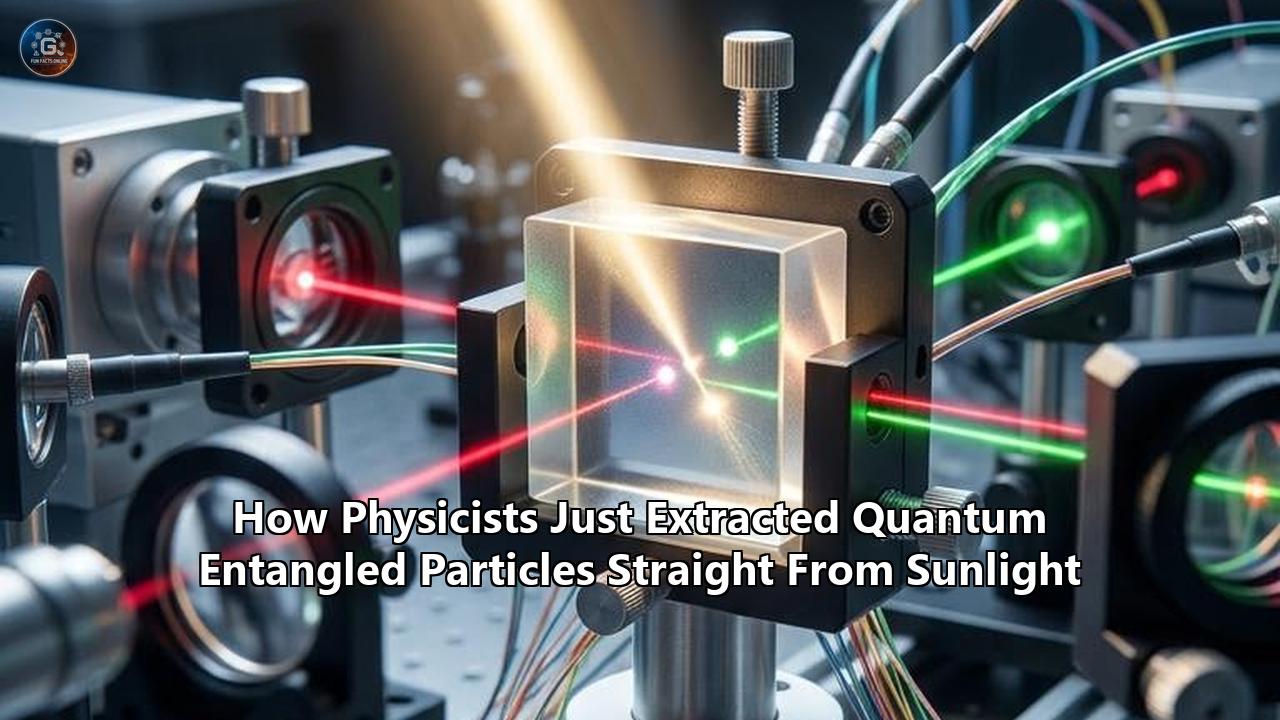
In a laboratory courtyard at the Max Planck Institute for the Science of Light in Erlangen, Germany, an optical assembly tracking the midday sky funneled raw solar radiation into a specialized glass cone, focused it down to the diameter of a human hair, and shot it straight into a nonlinear crystal.
The result, published in Optica by an international team from the Max Planck Institute and the University of Ottawa, overturns half a century of optical physics assumptions: natural, incoherent sunlight can directly drive spontaneous parametric down-conversion to generate high-fidelity, polarization-entangled photon pairs.
For decades, the standard physics curriculum taught that generating entangled light required an ultra-pure, spatially coherent, single-frequency laser. Natural sunlight—divergent, temporally disordered, broadband, and notoriously weak compared to laboratory beams—was dismissed by mainstream optics as fundamentally incapable of pumping quantum states.
The experimental team demonstrated that by separating degrees of freedom, the spatial and temporal disorder of the Sun does not destroy quantum correlations in polarization. The resulting photon pairs achieved a Bell-state fidelity of $93.9\%$, a quantum concurrence of $0.905$, and violated the Clauser-Horne-Shimony-Holt (CHSH) Bell inequality with a parameter of $S = 2.5408 \pm 0.2171$, decisively surpassing the classical physics threshold of $2$ by nearly three standard deviations.
Raw Solar Radiation (Direct / Incoherent)
                  │
                  ▼
   [ 1.4 m² Dual-Axis Fresnel Collector ]
                  │
                  ▼
   [ Solid Glass Conical TIR Concentrator ]
                  │
                  ▼
    [ 50 µm Multimode Optical Fiber ]
                  │
                  ▼
    [ 1.5 nm Bandpass Filter @ 405 nm ]
                  │
                  ▼
[ Polarization Sagnac Interferometer + 10-mm PPKTP Crystal ]
                  │
                  ▼
       Spontaneous Parametric Down-Conversion
                  │
        ┌─────────┴─────────┐
        ▼                   ▼
Signal Photon (810 nm)   Idler Photon (810 nm)
        └─────────┬─────────┘
                  │
                  ▼
   [ Quantum State Tomography (QST) ]
   • Fidelity: F = 93.9%
   • Concurrence: C = 0.905
   • Bell Parameter: S = 2.5408 (Violates Classical Limit > 2)
The realization of quantum entanglement in sunlight represents a fundamental shift in how quantum hardware can be powered. By removing the requirement for electricity-hungry, thermally sensitive onboard lasers, this approach offers an alternative engineering pathway for quantum satellites, deep-space optical transceivers, and remote quantum sensor networks.
The Coherence Dogma: Why Optics Dismissed the Sun for 50 Years
To understand why this experiment succeeded, one must look at why the wider physics community insisted for decades that it was impossible.
Spontaneous parametric down-conversion (SPDC) has served as the backbone of experimental quantum optics since the pioneering work of David Burnham and Donald Weinberg in 1970, and subsequent refinements by Leonard Mandel, Anton Zeilinger, and Paul Kwiat. In SPDC, a high-energy pump photon enters a crystal possessing non-zero second-order optical nonlinearity ($\chi^{(2)}$). Inside the dielectric lattice, the pump photon spontaneously annihilates to produce two lower-energy daughter photons—designated the "signal" and the "idler"—subject to strict conservation laws:
$$\hbar\omega_p = \hbar\omega_s + \hbar\omega_i \quad \text{(Energy Conservation)}$$
$$\mathbf{k}_p = \mathbf{k}_s + \mathbf{k}_i \quad \text{(Phase-Matching / Momentum Conservation)}$$
Because nonlinear optical coefficients are minuscule, achieving an appreciable pair-generation probability traditionally required an immense optical field density. Laser light provides this naturally: it concentrates billions of photons into a single spatial mode ($TEM_{00}$) with near-zero beam divergence and an extremely narrow spectral linewidth. The high spatial and temporal coherence ensures that the phase relationship between electromagnetic wave crests remains locked across the entire interaction volume of the crystal.
Sunlight, conversely, is the quintessential thermal light source. Emitted from a 5,778-Kelvin solar photosphere through random atomic collisions, solar photons arrive at Earth as a spatiotemporally incoherent soup.
The spatial coherence length of uncollected sunlight at ground level is mere micrometers, and its temporal coherence time spans just femtoseconds. Classical nonlinear optics textbooks explicitly state that without spatial and temporal coherence, phase-matching fails, phase relationships randomize, and conversion efficiency drops to near zero.
Consequently, when researchers proposed pumping a nonlinear crystal with sunlight, the consensus was unequivocal: the crystal would absorb broadband thermal heat, the incoherent phases would wash out quantum interference, and any generated photons would be lost in background thermal noise.
Decoupling Degrees of Freedom: The Mathematical Breakthrough
The theoretical foundation that broke this deadlock originated within the research group of Prof. Robert W. Boyd at the University of Ottawa. The team, led mathematically by Dr. Cheng Li, began by re-evaluating the fundamental quantum mechanics of the density operator governing parametric interactions.
The core realization was straightforward yet systematically overlooked: coherence is not a monolithic, all-or-nothing property of light. It is strictly degree-of-freedom specific.
A photon state exists across multiple independent Hilbert spaces:
$$\mathcal{H} = \mathcal{H}_{\text{spatial}} \otimes \mathcal{H}_{\text{temporal/spectral}} \otimes \mathcal{H}_{\text{polarization}}$$
In a standard SPDC process configured for polarization entanglement, the goal is to create a maximally entangled Bell state, such as:
$$|\Psi^+\rangle = \frac{1}{\sqrt{2}}\left(|H\rangle_s |V\rangle_i + |V\rangle_s |H\rangle_i\right)$$
Where $|H\rangle$ and $|V\rangle$ denote horizontal and vertical polarization states.
SPDC Polarization State Selection:
Input State:  |Pump⟩ = α|H⟩ + β|V⟩ (Controlled Polarization, Uncontrolled Phase/Space)
Interaction:  χ⁽²⁾ Nonlinear Lattice (Quasi-Phase-Matched)
Emission:     |Signal⟩ ⊗ |Idler⟩ in Sagnac Loop
Output State: |Ψ⁺⟩ = 1/√2 (|H⟩_s|V⟩_i + |V⟩_s|H⟩_i)
Boyd and Li proved that while spatial incoherence destroys position-momentum entanglement, and temporal incoherence degrades frequency-bin entanglement, neither spatial nor temporal incoherence directly couples into or degrades polarization entanglement, provided the input pump beam maintains a well-defined polarization state and the emission paths remain indistinguishable.
"As long as the pump beam is perfectly polarized, its spatial or temporal incoherence should not preclude the generation of polarization entanglement," Dr. Cheng Li explained. "The trick to harnessing sunlight is to keep different degrees of freedom of light from influencing each other during the process. This means that sunlight is perfectly capable of generating entangled photons, as long as one can concentrate enough sunlight into a nonlinear crystal to induce SPDC."
Before turning to the sky, the Ottawa group proved this principle in a controlled benchtop setting using light-emitting diodes (LEDs). LEDs, like the Sun, emit spatially and temporally disordered thermal light.
When the researchers filtered an LED’s polarization and focused it into a nonlinear crystal, the system generated clear polarization correlations. That benchtop success provided the proof of principle, but translating the concept to actual sunlight required resolving an extreme optical engineering challenge: concentrating raw sunlight into a microscopic crystal aperture without melting the optics or washing out the signal.
Engineering the Solar Engine: The Erlangen Optical Setup
To capture and harness natural sunlight, the University of Ottawa teamed up with Dr. Hanieh Fattahi's research group at the Max Planck Institute for the Science of Light (MPL) in Erlangen. The physical engineering required to channel solar photons into a sub-millimeter crystal aperture was immense.
Direct sunlight delivers an irradiance of approximately $1,000\text{ W/m}^2$ (1 Sun) at sea level on a clear day. In contrast, laboratory lasers focus milliwatts or watts into spot sizes measured in tens of micrometers, yielding local power densities exceeding megawatts per square centimeter. A standard lens cannot simply focus the Sun into a single-mode fiber because the Lagrange invariant (or étendue conservation) fundamentally caps the maximum brightness of an image formed by classical imaging systems:
$$\text{étendue} = A \cdot \Omega = \text{constant}$$
To overcome this geometric limit and drive nonlinear interactions, Fattahi's team developed a multi-stage non-imaging solar concentration system.
Solar Collection & Entanglement Generation Architecture:

 [ Direct Sunlight ]
         │
         ▼
 ┌─────────────────────────────────────────────────────────────┐
 │ 1. PRIMARY STAGE: 1.4 m² Acrylic Fresnel Lens              │
 │    • Mounted on automated dual-axis solar tracking motor    │
 │    • Gathers raw solar flux across 1.4 m² footprint         │
 └──────────────────────────────┬──────────────────────────────┘
                                │ (Converging Cone)
                                ▼
 ┌─────────────────────────────────────────────────────────────┐
 │ 2. SECONDARY STAGE: Solid Glass Conical Concentrator        │
 │    • Operates via Total Internal Reflection (TIR)           │
 │    • Compresses focal spot beyond standard geometric limits │
 └──────────────────────────────┬──────────────────────────────┘
                                │
                                ▼
 ┌─────────────────────────────────────────────────────────────┐
 │ 3. DELIVERY: 50 µm Core Multimode Fiber (MMF, NA = 0.22)   │
 │    • Channels concentrated thermal light into clean room    │
 └──────────────────────────────┬──────────────────────────────┘
                                │
                                ▼
 ┌─────────────────────────────────────────────────────────────┐
 │ 4. CONDITIONING & FILTERING                                 │
 │    • 20× Microscope Objective (NA = 0.40) collimates output │
 │    • 1.5 nm Narrowband Interference Filter centered @ 405 nm│
 │    • Glan-Thompson Polarizer sets pure linear state         │
 └──────────────────────────────┬──────────────────────────────┘
                                │
                                ▼
 ┌─────────────────────────────────────────────────────────────┐
 │ 5. NONLINEAR QUANTUM CORE: Polarization Sagnac (PSI)        │
 │    • 10-mm Periodically Poled KTP (ppKTP) Crystal           │
 │    • Quasi-Phase-Matched for Type-II SPDC                   │
 │    • Produces 810 nm Orthogonally Polarized Photon Pairs    │
 └──────────────────────────────┬──────────────────────────────┘
                                │
                                ▼
 ┌─────────────────────────────────────────────────────────────┐
 │ 6. DETECTION & ANALYSIS                                     │
 │    • Silicon Single-Photon Avalanche Diodes (SPADs)         │
 │    • quTAU Time-to-Digital Converter (81 ps Resolution)     │
 │    • Quantum State Tomography (16 Projective Bases)         │
 └─────────────────────────────────────────────────────────────┘
1. The Primary Collector
A precision-grooved $1.0\text{ m} \times 1.4\text{ m}$ acrylic Fresnel lens ($1.4\text{ m}^2$ total collection area) was mounted onto an active, dual-axis solar tracking platform stationed outdoors on the MPL grounds. The tracker continuously calculated solar azimuth and elevation to maintain the solar disk image dead-center on the primary focal point.
2. The Total Internal Reflection (TIR) Glass Cone
At the focal spot of the Fresnel lens, the researchers placed an in-house fabricated, solid glass conical concentrator. As light enters the wide planar base of the cone, it strikes the polished sloping sidewalls at angles steeper than the critical angle, undergoing multiple sequential total internal reflections. This non-imaging concentrator compresses the optical field down to its narrow tip with high transmission efficiency, bypassing the spatial aberrations inherent to multi-element lens stacks.
3. Fiber Injection and Routing
The tip of the glass cone was fusion-coupled into a multimode optical fiber (MMF) featuring a $50\text{ }\mu\text{m}$ core diameter and a numerical aperture ($\text{NA}$) of $0.22$. This flexible fiber channeled the collected solar photons through a conduit into the climate-controlled quantum optics laboratory, isolating the delicate downstream interferometers from outdoor wind, humidity, and thermal drift.
4. Spectral and Polarization Conditioning
Exiting the fiber, the solar pump light was collimated using a $20\times$ microscope objective ($\text{NA} = 0.4$). Because SPDC phase-matching is strictly wavelength-dependent, the team passed the collimated beam through a $1.5\text{ nm}$ full-width at half-maximum (FWHM) bandpass dielectric filter centered at $405\text{ nm}$. This isolated the specific ultraviolet-blue solar band capable of phase-matching while discarding out-of-band visible and infrared photons that would otherwise heat the crystal. Finally, the beam passed through a high-extinction polarizer to establish a deterministic pump polarization state.
5. The Polarization Sagnac Interferometer
The heart of the quantum engine utilized a 10-millimeter-long periodically poled potassium titanyl phosphate (ppKTP) crystal, cut and engineered for Type-II collinear SPDC. The crystal was embedded within a common-path Polarization Sagnac Interferometer (PSI).
A dual-wavelength polarizing beam splitter split the $405\text{ nm}$ pump into clockwise and counterclockwise paths traversing the crystal in opposite directions. The clockwise pump generated a $|H\rangle_s |V\rangle_i$ pair, while the counter-clockwise pump generated a $|V\rangle_s |H\rangle_i$ pair.
When these bidirectional paths recombined at the beam splitter, path indistinguishability erased any spatial information, superposing the two possibilities into the maximally entangled Bell state:
$$|\Psi^+\rangle = \frac{1}{\sqrt{2}}\left(|H\rangle_s |V\rangle_i + |V\rangle_s |H\rangle_i\right)$$
Verifying Quantum Correlations: Tomography, Fidelity, and Bell Violations
To confirm that the detected photons were genuinely entangled rather than exhibiting classical thermal noise correlations, the researchers implemented quantum state tomography across multiple clear-sky operational runs.
The generated signal and idler photons, centered at an infrared wavelength of $810\text{ nm}$, were separated and directed into independent polarization analyzers consisting of motorized quarter-wave plates, half-wave plates, and polarizing beam splitters. The photons were collected by silicon single-photon avalanche diodes (SPADs) and registered using a multichannel Time-to-Digital Converter (a qutools quTAU TDC) operating with an internal timing jitter resolution of $\tau = 81\text{ ps}$.
Experimental Timeline of Detection & Analysis:

[ Arrival of Twin Photons @ SPAD Detectors ]
                     │
                     ▼
[ Time-to-Digital Converter (quTAU, τ = 81 ps) ]
                     │
                     ▼
[ 1.0 ns Coincidence Window Filtering ]
                     │
                     ▼
[ 16 Projective Polarization Measurements ]
  { |HH⟩, |HV⟩, |VV⟩, |VH⟩, |RR⟩, |RL⟩, |DD⟩, |DA⟩, ... }
                     │
                     ▼
[ Maximum Likelihood Estimation (MLE) Matrix Inversion ]
                     │
                     ▼
┌───────────────────────────────────────────────────────────┐
│ Reconstructed Two-Photon Density Matrix ρ:                │
│ • Target Bell State: |Ψ⁺⟩ = 1/√2 (|HV⟩ + |VH⟩)           │
│ • State Fidelity:    F = ⟨Ψ⁺|ρ|Ψ⁺⟩ = 0.939 ± 0.027        │
│ • Concurrence:       C(ρ) = 0.905 ± 0.053                 │
│ • State Purity:      P = Tr(ρ²) = 0.919 ± 0.045           │
│ • Bell Parameter:    S = 2.5408 ± 0.2171 (Exceeds S ≤ 2)  │
└───────────────────────────────────────────────────────────┘
The time-correlation histogram showed sharp coincidence peaks with a temporal correlation width of approximately $1\text{ ns}$, matching the theoretical expectations for phase-matched SPDC emission under narrowband filtering.
The team then measured coincidence rates across 16 linearly independent polarization projection bases ($|HH\rangle, |HV\rangle, |VV\rangle, |VH\rangle, |RR\rangle, |RL\rangle, |DD\rangle, |DA\rangle$, etc.) and applied a Maximum Likelihood Estimation (MLE) algorithm to reconstruct the full $4 \times 4$ density matrix ($\rho$) of the two-photon state.
Density Matrix Structure (Reconstructed ρ):

            |HH⟩      |HV⟩      |VH⟩      |VV⟩
     ┌                                           ┐
|HH⟩ │  0.038    -0.012     0.008     0.014     │
|HV⟩ │ -0.012     0.468     0.441    -0.009     │  <-- Strong off-diagonal
|VH⟩ │  0.008     0.441     0.456     0.011     │      coherences confirm
|VV⟩ │  0.014    -0.009     0.011     0.038     │      quantum superposition
     └                                           ┘
The mathematical analysis yielded definitive quantitative parameters:
- Bell State Fidelity ($F$): Defined as $F = \langle \Psi^+ | \rho | \Psi^+ \rangle$, measuring the overlap between the experimental state and an ideal maximally entangled state. The sunlight-pumped source achieved:
$$F = 0.939 \pm 0.027 \quad (93.9\%)$$
- Quantum Concurrence ($C$): An entanglement metric ranging from $0$ (separable/classical) to $1$ (maximally entangled). The state registered:
$$C = 0.905 \pm 0.053$$
- State Purity ($P$): Calculated as $P = \text{Tr}(\rho^2)$, where $P=1$ corresponds to a pure state. The system achieved:
$$P = 0.919 \pm 0.045$$
- CHSH-Bell Inequality Test ($S$): Under local realism (classical physics), correlation bounds dictate that $S \le 2$. The team rotated polarization bases to the optimal Bell angles ($0^\circ, 45^\circ, 22.5^\circ, 67.5^\circ$) and measured:
$$S = 2.5408 \pm 0.2171$$
This exceeds the classical limit of $2$ by $2.94$ standard deviations, definitively ruling out local hidden-variable theories.
The fact that these metrics remained stable over three distinct experimental days confirms that observing quantum entanglement in sunlight is a repeatable physical process, not an artifact of short-lived atmospheric fluctuations.
Laser vs. Sunlight: The Hidden Efficiency Metric
A common misconception emerging from initial reporting is that natural sunlight is fundamentally vastly less efficient at producing entangled states than an engineered laser. A closer look at the physics shows that this disparity is largely an artifact of bandwidth utilization rather than intrinsic interaction mechanics.
Comparison of Photonic Conversion Dynamics:

Parameter                  Laboratory Laser Pump          Solar Pump (Erlangen Setup)
──────────────────────────────────────────────────────────────────────────────────────────
Spectral Linewidth (Δλ)    < 0.001 nm (Single Mode)       ~1.5 nm (Bandpass Filtered)
Spatial Coherence          Diffraction-limited TEM₀₀      Multimode (Incoherent)
Normalized Yield           ~1,600 pairs / (s · mW · GHz)  ~1,600 pairs / (s · mW · GHz)
Wall-Plug Efficiency       0.01% - 1.5% (Total System)   Passive Direct Harvesting (No Grid)
Waste Heat Management      Active Water/Thermo-Cooling    Optical Filtering / Passive Radiation
Deployability in Deep Space High Power Penalty            High Reliability / Free Fuel
When the Erlangen and Ottawa researchers calculated the pair-production rate per milliwatt of pump power within the crystal's phase-matching bandwidth, the sunlight-pumped system generated approximately $1,600\text{ photon pairs per second per milliwatt}$—a yield matching conventional laser-pumped SPDC sources.
The fundamental difference lies in spectral density. A laser packs all of its optical energy into an ultra-narrow frequency band ($\Delta\nu < 1\text{ MHz}$), which directly overlaps with the narrow phase-matching bandwidth of a thick nonlinear crystal. Sunlight distributes its energy across hundreds of nanometers (from 300 nm to 2,500 nm).
In this first-generation experiment, the $1.5\text{ nm}$ filter rejected over $99\%$ of the available solar spectrum, discarding significant raw photon flux to protect the crystal from thermal absorption.
Even with this spectral clipping, the experiment proved that lasers do not possess special quantum properties required to excite parametric down-conversion; the nonlinear lattice simply responds to individual photons that satisfy the phase-matching condition, regardless of whether those photons originated from a stimulated diode cavity or the core of a star.
The Peer-Review Pushback and Scientific Politics
The road to publication in Optica was marked by skepticism. For nearly three years, the research team encountered resistance from grant reviewers and peer referees who argued that incoherent solar pump fields could not produce measurable, non-classical coincidences above detector dark counts.
"Since the inception of this project, our idea has met with repeated doubt and pushback," Dr. Cheng Li recounted after the study's release. "Some world-renowned researchers in the field even questioned whether it would be possible to detect any photons—not to mention entangled photons—from sunlight-driven nonlinear optical processes. However, we trusted our calculations, continued improving the experimental setup, and eventually showed that it was possible."
The pushback centered around three primary technical objections:
- The Étendue Bottleneck: Skeptics argued that coupling non-collimated sunlight into a $50\text{ }\mu\text{m}$ fiber would lose so much power that the resulting SPDC rate would fall well below the thermal dark-count noise floor of standard silicon avalanche detectors.
- Temporal Group Velocity Dispersion: Critics argued that the wide angular divergence and broad wavelength spread of solar photons inside the ppKTP crystal would cause massive group-velocity mismatch, blurring the arrival times of daughter photons and wiping out the Hong-Ou-Mandel interference dip.
- Phase Noise and Multi-Pair Emission: Doubters asserted that high thermal bunching (the Hanbury Brown and Twiss effect characteristic of blackbody radiation) would cause excessive accidental coincidence counts, destroying the state's purity.
Theoretical Concerns vs. Experimental Solutions:

Theoretical Objection               Experimental Countermeasure / Reality
────────────────────────────────────────────────────────────────────────────────────────
Étendue Power Loss                  Non-imaging Conical TIR Concentrator + Fresnel Lens
                                    delivers tens of milliwatts into 50 µm MMF.

Group Velocity Dispersion           Narrowband 1.5 nm Filtering + 10-mm ppKTP Sagnac loop
                                    enforces indistinguishability of signal/idler paths.

Thermal Noise / Accidental Counts   quTAU TDC with 81 ps resolution isolates 1.0 ns
                                    temporal coincidence window, suppressing background.
By systematically proving each objection wrong with calibrated outdoor data, the team demonstrated that thermal photon statistics do not degrade single-pair polarization purity in the low-gain regime.
Parallel Discoveries: The Independent Validation from Xiamen
The Max Planck-Ottawa collaboration was not the only team investigating this domain. In June 2026, just weeks prior to the final publication of the Optica paper, a group led by physicists Wuhong Zhang and Lixiang Chen at Xiamen University in China published complementary findings in Physics World and related physics archives.
The Xiamen group constructed a rooftop solar-tracking telescope at their university laboratory, coupling solar radiation into a multimode fiber to pump a periodically poled potassium titanyl phosphate (PPKTP) crystal. While their initial setup focused primarily on measuring time-correlated photon pairs and spatial mode profiles rather than full 16-basis quantum state polarization tomography, their findings independently confirmed that natural sunlight drives SPDC with high temporal correlation.
The convergence of results from two independent international teams using different concentrator geometries confirmed that natural sunlight-driven nonlinear optics is an experimentally robust, universally reproducible phenomenon.
Orbital and Deep-Space Implications: Rewriting Satellite Architecture
The most immediate practical beneficiary of quantum entanglement in sunlight is aerospace and space-based quantum networking.
In 2016, China launched the Micius satellite (Quantum Experiments at Space Scale, or QUESS), proving that satellite-to-ground quantum key distribution (QKD) and space-based entanglement distribution are viable over distances exceeding 1,200 kilometers. However, Micius and its successors carry a major engineering penalty: SWaP (Size, Weight, and Power).
Satellite Quantum Payload Architecture: Conventional vs. Solar-Driven

A. Conventional Laser-Based Satellite (e.g., Micius / QUESS):
   [ Solar Panels ] ──( <30% Eff. )──► [ Battery / PDU ]
          │
          ▼
   [ Laser Diode Driver ] ──( Waste Heat )──► [ Radiator Thermal Loop ]
          │
          ▼
   [ Coherent Laser Diode ] ──► [ Frequency Doubler ] ──► [ SPDC Crystal ]

B. Solar-Driven Satellite (MPL / Ottawa Architecture):
   [ Passive Solar Collector / Concentrator ]
          │
          ▼
   [ Bandpass / Polarizing Filter ]
          │
          ▼
   [ SPDC Crystal / Photonic Chip ] ──► Direct Entangled Output

   • Zero Electrical-to-Optical Conversion Steps
   • Eliminates Laser Diodes, Drivers, and Bulky Thermal Cooling Radiators
   • Dramatically Reduces Failure Points in Deep-Space Radiation Environments
A standard space-based quantum payload requires:
- Photovoltaic arrays converting sunlight to electricity (efficiency: $28\text{–}32\%$).
- Power distribution units (PDUs) regulating voltage.
- Temperature-stabilized laser diode drivers.
- Optical laser cavities requiring millikelvin-level active thermal stabilization.
- Heavy cooling radiators to dissipate waste heat into space.
This complex chain suffers from severe parasitic losses. By the time orbital sunlight is converted into electricity, run through a laser driver, emitted as coherent light, and focused into an SPDC crystal, less than $1\text{ to }2\%$ of the original collected solar energy reaches the crystal as useful pump light.
Direct solar-driven quantum sources eliminate this entire electrical-to-optical conversion chain. In low Earth orbit (LEO) or deep space, sunlight is completely unfiltered by atmospheric absorption, providing a constant solar irradiance of approximately $1,361\text{ W/m}^2$ (AM0 spectrum).
"Sunlight is an abundant and reliable resource in many environments, especially in space," said Dr. Hanieh Fattahi. "Being able to generate quantum-entangled photons directly from sunlight could enable simpler and more resilient quantum systems for satellites and future deep-space missions."
By replacing bulky laser drivers and thermal dissipation hardware with a fixed passive parabolic concentrator and a micro-optic crystal stage, satellite manufacturers can dramatically shrink the mass and power budget of orbital QKD nodes.
For CubeSats—where total payload power is often capped at under 20 watts—solar-pumped quantum payloads make quantum communications viable on small satellite platforms.
Technical Bottlenecks and the Roadmap Ahead
While the proof-of-concept experiment proved that quantum entanglement in sunlight is scientifically viable, significant technical hurdles must be addressed before the technology can transition from an optical table to deployed hardware.
Current Limitations vs. Next-Generation Solutions:

Current Erlangen/Ottawa Prototype        Next-Generation Production Target
──────────────────────────────────────────────────────────────────────────────────────────
1.4 m² External Fresnel Assembly         Integrated Monolithic Parabolic Mirror (<0.1 m²)
Narrowband Filter Discards >99% Light    Chirped PPLN Crystals (Broadband Phase-Matching)
Active Electrical Dual-Axis Tracker      Passive Static Concentrators / Orbit Sun-Pointing
Laboratory Sagnac Bulk Optics            Integrated Silicon Nitride / LNOI Photonic Chips
External Crystal Temperature Controller  Athermal Quasi-Phase-Matched Waveguides
The primary engineering challenges include:
1. The Spectral Utilization Dilemma
The current design discards the vast majority of the solar spectrum via a $1.5\text{ nm}$ bandpass filter. Pumping nonlinear processes with the remaining broadband spectrum requires new crystal engineering.
The primary path forward involves chirped periodically poled lithium niobate (PPLN) or chirped ppKTP waveguides. In a chirped crystal, the domain inversion period ($\Lambda$) varies continuously along the length of the propagation axis ($z$):
$$\Lambda(z) = \Lambda_0 + \kappa z$$
This enables simultaneous quasi-phase-matching across tens or hundreds of nanometers of pump light, potentially boosting the photon-pair generation rate by two to three orders of magnitude without requiring larger solar collection dishes.
Chirped Quasi-Phase-Matching:
Pump: Wide Solar Band (400 - 450 nm) ──► | + | - | ++ | -- | +++ | --- | ──► Broadband Signal/Idler
                                        Increasing Domain Period Λ(z)
2. Chip-Scale Photonic Integration
The Erlangen experiment used free-space optomechanical components, mirrors, and a discrete bulk crystal. To withstand orbital launch vibrations, deep-space radiation, and extreme thermal cycling, the entire optical chain must be integrated onto a monolithic photonic integrated circuit (PIC).
Researchers at the University of Ottawa are already exploring Lithium Niobate on Insulator (LNOI) and Silicon Nitride ($\text{Si}_3\text{N}_4$) waveguide microresonators.
By exploiting spontaneous four-wave mixing (FWM) or high-$Q$ microring resonators, solar photons injected into an on-chip waveguide could generate entangled pairs within a microscopic footprint.
3. Fully Passive Temperature and Alignment Stabilization
The prototype still required electrical power to run its solar tracker and maintain the ppKTP crystal at its optimal quasi-phase-matching temperature ($28.5^\circ\text{C}$). Achieving a truly zero-electricity, self-sustaining quantum node will require:
- Athermal waveguide designs: Engineering materials with compensating thermo-optic coefficients ($\frac{dn}{dT}$) so that phase-matching remains invariant across temperature swings from $-40^\circ\text{C}$ to $+85^\circ\text{C}$.
- Static Non-Imaging Concentrators: Compound Parabolic Concentrators (CPCs) that capture sunlight across a wide acceptance angle (e.g., $\pm 25^\circ$) without requiring mechanical tracking motors.
What to Watch For Next
The demonstration that sunlight can generate quantum-entangled states opens several new avenues for experimental physics and engineering:
- Four-Wave Mixing (FWM) with Sunlight: Boyd's group is currently modeling third-order ($\chi^{(3)}$) nonlinear interactions powered by sunlight. Because third-order processes can occur in standard optical fibers and silicon photonic structures without requiring anisotropic crystal lattices, this could enable solar-pumped quantum chips fabricated via standard CMOS semiconductor processes.
- High-Altitude Balloon and Orbital CubeSat Trials: Research consortia in Germany and Canada are outlining mission concepts for high-altitude stratospheric balloon flights and $3\text{U}$ CubeSat orbital tests to validate solar SPDC performance outside the Earth's turbulent atmosphere.
- Deep-Space and Lunar Quantum Relays: As NASA's Artemis program and international space agencies plan permanent infrastructure on the Moon and interplanetary probes to Mars, solar-pumped quantum transceivers offer a lightweight, radiation-hardened solution for continuous quantum encrypted laser communications back to Earth.
By demonstrating that the disordered light of our nearest star can produce pure quantum entanglement, physicists have removed an artificial division between natural thermodynamics and quantum information science. The Sun is no longer just an energy source for biological and photovoltaic systems; it is now a validated emitter for the quantum state engineering of light.
Reference:
- https://www.optica.org/about/newsroom/news_releases/2026/researchers_generate_quantum_entanglement_using_sunlight/
- https://www.photonics.com/Articles/Sunlight-Driven-Quantum-Entanglement-Offers/p5/a72496
- https://mpl.mpg.de/news/article/quantum-entanglement-generated-by-sunlight-for-the-first-time
- https://studyfinds.com/sunlight-quantum-entanglement/
- https://thedebrief.org/forget-lasers-researchers-just-created-quantum-entanglement-using-sunlight/
- https://arxiv.org/html/2602.15655v1
- https://quantumzeitgeist.com/sunlight-generates-quantum-entanglement-without-lasers/
- https://www.techexplorist.com/sun-natural-source-quantum-entanglement/103870/
- https://www.sciencedaily.com/releases/2026/08/260807035133.htm
- https://opg.optica.org/optica/viewmedia.cfm?uri=optica-13-8-1508&seq=0
- https://www.eurekalert.org/news-releases/1139133
- https://physicsworld.com/a/sunlight-can-produce-correlated-pairs-of-photons/
- https://www.eurekalert.org/news-releases/1139133
- https://arxiv.org/html/2602.15655v1
- https://www.facebook.com/PhysikDesLichts/posts/%EF%B8%8F-quantum-entanglement-generated-by-sunlight-for-the-first-timescientists-have-d/1475393397954162/