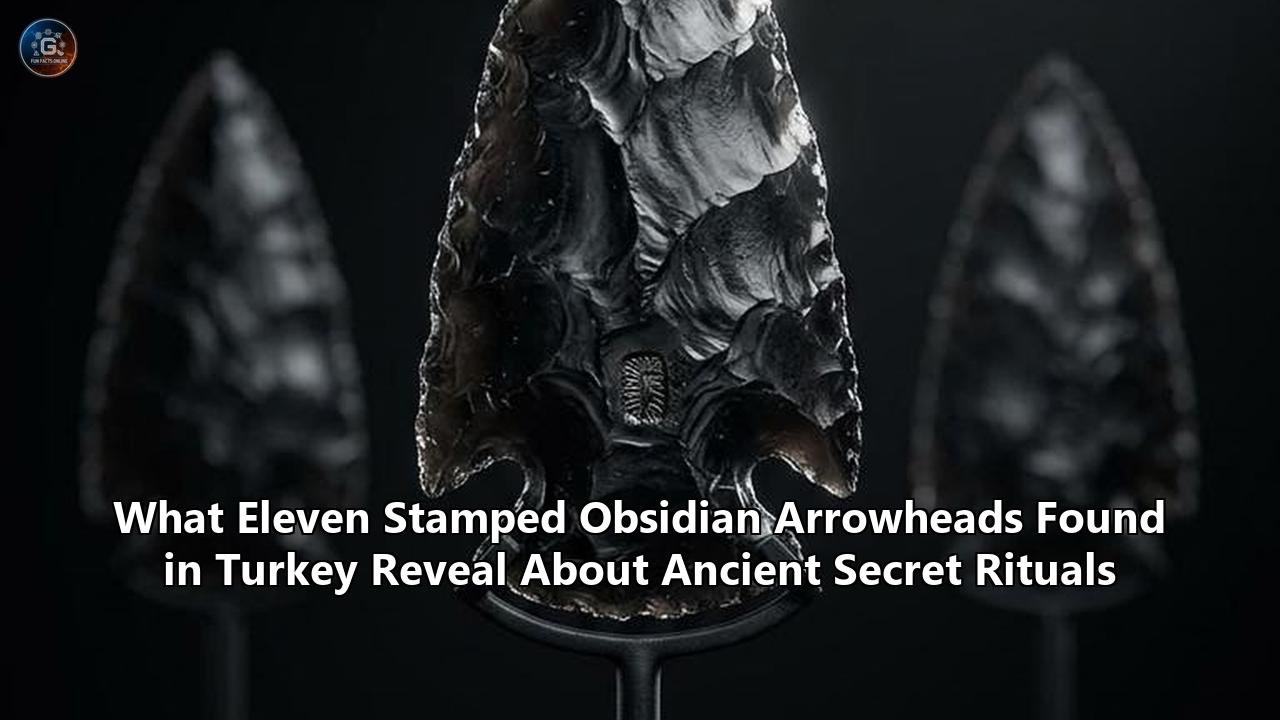
A team of prehistoric lithic specialists has documented 11 deliberately incised obsidian arrowheads recovered from the Neolithic settlement of Tepecik-Çiftlik in Central Anatolia. The study, published by archaeologists Alice Vinet and Denis Guilbeau in PLOS ONE, provides detailed physical evidence that early agricultural communities in Cappadocia systematically engraved lethal hunting and warfare projectiles with unique geometric incisions. Rather than serving as standardized maker’s marks or practical ownership tags, these painstakingly carved symbols point directly toward secretive, individualized ritual practices carried out during the late eighth and seventh millennia BCE.
The identification of these 11 specimens brings the total regional count of such marked volcanic glass points from 43 to 54 across Central Anatolia. Across more than a millennium of occupation, only a tiny fraction of manufactured points received these markings. Microscopic edge-wear and traceological analysis reveal that the incisions required hard flint tools and dozens of repetitive, high-pressure passes over brittle volcanic glass—a demanding technique applied to objects that were frequently broken, lost during hunts, or buried within domestic and mortuary contexts.
This discovery fundamentally challenges long-standing assumptions regarding early Neolithic technology, weapon production, and the emergence of non-linguistic symbolic communication in the ancient Near East.
+----------------------------------------------------------------------------------------------------+
|                               THE TEPECIK-ÇİFTLİK OBSIDIAN DISCOVERY                               |
+--------------------------+-------------------------------------------------------------------------+
| Primary Artifacts        | 11 newly identified incised obsidian arrowheads (corpus total: 54)      |
| Geographic Location      | Tepecik-Çiftlik, Melendiz Plain, Cappadocia, Central Turkey             |
| Chronological Range      | Late 8th to 7th Millennium BCE (c. 7100 – 6100 BCE)                     |
| Geological Source        | Göllü Dağ & Nenezi Dağ volcanic complexes                                |
| Manufacturing Tool       | Rare flint burins/micro-flakes (~1% of local lithic assemblage)         |
| Primary Function         | High-status projectile points modified for esoteric/ritual use          |
+--------------------------+-------------------------------------------------------------------------+
Forensic Deconstruction of the 11 Incised Projectiles
The artifacts at the center of the investigation come from Tepecik-Çiftlik, a tell settlement on the Melendiz Plain of Niğde Province, occupied continuously between roughly 7100 and 5800 BCE. The site sits inside a volcanic basin flanked by two major obsidian outcrops: Göllü Dağ, located just 20 kilometers to the north, and Nenezi Dağ, approximately 30 kilometers to the northwest.
Excavations at Tepecik-Çiftlik have yielded more than 730 obsidian arrowheads. Out of that massive assemblage, only 12 specimens carry intentional incisions—the single specimen documented during earlier excavation campaigns, and the 11 newly analyzed artifacts identified by Vinet and Guilbeau.
    Tepecik-Çiftlik Lithic Inventory
    ========================================================================================
    Total Obsidian Arrowheads Recovered:  [████████████████████████████████████████] 730
    Total Arrowheads Bearing Incisions:   [█] 12 (1.64%)
    ========================================================================================
Macroscopic and geochemical assessments link the raw material of these 11 points directly to the calc-alkaline volcanic flows of Göllü Dağ and the peralkaline formations of Nenezi Dağ. These sources provided the high-grade, black and translucent volcanic glass that dominated toolkits throughout the Anatolian plateau and circulated across long-distance exchange networks extending south to the Levant and Mesopotamia.
                             [Göllü Dağ Obsidian Quarry]
                                          │
                                          ▼ (~20 km transport)
   [Raw Volcanic Glass] ──► [Bifacial Pressure Flaking] ──► [Finished Projectile]
                                                                  │
                                                                  ▼
                                                      [Rare Flint Micro-Burin]
                                                                  │
                                                                  ▼ (20+ strokes per line)
                                                      [Esoteric Symbolic Incision]
To determine how the markings were made, the research team conducted microscopic traceology and replicative experimental archaeology. Obsidian registers a hardness of 5 to 5.5 on the Mohs scale, meaning that an obsidian tool cannot easily scratch or engrave another piece of obsidian without producing uncontrolled shatter, crushing, or micro-chipping.
The experimenters confirmed that Neolithic engravers had to utilize harder stones—specifically chert or flint (Mohs 7)—to execute clean linear incisions. At Tepecik-Çiftlik, flint tools represent barely 1% of the total lithic industry, indicating that craftspeople purposefully selected an exotic, minority material specifically to modify these select obsidian arrowheads.
+----------------------------------------------------------------------------------------------------+
|                                    TRACEOLOGICAL ETCHING METRICS                                   |
+--------------------------+-----------------------+-------------------------------------------------+
| Metric                   | Observed Value        | Interpretive Significance                       |
+--------------------------+-----------------------+-------------------------------------------------+
| Stroke Repetition Count  | 15 to 25 passes       | Rules out accidental manufacturing scratches    |
| Average Groove Depth     | 0.04 mm – 0.12 mm     | Deep enough to retain visual contrast/pigments  |
| Tool Material Required   | Imported Flint/Chert  | Intentional use of rare non-local lithic stock  |
| Production Timing        | Pre- and Post-Hafting | Executed during production and after maintenance|
+--------------------------+-----------------------+-------------------------------------------------+
High-magnification microscopy demonstrates that the incisions are not casual or accidental marks left by pressure-flaking tools or butchery contact. Each line consists of an intentional channel formed by 15 to 25 distinct, unidirectional tool passes executed with considerable manual pressure.
The patterns vary substantially across the 11 points:
- Single longitudinal grooves running parallel to the central dorsal ridge.
- Asymmetrical diagonal hatching across the blade lateral margins.
- Cross-hatched lattice grids etched directly into the basal stem.
- Complex chevron motifs cut through the projectile's pressure scars.
Crucially, no two designs among the 11 arrowheads match. Each object carries a completely unique visual composition.
The Collapse of Utilitarian Interpretations
When incised obsidian projectiles were first brought to academic attention in 1988 by archaeologist Kathryn Ataman—who examined an initial corpus of 31 points from the site of Can Hasan III—the primary interpretation centered on functional ownership. Ataman proposed that the marks operated as "hunter signatures" comparable to ethnographic examples observed among traditional Arctic and sub-Arctic hunting communities. Under that functionalist paradigm, hunters placed individualized marks upon their weapon tips to claim ownership over contested animal carcasses brought down by group hunting parties.
The expanded corpus from Tepecik-Çiftlik, paired with technological re-evaluations across Central Anatolia, directly disproves the hunter-signature hypothesis through three distinct archaeological contradictions:
                     HUNTER-SIGNATURE VS. RITUAL ESOTERICA HYPOTHESIS

   Utilitarian Model (Ataman 1988)              Ritual / Esoteric Model (Vinet & Guilbeau)
┌────────────────────────────────────────┐   ┌────────────────────────────────────────┐
│ • Frequent occurrence on projectiles   │   │ • Extreme rarity (< 2% of total points)│
│ • Standardized individual signatures   │   │ • Total absence of repeated designs    │
│ • Applied to durable arrow shafts      │   │ • Cut directly into fragile, lethal tip│
│ • Practical claim over animal meat     │   │ • Associated with magic, cult, & rites │
└────────────────────────────────────────┘   └────────────────────────────────────────┘
                    ▲                                            ▲
                    │                                            │
└────────── EMPIRICAL DATA REJECTS ──────────┘- Statistical Rarity: If incisions served to resolve ownership claims over hunted game, the practice would have been ubiquitous or at least common across hunting assemblages. Instead, marked projectiles make up less than 2% of the obsidian arrowheads recovered at Tepecik-Çiftlik, Can Hasan III, and Çatalhöyük. More than 98% of hunters or archers operated without marking their projectiles.
- Design Heterogeneity: If a signature system existed, individuals would repeatedly apply their specific mark across their personal quivers. In the known corpus of 54 Central Anatolian incised points, there is not a single instance of design duplication. Every incised point features a distinct, non-repeated geometric configuration.
- Substrate Illogic: In cross-cultural ethnography, property marks are placed on the arrow shaft, the foreshaft, or the fletching—the durable elements that survive impact and remain embedded in the prey. Placing labor-intensive markings on brittle, easily shattered obsidian tips that regularly fractured on bone impact makes no practical sense within a functional framework.
The empirical data demands an alternative explanatory model: the marks were esoteric, non-linguistic symbolic interventions embedded within ritualized, situational acts.
Symbolic Vectors: Deciphering Ancient Secret Rituals
The presence of unique, non-replicating incisions cut into weapons of lethal force places these 11 arrowheads at the intersection of early metallurgy precursors, hunting magic, body modification traditions, and esoteric ceremonial life.
                                 THE RITUAL MATRIX
                                         │
        ┌────────────────────────────────┼────────────────────────────────┐
        ▼                                ▼                                ▼
[Hunting & Warfare Magic]     [Rites of Passage]            [Apotropaic Talismans]
 • Animistic empowerment       • Guild initiation marks      • Deflection of malevolence
 • Sympathetic blood rites     • Secret society tokens       • Ancestral soul anchors
 • Lethal consecration         • Non-repeatable ordeals      • Inter-communal covenants
1. Consecration and Sympathetic Hunting Magic
In many prehistoric animistic cosmologies, hunting large, dangerous wild taxa—such as the aurochs (Bos primigenius), wild boar (Sus scrofa), and red deer (Cervus elaphus), all heavily represented in the faunal records of Tepecik-Çiftlik—was not merely a subsistence activity. It was a perilous metaphysical negotiation with non-human spirits.
Carving lines into the glassy face of an arrowhead before a hunt served as a material enchantment or consecration rite. By cutting into the stone with an exotic flint burin, the practitioner activated the weapon, binding its lethal agency to ensure that the projectile found its mark.
The fact that markings were sometimes added after the point had been manufactured or resharpened indicates that the incising event was tied to specific, contingent moments—such as an upcoming high-stakes expedition, a retaliatory raid, or a communal hunt requiring spiritual intercession.
2. Secret Societies and Rites of Passage
The Late Neolithic in Central Anatolia saw the gradual disintegration of the massive, communal mega-villages like early Çatalhöyük and the rise of smaller, more autonomous settlements where lineage groups, specialized sodalities, and secret cultic sodalities negotiated social authority.
The 11 arrowheads from Tepecik-Çiftlik may represent singular ritual tokens associated with rites of passage or initiations into warrior and hunter sodalities. In such contexts, an initiate would receive or carve an arrowhead with an individualized, unrepeatable motif signifying their spiritual ordeal, vow, or unique metaphysical name.
Because the mark was singular to that specific ritual moment, it was never duplicated on subsequent points. The object became a sacred talisman—retained on the person, carried in daily life, and eventually deposited within the home, a production workshop, or a grave.
+----------------------------------------------------------------------------------------------------+
|                             RITUAL TYPOLOGY OF ANATOLIAN INCISED POINTS                            |
+--------------------------+-----------------------+-------------------------------------------------+
| Ritual Context           | Physical Manifestation| Archaeological Correlate                        |
+--------------------------+-----------------------+-------------------------------------------------+
| Initiatory Ordeal        | Single unique motif   | Points curated in domestic caches or graves     |
| Sympathetic Activation   | Deep longitudinal cut | Points showing animal impact micro-fractures    |
| Apotropaic Sealing       | Cross-hatched grid    | Modified basal stems, covered when hafted       |
| Votive Commemoration     | Multi-angled chevrons | Unused, pristine blades placed in floor fill    |
+--------------------------+-----------------------+-------------------------------------------------+
3. Apotropaic Magic and Soul-Catching Grids
Cross-hatching, lattice grids, and geometric zigzags are recurring motifs in prehistoric ritual iconography across southwest Asia. In Neolithic visual culture, these designs frequently carried apotropaic properties—magical barriers designed to ward off malevolent forces, trap hostile spirits, or seal the vitality of the user.
Obsidian was viewed across the ancient world as a living, metaphysically charged material. Born of volcanic fire, boasting absolute blackness and mirror-like reflectivity, and capable of slicing at a cellular level, it held profound symbolic associations with blood, mirrors, and the spirit realm.
Incising geometric grids across its reflective surface fundamentally altered its spiritual state. By disrupting the reflective plane with permanent scratches, the artisan transformed a simple projectile into an apotropaic charm capable of deflecting the defensive magic of enemies or prey.
Stakeholder Impact Analysis: Who Is Affected
The verification and contextual analysis of the 11 incised arrowheads ripple outward across multiple academic, operational, and institutional sectors. The findings force adjustments in how prehistoric lithic records are excavated, preserved, cataloged, and interpreted across the Near East.
                                   STAKEHOLDER IMPACT ECOSYSTEM
                                                │
         ┌────────────────────────┬─────────────┴────────────┬────────────────────────┐
         ▼                        ▼                          ▼                        ▼
[Lithic Archaeologists]  [Cognitive Anthropologists] [Museum Curators]     [Levantine Researchers]
 • Re-examination of      • Pushback of complex       • Laser scanning of    • Tracking Anatolian
   museum backlogs          pre-writing semiotics       glass artifacts        trade & ritual spread
 • New traceology         • Analysis of early         • New public display   • Re-evaluating local
   standards for glass      esoteric sodalities         frameworks             obsidian caches
1. Anatolian Archaeologists and Lithic Analysts
For decades, lithic processing in Near Eastern excavations treated projectile points primarily as chronological markers, typological indicators, or economic proxies. Field teams sorting tens of thousands of debitage flakes and bifaces frequently prioritized silhouette classification (such as Byblos, Amuq, or Çatalhöyük point types) over high-magnification surface analysis.
The discovery at Tepecik-Çiftlik establishes that minute, easily overlooked surface modifications carry profound socio-religious data. Lithic analysts working at major Neolithic sites across Turkey—including Göbekli Tepe, Karahan Tepe, Çatalhöyük, Aşıklı Höyük, and Boncuklu Tarla—must now implement rigorous low-angle light screening and microscopic surface inspection protocols across both newly excavated and archived collections.
+----------------------------------------------------------------------------------------------------+
|                               FIELDWORK PROTOCOL TRANSFORMATIONS                                   |
+--------------------------+---------------------------------+---------------------------------------+
| Operational Stage        | Traditional Processing Standard | New Required Analytical Protocol      |
+--------------------------+---------------------------------+---------------------------------------+
| Field Sorting            | Silhouette & type classification| 10x raking-light surface inspection   |
| Cleaning & Conservation  | Bulk aqueous ultrasonic wash    | Residue-safe targeted solvent cleaning|
| Microscopic Analysis     | 5-10% representative sampling   | 100% surface traceology of intact tips|
| Digital Archiving        | 2D ortho-photography            | 3D confocal microscopy & RTI imaging  |
+--------------------------+---------------------------------+---------------------------------------+
2. Cognitive Anthropologists and Historians of Communication Systems
Historians of human cognition and semiotics are directly affected by these findings. The incised points prove that complex, abstract graphic codes were being inscribed onto portable hunting gear more than 3,500 years before the development of proto-cuneiform administrative tablets in Uruk and proto-Elamite scripts in southwestern Iran.
This material evidence provides cognitive scientists with concrete documentation of how early human brains utilized external symbolic storage to encode private, esoteric meanings outside of spoken language. The non-standardized nature of the Tepecik-Çiftlik engravings highlights a cognitive phase where symbolic marking was deliberately idiosyncratic, personal, and secret, operating in direct opposition to the standardized communal pictograms that later characterized administrative states.
3. Levantine and Mediterranean Trade Network Researchers
Research teams studying the long-distance obsidian exchange routes that crisscrossed the Fertile Crescent are forced to expand their trade models. For decades, the movement of obsidian from Cappadocia down into the Jordan Valley and the coastal Levant was modeled almost entirely as an economic trade in raw utilitarian material or elite display goods.
The identification of matching incised projectile practices at Levantine sites—such as the 9,000-year-old settlement near Tel Aviv, where Anatolian obsidian points bearing similar intentional engravings have been recovered—demonstrates that raw obsidian was not moving in an ideological vacuum. Complex ideological, symbolic, and ritual packages traveled directly alongside the volcanic glass.
                      TRANS-REGIONAL RITUAL-ECONOMIC NETWORK

   [Cappadocian Volcanic Core] (Göllü Dağ / Nenezi Dağ / Tepecik-Çiftlik)
               │
               │   • High-grade volcanic glass export
               │   • Esoteric incising rituals & symbolic codes
               │   • Specialized flint engraving techniques
               ▼
   [Southern Levantine Periphery] (Coastal Israel / Jordan Valley / Aswan Basin)
               │
               └──► Locally crafted Anatolian points with identical
                    esoteric incisions discovered 9,000 years later
4. Cultural Heritage Institutions and Turkish State Museums
Museums housing Anatolian Neolithic materials—such as the Niğde Museum, the Aksaray Museum, and the Museum of Anatolian Civilizations in Ankara—face immediate curatorial demands.
Collections that have sat in storage drawers for decades require re-curation under high-resolution Reflectance Transformation Imaging (RTI) and confocal optical microscopy. Exhibition narratives must shift from presenting obsidian merely as "Neolithic toolkits and knives" to showcasing these objects as intimate canvases of prehistoric spiritual belief, personal identity, and esoteric ceremony.
Systemic Changes: Transforming the Paradigm of Neolithic Life
The documentation of the 11 incised arrowheads shifts several foundational assumptions within prehistoric archaeology. These changes alter how researchers model early human social structures, the development of specialized knowledge, and the symbolic dimensions of everyday tools.
                     SYSTEMIC PARADIGM SHIFTS IN PREHISTORIC ARCHAEOLOGY

     Old Archaeological Model                          New Empirical Model
┌────────────────────────────────────────┐    ┌────────────────────────────────────────┐
│ • Neolithic tools = purely utilitarian │    │ • Functional tools double as talismans │
│ • Egalitarian, uniform village life    │    │ • Secret knowledge & elite sodalities  │
│ • Long-distance trade = raw materials  │    │ • Trans-regional ritual-symbolic flow  │
│ • Art confined to murals and figurines │    │ • Micro-scale personal body/tool magic │
└────────────────────────────────────────┘    └────────────────────────────────────────┘
1. Eradication of the Utility-Symbolism Dichotomy
Twentieth-century archaeology routinely divided material culture into functional utilitarian tools (axes, scrapers, arrowheads) and non-functional symbolic or ritual objects (figurines, wall murals, amulets).
The incised arrowheads from Tepecik-Çiftlik eliminate this artificial divide. An arrowhead was simultaneously an engineered hunting machine designed to slice through flesh and cause rapid hemorrhaging, and a consecrated ritual vehicle carrying esoteric codes.
The object proves that in the Neolithic worldview, mechanics and metaphysics were completely fused: a weapon was only truly functional if its spiritual and symbolic state had been properly manipulated.
2. Evidence of Esoteric Knowledge Guilds
The extreme rarity of the incisions, combined with the technical requirement of using rare flint burins on obsidian, points to the existence of restricted technical and ritual knowledge.
Not every villager had the authority, skill, or permission to engrave a weapon tip. This confirms that even within the outwardly egalitarian farming villages of early Anatolia, social differentiation was operating along spiritual, technological, and esoteric lines. Specialized individuals—whether shamans, ritual masters, master knappers, or cult leaders—controlled the secret graphic codes and the specific flint tools required to apply them.
+----------------------------------------------------------------------------------------------------+
|                               EVOLUTION OF EARLY SYMBOLIC MEDIUMS                                  |
+--------------------------+-----------------------+-------------------------------------------------+
| Horizon / Medium         | Primary Context       | Social Function                                 |
+--------------------------+-----------------------+-------------------------------------------------+
| Monumental Architecture  | Göbekli / Karahan Tepe| Public communal mythology, cosmic alignment     |
| Domestic Murals          | Çatalhöyük East Mound | Lineage history, ancestral commemoration        |
| Micro-Lithic Engraving   | Tepecik-Çiftlik       | Secret individual ritual, private magic, vows   |
| Clay Administrative Seals| Late Halaf / Uruk     | Economic ownership, institutional accounting    |
+--------------------------+-----------------------+-------------------------------------------------+
3. Weapons as Extensions of Personal Identity
The discovery adds substantial weight to theories that hunting and fighting gear in the Neolithic served as primary mechanisms of personal identity construction.
In a world where clothing, body paint, and tattoos have long decayed, these obsidian points provide a durable record of how individuals signaled their place within the universe. When an archer carried an incised point, they carried an unrepeatable physical statement of their personal lineage, initiation history, or spiritual alliance.
Chronological Consequences: Short-Term vs. Long-Term Impacts
The publication of this 11-artifact assemblage sets off a predictable chain of academic, methodological, and historical re-evaluations across the archaeological discipline.
TIMELINE OF ARCHAEOLOGICAL CONSEQUENCES
│
├── SHORT-TERM (0 – 3 Years)
│   ├── Systematic microscopic re-screening of Anatolian lithic archives
│   ├── Standardized application of RTI, pXRF, and 3D confocal scanning
│   ├── Organic residue testing on incision grooves (blood, resins, ochre)
│   └── Revision of excavation field manuals in Turkey and the Levant
│
└── LONG-TERM (3 – 10+ Years)
    ├── Construction of an open-access pan-Mediterranean database of lithic incisions
    ├── Decipherment of pre-writing non-linguistic semiotic frameworks
    ├── Re-evaluation of social hierarchy, secret societies, and early inequality
    └── Integrated GIS mapping of ideological exchange along prehistoric glass routes
Short-Term Consequences (0 to 3 Years)
+----------------------------------------------------------------------------------------------------+
|                                SHORT-TERM CONSEQUENCES ROADMAP                                     |
+--------------------------+---------------------------------+---------------------------------------+
| Domain                   | Immediate Action                | Projected Outcome (1-3 Years)         |
+--------------------------+---------------------------------+---------------------------------------+
| Museum Collections       | Raking-light re-examination     | Identification of 20-50 more specimens|
| Chemical Residue Testing | GC-MS and Proteomics on grooves | Detection of ancient pigments/blood   |
| Field Excavations        | High-magnification field labs   | Immediate spatial mapping of in-situ  |
| Scientific Publishing    | Inter-site comparative studies  | Regional typology of Neolithic symbols|
+--------------------------+---------------------------------+---------------------------------------+- Archive Re-examination: Archaeologists are launching systematic re-examinations of obsidian projectile collections stored in universities and museums across Europe, Turkey, and the Middle East. Given that these incisions are often microscopic and obscured by sediment or handling patina, hundreds of incised points likely sit unrecognized in museum bags. The corpus of 54 known Central Anatolian specimens will almost certainly double as archival screening progresses.
- Organic Residue and Pigment Testing: Research teams are applying advanced residue analysis—including Gas Chromatography-Mass Spectrometry (GC-MS) and micro-Raman spectroscopy—directly to the engraved grooves of the 11 Tepecik-Çiftlik points. Because these deep incisions could act as protective micro-traps for organic materials, testing can confirm whether the grooves were originally inlaid with red ochre, charcoal paste, tree resin, or animal/human blood during ritual consecration ceremonies.
- Standardization of Lithic Traceology Protocols: Field manuals across Turkish excavations are being rewritten to mandate low-angle raking light inspection and microscopic examination for every complete or near-complete projectile point recovered in-situ.
                RESIDUE ANALYSIS TESTING WORKFLOW ON INCISED GROOVES

   [Incised Obsidian Channel] ──► [Non-Destructive Micro-Raman Spectroscopy]
                                           │
                                           ├──► Detection of Mineral Inlays (Hematite / Ochre)
                                           │
                                           └──► [Micro-Solvent Extraction & GC-MS]
                                                       │
                                                       ├──► Plant Resins & Fixatives
                                                       └──► Ancient Heme & Protein Residues
Long-Term Consequences (3 to 10+ Years)
+----------------------------------------------------------------------------------------------------+
|                                 LONG-TERM HISTORICAL RE-EVALUATION                                 |
+--------------------------+---------------------------------+---------------------------------------+
| Domain                   | Evolutionary Impact             | Final Historical Paradigm             |
+--------------------------+---------------------------------+---------------------------------------+
| Semiotic History         | Pushback of abstract symbology  | Pre-cuneiform cognitive complexity    |
| Social Archaeology       | Mapping prehistoric sodalities  | Institutionalized secret societies    |
| Spatial Trade Dynamics   | Ideological trade integration   | Obsidian as a spiritual currency      |
| Anatolian Prehistory     | Central Anatolia as ideator core| Anatolia as primary semiotic incubator|
+--------------------------+---------------------------------+---------------------------------------+- Deciphering Pre-Writing Symbolic Networks: Over the next decade, computational archaeologists and semioticians will build comprehensive, AI-assisted digital databases compiling every incised lithic artifact from the Near East and Mediterranean basin. By cross-referencing graphic geometries with regional source locations, faunal associations, and architectural contexts, researchers will map the spatial grammar and regional dialectics of these pre-literate symbolic systems.
- Reconstruction of Prehistoric Cultic Geography: Tracing incised obsidian points from Cappadocian quarries down through Syria, Lebanon, Jordan, and Israel will allow scholars to map the exact pathways of ancient secret societies and ritual traditions. This will establish that prehistoric exchange routes were cultural and religious conduits that laid the ideological foundations for the interconnected Bronze Age civilizations that followed millennia later.
- Theoretical Re-evaluation of Social Stratification: The documentation of esoteric marking practices will permanently undermine simplistic egalitarian models of the Neolithic. Scholars will increasingly recognize that early human communities developed complex hierarchies based on ritual privilege, secret knowledge, and symbolic authority long before the emergence of institutionalized economic wealth or monarchical states.
Comparative Regional Inventory
To understand how the 11 arrowheads from Tepecik-Çiftlik fit into the broader archaeological landscape, scholars must examine them against the entire known corpus of incised obsidian projectiles across Central Anatolia.
+----------------------------------------------------------------------------------------------------+
|                     COMPLETE REGIONAL CORPUS OF INCISED OBSIDIAN PROJECTILES                       |
+--------------------------+---------------------+-------------------+-------------------------------+
| Archaeological Site      | Number of Specimens | Primary Period    | Diagnostic Markings           |
+--------------------------+---------------------+-------------------+-------------------------------+
| Tepecik-Çiftlik          | 12 (11 new + 1 old) | 7100 – 6100 BCE   | Asymmetrical, grids, chevrons |
| Can Hasan III            | 31                  | 7600 – 6600 BCE   | Fine parallel lines, lattices |
| Çatalhöyük               | 5                   | 7100 – 6000 BCE   | Dorsal grooves, diagonal cuts |
| Sırçalıtepe              | 2                   | 7500 – 7000 BCE   | Geometric flank incisions     |
| Karabatak                | 2                   | 7300 – 6800 BCE   | Transverse linear strokes     |
| Göllüdağ Kuşburnu/Kepez  | 1                   | 7800 – 7200 BCE   | Basal stem cross-hatch        |
| Kömürcü-Kaletepe         | 1                   | 7900 – 7400 BCE   | Single longitudinal incision  |
+--------------------------+---------------------+-------------------+-------------------------------+
| REGIONAL TOTAL           | 54                  | Late 8th-7th Mill.| 100% Unique / Non-Duplicating |
+--------------------------+---------------------+-------------------+-------------------------------+
The distribution demonstrates that while the practice spanned the entire Cappadocian volcanic territory and the Konya Plain, it remained intensely localized and strictly controlled.
Sites directly adjacent to obsidian sources—such as Kaletepe and Göllüdağ—yielded incised specimens, proving that the ritual act of engraving was sometimes carried out at the extraction and initial reduction workshops before points were ever distributed to residential settlements.
                     GEOGRAPHIC SPREAD OF INCISED POINTS

                          [Black Sea]
                               │
               ┌───────────────┴───────────────┐
               │                               │
        [Konya Plain]                  [Cappadocia Core]
        • Çatalhöyük (5)               • Tepecik-Çiftlik (12)
        • Can Hasan III (31)           • Göllüdağ / Kaletepe (2)
                                       • Sırçalıtepe / Karabatak (4)
                                               │
                                               ▼ (~800 km exchange corridor)
                                  [Southern Levant Sites]
                                  • Coastal Tel Aviv Outposts
                                  • Jordan Valley Settlements
Detailed Examination of Representative Specimens
To appreciate the mechanical and symbolic diversity of the 11 newly documented projectiles, individual technological breakdowns illustrate how artisans approached each piece of volcanic glass.
+----------------------------------------------------------------------------------------------------+
|                               REPRESENTATIVE SPECIMEN CASE STUDIES                                 |
+-------------------+--------------------+------------------------+----------------------------------+
| Artifact ID       | Morphology         | Engraving Technique    | Archaeological Context           |
+-------------------+--------------------+------------------------+----------------------------------+
| TC-OBS-2026-01    | Shouldered Point   | 18-stroke dorsal line  | Sub-floor domestic burial fill   |
| TC-OBS-2026-04    | Foliate Bipoint    | 22-stroke cross-grid   | Bone-tool manufacturing cache    |
| TC-OBS-2026-07    | Hollow-Base Point  | Asymmetrical chevrons  | Hearth-adjacent floor sweepings  |
| TC-OBS-2026-11    | Tanged Point       | Micro-serrated flank   | Open-air midden sediment         |
+-------------------+--------------------+------------------------+----------------------------------+
Specimen TC-OBS-2026-01: The Consecrated Burial Blade
Recovered from a sub-floor domestic context associated with an adult flexed burial, this shouldered point was knapped from translucent, smoky obsidian sourced from Göllü Dağ.
A single, deeply channeled longitudinal line runs exactly 14.2 mm down its central dorsal ridge. Microscopic traceology indicates that the incision was executed after the entire point had undergone invasive pressure flaking, perfectly bisecting the flaking scars.
The groove exhibits an average width of 0.08 mm and depth of 0.06 mm, showing internal parallel micro-striations that confirm at least 18 repetitive passes with a razor-sharp flint burin.
The projectile exhibits zero use-wear or impact fractures on its tip, indicating it was manufactured, consecrated with the single line, and placed directly into the funerary assemblage as a talisman or grave offering.
                 SPECIMEN TC-OBS-2026-01: MORPHOLOGY & PROFILE

                         /\
                        /  \
                       /    \
                      /  ||  \  ◄── Central longitudinal incision
                     /   ||   \     (14.2 mm length, 18 flint passes)
                    /    ||    \
                   |     ||     |
                   |     ||     |
                    \    ||    /
                     \__ || __/
                        |  |
                        |__|    ◄── Unmodified tanged base
Specimen TC-OBS-2026-04: The Workshop Lattice Point
Found within a dense lithic and bone tool production area, this foliate bipoint displays a completely different technological treatment.
The lower third of the artifact, near its basal tang, features a tightly packed cross-hatched lattice grid consisting of five intersecting diagonal grooves. The incisions cut through both the ventral and dorsal faces of the point.
Traceological analysis reveals that this engraving was executed before the final edge-retouching was completed, as several marginal pressure flakes cut away the outermost boundaries of the incisions. This sequence proves that for this object, the act of symbolic marking was not an afterthought, but an integral step embedded directly inside the manufacturing process.
                 SPECIMEN TC-OBS-2026-04: MORPHOLOGY & PROFILE

                         /\
                        /  \
                       /    \
                      /      \
                     /        \
                    /          \
                   |   \ \ / /  | ◄── Basal cross-hatch lattice
                   |    \ X /   |     (Applied before final edge retouch)
                    \  / / \ \ /
                     \________/
Specimen TC-OBS-2026-07: The Expended Hunting Point
Discovered in a hearth-adjacent domestic context, this hollow-base point made of dark, opaque Nenezi Dağ obsidian provides direct evidence of practical use paired with symbolic marking.
The blade displays four asymmetrical chevron incisions cut along its right lateral margin. Unlike the pristine burial blade of Specimen 01, this point displays a diagnostic burin-like step-terminating impact fracture at its distal tip—a textbook marker of high-velocity collision with animal bone during a hunt.
This specimen establishes that incised points were not merely static ceremonial display items; they were actively loaded into arrow shafts, loosed from bows, and recovered from animal carcasses before being brought back to the settlement for resharpening or discard.
                 SPECIMEN TC-OBS-2026-07: MORPHOLOGY & PROFILE

                        [XX]     ◄── Distal impact step fracture (hunting collision)
                        /  \
                       / /  \
                      / /    \   ◄── Asymmetrical chevron incisions
                     / /      \      (4 distinct angled cuts)
                    / /        \
                   |            |
                   |            |
                    \          /
                     \  /\    /
                      \/  \__/   ◄── Hollow-base indentation
Materials Science and the Physics of Volcanic Glass
Understanding the technological hurdle overcome by Neolithic artisans requires examining the materials science of volcanic glass.
Obsidian is an extrusive igneous rock formed when felsic lava extruded from a volcano cools rapidly with minimal crystal growth. The resulting amorphous mineraloid possesses high silica content ($SiO_2 \ge 70\%$), producing a completely isotropic structure with no planes of cleavage.
                               OBSIDIAN FRACTURE PHYSICS
                                           │
         ┌─────────────────────────────────┴─────────────────────────────────┐
         ▼                                                                   ▼
[Conchoidal Fracture Mechanics]                                     [Brittleness & Hardness]
 • Isotropic material (no crystal planes)                            • Mohs Hardness: 5.0 – 5.5
 • Propagates Hertzian cone stress waves                             • Cannot be scratched by obsidian
 • Produces molecular-sharp edges (~3 nm)                            • Requires Flint/Chert burins (Mohs 7)
 • High susceptibility to catastrophic shattering under friction     • Extreme precision required for linear channels
When struck, obsidian fractures conchoidally, producing smooth, curved surfaces that taper to edges only a few molecules thick—substantially sharper than modern surgical steel scalpels. However, its isotropic, glassy nature makes it exceptionally brittle and vulnerable to uncontrolled internal tensile stress failure.
Applying mechanical friction to engrave a linear channel into an obsidian surface creates localized shear stresses. If an artisan uses an improper tool, incorrect approach angle, or excessive downward force, the glass will spall, producing jagged micro-flakes that ruin the surface.
+----------------------------------------------------------------------------------------------------+
|                         MECHANICAL COMPARISON: OBSIDIAN VS. ENGRAVING MEDIA                        |
+--------------------------+-----------------------+---------------------+---------------------------+
| Material                 | Mohs Hardness         | Fracture Type       | Suitability for Engraving |
+--------------------------+-----------------------+---------------------+---------------------------+
| Obsidian (Anatolian)     | 5.0 – 5.5             | Pure Conchoidal     | Substrate (High Risk)     |
| Obsidian Flake (Tool)    | 5.0 – 5.5             | Pure Conchoidal     | Unusable (Crushes tip)    |
| Bone Awl                 | 3.0 – 4.0             | Fibrous Cleavage    | Unusable (Zero effect)    |
| Chert / Flint Burin      | 7.0                   | Conchoidal/Splintery| Optimal (Cuts clean groove)|
| Quartz Crystal           | 7.0                   | Conchoidal          | Usable (Prone to rolling) |
+--------------------------+-----------------------+---------------------+---------------------------+
To create the clean, controlled grooves documented across the Tepecik-Çiftlik corpus, Neolithic craftspeople had to maintain a precise kinetic protocol:
- Tool Edge Angle: The working edge of the flint burin had to be held at a consistent rake angle between 65° and 75° relative to the obsidian surface.
- Downward Force Vector: The artisan had to apply steady, low-to-medium compressive downward force (estimated between 8 and 12 Newtons) while pulling the tool along a single vector. Excessive force would induce lateral micro-shattering; insufficient force would merely polish the surface without biting into the glass.
- Multi-Pass Channel Excavation: A single pass of a flint point across obsidian leaves only an ephemeral, microscopic scratch less than 0.005 mm deep. Achieving the observed groove depths of 0.04 to 0.12 mm required between 15 and 25 precise repetitions inside the identical micro-channel.
This physical reality means that each incised arrowhead represents several minutes of deliberate, focused, and technically precarious manual labor. It was impossible to produce these markings in a casual, distracted, or accidental manner.
                     FLINT-ON-OBSIDIAN ENGRAVING MECHANICS

                     [Flint Burin]
                          \  (Rake Angle: 65° - 75°)
                           \
                            \ ────► Compressive Force: 8 - 12 N
                             \
      ════════════════════════▼════════════════════════  ◄── Obsidian Surface
           \_________________/
             Micro-Channel: 0.04 - 0.12 mm Depth
             (Constructed via 15 - 25 Identical Passes)
The Broader Landscape of Neolithic Projectile Technology
The 11 marked points from Tepecik-Çiftlik belong to a dynamic evolutionary sequence of projectile weapon development in the ancient Near East.
During the Pre-Pottery Neolithic A (PPNA, c. 9600–8800 BCE) and early Pre-Pottery Neolithic B (PPNB, c. 8800–7500 BCE), projectile points evolved from heavy, broad el-Khiam and Helwan points to refined, elongated Byblos and Jericho points. By the late eighth and seventh millennia BCE—the era of Tepecik-Çiftlik and Can Hasan III—lithic technology in Central Anatolia reached a peak of technical mastery characterized by highly controlled pressure flaking, delicate tang creation, and heat-treated tabular blade manufacture.
               CHRONOLOGICAL EVOLUTION OF NEAR EASTERN PROJECTILES

   [PPNA: 9600 - 8800 BCE]  ──► el-Khiam & Helwan Points (Notched, broad, heavy)
              │
   [PPNB: 8800 - 7500 BCE]  ──► Byblos, Jericho & Amuq Points (Elongated, bifacial pressure)
              │
   [Late PPNB / PN: 7500 - 6000 BCE]
              │
              └──► Central Anatolian Specialized Points (Tepecik-Çiftlik / Can Hasan III)
                   • Ultra-thin tabular obsidian pressure flaking
                   • Micro-tanged hafting systems
                   • Emergence of esoteric flint-engraved symbolic markings
At Tepecik-Çiftlik, obsidian was the undisputed material of choice, accounting for more than 95% of the total chipped stone industry. It was utilized for daily domestic tasks: butchering sheep and goats, harvesting cereals with sickle blades, scraping hides, and piercing leather.
Yet out of the hundreds of utilitarian scrapers, blades, and drills recovered from the site, not a single scraper, knife, or domestic blade has ever been found with deliberate symbolic incisions.
The practice of intentional engraving was reserved exclusively for projectile points.
+----------------------------------------------------------------------------------------------------+
|                         SELECTIVITY OF ENGRAVING ACROSS TOOL CLASSES                               |
+--------------------------+-----------------------+---------------------+---------------------------+
| Lithic Tool Class        | Total Recovered (Est.)| Incised Specimens   | Incision Percentage       |
+--------------------------+-----------------------+---------------------+---------------------------+
| Obsidian Projectiles     | 730                   | 12                  | 1.64%             |
| Obsidian Sickle Blades   | 2,400+                | 0                   | 0.00%                     |
| Obsidian End-Scrapers    | 1,800+                | 0                   | 0.00%                     |
| Obsidian Piercers/Borers | 650+                  | 0                   | 0.00%                     |
| Obsidian Prismatic Cores | 320+                  | 0                   | 0.00%                     |
+--------------------------+-----------------------+---------------------+---------------------------+
This absolute exclusivity proves that the symbolic act was inextricably bound to the specific functional and metaphysical nature of the projectile weapon.
Arrowheads were instruments of distance, speed, violence, and lethality. They mediated the boundary between the safe, settled domestic space of the tell village and the untamed, dangerous wilderness beyond the fields. By placing esoteric markings upon the only tools that were designed to be launched into the unknown, Neolithic communities sought to control the forces of death, wild animals, and foreign human enemies.
Future Research Horizons: Upcoming Scientific Milestones
The analytical framework established by Vinet and Guilbeau sets a clear agenda for the next decade of prehistoric research across Turkey and the broader Near East.
+----------------------------------------------------------------------------------------------------+
|                                  UPCOMING SCIENTIFIC MILESTONES                                    |
+--------------------------+---------------------------------+---------------------------------------+
| Project Milestone        | Methodology Applied             | Target Research Objective             |
+--------------------------+---------------------------------+---------------------------------------+
| Pan-Anatolian Lithic Scan| 3D Confocal Micro-topography    | Build digital atlas of all engravings |
| Ancient Proteomics       | LC-MS/MS Palaeoproteomics       | Identify species-specific blood residue|
| Volcanic Geochem Source  | High-Resolution LA-ICP-MS       | Pinpoint exact sub-outcrop magma flows|
| Cognitive Semiotic Model | Generative Network Analysis     | Test for non-linguistic syntax rules  |
+--------------------------+---------------------------------+---------------------------------------+
1. High-Precision Sub-Source Sourcing via LA-ICP-MS
While macroscopic and portable X-ray fluorescence (pXRF) analysis has firmly tied the Tepecik-Çiftlik points to Göllü Dağ and Nenezi Dağ, upcoming campaigns will employ Laser Ablation Inductively Coupled Plasma Mass Spectrometry (LA-ICP-MS).
This technique will trace the raw glass to specific volcanic domes and ravines (such as the East Göllü Dağ Kayırlı outcrops versus the West Göllü Dağ Kömürcü flows). Determining whether specific ritual motifs correlate with raw materials harvested from particular volcanic peaks will clarify whether sacred geographic associations influenced how stone was selected for magical engraving.
2. Palaeoproteomics and Ancient Blood Protein Extraction
Palaeoproteomic analysis using Liquid Chromatography-Tandem Mass Spectrometry (LC-MS/MS) represents the next frontier in testing the functional-ritual life history of these artifacts.
Proteins adhere tightly to the silica lattice of obsidian within micro-crevices. By extracting ancient peptide sequences directly from the incised channels, biochemists can test whether the incisions were bathed in human blood during bodily initiation rites, or whether they retain the myoglobin signatures of specific hunted prey (such as aurochs or wild boar) killed during consecrated hunts.
               PALAEOPROTEOMIC EXTRACTION FROM INCISED MICRO-CHANNELS

   [Incised Obsidian Groove] ──► [Non-Destructive Enzymatic Digestion (Trypsin)]
                                          │
                                          ▼
                             [Peptide Cleavage & Extraction]
                                          │
                                          ▼
                                     [LC-MS/MS]
                                          │
                                          ▼
   ┌──────────────────────────────────────┴──────────────────────────────────────┐
   ▼                                                                             ▼
[Human Keratin / Heme Markers]                                [Wild Animal Myoglobin Profiles]
• Confirms body-modification / initiation rites               • Confirms sympathetic hunting magic
• Votive human blood offerings                                • Species-specific consecrated kills
3. Generative Semiotic Network Modeling
Using advanced network analysis and topological data modeling, semioticians will map every known incised line across all 54 Anatolian artifacts.
By analyzing the stroke counts, intersection angles, directional orientations, and spatial placements on the blade faces, researchers will determine whether these markings followed an underlying structural syntax—a set of implicit cultural rules governing how symbols could be combined—or whether they were purely idiosyncratic expressions of personal, secret magic.
Strategic Significance for Near Eastern Prehistory
The documentation of these 11 incised projectiles from Tepecik-Çiftlik transforms how modern science views the intellectual and spiritual lives of early farming communities.
For generations, the transition to agriculture in the Neolithic was portrayed primarily as an economic revolution: the domestication of plants and animals, the invention of pottery, and the accumulation of material surpluses.
These 11 objects confirm that the Neolithic was an intellectual, psychological, and spiritual transformation of equal magnitude.
Long before the invention of the wheel, bronze metallurgy, or formal written languages, early communities in the shadow of Anatolia's volcanoes looked upon their lethal weapons not merely as pieces of chipped stone, but as sacred physical mediums capable of carrying private symbols, secret vows, and spiritual power across the ancient world.
+====================================================================================================+
|                                  SUMMARY OF RESEARCH ADVANCEMENTS                                  |
+====================================================================================================+
| 1. Empirical Confirmation  | 11 newly analyzed incised points expand regional corpus to 54 |
| 2. Rejection of Old Models | "Hunter signatures" disproven by extreme rarity & design uniqueness   |
| 3. Material Science Proof  | Traceology proves intentional flint burin use (15-25 passes/line)|
| 4. Socio-Spiritual Reality | Marks represent secret initiations, hunting magic, & apotropaism|
| 5. Macro-Scale Connections | Proves ideological & ritual packages moved with Cappadocian glass |
+====================================================================================================+
Reference:
- https://www.thecooldown.com/green-tech/obsidian-arrowheads-tel-aviv-archaeological-discovery/
- https://archaeologyteahouse.com/stories/mysterious-meaning-eleven-new-incised-arrowheads-found-at-tepecik-iftlik
- https://thedebrief.org/mysterious-engravings-on-rare-9000-year-old-projectiles-may-reveal-a-forgotten-symbolic-tradition-in-ancient-anatolia/
- https://www.youtube.com/shorts/tw4sqVVnzC8
- https://www.popsci.com/science/obsidian-neolithic-arrowheads-turkey/
- https://www.anthropology.net/p/the-obsidian-arrows-that-told-stories
- https://allthatsinteresting.com/canhasan-turkey-stone-age-obsidian-mirror
- https://www.facebook.com/physorg/posts/eleven-newly-identified-incised-obsidian-arrowheads-at-tepecik-%C3%A7iftlik-bring-the/1545486287606754/