The morning sun beats down on the Place du Parvis de Notre-Dame, baking the massive flagstones of the plaza where thousands of tourists shuffle in a slow, serpentine line, waiting to enter the newly restored cathedral above. But just feet away from their sneakers, behind a ring of steel barriers and a temporary wooden walkway, a very different kind of journey is taking place.
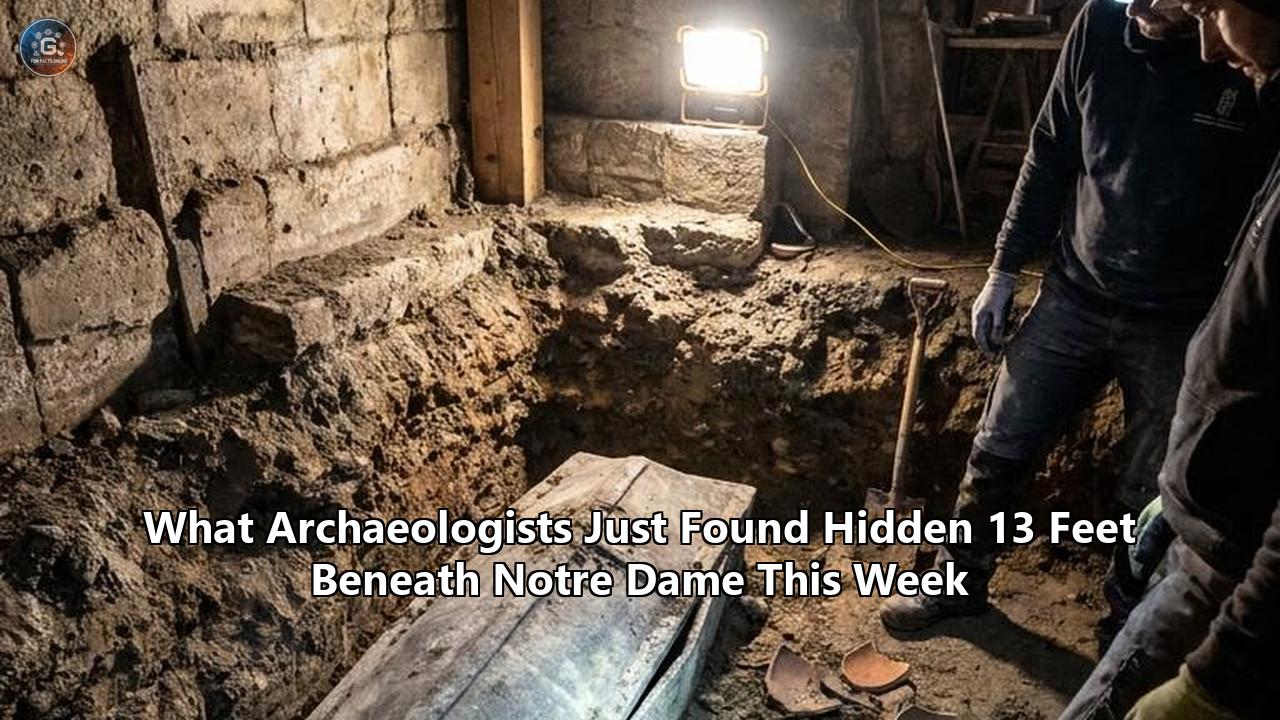
Four meters—nearly 13 feet—straight down into the dark, damp earth, a team of archaeologists in mud-spattered orange vests and white hardhats is digging back through time.
This week, the forecourt of Paris’s most famous monument has transformed into what French media are calling the "dig of the century". The excavation, led by Camille Colonna of the Paris municipal archaeology unit, has sliced open a subterranean window into 2,000 years of forgotten Parisian history.
At this depth, the air is cool, smelling of wet clay, river silt, and the unmistakable, stale scent of ancient decay. Trowel by trowel, the team is stripping away the physical layers of Paris, revealing that the ground beneath the cathedral is not merely dirt, but a dense, vertically stacked archive of human life.
The catalyst for this extraordinary investigation is entirely modern. Following the devastating 2019 fire that brought Notre Dame’s iconic spire crashing through its roof, the cathedral itself underwent a monumental restoration and successfully reopened in late 2024.
Now, the City of Paris is embarking on an ambitious plan to plant trees, install cooling water features, and create much-needed shade on the vast, hot expanse of the open plaza.
Under strict French heritage laws, however, the soil of the historic core cannot be disturbed by modern construction until preventive archaeologists have thoroughly mapped and excavated whatever lies beneath it.
What they have found 13 feet down this week is rewriting the earliest chapters of the French capital, turning up everything from Roman coins to a baffling medieval mystery that has left experts completely stumped.
The Stratigraphy of a Legend: Paris as a Historical Lasagna
To stand on the wooden viewing platform looking down into the active pit is to see twenty centuries of human habitation compressed into a single, vertical wall of earth. "Here you can see the layers—medieval Paris, Roman Paris, maybe even before that," says Yasmine Benali, a 22-year-old archaeology student watching the work proceed from behind the protective barriers. "It makes the city feel less like a postcard and more like something still being discovered."
[  PARVIS SURFACE Level: 2026 AD ]
       |
       |-- 0.5 Meters (20 Inches): 19th-Century Utility Lines & Haussmann Rubble
       |
       |-- 1.5 to 2.5 Meters: Medieval Street Foundations & Basements (c. 1163 AD)
       |
       |-- 3.0 Meters: Merovingian & Carolingian Grain Pits (6th–10th Centuries)
       |
       |-- 4.0 Meters (13 Feet): Gallo-Roman Lutetia Ruins & Roadways (4th–5th Centuries)
At the cathedral's birth in 1163, when Bishop Maurice de Sully ordered the first stones of the Gothic masterpiece to be laid, the parvis did not exist as an open plaza. Instead, the entire island of the Île de la Cité was a claustrophobic maze of timber-framed medieval houses, taverns, and workshops, all split down the middle by a single, narrow thoroughfare.
As Camille Colonna’s team dug downward, they first breached the modern utility lines and the heavy limestone rubble of the 19th century, when Baron Georges-Eugène Haussmann swept away the medieval slums to create the open grand squares we see today.
Just below that 20-inch threshold, the team struck the stone foundations and cellar walls of those long-demolished medieval houses.
Pressing deeper, they moved past the 10th century into the Merovingian and Carolingian eras (the 6th to 10th centuries), finding deep, circular grain storage pits cut into the clay.
Finally, at the 13-foot mark, the soil turned darker, denser, and packed with the heavy masonry of a Roman quarter dating back to the 4th and 5th centuries AD. It is at this deep, water-logged boundary near the level of the Seine River that this latest notre dame archaeological discovery has yielded its most startling secrets.
Layer 1: The Medieval Latrine and the "Da Vinci Code" Inscriptions
Paradoxically, the most spectacular finds of the week have emerged from the foulest places of the ancient city: the deep, stone-lined pits beneath the medieval houses that served as communal latrines and household rubbish dumps.
"For an archaeologist, an ancient toilet is pure gold," explains Valentine Breloux, a ceramic specialist with the Paris archaeology unit. "It’s where people dropped things they couldn't retrieve, and where household waste was safely buried away from the elements."
Because these deep pits remained sealed beneath layers of subsequent clay and stone, they created an anaerobic (oxygen-free) environment. The soft, organic waste inside acted as a protective cushion.
As Breloux carefully scraped away the dark, organic loam with a fine wooden tool, she began to uncover complete, unbroken ceramic vessels. "It's exceptionally rare to find complete ceramics in an urban dig," Breloux says. "Usually, we are playing a frustrating game of three-dimensional jigsaw puzzles with hundreds of tiny shards. But here, they miraculously came up whole, looking almost exactly as they did when a medieval Parisian homemaker discarded them 800 years ago."
+--------------------------------------------------------------+
|                    THE MEDIEVAL POTTERY MYSTERY              |
|                                                              |
|   [O]  Intact Earthenware Jugs                               |
|        - Found cushioned in anaerobic, soft organic waste.   |
|                                                              |
|   [?]  The Internal Red Inscriptions                         |
|        - Faint cursive markings painted inside the rims.      |
|        - Not maker's marks or merchant stamps.               |
|        - Currently undeciphered by paleographers.            |
+--------------------------------------------------------------+
But as the ceramics were brought up to the field washing station, they presented a puzzle that has confounded the entire team.
When conservators washed away the centuries of clinging dirt from the interior of the earthenware jugs and shallow bowls, they found faint, reddish writing painted directly onto the clay. The marks were not stamped or incised before firing; they were hand-painted onto the finished vessels.
"We stared at the first one and thought it was an anomaly—perhaps a single merchant’s tally or a personal mark of ownership," Breloux says. "But then we cleaned the second shard, the third, the fourth. The same mysterious, cursive red markings were painted on the inside of almost every single vessel from this specific household dump."
The writing is highly stylized, featuring looping characters that do not match standard medieval merchant tallies or known regional potter's marks.
Because the text is located on the inside of the vessels rather than the exterior, it would have been invisible when the pots were full of wine, water, or grain.
Some team members have jokingly dubbed the shards a "modern Da Vinci Code," while paleographers are actively scanning high-resolution multispectral scans of the red pigment to determine if the characters represent an early dialect of Old French, a coded ecclesiastical shorthand, or something far more esoteric.
"Of everything I have cleaned and cataloged from the Notre Dame site," Breloux remarks, looking at a freshly washed fragment under a magnifying lamp, "these painted vessels are the most astonishing. They suggest a level of household literacy—or perhaps a highly localized system of domestic ritual or accounting—that we simply have no record of."
Layer 2: The Coin of Constantine and the Fortified Retreat of Lutetia
To find the context of these medieval mysteries, the archaeologists had to push even deeper, past the foundations of the 12th-century cathedral town to the 13-foot Roman boundary. Here, the team struck the physical remains of Lutetia, the Roman predecessor to Paris.
During the height of the Pax Romana in the 1st and 2nd centuries AD, Lutetia was a sprawling, open-air city focused primarily on the Left Bank of the Seine, where grand public monuments like the Arenas of Lutetia and massive thermal bath complexes were constructed.
But by the late 3rd and early 4th centuries, as the borders of the Western Roman Empire began to fracture under the weight of civil wars and migrating Germanic tribes, the open plains of the Left Bank became indefensible.
The population made a dramatic, strategic retreat. They abandoned their grand villas, pulled back to the natural moat of the Île de la Cité, and fortified the island with a massive defensive stone wall.
To build this wall quickly, the Romans did something that modern preservationists might find shocking: they dismantled their own temples, monuments, and public buildings on the Left Bank, boated the stone blocks across the river, and reused them as raw building material.
This week, Camille Colonna’s team found definitive, physical proof of this desperate, ancient recycling project.
Buried at the 13-foot level, they uncovered a massive, beautifully carved Roman doorstep. The stone had originally belonged to a monumental public building—perhaps a temple or a judicial basilica—on the Left Bank.
"You can see the wear patterns from thousands of Roman sandals on what was once the threshold," Colonna explains, pointing to the deeply grooved limestone block. "But when they brought it here to the island, they didn't use it as a doorstep. They flipped it completely upside down and laid it flat into the dirt to serve as a paving stone for a newly fortified road. It is a tangible, poignant moment of a society in survival mode, prioritizing defense over architectural beauty."
+-------------------------------------------------------------+
|             THE ROMAN RECYCLING PROCESS (c. 300 AD)          |
|                                                             |
|   1. ORIGINAL USE:                                          |
|      Monumental temple/basilica doorstep on Left Bank.      |
|                                                             |
|   2. THE CRITICAL RETREAT:                                  |
|      Germanic incursions force retreat to Île de la Cité.   |
|                                                             |
|   3. AD-HOC REUSE:                                          |
|      Stone flipped upside down, laid as basic road paving.  |
+-------------------------------------------------------------+
Just adjacent to this repurposed threshold, pressed into the ancient road silt, the team found another crucial chronological marker: a small, circular coin.
When first pulled from the wet clay, the coin was nothing more than a featureless, black disc heavily encrusted with mineral deposits and rust.
"In the field, you have to resist the urge to scrape these coins," says Lucie Altenburg, a conservator-restorer with the Paris archaeology unit. "If you use a metal tool on-site, you risk destroying the incredibly fragile, oxidized surface details that are held together by nothing more than dirt and rust."
Altenburg took the black disc back to the specialized city conservation lab, where she subjected it to high-resolution X-ray imaging and micro-abrasive cleaning under a stereomicroscope.
Under the X-ray, the mineral crust became virtually transparent, and a face emerged from the darkness. It was the unmistakable, stern profile of Emperor Constantine the Great, complete with his imperial laurel wreath, dating the coin to the early 4th century AD (specifically the early 300s).
+-------------------------------------------------------------+
|                    LABORATORY DIAGNOSIS                     |
|                                                             |
|   Artifact: Heavily corroded metal disc                     |
|   Method: High-resolution X-Ray & Micro-abrasive cleaning   |
|   Result: Diademed profile of Constantine the Great         |
|   Date: Early 4th Century AD (c. 306–337 AD)                |
|   Significance: Firmly dates the Lutetia roadway layer      |
+-------------------------------------------------------------+
"A find like this is invaluable," Altenburg says. "It acts as a absolute chronological anchor for the stratigraphy. It tells us with absolute certainty that this paved road was in active use during or immediately after the reign of Constantine, right as the Christianization of the Roman Empire was beginning to take root."
The Parallel Investigation: How a Devastating Fire Unlocked the Soil
To truly understand how this current notre dame archaeological discovery outside the cathedral fits into the broader history of Paris, one must look at the chain of events set off by the tragic fire of April 15, 2019.
Before the blaze, Notre Dame was one of the most heavily trafficked tourist destinations on Earth, welcoming more than 12 million visitors annually. This constant, crushing flow of humanity made any systematic archaeological excavation of the cathedral’s interior floor practically impossible.
But when the wooden roof structure and the towering spire collapsed, they tore through the stone vaults, scattering charred oak timbers, lead roof tiles, and pulverized masonry onto the historic floor.
To stabilize the structural integrity of the cathedral and prepare for the reconstruction of the massive spire, engineers had to erect a colossal, 600-ton steel scaffolding system directly over the transept crossing—the exact center where the short arms of the cruciform church meet the main nave.
Under French heritage laws, the installation of such immense weight required an immediate "preventive excavation" to ensure the scaffolding’s heavy structural footings would not crush or destroy historical treasures buried beneath the floor slabs.
In early 2022, Christophe Besnier and his team from the National Institute for Preventive Archaeological Research (INRAP) were called in.
Initially, Besnier was given a highly restrictive window of just five weeks to excavate a small area of the transept floor, with permission to dig down only 16 inches—the exact depth of the proposed scaffolding foundations.
"We truly did not expect to find much at that shallow depth," Besnier recalled in a 2024 interview. "We assumed that centuries of successive floor installations, heating ducts, and structural repairs had completely scrambled or destroyed the medieval layers. But we were happily, spectacularly wrong."
The moment Besnier’s team pried up the 19th-century floor tiles, they struck a dense, virtually undisturbed treasure trove of medieval history.
As the five-week dig stretched into more than two months, the team unearthed 1,035 fragments of magnificent, highly decorated stone sculptures.
These pieces turned out to be the remnants of the cathedral’s original 13th-century rood screen (jubé)—a massive, 13-foot-high limestone partition that once separated the high altar and the private choir of the clergy from the public congregation standing in the nave.
+-------------------------------------------------------------+
|             THE RECONSTRUCTION DIG (2022–2024)              |
|                                                             |
|   Area: Transept Crossing (Interior Floor)                  |
|   Initial Authorized Depth: 16 inches (40 cm)               |
|   Actual Dig Duration: 2+ Months                            |
|   Key Discoveries:                                          |
|     - 1,035 fragments of 13th-Century Rood Screen            |
|       - 700+ pieces retaining original medieval paint        |
|     - Over 100 historical graves                            |
|     - Two body-shaped lead sarcophagi                       |
+-------------------------------------------------------------+
Built around 1230, this screen was a masterwork of Gothic sculpture, depicting vivid, life-sized scenes from the Passion of Christ.
But in the early 18th century, during the reign of King Louis XIV, artistic tastes and liturgical practices shifted.
The "Sun King" and his clergy wanted a more open, visible altar space, and they ordered the grand rood screen to be completely dismantled and destroyed.
Because the broken stone sculptures were still considered sacred, they could not simply be thrown away.
Instead, the workers buried the pieces directly beneath the cathedral floor, using them as structural fill.
"To find these pieces was an incredibly emotional moment," Besnier said. "Suddenly, we were holding sculpted hands, feet, and faces of saints that had not been seen by human eyes in nearly three centuries. And unlike the stone sculptures on the exterior of the cathedral, which have been scrubbed clean by centuries of acid rain and pollution, these buried fragments still bore their original, vibrant medieval paint."
More than 700 of the recovered fragments showed bright traces of blue, deep red, and delicate gold leaf.
These painted fragments are providing architectural historians with a rare, invaluable glimpse into what the interior of Notre Dame actually looked like in the 13th century: not a cold, grey stone monument, but a blindingly colorful, luminous space designed to mimic the heavenly Jerusalem on Earth.
The Lead Sarcophagi: The Poet, the Priest, and the Knight
While the discovery of the lost rood screen was a triumph of art history, the 2022–2024 interior excavations also revealed something far more intimate: a dense, subterranean cemetery containing over 100 graves.
Among these burials, archaeologists found two human-shaped lead sarcophagi buried deep beneath the transept crossing.
Because lead is highly durable and forms a hermetic seal when soldered shut, lead coffins were reserved strictly for the highest echelons of medieval and early modern French society.
To prevent degradation of any ancient organic matter, the two coffins were carefully extracted and transported to the forensic medicine institute at the University of Toulouse, where they were opened under strict scientific conditions.
The first sarcophagus was found with a clear, brass identification plate. It belonged to Canon Antoine de La Porte (1627–1710), a wealthy and influential high priest of the cathedral who died at the advanced age of 83.
De La Porte had used his vast personal fortune to help fund the extensive remodeling of the cathedral’s choir—the very remodeling that had resulted in the destruction of the 13th-century rood screen.
His skeletal remains showed that he lived a remarkably comfortable, sedentary lifestyle. "He had exceptionally good teeth and showed signs of gout, often called the 'disease of the rich,'" noted one researcher. He was buried with several medals and lay peacefully in his lead cocoon for over 300 years.
+-------------------------------------------------------------+
|               THE INHABITANTS OF THE LEAD SARCOPHAGI         |
|                                                             |
|   TOMB 1: CANON ANTOINE DE LA PORTE (d. 1710)               |
|     - Age at death: 83                                      |
|     - Status: Ultra-wealthy high priest, cathedral patron   |
|     - Health profile: Excellent teeth, signs of gout        |
|                                                             |
|   TOMB 2: "LE CAVALIER" (Likely JOACHIM DU BELLAY, d. 1560) |
|     - Age at death: Late 30s                                |
|     - Status: Experienced horseman, noble birth             |
|     - Health profile: Severe bone tuberculosis, meningitis   |
|     - Details: Embalmed, buried with a crown of flowers     |
+-------------------------------------------------------------+
The occupant of the second, deeper lead sarcophagus was initially a complete mystery. It was a body-shaped coffin molded closely to the contours of the deceased, but it bore no nameplate.
When forensic anthropologists opened the lid, they found the partially mummified remains of a young man, likely in his late 30s.
His pelvic bones were deeply deformed in a way that indicated he had spent his entire life riding horses from an early age, prompting scientists to nickname him "Le Cavalier" (The Knight).
"Le Cavalier" had lived a highly privileged but physically agonizing life. His bones showed clear signs of severe, chronic illness, including bone tuberculosis that had affected his spine and ribs, as well as chronic meningitis.
He had been carefully embalmed—a highly complex and expensive funeral practice in the Renaissance—and his skull had been sawed open to allow for the removal of his brain during the preservation process. He was laid to rest on a soft pillow of aromatic leaves and buried with a crown of delicate flowers.
For months, the identity of "Le Cavalier" remained a subject of intense academic debate.
However, in late 2024, researchers from INRAP and the French National Center for Scientific Research (CNRS) announced a stunning hypothesis: the physical profile of the skeleton matched almost perfectly with the historical record of Joachim du Bellay (1522–1560), one of France’s most celebrated Renaissance poets.
Du Bellay was a brilliant writer, co-founder of the influential literary group La Pléiade, and a canon of the cathedral.
He had suffered from poor health throughout his life, including severe deafness and symptoms that modern medical historians have long suspected were caused by tuberculosis and meningitis.
He died of a sudden apoplexy in his study at the age of 37.
Although historical records indicated Du Bellay was buried in the cathedral’s Saint-Crépin chapel, subsequent renovations in the 18th century had scrambled the burial locations, and his grave was long believed to have been lost.
The match of the age, the chronic bone pathologies, the equestrian pelvis (du Bellay was known to have ridden extensively from Paris to Rome), and the high-status embalming practices have convinced many that "Le Cavalier" is indeed the long-lost poet.
Inside the Conservation Lab: The Science of Resurrection
While the active excavation pit on the Place du Parvis de Notre-Dame remains the focus of public curiosity, the real investigative heavy lifting occurs behind the secure, sterile walls of the city's archaeological conservation center in northern Paris.
Here, in a series of brightly lit, climate-controlled rooms smelling of ethanol and damp soil, conservators like Lucie Altenburg work to stabilize artifacts before they can deteriorate from exposure to oxygen and dry air.
"When an object has been buried in wet, clay-heavy soil for centuries, it achieves a delicate state of physical equilibrium," Altenburg explains, adjusting the focus of a large stereomicroscope. "But the moment you dig it up and expose it to the air, that equilibrium is shattered. Organic materials like wood, leather, or textile will dry out too fast, causing the cellular walls to collapse and turning priceless history into worthless dust in a matter of hours."
To combat this, the lab relies on a specialized piece of high-tech equipment known to the team simply as "la lyo"—a large, industrial-grade lyophilizer, or freeze-dryer, originally developed for the biopharmaceutical industry.
+-------------------------------------------------------------+
|             THE LYOPHILIZATION (FREEZE-DRYING) PROCESS       |
|                                                             |
|   1. EXTRACTION:                                            |
|      Waterlogged organic object (wood/leather) is removed   |
|      from the wet clay of the parvis.                       |
|                                                             |
|   2. RAPID FREEZING:                                        |
|      The object is frozen rapidly to -40°C, turning all     |
|      internal liquid water into solid ice crystals.         |
|                                                             |
|   3. VACUUM SUBLIMATION:                                    |
|      The frozen object is placed inside "la lyo" vacuum     |
|      chamber. Pressure is dropped significantly.            |
|                                                             |
|   4. DRYING:                                                |
|      Gentle heat is applied, causing the ice to sublimate   |
|      directly into gas, bypassing the damaging liquid       |
|      phase and preserving the organic cellular structure.   |
+-------------------------------------------------------------+
When organic artifacts—such as the wooden handles of medieval knives, scraps of leather shoes from the 12th century, or waterlogged structural timbers—are recovered from the damp layers of the Île de la Cité, they are immediately placed into sealed water baths.
In the lab, Altenburg slowly replaces the water inside the objects with a PEG (polyethylene glycol) solution, which strengthens the wood fibers.
The objects are then frozen solid and placed inside the lyophilizer’s vacuum chamber.
By dropping the atmospheric pressure inside the chamber and applying gentle, controlled heat, the frozen water sublimates—meaning it transitions directly from solid ice to water vapor, bypassing the liquid phase entirely.
This process removes every molecule of moisture without causing the wood or leather to warp, shrink, or crack.
"It has completely revolutionized how we handle these delicate wet-site excavations," Altenburg says. "It allows us to rescue organic objects that previous generations of archaeologists would have had to watch rot away before their eyes."
Currently, Altenburg and her team are focusing their efforts on analyzing the chemical composition of the mysterious red pigment found on the interior of the medieval pottery shards.
Initial non-destructive X-ray fluorescence (XRF) analysis has revealed that the paint is rich in iron oxide, commonly known as red ochre—a widely available natural pigment in the Middle Ages.
However, the team is also looking for traces of organic binders, such as egg white or animal fat, which could help determine how the paint was mixed and perhaps shed light on why these markings were applied.
"We are also using multi-spectral imaging to enhance the legibility of the fading characters," Altenburg notes. "The writing was done quickly, with a fluid hand. By analyzing the stroke order and the pressure of the brush, our paleographers are hoping to determine if the writer was a trained scribe or a common merchant."
Two Worlds Collide: The Street and the Sanctuary
When you zoom out and look at the dual archaeological investigations of Notre Dame—the interior excavations of 2022–2024 and the current 2026 forecourt dig—a fascinating, structural contrast begins to emerge.
The interior of the cathedral was the domain of the elite, the powerful, and the sacred.
The archaeological record there is dominated by monumental limestone architecture, grand gilded sculptures of the saints, and the lead coffins of wealthy high priests, poets, and knights who spent fortunes to secure a resting place as close to the high altar as possible.
It was a world designed to transcend the messy realities of earthly life, built to project divine order and eternal stability.
+-------------------------------------------------------------------------+
|                  THE SUBTERRANEAN DUALITY OF NOTRE DAME                 |
+-------------------------------------------------------------------------+
|          THE SANCTUARY (Interior Digs)   |    THE STREET (Forecourt Dig) |
|------------------------------------------+------------------------------|
| - High-status burials (Canons & Nobles)  | - Common waste (latrine pits)|
| - Gilded 13th-century limestone art      | - Utilitarian red-paint pots |
| - Sacred Latin inscriptions              | - Discarded 4th-century coins|
| - Monolithic, intentional structures     | - Recycled Roman paving stone|
+-------------------------------------------------------------------------+
But just a few steps outside the cathedral’s great western portals, the archaeological record of the parvis tells a completely different story.
At 13 feet down, we find ourselves standing in the muddy, noisy, sometimes foul-smelling streets of the common people.
Here, the history of Paris is written not in gold leaf and fine marble, but in discarded pottery, recycled Roman doorsteps, lost coins, and the daily waste of families trying to survive the collapse of empires and the harsh realities of medieval urban life.
This duality is what makes this latest notre dame archaeological discovery so profound.
It democratizes our understanding of the cathedral.
Notre Dame did not rise out of a historical vacuum; it was built directly on top of the living, breathing, working-class heart of Paris.
The very people who cooked in the red-marked pots, threw their trash into the latrines, and walked on the rough Roman-paved streets were the bricklayers, stone-carvers, and daily worshipers who made the construction of the cathedral possible.
What Happens Next: The Future of the Parvis and Beyond
As the hot June days roll on, the team on the Place du Parvis de Notre-Dame is working against a ticking clock.
Preventive archaeology is, by its very nature, a compromise between the preservation of the past and the development of the future.
The excavation pit will not remain open forever.
Once Camille Colonna’s team has reached the lowest archaeological layers and carefully mapped every stone, the trench will be documented in ultra-precise three-dimensional digital scans.
The artifacts—the Roman doorstep, the coin of Constantine, the mysterious medieval pottery, and the thousands of animal bones and botanical samples that will tell scientists what ancient Parisians ate—will all be systematically cataloged, packed into crates, and moved to the permanent city archives.
The open pit will then be carefully filled with structured, supportive soil designed to protect the unexcavated remains below from shifting or crushing.
On the surface, the city will begin its planned transformation.
The hot, concrete expanse of the parvis will be planted with a dense grove of climate-resilient trees, transforming the plaza into a leafy, shaded urban oasis designed to lower local temperatures and provide a welcoming space for future generations of visitors.
But beneath the roots of those new trees, the ancient bones of Paris will remain, safe and sealed, waiting for the next generation of archaeologists to ask new questions.
Meanwhile, the intellectual work of this notre dame archaeological discovery is only just beginning.
By the end of 2026, the collective research program (PCR)—which brings together scientists from INRAP, the CNRS, and several French universities—plans to release a complete, highly detailed digital reconstruction of the 13th-century rood screen, allowing the public to virtually walk through the colorful, long-lost partition of the medieval cathedral.
At the same time, paleographers are continuing their painstaking work to decipher the faint red writing inside the medieval pots.
Each new test brings us one step closer to understanding what those silent characters are trying to tell us across the centuries.
For the tourists still waiting in the long line under the summer sun, looking over the barricades at the muddy pit, the lesson is clear.
Notre Dame is more than a magnificent monument of stone and glass.
It is the crown of a colossal, living mountain of human history, where every step we take on the streets above is supported by the quiet, buried lives of those who walked the very same ground thousands of years before.
Reference:
- https://www.kens5.com/article/syndication/associatedpress/only-on-ap-under-notre-dame-cathedral-a-dig-of-the-century-unearths-1700-years-of-history/616-e1071967-ff81-4fc5-96e7-25d545ee881b
- https://www.local10.com/news/world/2026/06/02/only-on-ap-under-notre-dame-cathedral-a-dig-of-the-century-unearths-1700-years-of-history/
- https://www.parisinsidersguide.com/archaeological-crypt-of-notre-dame.html
- https://www.wbal.com/only-on-ap-under-notre-dame-cathedral-a-dig-of-the-century-unearths-1700-years-of-history
- https://en.wikipedia.org/wiki/Notre-Dame_de_Paris
- https://www.newsmax.com/world/globaltalk/notre-dame-dig-treasures-paris-archaeology-roman/2026/06/02/id/1258233/
- https://www.click2houston.com/news/world/2026/06/02/only-on-ap-under-notre-dame-cathedral-a-dig-of-the-century-unearths-1700-years-of-history/
- https://www.paris.fr/pages/lucie-restauratrice-archeologique-revele-les-objets-enfouis-a-paris-33762
- https://lasvegassun.com/news/2026/jun/01/only-on-ap-under-notre-dame-cathedral-a-dig-of-the/
- https://www.sfgate.com/news/world/article/only-on-ap-under-notre-dame-cathedral-a-dig-of-22287136.php
- https://www.sfgate.com/news/world/article/only-on-ap-under-notre-dame-cathedral-a-dig-of-22287136.php
- https://www.jpost.com/archaeology/archaeology-around-the-world/article-831451
- https://shs.cairn.info/revue-archeosciences-2021-1-page-75?lang=en
- https://www.theguardian.com/world/2022/dec/09/notre-dames-uncovered-tombs-start-to-reveal-their-secrets
- https://www.nationalgeographic.com/history/article/notre-dame-restoration-surprising-treasures
- https://www.theguardian.com/world/2022/apr/14/ancient-tombs-statues-notre-dame-cathedral-archaeological-dig
- https://mymodernmet.com/notre-dame-lead-sarcophagus/
- https://www.goodnewsnetwork.org/beneath-notre-dame-cathedral-archaeologists-discover-more-than-1000-artifacts-and-statues/
- https://historymedieval.com/notre-dames-secrets-unearthed-during-restoration-efforts/
- https://artdaily.com/news/174052/Archaeology-of-Notre-Dame-de-Paris--Progress-in-research
- https://archaeology.org/news/2024/12/06/notre-dame-cathedral-fire-allows-archaeologists-to-unearth-historic-artworks/
- https://www.smithsonianmag.com/smart-news/notre-dame-repair-crews-discover-an-ancient-graveyard-with-a-sealed-sarcophagus-180979809/
- https://www.wbal.com/only-on-ap-under-notre-dame-cathedral-a-dig-of-the-century-unearths-1700-years-of-history
- https://www.britannica.com/list/26-historic-buildings-to-visit-the-next-time-youre-in-paris