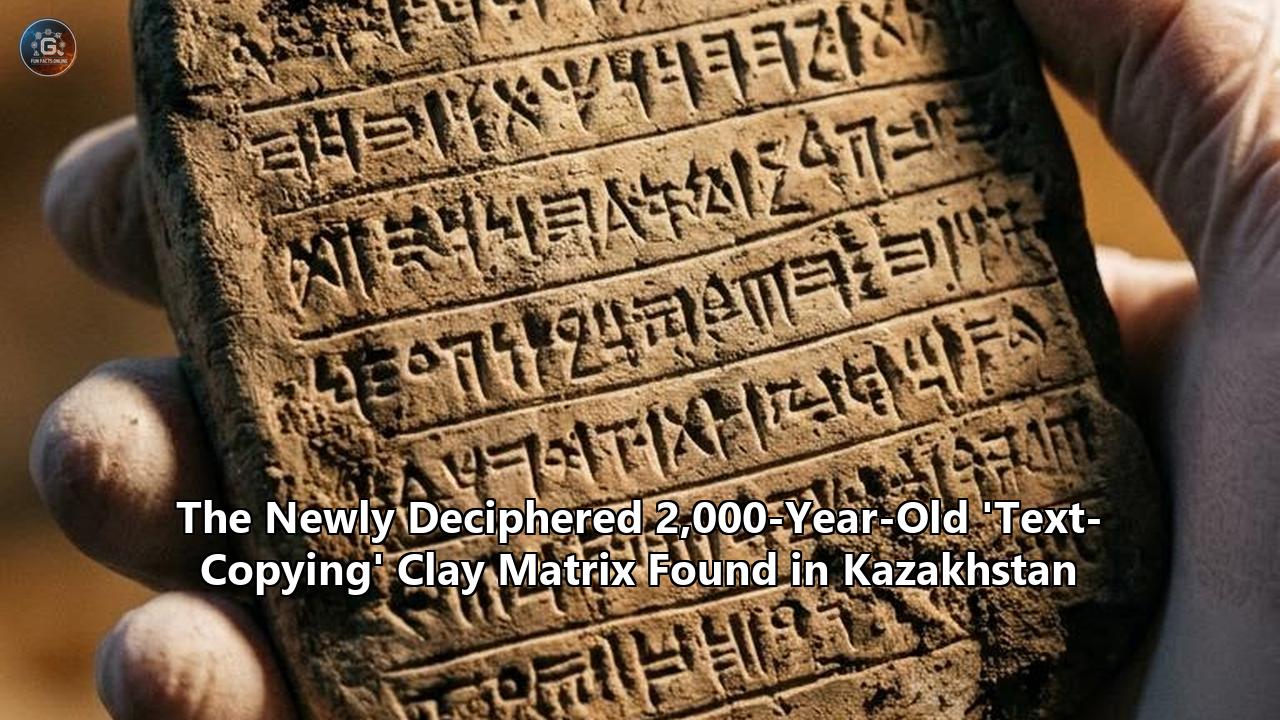
A dramatic discovery from the wind-swept plains of southern Kazakhstan has sent a thrill through the international archaeological community, offering a rare, tangible window into the sophisticated administrative machinery of a long-lost Silk Road empire. During the latest excavation season at the ancient settlement of Kultobe, researchers unearthed a series of 2,000-year-old baked clay fragments that represent an early printing precursor: a clay matrix designed for copying texts.
Led by Professor Alexander Podushkin, a renowned archaeologist from the Archaeology Center of South Kazakhstan Pedagogical University named after Uzbekali Zhanibekov, the team's find challenges the long-standing historical stereotype of early Central Asian states as illiterate, purely nomadic confederations. Instead, it reveals a society that utilized standardized, mass-producible written administration centuries before the invention of the European printing press.
The center of this revelation is the ancient clay matrix discovery, an artifact that served as a physical template or "stamp" to replicate written documents. In addition to this matrix, the team recovered 14 new inscription fragments carved on heavy, fired clay bricks. One of these bricks contains a nearly complete text, while others preserve vital historical and linguistic data. Together, they add between 300 and 400 newly identified characters to the existing written corpus of the site, representing a massive leap forward for paleolinguists who have spent decades trying to piece together the region's ancient languages.
Unpacking the Tech: The Science of the "Text-Copying" Matrix
To understand why this ancient clay matrix discovery is so important, it is necessary to examine the physical technology of ancient record-keeping. In the ancient world, particularly in Mesopotamia and across the Near East, writing was a labor-intensive, hand-crafted process. Scribes used a pointed stylus to press wedge-shaped cuneiform characters or alphabetic letters line-by-line into damp, raw clay tablets, which were then dried in the sun or baked in a kiln to create a permanent record. If a king or governor wanted to send the same decree to five different provinces, scribes had to copy the text by hand five separate times. This manual method was slow and inevitably introduced clerical errors.
The clay matrix found at Kultobe suggests a highly developed alternative. The matrix is a rectangular, pre-carved block of well-polished clay featuring a pre-arranged, raised inscription in reverse negative. When pressed firmly into a flat slab of raw, wet clay, the matrix leaves behind a clean, legible, and standardized impression of the entire text in a single movement. The resulting clay brick could then be dried, fired, and used as an official administrative document, a public decree, or even a foundation stone for a defensive structure.
This is, in essence, a regional forerunner to movable type and block printing. The physical characteristics of the Kultobe matrix support this functional analysis. Its edges are carefully trimmed with a knife, and the front surface shows distinct wear-and-tear, indicating that it was not a one-off decorative piece but a tool that saw repeated use in an ancient chancellery. By standardizing the physical medium of the text, the administrators of Kultobe created a highly reliable way to broadcast information, manage territory, and project political power.
This ancient clay matrix discovery was made possible by the unique geology of South Kazakhstan. The region's clay is highly specific—typically mixed-layer clays of the kaolinite-illite type, rich in iron. When baked, this clay turns a distinctive reddish, orange, or yellow-brown color due to the oxidation of paramagnetic iron into a trivalent state (hematite).
This mineralogical makeup provides incredible structural durability, which is why these bricks survived buried under layers of compact sediment and river silt for two millennia. To prevent warping and cracking during the drying and firing processes, ancient potters added non-plastic tempers like fine sand or crushed grog (old fired pottery) to the clay paste. Once stamped, the "informative bricks" were fired in highly advanced updraft kilns, turning the soft clay into a stone-like medium resistant to moisture and physical decay.
The Linguistic Puzzle: Deciphering the Proto-Sogdian Script
To appreciate the scale of this breakthrough, one must navigate the dizzying complexity of the script itself. The writing on the Kultobe matrix is not an easy-to-read alphabet, nor is it a simple pictographic system. It is an archaic form of the Sogdian script, sometimes referred to as Proto-Sogdian or Kangyuy script, which is deeply rooted in the Imperial Aramaic writing system.
When the Persian Achaemenid Empire dominated Central Asia in the 6th to 4th centuries BC, it utilized Aramaic as its official administrative language because it could be written easily in ink on papyrus, parchment, or leather. When the empire dissolved, local communities in Central Asia adopted the Aramaic script to write their own regional languages. Over generations, this script branched into several distinctive scripts, including Parthian, Choresmian, and Sogdian.
However, the transition from Aramaic to Sogdian was not a direct phonetic swap. Scribes developed a complex system of writing known as "heterography" or the use of "logograms". In practice, this meant that when a scribe wrote a document, they used traditional Aramaic spelling and vocabulary, but they read and pronounced the words as their Sogdian equivalents.
[Written Script (Aramaic Consonants)]  --->  [Scribe's Mental Translation]  --->  [Spoken Language (Sogdian)]
          "MLK" (King)                                                              "Shah" (King)
For example, a scribe would write the letters for the Aramaic word for "general" or "army leader" (using Aramaic characters), but when reading the brick aloud to an audience, they would pronounce the Eastern Iranian Sogdian word spādh-nī. To a modern scholar who is not trained in this specific system, an initial look at the clay tablet would suggest the text is written in pure Aramaic. It is only when the researcher identifies a few phonetic, non-logographic spellings that they realize they are actually reading a Middle Iranian language.
This linguistic trait makes deciphering the Kultobe texts exceptionally difficult. It requires an extraordinary grasp of both Semitic (Aramaic) and Indo-European (Iranian) linguistic roots. The process of unlocking this code has been a decades-long collaborative effort.
After Professor Podushkin first presented his findings to the National Academy of the French Republic in 2008, he attracted the attention of Nicholas Sims-Williams, an eminent paleolinguist and Research Professor of Iranian and Central Asian Studies at the School of Oriental and African Studies (SOAS), University of London. Working with French scholar Frantz Grenet, Sims-Williams and Podushkin managed to prove that the Kultobe inscriptions represent the oldest known written monuments of the Sogdian language, dating to the 1st to 3rd centuries AD—older even than the famous "Ancient Letters" found by explorer Marc Aurel Stein in a desert watchtower near Dunhuang, China.
The script’s historical lineage is immense. This archaic abjad—consisting of 22 consonantal signs where vowels are mostly omitted or implied by helper letters called matres lectionis—served as the direct evolutionary ancestor of the Old Uyghur alphabet. The Uyghurs, in turn, adapted this script, which eventually became the basis for the Traditional Mongolian script. The lines carved into the Kultobe clay matrix are, quite literally, the ancestors of the script still written in Mongolia today.
"People of Tents" and City Foundations: What the Texts Say
While the physical ancient clay matrix discovery is a marvel of ancient engineering, the actual messages deciphered from the newly found brick fragments are equally transformative for historians. The 14 fragments recovered in the latest field season have yielded text of immense historical value.
One of the newly deciphered fragments describes a major geopolitical event: the establishment and colonization of a city on land historically associated with nomadic tribes. This text details a division of land between the settled urban populations and the surrounding mobile groups. More importantly, the inscription contains the first known recorded native ethnic term translated as "people of tents".
               +----------------------------------------+
               |          THE KULTÓBE TREATY            |
               |                                        |
               |  [ Urban Sogdian Settlers ]            |
               |  - Established new defensive city      |
               |  - Controlled irrigation networks      |
               |                                        |
               |         [ Division of Land ]           |
               |  - Codified borders and trade access   |
               |                                        |
               |  [ Nomadic "People of Tents" ]         |
               |  - Maintained grazing rights           |
               |  - Provided security & horse archers   |
               +----------------------------------------+
For centuries, historians have viewed the relationship between the sedentary farmers of Central Asian oases and the nomadic horse archers of the northern steppes through a lens of violent, perpetual conflict. This "nomad versus farmer" dichotomy has been the standard narrative of ancient history textbooks. The new Kultobe texts paint a vastly more complex, cooperative, and treaty-based picture.
The mention of the "people of tents" and the formal "division of land" indicates that the sedentary Sogdian-speaking communities and the mobile nomadic groups did not exist in a state of constant war. Instead, they engaged in formal diplomacy, negotiated borders, and signed legal treaties that were stamped onto fired clay bricks to ensure their permanence. The "people of tents" were recognized as legitimate political stakeholders within the broader administration of the state.
This discovery provides a rare, internal perspective of the region's socio-political landscape. Instead of relying on external Chinese or Persian chronicles that often dismissed steppe-dwellers as lawless barbarians, the Kultobe inscriptions show how these communities were classified, treated, and integrated into the legal framework of their own regional empire.
The Kangju Kingdom: Redefining an Ancient Silk Road Power
The geographic and political context of these finds points directly to the Kangju (also spelled Kangyuy) state, a major but poorly understood kingdom that dominated Central Asia from roughly the 2nd century BC to the 4th century AD.
At its peak, the Kangju kingdom occupied a vital, strategic corridor along the Syr Darya and Talas river basins, linking the northern steppes of modern Kazakhstan with the rich oasis cities of Samarkand, Bukhara, and Tashkent (Chach). This positioned the Kangju as the gatekeepers of the early Silk Road trade, managing the flow of luxury goods, ideas, and people between Han Dynasty China, the Roman Empire, the Kushan Empire, and the Parthian state.
               [ Northern Steppes (Nomads / Alans) ]
                                |
                                v
               [ KANGJU STATE (Syr Darya Valley) ]  <---> [ Han China (East) ]
              (Kultobe - Administrative Capital)
                                ^
                                |
                                v
       [ Oasis Cities (Samarkand / Bukhara / Kushans) ]
Historically, our understanding of the Kangju has been highly asymmetric. We knew of them primarily through Chinese dynastic chronicles, such as Sima Qian’s Shiji (written around 90 BC) and the Hou Han Shu (History of the Later Han). Sima Qian described the Kangju as a nomadic people with "80,000 or 90,000 skilled archers" who resembled the neighboring Yuezhi in their customs. Because of these external accounts, modern historians long characterized the Kangju as a loose, transient alliance of horse-riding warriors with little in the way of permanent infrastructure, literacy, or centralized governance.
The material archaeology of Kultobe, capped by this specific ancient clay matrix discovery, has permanently shattered this view.
Excavations have revealed that the Kangju state possessed an advanced, highly structured economy that integrated both agricultural sophistication and urban development. Archaeologists have discovered remnants of vast irrigation canals dating to the Kangju-Kushann period. These canals were so extensive that the total land area under irrigation in the Syr Darya valley was four times greater than the irrigated territory of the same region in the high Middle Ages. The Kangju were master hydrologists, turning dry valleys into fertile agricultural basins that fed a large, sedentary population.
Furthermore, the discovery of defensive citadels, professional ceramic factories, metal-smelting workshops, and a sophisticated written administrative apparatus shows that the Kangju possessed all the hallmarks of a complex, civilized state. They had a specialized class of bureaucrats, scribes, and legal experts who drafted treaties, managed the state's borders, and maintained a centralized archive of "informative bricks".
The Thirty-Year Excavation of Kultobe: A Father-Son Legacy
The physical site of Kultobe, where these artifacts have been uncovered, is located in South Kazakhstan's Ordabasy district, near the village of Sary Aryk. Situated in the fertile floodplain of the Arys River, the settlement has been the subject of intensive archaeological exploration for over half a century.
The story of Kultobe’s rediscovery is also a deep familial legacy. The mound was first explored in 1964 by an archaeological team from the Shymkent Pedagogical Institute under the direction of Nikolai Podushkin. Decades later, in 1991, his son, Professor Alexander Podushkin, took over the excavations. Over the last 35 years, the younger Podushkin has led a dedicated team through the challenging landscape to piece together the remnants of this lost civilization.
The work has been a race against time and nature. The central citadel of the ancient settlement—the heart of the Kangju administrative capital—was completely washed away by the volatile waters of the Arys River when it changed its course in the decades before World War II. Only the rabad, the surrounding suburbs and fringes of the settlement, survived.
It is within these surviving residential and administrative fringes that Alexander Podushkin and his team have made their most dramatic finds. Over more than three decades of systematic excavation, the team has recovered small, scattered fragments of clay writing. For many years, they had only 18 small fragments and a few larger pieces, totaling about 800 characters spread across 60 conventional lines. Every fragment was a precious puzzle piece.
The latest excavation season has transformed the scale of this research. The addition of 14 new, highly informative fragments—including the nearly complete brick text and the text-copying matrix—represents a major expansion of the available historical record. The team’s hard work has effectively doubled the density of the written corpus, turning a series of isolated linguistic clues into a cohesive, readable historical narrative.
Elite Graves and Martial Wealth: The Kylyshzhar Connection
To complement the administrative and literacy-focused finds at the Kultobe settlement, Professor Podushkin's expedition also conducted excavations at the nearby Kylyshzhar burial ground. The graves excavated this season have yielded a rich array of elite funerary goods, providing a physical, material context to the wealthy society that commissioned the clay matrices.
Among the artifacts recovered from the Kylyshzhar catacombs and grave mounds are heavy iron weapons, including swords and daggers, specialized horse riding equipment, and complex personal ornaments. Crucially, the graves of the Kangju elites contained exquisite jewelry, including gold earrings, torcs, and imported glass beads.
These grave goods tell a story of immense wealth and extensive trade connections. The presence of imported luxury items, such as Roman-style glass, Chinese silks, and beautifully crafted gold jewelry, demonstrates that the leaders of the Kangju state were not isolated in their Central Asian steppes. They were active participants in the globalized trade of the Silk Road, using their strategic position to accumulate immense wealth.
This martial and material wealth went hand-in-hand with the state's written bureaucracy. The administrative treaties stamped with the clay matrix protected the borders, secured the trade routes, and codified the legal alliances that allowed this wealth to accumulate. The elite graves of Kylyshzhar are the physical manifestation of the political stability and economic prosperity recorded on the Kultobe informative bricks.
The Technical Future of Clay Decipherment
While the physical extraction of these clay artifacts is a triumph of traditional field archaeology, the task of fully translating and understanding them has increasingly relied on advanced diagnostic tools. Unlocking the micro-reliefs of heavily eroded, 2,000-year-old clay is a complex, interdisciplinary science.
In the past, scholars had to rely on raking light—positioning a single lamp at sharp angles to cast shadows in the microscopic grooves left by styluses or stamps—and manual line drawings. This process was slow, subjective, and prone to human error. A single speck of dirt, a hairline crack, or a microscopic chip in the baked clay could easily be misidentified as a stroke, changing a letter, a word, or an entire sentence's meaning.
Today, researchers are employing digital imaging to bypass these human limitations. One of the most significant tools used in modern cuneiform and epigraphic studies is the Portable Light Dome (PLD), a scanning system developed by engineers at KU Leuven in Belgium. The device features a dome-shaped array of programmatically controlled LED lights with a high-resolution camera mounted at the apex.
                     [ Camera at Apex ]
                             ||
                      .------||------.
                     /   *   *   *   \  <--- [ Dome Shell ]
                    /  *   [PLD]   *  \
                   /  *    *   *    *  \  <--- [ Multi-Angle LED Lights ]
                  |---------------------|
                  |     Clay Tablet     | <--- [ Object to scan ]
                  '---------------------'
By placing a clay fragment inside the dome, the system photographs the object hundreds of times, with each photo captured under a different light source angle. Specialized software then processes these images to construct an interactive 3D model of the clay surface. Scholars can digitally manipulate the light source in real-time, stripping away the visual distraction of the clay’s color, texture, and physical staining to isolate the pure, three-dimensional relief of the script. This technology allows researchers to detect faint, previously invisible seal impressions, microscopic handwriting variations, and the precise angles of the matrix stamps.
Furthermore, the academic community is beginning to deploy artificial intelligence models to assist in the reconstruction and translation of fractured clay archives. Projects such as the "Fragmentarium" at LMU Munich and the "Palaeographicum" tool developed by researchers in Germany are trained on hundreds of thousands of digitized ancient scripts. These AI models can compare the shapes, spacing, and repetition patterns of damaged characters across thousands of miles and different museum databases.
By identifying the unique "handwriting" of specific ancient scribes or the exact physical dimensions of particular stamping matrices, AI can help match scattered fragments of the same document that have been separated for millennia. Applied to the Kultobe corpus, these modern diagnostic technologies promise to accelerate the translation of the remaining undeciphered signs, turning the fragmentary clay archive into a fully digitized, searchable library of early Central Asian history.
Why the Discovery Changes the Global History of Writing
The implications of this ancient clay matrix discovery at Kultobe extend far beyond the borders of South Kazakhstan. This artifact challenges several foundational assumptions about the global history of technology and the evolution of written communication.
Traditionally, the history of printing is taught as a series of distinct, localized breakthroughs:
- The clay stamps of the ancient Near East
- The mysterious Phaistos Disc of Minoan Crete
- The invention of woodblock printing in Tang Dynasty China
- Johannes Gutenberg's development of movable metal type in 15th-century Europe
In this Eurocentric and Sinocentric narrative, the vast steppes of Central Asia are often treated as a technological void—a blank space on the map crossed by merchants and armies but lacking its own domestic technological innovation.
The Kultobe matrix rewrites this history. It demonstrates that 2,000 years ago, a highly organized state in South Kazakhstan had independently developed a system of mass-copying texts using pre-arranged, reusable clay templates. This is not a simple personal signet seal used to sign an individual trade document. It is a systematic tool designed to replicate long blocks of text for public distribution.
This discovery shows that the urge to industrialize, standardize, and accelerate the written word is a universal human drive that arose independently in multiple civilizations. The bureaucrats of the Kangju state faced the same administrative challenges as the rulers of Han China, the Roman Empire, or the kingdoms of Mesopotamia: they needed a reliable, fast, and unalterable way to communicate laws, treaties, and boundaries across vast distances. Their solution—the clay matrix—was a brilliant piece of native engineering that bridged the gap between manual writing and mechanized printing.
What to Watch For Next
As researchers conclude the analysis of the latest excavation finds, archaeologists, historians, and paleolinguists are already preparing for the next phases of research. The immediate priority is the stabilization, preservation, and high-resolution scanning of the newly recovered matrix and the 14 brick fragments. The raw clay must be treated to prevent crumbling, and the inscriptions will be uploaded to international databases for collaborative study.
Several major questions remain unresolved, providing an exciting roadmap for future discoveries:
- Are there more matrices? The discovery of a single text-copying matrix strongly suggests that others must have existed. Scribes would have needed different matrices for different treaties, decrees, or administrative records. Future excavations at Kultobe and surrounding Kangju sites will target potential chancellery archives in search of a larger "printing press" toolkit.
- What other treaties were signed? The newly deciphered reference to the "people of tents" and the division of land hints at a complex legal landscape. Scholars are eager to translate the remaining fragments to see if they record treaties with other nomadic groups, such as the northern Alans, Sarmatians, or the neighboring Kushan Empire to the south.
- Can we find the production centers? Scholars want to locate the physical kilns and workshops where these massive, informative bricks were pressed, dried, and baked. Identifying these production sites will provide invaluable data on the industrial capacity and economic organization of the Kangju state.
- How will AI transform the translation? As more Kultobe characters are digitized, feeding this unique early Sogdian script into machine-learning models could help reconstruct highly damaged fragments that have baffled human eyes for decades.
The ancient clay matrix discovery at Kultobe is a reminder that history is not a static, settled record. Beneath the wind-swept soils of southern Kazakhstan lies a vibrant, literate, and highly innovative past that is only now beginning to speak to us again. Through the dedication of archaeologists like Alexander Podushkin and the precision of modern linguistic science, the silent clay of the Kangju kingdom has finally broken its 2,000-year silence, revealing a world where the pen—and the clay stamp—was just as powerful as the sword.
Reference:
- https://arkeonews.net/new-kangju-inscriptions-in-kazakhstan-reveal-written-evidence-from-a-2000-year-old-central-asian-state/
- https://astanatimes.com/2026/07/archaeologists-discover-inscriptions-and-artifacts-from-ancient-kangju-state-in-southern-kazakhstan/
- https://stories.kuleuven.be/en/stories/mysterious-cuneiform-script-comes-out-of-the-closet
- https://www.smithsonianmag.com/history/have-scholars-finally-deciphered-a-mysterious-ancient-script-180980497/
- https://www.kt.kz/eng/society/ancient_artifacts_discovered_in_kazakhstan_1377917668.html
- https://arkeonews.net/new-kangju-inscriptions-in-kazakhstan-reveal-written-evidence-from-a-2000-year-old-central-asian-state/
- https://www.researchgate.net/publication/382281075_Characterization_of_Kazakhstan's_Clays_by_Mossbauer_Spectroscopy_and_X-ray_Diffraction
- https://grokipedia.com/page/Sogdian_alphabet
- https://sogdians.si.edu/sidebars/sogdian-language/
- https://brill.com/display/book/9789004517981/BP000025.xml?language=en
- https://en.wikipedia.org/wiki/Nicholas_Sims-Williams
- https://www.arashzeini.com/sogdian-two/
- https://en.wikipedia.org/wiki/Sogdian_language
- https://arkeonews.net/new-kangju-inscriptions-in-kazakhstan-reveal-written-evidence-from-a-2000-year-old-central-asian-state/
- https://www.historyfiles.co.uk/KingListsFarEast/AsiaKangju.htm
- https://grokipedia.com/page/Kangju
- https://en.wikipedia.org/wiki/Kangju
- https://astanatimes.com/wp-content/uploads/2014/08/at58.pdf
- https://timesofindia.indiatimes.com/world/rest-of-world/ai-unlocks-3000-year-old-mystery-in-germany-hidden-inside-ancient-clay-tablets-once-thought-impossible-to-decode/articleshow/131308719.cms
- https://www.popularmechanics.com/science/archaeology/a70299506/archaeologists-decode-ancient-tablet-that-says-king-will-die/
- https://www.youtube.com/watch?v=jC7tYpiTB5Y