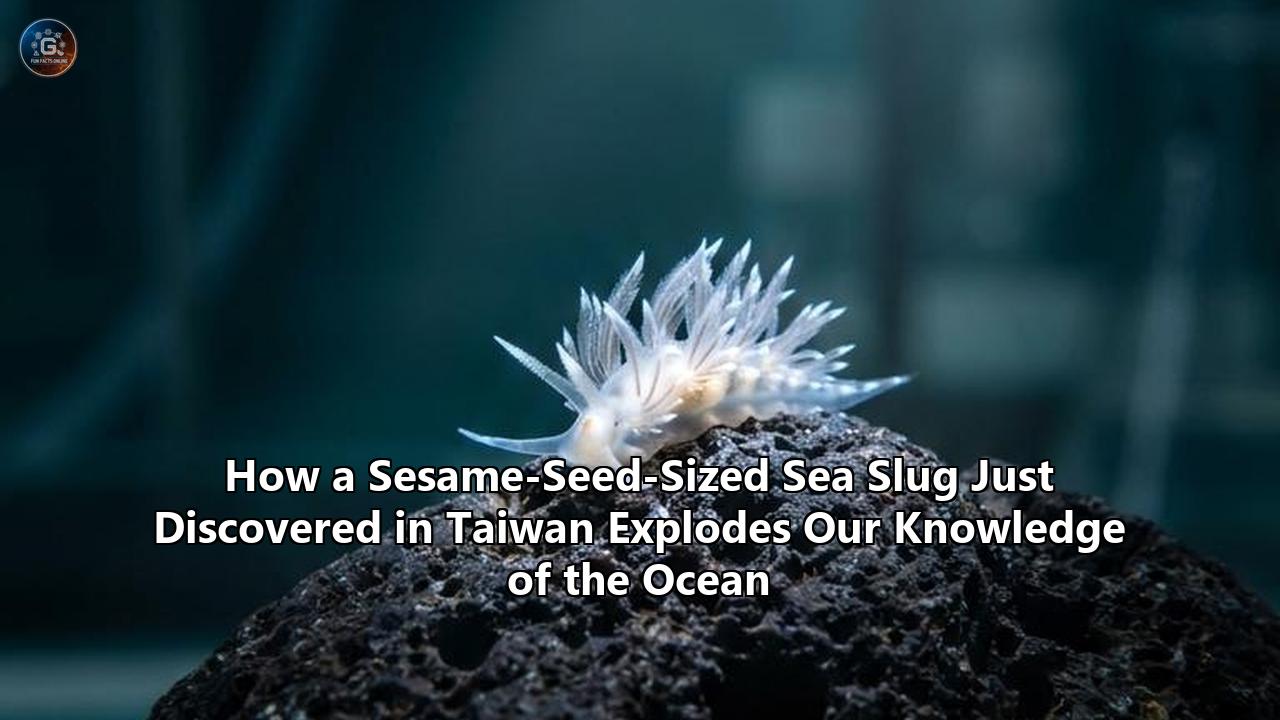
Off the wave-battered coast of Keelung, northern Taiwan, a tiny marine predator measuring less than three millimeters in length has completely disrupted our understanding of ocean biodiversity.
On May 11, 2026, researchers officially published the description of Thecacera sesama in the open-access scientific journal ZooKeys. This newly identified organism is so small that it can comfortably sit on a single sesame seed with room to spare, yet its formal classification represents the first addition to its genus in nearly three decades.
Representing a collaborative triumph between National Taiwan Ocean University (NTOU), the National Museum of Natural Science, and the National Taipei University of Education, this discovery highlights how much of the marine world remains completely invisible to the human eye. It also highlights how modern digital networks, local diving communities, and advanced genetic sequencing are shifting the boundaries of traditional taxonomy.
While the ocean covers more than 70 percent of the Earth's surface, our understanding of its ecosystems has historically been biased toward larger, more conspicuous organisms. The formal declaration of this new sea slug species serves as a stark reminder that the microscopic underpinnings of our oceans are teeming with undocumented life, waiting for the right pair of eyes—and a massive dose of scientific persistence—to be brought to light.
Act I: The Accidental Spark in Mother Rock Bay (Summer 2019)
The journey to cataloging Thecacera sesama did not begin in a high-tech laboratory or during an expensive oceanographic expedition. Instead, it started during a routine recreational dive in the summer of 2019.
Ho-Yeung Chan, then an undergraduate student at National Taiwan Ocean University’s Institute of Marine Biology, was exploring the shallow, rocky depths of Mother Rock Bay, located off the Ruifang District of northeastern Taiwan. Descending to a depth between 18 and 30 meters, Chan was navigating an underwater landscape dominated by complex, frilly colonies of bryozoans. These tiny colonial invertebrates, often referred to as "moss animals," grow in dense, fan-like clusters that filter detritus from the passing currents.
To the untrained eye, these bryozoan colonies look like nothing more than patches of underwater turf or plant life. But to those who know where to look, they are complex marine jungles.
As Chan hovered near the sea floor, a minute speck of movement caught his attention. Clinging to one of the bryozoan stalks was a creature so small it was barely distinguishable from the surrounding organic debris.
+-------------------------------------------------------------+
|  THE PHYSICAL ANATOMY OF THE "SESAME" SEA SLUG              |
|                                                             |
|   - Maximum Length: 2.83 mm (Holotype: 2.02 mm)             |
|   - Body Color: Translucent white (internal organs visible)  |
|   - Distinctive Pattern: Densely speckled with two spots:   |
|       * Small black spots (0.03–0.10 mm)                    |
|       * Larger yellow spots (0.07–0.15 mm)                  |
|   - Structural Features:                                    |
|       * 9 to 12 rhinophoral lamellae                        |
|       * 5 pinnate branchial plumes (gills)                  |
|       * Short, blunt propodial tentacles on the head         |
+-------------------------------------------------------------+
Using a camera equipped with a specialized macro lens, Chan managed to capture a few high-resolution photographs. The images revealed an astonishingly beautiful organism: a translucent, white-bodied nudibranch covered in tiny, circular black dots and slightly larger yellow speckles, interspersed with white, snowflake-like pigment patches.
The creature’s sensory rhinophores—the antenna-like structures on its head used to detect chemical signals in the water—emerged from flared, cup-like sheaths, while its delicate gills sat on its back, flanked by two finger-like appendages.
At the time, Chan was captivated by the find, but he did not yet realize that he had photographed a species completely unknown to science.
Act II: A Facebook Message Sparks an Invertebrate Mystery (2019–2020)
Faced with an animal that did not match any of the standard species guides for Taiwanese waters, Chan did not follow the historical route of sending physical specimens to European or North American museums. Instead, he utilized the decentralized, highly connected landscape of 21st-century citizen science.
Chan uploaded his macro photographs to Facebook and sent a direct message to Hsini Lin, a widely respected sea slug identification expert and educator in Taiwan.
When Lin examined the images, the reaction was immediate. The bizarre combination of a translucent body, highly localized black-and-yellow speckling, and a total length of under three millimeters did not align with any known nudibranch in the region.
While it shared superficial similarities with Thecacera pennigera—a cosmopolitan species known for its orange, black, and white markings—the newly photographed specimen was vastly smaller and possessed a completely distinct color distribution.
Traditional Taxonomy vs. Modern Decentralized Taxonomy
========================================================================
Feature                 Traditional Model         Modern Digital Model
------------------------------------------------------------------------
Primary Finder          Academic Expeditions      Recreational Divers / Students
Initial Sharing         Museum Archives           Social Media (Facebook, iNaturalist)
Expert Verification     Physical Mail / Letters   Instant Messaging / DM Photo Sharing
Time to Discovery       Months to Years           Hours to Days
Local Collaboration     Low                       High (Divers nickname species early)
========================================================================
The Facebook conversation marked a critical turning point. It transformed Chan’s casual dive photo into an active scientific investigation.
Because of its tiny size and rounded markings, local Taiwanese divers had already begun calling the elusive creature "sesame" (芝麻) in Chinese. This local vernacular would eventually lay the groundwork for the species' formal scientific name, Thecacera sesama, reflecting an admirable modern trend of integrating local ecological culture into formal scientific nomenclature.
However, translating a social media post into a peer-reviewed scientific paper required physical proof. The researchers needed specimens—and finding them in one of the most volatile marine environments in East Asia would prove to be a logistical nightmare.
Act III: Battling Typhoons and Monsoons along the Keelung Coast (2021–2025)
To build a watertight case for a new sea slug species, the scientific team had to collect live specimens for physical and genetic analysis. This was far easier said than done.
The northeastern coast of Taiwan, particularly around Keelung and Ruifang, is characterized by some of the most challenging oceanographic and meteorological conditions in the region. The local marine environment is heavily shaped by seasonal extremes:
- The Summer Season (May to September): The coast is frequently battered by intense West Pacific typhoons, which create massive underwater surges, destroy delicate habitats, and make diving highly dangerous.
- The Winter Season (October to April): Robust northeast monsoonal winds generate powerful, relentless swells and drive water temperatures down below 16°C (60.8°F).
Because of these compounding environmental factors, researchers have a narrow window of only about four months out of the year when they can safely dive to search for micro-fauna.
Even when conditions are perfect, finding an animal smaller than a grain of rice at depths of nearly 100 feet is an extraordinary challenge of visual endurance. Divers must hover perfectly still, contending with currents, while scanning microscopic bryozoan fronds millimeter by millimeter.
Between May 2021 and June 2025, the research team conducted dozens of targeted dives at Mother Rock Bay. The search was a grueling waiting game.
After four years of persistent, cold, and often frustrating field work, the team managed to collect a grand total of just six individual specimens. Every single one was precious, and the small sample size meant that there was absolutely no room for error once they entered the laboratory.
Act IV: The Extreme Challenges of Microscopic Genetic Extraction (Late 2025)
Once the six specimens were safely transported to the laboratories of National Taiwan Ocean University, the team faced a delicate scientific dilemma.
In modern taxonomy, physical descriptions of an animal’s shape and color (morphology) are no longer sufficient to declare a new species. Researchers must perform "integrative taxonomy," combining physical measurements with rigorous DNA sequencing to prove that the animal is genetically distinct from its closest relatives.
However, the sheer physical diminutiveness of Thecacera sesama presented a massive roadblock.
The largest collected specimen was only 2.83 mm long, while the holotype (the single physical specimen that acts as the official voucher for the species) was a mere 2.02 mm. Typically, geneticists extract DNA from a tiny tissue clip, preserving the rest of the animal's body for museum archives so that future scientists can study it.
But with Thecacera sesama, a single tissue clip did not contain enough genetic material for reliable sequencing.
The Lab Dilemma: Specimen Conservation vs. DNA Extraction
+------------------------------------------------------------------------+
| Total Specimens Collected: 6                                           |
|                                                                        |
| [Specimen 1] \                                                         |
| [Specimen 2]  }---> FULLY DISSOLVED FOR DNA EXTRACTION                 |
| [Specimen 3] /      (Sacrificed to obtain mitochondrial gene sequences)|
|                                                                        |
| [Specimen 4] \                                                         |
| [Specimen 5]  }---> KEPT INTACT FOR MUSEUM ARCHIVES                    |
| [Specimen 6] /      (Preserved as physical holotypes/paratypes)        |
+------------------------------------------------------------------------+
To solve this, the researchers had to make a calculated sacrifice: they fully dissolved three of their six precious specimens.
By completely liquefying the bodies of these three individuals, they were able to extract enough high-quality mitochondrial DNA to run polymerase chain reactions (PCR) and sequence two critical target genes:
- 16S ribosomal RNA (16S rDNA): A gene commonly used to study evolutionary relationships and solve deep taxonomic histories in mollusks.
- Cytochrome c Oxidase Subunit I (COI): Often referred to as the "DNA barcode" for animal life, this gene is highly effective for distinguishing closely related species.
The remaining three intact specimens were carefully preserved in alcohol and designated as the official physical types to be deposited in museum collections, ensuring that both the physical and genetic legacies of the species were secured.
Act V: The 14.17% Divergence and the History of the Thecacera Genus (Early 2026)
With the genetic sequences in hand, the researchers constructed a phylogenetic tree to determine exactly where this tiny "sesame" fit into the evolutionary history of the family Polyceridae.
The molecular data yielded a definitive verdict: the sesame sea slug was a sister species to Thecacera picta, a beautifully colored nudibranch originally described in 1972 by the legendary Japanese malacologist Kikutarō Baba from specimens found in Suruga Bay, Japan.
          Genomic Distance of the COI Gene (Cytochrome c Oxidase I)

  [Thecacera sesama] <================= 14.17% =================> [Thecacera picta]
  (Taiwan, Max 2.83mm)                                          (Japan, Max 20mm)

  * Note: The standard threshold for species-level divergence in nudibranchs
    is typically between 10% and 15%. This places T. sesama firmly as a
    distinct evolutionary branch.
The genetic distance between Thecacera sesama and Thecacera picta in the COI gene was calculated at 14.17 percent. In the world of nudibranch taxonomy, a genetic divergence of 10 to 15 percent is the widely accepted standard for delineating separate species. This 14.17 percent gap confirmed beyond any mathematical doubt that the sesame sea slug was indeed a distinct, new sea slug species.
To put this discovery into historical context, the genus Thecacera was first established in 1828 by the Scottish zoologist John Fleming. The genus name is derived from the Greek words theke (meaning "sheath" or "receptacle") and keras (meaning "horn"), a direct reference to the unique protective sheaths that shield their sensory rhinophores.
Historically, members of this genus have been highly prized by marine biologists and underwater photographers for their striking, vibrant color patterns. Some of the most notable species in the genus include:
- Thecacera pennigera (Montagu, 1813): The type species of the genus, commonly known as the "winged thecacera". It is a global traveler, often found on boat hulls, and is characterized by orange and black spots on a white body.
- Thecacera darwini (Pruvot-Fol, 1950): Named in honor of Charles Darwin, who originally collected a specimen off the coast of Chile in 1845 during his voyage on the HMS Beagle. It can reach a robust length of 45 millimeters and features a white body with stark black spots.
- Thecacera pacifica (Bergh, 1883): Popularly known in diving circles as the "Pikachu nudibranch" due to its bright yellow body and black-tipped rhinophore sheaths, which bear a striking resemblance to the famous Pokémon character.
                     SIZE COMPARISON OF THE THECACERA GENUS

  [T. darwini]   ============================================ 45 mm

  [T. pennigera] ============================== 30 mm

  [T. picta]     ==================== 20 mm

  [T. vittata]   ======== 8.5 mm

  [T. sesama]    == 2.83 mm
At less than three millimeters, Thecacera sesama is an absolute dwarf within its evolutionary lineage.
The next smallest member of the genus, Thecacera vittata, measures roughly 8.5 millimeters—nearly three times the maximum size of the Taiwanese sesame slug. The discovery of such an exceptionally tiny animal within a well-studied genus demonstrates that our historical census of the oceans has systematically overlooked species simply because of their microscopic scale.
Act VI: Micro-Predators of the Moss-Animal Jungle
Despite its minute size, Thecacera sesama is not a passive organism drifting aimlessly through the water. It is a highly specialized, active predator.
During their extended laboratory observations, the research team from National Taiwan Ocean University recorded the daily life of the sea slug. They discovered that the species has a remarkably streamlined life, exhibiting only four primary behaviors:
- Feeding: Actively grazing on its prey.
- Searching: Navigating the complex branches of its host colony.
- Mating: Engaging in reciprocal hermaphroditic reproduction.
- Egg-laying: Depositing tiny, coiled egg masses back onto the prey structures.
                 THE TROPHIC WEB OF MOTHER ROCK BAY

   [ Solar Energy / Detritus ]
               |
               v
     [ Bryozoan Forest ]  <--- Formed by microscopic zooids
               |
               v
     [ Thecacera sesama ] <--- Uses specialized radula to feed on zooids
Every single one of these behaviors is centered around a single, specific species of bryozoan. Like many nudibranchs, Thecacera sesama is stenophagous, meaning it has an incredibly narrow diet and can only survive by feeding on a very specific prey organism.
To consume these colonial animals, the sea slug uses its radula—a microscopic, ribbon-like tongue covered in hardened, curved teeth. The slug positions its mouth parts against the hard outer skeleton of the bryozoan, uses its radular teeth to rasp or puncture the protective casing of the individual bryozoan zooids, and then utilizes a highly muscular pharyngeal pump to suck out the soft, nutrient-rich internal tissues of its prey.
In a fascinating ecological twist, the research team noted that the specific bryozoan species hosting Thecacera sesama does not match any current records for the region.
This suggests that the discovery of this new sea slug species has inadvertently led scientists to a second, nested discovery: a completely undocumented species of bryozoan. It is an elegant ecological chain reaction, showing that mapping a single microscopic predator can open up an entire undisclosed food web.
Looking Forward: The Race to Map the Unseen Ocean
The formal naming of Thecacera sesama in May 2026 is far more than a simple addition to a taxonomic checklist; it is an active wake-up call for the global marine biology community.
The fact that an animal smaller than a grain of rice, living in shallow waters heavily frequented by recreational divers, managed to evade scientific description until now suggests that our current estimates of ocean biodiversity are vastly understated.
ESTIMATED VS. DOCUMENTED MARINE SPECIES (GLOBAL)
========================================================================
Status                      Number of Species      Percentage of Total
------------------------------------------------------------------------
Formally Documented         ~240,000               10% to 20% (Estimated)
Estimated Undiscovered      1.4 to 2.2 Million     80% to 90% (Estimated)
========================================================================
* Note: The vast majority of undiscovered marine organisms are believed to
  be micro-invertebrates under 5mm in length.
Marine microfauna—organisms measuring less than five millimeters—play an incredibly vital role in marine ecosystems. They serve as critical links in the marine food web, converting nutrients from microscopic prey into biomass that sustains larger invertebrates, fish, and ultimately, commercial marine resources.
Yet, because these creatures are incredibly difficult to spot with the naked eye and require immense effort to study, they are almost entirely absent from marine conservation assessments.
The discovery also highlights a pressing environmental concern. The primary habitat of Thecacera sesama—Mother Rock Bay in northeastern Taiwan—is not currently designated as a marine protected area (MPA).
The region is subjected to constant coastal run-off, intense marine traffic, and potential habitat destruction from unregulated recreational use. By formally describing endemic micro-species like T. sesama, researchers are building the critical baseline data needed to lobby local governments for official habitat protection.
As the scientific community looks to the future, several crucial questions remain unresolved:
- Geographic Range: Does Thecacera sesama exist outside of northern Taiwan? While a few unconfirmed photographs from Kenting National Park in the far south of the island suggest it might have a wider local distribution, its range is likely strictly limited by the distribution of its single bryozoan prey species.
- The Host Bryozoan: When will the host bryozoan species be formally described, and what unique chemical defenses does it share with its tiny nudibranch predator?
- Adaptive Physiology: How does an animal this small regulate its body temperature and successfully reproduce in waters that drop below 16°C during the winter monsoons?
What is certain is that the traditional era of ocean exploration—where scientists believed they had mapped all the major players in shallow coastal waters—is officially over. By proving that a vibrant, structurally complex, and genetically distinct new sea slug species can hide in plain sight on a heavily dived coastline, Thecacera sesama has expanded our biological horizons.
The ocean's greatest secrets do not only lie in the abyssal depths of the Mariana Trench; sometimes, they are clinging to a blade of marine moss just off a public beach, waiting for a curious diver with a macro lens to look a little closer.
Reference:
- https://www.sciencedaily.com/releases/2026/05/260526022002.htm
- https://bioengineer.org/new-tiny-sesame-sea-slug-species-discovered-in-northern-taiwan-waters/
- https://www.discovermagazine.com/sesame-sized-sea-slug-found-off-taiwan-turns-out-to-be-a-new-species-49154
- https://en.seaslug.world/blog/thecacera-sesama-new-species-2026
- https://www.popsci.com/environment/new-sea-slug/
- https://www.curiousspecies.com/new-species/-sesame-seed-sea-slug?rq=Sesa
- http://novataxa.blogspot.com/2026/05/thecacera.html
- https://www.curiousspecies.com/new-species/-sesame-seed-sea-slug?rq=Sesa
- https://www.geneonline.com/new-sea-slug-species-thecacera-sesama-discovered-in-taiwan-measuring-just-a-grain-of-rice-in-size/
- https://www.iflscience.com/beautiful-sea-slug-covered-in-sesame-seed-like-spots-discovered-off-coast-of-taiwan-83618
- https://pubmed.ncbi.nlm.nih.gov/42164328/
- https://en.wikipedia.org/wiki/Thecacera_picta
- https://www.marinespecies.org/aphia.php?p=taxdetails&id=138371
- https://opistobranquis.info/en/guia/doridida/doridoidei/polyceroidea/thecacera-pennigera/
- https://invasions.si.edu/nemesis/species_summary/78342
- http://slugsite.us/bow/nudiwk67.html
- https://en.wikipedia.org/wiki/Thecacera
- https://ecomagazine.com/news/research/tiny-sesame-sea-slug-species-discovered-in-the-waters-of-northern-taiwan/
- https://www.mdpi.com/1424-2818/15/4/484
- http://echinoblog.blogspot.com/2016/10/seaslugday2016-nudibranchs-eat-all.html
- https://nudibranchdomain.org/wp-content/uploads/DIET-FEEDING-DIGESTION-Chtr-3.pdf