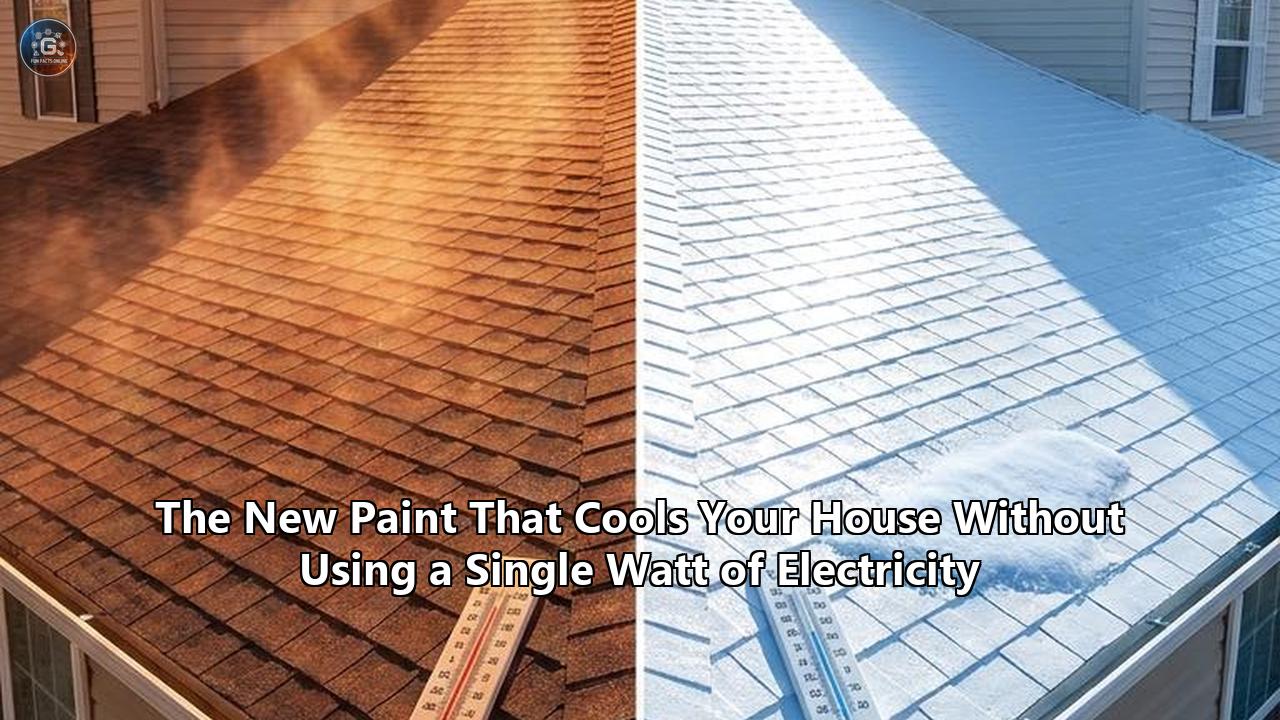
As record-breaking heat domes compress urban centers and strain power grids to their absolute limits, a quiet, unpowered revolution is taking place on the rooftops of some of the world's most vulnerable cities. For decades, keeping human habitats livable during extreme summers has meant relying on active, energy-intensive mechanical cooling—namely, air conditioning, which currently consumes roughly 10% of the world’s entire electricity supply. However, a series of milestones in materials science has paved the way for a highly scalable, zero-electricity solution: the deployment of energy efficient cooling paint.
This transition from specialized laboratory curiosities to a commercial reality marks a pivotal moment in building technology. Historically, "cool roof" coatings were simply reflective white paints that bounced away a fraction of visible light, still warming up under direct midday sun. Today, a new generation of smart materials does what was once thought thermodynamically impossible under direct sunlight: they actively drop below the temperature of the surrounding air without drawing a single watt of electricity.
By exploiting the coldest heat sink in the universe—the near-absolute-zero void of deep space—these advanced formulations function as silent, unpowered heat pumps. As commercial production scales up and manufacturers overcome long-standing aesthetic and environmental barriers, this passive thermal technology is beginning to reshape architecture, logistics, and climate adaptation strategies globally.
The Core News: A Convergence of Three Breakthroughs
The commercial explosion of radiative cooling technologies is driven by three distinct scientific breakthroughs that solved the classical limitations of passive daytime radiative cooling (PDRC).
┌─────────────────────────────────────────────────────────────────────────┐
│                    THE 2026 COOLING PAINT LANDMARK                      │
├──────────────────────────┬──────────────────────────┬───────────────────┤
│      SULFATE BASE        │      CEMENT HYDRATE      │ BILAYER CELLULOSE │
│      (Purdue/Ruan)       │         (CCP-30)         │   (Nature Energy) │
├──────────────────────────┼──────────────────────────┼───────────────────┤
│ • 98.1% Reflectance      │ • Tri-modal action       │ • Structural color│
│ • 19°F night cooling     │ • "Sweats" stored water  │ • 9°C sub-ambient │
│ • Barium sulfate matrix  │ • Humid climate mastery  │ • Zero-dye system │
└──────────────────────────┴──────────────────────────┴───────────────────┘
1. Barium Sulfate Paints Move Beyond the Lab
The first development is the commercial scaling of the ultra-white paint formulation originally developed by a research team at Purdue University, led by Professor of Mechanical Engineering Xiulin Ruan. Holding the Guinness World Record for the whitest substance ever created, this barium sulfate-based coating reflects up to 98.1% of all incoming solar radiation.
Recent licensing agreements and manufacturing partnerships have finally resolved the cost and application challenges of the paint’s exceptionally high pigment volume concentration (60%), enabling volume production at prices competitive with premium commercial exterior coatings.
2. The Biomimetic "Sweating" Paint (CCP-30)
The second development addresses a critical vulnerability of traditional radiative cooling: high humidity. In humid, tropical regions, the thick blanket of atmospheric water vapor absorbs outgoing infrared radiation, trapping heat and neutralizing the performance of standard sky-facing cooling coatings.
To bypass this barrier, an international research team from China, Singapore, Saudi Arabia, the United Kingdom, and the United States developed an energy efficient cooling paint known as CCP-30, publishing their peer-reviewed findings in Science. Made from a highly porous calcium silicate hydrate (C-S-H) gel network—essentially a nanostructured cement paste—this paint cools a building by mimicking how the human body perspires.
It absorbs rain and atmospheric moisture, stores it within its porous matrix, and slowly evaporates the liquid during peak daylight hours. This evaporative cooling mechanism works alongside traditional reflection and infrared radiation to deliver up to ten times the cooling power of previous commercial alternatives in heavy humidity.
3. The Structural Color Breakthrough
The third milestone removes the primary aesthetic objection to radiative cooling: the requirement that buildings be painted a blinding, high-glare white. Because traditional colored dyes work by absorbing specific wavelengths of light, adding color to cooling paint has historically compromised its ability to reflect solar radiation, causing the surface to heat up rapidly.
A study published in Nature Energy by Liu et al. introduces a biomass-derived, color-tunable bilayer ethyl cellulose coating. This material uses controlled drying-induced self-stratification to create a top layer featuring nonabsorptive structural color via thin-film interference, backed by a highly reflective, highly emissive bottom layer.
The resulting coating displays vibrant custom colors while achieving a solar reflectance of up to 97.0% and sub-ambient cooling of up to 9°C (16.2°F) under direct solar intensity. This development ensures that selecting an energy efficient cooling paint no longer requires architects and homeowners to compromise on aesthetic variety.
The Physics of Radiative Sky Cooling
To comprehend how these coatings drop below ambient temperatures without power, one must look beyond basic reflection. Standard white paints reflect a significant portion of visible light, but they still absorb ultraviolet and near-infrared radiation. Furthermore, they have poor thermal emissivity, meaning they struggle to shed the heat they do absorb, causing them to warm up under the sun.
                 SOLAR RADIATION (0.3 - 2.5 μm)
                       │         │
                       ▼         │ Bounces off (reflectance > 95%)
                 ┌───────────┐   │
                 │  COOLING  │◄──┘
                 │   PAINT   │───┐
                 └───────────┘   │ Emits thermal energy (8 - 13 μm)
                       ▲         ▼
                       │    [ATMOSPHERIC WINDOW]
                       │         │
                       │         ▼
                 DEEP SPACE VACUUM (3 K / -270°C)
True passive radiative cooling relies on two simultaneous thermodynamic actions:
- Maximized Solar Reflectance ($\ge 95\% - 99\%$): The surface must reflect virtually all wavelengths of solar energy, spanning ultraviolet, visible, and near-infrared light ($0.3$ to $2.5\,\mu\text{m}$).
- High Thermal Emissivity ($\ge 90\% - 99\%$): The surface must convert its internal thermal energy into infrared radiation and emit it within a very specific narrow band: the "atmospheric transmission window" between $8$ and $13\,\mu\text{m}$.
The earth's atmosphere is composed of gases—primarily water vapor, carbon dioxide, ozone, and methane—that are highly opaque to most infrared wavelengths, absorbing thermal energy and radiating it back toward the ground (the greenhouse effect). However, the $8\text{ to }13\,\mu\text{m}$ spectral band represents an optical transparency window where the atmosphere is practically invisible to infrared radiation.
An object that radiates heat within this specific frequency band acts as if the atmosphere is not there. The thermal energy bypasses the air, travels past the clouds, and shoots directly into the vacuum of outer space, which sits at an absolute temperature of roughly $3\text{ Kelvin}$ ($-270^\circ\text{C}$ or $-454^\circ\text{F}$).
By tuning the spectral properties of a paint so that it emits energy into this atmospheric window while reflecting sunlight, the coating acts as a radiative pipe connected to the deep space cold sink. As a result, the net heat flux of the surface becomes negative, allowing it to become colder than the air touching it.
Comparing the Three Innovations
| Performance & Material Metrics | Barium Sulfate (Purdue/Ruan Formula) | Biomimetic Sweating Paint (CCP-30) | Bilayer Ethyl Cellulose Coating |
|---|---|---|---|
| Primary Chemical Composition | Barium Sulfate ($\text{BaSO}_4$) in Acrylic or Fluoropolymer matrix | Calcium Silicate Hydrate (C-S-H) Nanoporous Gel | Biomass-Derived Ethyl Cellulose Bilayer |
| Solar Reflectance | Up to $98.1\%$ | $88\%$ to $92\%$ (Water-state independent) | Up to $97.0\%$ |
| Infrared Emissivity ($8\text{-}13\,\mu\text{m}$) | $95\%$ to $97\%$ | Up to $95\%$ | Up to $95\%$ |
| Maximum Sub-Ambient Cooling | $8^\circ\text{F}$ ($4.4^\circ\text{C}$) in midday sun; $19^\circ\text{F}$ ($10.5^\circ\text{C}$) at night | Equivalent to $10\times$ cooling power of PDRC in tropical humidity | Up to $9^\circ\text{C}$ ($16.2^\circ\text{F}$) sub-ambient daytime cooling |
| Aesthetic / Color Profile | Intense, ultra-matte white (Guinness World Record) | Off-white to pale grey cementitious matte | Full color spectrum via structural interference |
| Key Mechanical Advantage | High compatibility with existing spray/roll paint lines | Rapid curing, high structural strength, cheap raw material | Non-toxic, biodegradable, derived from circular economy biomass |
| Primary Climate Target | Dry, hot climates with low cloud cover | Hot, highly humid tropical zones | Architectural, automotive, and aesthetic urban spaces |
Deep Dive: The Barium Sulfate Formulation
The development of the ultra-white paint by Professor Xiulin Ruan's lab at Purdue University required redefining how pigments scatter light. Traditional white paints rely heavily on titanium dioxide ($\text{TiO}_2$) as their primary reflective pigment. Titanium dioxide has a high refractive index ($\sim 2.76$), making it excellent at scattering visible light.
However, $\text{TiO}_2$ has a relatively narrow electronic bandgap (typically below $4.13\,\text{eV}$ for rutile and anatase phases), which causes it to absorb ultraviolet light. This ultraviolet absorption heats up the pigment particles, translating into net thermal gain under direct sunlight.
TITANIUM DIOXIDE PAINT (Standard Cool Roof)
  Solar Light (including UV) ────► [TiO2 Particles] ──► Absorbs UV (Heats up)

BARIUM SULFATE PAINT (Ultra-White Radiative)
  Solar Light (including UV) ────► [BaSO4 Particles] ──► Reflects UV & Visible (Stays cool)
To bypass ultraviolet absorption, Ruan’s team substituted titanium dioxide with barium sulfate ($\text{BaSO}_4$), an earth-abundant compound often used in photo paper, cosmetics, and medical diagnostics. Barium sulfate features an exceptionally wide bandgap, allowing it to reflect high-energy ultraviolet photons rather than absorbing them.
Simply changing the material, however, was not enough. To achieve a solar reflectance of $98.1\%$, the engineers altered the particle morphology. In a standard white paint, the pigment particles are relatively uniform in size, which limits light scattering to a narrow range of wavelengths.
The Purdue team engineered a formulation with a highly diverse, multimodal distribution of barium sulfate particle sizes. This broad size variation ensures that smaller particles scatter short-wavelength ultraviolet light, medium particles scatter visible wavelengths, and larger particles scatter near-infrared light, resulting in broadband reflection across the solar spectrum.
   BaSO4 PARTICLE SIZE SCATTERING PROFILE:

    [ o ] Small Particles (0.1 - 0.2 μm)   ──► Scatters UV Light
    [ O ] Medium Particles (0.3 - 0.6 μm)  ──► Scatters Visible Light
   [ OOO ] Large Particles (0.8 - 1.5 μm)  ──► Scatters Near-Infrared
This structural configuration requires a high pigment volume concentration (PVC) of approximately 60%. While a high PVC maximizes optical performance, it reduces the quantity of polymer binder, making the paint film more brittle and prone to peeling or cracking over time.
To bring this formula to market, the team spent years adjusting the binder matrix, utilizing high-performance fluoropolymers and acrylic resins that encapsulate the barium sulfate particles. This keeps the paint flexible, weather-resistant, and suitable for standard application rollers and spray equipment.
When scaled to a building, the thermal performance of this barium sulfate formulation is substantial. Under direct midday sun, the paint maintains a net radiative cooling power of approximately $117\,\text{W/m}^2$.
On a standard residential rooftop of $1,000\,\text{sq ft}$ ($93\,\text{m}^2$), this performance yields roughly $10\,\text{kW}$ of continuous cooling capacity. This is equivalent to or greater than the cooling output of most residential central air conditioning systems, all achieved without consuming any electricity.
Deep Dive: The Biomimetic "Sweating" Paint (CCP-30)
While barium sulfate paints perform exceptionally well in arid regions like Arizona or West Texas, their passive radiative mechanism encounters physical barriers in humid tropical regions like Singapore, Miami, or Mumbai. In these climates, the atmospheric column is saturated with water vapor, which acts as a greenhouse gas and blocks the $8\text{ to }13\,\mu\text{m}$ infrared transmission window. This reduces the radiative heat transfer back out to deep space, limiting the effectiveness of standard radiative paints.
To solve this geographic limitation, an international consortium of engineers turned to biomimicry. Their paint, CCP-30, mimics human skin, which uses the phase change of liquid water into gas (perspiration) to dissipate heat and regulate core body temperature.
  CCP-30 CEMENT MATRIX (HUMID DAYS)

  Rain / High Humidity ──────► [ Porous C-S-H Network ] (Absorbs up to 30% weight in H2O)
                                        │
                         Solar Heat ────┼────► Evaporation (Latent Heat Loss)
                                        ▼
                               [ Sweats Out Heat ] ──► Sub-ambient cooling in 90% humidity
The paint is built around a porous matrix of calcium silicate hydrate (C-S-H)—the primary binding gel produced during the hydration of cement. By modifying this C-S-H gel at a nanoscopic level, the researchers created a network of tiny, interconnected pores designed to absorb and store ambient moisture.
This porous structure can hold approximately 30% of its total dry weight in water. The source of this water is entirely passive, drawing from morning dew, rainfall, or high atmospheric humidity.
When the sun beats down during the hottest hours of the day, the thermal energy does not penetrate the building. Instead, it drives the evaporation of the water stored within the paint’s porous channels. Because the latent heat of vaporization for water is exceptionally high ($2260\,\text{kJ/kg}$), this process absorbs and carries away substantial thermal energy.
Importantly, the paint’s optical and reflective characteristics do not degrade when its pores are saturated with water. Even when completely wet, CCP-30 maintains a high solar reflectance of up to 92% and continues to emit heat at 95% efficiency in the infrared spectrum.
In pilot tests conducted in Singapore, where relative humidity routinely exceeds 80%, this tri-modal mechanism (reflection, infrared radiation, and evaporation) delivered up to ten times the cooling performance of traditional reflective paints. This translated to energy savings of 30% to 40% in residential HVAC power consumption, offering a functional passive cooling solution for high-humidity urban environments.
Deep Dive: The Structural Color Revolution
The final piece of the modern passive cooling puzzle addresses an aesthetic challenge. For years, widespread urban adoption of PDRC was limited by a simple architectural reality: most people do not want their entire neighborhoods painted a uniform, blinding white.
Conventional colored paints derive their hue from chemical pigments that selectively absorb specific wavelengths of visible light, reflecting the rest. Unfortunately, absorbing any visible light introduces thermal energy, which compromises sub-ambient cooling performance.
CONVENTIONAL COLORED PAINT:
  Solar Light ──► [Chemical Pigment (e.g., Red Dye)] ──► Absorbs Green & Blue Wavelengths (Heats Up)
                                                      ──► Reflects Red Wavelength (Visual Color)

STRUCTURAL BILAYER CELLULOSE PAINT (Nature Energy, 2026):
                 ┌────────────────────────────────┐
  Solar Light ──►│ TOP: Helical Cellulose Crystals │ ──► Reflects Target Color via Optical Interference
                 ├────────────────────────────────┤
                 │ BOTTOM: High-Emissive White    │ ──► Reflects 97% Solar Spectrum
                 └────────────────────────────────┘     Emits Infrared to Space (Sub-ambient Cooling)
The June 2026 study published in Nature Energy overcomes this issue through structural coloration, mimicking the shimmering, non-fading colors found on beetle shells, peacock feathers, and butterfly wings.
The researchers developed a bilayer coating based on ethyl cellulose—an abundant, non-toxic, and biodegradable biomass derivative. The material is produced through a single-step casting process, during which the paint self-stratifies as it dries. This process organizes the ethyl cellulose into two distinct optical layers:
- The Structural Color Top Layer: As the solvent evaporates, the ethyl cellulose molecules on the outer surface assemble into helical, periodic liquid crystal structures. This helical arrangement creates thin-film optical interference. By adjusting the pitch of the molecular helix, the coating can reflect specific wavelengths of visible light, generating rich, non-fading colors like blue, red, or green, without absorbing any solar heat.
- The High-Reflective, High-Emissive Bottom Layer: Beneath the colorful structural layer, the ethyl cellulose forms a highly porous, disordered white scattering matrix. This bottom layer acts as an optical barrier, reflecting any solar wavelengths that pass through the top layer (up to 97.0% overall) and radiating internal thermal energy outward through the $8\text{ to }13\,\mu\text{m}$ atmospheric window.
By decoupling color from light absorption, this bio-based bilayer coating can keep a brightly colored roof up to 9°C (16.2°F) cooler than the ambient air temperature. It provides a pathway to deploy energy efficient cooling paint across historic cities, suburban developments, and commercial vehicles where strict color ordinances and aesthetic standards apply.
The Economics and Grid Impact
The commercialization of these energy-free cooling paints arrives at a critical juncture for the global energy grid. According to the International Energy Agency (IEA), global demand for space cooling is projected to triple by 2050, requiring vast amounts of new electricity capacity.
In dense metropolitan areas, the widespread use of air conditioners exacerbates the urban heat island (UHI) effect. Conventional AC units work as heat pumps, extracting heat from indoor spaces and venting it into the surrounding streets, where it gets trapped by dark asphalt and concrete. This raises local temperatures, forcing buildings to run their air conditioning units even harder, creating a dangerous warming loop.
  THE URBAN HEAT ISLAND VITIATION LOOP:

  ┌─────────────────────────────────────────────────────────────┐
  ▼                                                             │
  Metropolitan Areas Heat Up (Dark Asphalt / Concrete)          │
  │                                                             │
  ▼                                                             │
  Buildings Run AC Harder to Maintain Comfort                   │
  │                                                             │
  ▼                                                             │
  Air Conditioners Vent Hot Exhaust into Local Streets ─────────┘
The adoption of energy efficient cooling paint helps break this cycle. Because radiative and evaporative paints transfer thermal energy out of the biosphere entirely, they provide local cooling without localized heat exhaust.
  BREAKING THE LOOP WITH RADIATIVE PAINT:

  Radiative Cooling Paint on Roofs & Roads
  │
  ▼
  Thermal Energy Radiates Directly to Outer Space
  │
  ▼
  Ambient Surface and Air Temperatures Drop Naturally
  │
  ▼
  HVAC Grid Load Decreases by 20% to 40% (No Heat Exhaust)
Market Expansion and Scaling Costs
The global radiative cooling paint market is experiencing rapid expansion. Valued at approximately USD 3.98 million in 2025, the market is projected to reach USD 22.59 million by 2034, growing at a compound annual growth rate (CAGR) of 24.0%.
    PROJECTED GLOBAL MARKET SIZE FOR RADIATIVE COOLING PAINT

    $25 M ─────────────────────────────────────────────── $22.59 M
    $20 M ──────────────────────────────────────────────/
    $15 M ─────────────────────────────────────────────/
    $10 M ────────────────────────────────────────────/
    $5 M  ─── $3.98 M ─── $4.94 M ───────────────────/
    $0 M ─────── 2025 ─────── 2026 ───────────────────── 2034
This rapid scaling has brought significant manufacturing efficiencies. In 2026, the retail cost of radiative cooling paint has stabilized at an average of USD 6.29 per square meter.
At this price point, retrofitting a typical 150-square-meter (approx. 1,600-square-foot) residential roof costs less than USD 1,000 in materials. For commercial and industrial structures, such as logistics warehouses and manufacturing facilities, the payback period is remarkably short.
Projected Energy and Operational Savings
Field data from building retrofits across the Sun Belt in the United States and suburban districts in Asia shows that applying a radiative cooling coating reduces overall building cooling energy requirements by 20% to 40%.
┌─────────────────────────────────────────────────────────────────────────┐
│              ESTIMATED ANNUAL ENERGY SAVINGS BY SUBSTRATE                │
├──────────────────────┬──────────────────────┬───────────────────────────┤
│    BUILDING TYPE     │   COATED AREA (m²)   │  ANNUAL SAVINGS (USD)*    │
├──────────────────────┼──────────────────────┼───────────────────────────┤
│ Standard Residence   │         150          │       $350 - $600         │
│ Commercial Office    │       1,200          │     $2,800 - $4,500       │
│ Logistics Warehouse  │      10,000          │    $24,000 - $38,000      │
└──────────────────────┴──────────────────────┴───────────────────────────┘
*Calculated at an average electricity rate of $0.16/kWh, assuming hot climate zone operation.
In industrial applications, such as temperature-controlled logistics, the benefits are even more pronounced. Coating refrigerated transport vehicles and cold-storage facilities with energy efficient cooling paint significantly reduces the load on diesel-powered refrigeration units, lowering both fuel consumption and emissions.
Furthermore, applying these paints to the backsheets of photovoltaic solar panels helps lower their operating temperatures, improving their energy conversion efficiency and service life.
Practical Engineering Obstacles & Mitigation Strategies
While the physical principles behind radiative cooling are sound, transitioning these formulations from a controlled laboratory to real-world infrastructure exposes physical and market challenges. Paint must withstand years of environmental exposure while maintaining its specialized optical qualities.
      PRACTICAL CHALLENGES                2026 ENGINEERING SOLUTIONS
┌───────────────────────────────┐      ┌───────────────────────────────────┐
│ Dirt Accumulation (Soiling)   │ ────►│ Hydrophobic Fluoropolymer Resins │
├───────────────────────────────┤      ├───────────────────────────────────┤
│ High Solar Glare Risk         │ ────►│ Texture Tuning & Micro-roughness  │
├───────────────────────────────┤      ├───────────────────────────────────┤
│ Heavy Winter Heating Deficit  │ ────►│ Regional Zoning & Smart Coatings  │
├───────────────────────────────┤      ├───────────────────────────────────┤
│ High Binder Pigment Ratio     │ ────►│ Core-Shell Nanoparticle Design    │
└───────────────────────────────┘      └───────────────────────────────────┘
1. The Soiling and Dirt Resistance Problem
The primary challenge facing radiative cooling paints is maintaining long-term reflectivity. Because these coatings rely on high solar reflectance to achieve sub-ambient cooling, any accumulation of dust, soot, organic matter, or road grime will degrade their performance.
Field tests indicate that unmitigated dust accumulation can reduce solar reflectance by up to 2% per month in dusty or high-pollution urban areas, quickly negating the sub-ambient cooling effect.
To address this issue, modern cooling paints incorporate self-cleaning, hydrophobic binders, such as polyvinylidene fluoride (PVDF) fluoropolymers and specialized silicones. These binders create a micro-nanostructured, low-surface-energy outer shell—similar to a lotus leaf.
This structure prevents dirt particles from bonding to the surface. Rainwater or simple low-pressure washing easily sweeps away accumulated dust, preserving the coating's optical properties with minimal maintenance.
2. The Glare and Reflected Radiation Hazard
Painting large numbers of vertical walls and building facades with an ultra-reflective white paint presents visual hazards in densely populated areas.
The intense, specular glare from these surfaces can blind motorists, annoy neighbors, and redirect thermal energy onto adjacent structures. This can raise the temperature of neighboring buildings rather than cooling the overall neighborhood.
  SPECULAR GLARE VS. DIFFUSE OPTICAL SCATTERING:

  Specular Glare (Polished Surface)   Diffuse Scattering (Micro-rough Surface)
         Incoming Sun                        Incoming Sun
             \                                   \
              \                                   \  / \
               ▼                                   ▼ V   ▼
        ───────/───────                      ─────/\/\/\/\─────
        Intense, concentrated ray            Soft, scattered light
        Blinds eyes, heats neighbors         Safer for urban spaces
To counter this, manufacturers have shifted from specular (mirror-like) formulations to highly diffuse scattering profiles. By introducing microscopic surface roughness and using pigment particles that scatter light in all directions, the reflected solar energy is softened.
Furthermore, the integration of structural color options (as seen in the Nature Energy research) allows these paints to reflect thermal energy safely while appearing in softer, non-glaring pastel tones to the human eye.
3. The Winter Heating Penalty
In temperate climates that experience hot summers but cold winters, installing a highly efficient cooling paint can create a winter heating penalty.
During the winter months, a building's roof needs to absorb solar heat to reduce the heating load on indoor boilers and heat pumps. An active, year-round radiative cooling paint will continue to shed heat even when outdoor temperatures are freezing, which can increase winter heating costs and offset summer savings.
Consequently, regional zoning is critical. Passive cooling paints provide the greatest net benefit in warm-weather states and tropical regions where cooling loads dominate year-round.
For temperate regions, researchers are developing phase-change and thermochromic coatings. These materials act as reflective, radiative surfaces during hot summer temperatures, but transition to absorptive, non-radiative states when temperatures drop below a certain threshold (e.g., $20^\circ\text{C}$ or $68^\circ\text{F}$), helping to balance seasonal energy demands.
4. Binder Degradation and Weatherability
The high pigment volume concentration (around 60%) required for barium sulfate coatings can compromise structural integrity. With less polymer binder available to hold the pigment together, standard coatings are vulnerable to weathering, chalking, and micro-cracking when exposed to UV radiation and moisture.
To improve durability, paint chemists utilize core-shell nanoparticle designs. In these formulations, each barium sulfate particle is individually encapsulated in a thin, highly resilient acrylic or silicate shell before being dispersed into the liquid binder.
This method ensures uniform pigment distribution, reduces the required binder-to-pigment ratio, and protects the active pigments from environmental degradation, extending the paint's service life to over ten years.
High-Performance Resin Platforms
To deploy these active pigments across diverse industrial settings, manufacturers have transitioned from simple acrylic bases to four specialized resin platforms, each tailored to specific operational requirements:
                     HIGH-PERFORMANCE RESIN ENGINES
                                   │
         ┌───────────────────┬─────┴─────┬───────────────────┐
         ▼                   ▼           ▼                   ▼
     INORGANIC             PVDF       SILICONES             TPU
     SILICATES        FLUOROPOLYMERS                     FLEXIBLE
  • Class-A Fire     • 20+ Year Life • Thermal Max      • Elastomeric
  • Infrastructure   • Luxury Villas • Petrochem Tanks  • Membranes
1. Inorganic Silicates (Mineral Binders)
- Key Advantage: Completely non-combustible with an A-level fire rating; chemically bonds to masonry and concrete substrates.
- Typical Scenario: High-rise residential complexes, public transport infrastructure, tunnels, and historic stone facades.
- Mechanical Profile: Extreme hardness and UV stability; highly vapor-permeable, allowing buildings to breathe without bubbling.
2. Fluoropolymers (PVDF / FEVE)
- Key Advantage: Exceptional weatherability and dirt shedding; resists chalking, chemical exposure, and UV breakdown for more than 20 years.
- Typical Scenario: Landmark architectural facades, luxury residential roofs, offshore facilities, and coastal structures.
- Mechanical Profile: Low surface energy creates a self-cleaning surface where rain washes away accumulated dust.
3. Silicone Resin Emulsions
- Key Advantage: Superior thermal stability and high water repellency.
- Typical Scenario: Petrochemical storage tanks, electrical sub-stations, transformer boxes, and high-voltage power lines.
- Mechanical Profile: Remains flexible across extreme temperature ranges; prevents rust and moisture penetration while maintaining high infrared emissivity.
4. Thermoplastic Polyurethanes (TPU / Flexible Resins)
- Key Advantage: Exceptional elongation and crack-bridging capability; remains flexible on moving or vibrating substrates.
- Typical Scenario: Single-ply waterproofing membranes, metal roofing, flexible expansion joints, and commercial shipping containers.
- Mechanical Profile: Can stretch up to 300% without tearing, maintaining a seamless reflective barrier over uneven or shifting structural surfaces.
Real-World Applications: Leading Commercial Innovations
As the science of passive radiative cooling has matured, several commercial brands have emerged to lead the deployment of these technologies across diverse global industries.
i2Cool Limited
Incubated out of the City University of Hong Kong, i2Cool has established itself as an early pioneer in the commercial radiative cooling space. The company's flagship paint products utilize a finely tuned micro-nanostructured pigment matrix designed to optimize heat dissipation through the $8\text{ to }13\,\mu\text{m}$ atmospheric window.
Originally deployed on commercial buildings in high-density areas of Hong Kong and Mainland China, i2Cool's coatings have expanded to solar panel installations, industrial warehouses, and cold-chain logistics hubs. By dropping rooftop temperatures and reducing cooling loads, the brand's installations help lower overall carbon emissions for large-scale real estate portfolios.
Ceracool
Ceracool has approached radiative cooling through the lens of ceramic material science. The company's formulations boast up to 99% solar reflectance and 97% emissivity within the atmospheric transparency window.
To broaden market appeal, Ceracool developed a line of high-performance colored paints that achieve up to 96% solar reflectance, overcoming the aesthetic limits of traditional dark exterior paints.
A conventional two-coat white acrylic paint absorbs twice as much solar energy as Ceracool's high-reflectance red formulation, demonstrating the capabilities of modern pigment engineering.
Designed with a two-coat system—a colorful, high-adhesion base coat and a self-cleaning, weather-resistant top coat—Ceracool offers a projected 30-year durability profile suitable for harsh industrial and residential environments.
Azure Era
Operating primarily in rapid-growth industrial markets, Azure Era specializes in large-scale infrastructure applications. The company's radiative coatings are engineered for steel-framed factories, chemical processing plants, and grain silos.
By mitigating the extreme solar heat gain that affects metal roofs, Azure Era's coatings protect sensitive industrial assets, improve indoor working conditions, and reduce reliance on heavy mechanical ventilation systems in warm climates.
The Industrialization Landscape
The development of energy efficient cooling paint is supported by a robust industrial ecosystem. Major global paint manufacturers, including AkzoNobel and Nippon Paint, have begun integrating these advanced formulations into their commercial product lines, signaling a transition from niche technology to mainstream construction standards.
               THE COMMERCIAL COOLING PAINT VALUE CHAIN

  [ RAW MATERIALS ] ──► [ FORMULATORS ]  ──► [ APPLICATORS ] ──► [ END USERS ]
  • Barium Sulfate      • i2Cool             • Painting          • Real Estate
  • Biomass Cellulose   • Ceracool             Contractors       • Logistics
  • Fluoropolymer       • AkzoNobel          • Spray Teams       • Municipalities
    Resins              • Nippon Paint
By collaborating with chemical companies, these manufacturers are optimizing supply chains for key raw materials like high-purity barium sulfate, ethyl cellulose, and fluoropolymer resins.
At the same time, they are working to train commercial painting contractors on proper application techniques. Because these paints can be applied using standard commercial sprayers, rollers, and brushes, they fit easily into existing construction workflows, eliminating the need for specialized application machinery.
Forward-Looking Perspective: What to Watch Next
As the world seeks scalable climate solutions, the mass adoption of energy efficient cooling paint could play a vital role in cooling both human habitats and the planet. Beyond reducing individual energy bills, this technology offers a practical, low-barrier tool for large-scale climate adaptation.
┌─────────────────────────────────────────────────────────────────────────┐
│                     THE PLANETARY IMPACT HORIZON                        │
├─────────────────────────────────────────────────────────────────────────┤
│ • Offset Global Warming: Covering 0.5% - 1% of the earth's surface     │
│   with ultra-white paint could reflect enough solar energy to help      │
│   stabilize global temperature trends.                   │
├─────────────────────────────────────────────────────────────────────────┤
│ • Municipal Mandates: Cities are beginning to require high-reflectance  │
│   radiative coatings for new commercial construction.           │
├─────────────────────────────────────────────────────────────────────────┤
│ • Hybrid Smart Materials: Development of thermo-responsive paints that   │
│   switch from cooling in summer to heating in winter.           │
└─────────────────────────────────────────────────────────────────────────┘
Climate modeling conducted by researchers at Purdue University suggests that covering just 0.5% to 1.0% of the earth's total surface—including rooftops, roads, and unused land—with ultra-white radiative paint could theoretically reflect enough solar energy back into space to help offset global warming trends.
While coating such a vast area presents monumental logistical challenges, applying the technology to urban centers remains an achievable and highly effective goal.
In the coming years, watch for several key developments in this space:
- Municipal Building Codes and Mandates: Hot-climate cities across the Sun Belt, Southern Europe, and Asia may begin transitioning from standard reflective "cool roof" standards to active radiative and evaporative specifications for new commercial and residential construction.
- Standardization of Performance Metrics: The Cool Roof Rating Council (CRRC) and other international standards organizations are developing updated testing protocols to certify sub-ambient cooling performance and long-term solar reflectance retention.
- The Rise of Smart, Responsive Coatings: Beyond static paints, look for the commercialization of smart coatings that alter their optical properties based on temperature, providing summer cooling and winter heat retention in temperate climates.
By turning ordinary structural surfaces into active, unpowered radiators directed at the deep space cold sink, these advanced paints offer a powerful tool in the fight against rising global temperatures.
The transition from lab breakthrough to mass-market availability marks a quiet but significant milestone in building science, proving that the most effective solutions to our energy challenges can sometimes come from a simple can of paint.
Reference:
- https://www.youtube.com/watch?v=saOFnatrPWQ
- https://www.statsmarketresearch.com/global-radiative-cooling-paint-market-8075936
- https://happyeconews.com/scientists-develop-energy-efficient-cooling-paint/
- https://economictimes.indiatimes.com/news/international/us/scientists-developed-a-colored-paint-that-stayed-up-to-9c-cooler-under-direct-sunlight-and-its-one-step-coating-could-help-buildings-beat-heat-without-sacrificing-color/articleshow/132014253.cms?from=mdr
- https://gd3u.com/is-radiative-cooling-paint-finally-coming-to-the-mass-market/
- https://www.smithsonianmag.com/innovation/ultra-white-paint-may-someday-replace-air-conditioning-180977560/
- https://www.youtube.com/watch?v=NlxAOPeHlZw
- https://cera.cool/
- https://www.gblsim.com/cooling-ultra-white-paint/
- https://www.popsci.com/science/cooling-paint/
- https://happyeconews.com/scientists-develop-energy-efficient-cooling-paint/
- https://lifeboat.com/blog/2025/06/passive-cooling-paint-sweats-off-heat-to-deliver-10x-cooling-and-30-energy-savings
- https://economictimes.indiatimes.com/news/international/us/scientists-developed-a-colored-paint-that-stayed-up-to-9c-cooler-under-direct-sunlight-and-its-one-step-coating-could-help-buildings-beat-heat-without-sacrificing-color/articleshow/132014253.cms?from=mdr
- https://bioengineer.org/one-step-bilayer-ethyl-cellulose-enables-full-color-cooling/
- https://coldrays.com/painting-a-cooler-future-the-evolution-of-radiative-cooling-coatings/
- https://www.purdue.edu/research/features/stories/the-whitest-paint-is-here-and-its-the-coolest-literally/
- https://www.anthropocenemagazine.org/2025/06/new-paint-sweats-to-cool-off-buildings/
- https://alticpaint.com/energy-savings-with-heat-reflective-paint/
- https://cdn.asp.events/CLIENT_CL_EA_DE3B6632_02E3_4F5C_06E2D09D198B097F/sites/SustainableDesignChinese/media/brochure/SDS_2023_Brochure_double-page.pdf
- https://whiteproject3.com/radiative-cooling-paint/