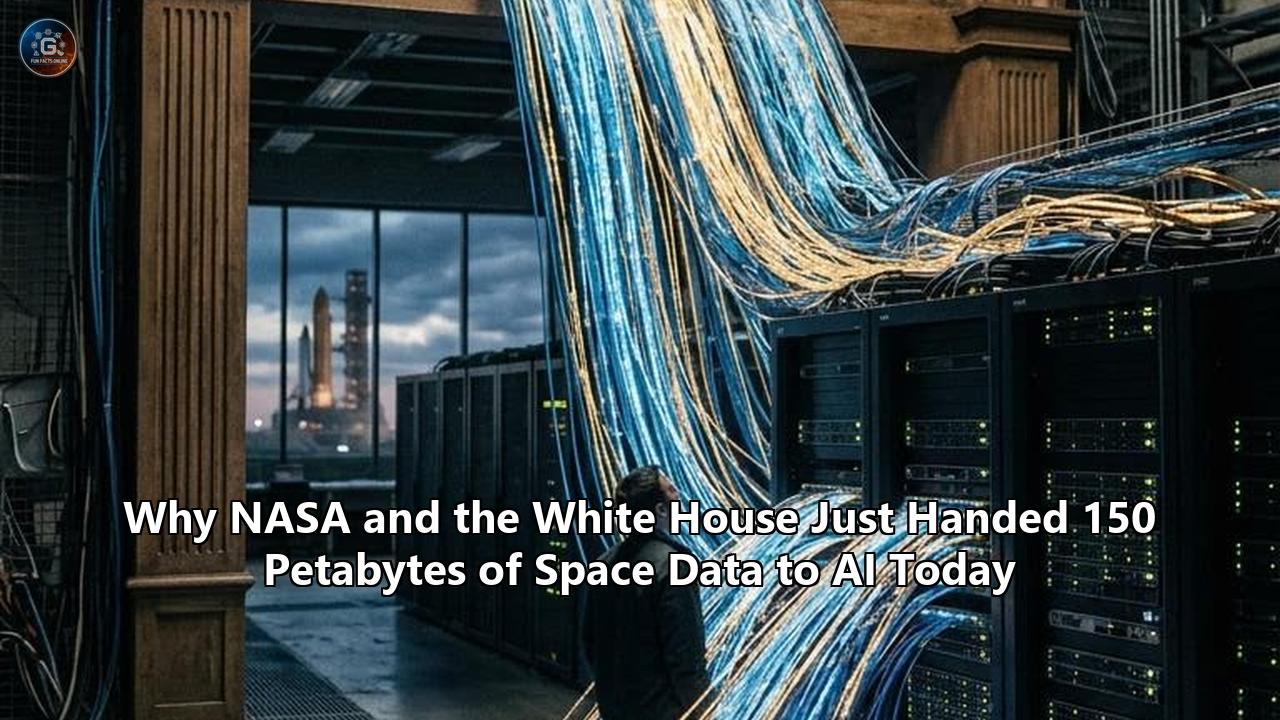
The White House Office of Science and Technology Policy (OSTP) and NASA officially expanded the federal Genesis Mission initiative, committing more than 150 petabytes of observational, astronomical, and planetary data to high-performance artificial intelligence computing nodes hosted across the Department of Energy’s national laboratory network.
The decision opens 70 years of space exploration archives—encompassing deep-space telescope imagery, satellite radar records, planetary rover telemetry, and solar activity logs—to agentic and physics-informed AI systems built to analyze multi-modal datasets at scale. Framed as part of a $5 billion federal push to modernize national scientific infrastructure, the program links NASA’s Earth Science Data Systems (ESDS) and astrophysics archives directly into the Department of Energy’s American Science and Security Platform.
The immediate objective is to eliminate a decades-long analytical bottleneck. While satellites and space telescopes have gathered petabytes of high-resolution data over the past half-century, only a small fraction has undergone manual reduction and detailed analysis by human researchers. By deploying physics-informed neural networks (PINNs) and agentic workflows directly against these archives, federal officials intend to compress analytical timelines from years down to days or hours.
“America has invested for generations in the data, missions, and technical expertise that make NASA one of the world's greatest engines of discovery,” said NASA Administrator Jared Isaacman in a statement released alongside the OSTP announcement. “The Genesis Mission is an opportunity to turn that foundation into faster science, stronger engineering, and better mission outcomes. Leveraging our relationships with interagency counterparts, NASA can advance AI tools that accelerate exploration, strengthen American leadership in space, and open new paths to understanding our planet and the universe.”
                       FEDERAL GENESIS MISSION AI INFRASTRUCTURE

 +------------------------+     +------------------------+     +------------------------+
 |   NASA Archives        |     |   DOE HPC Compute      |     |  Interagency AI Models |
 |   - Earth Science      | ==> |   - American Science & | ==> |  - Physics-Informed    |
 |   - Deep Space Telemetry|     |     Security Platform  |     |  - Agentic Workflows   |
 |   - Solar & Planetary  |     |   - Frontier & Aurora  |     |  - Foundation Models   |
 |   (150+ Petabytes)     |     |     Supercomputers     |     |  (Prithvi & Beyond)    |
 +------------------------+     +------------------------+     +------------------------+
The scale of the technical commitment is unprecedented in civilian space policy. By connecting federal supercomputing nodes to massive repositories of remote sensing and deep-space telemetry, the White House is reshaping how government-funded science operates. The initiative shifts emphasis away from isolated university-level analytical projects toward centralized, AI-native research workflows capable of processing global-scale data streams simultaneously.
The Technical Infrastructure: Moving 150 Petabytes to High-Performance Computing
Processing 150 petabytes—an information volume roughly equivalent to 30 million feature-length high-definition movies—presents severe computational and logistical challenges. Up to this point, NASA’s Earth System Data Records and deep-space archives operated primarily as public cloud-storage repositories. Researchers downloaded individual subsets of data, converted file formats locally, and trained isolated machine learning models on limited hardware.
Under the new Genesis Mission framework, data architecture undergoes a structural redesign. Rather than forcing scientists to pull terabytes of data down to local servers, the data pipelines bring high-performance computing capabilities directly to the cloud-native storage architecture.
┌─────────────────────────────────────────────────────────────────────────────────┐
│                          DATA PIPELINE TRANSFORMATIONS                          │
├─────────────────────────────────────────────────────────────────────────────────┤
│  Legacy Workflow:                                                               │
│  NASA Open Archives ──> Local Download ──> Manual Formatting ──> Isolated ML    │
│  (80% latency, bottlenecked by bandwidth and local GPU limits)                 │
├─────────────────────────────────────────────────────────────────────────────────┤
│  Genesis Mission Workflow:                                                      │
│  NASA Cloud Repositories ──(Direct Interconnect)──> DOE HPC Compute Nodes       │
│                                                     │                           │
│                                                     ▼                           │
│                                          Agentic & Physics AI                   │
│                                                     │                           │
│                                                     ▼                           │
│  Real-time climate predictions, rapid exoplanet detection, autonomous spacecraft│
└─────────────────────────────────────────────────────────────────────────────────┘
The hardware backing this initiative relies on the Department of Energy’s flagship supercomputers, including systems like Frontier at Oak Ridge National Laboratory and Aurora at Argonne National Laboratory. High-speed, dedicated optical networks connect NASA's Marshall Space Flight Center, Goddard Space Flight Center, and Jet Propulsion Laboratory to these exascale systems.
The computational strategy rests on three distinct technical pillars:
- Physics-Informed Neural Networks (PINNs): Unlike standard generative AI models that rely strictly on statistical correlations, PINNs embed physical laws—such as fluid dynamics, radiative transfer equations, and conservation of mass and energy—directly into the neural network's loss functions. This prevents models from producing physically impossible scientific results when generating climate forecasts or modeling stellar interiors.
- Agentic AI Workflows: Automated research agents will run autonomously across multi-spectral datasets. These agents can form hypotheses, construct query algorithms, check cross-instrument observations, and flag anomalous spectral lines or orbital deviations without human prompting.
- Multi-Modal Foundation Models: Building on previous open-source projects like the IBM-NASA Prithvi geospatial model, new national foundation models are being trained on continuous streams of satellite imagery, atmospheric chemistry profiles, solar magnetograms, and deep-space telemetry simultaneously.
The technical objective is to transition NASA’s archives from passive storage libraries into an active, self-interrogating ecosystem.
Who Is Affected: A Systematic Breakdown Across Sectors
The integration of NASA AI space data into high-performance computing clusters changes operational models across planetary science, earth systems modeling, private aerospace, and international research consortiums.
+-----------------------------------------------------------------------------------+
|                            STAKEHOLDER IMPACT MATRIX                              |
+-----------------------------------+---------------+-------------------------------+
| Sector                            | Timeline      | Core Operational Change       |
+-----------------------------------+---------------+-------------------------------+
| Astrophysics & Astronomy          | 0-12 Months   | Automated signal extraction   |
| Earth & Climate Science           | 0-18 Months   | Unified multi-spectral models |
| Commercial Aerospace              | 12-36 Months  | Autonomous lunar & orbit ops  |
| Global Research Hubs              | Continuous    | Access & cloud transfer shifts|
+-----------------------------------+---------------+-------------------------------+
1. Astrophysicists and Planetary Scientists
For decades, observational astronomy has faced a severe signal-to-noise bottleneck. Instruments like the Transiting Exoplanet Survey Satellite (TESS), the Hubble Space Telescope, and the James Webb Space Telescope (JWST) generate far more raw data than human observational teams can manually vet.
Under the expanded Genesis Mission:
- Exoplanet detection algorithms will shift from evaluating individual light curves to running simultaneous, multi-variate agentic sweeps across the full 150-petabyte archive.
- Gravitational wave research will benefit from automated cross-matching between optical, infrared, and radio observatory logs, identifying optical counterparts to transient cosmic events in seconds rather than days.
- Planetary surface mappers analyzing Mars rover imagery and orbital synthetic aperture radar (SAR) will deploy agentic neural networks to automate geological stratigraphy and surface hazard assessment for future robotic exploration.
2. Earth Observation and Climate Researchers
Climate scientists work with some of the most complex, high-volume datasets in the federal inventory. NASA’s Earth Science Data Systems currently maintain continuous records from platforms like Landsat, MODIS, Surface Water and Ocean Topography (SWOT), and the MERRA-2 atmospheric reanalysis model.
                       EARTH OBSERVATION DATA FUSION

  +-----------------------+     +-----------------------+     +-----------------------+
  |   Landsat & Sentinel  |     | MERRA-2 Atmospheric   |     | SWOT Hydrological     |
  |   (Land Cover/Use)    |     | (40-Year Reanalysis)  |     | (Surface Water Radar) |
  +-----------+-----------+     +-----------+-----------+     +-----------+-----------+
              |                             |                             |
              +----------------------+      |      +----------------------+
                                     |      |      |
                                     v      v      v
                       +---------------------------------+
                       | Physics-Informed Foundation AI  |
                       +----------------+----------------+
                                        |
                                        v
                       +---------------------------------+
                       | - Real-time wildfire prediction |
                       | - Hydrological stress modeling  |
                       | - Glacier collapse forecasting  |
                       +---------------------------------+
By subjecting these multi-decadal observations to physics-informed AI, climate researchers can:
- Unify disparate satellite channels into dynamic, digital-twin models of Earth systems.
- Improve hyper-local weather and extreme event modeling, combining 40 years of atmospheric chemistry and sea-surface temperature data to project micro-climate shifts, crop yields, and wildfire propagation pathways.
- Monitor cryospheric instability in near-real-time, automatically calculating glacier melt rates and ice-shelf calving risks using automated radar interpretation.
3. Commercial Aerospace and Subsystem Engineers
The executive mandate specifically targets space systems engineering, flight-software compilation, and surface logistics. Commercial space companies operating under NASA’s Commercial Lunar Payload Services (CLPS) and Artemis initiatives gain access to pre-trained design and navigation models derived from federal spaceflight archives.
Engineers will use these specialized neural networks to:
- Automate space subsystem design, relying on AI models trained on 70 years of structural stress testing, telemetry failure logs, and thermal vacuum chamber data.
- Simulate autonomous lunar rover routing, utilizing topography models generated by planetary orbiters.
- Develop resilient flight software capable of dynamically adapting to unexpected in-flight hardware degradation by referencing decades of spaceflight error logs.
4. International Research Institutions
The shift toward centralized, national AI-driven computing platforms creates new dynamics for international research partners. While NASA maintains its long-standing open data policy, analyzing 150 petabytes effectively requires access to massive exascale computing infrastructure.
Foreign scientific entities have already recognized this requirement. In mid-2026, researchers at ETH Zurich transferred roughly 100 petabytes of publicly available NASA climate and environmental data to the Swiss National Supercomputing Centre (CSCS) in Lugano. This preemptive transfer highlights a growing reality: global scientific institutions must secure their own high-performance compute clusters to train independent AI models on public space data, or rely on access agreements with U.S. federal platforms.
What Changes: Moving from Manual Reduction to Agentic Discovery
The primary systemic change driven by this White House policy is the elimination of manual data preparation. Historically, up to 80 percent of a scientific data project was spent downloading, cleaning, calibrating, and converting satellite and telescope files into standardized formats.
┌─────────────────────────────────────────────────────────────────────────────────┐
│                    HISTORICAL VS. AGENTIC DATA PARADIGM                         │
├───────────────────────────────────┬─────────────────────────────────────────────┤
│ Historical Data Pipeline          │ Genesis Agentic Pipeline                    │
├───────────────────────────────────┼─────────────────────────────────────────────┤
│ Data collection by spacecraft     │ Continuous ingestion into cloud HPC nodes   │
│ Raw archive storage               │ Automated vectorization & embeddings        │
│ Manual download by single team    │ Agentic cross-mission feature linking       │
│ Hand-labeled training subsets     │ Zero-shot physics-informed inferences       │
│ Month-long processing runs        │ Real-time anomaly detection                 │
│ Isolated scientific paper         │ Dynamic model update across federal system  │
└───────────────────────────────────┴─────────────────────────────────────────────┘
The application of NASA AI space data within agentic frameworks fundamentally alters four core operational processes:
1. Cross-Mission Data Synthesis
Previously, analyzing an event across multiple NASA instruments—such as correlating a solar coronal mass ejection recorded by the Solar Dynamics Observatory (SDO) with ionospheric disturbances logged by Earth-orbiting satellites and grid anomalies recorded on the ground—required months of manual data alignment.
Agentic AI tools can cross-reference temporal and spatial coordinates across dozens of disparate datasets automatically. The network links multi-spectral optical data, magnetic field readings, and particle counts into a single contextual framework, revealing systemic interactions that human research teams could easily miss.
2. Elimination of Human Labeling Dependencies
Conventional machine learning models require vast quantities of human-annotated data—for example, specialists hand-tracing thousands of satellite images to label forests, flood zone margins, or crater walls.
┌─────────────────────────────────────────────────────────────────────────────────┐
│                    LABELING BOTTLENECK VS. FOUNDATION MODELS                    │
├─────────────────────────────────────────────────────────────────────────────────┤
│  Supervised Learning (Old):                                                     │
│  Raw Satellite Data ──> Human Expert Labels (Slow) ──> Specialized Single-Task  │
│                                                        Model                    │
├─────────────────────────────────────────────────────────────────────────────────┤
│  Self-Supervised Foundation Models (New):                                       │
│  150 PB Raw Space Data ──> Masked Autoencoders / FMs ──> Multi-Task Adaptation  │
│                            (No Human Labeling Needed)   (Wildfires, Floods,     │
│                                                          Exoplanets, Telemetry) │
└─────────────────────────────────────────────────────────────────────────────────┘
Foundation models trained directly on raw NASA AI space data use self-supervised learning methods, such as masked autoencoders. The network learns the underlying physical structure of the dataset by predicting obscured portions of images, spectra, or telemetry streams. Once pre-trained, these models adapt to specialized downstream tasks—such as mapping deforestation or detecting gas giant atmospheres—using minimal fine-tuning.
3. Real-Time Telemetry Processing
Spacecraft health monitoring has traditionally relied on rule-based limit checks. If a thermal sensor or voltage channel breaches a predefined threshold, mission controllers receive an alert.
Deploying neural networks directly across historical mission failure logs enables predictive anomaly detection. Models can recognize subtle, multi-variable signature shifts hours or days before a hardware component fails, giving ground controllers time to adjust operational parameters or deploy flight-software patches.
4. Direct Integration with National Infrastructure Models
By pulling NASA data into the broader Genesis Mission compute framework, space observation records connect directly to models governing non-space systems.
For example, space weather data from NASA satellites flows into Department of Energy digital twins of the national electric power grid, providing immediate predictive alerts when solar storms threaten surface high-voltage transformers. Similarly, hydrological measurements from space inform agricultural and water-resource allocation algorithms operated by interagency partners.
Short-Term Consequences (0 to 12 Months)
The announcement triggers immediate administrative, computational, and research realignments across participating agencies. Over the next four quarters, several concrete milestones will reframe how space data is accessed and applied.
┌─────────────────────────────────────────────────────────────────────────────────┐
│                        SHORT-TERM IMPLEMENTATION ROADMAP                        │
├──────────────┬──────────────────────────────────────────────────────────────────┤
│ Q3-Q4 2026   │ Establish cloud-to-HPC interconnects between NASA and DOE nodes  │
│              │ Ingest high-priority telemetry and multi-spectral datasets       │
├──────────────┼──────────────────────────────────────────────────────────────────┤
│ Q1-Q2 2027   │ Launch initial agentic sweeps across archived Kepler & TESS data │
│              │ Deploy automated lunar topography & rover routing tools          │
│              │ Release multi-modal foundational Earth-system model updates       │
└──────────────┴──────────────────────────────────────────────────────────────────┘
1. Rapid Cloud-to-HPC Pipeline Integration
The immediate technical priority involves linking NASA’s cloud repositories directly to the Department of Energy's computing infrastructure. Over the next six months, software engineering teams will establish secure high-speed interconnects and containerized data pipelines. Priority access will be given to high-volume datasets critical to active space missions, including lunar surface imagery for the Artemis program and active satellite remote-sensing records.
2. Immediate Deployment for Artemis and CLPS Mission Planning
With commercial lunar landers and human missions preparing for lunar surface operations, NASA’s planetary geology datasets are being processed through initial AI pipelines. Specialized neural networks will process high-resolution imagery from the Lunar Reconnaissance Orbiter (LRO), automatically generating micro-topography maps, hazard probability matrices, and permanent shadow ice distribution estimates to guide landing site selection.
                       LUNAR SURFACE NAVIGATION PIPELINE

  +-----------------------+     +-----------------------+     +-----------------------+
  |   LRO High-Res        |     | Lunar Radar & Thermal |     | Historical Slope &    |
  |   Surface Imagery     |     | Mapper Records        |     | Crater Datasets       |
  +-----------+-----------+     +-----------+-----------+     +-----------+-----------+
              |                             |                             |
              +----------------------+      |      +----------------------+
                                     |      |      |
                                     v      v      v
                       +---------------------------------+
                       | Specialized Neural Topographic  |
                       |          Mapper Model           |
                       +----------------+----------------+
                                        |
                                        v
                       +---------------------------------+
                       | - Dynamic landing hazard matrices|
                       | - Autonomous rover pathfinding  |
                       | - Permanent shade ice maps      |
                       +---------------------------------+
3. Automated Resurfacing of Legacy Discoveries
Within the first year of large-scale agentic analysis, researchers expect a wave of "archival discoveries". By running updated physics-informed models across archived observations from retired missions—such as the Kepler Space Telescope, Spitzer, and early Earth Observing System satellites—the AI platform is designed to identify signals that were obscured by background noise under older processing techniques. Scientists anticipate the identification of previously overlooked exoplanet candidates, faint near-Earth asteroids, and historical micro-climate shifts.
4. Operationalization of Initial Interagency AI Models
Federal development teams will roll out updated open-source foundation models. Building on the framework established by the Prithvi model family, these updated tools will incorporate multi-modal inputs, allowing scientific users to prompt models using combined natural language, spatial coordinates, and spectral ranges.
Long-Term Consequences (1 to 10 Years)
Over a multi-year horizon, handing 150 petabytes of scientific archives over to advanced AI architectures will fundamentally alter space mission engineering, deep-space exploration, and academic governance.
                                LONG-TERM IMPACT HORIZON

  2026-2027                    2028-2030                    2031-2035
  +-----------------------+    +-----------------------+    +-----------------------+
  | Static Archive Mining |    | On-Board Edge AI      |    | Autonomous Discovery  |
  | - Ground-based HPC    | -> | - Probes carry models | -> | - Self-directed space |
  | - Retrospective scans |    | - Real-time filtering |    |   exploration systems |
  | - System integration  |    | - Near-instant response|   | - Adaptive science ops|
  +-----------------------+    +-----------------------+    +-----------------------+
1. From Ground-Based Compute to On-Board Edge AI
The models currently being trained on ground-based supercomputing nodes will ultimately be compressed and deployed directly aboard deep-space probes and orbital satellites.
Future missions to the outer solar system—such as probes exploring Europa, Titan, or Enceladus—face severe communication latency and bandwidth constraints. A spacecraft operating at Jupiter or Saturn cannot stream petabytes of raw imagery back to Earth for analysis.
By carrying lightweight, pre-trained edge AI models derived from ground-based physics systems, spacecraft will analyze scientific data locally, instantly adapt their instrumentation priorities, navigate terrain autonomously, and transmit back only high-priority scientific discoveries.
┌─────────────────────────────────────────────────────────────────────────────────┐
│                    EDGE AI VS. TRADITIONAL DEEP SPACE OPS                       │
├───────────────────────────────────┬─────────────────────────────────────────────┤
│ Traditional Deep Space Operations │ On-Board Edge AI Operations                 │
├───────────────────────────────────┼─────────────────────────────────────────────┤
│ Collect raw sensor data           │ Collect raw sensor data                     │
│ Compress for deep-space link      │ Process instantly via on-board edge models  │
│ Transmit across solar system      │ Detect anomalous physics / surface targets  │
│ Wait hours/days for ground review │ Re-orient instruments autonomously in sec  │
│ Transmit revised command sequence │ Transmit synthesized scientific summary     │
└───────────────────────────────────┴─────────────────────────────────────────────┘
2. Restructuring Federal R&D Funding and Academic Evaluation
The White House mandate signals a broader structural transformation in federal research funding allocation. The Administration's policy explicit guidance suggests shifting federal research investments away from traditional, multi-year consensus peer-review grants toward individual researchers operating high-throughput AI systems.
This policy realignment will force academic institutions to adapt rapidly:
- University departments will prioritize hiring scientific teams fluent in machine learning architectures, physics-informed modeling, and high-performance computing over traditional manual data reduction techniques.
- The traditional scientific publication pipeline—where gathering, processing, and publishing data takes three to five years—will face pressure from AI-driven workflows that generate, test, and publish findings continuously.
3. Managing the 600-Petabyte Scale Horizon
While 150 petabytes represents NASA's accumulated historical archive, the volume of incoming space data is accelerating rapidly. The deployment of next-generation missions—including the joint NASA-ISRO Synthetic Aperture Radar (NISAR), the Surface Water and Ocean Topography (SWOT) satellite, and the Nancy Grace Roman Space Telescope—will expand NASA’s archive toward 600 petabytes before 2030.
                          NASA DATA ARCHIVE GROWTH TRAJECTORY

  Petabytes
   700 ┌───────────────────────────────────────────────────────────────────┐
       │                                                                ■  │ 600 PB
   600 │                                                                   │ (Estimated
       │                                                                   │  2030)
   500 │                                                                   │
       │                                                                   │
   400 │                                                                   │
       │                                                                   │
   300 │                                                                   │
       │                                                                   │
   200 │                                                 ■                 │ 150 PB (July 2026
       │                                                                   │  Genesis Expansion)
   100 │                           ■                                       │ 70 PB (2023)
     0 └─┬─────────────────────────┬─────────────────────┬─────────────────┘
        2023                      2024                  2026             2030
Without the AI foundation models and automated ingestion pipelines established under the Genesis Mission, federal data centers would face computational gridlock. The current infrastructure expansion establishes the computational backbone required to ingest, index, and analyze this multi-hundred-petabyte stream in real time.
4. Cross-Domain Technological and Industrial Spinoffs
Space exploration technologies historically produce broader industrial applications. Processing NASA AI space data through joint federal AI platforms is expected to drive progress in non-aerospace sectors:
- Energy and Grid Resilience: Algorithms designed to model solar wind dynamics and magnetospheric interactions will directly enhance terrestrial energy grid protection models.
- Material Science and Semiconductor Manufacturing: AI tools trained to optimize satellite thermal shielding and aerospace subsystem designs will feed into federal semiconductor and advanced materials initiatives.
- Autonomous Terrestrial Robotics: Autonomous flight software and rover navigation algorithms developed for the lunar surface will apply to extreme-environment industrial robotics on Earth, such as deep-sea exploration and hazardous mining operations.
Critical Risks, Bottlenecks, and Scientific Governance
While the integration of AI into federal space data archives offers significant capabilities, it introduces notable scientific, technical, and political challenges.
┌─────────────────────────────────────────────────────────────────────────────────┐
│                          RISKS & GOVERNANCE CHALLENGES                          │
├───────────────────┬─────────────────────────────────────────────────────────────┤
│ Challenge         │ Impact                                                      │
├───────────────────┼─────────────────────────────────────────────────────────────┤
│ Hallucination     │ Generating false physical phenomena or false-positive targets│
│ Compute Footprint │ Massive electrical and cooling demands at HPC data centers   │
│ Open Data Balance │ Maintaining public availability while securing dual-use tech│
│ Data Sovereignty  │ International dependencies on national supercomputing nodes │
└───────────────────┴─────────────────────────────────────────────────────────────┘
1. Hallucination and False Discoveries in Physical Sciences
Standard generative AI models frequently suffer from hallucinations—generating plausible-sounding but factually incorrect outputs. In observational astronomy or Earth science, an AI hallucination could lead to false reports of exoplanet detections, inaccurate climate trend projections, or erroneous atmospheric chemistry readings.
Mitigating this risk requires strict integration of physics-informed neural network architectures. By enforcing mathematical constraints—ensuring energy conservation, momentum balance, and physical boundaries within the neural net's operational loss functions—engineers reduce the risk of physically impossible outputs. However, verifying AI-generated scientific hypotheses still requires rigorous validation pipelines and expert human oversight.
2. High Computational Power Demands
Training and running foundational AI models across 150 petabytes demands immense electrical power and computational resources. The Department of Energy’s exascale supercomputers draw tens of megawatts of power continuously.
As federal data volumes grow toward 600 petabytes, the energy footprint of federal scientific computing will expand substantially. Balancing the environmental and operational costs of exascale AI compute against its scientific output presents an ongoing operational challenge for federal energy managers.
3. Open Data Access vs. Dual-Use Technology Controls
NASA’s historical mandate prioritizes free, open, and unrestricted public access to scientific data. However, combining high-resolution satellite remote sensing with advanced agentic AI models creates tools with significant dual-use intelligence and defense capabilities.
For instance, an AI model capable of autonomously tracking subtle surface deformation on Mars can easily be adapted to analyze Earth-based terrestrial infrastructure, military installations, or industrial manufacturing hubs. Maintaining NASA’s commitment to open scientific access while protecting sensitive dual-use AI capabilities will require carefully calibrated data governance policies across participating federal agencies.
What to Watch Next: Key Implementation Milestones
As the federal expansion moves from policy announcement to technical execution, several key metrics will indicate whether the initiative meets its operational targets:
┌─────────────────────────────────────────────────────────────────────────────────┐
│                           KEY MILESTONES TO MONITOR                             │
├───────────────────┬─────────────────────────────────────────────────────────────┤
│ Milestone         │ Target Timeline & Deliverable                               │
├───────────────────┼─────────────────────────────────────────────────────────────┤
│ Interconnects     │ Q4 2026: Cloud-to-HPC throughput benchmarks published       │
│ Foundation Models │ Q1 2027: Public release of multi-modal space science FMs    │
│ Artemis Support   │ Q2 2027: Deployment of AI-generated lunar landing maps      │
│ Science Outputs   │ Mid-2027: First peer-reviewed papers built via agentic sweeps│
└───────────────────┴─────────────────────────────────────────────────────────────┘- Cloud-to-HPC Throughput Benchmarks (Q4 2026): Technical reports detailing data transfer speeds and pipeline integration metrics between NASA cloud storage and DOE supercomputing nodes.
- Public Release of Multi-Modal Space Foundation Models (Q1 2027): The rollout of open-source model weights built on NASA’s archives, allowing global researchers to evaluate performance improvements over previous models like Prithvi.
- Artemis Landing Hazard Maps (Q2 2027): Operational deployment of AI-generated lunar surface topography tools supporting upcoming robotic and crewed landing site selections.
- Peer-Reviewed Archival Discoveries (Mid-2027): The emergence of the first wave of scientific papers citing discoveries made autonomously by agentic sweeps across historical telescope and satellite archives.
The shift initiated by NASA and the White House moves federal space data from passive archival storage directly into the active engine of high-performance artificial intelligence. How effectively researchers, engineers, and international partners navigate this new computational landscape will shape the trajectory of space exploration and Earth science for decades to come.
Reference:
- https://www.whitehouse.gov/releases/2026/07/45502/
- https://www.nasa.gov/news-release/nasa-joins-genesis-mission-to-accelerate-ai-driven-discovery/
- https://stocktwits.com/news-articles/markets/equity/trump-5b-genesis-mission-ai-initiative-targeting-cancer-chips-quantum-computing/cZZm1gVR7DG
- https://satnews.com/2026/07/22/nasa-joins-federal-genesis-mission-initiative-to-process-150-petabytes-of-space-data-via-ai-architectures/
- https://www.earthdata.nasa.gov/about/ai-strategy
- https://www.techradar.com/pro/white-house-wants-to-shift-billions-of-dollars-of-research-funding-away-from-slow-consensus-peer-review-and-into-individual-scientists-and-ai
- https://www.swissinfo.ch/eng/swiss-ai/swiss-supercomputer-fed-with-a-vast-trove-of-nasa-data/91762553
- https://research.ibm.com/blog/ibm-nasa-foundation-models
- https://www.earthdata.nasa.gov/news/blog/nasa-ibm-research-apply-ai-weather-climate
- https://economictimes.indiatimes.com/tech/artificial-intelligence/nasa-climate-data-copied-to-swiss-supercomputer-for-ai-training-amid-us-funding-cuts/articleshow/132517258.cms?from=mdr
- https://thenextweb.com/news/trump-5-billion-genesis-mission-ai-science-research