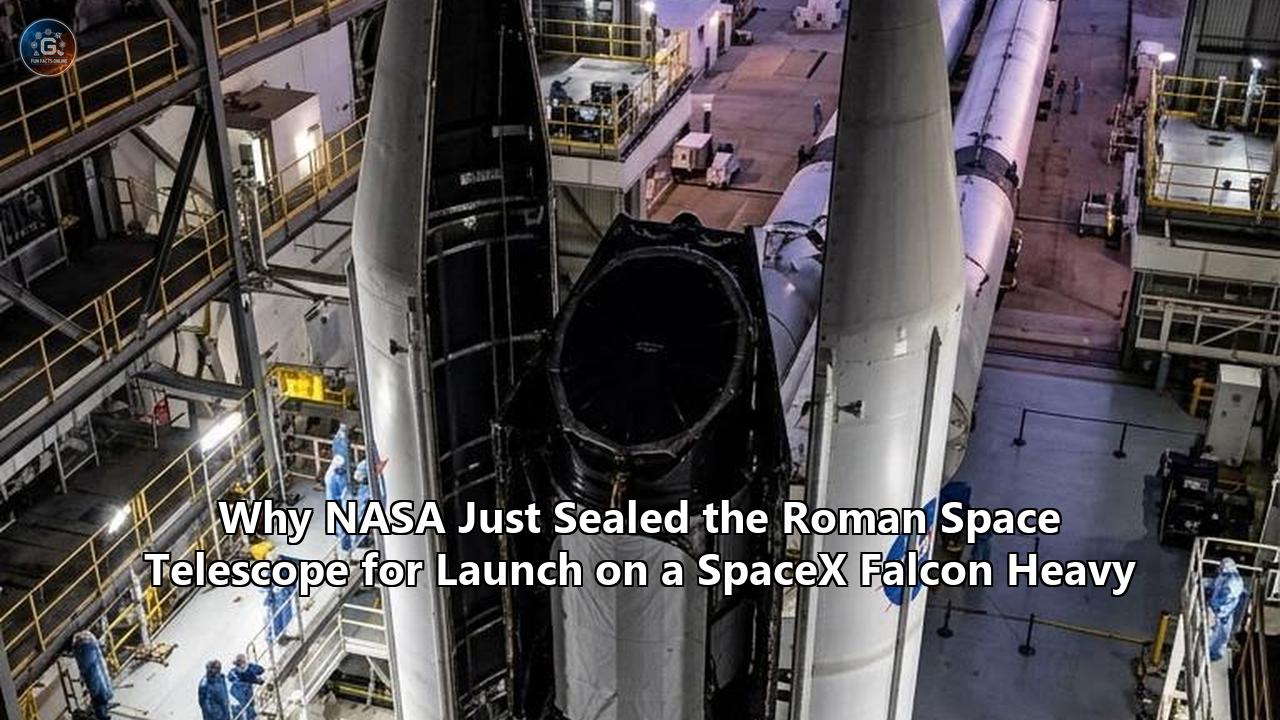
At 7:26 a.m. Eastern Daylight Time on August 30, 2026, a 27-engine SpaceX Falcon Heavy rocket will lift off from Launch Complex 39A at NASA’s Kennedy Space Center, carrying the Nancy Grace Roman Space Telescope into a direct-injection trajectory toward the Sun-Earth Lagrange Point 2 (L2).
Inside the Payload Hazardous Servicing Facility (PHSF) in Florida, technicians completed the definitive mechanical sealing of the 4.2-metric-ton observatory within its 43-foot-tall (13.1-meter), 17.1-foot-diameter (5.2-meter) carbon-composite payload fairing. The event marks the irreversible transition of NASA’s flagship astrophysics project from an accessible ground assembly into a sealed, flight-ready space payload.
================================================================================
ROMAN SPACE TELESCOPE: FLIGHT & PERFORMANCE SPECIFICATIONS
================================================================================
Aperture Diameter               2.4 meters (7.9 feet)
Optical Configuration           Three-Mirror Anastigmat (f/7.9)
Field of View                   0.281 square degrees (~100x Hubble FOV)
Primary Sensor Active Pixels    300.8 Megapixels (18x Teledyne H4RG-10 arrays)
Spectral Coverage               0.48 to 2.30 microns (Visible blue to Near-IR)
Data Downlink Throughput        11 Terabits / day (~1.375 Terabytes / day)
Dry Payload Mass                4,166 kg (9,184 lb)
Total Wet Launch Mass           ~10,500 kg (23,148 lb with propellant/adapter)
Onboard Propellant              290 gallons (~1,100 kg) Hydrazine (N2H4)
Total Mission Lifecycle Cost    $3.934 Billion (Under $4.0B Congressional Cap)
Target Operational Orbit        Sun-Earth L2 Quasi-Halo (1.5 million km)
================================================================================
Sealing the observatory is not simply an enclosure for transport; it sets rigid physical boundaries on thermal stability, atmospheric contamination, and mechanical shock loads that the telescope must withstand during its ascent. By executing this encapsulation process, NASA and launch services provider SpaceX cleared the final critical path item on a schedule running nine months ahead of the agency’s baseline commitment.
The Physics of Fairing Encapsulation: Mitigating Launch Environment Extremes
The physical encapsulation inside the Payload Hazardous Servicing Facility isolates the telescope's optical surfaces from the outside environment. The primary mirror—a 2.4-meter lightweight beryllium optic originally fabricated and transferred to NASA by the National Reconnaissance Office (NRO)—is coated with a specialized protected silver formulation designed for over 98% reflectivity across the 0.48 to 2.30 micrometer band.
                                  TOP FAIRING DOME
                                     /        \
                                    /   /\     \
                                   |   /  \     |  <-- Deployable Aperture Cover (DAC)
                                   |  | OTA|    |  <-- 2.4m Primary Mirror & Baffles
                                   |  | WFI|    |  <-- 300.8 MP Wide Field Instrument
                                   |  | CGI|    |  <-- Coronagraph Instrument
                                   |  |____|    |
                                   |  [SASS]    |  <-- Solar Array Sunshield (Stowed)
                                   |  [ BUS]    |  <-- 290 gal Hydrazine Fuel Tank
                                    \  /  \    /
                                     \/____\__/    <-- Falcon Heavy Payload Adapter (PAF)
                                         ||
                                   FALCON HEAVY S2
To prevent molecular contamination that could degrade optical throughput in the near-ultraviolet and blue spectrum (0.48–0.60 µm), the sealed fairing environment must maintain strict cleanroom parameters:
- Continuous purge using ultra-pure gaseous nitrogen ($GN_2$) at a Class 100 (ISO 5) level inside the inner envelope, preventing airborne particulate counts from exceeding 100 particles ($\ge 0.5\,\mu\text{m}$) per cubic foot.
- Non-volatile residue (NVR) limits restricted to less than 1.0 milligram per square foot ($1.0\text{ mg/ft}^2$) across all forward optical assemblies.
- Internal acoustic damping blankets lined along the 5.2-meter fairing walls to attenuate the 142-decibel (dB) Overall Sound Pressure Level (OASPL) generated during the initial 120 seconds of atmospheric ascent.
ASCENT TIME PROFILE & DYNAMIC LOADS (T+0 to T+225s)
================================================================================
Event                    Time (s)     Altitude (km)    Dynamic Pressure / Shock
--------------------------------------------------------------------------------
Liftoff (LC-39A)         T+00:00       0.0 km          142 dB OASPL Acoustic Load
Max-Q (Dynamic Pressure) T+01:12      12.8 km          ~34.5 kPa Max Dynamic Load
Side Booster MECO        T+02:22      61.4 km          ~3.2 g Peak Acceleration
Center Core MECO         T+03:34      92.1 km          ~4.1 g Longitudinal Load
Fairing Jettison         T+03:48     118.0 km          < 0.1 Pa (Molecular Safety)
Stage 2 Cutoff (SECO-1)  T+08:35     185.0 km          Orbital Insertion Coast
================================================================================
During ascent through Max-Q (maximum dynamic pressure at approximately 72 seconds after launch), the exterior surface of the fairing experiences friction heating reaching peaks of 120°C (248°F). The internal radiation barrier ensures that thermal gradients on the internal metering structure of the Optical Telescope Assembly (OTA) remain below a variation of $\pm 0.5^\circ\text{C}$, preventing structural distortion of the telescope's carbon-fiber composite truss prior to deployment.
Launch Vehicle Performance: The SpaceX Falcon Heavy Direct-Injection Mechanics
NASA secured the Falcon Heavy launch under a $255 million firm-fixed-price contract administered by the Launch Services Program (LSP) at Kennedy Space Center. Choosing a heavy-lift launch architecture with three Falcon cores—generating a combined sea-level thrust of 5,130,000 pounds-force (22.8 meganewtons) through 27 Merlin 1D engines—enables a high-energy transfer trajectory.
================================================================================
LAUNCH VEHICLE FLIGHT ARCHITECTURE: SPACEX FALCON HEAVY
================================================================================
Configuration                 Expendable Center Core / Recoverable Side Boosters
Core Engines                  27 Merlin 1D Sea-Level (Stage 1 + Boosters)
Upper Stage Engine            1 Merlin Vacuum (MVacD, 934 kN thrust, Isp 348 s)
Total Liftoff Mass            ~1,420,000 kg (~3,130,000 lb)
Characteristic Energy ($C_3$)  $-0.5\text{ to }+1.2\text{ km}^2/\text{s}^2$ (Target Injection)
Orbital Transfer Velocity     $\Delta v \approx 3,850\text{ m/s}$ (From LEO Park to L2)
Cruise Duration to Halo Orbit 90 to 105 days
Trans-L2 Injection Accuracy   $\pm 1.5\text{ m/s}$ 3-sigma velocity vector margin
================================================================================
The launch dynamics follow a precise energy-insertion sequence:
- Side Booster Separation (T+02:22): The two outer cores burn through approximately 820 metric tons of densified RP-1 and liquid oxygen (LOX) before staging at an altitude of ~61 kilometers, initiating boostback burns to return to Cape Canaveral Landing Zones LZ-1 and LZ-2.
- Core Burn and Staging (T+03:34): The center core burns at maximum throttle before cutting off its engines at Mach 8.5.
- Upper Stage Ignition & Fairing Separation (T+03:48): The fairing halves separate via a pneumatic-mechanical thruster latch at an altitude exceeding 118 kilometers, where the atmospheric density drops below $10^{-4}\,\text{Torr}$, eliminating any risk of free molecular aerodynamic heating altering the optical calibration of the payload.
- Trans-L2 Injection (TL2I): Following an orbital coast in a 185-kilometer low-Earth parking orbit, the Merlin Vacuum engine completes a second burn, boosting the observatory into a hyperbolic escape trajectory toward Sun-Earth L2, 1.5 million kilometers (930,000 miles) outward from Earth along the Sun-Earth axis.
                     ORBITAL TRAJECTORY TO SUN-EARTH L2
                     ----------------------------------
                 [Earth]
                    \
                     \--- (TL2I Burn: ~3.85 km/s)
                      \
                       \---> Cruise Path (1.5 Million Kilometers / ~90 Days)
                              \
                               \---> Halo Orbit Insertion Maneuver (~12 m/s Delta-V)
                                      \
                                    [ L2 POINT ]
                                   (Quasi-Halo Loop)
The high energy provided directly by the Falcon Heavy minimizes the need for high-propellant apogee burns by the spacecraft itself. Roman's onboard propulsion system carries 290 gallons (approximately 1,100 kilograms) of high-purity hydrazine ($N_2H_4$).
Because the launch vehicle achieves the required characteristic energy ($C_3$) directly, Roman reserves over 80% of its propellant budget for active station-keeping, halo orbit maintenance (requiring $\sim 3.5\text{ m/s}$ per year), and momentum wheel desaturation during its 5-to-10-year mission lifetime.
Sensor Architecture: The 300.8-Megapixel Wide Field Instrument
The operational core of the Nancy Grace Roman Space Telescope is its Wide Field Instrument (WFI). While Roman shares an identical 2.4-meter primary mirror diameter with the Hubble Space Telescope, its optical layout uses a three-mirror anastigmat design that magnifies its instantaneous field of view to 0.281 square degrees—a 100-fold expansion over Hubble’s Advanced Camera for Surveys (ACS) and Wide Field Camera 3 (WFC3).
================================================================================
WIDE FIELD INSTRUMENT (WFI) TECHNICAL METRICS
================================================================================
Focal Plane Composition       18 Teledyne H4RG-10 HgCdTe Focal Plane Arrays
Array Format                  $3 \times 6$ Grid Layout
Individual Sensor Resolution  $4096 \times 4096$ pixels ($16.78\text{ Megapixels}$ per chip)
Total Active Resolution       $300,816,384\text{ pixels}$ (300.8 Megapixels)
Pixel Physical Pitch          10.0 micrometers
Angular Resolution (Scale)    0.11 arcseconds per pixel
Operational Cryo-Temperature  95 Kelvin ($-178.15^\circ\text{C}$) via Passive Radiators
Read Noise Floor              $< 15\text{ electrons rms}$ (using multi-accum sampling)
Dark Current Floor            $< 0.005\text{ electrons/pixel/second}$
Field-of-View Area            0.281 square degrees ($1,011.6\text{ arcmin}^2$)
Filter Wheel Complements      8 Imaging Filters + 1 Slitless Grism + 1 Prism
================================================================================
The focal plane assembly (FPA) integrates 18 individual Teledyne Hawaii-4RG (H4RG-10) mercury-cadmium-telluride ($HgCdTe$) sensor chips, each containing $4096 \times 4096$ physical detector elements. This mosaic covers an active imaging surface of 300.8 million pixels.
              WFI FOCAL PLANE ARRAY: 18x H4RG-10 MOSAIC ARCHITECTURE
               [Chip 01] [Chip 02] [Chip 03] [Chip 04] [Chip 05] [Chip 06]
               [Chip 07] [Chip 08] [Chip 09] [Chip 10] [Chip 11] [Chip 12]
               [Chip 13] [Chip 14] [Chip 15] [Chip 16] [Chip 17] [Chip 18]
               |<------------------ 0.281 Square Degrees ----------------->|
The optical train routes photons through a 10-position filter and dispersive element wheel, allowing spectroscopic and multi-band photometric selection across near-infrared bands:
================================================================================
WFI FILTER PASSBANDS AND SPECTRAL COVERAGE
================================================================================
Element Identifier    Band Type         Wavelength Range       Primary Science Target
--------------------------------------------------------------------------------
F062 (R-Band)         Broadband Filter  0.48 – 0.76 µm         Optical Transition / Lensing
F087 (Z-Band)         Broadband Filter  0.76 – 0.98 µm         High-z Galaxy Surveys
F106 (Y-Band)         Broadband Filter  0.93 – 1.19 µm         Dark Energy / Supernovae
F129 (J-Band)         Broadband Filter  1.13 – 1.45 µm         Weak Gravitational Lensing
F158 (H-Band)         Broadband Filter  1.38 – 1.77 µm         Infrared Photometry Baseline
F184 (K-Short)        Broadband Filter  1.68 – 2.00 µm         Deep Cosmic Structure
F213 (K-Long)         Broadband Filter  1.95 – 2.30 µm         Galactic Core Microlensing
F146 (Wide-Band)      Panoramic Filter  0.93 – 2.00 µm         High-Cadence Microlensing
GRISM                 Dispersive Spec.  1.00 – 1.93 µm (R=460) Galaxy Redshift Surveys
PRISM                 Dispersive Spec.  0.75 – 1.80 µm (R=100) Type Ia SNe Spectroscopy
================================================================================
To prevent thermal infrared emission from blinding the focal plane array, the Wide Field Instrument is actively isolated from the spacecraft bus. Passive thermal radiators dump parasitic heat into deep space, keeping the 18 sensor chips stabilized at 95 Kelvin ($-178.15^\circ\text{C}$), while the Cold Optical Baffle Assembly (COBA) maintains an internal stray light attenuation factor greater than $10^9$.
Extreme Starlight Suppression: The Coronagraph Instrument (CGI)
Mounted beside the Wide Field Instrument on the composite Instrument Carrier is the Coronagraph Instrument (CGI). Designed as an advanced optical technology demonstration, CGI tests high-contrast starlight suppression systems capable of operating directly in space.
                    CORONAGRAPH OPTICAL ARCHITECTURE (CGI)
                    ---------------------------------------
   Incoming Light ---> [ Deformable Mirror 1 ] ---> [ Deformable Mirror 2 ]
   (Star + Planet)         (48x48 Actuators)            (48x48 Actuators)
                                  |
                                  v
                       [ Focal Plane Mask (FPM) ]  <-- Blocks Centered Starlight
                                  |
                                  v
                       [ Lyot Stop & Spatial Filter ]
                                  |
                                  v
                       [ EMCCD Detector Array ]    <-- Exoplanet Signal Detected
                            (165 K Cryo-EMCCD)         (Raw Contrast: 10^-9)
The technical requirements for direct exoplanet imaging are demanding. An Earth-sized planet orbiting a Sun-like star produces a reflected light contrast on the order of $10^{-10}$ relative to the host star, while gas giants like Jupiter exhibit a contrast between $10^{-8}$ and $10^{-9}$.
================================================================================
CORONAGRAPH INSTRUMENT (CGI) SPECIFICATIONS
================================================================================
Primary Optical Contrast      $1.0 \times 10^{-9}$ (1 part in 1,000,000,000 suppression)
Inner Working Angle (IWA)     0.15 arcseconds (~3.0 $\lambda/D$ at 575 nm)
Outer Working Angle (OWA)     0.45 arcseconds (~9.0 $\lambda/D$ at 575 nm)
Active Wavefront Correction   Dual $48 \times 48$ Piezoceramic Deformable Mirrors
Total Surface Actuators       4,608 Active Actuators (2,304 per mirror)
Actuator Stroke Resolution    $\sim 10\text{ Picometers}$ ($0.01\text{ Nanometers}$)
Wavefront Sensor Feedback     Low-Order Wavefront Sensor (LOWFS) at 1 kHz Loop Rate
Detector Technology           Cryogenic Electron-Multiplying CCD (EMCCD, 165 K)
EMCCD Dark Current Rate       $< 0.001\text{ electrons / pixel / hour}$
Operating Spectral Bands      Band 1 (575 nm, 10%), Band 4 (825 nm, 11%)
================================================================================
To achieve this level of performance, the Roman Coronagraph introduces two piezoceramic deformable mirrors (DMs) operating in tandem. Each deformable mirror contains 2,304 individual electro-mechanical actuators arranged in a $48 \times 48$ grid.
These actuators move in real time with a precision of 10 picometers—less than the diameter of a hydrogen atom—to counteract microscopic wavefront errors and optical aberrations caused by structural flexing or thermal variations.
The system's Low-Order Wavefront Sensor (LOWFS) feeds optical displacement data to an onboard digital signal processor at 1 kilohertz (kHz). This control loop stabilizes line-of-sight pointing drift down to under 0.5 milliarcseconds, allowing astronomers to see faint, cold exoplanets and circumstellar debris disks orbiting nearby stars.
Data Throughput: Processing 11 Terabits per Day
The panoramic mapping capability of the Nancy Grace Roman Space Telescope creates a high-volume data pipeline. Unlike the Hubble Space Telescope, which generates roughly 18 gigabytes of science data daily, Roman’s high-cadence surveys will produce 11 terabits (1.375 terabytes) of compressed science data every 24 hours.
DAILY DATA TRANSMISSION VOLUME COMPARISON
================================================================================
Observatory    Daily Downlink      Active Detector Size   Downlink Band Architecture
--------------------------------------------------------------------------------
Hubble (HST)   ~0.018 TB / day      16 Megapixels         S-band / Multiple DSN Passes
Webb (JWST)    ~0.060 TB / day      68 Megapixels         Ka-band (28.0 GHz, 28 Mbps)
Roman (NGRST)  ~1.375 TB / day     300.8 Megapixels       Ka-band (26.0 GHz, 285 Mbps)
================================================================================
To move this volume of astrophysical data across 1.5 million kilometers of space to Earth, the spacecraft bus utilizes a high-rate communications architecture:
- Ka-Band High-Gain Antenna (HGA): Operating at 26 GHz with a 285-megabit-per-second (Mbps) downlink rate, transmitting during continuous daily ground passes.
- Onboard Storage Solid-State Recorder (SSR): A 1.8-terabyte radiation-hardened flash memory matrix designed to buffer up to 36 hours of continuous full-array science operations during ground network switchovers.
- Ground Stations: Reception handled by dedicated Ka-band terminals within the Space Network, including the White Sands Ground Terminal in New Mexico, supplemented by the European Space Tracking network (ESTRACK) and NASA's Deep Space Network (DSN).
                      SPACE-TO-GROUND DATA TRANSMISSION PIPELINE
                      ------------------------------------------
 [ 18x H4RG Focal Plane Array ]
            |
            v  (300.8 MP Raw Uncompressed Frames)
 [ Onboard Lossless Compression Engine (2.2:1 Compression Ratio) ]
            |
            v
 [ 1.8 TB Solid-State Recorder (SSR Buffer) ]
            |
            v
 [ 26 GHz Ka-Band High-Gain Antenna (285 Mbps) ]
            |
            | ~~~ (1.5 Million km Free-Space Transmission) ~~~
            v
 [ White Sands Ground Terminal / DSN Receiving Stations ]
            |
            v
 [ Space Telescope Science Institute (STScI) Archive (1.4 Petabytes/Year) ]
Over the course of its initial five-year mission, the Space Telescope Science Institute (STScI) in Baltimore, Maryland, projects Roman will archive more than 20 petabytes of processed public science imagery and spectral cubes—an order of magnitude larger than the combined historical data holdings of Hubble and Webb.
Quantitative Cosmological Projections: Measuring Dark Energy and Exoplanets
The Roman Space Telescope's launch is focused on solving large-scale cosmological questions, specifically the expansion rate of the universe and the physical nature of dark energy.
================================================================================
CORE SURVEY PROGRAMMATIC ALLOCATIONS (5-YEAR TIMELINE)
================================================================================
High Latitude Wide Area Survey (HLWAS)      2,200 sq. deg. (~1.5 years time-share)
High Latitude Time Domain Survey (HLTDS)     50,000+ Supernovae Ia cataloged
Galactic Bulge Time Domain Survey (GBTDS)    ~100 Million Stars / 15-min cadence
General Investigator Science Program        ~25% Allocated to Open Science Proposals
Coronagraph Tech Demonstration Target Runs  ~3 months allocated across Mission Years 1-2
================================================================================
HIGH LATITUDE SURVEY: 3D COSMIC MAPPING
---------------------------------------
Z = 3.0 |==========================================| High Redshift
| . : . : . . : . |
Z = 2.0 | . : * . : * : . | Baryon Acoustic
| : . . : . . : | Oscillations (BAO)
Z = 1.0 | * . : . * . : . * : |
| . : . . : . . | Weak Lensing
Z = 0.0 |==========================================| (2 Billion Galaxies)
[ 2,200+ Square Degrees ]1. The High Latitude Wide Area Survey (HLWAS)
The High Latitude Survey will map over 2,200 square degrees of the extragalactic sky in four near-infrared filters ($Y, J, H, \text{and } F184$), extending to a point-source sensitivity of $J = 26.7\,\text{AB}$ magnitude.
Using high-resolution weak gravitational lensing, Roman will measure subtle cosmic shear distortions across more than 2 billion galaxies, mapping the distribution of dark matter across 11 billion years of cosmic history.
The survey will measure the dark energy equation of state parameters—$w_0$ (its current value) and $w_a$ (its time-dependent evolution)—with a sub-1% margin of error, determining whether dark energy matches Einstein’s static cosmological constant ($w = -1$) or behaves as a dynamical scalar field:
$$w(a) = w_0 + w_a(1 - a)$$
2. High-Latitude Time-Domain Supernova Survey
Roman will perform repeated, ultra-precise photometric sweeps of dedicated deep fields, discovering and characterizing more than 20,000 Type Ia supernovae up to redshift $z \approx 2.5$. This broad sample provides an independent probe of the Hubble tension—the unresolved gap between direct local measurements of the expansion rate ($H_0 \approx 73\text{ km/s/Mpc}$) and early-universe CMB predictions ($H_0 \approx 67.4\text{ km/s/Mpc}$).
               PROJECTED EXOPLANET DISCOVERY MODES BY THE NUMBERS
================================================================================
Discovery Channel          Detection Target Class             Expected Yield
--------------------------------------------------------------------------------
Gravitational Microlensing Earth/Mars analogs at 1–5 AU       ~1,400 bound worlds
Microlensing Outer Orbit   Saturn/Jupiter analogs (5–30 AU)   ~1,000 cold gas giants
Microlensing Unbound       Free-floating "Rogue" Planets      Hundreds (Free-mass)
Direct CGI Imaging         Gas Giants ($10^{-9}$ contrast)    10 to 30 systems
Transit Exoplanets         Hot/Warm Gas Giants & Neptunes     100,000+ candidates
================================================================================
3. Galactic Bulge Time Domain Exoplanet Survey
By monitoring 100 million stars located in the crowded central Milky Way every 15 minutes continuously for hundreds of days, Roman will utilize gravitational microlensing to survey cool, wide-orbit planets.
Because gravitational microlensing depends on the mass of the intervening lens rather than its light output, Roman will detect planets down to the mass of the Moon at orbital distances from 1 to 10 Astronomical Units (AU), complementing Kepler’s and TESS's focus on close-in planets.
Industrial Execution and Cost Discipline
The Nancy Grace Roman Space Telescope represents a notable project management success within NASA’s astrophysics division. Flagship missions often face cost overruns and multi-year delays; Roman, by comparison, completed its assembly and environmental verification while staying below its congressionally mandated lifecycle cost cap.
================================================================================
MISSION BUDGET AND HARDWARE BREAKDOWN
================================================================================
Congressional Life-Cycle Cost Cap    $4.000 Billion
Current Agency Baseline Cost (ABC)   $3.934 Billion (Development + First 5 Yrs)
Estimated Cost Savings via NRO Optic ~$250 Million (In Heritage Mirror Tooling)
Launch Services Contract Cost (NLS)  $255 Million (SpaceX Falcon Heavy Delivery)
Wide Field Instrument Prime Cost     ~$380 Million (Design, Focal Plane, Testing)
Spacecraft Integration Base Facility NASA Goddard Space Flight Center (GSFC)
Projected Schedule Margin Consumed   -9 Months (Delivering ahead of May 2027 gate)
================================================================================
Key factors contributing to this budget and schedule performance include:
- Heritage Optical Components: Using an existing 2.4-meter primary mirror donated by the National Reconnaissance Office saved an estimated $250 million in direct glass casting, coarse figuring, and structural tooling costs.
- Modular Payload Design: NASA's Goddard Space Flight Center organized assembly around a dedicated Instrument Carrier grid, allowing the Wide Field Instrument (built by BAE Systems) and the Coronagraph Instrument (built by JPL) to be built, tested, and calibrated in parallel cleanrooms before being mounted onto the spacecraft bus.
- Testing Pipeline: Complete thermal vacuum (TVAC) optical verification of the Spacecraft bus + Integrated Payload Assembly (SCIPA) was conducted inside Goddard's 27-meter-tall Space Environment Simulator (SES). This allowed the observatory to validate its sub-nanometer optical alignment under flight-grade cryo-vacuum conditions before it was moved to Kennedy Space Center via the agency's transport barge Pegasus.
                ROMAN SPACE TELESCOPE: TIMELINE TO FIRST LIGHT
================================================================================
Milestone Target    Operational Timeline Events & Objectives
--------------------------------------------------------------------------------
T+00:00:00          Liftoff from LC-39A on SpaceX Falcon Heavy (August 30, 2026)
T+00:45:00          Separation from Falcon Heavy Stage 2; Trans-L2 Injection
T+01:05:00          Autonomous Solar Array Sunshield (SASS) Deployment (4.5 kW)
T+03 Days           First Mid-Course Trajectory Correction Maneuver (TCM-1)
T+30 to T+90 Days   Cruise Phase to L2; Instrument Outgassing Phase
T+90 to T+105 Days  Insertion Burn into Sun-Earth L2 Halo Orbit (~1.5M km)
T+105 Days          Deployable Aperture Cover (DAC) Latch Ejection
T+120 Days          Cryo-Cooling Reaches 95 K; First Optical Calibration Wavefront
T+180 Days          Commissioning Complete; Start of 5-Year Science Survey
================================================================================
Flight Readiness: The Road to Liftoff
With encapsulation complete inside the Payload Hazardous Servicing Facility at Kennedy Space Center, the Roman Space Telescope has cleared its mechanical integration milestones. Technicians have secured the fairing-enclosed payload onto the specialized Falcon Heavy Payload Attach Fitting (PAF) and mated it to the 9-meter interstage adapter of the launch vehicle.
The integrated stack moves to the pad at Launch Complex 39A for final electrical continuity checks, hypergolic helium pressurization sweeps, and the countdown sequence.
When the countdown reaches zero on August 30, 2026, the Roman Space Telescope launch will send 300.8 megapixels of near-infrared imaging hardware, an active starlight-canceling coronagraph, and a 2.4-meter wide-field optical assembly into deep space. Stationed 1.5 million kilometers away at the Sun-Earth L2 point, the observatory is built to capture the wide-field infrared universe at an unprecedented rate, mapping billions of galaxies, discovering thousands of distant worlds, and charting the fundamental structure of the cosmos.
Reference:
- https://www.facebook.com/100094096938401/videos/nasas-next-great-observatory-is-almost-here-the-nancy-grace-roman-space-telescop/1914946799892007/
- https://satnews.com/2026/08/23/nasa-roman-space-telescope-passes-flight-readiness-review-ahead-of-spacex-falcon-heavy-launch/
- https://spacedaily.com/t-roman-hubble-tension-expansion-cosmology/
- http://www.sciencedaily.com/releases/2026/08/260826055448.htm
- https://www.cfpublic.org/2026-07-30/falcon-heavy-fueled-to-launch-nancy-grace-roman-space-telescope
- https://www.space.com/space-exploration/launches-spacecraft/nasas-roman-space-telescope-arrives-in-florida-ahead-of-spacex-falcon-heavy-launch-this-summer
- https://www.researchgate.net/publication/383370567_Survey_science_with_the_Nancy_Grace_Roman_Space_Telescope_Wide_Field_Instrument
- https://en.wikipedia.org/wiki/Nancy_Grace_Roman_Space_Telescope
- https://spie.org/AS26/conferencedetails/space-telescopes-and-instrumentation-optical-ir-mm-wave
- https://academic.oup.com/mnras/article/501/2/2688/6024678
- https://www.wusf.org/the-florida-roundup/2026-08-24/nasa-scientist-nancy-grace-roman-space-telescope
- https://roman.ipac.caltech.edu/news/nasa-successfully-integrates-coronagraph-for-roman-space-telescope
- https://www.mpia.de/news/science/2026-08-roman-launch
- https://www.facebook.com/stsci/videos/-we-are-officially-fewer-than-30-days-from-the-launch-of-the-nancy-grace-roman-s/1369159971280270/