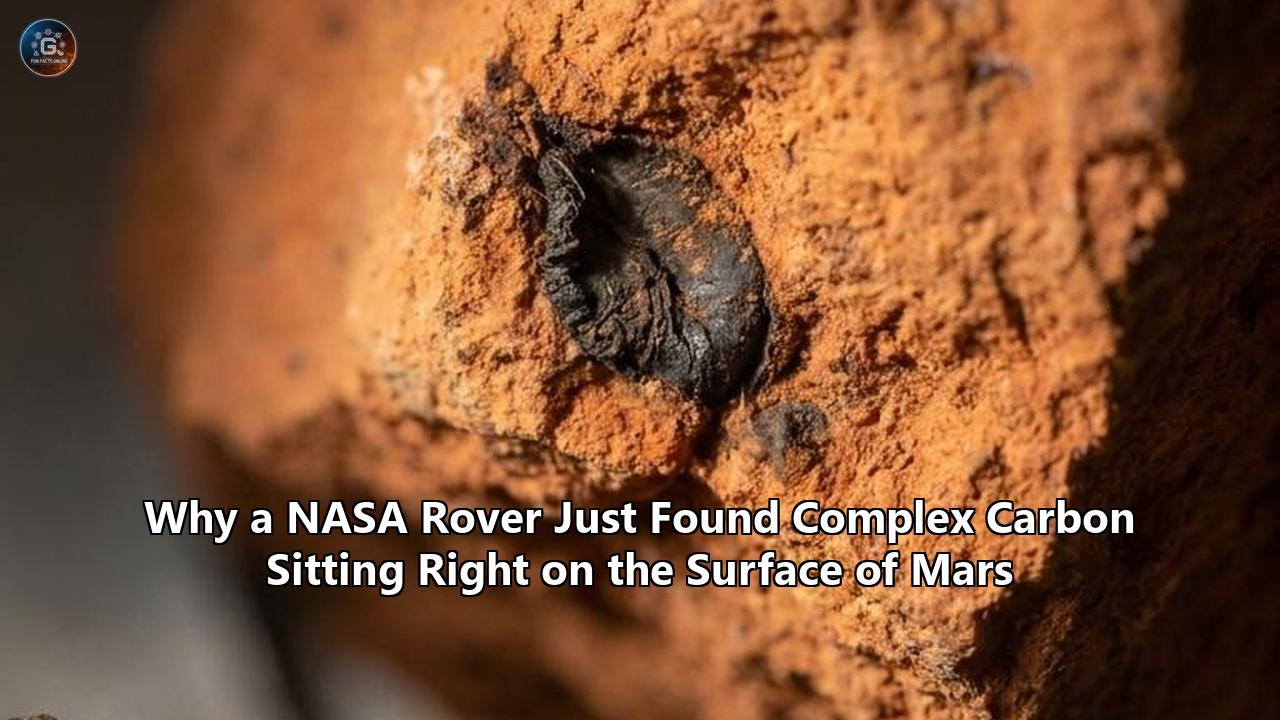
On June 24, 2026, a team of planetary scientists publishing in the journal Science Advances confirmed that NASA’s Perseverance rover had detected a high concentration of macromolecular organic carbon (MMC) directly on the natural surface of Martian rocks.
The measurements, taken from a geologically rich outcropping known as Bright Angel inside Jezero Crater, represent the most robust, intact, and structurally complex detection of carbon chemistry ever recorded on the Martian surface.
What makes the discovery particularly startling to the scientific community is not just the complexity of the carbon detected, but its location. The molecules were identified just microns beneath the planet’s top soil layer—a region long believed to be an absolute "dead zone" where harsh ultraviolet radiation, cosmic rays, and highly reactive oxidizing chemicals like perchlorates should have long since ripped any complex organic bonds apart.
Instead, Perseverance’s high-tech suite of instruments revealed a thriving, deeply preserved chemical fossil.
This discovery fundamentally disrupts decades of planetary science assumptions. It suggests that early Mars may have been completely bathed in prebiotic or biological chemistry, and that these complex structures can somehow survive the harsh modern environment of the Red Planet.
Yet, the announcement arrives at a moment of bitter irony. Just months before this scientific triumph, political gridlock and budget cuts in Washington effectively killed NASA’s ambitious Mars Sample Return (MSR) mission, leaving the very rocks that could confirm the existence of extraterrestrial life stranded on a world 140 million miles away.
The Breakthrough at Bright Angel
To understand why this discovery is reverberating through the space corridors of Pasadena, Washington, and Beijing, one must look at the specific dirt Perseverance is currently traversing.
Since landing on February 18, 2021, the six-wheeled rover has been exploring Jezero Crater, a 28-mile-wide impact basin that was home to a deep lake and a rushing river delta system roughly 3.8 billion years ago. The rover’s primary objective is astrobiology: finding signs of ancient microbial life.
In July 2024, Perseverance arrived at "Bright Angel," an outcropping characterized by light-toned sedimentary rocks exposed by the ancient flow of Neretva Vallis, a river channel that once fed the Jezero lake. It was here that the rover encountered a mudstone slab dubbed "Cheyava Falls".
Initial imagery of Cheyava Falls shocked scientists by revealing tiny, millimeter-sized white spots ringed by dark, reddish rims. On Earth, these "leopard spots" are a classic signature of chemical reactions driven by microbes living in groundwater, where they utilize iron and phosphate as an energy source. At the time, NASA officials cautiously hinted that Cheyava Falls represented the most compelling potential biosignature yet discovered.
The June 24, 2026 paper, led by Dr. Ashley Murphy of the Planetary Science Institute, took those observations a massive step further. Using Perseverance's Scanning Habitable Environments with Raman and Luminescence for Organics and Chemicals (SHERLOC) instrument, the team shined a deep-ultraviolet laser at Cheyava Falls and a neighboring rock called Walhalla Glades.
                                  [ NERETVA VALLIS ]
                           (Ancient Riverbed Flowing In)
                                        │
                                        ▼
                             [ BRIGHT ANGEL OUTCROP ]
                       (Sedimentary Mudstones Exposed)
                                 /            \
                                /              \
                  [ CHEYAVA FALLS ]          [ WALHALLA GLADES ]
                 - "Leopard Spots"          - Silicate-dominated
                 - Carbonates & sulfates    - Deeply preserved MMC
                 - High-density MMC
By measuring the specific way the UV light scattered back, SHERLOC recorded hundreds of distinct organic detections. The instrument confirmed the presence of macromolecular carbon (MMC)—dense, resilient, aromatic networks of carbon atoms that are structurally similar to coal or ancient fossilized organic matter on Earth.
Importantly, SHERLOC achieved these results on the un-drilled, natural surfaces of the rocks. Historically, rovers like Curiosity had to drill deep into Martian clay, extract powder, and heat it to extreme temperatures inside an onboard oven (the Sample Analysis at Mars instrument) to detect organic remnants.
By finding intact organic carbon on mars right on the exposed rock faces, Perseverance demonstrated that these molecules are either incredibly rugged or have been recently exposed by wind erosion at a rate that outpaces Martian environmental degradation.
Astrobiology's Dual Paths: Biotic vs. Abiotic
While the presence of complex organic carbon on mars is an essential prerequisite for life, planetary scientists are quick to emphasize that carbon does not automatically equate to ancient Martian biology. Macromolecular carbon can be synthesized through two distinctly different pathways:
The Biotic Pathway
On Earth, MMC is most commonly the leftover garbage of life. When micro-organisms, plants, or algae die, their soft tissues are buried and subjected to heat and pressure. Over millions of years, volatile elements like hydrogen, oxygen, and nitrogen are squeezed out, leaving behind a carbon-rich macromolecular skeleton.
The fact that the MMC at Bright Angel is co-located with the "leopard spots" and embedded in minerals like carbonates and sulfates—which form when water alters rock—makes the biological hypothesis highly attractive. It paints a picture of an ancient lakebed where microbial mats could have thrived, utilizing chemical energy from the sediment and leaving behind carbonized organic residues.
The Abiotic Pathway
However, nature has several highly efficient ways of producing complex organic molecules without any help from living systems. These non-biological chemical processes are common in the solar system:
- Serpentinization: When water reacts with volcanic, olivine-rich rocks, it produces hydrogen gas. This hydrogen can react with dissolved carbon dioxide in groundwater to synthesize methane and more complex, chain-like macromolecular carbon molecules. This is an inorganic process that occurs deep in Earth's ocean floors and hydrothermal vents.
- Meteoritic Deposition: Space is surprisingly dusty and organic. Carbonaceous chondrite meteorites and interplanetary dust particles are packed with complex macromolecular carbon. Over billions of years, a steady rain of cosmic debris could have seeded the surface of Mars with organic molecules, which were then washed into the Jezero lake basin and trapped in the mud.
- Atmospheric Photochemistry: High-altitude ultraviolet light reacting with carbon dioxide in Mars' early, thick atmosphere could have produced organic compounds that drifted down to the surface like prebiotic snow.
┌─────────────────────────────────────────────────────────────────────────┐
│                    MACROMOLECULAR CARBON ORIGINS                        │
├────────────────────────────────────┬────────────────────────────────────┤
│         BIOTIC PATHWAYS            │         ABIOTIC PATHWAYS           │
├────────────────────────────────────┼────────────────────────────────────┤
│ • Fossilized microbial mats        │ • Serpentinization (water-rock)    │
│ • Hydrocarbon coal-like residues   │ • Meteoritic delivery (cosmic dust)│
│ • Extracellular metabolic waste    │ • Atmospheric photochemistry (UV)  │
└────────────────────────────────────┴────────────────────────────────────┘
The SHERLOC instrument on Perseverance is an exceptional tool for mapping the location and basic structure of these carbon deposits, but it lacks the analytical resolution to determine their biogenicity. It cannot measure the subtle isotopic ratios of carbon-12 and carbon-13, nor can it map the atomic-scale chiral structures that would decisively separate a biological cell from a random abiotic chemical reaction.
To draw that line, the samples must be placed under the massive, building-sized electron microscopes and mass spectrometers found in laboratories on Earth.
Who is Affected? The Ripple Effects of the Discovery
The confirmation of widespread, surface-stable organic carbon on mars has sent shockwaves through multiple sectors of the scientific, geopolitical, and engineering communities. The impact of this discovery extends far beyond the immediate research team, altering career trajectories, institutional priorities, and international space strategies.
                                  [ DISCOVERY OF SURFACE MMC ]
                                                │
         ┌──────────────────────────────────────┼──────────────────────────────────────┐
         ▼                                      ▼                                      ▼
[ Astrobiology Community ]             [ Aerospace Institutions ]             [ Geopolitical Players ]
  - Rewriting Martian history            - JPL facing layoffs                   - China's space race edge
  - Rethinking organic survival          - MSR mission cancelled                - Tianwen-3 gains priority
  - Shifting biosignature metrics        - Pivot to lunar/Artemis               - Robotic vs. crewed debate
1. The Astrobiological Community
For astrobiologists, this discovery is both a vindication and a profound shift in operational parameters. For decades, the prevailing consensus was that searching for organic material on Mars required digging deep beneath the surface. The Martian soil was seen as an active chemical destroyer, characterized by intense UV radiation that acts as a sterilizing agent and perchlorates that oxidize and degrade complex molecules.
The discovery of MMC on the un-drilled surface of mudstones forces a major reevaluation of Martian surface chemistry.
Astrobiologists must now study how these macromolecular chains were shielded. Was it due to a thin coating of clay or silica minerals that acted as a natural sunscreen? Or is macromolecular carbon inherently far more resistant to the harsh modern Martian climate than laboratory simulations on Earth suggested?
This changes the target criteria for future planetary landers, making surface-level sedimentary outcroppings much higher priority targets.
2. NASA and the Jet Propulsion Laboratory (JPL)
For the engineers and scientists at JPL in Pasadena, California—the birthplace of Perseverance and the historic center of Mars exploration—the discovery brings a mix of pride and profound institutional pain.
JPL has recently faced one of its most challenging fiscal stretches in decades. Over the last two years, the laboratory has executed multiple rounds of deep layoffs, shedding hundreds of highly skilled aerospace engineers, scientists, and support staff.
The primary driver of this crisis was the spiraling cost and ultimate administrative collapse of the Mars Sample Return (MSR) program.
  JPL Fiscal Year 2026 Reality:
  ┌────────────────────────────────────────────────────────────────────────┐
  │ • Major budget cuts: Trump Administration proposed deep science cuts    │
  │ • Layoffs: Hundreds of staff let go due to MSR funding loss            │
  │ • Mission paradox: Perseverance finds prime targets, but MSR is dead    │
  │ • Strategic pivot: Shifts toward lunar Artemis and commercial outreach │
  └────────────────────────────────────────────────────────────────────────┘
The original MSR architecture—a joint venture between NASA and the European Space Agency (ESA) designed to send a lander to retrieve Perseverance’s sealed sample tubes, launch them into Martian orbit, and fly them back to Earth—was projected to cost up to $11 billion and face delays stretching into the 2040s.
In early 2026, as part of the FY2026 budget process, the US Congress formally declined to fund the existing MSR program architecture, effectively killing the project in its current form.
The fact that Perseverance has now discovered what could be the definitive proof of ancient life in the very samples it is currently caching—such as the Cheyava Falls core—creates an extraordinary paradox. JPL has the target, but they no longer have the arrow.
3. The European Space Agency (ESA)
The shockwaves from the MSR cancellation have traveled across the Atlantic, deeply affecting European aerospace partners. Under the joint MSR architecture, ESA was responsible for developing key components, most notably the Earth Return Orbiter (ERO), a massive spacecraft contracted to Airbus Defence and Space for €491 million.
Following the U.S. budget decisions in January 2026, ESA Director of Human and Robotic Exploration, Daniel Neuenschwander, confirmed that "Mars Sample Return is currently not planned to be continued".
In March 2026, ESA member states formally requested the cancellation of the Earth Return Orbiter program. This decision has forced European space agencies to quickly pivot, trying to salvage and reuse developed technologies, such as advanced electric propulsion systems, for other scientific endeavors.
For European astrobiologists, who had dedicated over a decade of their careers to preparing for the analysis of returned Martian soil, the cancellation is a devastating scientific blow.
The Geopolitical Shift: The Rise of China’s Tianwen-3
As the United States and Europe scale back their Mars exploration ambitions due to budget constraints, the geopolitical balance of power in deep-space exploration is rapidly shifting.
The primary beneficiary of the Western retreat from Mars Sample Return is the China National Space Administration (CNSA).
                         MARS SAMPLE RETURN: THE RACE TO EARTH
┌───────────────────────────────────────────────┬───────────────────────────────────────────────┐
│                 UNITED STATES / ESA           │                     CHINA                     │
├───────────────────────────────────────────────┼───────────────────────────────────────────────┤
│ • Status: Cancelled in current form (Jan 2026)│ • Status: Active, fast-tracked, high priority │
│ • Target: High-value, scientifically chosen   │ • Target: Grab-and-go, lower-risk landing site│
│   samples in Jezero Crater (Bright Angel)     │ • Projected Launch: 2028 - 2031 (Tianwen-3)    │
│ • Est. Return: Indefinite (post-2035 if ever) │ • Est. Return: ~2031                          │
│ • Advantage: Superior, diverse rock selection  │ • Advantage: Clear political and financial will│
└───────────────────────────────────────────────┴───────────────────────────────────────────────┘
While NASA's MSR project is stalled in bureaucratic purgatory, China is actively fast-tracking its own sample return mission, known as Tianwen-3.
The mission, which is scheduled to launch as early as late 2028 or 2031, is designed as a direct "grab-and-go" endeavor.
Unlike Perseverance, which has spent years meticulously scanning, analyzing, and selecting individual rocks from highly complex lakebed sediments, Tianwen-3 will land on a geologically simpler, flatter, and safer Martian plain. It will scoop up a bulk sample of topsoil and immediate subsurface dirt, load it into an ascent vehicle, and immediately head back to Earth.
From a purely geological standpoint, China's samples may not be as rich or targeted as the mudstones Perseverance has collected at Bright Angel. However, the reality of orbital mechanics and political funding means that China is now highly likely to become the first country in human history to return physical samples of Mars to Earth.
If China's grab-and-go mission succeeds in returning Martian soil by 2031, and their domestic laboratories identify even simple prebiotic compounds or signs of microbial residue, it will represent a historic scientific coup.
The United States, despite having spent billions of dollars deploying the sophisticated Perseverance rover and identifying prime astrobiological targets, faces the very real prospect of watching from the sidelines as Chinese scientists announce the discovery of extraterrestrial life.
What Changes? A New Strategy for Mars Exploration
The intersection of two major events—the discovery of stable organic carbon on mars and the cancellation of the Mars Sample Return mission—forces a profound change in how humanity conducts planetary science.
With the path to physically bringing Martian rocks back to Earth blocked for the foreseeable future, the scientific community is undergoing several fundamental transitions:
1. From Sample Return to Advanced In-Situ Analysis
For the past twenty years, the design of Mars rovers was guided by a "find and cache" philosophy. Rovers were equipped with instruments designed to identify interesting targets, package them into titanium tubes, and leave them on the ground. They were not designed to be self-contained mobile laboratories capable of making definitive scientific discoveries on their own.
As Dr. Kyle Uckert, SHERLOC deputy principal investigator at NASA’s Jet Propulsion Lab, explained:
"The science payload of the Perseverance rover was not designed to distinguish between organics formed via abiotic and biotic processes but was instead selected to identify compelling rocks to be collected for possible return to Earth for more rigorous testing."
With MSR canceled, this design philosophy is no longer viable. Future robotic missions to Mars will have to undergo a major design pivot.
Instead of caching systems, future landers and rovers must be equipped with miniaturized, ultra-high-resolution laboratories capable of doing advanced chemistry on-site. This includes:
- Miniaturized Mass Spectrometers: Instruments capable of measuring precise isotopic ratios of carbon, nitrogen, and sulfur without destroying the molecular structure.
- Chirality Detectors: Systems that can determine if organic molecules are "left-handed" or "right-handed"—a key signature of biological life, which almost exclusively uses single-handed molecular forms.
- Subsurface Drills with Integrated Sensors: Since surface radiation still poses a threat to delicate biosignatures over long periods, future landers must be able to drill several meters down and analyze samples within an actively shielded internal environment.
                  OLD PARADIGM: "Find & Cache" (2010s - 2025)
                  ┌────────────────────────────────────────┐
                  │ Rover identifies target -> Drills core  │
                  │ -> Seals in tube -> Drops on surface   │
                  │ -> Waits for future recovery mission   │
                  └────────────────────────────────────────┘
                                      │
                                      ▼ (MSR Cancelled)
                                      │
                  NEW PARADIGM: "In-Situ Analysis" (2026+)
                  ┌────────────────────────────────────────┐
                  │ Rover identifies target -> Drills core  │
                  │ -> Processes sample in onboard lab     │
                  │ -> Analyzes isotopes & molecular shape │
                  │ -> Transmits definitive proof to Earth │
                  └────────────────────────────────────────┘
2. The Broadening of Planetary Habitability Metrics
The discovery of macromolecular carbon in two vastly different mudstones at Bright Angel—coupled with Curiosity’s historic detections of organics in Gale Crater, more than 2,300 miles away—fundamentally changes our understanding of the ancient Martian environment.
It proves that the raw ingredients for life were not isolated anomalies. As the authors of the Science Advances paper wrote, this widespread distribution "indicates that the habitability of Mars, and the availability of organics, may have been widespread across the planet billions of years ago."
This realization changes how we define a "habitable zone" on early Mars. Historically, scientists looked for very specific, highly localized delta formations or hot springs.
Now, the search must expand to view the entire planet as a interconnected prebiotic system. It suggests that early Mars, with its active hydrology, volcanic heat, and thick atmosphere, had a robust and active planetary-scale carbon cycle, much like early Earth.
Short-Term Consequences: The Immediate Fallout (1–3 Years)
The immediate consequences of the Bright Angel discovery, occurring alongside NASA’s budget crises, are already playing out in real-time across the space sector:
Operational Slowdown of Perseverance
To balance the federal budget, the Trump administration’s NASA funding requests for the coming fiscal years propose direct cuts to active planetary science missions.
Perseverance, despite making some of the most significant discoveries in planetary science history, is facing an active reduction in its operational funding.
NASA has proposed pulling resources from Perseverance to support other planetary missions, a move that will reduce the "pace of operations" for the six-wheeled rover. This means the rover will drive slower, perform fewer science scans per month, and likely take longer to climb out of Jezero Crater to explore the surrounding ancient plains.
       CONGESTED FUNDING PATHWAYS: CONSEQUENCES FOR PERSEVERANCE
┌──────────────────────────────────────┬──────────────────────────────────────┐
│          BUDGET CUT REALITY          │          IMMEDIATE IMPACT            │
├──────────────────────────────────────┼──────────────────────────────────────┤
│ • NASA FY2026 science budget reduced │ • Rover operations slowed down       │
│ • Perseverance funding reallocated   │ • Fewer targets scanned per month    │
│ • Staff and engineering cuts at JPL  │ • Scientific team downsized          │
│ • Core samples left unguarded on Mars│ • Loss of real-time analysis speed   │
└──────────────────────────────────────┴──────────────────────────────────────┘
Congressional Lobbying and Public Pressure
The timing of the Science Advances paper has provided a powerful tool for space advocates and members of Congress representing California and Maryland (the home states of JPL and Goddard Space Flight Center).
Armed with proof that Perseverance is sitting directly on top of complex organic carbon on mars, politicians are actively lobbying to restore funding to Mars exploration programs.
While the original, multi-billion-dollar MSR architecture is dead, the US Congress did allocate $110 million to the "Mars Future Missions" program in its final 2026 spending bill. This money is specifically designed to keep the lights on for key technologies—such as specialized entry, descent, and landing systems, and advanced spectroscopy—in the hopes that a cheaper, more streamlined sample return concept can be revived by the end of the decade.
The European Transition
In Europe, the immediate task is managing the wind-down of the Earth Return Orbiter program.
ESA is currently engaged in intensive talks with Airbus Defence and Space to salvage what they can from the €491 million contract.
Rather than throwing away years of research and development, engineers are working to adapt the spacecraft’s advanced electric propulsion systems and orbital rendezvous technologies for other planned European deep-space missions, such as prospective flights to the asteroid belt or the icy moons of Jupiter.
Long-Term Consequences: What the Future Holds (5–15 Years)
Looking further down the road, the discovery of surface-stable macromolecular carbon and the current geopolitical realignment will shape deep space exploration for decades.
                LONG-TERM SPACE EXPLORATION TRAJECTORY (2030s)
┌─────────────────────────────────────────────────────────────────────────────┐
│ 1. THE RISE OF COMMERCIAL RETRIEVAL                                         │
│    • Private commercial entities (e.g., SpaceX Starship) contract with NASA │
│    • Cost of sample return drops from $11 billion to under $2 billion        │
├─────────────────────────────────────────────────────────────────────────────┤
│ 2. REORIENTATION OF HUMAN MISSIONS                                          │
│    • Trump Administration shifts focus to human Mars landing over robotic    │
│    • Samples to be retrieved directly by astronauts rather than robot landers │
├─────────────────────────────────────────────────────────────────────────────┤
│ 3. THE SINO-AMERICAN ASTROBIOLOGY RACE                                      │
│    • China's Tianwen-3 returns bulk samples by early 2030s                   │
│    • US scrambles to launch alternative recovery or direct human flight      │
└─────────────────────────────────────────────────────────────────────────────┘
1. The Commercialization of Mars Sample Return
With NASA’s traditional flagship mission architecture dead, the agency is actively looking to the commercial sector for a lifeline.
In 2024 and 2025, NASA funded several private aerospace companies to conduct feasibility studies on using commercial launch systems to retrieve the Martian samples at a fraction of the cost.
In the long term, we are likely to see a transition away from custom-built, government-operated Mars landers toward commercial transportation contracts.
If companies like SpaceX can demonstrate reliable landing and launch capabilities with their Starship system, NASA may choose to buy a commercial "delivery and return" service. This approach could slash the cost of returning Perseverance's sample tubes from $11 billion to under $2 billion, making sample return politically and financially viable once again.
2. A Shift in Human Mars Exploration Timelines
The Trump administration's space policy has consistently favored crewed exploration over robotic science, emphasizing a return to the Moon through the Artemis program and an eventual human footprint on Mars.
In fact, the White House’s FY2026 budget blueprint explicitly argued that the goals of Mars Sample Return "would be achieved by human missions to Mars," implying that instead of spending billions on complex robotic return vehicles, we should simply wait until astronauts can land on the Red Planet, pick up the sample tubes, and bring them back in their spacecraft.
While this sounds appealing to advocates of human spaceflight, the timeline for a crewed mission to Mars is highly uncertain, with most realistic estimates pointing to the late 2030s or 2040s at the earliest.
Relying on human missions to retrieve Perseverance's samples means that the tubes sitting in Jezero Crater will likely remain undisturbed on the Martian surface for at least another fifteen to twenty years.
3. Resolving the Prebiotic Chemistry Puzzle
Even if the macromolecular carbon found at Bright Angel is ultimately proven to be completely abiotic (non-biological), the scientific consequences remain profound.
Earth’s active plate tectonics, geological churning, and water cycle have completely erased the geological record of our planet’s first 500 million years—the precise window of time when prebiotic chemistry transitioned into the first living cells.
Mars, by contrast, is a geologically quiet world that acts as a giant solar system time capsule.
If the organic carbon on mars was produced through abiotic processes like serpentinization, it provides scientists with a pristine, unaltered look at the exact chemical conditions that existed in the early solar system.
By studying the molecular structure and distribution of these lifeless organic compounds, scientists can reconstruct the step-by-step path that prebiotic molecules took on their way to becoming living organisms, giving us a clearer understanding of how life began on Earth.
What to Watch For Next
As this extraordinary scientific and political drama continues to unfold, several key milestones and decision points will determine the future of Mars exploration:
- The Perseverance Ascent (2026–2027): Watch the path of the rover as it completes its exploration of the Bright Angel formation and begins its climb out of Jezero Crater. Its upcoming path will target ancient crater rim rocks that could contain even older organic records.
- China’s Tianwen-3 Progress (Late 2028): Keep a close eye on the development and testing of China's Tianwen-3 spacecraft. Any confirmation of a firm launch date for their sample return attempt will add immediate geopolitical pressure on Western policymakers.
- Commercial MSR Studies (2026–2027): Watch for NASA's evaluation of commercial studies for a revamped, lower-cost Mars Sample Return mission. If a private partner presents a viable, low-cost architectural concept, it could prompt Congress to restore funding and restart the recovery program.
- The Fate of the Mars Future Missions Budget: Follow the ongoing budget battles in Washington. Whether the "Mars Future Missions" program remains funded at or above its current $110 million allocation will serve as a direct indicator of the U.S. government's long-term commitment to retrieving these potentially life-bearing samples.
Perseverance’s historic discovery at Bright Angel has proven that early Mars was a world rich in the fundamental carbon building blocks of life.
But whether humanity will ever bring those priceless samples home to answer the ultimate question of our place in the universe, or leave them resting on the dusty Martian surface, remains a question that will be decided not on Mars, but in the halls of power on Earth.
Reference:
- https://www.theguardian.com/science/2026/jun/24/nasa-rover-detects-potential-signatures-ancient-microbial-life-mars
- https://www.space.com/astronomy/mars/did-nasa-just-find-evidence-of-ancient-life-on-mars-perseverance-rover-spots-complex-carbon-in-red-planet-rocks
- https://eos.org/research-and-developments/perseverance-spots-organic-matter-on-mars
- https://www.livescience.com/space/mars/nasa-rover-finds-record-breaking-trove-of-complex-organic-molecules-on-mars
- https://nautil.us/perseverance-scratches-the-martian-surface-finds-organic-carbon-1282262
- https://futurism.com/space/nasa-rover-complex-organic-matter-mars
- https://www.livescience.com/space/mars/nasas-mars-sample-return-is-dead-leaving-china-to-retrieve-signs-of-life-from-the-red-planet
- https://www.sciencenews.org/article/mars-carbon-complex-organic-rock
- https://www.nasa.gov/solar-system/nasas-curiosity-rover-measures-intriguing-carbon-signature-on-mars/
- https://www.latimes.com/politics/story/2026-04-19/renewed-threat-to-jpl-as-trump-administration-tries-again-to-cut-nasa
- https://www.leonarddavid.com/nixed-by-nasa-budget-cuts-mars-sample-return-what-now/
- https://europeanspaceflight.com/esa-member-states-call-for-cancellation-of-earth-return-orbiter/
- https://www.universetoday.com/articles/nasas-mars-sample-return-is-dead-paving-the-way-for-china
- https://www.leonarddavid.com/mars-sample-return-given-the-political-axe/
- https://www.spacescout.info/2025/09/after-biosignature-announcement-mars-sample-return-remains-in-limbo/