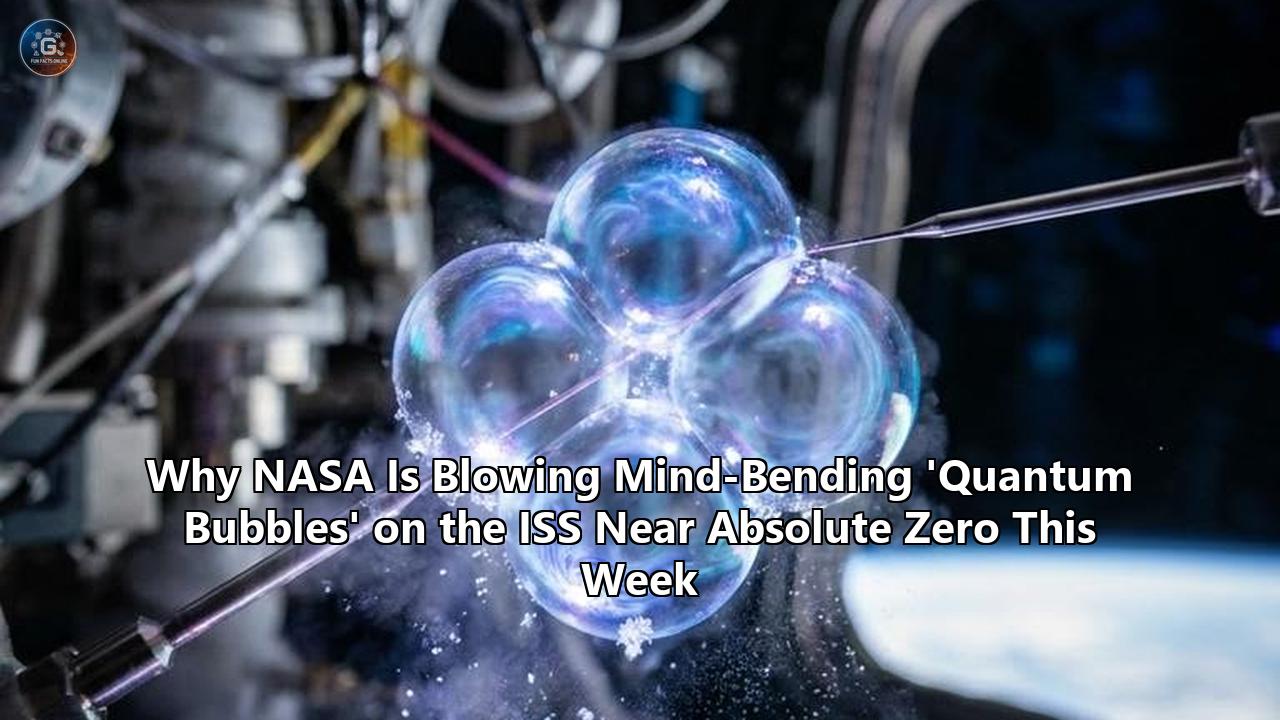
A massive scientific hardware activation on the International Space Station (ISS) has established low Earth orbit as the absolute frontier of quantum research. On June 23, 2026, NASA officially announced that its newly upgraded Cold Atom Lab (CAL) had successfully resumed full operations after a series of critical on-orbit installations. This milestone marks the start of a series of experiments designed to generate "quantum bubbles"—hollow, ultra-thin shells of matter cooled to within a fraction of a degree above absolute zero.
The latest operational phase relies on a sequence of upgrades delivered to the station on April 11, 2026, aboard Northrop Grumman’s CRS-24 Cygnus XL resupply mission. Following installation by NASA astronaut Jessica Meir on May 8, 2026, and weeks of calibration, the facility is now executing experiments that yield Bose-Einstein Condensates (BECs) up to five times larger than those produced by prior hardware iterations. By utilizing a redesigned magnetic trap to manipulate these clouds of matter, researchers are probing physical phenomena that cannot be replicated in any terrestrial laboratory.
This data-driven initiative aims to map the properties of quantum matter when confined to curved, three-dimensional manifolds. Operating at picokelvin-scale temperatures—orders of magnitude colder than the average temperature of deep space—the facility is yielding critical quantitative insights into the behavior of superfluids, quantum vortices, and the transition from three-dimensional to quasi-two-dimensional quantum systems.
The Coldest Spot in the Universe Gets a 5x Upgrade
To understand why the Cold Atom Lab is unique, one must examine its thermal parameters. The instrument is designed to cool atomic gases to less than one-tenth of a billionth of a degree Kelvin above absolute zero (approximately $100 \text{ pK}$ to $52 \text{ pK}$, or $-459.67^\circ\text{F}$). For comparison, the average temperature of the cosmic microwave background in deep space is $2.73 \text{ K}$ ($-454.76^\circ\text{F}$), making the interior of this mini-fridge-sized instrument on the ISS roughly $50$ billion times colder than natural space vacuum.
Under these extreme conditions, the thermal de Broglie wavelength of the atoms expands to macroscopic scales. Instead of behaving like billiard balls colliding with one another, the atoms overlap and merge into a single, coherent quantum wavepacket—a Bose-Einstein Condensate, first observed on Earth in 1995.
The primary constraint of terrestrial BEC experiments is gravity. On Earth, a gravitational force of $1 \text{ g}$ causes the atom cloud to fall to the bottom of the vacuum chamber within a fraction of a second, terminating the experiment before precise measurements can be taken. To counter this, Earth-based scientists use magnetic or optical traps to hold the atoms in place, but these strong fields distort the quantum state and introduce thermal perturbations.
Terrestrial Lab vs. Low Earth Orbit Quantum Environments

Terrestrial Lab (1-g)
[ Atoms dropped rapidly ] ---> Observation time: ~0.1 to 0.5 seconds
                                  Deformation: High (Gravity pools atoms)
                                  Minimum Temperature: ~10-100 nK

ISS Cold Atom Lab (Microgravity)
[ Atoms float freely ]     ---> Observation time: Up to 10 seconds
                                  Deformation: Near-Zero (Perfect symmetry)
                                  Minimum Temperature: ~52 pK (SM-3X Module)
In the microgravity environment of the ISS, which provides a residual acceleration of approximately $10^{-6} \text{ g}$, the atoms can be released from their traps and observed floating freely for up to 10 seconds. This prolonged observation time allows the system to reach much lower temperatures through adiabatic expansion, where the physical boundaries of the trap are slowly pulled back, dropping the average atomic velocity to less than $100 \ \mu\text{m/s}$.
The June 2026 activation of the Science Module-3X (SM-3X) and the Heater/Electromagnet eXperiment Module 1 (HXM-1) has substantially expanded these operational limits. The SM-3X module:
- Generates condensates with up to 5 times the total atom count of prior iterations.
- Features a redesigned, mesoscopic chip-trap that yields a highly homogeneous magnetic potential.
- Enhances the loading efficiency of Rubidium-87 ($^{87}\text{Rb}$) and Potassium-41 ($^{41}\text{K}$) gas clouds.
- Mitigates unwanted magnetic field fluctuations down to micro-Gauss levels, shielding the delicate atoms from the high electromagnetic noise of the space station.
By scaling the volume and density of the BECs by a factor of five, the team at NASA's Jet Propulsion Laboratory (JPL) can now inflate quantum bubbles to much larger dimensions, enabling higher-resolution optical imaging and more prolonged structural studies.
Decelerating Atoms from 750°F to 52 Picokelvins
The thermodynamic path required to produce these ultra-cold states is highly non-linear, beginning with intense heat and ending in unprecedented cold.
The process is initiated by heating solid metallic strips of Rubidium-87 and Potassium-41 inside the CAL science module’s vacuum chamber to temperatures as high as $750^\circ\text{F}$ ($400^\circ\text{C}$). At this temperature, the metals vaporize, producing a dilute gas with high thermal kinetic energy. The atoms in this vapor travel at speeds of several hundred meters per second, characterized by a highly chaotic Maxwell-Boltzmann velocity distribution.
   [ Vaporization ] ---------> [ Laser Cooling ] ---------> [ Magnetic Trapping ] ---------> [ Evaporative Cooling ] ---------> [ BEC / Bubble ]
     Temp: ~750°F                Temp: ~100 µK                Temp: ~1 µK                     Temp: ~52 pK                 Shape: 3D Shell
     Speed: ~400 m/s             Speed: ~10 cm/s              Speed: ~1 cm/s                  Speed: <100 µm/s             Diameter: ~100 µm
To slow these high-velocity atoms, the Cold Atom Lab uses a multi-stage cooling protocol:
1. Magneto-Optical Trapping (MOT)
Three orthogonal pairs of counter-propagating laser beams, tuned slightly below the atomic transition frequency (red-detuned), intersect at the center of a magnetic quadrupole field. When an atom moves toward one of the laser beams, the Doppler effect shifts the laser light into resonance with the atomic transition. The atom absorbs a photon, receiving a momentum kick in the direction opposite to its motion.
The atom then re-emits a photon in a random direction. Over thousands of absorption-emission cycles, this "optical molasses" drains the kinetic energy from the atoms, cooling the gas from $750^\circ\text{F}$ down to approximately $100 \ \mu\text{K}$ (one-ten-thousandth of a degree above absolute zero) within a few seconds.
2. Magnetic Capture and Transport
Once the atoms are slowed to a near-standstill, the lasers are turned off, and a magnetic trap generated by the system's micro-engineered atom chip captures the cloud. The chip generates strong magnetic field gradients that interact with the magnetic dipole moments of the atoms, pinning them in place.
The trapped gas is then magnetically transported from the high-pressure collection region to an ultra-high vacuum (UHV) science chamber, where pressures are maintained below $10^{-11} \text{ Torr}$ to prevent collisions with background gas molecules.
3. Forced Evaporative Cooling
To pass the threshold of quantum degeneracy, the hottest remaining atoms must be selectively removed. This is achieved using a radiofrequency (RF) "knife". By applying a precisely tuned RF field, the spins of the most energetic atoms at the outer edges of the trap are flipped, causing them to escape.
The remaining, colder atoms re-thermalize through elastic collisions, lowering the overall temperature of the cloud. On Earth, gravity limits how weak this trap can be made during evaporation, as the atoms will simply fall out of the bottom if the trapping potential is lowered too far.
In low Earth orbit, however, the trap can be relaxed to extremely shallow levels. This allows for a final stage of cooling known as "delta-kick cooling," where a brief pulse of the magnetic trap acting as a collimating lens stops the expansion of the cloud, yielding temperatures as low as $52 \text{ pK}$.
The Mechanics of Quantum Bubble Inflation in LEO
With the activation of the SM-3X module, the primary focus of NASA’s five selected flight investigation teams is the generation and stabilization of hollow, shell-shaped Bose-Einstein Condensates. The creation of these shell potentials is a major experimental milestone, enabling the first real-world tests of quantum many-body systems on curved, closed manifolds.
On Earth, inflating a quantum bubble is physically impossible due to gravitational asymmetry. If scientists attempt to generate a spherical, shell-shaped trapping potential on Earth, the gravitational force pulls the ultracold atoms downward, causing them to pool entirely at the bottom of the shell. The resulting shape is not a bubble, but rather an asymmetrical, bowl-like droplet where $95\%$ of the atomic density is concentrated at the lowest point.
Terrestrial 1-g Environment           Microgravity ISS Environment
         .---------.                           .---------.
        /   ___     \                         /   ___     \
       |   /   \     |                       |   /   \     |
       |  |  *  |    |                       |  |  *  |    |  <-- Uniform Shell
       |   \___/     |                       |   \___/     |      (No pooling)
        \  (   )    /                         \         /
         '--uuu----'                           '-------'
            |||
      Gravity pools atoms
      at bottom (95% asymmetry)
In low Earth orbit, the lack of a dominant gravitational vector allows the atoms to distribute evenly across the surface of the shell. This allows researchers to conduct NASA quantum bubbles ISS experiments at scales and geometries previously restricted to mathematical models.
Radiofrequency Dressing of Species
To construct these hollow structures, the Cold Atom Lab employs a technique known as "radiofrequency (RF) dressing". The process begins with a standard, spherically symmetric magnetic trap that holds a dense, solid core of $^{87}\text{Rb}$ atoms at the center of the chip-trap.
An RF field is then introduced to couple the different Zeeman sub-levels of the atomic ground state. This coupling generates a deformed potential energy surface, where the energy minimum is no longer at the center of the trap, but rather on an ellipsoid shell where the local magnetic field is resonant with the applied RF frequency:
$$\hbar \omega_{\text{RF}} = g_F \mu_B B(\mathbf{r})$$
Where:
- $\hbar$ is the reduced Planck constant.
- $\omega_{\text{RF}}$ is the frequency of the radiofrequency field.
- $g_F$ is the Landé g-factor of the atomic state.
- $\mu_B$ is the Bohr magneton.
- $B(\mathbf{r})$ is the spatially varying magnetic field of the trap.
By sweeping the frequency of the RF field outward, the radius of this resonant shell increases, "inflating" the solid core of atoms into a hollow, spherical bubble.
The optical density profiles of these expanding bubbles, captured via high-resolution absorption imaging, demonstrate the highly uniform distribution of atoms across the shell’s surface. In past runs, these bubbles reached diameters of approximately $100 \ \mu\text{m}$ to $200 \ \mu\text{m}$, with a shell thickness of just a few micrometers.
With the SM-3X's five-fold increase in atom count, scientists can now inflate these bubbles to larger diameters ($>500 \ \mu\text{m}$) or thin the shell out further, driving the system into a true two-dimensional quantum state.
Atomic Density Profile Across the Bubble Radius (r)

Solid Core (Initial BEC State)             RF-Dressed Shell (Inflated State)
        Density (n)                                Density (n)
           ^                                               ^
           |     /\                                        |     /\      /\
           |    /  \                                       |    /  \    /  \
           |   /    \                                      |   /    \  /    \
           |  /      \                                     |  /      \/      \
           +------------> Radius (r)                       +--------------> Radius (r)
               r = 0 (Center)                                 -r_0      0      r_0
                                                            (Outer boundaries of shell)
The physical transition from a three-dimensional "thick" shell to a quasi-two-dimensional "thin" bubble is of profound scientific interest. On a curved 2D manifold, the behavior of quantum superfluids changes fundamentally.
For instance, the Berezinskii-Kosterlitz-Thouless (BKT) phase transition, which governs the pairing of topological defects (vortices) in 2D systems, can be studied without the edge effects that typically plague flat, terrestrial 2D traps.
Hardware Engineering on the ISS: Inside the SM-3X and HXM-1 Modules
The physical constraints of operating a precision quantum physics laboratory on a space station traveling at $17,500 \text{ mph}$ ($28,000 \text{ km/h}$) are extraordinary. The ISS is a highly dynamic environment, subject to structural vibrations from crew exercise, life-support pumps, solar array tracking motors, and thruster firings. Furthermore, the station’s orbit traverses the South Atlantic Anomaly, exposing electronics to high ionizing radiation, while the onboard power grid is subject to voltage fluctuations.
To protect the delicate quantum states, the Cold Atom Lab was engineered as a self-contained, highly isolated facility. The entire system is packed into a "quad-locker" and a "single locker" configuration, fitting inside an EXPRESS (Expedite the Processing of Experiments to Space Station) rack in the Destiny laboratory module.
+------------------------------------------------------------+
|                CAL EXPRESS Rack Configuration             |
+-----------------------------+------------------------------+
|        Quad Locker          |        Single Locker         |
|  +-----------------------+  |  +------------------------+  |
|  |    Science Module     |  |  |  Laser Subsystem       |  |
|  |  (Vacuum Chamber, UHV) |  |  |  (Fiber-Optic Coupled) |  |
|  +-----------------------+  |  +------------------------+  |
|  |  SM-3X / HXM-1 Upgrades|  |  |  Controller / Power    |  |
|  |  (Redesigned Trap/Amps)|  |  |  (Liquid Heat Exch.)   |  |
|  +-----------------------+  |  +------------------------+  |
+-----------------------------+------------------------------+
The Science Module-3X (SM-3X)
The core of the April 2026 upgrade is the SM-3X module, which replaces the older Science Module 3 (SM-3). The primary engineering modifications include:
- Micro-Engineered Atom Chip: The new chip features an array of sub-millimeter copper wires deposited onto a silicon substrate. By routing currents through these wires, the chip can generate localized magnetic field gradients of up to $1000 \text{ G/cm}$ with microsecond response times, allowing for rapid manipulation of the gas clouds.
- Redesigned Metal Atom Sources: These upgraded vapor dispensers utilize a highly stable heating element to release precise, repeatable quantities of $^{87}\text{Rb}$ and $^{41}\text{K}$ atoms into the chamber. This design minimizes the deposition of background metallic films on the chamber's optical windows, ensuring long-term optical transmission and extending the operational lifespan of the instrument.
- Mesoscopic Chip-Trap Geometry: The physical layout of the magnetic coils has been optimized to eliminate spatial anomalies. This guarantees that when the quantum bubble is inflated, the shell thickness is uniform to within $\pm 2\%$ across its entire $360$-degree surface.
The Heater/Electromagnet eXperiment Module 1 (HXM-1)
To support the enhanced magnetic trapping and RF dressing capabilities of the SM-3X, engineers also integrated the HXM-1 module. The HXM-1 provides:
- High-Precision Power Electronics: The module delivers low-noise, high-current pulses to the atom chip and external magnetic coils. Current stability is maintained to within 1 part in $10^6$, which is critical for preventing magnetic noise from dephasing the spin states of the atoms.
- Active Thermal Management: The high currents required to generate the trapping fields produce substantial waste heat. The HXM-1 coordinates with the space station’s internal liquid-loop cooling system, using water-cooled cold plates to keep the temperatures of the magnetic amplifiers stable to within $\pm 0.1^\circ\text{C}$. This level of thermal regulation prevents drift in the magnetic fields during prolonged experimental runs.
- Ultra-High Magnetic Shielding: The physics package is wrapped in a multi-layer Mu-Metal shield that provides greater than $55 \text{ dB}$ of attenuation against external magnetic fields. This shield isolates the atoms from the geomagnetic field of Earth, which oscillates as the ISS orbits at $7.66 \ \text{km/s}$, as well as the local electromagnetic fields of the station's electrical subsystems.
Quantitative Milestones and the Path to Quantum 2.0
The successful deployment of the SM-3X and HXM-1 modules marks the fourth major upgrade of the Cold Atom Lab since its launch in May 2018. Over its eight-year operational history, the facility has compiled an impressive array of quantitative achievements:
- $100,000+$ Completed Runs: The lab has executed over $100,000$ individual experimental sequences, controlled entirely by researchers on Earth via JPL's operations center in Pasadena, California.
- 5 Supported Research Teams: The facility currently hosts five international, PI-led consortia, including three Nobel laureates, who compete for daily experimental time slices.
- $100 \ \mu\text{m}$ Coherence Scales: The lab has demonstrated matter-wave interferometry where the wavefunctions of single atoms are split and separated by macroscopic distances ($>40 \ \mu\text{m}$), then recombined to produce high-contrast quantum interference fringes.
- 52 Picokelvin Cold Record: Through delta-kick cooling, the facility has achieved some of the lowest kinetic temperatures ever recorded in the universe, matching or exceeding any terrestrial drop-tower or elevator facility.
Cold Atom Lab Operational Milestones (2018 - 2026)

Year   Phase/Upgrade   Core Scientific Goal                 BEC Volume Scale
-----------------------------------------------------------------------------
2018   Launch (SM-1)   First orbital BEC production         1.0x (Baseline)
2020   Upgrade (SM-2)  First dual-species condensates       1.5x
2022   Upgrade (SM-3)  First observation of quantum bubbles 2.0x
2026   Upgrade (SM-3X) Quantum 2.0, Large-scale 3D shells   5.0x
This sustained operational cadence has allowed the facility to transition from "Quantum 1.0" technologies—which rely on the passive observation of quantum mechanics (such as standard semiconductor transistors, lasers, and GPS clocks)—to "Quantum 2.0," which involves the direct, active manipulation of coherent, macroscopic quantum states.
By demonstrating that complex quantum architectures can operate reliably in orbit for years, NASA is laying the groundwork for a suite of highly sensitive space-based sensors.
Precision Physics on Curved Manifolds: The Science of Curved Superfluids
To appreciate the physical mechanics of these hollow structures, it is helpful to look at the unique geometry of the trap.
A standard, ground-based Bose-Einstein Condensate is a three-dimensional, ellipsoidal cloud. Its physics is governed by the standard Gross-Pitaevskii equation, which describes the behavior of a weakly interacting Bose gas using a mean-field approximation:
$$i\hbar \frac{\partial \psi(\mathbf{r}, t)}{\partial t} = \left[ -\frac{\hbar^2}{2m} \nabla^2 + V_{\text{ext}}(\mathbf{r}) + g |\psi(\mathbf{r}, t)|^2 \right] \psi(\mathbf{r}, t)$$
Where:
- $\psi(\mathbf{r}, t)$ is the macroscopic wavefunction of the condensate.
- $V_{\text{ext}}(\mathbf{r})$ is the trapping potential.
- $g = \frac{4\pi\hbar^2 a}{m}$ is the interaction strength, governed by the s-wave scattering length $a$.
When the trapping potential $V_{\text{ext}}(\mathbf{r})$ is transitioned into an RF-dressed shell, the geometry forces the wavefunction to deform into a hollow spherical manifold $S^2$. This deformation introduces topological and thermodynamic changes to the system:
1. Topological Defect Dynamics (Vortices)
In a solid, rotating 3D condensate, quantum vortices (quantized whirlpools of superfluid) align parallel to the rotation axis, forming a uniform triangular lattice (an Abrikosov lattice).
However, when a superfluid is confined to a hollow sphere, the vortices are constrained to the surface of the shell. Because a sphere has a non-zero Euler characteristic ($\chi = 2$), the Poincaré-Hopf theorem dictates that the vector field of the superfluid flow must contain singularities.
Essentially, you cannot comb the hair on a billiard ball without creating a cowlick. This topological constraint guarantees that there must be at least two quantized vortices on any rotating quantum bubble, regardless of the rotation speed.
Superfluid Vortex Alignment: Flat 3D vs. Curved 2D Shell

Flat 3D Condensate (Abrikosov Lattice)        Curved 2D Shell (Topological Constraints)
        +-------------------+                       .-----------------.
        |   |   |   |   |   |                      /   *             \
        |   v   v   v   v   v   |                     /    |  (Vortex 1)  \
        |   |   |   |   |   |   |                    |     v               |
        |   v   v   v   v   v   |                    |                     |
        |   |   |   |   |   |   |                    |     ^               |
        +-------------------+                     \    |  (Vortex 2)  /
        (Vortices align parallel                    \  *             /
         to the rotation axis)                       '-----------------'
                                                  (Poincaré-Hopf Theorem forces
                                                   at least two surface vortices)
The SM-3X upgrade is designed to let researchers observe these surface vortices for the first time. By utilizing the redesigned magnetic trap to spin the bubble, they can measure how these vortices interact, migrate, and pair up on a curved surface, providing a physical system to validate theories of topological phase transitions on non-Euclidean spaces.
2. The 3D-to-2D Dimensionality Crossover
When the shell thickness $d$ of the bubble is compressed so that it is smaller than the healing length of the superfluid ($\xi = \frac{1}{\sqrt{8\pi n a}}$), the system undergoes a dimensional crossover. The degrees of freedom perpendicular to the shell's surface are frozen out, leaving only the two angular coordinates on the sphere:
$$\xi \gg d$$
In this regime, the thermodynamics of the gas are completely rewritten. The standard 3D Bose-Einstein condensation transition temperature $T_c$, which is governed by the 3D density $n_{3D}$, is replaced by the Berezinskii-Kosterlitz-Thouless (BKT) transition temperature $T_{\text{BKT}}$:
$$T_{\text{BKT}} \approx \frac{\pi \hbar^2 n_s}{2 m k_B}$$
Where $n_s$ is the superfluid phase density.
By adjusting the RF dressing parameters to systematically thin the bubble wall, researchers are mapping this dimensional crossover with high quantitative accuracy, tracking how the phase coherence of the wavepacket changes as it is squeezed into two dimensions.
Dual-Species Interferometry and the Universality of Free Fall
While the study of single-species quantum bubbles of Rubidium-87 ($^{87}\text{Rb}$) is a core goal, the Cold Atom Lab’s ability to work with dual-species mixtures—combining $^{87}\text{Rb}$ and Potassium-41 ($^{41}\text{K}$)—opens up other research paths.
Dual-Species Core-Shell Phase Separation

         Potassium-41 Core (Smaller, repulsive interactions)
               |
               v
             (---)
            ((---))
           (((---)))
          ((((---))))
         ||||||||||||| <--- Rubidium-87 Outer Shell
         |||||||||||||      (Forms naturally via inter-species repulsion)
By tuning the interaction strength between these two species using Feshbach resonances, researchers can induce phase separation. The $^{41}\text{K}$ atoms can be compressed into a tight, solid core at the center, while the $^{87}\text{Rb}$ atoms are pushed outward to form a shell, creating a self-assembling quantum bubble that does not require an RF-dressing field.
This "mixture approach" yields a highly stable, low-noise shell structure, as it bypasses the thermal heating associated with continuous RF coupling.
Beyond bubble physics, these dual-species mixtures are utilized in atom interferometry. Atom interferometers use lasers as beam splitters, mirrors, and recombiners to manipulate the wavefunctions of atoms.
By splitting the wavepacket of an atom so that it exists in a spatial superposition—simultaneously traversing two different paths—and then recombining it, scientists can measure external forces with high sensitivity.
$$\Delta \Phi = \mathbf{k}_{\text{eff}} \cdot \mathbf{a} \cdot T^2$$
Where:
- $\Delta \Phi$ is the phase shift between the two paths.
- $\mathbf{k}_{\text{eff}}$ is the effective wavevector of the laser pulses.
- $\mathbf{a}$ is the acceleration experienced by the atoms (such as gravity).
- $T$ is the interrogation time (the time between laser pulses).
Because the phase shift scales quadratically with the interrogation time ($T^2$), the $10$-second free-fall times achievable in the ISS microgravity environment allow for an improvement in sensitivity compared to Earth-based interferometers.
Using both $^{87}\text{Rb}$ and $^{41}\text{K}$ in a dual-species interferometer, the research teams are conducting tests of the Universality of Free Fall (UFF), a cornerstone of Einstein’s General Theory of Relativity.
The UFF states that in a uniform gravitational field, all objects accelerate at the exact same rate, regardless of their mass or composition. By simultaneously dropping wavepackets of Rubidium and Potassium in microgravity and comparing their accelerations via interferometry, the team can measure the Eötvös parameter $\eta$:
$$\eta = 2 \cdot \frac{a_{\text{Rb}} - a_{\text{K}}}{a_{\text{Rb}} + a_{\text{K}}}$$
Any non-zero value of $\eta$ would signal a violation of the Equivalence Principle, pointing to new physics beyond the Standard Model, such as the existence of a fifth force or light dark matter fields.
The SM-3X upgrade, with its improved current stability and magnetic field homogeneity, is designed to push the measurement of $\eta$ in space to new bounds.
Technical Specifications: Comparing CAL Upgrades
To understand the progress made with this latest mission, we can look at the technical specifications of the Cold Atom Lab's science modules over time:
| Parameter | SM-1 (2018 Launch) | SM-2 (2020 Upgrade) | SM-3 (2022 Upgrade) | SM-3X (2026 Upgrade) |
|---|---|---|---|---|
| Typical BEC Atom Count ($^{87}\text{Rb}$) | $1 \times 10^4$ | $3 \times 10^4$ | $5 \times 10^4$ | $2.5 \times 10^5$ |
| Minimum Temperature Achieved | $100 \text{ nK}$ | $1 \text{ nK}$ | $250 \text{ pK}$ | $52 \text{ pK}$ |
| Coherent Observation Time | $1.1 \text{ s}$ | $2.5 \text{ s}$ | $5.0 \text{ s}$ | $10.0 \text{ s}$ |
| Magnetic Field Homogeneity | $\pm 15 \ \mu\text{G}$ | $\pm 5 \ \mu\text{G}$ | $\pm 2 \ \mu\text{G}$ | $\pm 0.5 \ \mu\text{G}$ |
| Available Species | $^{87}\text{Rb}$ | $^{87}\text{Rb}$, $^{39}\text{K}$ | $^{87}\text{Rb}$, $^{41}\text{K}$ | $^{87}\text{Rb}$, $^{41}\text{K}$ |
| Primary Structural Geometry | Point Cloud | 1D Wire Trap | Ellipsoidal Shell | 3D Spherical Shell / Thin Bubble |
The five-fold increase in the Rubidium-87 atom count ($2.5 \times 10^5$ atoms) in the SM-3X module is a key driver for the bubble inflation experiments.
In prior modules, attempting to inflate a bubble to a diameter of $200 \ \mu\text{m}$ spread the atoms so thin that the signal-to-noise ratio of the absorption imaging became too low for precise measurements.
With the SM-3X, the high atomic density allows for the inflation of much larger bubbles while maintaining clear optical depth profiles, allowing researchers to study the bubble dynamics in high resolution.
The Aerospace Supply Chain: From Cape Canaveral to the ISS
The physical journey of the SM-3X and HXM-1 hardware from Earth to the low Earth orbit laboratory required precise logistical execution. Because the hardware is sensitive to static charges, mechanical shock, and moisture, the assembly and transport process was tightly managed:
1. Assembly and Ground Testing (JPL, Pasadena, CA)
The modules were designed, built, and tested at NASA's Jet Propulsion Laboratory. Ground testing required simulating the thermal and mechanical environments of space using shake tables and thermal vacuum (TVAC) chambers.
Because the quantum sensors must operate in extreme vacuum, the SM-3X's internal physics package was baked at high temperatures for weeks to outgas any residual volatile compounds, achieving a vacuum pressure of $<10^{-11} \text{ Torr}$.
2. The Launch (April 11, 2026)
The hardware was packed into custom transport cases and integrated into the cargo bay of Northrop Grumman's Cygnus XL spacecraft (S.S. Steven R. Nagel).
The spacecraft launched atop a SpaceX Falcon 9 rocket from Space Launch Complex 40 (SLC-40) at Cape Canaveral Space Force Station in Florida. The Falcon 9 booster (B1094-7) performed a successful landing at Landing Zone 1 (LZ-1) seven minutes after liftoff, while Cygnus was injected into a transfer orbit.
Launch Statistics (NG-24 Cygnus XL)

Launch Mass: ~11,000 lbs (4,990 kg) total cargo
Cygnus XL Volume Capacity: 33% increase over standard Cygnus
Docking Date: April 13, 2026 (via Canadarm2 capture)
Primary Scientific Payloads: SM-3X & HXM-1 modules, Stem Cell Expansion hardware,
                             Gut Microbiome experiments
3. Installation and Calibration (May 8, 2026)
After docking, the cargo was transferred to the ISS. Due to the delicate nature of the fiber-optic lines and electrical connectors, the installation of the SM-3X and HXM-1 required astronaut Jessica Meir to wear an augmented reality (AR) headset.
The AR headset projected real-time, 3D step-by-step assembly schematics over the physical EXPRESS rack, ensuring that the optical fibers—which are sensitive to bending down to millimeter scales—were routed without inducing stress or signal loss.
   [ April 11: Launch ] ---> [ April 13: Docking ] ---> [ May 8: Installation ] ---> [ Mid-June: Calibration ] ---> [ Late June: First Bubbles ]
     Falcon 9 Rocket           Canadarm2 Capture         Astronaut J. Meir          Remote commands from JPL       High-density shell BECs
Following physical installation, JPL engineers spent several weeks running automated remote calibration scripts, tuning the laser diode frequencies, adjusting the magnetic trap alignments, and verifying that the internal vacuum had recovered from any vibration-induced outgassing. This culminated in the full activation of the system this week.
The Broader Landscape of Space-Based Quantum Sensing
The upgrades to the Cold Atom Lab are part of a broader, global effort to mature quantum technologies for orbit. Multiple space agencies are investing in space-based quantum systems, recognizing that Low Earth Orbit offers a unique testing ground.
For example, China's Space Cold Atom Clock (SCAC), which launched aboard the Tiangong-2 space laboratory in 2016, demonstrated continuous, cold-atom-referenced clock operations in orbit for nearly three years.
Additionally, the European Space Agency (ESA) is developing the STE-QUEST (Space-Time Explorer and Quantum Equivalence Principle Space Test) mission concept, which aims to place an optical lattice clock and dual-species atom interferometer in an eccentric Earth orbit to test General Relativity with high precision.
In the private sector, companies are partnering with space agencies to explore the commercial potential of quantum hardware. The deployment of high-precision atom interferometers in low Earth orbit could support several dual-use applications:
1. Relativistic Geodesy and Climate Monitoring
By deploying a network of space-based quantum gravity sensors (gravimeters), scientists can map the gravitational field of Earth with high spatial and temporal resolution.
These sensors can detect tiny mass redistributions caused by the movement of underground aquifers, the melting of polar ice sheets, and changes in ocean currents, providing high-precision data for climate change modeling.
Geodetic Mapping via Space-Based Quantum Interferometry

             [ Spacecraft in LEO ]
                      ||
       Laser Beam     || (Senses tiny gravitational anomalies)
                      \/
    ~~~~~~~~~~~~~~~~~~~~~~~~~~~~~~~~~~ (Earth's Surface)
             [ Water Table Shift ]
             [ Glacial Mass Loss ]
2. GPS-Free Navigation and Timing
For deep-space exploration missions, such as crewed voyages to Mars, standard GPS navigation is unavailable. Space-based quantum inertial sensors (gyroscopes and accelerometers) can provide drift-free, autonomous navigation by tracking the spacecraft's acceleration and rotation relative to the quantum properties of trapped atoms.
Additionally, space-qualified optical atomic clocks, which have achieved stability levels of $10^{-18}$ (resolving a drift of just one second every $30$ billion years), can provide highly synchronized timing networks for deep-space communications and global positioning networks.
3. Dark Matter and Fundamental Physics Probes
Many theoretical models of dark matter suggest that it consists of ultralight, scalar fields that couple to standard matter. This coupling would manifest as tiny, time-varying oscillations in fundamental constants, such as the fine-structure constant $\alpha$ or the electron mass $m_e$.
By comparing the frequencies of different optical atomic clocks or tracking the phase shift in an atom interferometer on the ISS, researchers can hunt for these high-frequency oscillations, mapping dark matter domains that are shielded by the atmosphere or seismic noise of Earth.
Future Milestones: What to Watch Next
As the Cold Atom Lab enters this upgraded operational phase, the scientific community is tracking several upcoming milestones and unresolved questions:
- Observation of Vortex Pairing: Will the Rubidium-87 quantum bubbles exhibit the predicted Berezinskii-Kosterlitz-Thouless (BKT) transition on a curved surface? Researchers will be watching the absorption images for the appearance of paired, counter-rotating vortex cores as the temperature is lowered toward $52 \text{ pK}$.
- Transition to Quasi-2D Shells: How thin can the bubble wall be made before the shell stability collapses? The SM-3X's five-fold increase in atom count will allow researchers to push the shell potential to its thinnest limits, testing the boundary of the 3D-to-2D dimensional crossover.
- Long-Term Hardware Survivability: NG-24 is scheduled to be the final hardware resupply mission for the Cold Atom Lab. With the SM-3X representing its ultimate hardware peak, the system’s longevity in the radiation environment of LEO will determine the total volume of science that can be extracted before the ISS's planned decommissioning in 2030.
- First Quantum Test Mass Flight Data: Can the dual-species $^{87}\text{Rb}$ and $^{41}\text{K}$ mixtures be stabilized to act as a single, cohesive quantum test mass that does not expand in free-fall? Resolving this would allow for even longer interrogation times in future orbital interferometers, paving the way for next-generation gravity mappers.
The successful activation of the SM-3X and HXM-1 modules this week has converted the International Space Station into an active hub for Quantum 2.0 research. By blowing high-density quantum bubbles near absolute zero, NASA is not only validating advanced physics models on curved manifolds, but is also flight-testing the technologies that will navigate, time, and map the future of human exploration across the solar system.
Reference:
- https://www.sciencedaily.com/releases/2026/06/260622091507.htm
- https://www.nasa.gov/missions/station/iss-research/cold-atom-laboratory/nasas-quantum-lab-aboard-space-station-gets-chilly-upgrade/
- https://www.iqo.uni-hannover.de/arbeitsgruppen/theory-of-quantum-sensors/forschungsprojekte/quantum-gases-in-microgravity-and-space-3
- https://evrimagaci.org/gpt/cygnus-xl-launches-supplies-and-science-to-iss-537510
- https://www.nasa.gov/missions/station/iss-research/cold-atom-laboratory/nasas-quantum-lab-aboard-space-station-gets-chilly-upgrade/
- https://pasaulionaujoves.lt/tarptautines-kosmines-stoties-astronautai-aktyvavo-atnaujinta-cold-atom-lab/
- https://www.sciencedaily.com/releases/2026/06/260622091507.htm
- https://science.nasa.gov/wp-content/uploads/2023/05/154_db3e171ebe8989ee9497cc550c75454c_LundbladNathan.pdf
- https://www.space.com/ultracold-bubbles-on-space-station
- https://arxiv.org/html/2305.13285v2
- https://english.tachyonbeam.com/2026/04/11/the-northrop-grumman-cygnus-spacecraft-blasted-off-for-its-ng-24-mission-for-nasa/
- https://issnationallab.org/iss360/nasas-cold-atom-laboratory-a-new-iss-facility-for-studying-quantum-phenomena/
- https://www.jpl.nasa.gov/missions/cold-atom-laboratory-cal/
- https://www.researchgate.net/publication/370949652_NASA's_Cold_Atom_Laboratory_Four_Years_of_Quantum_Science_Operations_in_Space
- https://science.nasa.gov/biological-physical/cold-atom-lab-upgrade-studies-dark-matter-quantum-physics/
- https://assets.science.nasa.gov/content/dam/science/cds/science-enabling-technology/events/2025/quantum-day/2_SMD_Quantum_Day_Cold_Atom_Lab.pdf
- https://www.basenor.com/blogs/news/spacex-launches-ng-24-cygnus-to-iss-whats-on-board
- https://sciencesprings.wordpress.com/
- https://www.jpl.nasa.gov/missions/cold-atom-laboratory-cal/
- https://www.patsnap.com/de/resources/blog/articles/optical-atomic-clock-technology-landscape-2026/
- https://issnationallab.org/spotlight/april-2026/
- https://svs.gsfc.nasa.gov/31389/
- https://science.nasa.gov/biological-physical/cold-atom-lab-upgrade-studies-dark-matter-quantum-physics/