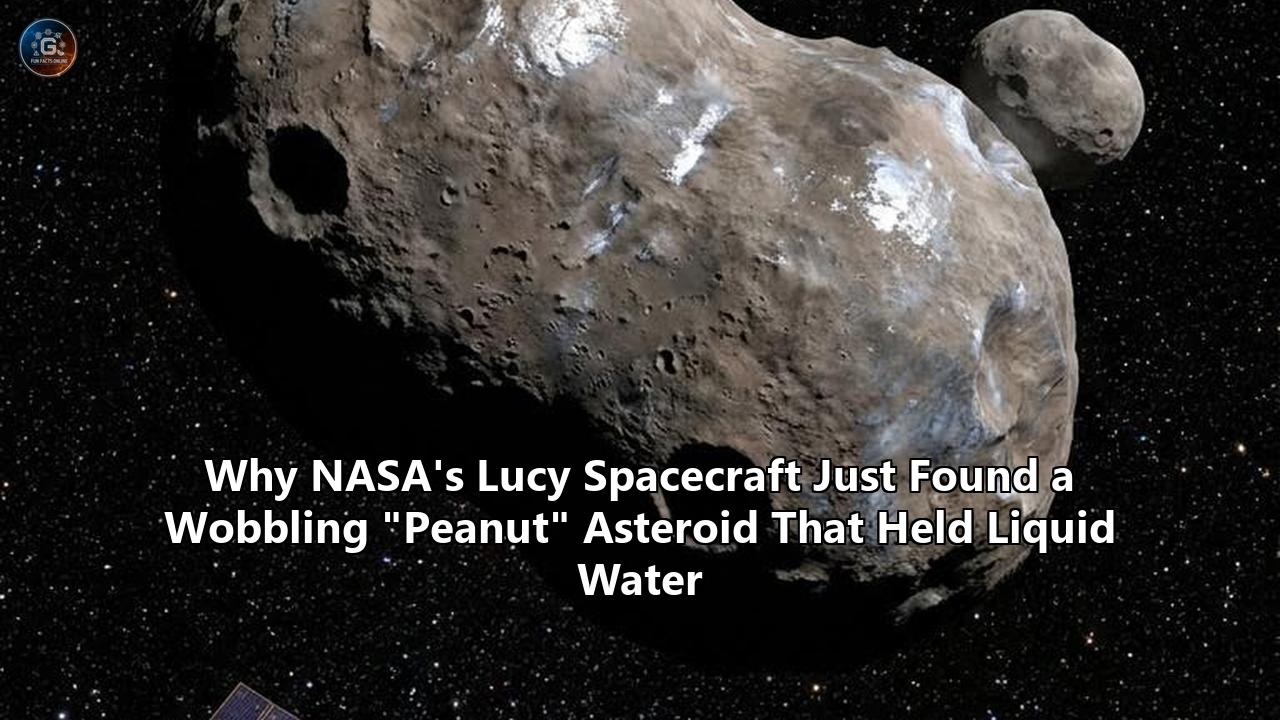
On June 18, 2026, a team of researchers led by the Southwest Research Institute (SwRI) published a study in the journal Science that transformed our understanding of how small bodies in our solar system age, move, and interact with volatiles. Titled “The Lucy flyby of (52246) Donaldjohanson: A bilobed asteroid with tumbling rotation,” the paper laid out the complex history of a relatively small, carbonaceous main-belt asteroid that NASA’s Lucy spacecraft encountered on April 20, 2025.
The findings are a masterclass in cosmic forensics. Using high-resolution imaging and infrared spectroscopy collected from just 600 miles (960 kilometers) away, scientists revealed that Donaldjohanson is not a static, inert lump of rock. Instead, it is a wobbling, peanut-shaped contact binary that experienced brief but significant exposure to liquid water in its distant past, and is currently undergoing a slow-motion geological self-resurfacing that is erasing its own history.
This discovery provides a valuable case study. By examining Donaldjohanson through this lens, we can extract critical principles of planetary evolution, orbital dynamics, and volatile delivery. The NASA Lucy mission asteroid campaign has demonstrated that even the briefest flyby of an seemingly minor target can challenge established models of solar system history and reshape how we plan deep-space exploration.
1. Comparing the Nomads and the Homesteader: Donaldjohanson vs. Bennu and Ryugu
To grasp the scientific value of Donaldjohanson, we must first place it in context with other carbon-rich (C-type) asteroids that have been studied up close. In recent years, near-Earth asteroids Bennu and Ryugu served as the primary archetypes for primitive, carbonaceous space rocks, visited by NASA’s OSIRIS-REx and JAXA’s Hayabusa2 missions respectively. However, Bennu and Ryugu are "nomads." They are ancient bodies—estimated to have formed between 1 and 2 billion years ago—that long ago migrated out of the main asteroid belt and into orbits that cross Earth’s path. Because they now orbit much closer to the Sun, they have been subjected to intense solar heating, tidal stresses, and cosmic radiation that have altered their pristine outer layers.
Donaldjohanson, affectionately referred to as "DJ" by the mission team, is a "homesteader". At approximately 155 million years old, it is a youngster in astronomical terms. Crucially, it has remained in its birthplace: the cold, relatively protected environment of the inner main asteroid belt.
| Characteristic | Donaldjohanson (DJ) | Bennu / Ryugu |
|---|---|---|
| Location | Inner Main Asteroid Belt | Near-Earth Orbit |
| Estimated Age | ~155 million years | 1 to 2 billion years |
| Water Alteration | Brief, iron-rich clays | Prolonged, magnesium-rich clays |
| Rotational State | Tumbling (two-axis rotation) | Principal axis (single-axis rotation) |
| Structure | Contact binary (bilobed "peanut") | Spinning top / Rubble pile |
This disparity in age and orbital history yields a core lesson: not all primitive carbonaceous asteroids are created equal. By remaining in the main belt, Donaldjohanson preserves a snapshot of carbonaceous material that has not been baked by close solar proximity or disrupted by near-Earth gravitational encounters. It allows scientists to compare a relatively pristine main-belt resident with its more evolved, wandering near-Earth cousins, revealing how the location of an asteroid drastically dictates its physical and chemical evolution over hundreds of millions of years.
2. The Chemistry of Fleeting Hydration: Iron-Rich Clays
One of the most remarkable discoveries made during the April 2025 flyby was the detection of iron-rich clay minerals, specifically iron-bearing phyllosilicates, on Donaldjohanson's surface. Clay minerals do not form in a vacuum; they require the presence of liquid water. When water flows through dry silicate rocks, it chemically alters the minerals, hydrating them and forming clays. The detection of these phyllosilicates by Lucy's infrared spectrometer provides the first direct evidence that Donaldjohanson's progenitor parent body once held liquid water.
However, the specific chemistry of these clays tells a story of a brief, transient hydrothermal event rather than a long-lived oceanic epoch. On Bennu and Ryugu, the clay minerals are heavily enriched with magnesium. In planetary chemistry, when liquid water is present inside a porous asteroid for prolonged periods—potentially lasting millions of years—the iron initially present in the clays is gradually replaced by magnesium through sustained water-rock chemical reactions.
The iron-bearing phyllosilicates on Donaldjohanson, which closely match those found in rare, carbon-rich meteorites like QUE 97990, indicate that the water exposure on its parent body was exceptionally brief.
[Dry Rock + Ice]
       │
       ▼ (Internal Heating via Al-26 decay)
[Melting Ice / Liquid Water Flowing]
       │
       ▼ (Rapid cooling / freezing / impact disruption)
[Iron-bearing Clays Formed & Preserved] <─── Donaldjohanson's state
       │
       ▼ (Sustained liquid water over millions of years)
[Magnesium-bearing Clays Formed]        <─── Bennu / Ryugu's state
This chemical fingerprint reveals that water distribution and heat-driven hydrothermal processes in the early solar system were highly heterogeneous. While some massive parent asteroids sustained warm, liquid interiors for eons, others experienced only fleeting, localized melting events before freezing solid or being shattered by collisions. Donaldjohanson acts as a rare preservation of this initial, short-lived phase of solar system hydration.
3. The Physics of the Tumbling Wobble: Non-Principal Axis Rotation
Most major planets and large asteroids rotate in a highly predictable, steady manner around a single, stable axis—known as the principal axis of maximum inertia. Donaldjohanson does not. The SwRI-led analysis revealed that the asteroid's rotation is an irregular, wobbly tumble. It turns end-over-end once every 10.5 Earth days (approximately 252 hours) while simultaneously wobbling around its horizontal axis once every 26.5 Earth days.
This state is known as non-principal axis (NPA) rotation. To understand how an asteroid ends up in a perpetual tumble, scientists point to two primary mechanisms:
- Catastrophic Impact: The violent collision that shattered Donaldjohanson's parent body 155 million years ago would have imparted massive, chaotic torque on the newly formed fragment, setting it spinning wildly on multiple axes.
- The YORP Effect: The Yarkovsky-O'Keefe-Radzievskii-Paddack (YORP) effect is a subtle, continuous force driven by solar radiation. When sunlight hits an asymmetrical asteroid, the surface absorbs the energy and re-radiates it as heat. Because of the asteroid's irregular shape, this thermal radiation is emitted unevenly, acting like tiny, whispering rocket thrusters. Over millions of years, the YORP effect can slow down or speed up an asteroid's spin, eventually destabilizing its rotation and inducing a wobbly tumble.
                Sunlight (Incoming Radiation)
                      │
                      ▼
             ┌────────────────┐
             │  Asymmetrical  │
             │   Asteroid     │
             └────────────────┘
               /            \
              /              \
    Thermal Radiation     Thermal Radiation
    (Weak Force Left)     (Stronger Force Right)
              \              /
               ▼            ▼
             [Net Rotational Torque (YORP)] ───► Induces Tumbling / Wobbling
Under normal circumstances, internal physical friction within an asteroid gradually dampens this wobbling motion. As the asteroid flexes and deforms under the changing rotational stresses, kinetic energy is dissipated as heat, eventually forcing the body to settle into a stable, single-axis spin.
The fact that Donaldjohanson is still actively tumbling after 155 million years is a highly revealing data point. It suggests two possibilities: either the asteroid's internal structural composition is highly rigid and low-friction, preventing the rapid dissipation of rotational energy, or the YORP effect is continually driving the tumble, keeping the asteroid in a perpetual state of dynamic instability.
4. The Coalescence of a Contact Binary: Building the "Peanut"
When the first raw images from the NASA Lucy mission asteroid flyby began streaming back to Earth, they defied pre-encounter mathematical models. Ground-based lightcurve observations and NEOWISE infrared surveys had estimated Donaldjohanson to be a roughly spherical or slightly elongated object with a diameter of about 3.9 kilometers. The close-up images from Lucy’s Long-Range Reconnaissance Imager (L'LORRI) revealed a far more dramatic reality: an elongated, dumbbell-shaped contact binary measuring 8 kilometers (5 miles) in length and 3.5 kilometers (2.2 miles) at its widest point.
       Heavily Cratered                      Heavily Cratered
            Lobe                                   Lobe
        ┌──────────┐                           ┌──────────┐
     ──►│          │◄─────────────────────────►│          │◄──
        │          │      Smooth, Narrow       │          │
        └──────────┘           Neck            └──────────┘
             │             ┌──────────┐             │
             └────────────►│          │◄────────────┘
                           └──────────┘
The contact binary shape resembles a peanut or "two nesting ice cream cones," consisting of two distinct, heavily cratered lobes joined together by a narrow, cylindrical neck. This morphology is a testament to the constructive power of low-velocity collisions.
Contact binaries do not form from a single, eroding block of stone. Instead, they are born in the aftermath of a catastrophic smash-up. When a parent asteroid is shattered by a high-energy impact, it ejects a cloud of rocky debris into nearby orbits. Over time, these fragments drift close to one another. If two large fragments approach each other at high speeds, they will shatter each other upon impact. However, if their relative velocities are exceptionally low—on the order of a few meters per second—they will undergo a gentle, gravitational merger.
Rather than destroying each other, the two blocks make soft contact, welding together under their combined, weak gravitational fields to form a single, bilobed entity. Donaldjohanson represents a pristine example of this gentle re-accumulation process, proving that collisional families are characterized by immediate, localized construction even in the wake of massive destruction.
5. Geologic Resurfacing: The Mystery of the Missing Craters
When planetary scientists examine the surface of an airless body like an asteroid, they use impact craters as a geological clock. Because space is filled with micrometeoroids and small debris, an asteroid's surface is constantly bombarded over millions of years. By counting the density and size distribution of these craters, researchers can estimate how long a particular surface has been exposed to the harsh vacuum of space.
During the flyby, scientists noted a striking geological paradox on Donaldjohanson. While the two outer lobes are heavily scarred with large craters, the asteroid exhibits an almost complete lack of small craters measuring less than 400 meters (1,310 feet) in diameter. Under standard impact models, smaller craters should be incredibly abundant, outnumbering larger craters by orders of magnitude. Their absence points to an active, ongoing geologic process that is systematically erasing them.
                     [Micrometeoroid Impact]
                               │
                               ▼ (Seismic Shaking)
                 ┌───────────────────────────┐
                 │ Loose Regolith Mobilized  │
                 └───────────────────────────┘
                               │
                               ▼ (Gravity-driven flow)
                 ┌───────────────────────────┐
                 │ Downslope Mass Movement   │
                 └───────────────────────────┘
                               │
            ┌──────────────────┴──────────────────┐
            ▼                                     ▼
 [Small Craters Filled In]              [Neck Region Smoothed]
This self-cleaning mechanism is driven by a combination of the asteroid's wobbly rotation, its irregular gravity field, and seismic shaking. Because Donaldjohanson is a contact binary, its gravitational field is highly complex and non-uniform, with gravitational potential wells sloping sharply toward the narrow neck connecting the two lobes.
Every time a larger object strikes the asteroid, it sends seismic shockwaves rippling through the loose, gravelly soil (regolith) covering the surface. Because of Donaldjohanson’s wobbly, two-axis rotation and asymmetric gravity, this shaking causes the loose regolith to act like a fluid. Dust, gravel, and boulders slide downslope, migrating away from the high points of the lobes and pooling in the gravitational low of the neck.
This downslope mass wasting fills in and erases any small, shallow craters that have formed, while simultaneously coating the neck region in a thick, remarkably smooth blanket of fine debris. It shows that even in the microgravity environment of a small asteroid, gravity-driven mass wasting is a powerful force capable of dynamically altering a world’s appearance over geologically short timescales.
6. Collisional Family Archaeology: Reconstructing the Erigone Parent Body
Donaldjohanson does not orbit in isolation. Dynamic tracking of its orbital trajectory confirms that it belongs to the Erigone collisional family—a sprawling collection of roughly 2,000 space rocks located in the inner main asteroid belt. By tracing the orbits of these family members backward in time, astronomers determined that they all originated from a single, massive parent asteroid that was completely shattered in a catastrophic collision approximately 155 million years ago.
The Lucy flyby has allowed scientists to perform a detailed "forensic autopsy" on this vanished parent body. By studying Donaldjohanson up close, researchers can infer the physical and chemical characteristics of the ancestral asteroid from which it was carved.
- Shattering a Wet Ancestor: The discovery of iron-rich clays on Donaldjohanson proves that the Erigone parent body was rich in carbon and water ice, and experienced brief internal heating that melted the ice into liquid water.
- The Impact Event: The preservation of both the delicate contact binary shape and the unstable tumbling rotation suggests that Donaldjohanson was ejected from the collision site as a collection of slow-moving fragments that coalesced shortly after the blast.
- Dating the Family: By counting the larger, preserved craters on the stable lobes of Donaldjohanson, scientists were able to confirm the age of the Erigone family at 155 million years, verifying the orbital backtracking calculations with direct physical evidence.
This forensic reconstruction demonstrates the immense value of target-rich missions. By visiting a single, well-chosen representative of an asteroid family, we can unlock the history of thousands of related bodies, turning a brief flyby into a sweeping exploration of an entire cosmic lineage.
7. Operational Rehearsal: The Engineering Value of Lucy’s Flight Path
While the scientific return from the Donaldjohanson flyby has been immense, the encounter was originally conceived as an operational "dress rehearsal". NASA’s Lucy spacecraft, which launched in October 2021, is on an unprecedented 12-year journey to explore the Jupiter Trojan asteroids. These two massive swarms of ancient space rocks orbit the Sun in stable gravitational pockets—the L4 and L5 Lagrange points—that lead and trail Jupiter in its orbit.
Because no spacecraft has ever visited the Trojans, the engineering challenges of navigating, tracking, and imaging these incredibly dark, distant targets are immense. The flyby of Donaldjohanson in the main belt served as a critical test run for Lucy's sophisticated suite of instruments:
- Terminal Tracking Cameras (T2CAM): Because Lucy passes its targets at high relative speeds (about 13.4 kilometers per second for Donaldjohanson), the spacecraft cannot rely on pre-programmed commands to point its cameras. Instead, it uses T2CAM to autonomously lock onto the asteroid, adjust its orientation in real-time, and keep the target centered in the fields of view of its scientific instruments.
- L’LORRI (Lucy Long Range Reconnaissance Imager): The mission’s high-resolution, black-and-white visible camera was tested to ensure it could resolve fine surface features under challenging lighting conditions. L'LORRI successfully captured details as small as 50 meters from a distance of over 600 miles.
- L’Ralph (Infrared Spectrometer / LEISA): This instrument was pushed to its limits to detect the incredibly faint absorption features of hydrated clay minerals, proving that its sensitive detectors could map composition across an asteroid’s surface even at extreme flyby velocities.
                             [Target Locked by T2CAM]
                                        │
                                        ▼ (Real-time pointing correction)
       ┌────────────────────────────────┴────────────────────────────────┐
       ▼                                ▼                                ▼
[L'LORRI Captures Image]    [L'Ralph Maps Composition]       [L'TES Measures Heat]
The flawless performance of these systems during the April 2025 pass has given mission controllers complete confidence as Lucy barrels toward its primary objectives in the Jovian system. The operational lesson here is profound: deep-space engineering rehearsals should be treated not as idle tests, but as high-yield scientific opportunities. By designing calibration targets that are scientifically compelling in their own right, space agencies can maximize the scientific dividend of every ounce of propellant burned.
8. Tracing the Water Pipeline: How Asteroids Hydrated Earth
The discovery of water-altered clays on a young main-belt asteroid like Donaldjohanson feeds directly into one of the most fundamental questions in planetary science: Where did Earth’s water come from?
During the formation of the inner solar system, the region where Earth resides was far too hot for water ice to condense. The young Earth likely formed dry and barren. Most models suggest that Earth's vast oceans were delivered later by a rain of volatile-rich asteroids and comets hailing from the colder, outer regions of the solar system beyond the "snow line".
               [Early Solar System Formation]
                             │
            ┌────────────────┴────────────────┐
            ▼                                 ▼
      [Inner Zone]                      [Outer Zone]
    (Hot, Dry, Rocky)                 (Cold, Volatile-Rich)
   - Early Earth forms             - Carbonaceous Asteroids (C-type)
                                   - Water-ice reservoirs
                                              │
                                              ▼ (Gravitational scattering)
                                   [Main Asteroid Belt Established]
                                              │
                                              ▼ (Collisional fragmentation / migration)
                                   [Water delivered to early Earth]
Carbonaceous (C-type) asteroids in the main belt are considered the most likely candidates for this water delivery system. By showing that Donaldjohanson contains iron-rich clays, the NASA Lucy mission asteroid data provides a direct physical link in this cosmic supply chain.
Because Donaldjohanson belongs to the Erigone family, it represents a massive reservoir of water-bearing material that has remained relatively undisturbed since the dawn of the solar system. By analyzing the hydrogen isotopes preserved in these clays, scientists can determine if the water trapped inside these main-belt homesteaders matches the chemical signature of the water in Earth’s oceans, potentially confirming that the shattering of carbonaceous parent bodies 155 million years ago is part of a continuous process of volatile transport that has been feeding planetary atmospheres for billions of years.
9. Preparing for the Trojan Swarms: A Preview of the "Fossils"
As the Lucy spacecraft continues its long cruise toward its first primary target—the Trojan asteroid (3548) Eurybates, which it will encounter in August 2027—the data from Donaldjohanson is being used to rewrite the scientific expectations for what lies ahead.
                                  [Lucy Spacecraft Path]
                                            │
                                            ├─► April 2025: Donaldjohanson (Main Belt)
                                            │
                                            ├─► August 2027: Eurybates (L4 Trojan)
                                            │
                                            └─► 2033: Patroclus-Menoetius (L5 Trojan)
The Trojan asteroids are considered the ultimate "fossils" of planet formation—pristine remnants of the primordial disk of gas and dust that swarmed around the Sun 4.5 billion years ago. Because they have been trapped in their orbits near Jupiter for eons, they are expected to preserve the raw, unaltered building blocks of the giant planets.
Donaldjohanson shares key similarities with Eurybates. Both are carbonaceous, C-type asteroids, and both are members of collisional families. Eurybates is the only known Trojan asteroid that belongs to a major disruptional collisional family.
The discoveries at Donaldjohanson have given scientists a predictive toolkit for what they might find at Eurybates:
- Widespread Binary Systems: If a young, 155-million-year-old main-belt asteroid can easily form a stable contact binary like Donaldjohanson, then the ancient, highly populated Trojan swarms are likely teeming with contact binaries, binary moonlets, and complex gravitational pairings.
- Athermal Resurfacing: The mechanism of seismic shaking and regolith migration that smoothed Donaldjohanson’s neck and erased its small craters is highly likely to be active on the Trojans. Scientists now expect to see highly smoothed terrains and a deficit of small craters on any Trojan contact binaries they encounter.
- Fleeting Hydrothermal Signatures: The detection of iron-rich clays on Donaldjohanson shows that water-rock alteration can be brief and highly localized. When Lucy analyzes the surfaces of the Trojans, scientists will look specifically for iron-bearing phyllosilicates, which would suggest that these outer solar system bodies also experienced brief, transient heating events early in their history.
10. The Structural Integrity of Low-Gravity Rubble Piles
From a mechanical perspective, Donaldjohanson represents a extreme physical regime. It is not a solid block of granite; rather, it is a self-gravitating "rubble pile". This means it is a loose collection of shattered rocks, gravel, and dust held together only by the incredibly weak gravitational pull of its own mass.
When a rubble pile is subjected to the complex, non-principal axis rotation seen in Donaldjohanson, the physical stresses on its structure are immense. As the asteroid tumbles end-over-end, centrifugal forces continuously change in direction and magnitude across its 8-kilometer length.
At the tips of the two lobes, the centrifugal force acts to pull the material away from the center of mass, opposing the weak gravity. At the narrow neck connecting the lobes, shear stresses and compressive forces are constantly shifting as the object wobbles.
                     <- Centrifugal Force (Pulls Outward)
                      ┌──────────┐
                   ◄──│   Lobe   │
                      └──────────┘
                           │  ◄── Compressive & Shear Stresses at Neck
                      ┌──────────┐
                      │   Neck   │
                      └──────────┘
                           │  ◄── Compressive & Shear Stresses at Neck
                      ┌──────────┐
                   ◄──│   Lobe   │
                      └──────────┘
                     <- Centrifugal Force (Pulls Outward)
This structural dynamic raises a provocative question: Why doesn’t the peanut fly apart?
The answer lies in the physics of granular cohesion and electrostatic forces. In a low-gravity environment, the physical friction between jagged, interlocking boulders can provide surprisingly high structural strength.
Additionally, fine-grained dust particles on the surface carry electric charges from constant exposure to solar UV radiation and cosmic rays. These electrostatic forces cause the fine dust to cling together, acting like a weak cement that binds the larger boulders together.
Donaldjohanson is therefore a vital natural laboratory. By analyzing its shape and rotation, researchers can calculate the precise balance of gravity, centrifugal force, physical friction, and electrostatic cohesion required to keep a wobbly contact binary intact.
These calculations are not just academic exercises; they are vital for future planetary defense missions. If humanity ever needs to deflect a contact binary or rubble-pile asteroid, understanding its internal cohesion and structural limits is the difference between successfully nudging the rock or accidentally shattering it into a cloud of even more dangerous fragments.
11. What to Watch for Next in the Deep-Space Fossil Hunt
The publication of the Donaldjohanson findings in Science marks the end of Lucy's preliminary main-belt exploration phase, but it is only the beginning of a much larger scientific narrative. As the spacecraft hurtles toward its date with Eurybates in August 2027, the planetary science community is preparing for a flood of new data.
                                  [Lucy's Target Timeline]
                                             │
                       ├─► April 20, 2025: Donaldjohanson (Complete)
                       │
                       ├─► August 12, 2027: (3548) Eurybates & Queta
                       │
                       ├─► September 15, 2027: (15094) Polymele & Shaun
                       │
                       ├─► April 18, 2028: (11351) Leucus
                       │
                       ├─► November 11, 2028: (21900) Orus
                       │
                       └─► March 2, 2033: (617) Patroclus & Menoetius
There are several unresolved questions and upcoming milestones that will determine the final legacy of Donaldjohanson's discovery:
- Is the Neck Region Active? Some scientists hypothesize that the neck of Donaldjohanson could still be actively collecting fine dust, functioning as a "dust trap" that slowly accumulates material over time. Continued ground-based photometric observations of the asteroid's lightcurve will search for subtle changes in its brightness that could indicate ongoing dust lofting or surface changes.
- Searching for Volatile Reservoirs: While the surface of Donaldjohanson shows only hydrated clays, the interior of the asteroid could still harbor reservoirs of water ice protected from solar heating by the thick layer of insulating regolith. Thermal modeling based on the Lucy data will estimate the depth at which ice could remain stable over 150 million years.
- Deepening the Contrast with Bennu and Ryugu: As researchers continue to analyze the returned physical samples from Bennu and Ryugu in terrestrial laboratories, they will compare those physical chemical structures directly with the remote sensing data from Donaldjohanson, further refining our chemical models of the early solar system.
NASA’s Lucy mission has demonstrated that the distinction between a "test run" and a "primary target" is largely artificial. By treating every encounter as a high-stakes scientific opportunity, the mission team has turned an engineering calibration flyby into a transformative moment in planetary science. The wobbly, peanut-shaped survivor of a 155-million-year-old cosmic collision has shown us that water was present, dynamic, and fleeting in the early solar system, leaving behind a trail of iron-rich breadcrumbs that scientists are now eagerly following into the deep dark of the Jovian Trojans.
Reference:
- https://www.swri.org/newsroom/press-releases/swri-led-lucy-mission-reveals-wobbling-peanut-asteroid
- https://www.reddit.com/r/InterstellarKinetics/comments/1u9pza9/study_nasas_lucy_mission_has_discovered_evidence/
- https://gizmodo.com/nasa-flyby-reveals-violent-origin-of-weird-peanut-shaped-asteroid-2000773647
- https://mypregnancychoices.org/article/nasa-s-lucy-unveils-peanut-shaped-asteroid-s-wobbly-secrets
- https://science.nasa.gov/missions/nasas-lucy-reveals-wobbling-peanut-shaped-asteroid/
- https://en.wikipedia.org/wiki/52246_Donaldjohanson
- https://www.iflscience.com/nasas-lucy-mission-finds-evidence-of-ancient-water-on-asteroid-donaldjohanson-83848
- https://www.dlr.de/en/latest/news/2025/lucy-spacecraft-to-fly-by-asteroid-donaldjohanson-this-easter
- https://www.swri.org/newsroom/technology-today/lucy-encounters-asteroid-donaldjohanson
- https://grokipedia.com/page/52246_Donaldjohanson
- https://science.nasa.gov/mission/lucy/
- https://www.youtube.com/watch?v=qLtgrQvcQOA
- https://www.nasa.gov/missions/first-scientific-instrument-installed-on-nasas-lucy-spacecraft/
- https://pmc.ncbi.nlm.nih.gov/articles/PMC12226690/
- https://www.swri.org/newsroom/technology-today/diamonds-the-sky
- https://www.eoportal.org/satellite-missions/lucy
- https://www.lockheedmartin.com/en-us/products/lucy.html