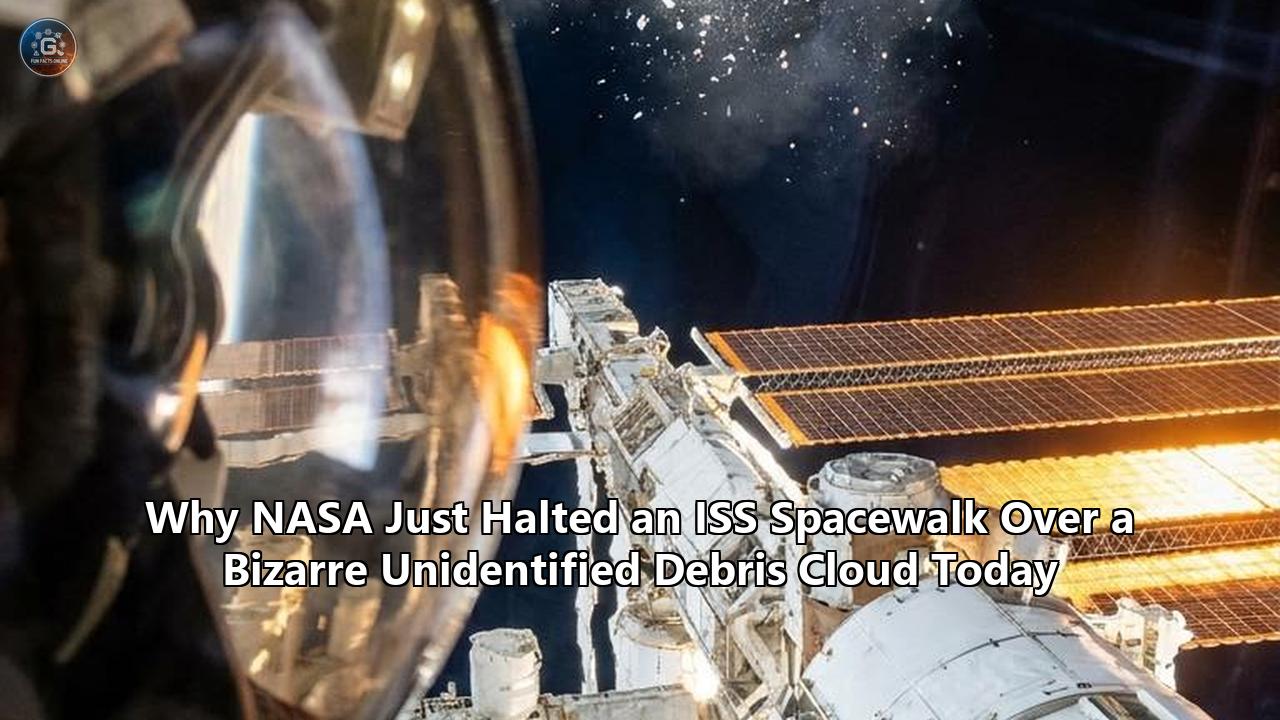
At 8:14 a.m. Eastern Time, just as the International Space Station’s Quest airlock pressure dropped below 5 psi, Houston Mission Control issued an immediate "abort and repressurize" command. The two astronauts inside, fully sealed within their Extravehicular Mobility Units (EMUs) and hours into their nitrogen-purging pre-breathe protocol, were forced to stand down.
The cause was not a spacesuit malfunction, a cooling loop failure, or a sudden degradation of station hardware. Instead, the abrupt halt was triggered by the U.S. Space Surveillance Network (SSN), which detected an anomalous and entirely unidentified debris cloud intersecting the orbital track of the International Space Station.
Having a NASA ISS spacewalk cancelled at the last possible minute is a rare and operationally expensive event, but the circumstances surrounding today’s scrub are entirely unprecedented. Space Command did not alert NASA to a known defunct satellite, a spent rocket booster, or debris from a previous anti-satellite (ASAT) weapon test. The radar telemetry painted a picture of a dense, highly localized cluster of shrapnel that appeared to have materialized overnight, possessing orbital characteristics that defy the standard models of satellite fragmentation.
To understand why this specific debris cloud forced Mission Control’s hand—and why the aerospace defense community is quietly scrambling—requires looking past the official press releases and diving into the intricate, high-stakes mechanics of space domain awareness, orbital risk management, and the terrifying realities of hypervelocity impacts.
Inside the "Pizza Box": The Mathematics of an Abort
When the public hears about space debris, they often picture a crowded, chaotic highway. In reality, low Earth orbit (LEO) is a vast volume of space where collisions are statistically rare but catastrophically energetic. To manage this risk, NASA and the U.S. Space Force operate within strict geometric and mathematical boundaries.
The primary mechanism for ISS safety is a conceptual volume of space surrounding the station, colloquially known in Mission Control as the "pizza box." This imaginary safety zone extends approximately 2.5 miles (4 kilometers) vertically and 30 miles (50 kilometers) horizontally in both cross-track and along-track directions. Whenever a tracked object is projected to enter this box, the Trajectory Operations Officer (TOPO) at NASA’s Johnson Space Center begins a rigorous Conjunction Assessment (CA).
For everyday operations, the threshold for executing a Debris Avoidance Maneuver (DAM)—firing the station's thrusters or docked spacecraft engines to alter the ISS trajectory—is a Probability of Collision (Pc) greater than 1 in 10,000. However, the calculus changes drastically when a spacewalk is on the schedule.
Astronauts conducting Extravehicular Activity (EVA) are the ultimate soft targets. Therefore, the risk threshold for an EVA is tightened by an entire order of magnitude to a 1 in 100,000 probability of collision. If a piece of debris threatens to break that threshold, the EVA is scrubbed.
Today, the telemetry relayed from the 18th Space Defense Squadron at Vandenberg Space Force Base indicated that a newly detected cluster of debris was not just threatening the pizza box, but was projected to drift through the immediate vicinity of the ISS orbit with a Pc exceeding 1 in 10,000. Under normal conditions, this would trigger a standard DAM. But because the cloud was completely uncatalogued, newly formed, and rapidly diffusing, the exact trajectory of individual fragments could not be resolved in time to calculate a safe avoidance burn.
NASA was trapped in an orbital blind spot. Moving the station might inadvertently steer it into a denser pocket of the unidentified cloud. The only viable option was to halt the spacewalk, command the crew to shelter, and wait for the radar data to clarify the threat.
Anatomy of an Anomalous Debris Cloud
What makes today’s incident deeply alarming for orbital analysts is the physical nature of the debris cloud itself. Space fragments are relentlessly tracked by a global network of phased-array radars—most notably the Space Fence facility on Kwajalein Atoll in the Marshall Islands, which can detect objects as small as a marble.
When a satellite or spent upper stage breaks apart, it leaves a distinct forensic signature. Analysts can examine the altitude, inclination, and velocity of the fragments to reverse-engineer the event. An explosion caused by unvented rocket propellant creates a specific dispersion pattern, pushing fragments forward and backward along the orbital track. A kinetic impact, such as two satellites colliding or a deliberate ASAT missile strike, creates a much wider, chaotic scatter, throwing debris into entirely new orbital planes.
The debris cloud detected today fits neither profile.
Initial radar cross-section data suggests a highly concentrated "swarm" of extremely small, metallic fragments orbiting at roughly 410 kilometers in altitude, matching the station's 51.6-degree inclination. The lack of a known progenitor object—meaning no registered satellite or rocket body was tracked at that location prior to the fragmentation—points to several unsettling possibilities.
First, it could be the spontaneous, energetic disassembly of an uncatalogued "dark" object. Nations occasionally deploy classified payloads with minimal radar cross-sections. If such a classified microsatellite experienced a catastrophic battery failure or propulsion system rupture, it would generate a sudden, unexplained cloud of shrapnel.
Second, analysts are considering the possibility of an anomalous shedding event from an undisclosed materials experiment. Some advanced thermal coatings or experimental shielding materials, if subjected to rapid thermal cycling or atomic oxygen degradation, could delaminate and violently shed away in a cloud of high-density flakes.
Third, and perhaps most concerning to the Space Surveillance Network, is the possibility of a "secondary cascade." If an untrackable piece of micro-debris struck an already defunct, unmapped piece of hardware at orbital velocities, the resulting collision would spawn hundreds of new fragments. The fact that this cloud appeared essentially out of nowhere, right in the orbital path of the ISS, highlights a terrifying vulnerability in global Space Domain Awareness (SDA).
The Lethal Physics of Extravehicular Activity
To understand the severity of having a NASA ISS spacewalk cancelled for debris, one must understand the absolute vulnerability of an astronaut outside the protective hull of the space station.
The International Space Station itself is wrapped in specialized armor. The habitable modules are encased in Stuffed Whipple shields—a multi-layered defense system designed specifically to defeat micrometeoroids and orbital debris (MMOD). When a piece of debris strikes the station’s outer bumper shield (usually a thin sheet of aluminum) at hypervelocity, the immense kinetic energy causes the projectile to vaporize into a cloud of plasma and molten gas. This plasma cloud then hits subsequent layers of Kevlar and Nextel ceramic cloth, which absorb the shock before it can breach the inner pressure shell.
An astronaut’s Extravehicular Mobility Unit (EMU) does not have this luxury.
Spacesuits are marvels of engineering, functioning as personalized, human-shaped spacecraft. The outermost layer of the suit, the Thermal Micrometeoroid Garment (TMG), is designed to protect against extreme temperature swings and minor impacts. It consists of an outer layer of Ortho-Fabric (a blend of Gore-Tex, Kevlar, and Nomex), multiple layers of aluminized Mylar for thermal insulation, and an inner layer of neoprene-coated nylon.
However, this fabric cannot defeat a direct strike from a solid piece of debris moving at 17,500 miles per hour (roughly 7.8 kilometers per second). At these hypervelocities, kinetic energy scales with the square of the velocity. A piece of aluminum no larger than a grain of rice hits with the explosive force of a high-caliber sniper round.
If a fragment from today’s unidentified debris cloud had struck a spacewalking astronaut, the results would have been immediate and catastrophic. A puncture to the EMU would instantly trigger a depressurization event. While the suit’s Primary Life Support System (PLSS) has a high-flow oxygen purge valve designed to maintain pressure for a short time following a minor leak, it cannot compensate for a structural tear caused by a hypervelocity strike. Furthermore, a strike to the suit’s liquid cooling and ventilation garment (LCVG) would cause the cooling water to instantly boil into the vacuum of space, blinding the astronaut with vapor and rapidly overheating the suit's electronics.
NASA’s strict adherence to the 1-in-100,000 threshold is born of this unforgiving physics. In the vacuum of low Earth orbit, there are no minor injuries.
The Psychological and Operational Cost of a Scrub
Behind the closed doors of Mission Control, halting an EVA is not a simple matter of hitting a pause button. The operational toll on the crew, the station, and the mission timeline is immense.
Preparing for a spacewalk requires months of underwater choreography in the Neutral Buoyancy Laboratory (NBL) in Houston, followed by weeks of on-orbit tool gathering, suit sizing, and systems checks. On the day of the EVA, the astronauts undergo a grueling biological preparation phase. Because the EMU spacesuits operate at a low pressure (roughly 4.3 psi) to allow for joint mobility, astronauts must purge the nitrogen from their bloodstreams to prevent decompression sickness (the bends). This requires breathing pure oxygen for hours before the hatch is opened, often utilizing the station's exercise equipment to accelerate the metabolic off-gassing of nitrogen.
When the abort call came down today, the crew had already endured this exhaustive pre-breathe protocol. They were physically locked inside the suits, isolated in the Quest airlock, mentally prepared for six to seven hours of high-risk external construction. Reversing this process involves a slow, deliberate repressurization of the airlock, disconnecting umbilicals, and carefully doffing the heavy EMUs—a deeply frustrating and physically exhausting process that leaves the crew fatigued.
Operationally, having this NASA ISS spacewalk cancelled creates a massive scheduling bottleneck. The ISS operates on a master timeline orchestrated down to the minute. Today’s EVA was designed to accomplish critical maintenance, likely involving the ongoing upgrades to the station’s power grid or external cooling systems. Delaying these tasks forces flight planners to rewrite the master schedule, pushing back subsequent EVAs, interfering with visiting vehicle arrivals (such as incoming SpaceX Cargo Dragons or Roscosmos Progress ships), and disrupting hundreds of hours of scheduled microgravity science experiments inside the U.S. Destiny laboratory.
NASA cannot simply try again tomorrow. The spacewalking crew must rest, the EMU suits must undergo turnaround maintenance, and most importantly, the Space Surveillance Network must fully map the new debris cloud to ensure the orbital environment is safe. It could be weeks before the crew is cleared to open the hatch again.
Geopolitics and the "Dark Object" Dilemma
While NASA focuses on the immediate safety of the crew, the broader aerospace defense community is focused on the origin of the anomalous cloud. This incident casts a harsh light on a growing geopolitical friction point in low Earth orbit: the proliferation of uncatalogued payloads and the limitations of global space traffic management.
Under the United Nations Convention on International Liability for Damage Caused by Space Objects, a launching state is absolutely liable to pay compensation for damage caused by its space object on the surface of the Earth or to aircraft, and liable for damage in space if they are at fault. However, determining fault requires attribution, and attribution requires accurate tracking from launch to orbit.
In recent years, the orbital domain has become increasingly congested, not just with commercial megaconstellations like SpaceX’s Starlink, but with classified military payloads from the United States, China, and Russia. These nations frequently launch experimental satellites, some of which are designed with proximity operations in mind—the ability to approach, inspect, or potentially interfere with other orbital assets.
When a registered satellite breaks apart, the SSN can immediately identify the owner, and diplomatic channels are utilized to assess the risk. For instance, when Russia intentionally destroyed its defunct Cosmos 1408 satellite with a direct-ascent ASAT missile in 2021, generating thousands of pieces of trackable debris, the U.S. State Department and NASA issued immediate, targeted condemnations.
But what happens when an unknown object fragments? If today's debris cloud originated from a highly classified reconnaissance satellite that suffered a catastrophic failure, the operating nation has every incentive to remain silent, leaving NASA and the rest of the international space community to manage the fallout blindly.
This creates a dangerous void in space domain awareness. Without knowing the exact material composition of the debris (e.g., dense titanium vs. lightweight carbon composite), trajectory analysts struggle to predict how atmospheric drag will affect the cloud over time. Dense metallic fragments will maintain their orbit longer, posing a persistent threat to the ISS, while lightweight fragments will succumb to atmospheric drag and burn up more rapidly. Until the Department of Defense can identify the source object, TOPO engineers must model the absolute worst-case scenarios, effectively paralyzing external ISS operations.
The Looming Shadow of Kessler Syndrome
Today’s event is a stark reminder of the fragile state of low Earth orbit as the ISS nears its planned decommissioning in 2030. The station is currently flying through the most congested orbital environment in human history, and the margins for error are shrinking daily.
Aerospace engineers often discuss the theoretical threshold of the Kessler Syndrome—a scenario proposed by NASA scientist Donald Kessler in 1978, in which the density of objects in LEO becomes high enough that collisions between objects cause a cascade. Each collision generates shrapnel that in turn creates further collisions, eventually rendering specific orbital bands entirely unusable.
We are not yet at a runaway Kessler cascade, but the sudden appearance of today's unidentified debris cloud acts as a localized micro-cascade. It demonstrates how quickly the environment can degrade from "safe for spacewalks" to "immediate abort" without any prior warning.
The International Space Station, at the size of a football field, is the largest target in orbit. While it has limited maneuverability via the Zvezda service module thrusters or docked cargo ships, these maneuvers require hours of warning to calculate the exact delta-v (change in velocity) needed to safely alter the trajectory without throwing off the station's delicate center of gravity or missing future rendezvous windows.
If a debris cloud appears with zero warning, maneuvering is impossible. The only defense is the station's physical shielding and the emergency safe-haven protocols. During extreme close-approach events, the crew is ordered to seal the hatches between station modules and strap into their respective return spacecraft (Crew Dragon and Soyuz). If the station suffers a catastrophic depressurization from a debris strike, the crew can immediately undock and return to Earth.
Fortunately, the trajectory of today’s anomalous cloud did not warrant a full station evacuation, but it was close enough to force the NASA ISS spacewalk cancelled protocol. It serves as a grim dress rehearsal for the kind of unpredictable space weather that will only become more common as the sheer tonnage of mass in low Earth orbit continues to multiply.
The Command Center Response: Tracking the Untrackable
Inside the Mission Control Center in Houston, the aftermath of the scrub shifts the burden of work from the EVA planners to the Flight Dynamics Division. The immediate priority is coordinating with the U.S. Space Command’s 18th Space Defense Squadron to build a highly accurate ephemeris (a table of values that gives the positions of astronomical objects) for every newly detected fragment of the bizarre cloud.
This requires tasking highly specialized sensor networks. The Space Fence radar will be pushed to its limits to sweep the orbital plane, pinging the debris as it passes over the Pacific. Optical telescopes and phased-array radars operated by the Air Force Maui Optical and Supercomputing (AMOS) site will attempt to capture photometric data—analyzing how sunlight glints off the fragments to determine their shape, size, and rotation rate.
These data points will feed directly into the supercomputers running Astrodynamics Support Workstation (ASW) software. The algorithms will attempt to propagate the orbits of hundreds of new fragments backward in time, searching for the exact moment of fragmentation and attempting to trace that point back to a specific launch vehicle or known trajectory.
Until that computational heavy lifting is complete, the ISS is in a state of elevated readiness. The TOPO desk will continually monitor the "pizza box," running thousands of Monte Carlo simulations to calculate the shifting probabilities of a strike as the debris cloud naturally spreads out along its orbital track.
What Happens Next: Recovery and Rescheduling
For the immediate future, all external ISS operations are indefinitely frozen. The engineering teams at Johnson Space Center will review the telemetry of the aborted spacewalk to ensure that the rapid change in plans did not inadvertently damage any airlock systems or EMU life support components.
The broader implications for the ISS manifest are significant. If the debris cloud remains in a menacing orbit, NASA may be forced to execute a Predetermined Debris Avoidance Maneuver (PDAM). This would involve firing thrusters to slightly raise or lower the station's altitude, effectively stepping out of the path of the spreading debris ring. However, changing the station's altitude alters its phasing, meaning incoming cargo missions or crew rotations might have to adjust their launch windows or alter their rendezvous profiles to catch the newly positioned station.
Furthermore, this incident will likely trigger urgent, high-level discussions within the United Nations Committee on the Peaceful Uses of Outer Space (COPUOS) and between the major spacefaring nations. The sudden generation of untracked, anomalous debris highlights a glaring loophole in international space law: the lack of a centralized, globally enforceable space traffic management system.
While the U.S. Department of Defense maintains the most comprehensive catalog of space objects, it is fundamentally a military organization, not a civilian air traffic controller for space. The transition of civilian space traffic management to the Department of Commerce is ongoing, but incidents like today prove that the current orbital environment is moving faster than bureaucratic reform.
For the astronauts aboard the ISS, the cancellation of their spacewalk is a harsh reminder of the hostile environment just millimeters beyond their bulkheads. They will unpack their tools, secure their suits, and wait for Mission Control to unravel the mystery of the phantom debris. The orbital frontier remains as unforgiving as ever, demanding absolute precision and offering zero margin for the unknown. Until the skies clear and the mathematics of safety align once more, the hatch to the vacuum will remain firmly sealed.