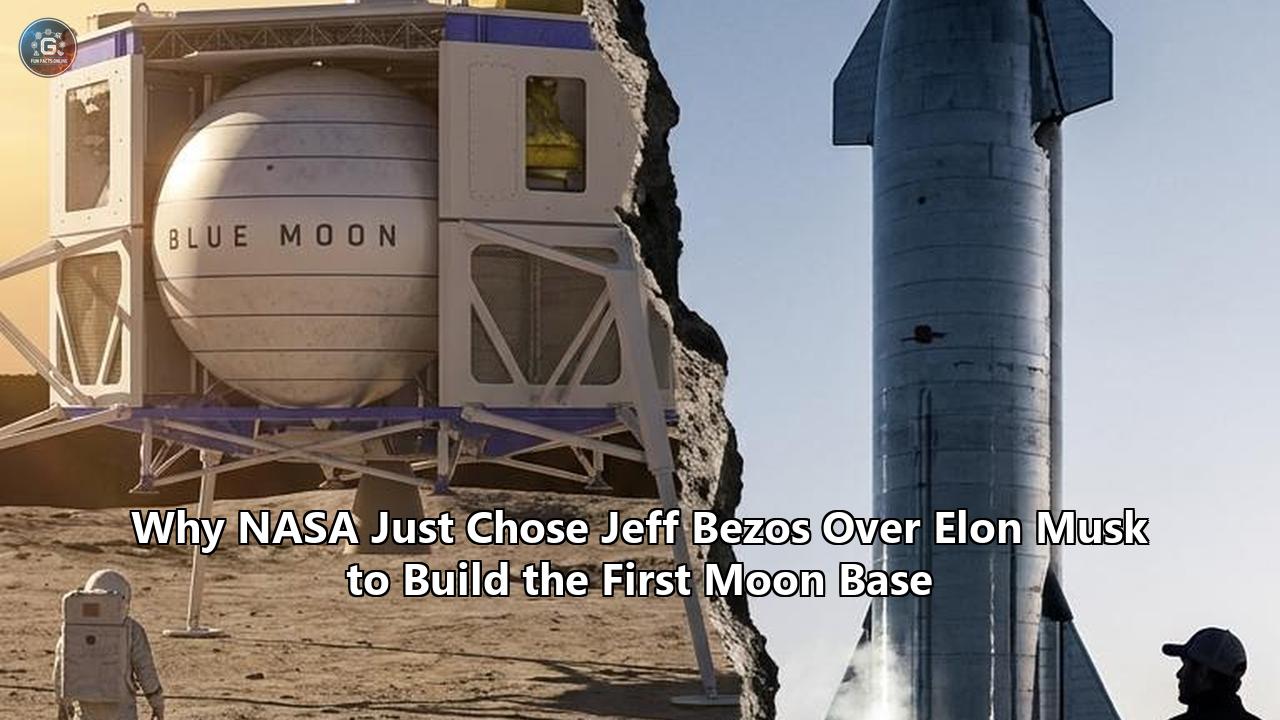
On Tuesday, May 26, 2026, the National Aeronautics and Space Administration (NASA) shifted the geopolitical and commercial gravity of the modern space race. At a highly anticipated press conference at the Mary W. Jackson NASA Headquarters in Washington, D.C., NASA Administrator Jared Isaacman announced the first major commercial procurement push under the agency's revised, $20 billion Moon Base initiative.
The headline of the day belonged to Jeff Bezos. His private space venture, Blue Origin, secured an initial $188 million contract to deliver the foundational elements of humanity's first permanent base near the lunar South Pole. When factoring in an option period for two subsequent task orders, the potential value of the contract climbs by an additional $280.4 million, representing a total package of $468.4 million.
Under the terms of this agreement, Blue Origin will use its uncrewed Blue Moon Mark 1 (MK1) "Endurance" cargo lander to conduct the very first Moon Base mission, designated "Moon Base I," targeted for launch as early as Fall 2026.
This milestone announcement represents a strategic pivot. While Elon Musk's SpaceX has long been positioned as the primary contractor for transporting human crews to the lunar surface under the Artemis program, NASA's new leadership chose Bezos's single-launch, low-overhead cargo lander to establish the physical infrastructure of the base.
                               $20 BILLION MOON BASE INITIATIVE
                         (Phase 1 Commercial Procurement Breakdown)
┌────────────────────────────────────────────────────────────────────────────────────────┐
│                                                                                        │
│  ┌───────────────────────┐   ┌───────────────────────┐   ┌──────────────────────────┐  │
│  │      BLUE ORIGIN      │   │       ASTROLAB        │   │      LUNAR OUTPOST       │  │
│  │     $188M - $468M     │   │         $219M         │   │          $220M           │  │
│  │  (Delivery Landers)   │   │  (CLV-1/FLEX Rover)   │   │     (Pegasus Rover)      │  │
│  └───────────────────────┘   └───────────────────────┘   └──────────────────────────┘  │
│                                                                                        │
│                                ┌───────────────────────────┐                           │
│                                │    FIREFLY AEROSPACE      │                           │
│                                │           $75M            │                           │
│                                │   (MoonFall Drone Carrier)│                           │
│                                └───────────────────────────┘                           │
│                                                                                        │
└────────────────────────────────────────────────────────────────────────────────────────┘
The hardware being purchased in this initial round of contracts is extensive:
- $219 million awarded to California-based Astrolab to develop the CLV-1 crewed rover, built on its Flexible Logistics and Exploration (FLEX) architecture.
- $220 million awarded to Colorado-based Lunar Outpost to develop the Pegasus, an agile rover designed for manual, remote, or autonomous operations.
- $75 million awarded to Texas-based Firefly Aerospace to build the spacecraft for the "MoonFall" mission, which will transport JPL-developed autonomous drones to survey potential landing sites by 2028.
The decision to place Bezos at the forefront of the cargo logistics pipeline is a major shift in how the NASA moon lander contract ecosystem is managed, introducing a dual-provider framework that mitigates the engineering and operational risks of SpaceX’s massive Starship Human Landing System (HLS).
The Logistics Math: Why Single-Launch Architecture Beat Multi-Tanker Complexity
To understand why Blue Origin clinched the rights to deploy the base’s early infrastructure, one must look at the stark mathematical differences between the vehicle architectures designed by Blue Origin and SpaceX.
Prior to this announcement, the primary NASA moon lander contract was held exclusively by SpaceX under the Human Landing System (HLS) Option A and Option B awards, totaling approximately $4.05 billion. SpaceX's solution, the Starship HLS, is a colossus. It stands 52.1 meters (171 feet) tall with a 9-meter (30-foot) diameter. In its fully reusable configuration, Starship is designed to deposit a staggering 100 metric tons (220,000 pounds) of payload onto the lunar surface.
However, Starship's immense capacity comes with an equally massive operational cost: Earth-orbit refueling. Because Starship utilizes liquid methane (LCH4) and liquid oxygen (LOX) propellants, it cannot break Earth's gravity and transit to cislunar space on its own fuel reserves.
To reach Near-Rectilinear Halo Orbit (NRHO), a Starship HLS must launch into Low Earth Orbit (LEO) empty. SpaceX must then launch a series of Super Heavy/Starship tanker flights to refuel the HLS vehicle in orbit.
NASA and independent aerospace analysts project that SpaceX will require between 10 and 20 tanker launches to transfer the necessary cryogenic propellants to support a single lunar landing.
                          PROPULSION ARCHITECTURE COMPARISON

          SPACEX STARSHIP HLS                        BLUE ORIGIN BLUE MOON MK1
     ┌───────────────────────────┐                  ┌───────────────────────────┐
     │ • Height: ~52.1 Meters    │                  │ • Height: 8.05 Meters     │
     │ • Diameter: 9.0 Meters    │                  │ • Diameter: 3.08 Meters   │
     │ • Propellant: CH4 / LOX   │                  │ • Propellant: LH2 / LOX   │
     │ • LEO Refueling: Required │                  │ • LEO Refueling: None     │
     │   (10 to 20 Tanker Flights)                  │   (Single-Launch Direct)  │
     │                           │                  │                           │
     │ • Surface Payload: 100t   │                  │ • Surface Payload: 3t     │
     └───────────────────────────┘                  └───────────────────────────┘
This multi-tanker approach introduces a high statistical variance in mission risk:
- Launch Cadence Vulnerability: To fuel a single Starship HLS, SpaceX must maintain an unprecedented launch cadence. If a single tanker launch fails, or if pad damage occurs at Starbase or Cape Canaveral, the entire mission timeline slips.
- Boil-Off Decay: Cryogenic propellants naturally boil off over time. If the refueling sequence takes weeks to complete, early-deposited propellants will boil away, demanding even more tanker flights.
- Orbital Refueling Tech Maturity: At-scale cryogenic propellant transfer in zero-gravity remains an unproven technology. SpaceX is not scheduled to demonstrate this capability until late 2026 or 2027.
By contrast, the Blue Moon Mark 1 (MK1) Endurance lander is built around a much simpler, low-risk single-launch architecture.
Measuring 8.05 meters (26.4 feet) in height and 3.08 meters (10.1 feet) in diameter, the MK1 has a wet launch mass of 21,350 kilograms (47,070 pounds). It is custom-optimized to fly as a primary payload inside the 7-meter fairing of Blue Origin's heavy-lift New Glenn rocket.
                                    NEW GLENN ROCKET
                       (Launch Vehicle for Blue Moon MK1 Endurance)
     ┌──────────────────────────────────────────────────────────────────────────────┐
     │ Height: 98 Meters (321 Feet) | Fairing Diameter: 7 Meters (23 Feet)          │
     │ LEO Payload Capacity: 45 Metric Tons (99,000 Pounds)                         │
     │ First-Stage Power: 7 BE-4 Liquid Methane/Oxygen Engines                      │
     │ Upper-Stage Power: 2 BE-3U Liquid Hydrogen/Oxygen Engines                    │
     └──────────────────────────────────────────────────────────────────────────────┘
Because New Glenn can lift 45 metric tons to LEO, it can send the MK1 Endurance lander directly to cislunar space on a direct-ascent trajectory.
The MK1 requires zero orbital refueling flights. It transits to cislunar space, performs its own orbital insertion, and descends to the lunar South Pole using a single, highly efficient BE-7 engine.
While the MK1's payload capacity is limited to 3 metric tons (6,600 pounds), this is more than enough to deliver early infrastructure like rovers, science packages, and power systems.
NASA's newly refined procurement strategy establishes a parallel workflow, ensuring that the primary NASA moon lander contract does not rely on a single, highly complex launch architecture. By awarding the uncrewed logistics phase to Blue Origin, the agency has effectively split the risk profile of the broader program:
$$\text{Total Mission Risk} = P(\text{Starship HLS Delay}) \times P(\text{Blue Moon Cargo Success})$$
Because Blue Origin can deliver rovers and survival gear autonomously using a single launch, NASA can build out the physical base camp even if SpaceX's crewed Starship faces technical delays.
Propellant Physics: The Cryogenic Battle of LH2/LOX vs. Methalox
The selection of Blue Origin also highlights a quiet but profound battle over propellant physics and the long-term mechanics of deep-space survival.
                              PROPELLANT PERFORMANCE DATA
┌──────────────────────────────────────┬──────────────────┬─────────────────────────────┐
│ Metric                               │ LH2 / LOX        │ LCH4 / LOX (Methalox)       │
├──────────────────────────────────────┼──────────────────┼─────────────────────────────┤
│ Vacuum Specific Impulse ($I_{sp}$)   │ ~450 seconds     │ ~380 seconds                │
│ Storage Temperature (Boiling Point)  │ 20 Kelvin        │ 111 Kelvin                  │
│ Molecular Size (Leakage Risk)        │ Ultra-Small      │ Moderate                    │
│ Liquid Density                       │ Low (70.8 g/L)   │ High (422.6 g/L)            │
└──────────────────────────────────────┴──────────────────┴─────────────────────────────┘
Specific Impulse Efficiency
The BE-7 engine powering the Blue Moon MK1 is a dual-expander cycle engine that burns liquid hydrogen (LH2) and liquid oxygen (LOX). In vacuum conditions, LH2/LOX offers a specific impulse ($I_{sp}$) of roughly 450 seconds, representing the absolute pinnacle of chemical rocket propulsion.
SpaceX's Raptor engines, which burn liquid methane (LCH4) and LOX (methalox), operate at a lower vacuum specific impulse of approximately 380 seconds.
This means that for every kilogram of fuel burned, Blue Origin’s engine produces significantly more thrust-seconds, allowing the Blue Moon lander to execute precise braking and descent maneuvers with a lower overall propellant mass fraction.
The Boil-Off Barrier
Liquid hydrogen's Achilles' heel has always been its extremely low boiling point: 20 Kelvin (-253°C or -424°F). At this temperature, even minor exposure to solar radiation causes the hydrogen to boil off, venting precious fuel into space.
Without active cooling, a spacecraft transiting to the Moon or Mars can lose up to 42% of its liquid hydrogen mass per year to boil-off, making long-term storage in cislunar space impossible. Liquid methane, which boils at 111 Kelvin (-161.6°C), is far denser and much easier to store for long periods.
To solve this 60-year-old engineering bottleneck and make LH2 viable for sustained lunar operations, Blue Origin spent years developing proprietary "Zero Boil-Off" (ZBO) technology.
The ZBO system is an active, solar-powered refrigeration system that cools the propellant tanks. It relies on a two-part system:
- Passive Thermal Barriers: Tanks are wrapped in advanced Multi-Layer Insulation (MLI) and suspended by low-conductivity structural struts to minimize conductive heat transfer from the lander's frame.
- Active Cryocoolers: Solar-powered, closed-loop helium cryocoolers actively extract heat from the propellant tanks, compressing and reliquefying any vaporized hydrogen before it can escape the system.
This technology completed testing inside the historic Thermal Vacuum Chamber A at NASA’s Johnson Space Center in Houston. Over a multi-week test campaign, the uncrewed Endurance lander was subjected to extreme temperature swings resembling the lunar day-night cycle.
The ZBO system performed flawlessly, maintaining the liquid hydrogen tanks at a stable 20 Kelvin without venting fuel.
This data-backed milestone gave NASA's leadership the hard quantitative proof needed to sign the checks. By validating ZBO on the uncrewed MK1 lander, Blue Origin cleared a critical technical hurdle for its larger, crew-rated Mark 2 (MK2) lander, which is slated to fly under a separate $3.4 billion NASA moon lander contract for the Artemis V mission.
Strategic Risk Mitigation: The "Apollo Playbook" Returns
NASA Administrator Jared Isaacman’s strategic vision for the Moon Base initiative represents a deliberate move away from single-architecture dependencies.
“We are leveraging the NASA playbook from the 1960s,” Isaacman stated. “We intend to take an iterative approach, sending a demand signal to industry for a lot of landers and rovers and tech demonstrations.”
Behind these words lies a stark administrative reality: SpaceX’s Starship development, while rapid, has experienced notable delays.
                               ARTEMIS / MOON BASE TIMELINE
┌─────────────────────────┬─────────────────────────────────────────────────────────────┐
│ Year                    │ Milestone                                                   │
├─────────────────────────┼─────────────────────────────────────────────────────────────┤
│ April 2026              │ Artemis II successfully completes crewed lunar flyby        │
│ Fall 2026               │ Moon Base I launches (Blue Origin Endurance lander)         │
│ Late 2026               │ Moon Base II (Griffin) & III (Nova-C Trinity) launch        │
│ Mid-2027                │ Artemis III: Crewed orbital docking & Starship HLS trial    │
│ 2028                    │ Artemis IV: First crewed lunar landing since 1972           │
│ 2029                    │ Moon Base Phase 2 transition (Early Habitation)             │
│ 2032                    │ Moon Base Phase 3 transition (Sustained Human Presence)     │
└─────────────────────────┴─────────────────────────────────────────────────────────────┘
The successful completion of the Artemis II mission in April 2026, which sent four astronauts around the Moon in a record-breaking orbit, has put immense pressure on the agency to deliver a landing.
However, SpaceX’s orbital refueling trials and the uncrewed Starship HLS demonstration landing have both slipped.
Artemis III—now scheduled for mid-2027—will not involve a lunar landing; instead, it will focus on complex docking maneuvers between the Orion spacecraft and HLS landers in Earth orbit. The first crewed landing, under Artemis IV, is scheduled for early 2028.
                     CONGRESSIONAL & GEOPOLITICAL PRESSURE
     ┌────────────────────────────────────────────────────────────────────────┐
     │ Trump National Space Policy (2025/2026)                                │
     │ • Achieve crewed landing before the end of presidential term (2029)    │
     │ • Beat China's planned crewed landing (targeted for before 2030)       │
     │ • Establish permanent base at South Pole to secure lunar resources     │
     └────────────────────────────────────────────────────────────────────────┘
By establishing the Moon Base program as an independent logistics line, NASA's Moon Base Program Executive, Carlos García-Galán, has decoupled the physical construction of the base from the crewed landing schedules.
If Starship HLS is delayed to 2029 or 2030, NASA can continue sending uncrewed cargo missions to deposit rovers, science tools, and power systems.
When astronauts finally arrive, they will find an active, fully mapped, and pre-positioned base camp waiting for them.
This parallel path is also a geopolitical necessity. China’s Chang’e program has executed successful, highly precise robotic landings at the lunar South Pole.
The China National Space Administration (CNSA) plans to land astronauts on the Moon before 2030 and establish its own International Lunar Research Station (ILRS) by 2035, utilizing the heavy-lift Long March 10 rocket.
                             THE BILATERAL LUNAR RACE

          UNITED STATES (NASA + Partners)            CHINA (CNSA)
     ┌───────────────────────────┐                  ┌───────────────────────────┐
     │ • Base: Moon Base One     │                  │ • Base: ILRS              │
     │ • Crewed Landing: 2028    │                  │ • Crewed Landing: <2030   │
     │ • Target: South Pole      │                  │ • Target: South Pole      │
     │   (Shackleton Ridge)      │                  │   (Amundsen/Shackleton)   │
     │ • Base Complete: 2032     │                  │ • Base Complete: 2035     │
     └───────────────────────────┘                  └───────────────────────────┘
To maintain US leadership, NASA is using Blue Origin’s high-achievability, single-launch MK1 lander to guarantee that American assets are the first to claim long-term real estate at the Shackleton Connecting Ridge.
Breaking Down the $20 Billion Moon Base Blueprint
The Moon Base program is not a single outpost, but a sprawling, phased infrastructure initiative designed to eventually span several hundred square miles near the lunar South Pole.
Carlos García-Galán’s office has outlined a strict three-phase blueprint to guide this massive capital expenditure.
                          MOON BASE THREE-PHASE BLUEPRINT

    PHASE 1: Now–2029               PHASE 2: 2029–2032              PHASE 3: 2032+
 ┌──────────────────────┐        ┌──────────────────────┐        ┌──────────────────────┐
 │ • Uncrewed Logistics │        │ • Early Habitation   │        │ • Sustained Presence │
 │ • Scout Site Mapping │───────>│ • Power Grid Layout  │───────>│ • 30-Day Human Stays │
 │ • Rover Deployments  │        │ • Solar / Nuclear Rx │        │ • Closed-Loop Life   │
 │ • Plume Dynamics     │        │ • Semi-Perm Outpost │        │   Support Systems    │
 └──────────────────────┘        └──────────────────────┘        └──────────────────────┘
Phase 1: Experiment and Learn (Now–2029)
The primary objective of Phase 1 is to master the physics of landing heavy payloads in close proximity and map the terrain for resources. This phase is driven by three initial uncrewed missions scheduled for late 2026:
- Moon Base I: Blue Origin's MK1 Endurance lander will touch down on the Shackleton Connecting Ridge. The lander will carry the Stereo Cameras for Lunar Plume-Surface Studies (SCALPSS 1.1). Developed by NASA’s Langley Research Center, SCALPSS uses stereophotogrammetry to capture 3D imagery of how the lander’s BE-7 engine plume interacts with the highly abrasive lunar regolith. This data is critical for understanding "plume-surface interaction" (PSI), a major engineering hazard where blasted dust can sandblast surrounding habitats or vehicles. The lander will also deploy a Laser Retroreflective Array (LRA) to act as a permanent cislunar lighthouse, allowing orbiting satellites to calculate precise landing coordinates.
- Moon Base II: Utilizing Astrobotic's Griffin cargo lander, this mission will transport more than 500 kilograms (1,100 pounds) of hardware to the surface. Its primary payload is Astrolab's Flight Line Integration Pathfinder (FLIP) rover, a scaled prototype designed to test early mobility and battery survival systems in cold South Pole shadows.
- Moon Base III: Intuitive Machines will deploy its Nova-C Trinity lander to the South Pole. This lander will carry Lunar Vertex, an instrument suite designed by Johns Hopkins University's Applied Physics Laboratory to study "lunar swirls" (bright, localized magnetic anomalies) to understand space weathering and magnetic shielding on the surface.
Following these precursors, NASA will begin delivering the full-scale rovers in 2028 to support the crewed Artemis IV landing.
Phase 2: Early Habitation (2029–2032)
Phase 2 transitions the program from robotic scouting to stationary infrastructure.
During this period, NASA will deploy fixed communication towers, localized navigation networks, and a surface power grid.
Central to the power grid will be the development of Space Reactor-1 Freedom (SR-1), a compact, nuclear fission surface reactor designed to provide up to 10 kilowatts of continuous electrical power, bypassing the limits of the 14-day lunar night.
                     SPACE REACTOR-1 FREEDOM (SR-1)
     ┌────────────────────────────────────────────────────────────────────────┐
     │ • Reactor Type: High-Temperature Fission Reactor                       │
     │ • Continuous Power Output: 10 Kilowatts (Continuous)                    │
     │ • Life Expectancy: 10+ Years                                           │
     │ • Objective: Support habitats and charging grids during lunar night    │
     └────────────────────────────────────────────────────────────────────────┘
The heavy cargo deliveries during Phase 2 will transition to Blue Origin's larger, crew-rated Mark 2 (MK2) lander and SpaceX's Starship, both of which will deliver early habitat modules, airlocks, and life support systems.
Phase 3: Sustained Human Presence (2032 and Beyond)
By 2032, the Moon Base is projected to establish "operating capability," supporting semi-permanent human habitation.
Astronaut stays will extend from brief 7-day sorties to 30-to-90-day deployments, supported by closed-loop life support systems that recycle water and oxygen.
Phase 3 will focus heavily on In-Situ Resource Utilization (ISRU): extracting water ice from the permanently shadowed regions (PSRs) of craters like Shackleton. This harvested ice will be split via electrolysis into liquid hydrogen and liquid oxygen, creating a self-sustaining cislunar fueling depot to resupply the Blue Moon and Starship fleets directly from the Moon.
Detailed Specifications of the First Moon Base Hardware
To execute these phases, NASA is investing in highly specialized hardware capable of surviving the extreme thermal environment of the lunar South Pole, where temperatures swing from 120°C (248°F) in direct sunlight to -230°C (-382°F) in shadowed craters.
                              LUNAR ROVER COMPARISON
┌──────────────────────────────────────┬──────────────────┬─────────────────────────────┐
│ Feature                              │ Astrolab FLEX    │ Lunar Outpost Pegasus       │
├──────────────────────────────────────┼──────────────────┼─────────────────────────────┤
│ Wet Weight                           │ ~1,400 kg        │ ~900 kg                     │
│ Payload Capacity                     │ 1,500 - 1,600 kg │ 300 - 500 kg                │
│ Top Speed                            │ 20 km/h (12 mph) │ 14.5 km/h (9 mph)           │
│ Primary Control Mode                 │ Crewed/Remote    │ Autonomous/Remote           │
│ Battery Thermal Protection           │ Venturi Enclosure│ Passive/Active Hybrid       │
└──────────────────────────────────────┴──────────────────┴─────────────────────────────┘
The Astrolab FLEX Rover
Astrolab’s Flexible Logistics and Exploration (FLEX) rover is a heavy-duty, versatile platform. It is designed to act as a flatbed utility truck.
- Mass: Weighs approximately 1,400 kilograms (3,100 pounds) dry.
- Payload: Capable of carrying up to 1,600 kilograms (3,500 pounds) and 3 cubic meters of cargo. This allows it to carry two fully suited astronauts, large scientific instruments, or structural cargo.
- Mobility: Powered by four hyper-deformable lunar wheels designed by Venturi, which warp to absorb ground irregularities and resist solar radiation. It can reach speeds of up to 20 km/h (12.4 mph).
- Survival: Features a custom, vacuum-insulated battery enclosure built by Venturi, designed to protect the lithium-ion cells from freezing during long stays in deep shadows.
The Lunar Outpost Pegasus Rover
The Pegasus rover is a lighter, highly agile scout vehicle.
- Mass: Weighs approximately 900 kilograms (1,980 pounds).
- Mobility: Pegasus is built for speed and endurance, capable of reaching over 14.5 km/h (9 mph). It is designed to drive continuously for up to a year.
- Control Modes: Highly autonomous, the Pegasus can navigate the complex, rocky terrain of the South Pole independently, plotting routes around hazards without requiring direct driver input from astronauts or controllers on Earth.
- Role: Acting as a precursor scout, Pegasus will map regolith density, search for water ice deposits, and survey paths before the heavier FLEX rovers or human crews venture into uncharted regions.
Firefly Elytra and the "MoonFall" Drones
The $75 million "MoonFall" contract represents a unique approach to lunar exploration.
Instead of relying solely on wheeled rovers, NASA's Jet Propulsion Laboratory (JPL) is developing four autonomous hopping drones.
                                  MOONFALL MISSION
               (Elytra Spacecraft Carrier + 4 Autonomous JPL Drones)
     ┌────────────────────────────────────────────────────────────────────────┐
     │ Elytra Spacecraft: Performs 45-day transit to Moon                     │
     │ Deployment Altitude: 50 Kilometers (31 Miles) above South Pole         │
     │ Drone Function: High-resolution stereo imaging of deep craters         │
     │ Operational Goal: Identify permanent ice deposits and landing hazards  │
     └────────────────────────────────────────────────────────────────────────┘
Firefly’s Elytra spacecraft will act as the transport carrier.
- The Flight Profile: Elytra will launch from Earth with the four drones stowed inside its cargo bay.
- The Orbit: After a 45-day transit, Elytra will enter a low lunar orbit and perform a precise deorbit and braking maneuver to deploy the drones approximately 50 kilometers (31 miles) above the South Pole.
- The Drones: Once deployed, these small, rocket-powered drones will make short, controlled hops across the surface. Because they are not bound by wheels, they can hop directly into steep, permanently shadowed craters (like Shackleton or Shoemaker) where traditional rovers would get stuck or lose solar power.
- The Payloads: Equipped with high-resolution stereo cameras and multispectral sensors, the drones will map the floors of these craters in 3D, searching for exposed water ice and identifying flat, safe zones for future resource-harvesting operations.
The Financial and Corporate Battlefield: Bezos vs. Musk
The awarding of this NASA moon lander contract to Blue Origin is not just a triumph of engineering; it is a major upset in the ongoing "Billionaire Space Race."
For years, Elon Musk's SpaceX enjoyed a near-monopoly on NASA's most prestigious deep-space contracts. SpaceX won the initial $2.9 billion HLS Option A contract in 2021, followed by a $1.15 billion Option B extension in 2022, while Blue Origin’s protests were repeatedly dismissed.
However, several commercial and political factors have re-aligned the playing field:
1. The Gateway Cancellation Dividend
In early 2026, NASA quietly made a monumental shift in its cislunar strategy: it indefinitely canceled the Lunar Gateway, the planned orbiting space station around the Moon.
Originally envisioned as a transfer hub for astronauts moving from Orion to HLS landers, Gateway faced mounting criticism for adding unnecessary complexity, cost, and delay to the landing timeline.
By canceling Gateway, NASA freed up several billion dollars in its budget. Under the direction of Carlos García-Galán, these funds were immediately redirected to the surface, forming the core of the $20 billion Moon Base initiative.
Furthermore, technologies developed for the Gateway—such as the Habitation and Logistics Outpost (HALO) module and the European Service Module (ESM) integration—are being repackaged for direct deployment onto the lunar surface, accelerating the base's development.
                            REALLOCATED CISTUNAR BUDGET
     ┌────────────────────────────────────────────────────────────────────────┐
     │ Canceled Orbiting Station (Gateway) -> Redirected to Moon Base Surface │
     │ • Reallocated Capital: Estimated $4 - $6 Billion                       │
     │ • Technical Repurposing: HALO module repurposed as surface habitat     │
     │ • Primary Beneficiary: Commercial Cargo & Rover Landers                │
     └────────────────────────────────────────────────────────────────────────┘
2. Corporate Diversification
With SpaceX preparing for a potential $1.75 trillion initial public offering (IPO) and absorbing an increasing share of NASA’s Earth-orbit work (including ISS crew rotations and the primary Deorbit Vehicle contract), NASA’s leadership became concerned about single-source vulnerability.
If SpaceX encountered a systemic failure or went through a complex corporate restructuring, the entire US space program could grind to a halt.
By awarding this major cargo delivery contract to Blue Origin, NASA is actively fostering a commercial duopoly, ensuring that Blue Origin remains a viable, highly capable competitor.
3. Personal Subsidies
Jeff Bezos, whose net worth is estimated at $284 billion, has treated Blue Origin’s lunar ambitions as a legacy-defining endeavor.
Because the initial $188 million contract does not cover the full development costs of the MK1 Endurance lander, Blue Origin is heavily co-funding the missions itself.
To support this rapid scale-up, Florida Governor Ron DeSantis announced a $600 million expansion of Blue Origin’s Rocket Park campus in Cape Canaveral to boost the production rate of New Glenn rocket components.
This massive private co-investment made Blue Origin an incredibly cost-effective option for NASA, giving the agency a high-capability cargo landing system at a fraction of its true development cost.
Projections and Milestones: What to Watch for Next
As the Moon Base initiative moves from contracts to physical launchpads, the coming months will see several critical milestones that will dictate the success of the program:
                            UPCOMING CRITICAL MILESTONES
┌──────────────────────┬──────────────────────┬─────────────────────────────────────────┐
│ Projected Date       │ Organization         │ Event / Technical Objective             │
├──────────────────────┼──────────────────────┼─────────────────────────────────────────┤
│ Summer 2026          │ Blue Origin          │ Maiden flight of the New Glenn Rocket   │
│ Mid-2026             │ Blue Origin          │ BE-7 engine full-duration hot-fire test │
│ Fall 2026            │ NASA / Blue Origin   │ Launch of Moon Base I (Endurance)       │
│ Late 2026            │ NASA / SpaceX        │ LEO cryogenic propellant transfer demo  │
│ Summer 2027          │ NASA / ESA / KASI    │ Launch of Moon Base III (Nova-C)        │
│ Early 2028           │ NASA / Partners      │ Launch of Moon Base II (Griffin/FLEX)   │
└──────────────────────┴──────────────────────┴─────────────────────────────────────────┘
1. New Glenn's Maiden Flight (Summer 2026)
The absolute gatekeeper for Blue Origin's Moon Base I mission is the maiden flight of its New Glenn rocket.
The heavy-lift booster must fly successfully from Cape Canaveral’s Space Launch Complex 36 (SLC-36) before the MK1 Endurance lander can be integrated for its flight to the Shackleton Connecting Ridge.
Any delay in New Glenn's orbital debut will compress the timeline for the Fall 2026 lunar landing target.
2. BE-7 Hot-Fire Tests (Huntsville, Alabama)
In the second quarter of 2026, Blue Origin is scheduled to conduct a series of full-duration hot-fire tests of the BE-7 engine integrated with actual MK1 flight propellant tanks.
This test campaign will validate the engine's deep-throttling capability (essential for soft-landing on the Moon) and verify the structural integrity of the lightweight, 3D-printed injectors under prolonged cryogenic exposure.
3. SpaceX's LEO Refueling Demonstration (Late 2026)
While Blue Origin builds the cargo infrastructure, all eyes will remain on Starbase in Boca Chica, Texas, where SpaceX must execute its first orbital propellant transfer demonstration.
SpaceX must successfully transfer liquid oxygen and liquid methane between two docked Starships in orbit.
The efficiency of this transfer, measured by the volume of propellant successfully moved without venting or boil-off, will determine whether SpaceX can meet its 2028 crewed landing target under Artemis IV.
4. The Geopolitical Race to the South Pole
As NASA’s commercial partners prepare their vehicles, China's CNSA is moving ahead with its own heavy-lift Long March 10 integration and Chang'e 7 and 8 South Pole robotic missions.
The physical race to the Shackleton Connecting Ridge is a battle for strategic territory. The first nation to successfully land, establish a local GPS/communications grid, and deploy active rovers will have a significant advantage in claiming the highly coveted, permanently shadowed water ice reserves.
Establishing a permanent base on the Moon is no longer a collection of artist concepts; it is a meticulously scheduled, data-driven logistical blueprint.
By choosing Jeff Bezos's single-launch cargo architecture alongside Elon Musk's heavy human landers, NASA has built a redundant, high-efficiency supply chain.
The uncrewed, 3-metric-ton Endurance lander currently sitting in the cleanrooms at Cape Canaveral is not just a test vehicle—it is the first brick in America's first celestial city.
References
- --- The Washington Post: Details on Blue Origin's $188M delivery contract and the $219M/$220M rover contracts.
- --- Financial Times: Details on NASA's commercial contracts, Blue Origin's $468M potential total, and the $20B Moon Base program.
- --- The Guardian: NASA Administrator Jared Isaacman's quotes on the "iterative approach" and the 1960s playbook.
- --- PBS News: Timing of Artemis II, Artemis III orbital docking tests, and the 2028 landing targets.
- --- Forbes: Details on the Blue Moon Mark 1 Endurance contract and the Shackleton Connecting Ridge landing site.
- --- Wikipedia: Starship HLS specifications, LEO refueling details, and the $3.4B Blue Moon MK2 contract.
- --- Teslarati: Information on the logistical overhead of Starship HLS and the uncrewed Moon Base mission sequences.
- --- GeekWire: Details on the rovers' weights, speeds, ranges, and Carlos García-Galán's quotes on the base's physical scale.
- --- GovConWire: Information on the Phase 1 High Achievability Mission task orders.
- --- SpaceQ: Specific science instruments (SCALPSS, LRA) and the cargo breakdown for Moon Base II.
- --- Benzinga: Details on the Florida Cape Canaveral facility expansion and the revised National Space Policy.
- --- Unilad: Net worth of Jeff Bezos, Elon Musk's reactions on X, and China's Long March 10 capabilities.
- --- Sevilla.org: Carlos García-Galán's background, the cancellation of the Gateway program, and the three-phase schedule.
- --- Payload Space: García-Galán’s interview on transitioning cislunar orbital tech to the lunar surface.
- --- Wikipedia: Biography and Senate confirmation details of NASA Administrator Jared Isaacman.
- --- NASA: Workforce updates and policy directives issued by Jared Isaacman in May 2026.
- --- CBS News (YouTube): Jared Isaacman's interview on the US-China space race and nuclear space reactors.
- --- SatNews: The Space Review analysis of the single-launch MK1 vs. Starship refueling requirements.
- --- NewSpaceEconomy: Details on the "Zero Boil-Off" (ZBO) technology, BE-7 engine specs, and New Glenn's cargo capacity.
- --- Wikipedia: Blue Moon MK1 mass, dimensions, and propellant properties.
- --- Grokipedia: Detailed comparison of MK1 dry/wet mass and the Cislunar Transporter specs.
- --- NASA: Results of the Thermal Vacuum Chamber A testing at Johnson Space Center.
- --- India Today: Context of the "Endurance" lander's name and its precision landing accuracy goals.
- --- Gizmodo: Starship HLS milestones and the delivery of Blue Moon MK2 mockups to Johnson Space Center.
- --- Astrolab: FLEX rover mass, payload capacity, and Venturi wheel characteristics.
- --- Venturi Space: FLEX and FLIP rover weights, speeds, and SpaceX rideshare plans.
- --- AIAA: Flight data and results from the SCALPSS 1.1 instrument aboard the Firefly Blue Ghost landing.
- --- NASA: Technical slide deck on Plume-Surface Interaction (PSI) physics and SCALPSS sensor architecture.
- --- Mashable: Specifications of the Lunar Outpost Pegasus rover and the MoonFall hopping drones.
- --- Intellectia: Stock performance of Firefly Aerospace and details of the $75M JPL subcontract.
- --- Moomoo*: Details of the Elytra spacecraft's flight profile and deorbit maneuvers.
Reference:
- https://www.ft.com/content/2f764093-9413-4945-91f5-19ec8802f1b0?syn-25a6b1a6=1
- https://www.theguardian.com/science/2026/may/26/nasa-jeff-bezos-blue-origin
- https://www.govconwire.com/articles/nasa-moon-base-contract-awards-4-companies
- https://www.benzinga.com/news/space/26/05/52799499/jeff-bezos-blue-origin-nasa-moon-contract-artemis
- https://www.forbes.com/sites/jamiecartereurope/2026/05/26/nasa-picks-bezoss-blue-origin-over-spacex-for-key-moon-base-mission/
- https://www.geekwire.com/2026/nasa-taps-blue-origin-to-deliver-lunar-rovers-for-moon-base-initiative/
- https://www.teslarati.com/nasas-first-human-outpost-on-the-moon-starts-now-spacex-on-deck/
- https://venturi.space/en/rovers/
- https://mashable.com/article/nasa-sls-artemis-2-rollout-facts
- https://intellectia.ai/news/stock/firefly-aerospace-wins-nasa-contract-for-lunar-drones
- https://www.forbes.com/sites/jamiecartereurope/2026/05/26/nasa-picks-bezoss-blue-origin-over-spacex-for-key-moon-base-mission/
- https://en.wikipedia.org/wiki/Starship_HLS
- https://en.wikipedia.org/wiki/SpaceX_Starship
- https://www.eoportal.org/satellite-missions/artemisprogram
- https://satnews.com/2026/01/06/blue-moon-mk1-the-innovative-affordable-and-expedited-pivot-for-artemis/
- https://en.wikipedia.org/wiki/Blue_Moon_(spacecraft))
- https://grokipedia.com/page/Blue_Moon_(spacecraft))
- https://newspaceeconomy.ca/2025/11/14/what-is-blue-moon/
- https://www.nasa.gov/missions/artemis/blue-origin-moon-lander-completes-testing-at-nasa-vacuum-chamber/
- https://www.indiatoday.in/science/story/blue-origin-blue-moon-mark-1-endurance-pathfinder-mission-launch-2026-nasa-testing-jeff-bezos-science-news-space-news-2860371-2026-01-31
- https://indianexpress.com/article/technology/science/blue-origins-cargo-moon-lander-moves-closer-to-launch-after-nasa-testing-10675952/
- https://www.pbs.org/newshour/science/watch-nasa-shares-plans-to-construct-moon-base
- https://espacial.sevilla.org/en/news/carlos-garcia-galan-the-spanish-engineer-chosen-by-nasa-to-lead-its-future-permanent-lunar-base/
- https://www.unilad.com/news/world-news/nasa-moon-base-plans-jeff-bezos-elon-musk-663673-20260527
- https://www.nasa.gov/reference/moonbase-about/
- https://spaceq.ca/nasa-outlines-iterative-moon-base-strategy-lunar-outpost-awarded-ltv-contract-with-consortium-partner-mda-space/
- https://en.wikipedia.org/wiki/Blue_Moon_Pathfinder_Mission_1
- https://ntrs.nasa.gov/api/citations/20250001741/downloads/SCALPSS_CLPS_CS-6_Payload_Workshop_250224.pdf
- https://www.autoevolution.com/news/nasa-reveals-the-details-of-the-first-ever-moon-base-missions-270565.html
- https://www.youtube.com/watch?v=Vz7-Ms05thA
- https://www.irishtimes.com/world/2026/05/27/moon-base-plans-revealed-as-nasa-chief-says-the-grand-return-is-close-at-hand/
- https://www.astrolab.space/flex-rover/
- https://www.nasa.gov/podcasts/houston-we-have-a-podcast/commercial-and-international-lunar-rovers/
- https://spacesettlementprogress.com/category/cislunar/page/2/
- https://www.nasa.gov/news-release/nasa-provides-update-on-moon-base-rovers-landers-missions/
- https://www.moomoo.com/403
- https://payloadspace.com/qa-with-lunar-base-manager-carlos-garcia-galan/
- https://timesofindia.indiatimes.com/technology/tech-news/jeff-bezos-space-company-blue-origin-wins-nasa-contract-for-lunar-mission/articleshow/131345696.cms
- https://en.wikipedia.org/wiki/Jared_Isaacman
- https://www.nasa.gov/blogs/workforce-updates/2026/05/22/a-message-from-administrator-jared-isaacman/
- https://gizmodo.com/watch-out-spacex-nasa-is-already-training-on-blue-origins-moon-lander-prototype-2000756309
- https://arc.aiaa.org/doi/abs/10.2514/6.2026-1311