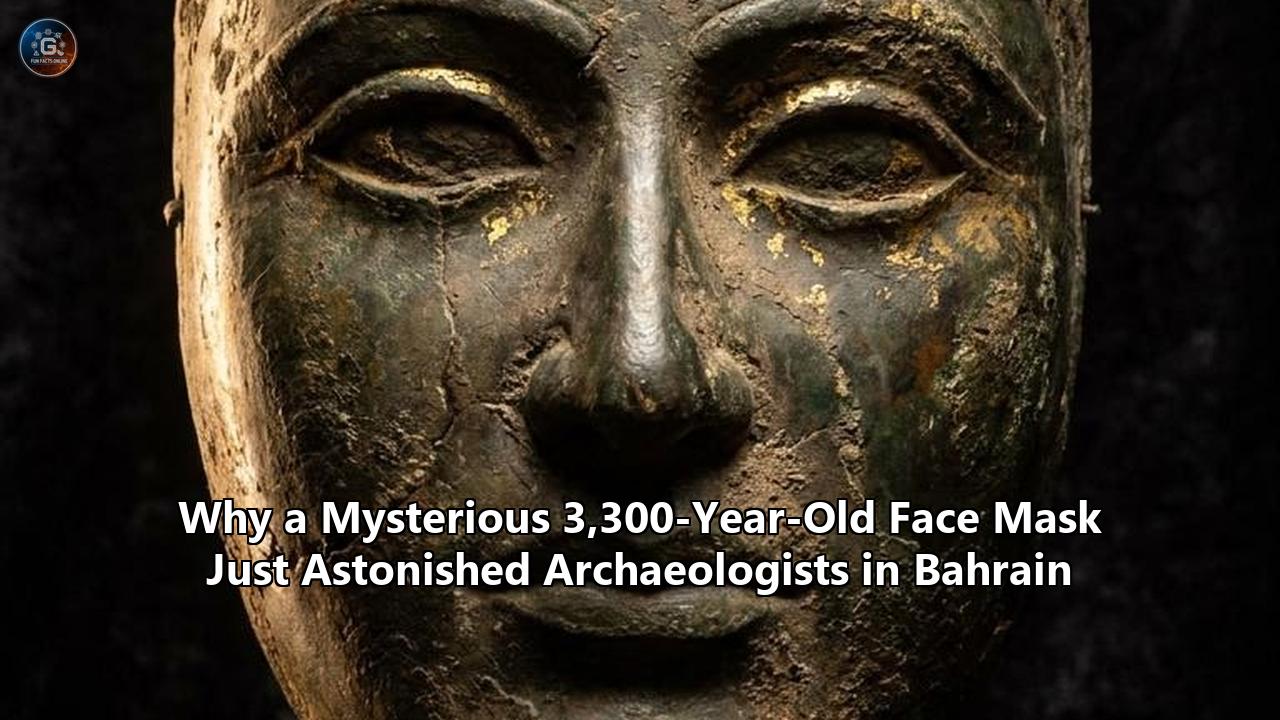
In January 2026, during a regional archaeological symposium in Manama, the Bahrain Authority for Culture and Antiquities (BACA) unveiled a discovery that has dramatically reshaped our understanding of the ancient Gulf. Emerging from a communal grave at the Al-Hillah excavation site in southern Bahrain, archaeologists recovered a masterfully crafted, 3,300-year-old decorated ceramic face mask. Known technically as a faience mask, this rare artifact depicts a female face adorned with intricate jewelry and striking almond-shaped eyes highlighted by dark, ancient bitumen.
The announcement, delivered by lead BACA archaeologist Mashael Al Shamsi at the "Gulf Archaeology: Discovery and Preservation" conference, has captivated researchers worldwide. This is only the second artifact of its kind ever excavated in Bahrain, making it an exceedingly rare prize in regional archaeology.
Found nestled alongside the skeletal remains of two women and an infant, the mask offers a tangible connection to the spiritual world, burial rituals, and long-distance trade of the enigmatic Dilmun civilization. The discovery does more than just fill a gap in the museum showcases of the Gulf; it opens a direct window into the funerary practices, aesthetic standards, and high-temperature material technologies of a society that dominated maritime trade over three millennia ago.
The Anatomy of a Masterpiece: Materials, Motifs, and Bitumen
To appreciate why this object has caused such a stir, one must look closely at its physical and artistic makeup. The newly uncovered ancient mask Bahrain archaeology teams presented to the public is a small, ornamented ceramic head sculpted from faience—a non-clay ceramic material composed of crushed quartz or sand, small amounts of lime, and plant ash. When fired, the glaze fuses into a smooth, lustrous, vitreous surface that can mimic precious stones like turquoise or lapis lazuli.
+-------------------------------------------------------------+
|               STRUCTURAL DETAIL OF THE FAIEENCE MASK        |
+-------------------------------------------------------------+
| Material:      High-silica ceramic (faience)                |
| Hair/Headband: Inlaid decoration, likely shell in bitumen   |
| Eyes:          Almond-shaped, outlined in black bitumen     |
| Eyebrows:      Thick, dramatic arch inlaid with bitumen     |
| Ears:          Three distinct piercings on each lobe       |
| Jewelry:       Sculpted necklace and pendant earrings      |
+-------------------------------------------------------------+
The craftsmanship of the mask is exceptionally sophisticated for the Late Bronze Age:
- The Features: The face is clearly defined, representing a woman with idealized, symmetrical features.
- The Inlays: The wide, almond-shaped eyes, along with their dramatic outlines and thick, arched eyebrows, are deeply inlaid with bitumen—a naturally occurring petroleum-based tar that was highly valued in antiquity for its adhesive and waterproofing qualities.
- The Adornment: Highlighting her status, the figure wears a prominent headband and a detailed necklace, alongside dangling pendant earrings. These items of jewelry were meticulously decorated with tiny, delicate shell fragments set firmly into the dark bitumen backing, creating a stark, high-contrast mosaic effect.
- The Piercings: Each ear of the ceramic face is pierced with three distinct holes. Archaeologists suggest these holes once held actual metal or bead rings that have since decayed or been lost to history.
The use of bitumen is particularly telling. While Bahrain has native asphalt seeps, the chemical composition of the bitumen used in Dilmun often points to trade links with Mesopotamian sources, specifically the oil seeps of Hit in modern-day Iraq. This mixture of local marine shell fragments, imported bitumen, and specialized faience pyrotechnology reveals a highly connected artisan class capable of blending materials from across the known world into a single, cohesive ritual object.
The Hilla Excavation: Layered History Near Qal’at al-Bahrain
The mask was recovered from the Al-Hillah site (frequently spelled Al-Hilla), named after the adjacent historic village of Hillat Abdul Saleh in northern Bahrain. Geographically, the site sits in a critically important archaeological corridor, located roughly 250 meters south of Qal’at al-Bahrain (the Bahrain Fort), which is celebrated as the country's first UNESCO World Heritage Site.
                [ Persian Gulf Coastline ]
                            |
                    ( ~250 meters )
                            |
               [ Qal'at al-Bahrain / Fort ]
                            |
                [ Al-Hillah Excavation Site ]
            (Focus: Middle Dilmun Soil Layers)
                            |
               [ Village of Hillat Abdul Saleh ]
Excavations in this general sector began as early as 1953 under the direction of Danish archaeologist Geoffrey Bibby and his team. Yet, despite decades of seasonal digs, only about a quarter of this vast historic zone has been scientifically investigated. The depths beneath the topsoil hold a complex, multi-layered stratigraphy, stacking centuries of human habitation like a vertical timeline.
While the upper layers of Al-Hillah contain extensive residential remains and architecture dating to the Late Islamic Period, the deeper trenches descend straight into the Middle Bronze Age. It is within these Middle Dilmun soil layers, which date from roughly 1600 BCE to 1000 BCE, that the BACA excavation team made their discovery.
The Middle Dilmun phase was a period of profound transition. Following the collapse of the Old Dilmun commercial empire around 1700 BCE—partially driven by the decline of the Indus Valley Civilization and shifting trade routes—the islands of Bahrain underwent a phase of political restructuring. The region came under the cultural and political sphere of the Kassite Dynasty of Babylon. It was during this era of deep Babylonian interaction, between 1450 and 1350 BCE, that the deceased in the Hilla tomb were laid to rest, accompanied by their prized ceramic mask.
The Secrets of the Triple Tomb
The physical context of the ancient mask Bahrain archaeology find is as intriguing as the artifact itself. The mask was not found in a grand palace or a central temple treasury, but inside a modest collective grave that held the remains of three individuals: two adult women and an infant.
+-----------------------------------------------------------------+
|                  AL-HILLAH COLLECTIVE GRAVE MAP                 |
+-----------------------------------------------------------------+
|                                                                 |
|   [ Skeleton A: Adult Female ]                                  |
|     - Badly preserved bones                                     |
|     - Accompanying grave goods (Vase, needles)                  |
|                                                                 |
|                  ~ Time Interval / Soil Layer ~                 |
|                                                                 |
|   [ Skeleton B: Adult Female ]                                  |
|     - Infant placed directly on her lap                         |
|     - Faience Mask placed near head                             |
|     - Surrounded by thousands of beads                          |
|                                                                 |
+-----------------------------------------------------------------+
Anthropological analysis of the bones reveals a complex story of bereavement and community. The infant was found placed directly on the lap of one of the female skeletons. While a modern observer might instantly assume a mother-and-child relationship, Al Shamsi cautions against premature conclusions.
"We cannot confirm whether or not they are mother and child," she stated. "In my opinion, the infant could be related to one or both of the adults, but it's not something that can be confirmed within the archaeological record."
Crucially, stratigraphic evidence within the grave indicates that the three individuals were not buried at the same time. By carefully analyzing the micro-layers of soil inside the tomb, the excavation team discovered subtle changes in soil density and composition—including signs of water percolation and rainfall that occurred after the first burial but before the last. This reveals that the tomb was deliberately reopened, perhaps years apart, to place a family member or a person of similar social standing alongside the original occupant.
This process of reopening graves was a common practice in Dilmun, but it came with a cost. The physical act of digging back into the tomb disturbed the older remains. "It appears that there was a disturbance between burials at some point, because the woman and infant's bones were in a bad state," Al Shamsi observed. Despite this disruption, the placement of the ceramic mask near the head of the deceased suggests that its protective or ritual function remained paramount during the secondary funerary rites.
Adornments, Agate, and Ancient Eyeliner: The Grave Goods
While the mask is undoubtedly the crown jewel of the season, it did not exist in isolation. To paint a complete picture of who these women were, BACA archaeologists employed meticulous fine-sand sieving. This slow, labor-intensive process of passing every trowel of dirt through fine mesh screens paid off handsomely, yielding an array of personal ornaments and tools that would have otherwise been lost to time.
Among the key items retrieved from the grave and the surrounding soil were:
- Two Seashell Rings: Fashioned from large marine gastropod shells, these rings were polished to a pearlescent sheen. They were likely worn on the fingers or used as hair slides, showcasing how Dilmun’s people utilized the natural bounty of their marine environment for personal adornment.
- A Large Ceramic Vessel: A heavy, wheel-thrown storage jar placed near the feet of the skeletons, which originally held liquid or food offerings intended to sustain the deceased on their journey to the afterlife.
- Sewing Needles and Awls: Several bronze and bone sewing implements were uncovered. These tools indicate that the women buried in the tomb were actively engaged in textile production, leatherworking, or sail-making—crucial industries in a maritime trading nation.
- Thousands of Tiny Beads: Spread like a colorful cloud around the skeletal remains were thousands of beads crafted from an astonishing variety of materials. These included local pearls, imported agate and carnelian from India, lapis lazuli from the badlands of Afghanistan, marble, polished stone, quartz, and even delicate disks carved from ostrich eggshells.
- A Traditional Kohl Applicator: A slender bronze wand used for applying dark cosmetic kohl to the eyes.
The kohl applicator holds a special, deeply human significance for the archaeologists. In a poignant reflection, Al Shamsi shared her personal reaction to unearthing the cosmetic tool.
“My favorite discovery is the kohl applicator—with the kohl still on it!” she said. “I feel this connection between myself and the woman that used it, although we lived almost 3,330 to 3,400 years apart. I, as a woman, feel close to her because wearing eyeliner is something I do. She was doing something we still do regularly, almost every day!”
The presence of the kohl applicator, combined with the shell rings and the thousands of beads, underscores that these women were buried with their prized personal possessions. These were not hurried burials; they were highly ritualized acts of love and respect, designed to preserve the earthly identity and beauty of the deceased in the spirit world.
Dilmun: The Legendary Trade Empire of the Gulf
To understand the broader implications of the ancient mask Bahrain archaeology has yielded, one must place it in the context of the Dilmun civilization. Spanning present-day Bahrain, eastern Saudi Arabia, Kuwait, and parts of Qatar, Dilmun was one of the most vital trade hubs of the ancient world.
                     [ MESOPOTAMIA ]
                     (Sumer / Babylon)
                            ^
                            |  Bitumen, Grain, Textiles
                            v
                      [ DILMUN ] <--- (Pearls, Dates, Fresh Water)
                       (Bahrain)
                            ^
                            |  Copper, Timber, Agate
                            v
                    [ INDUS VALLEY ]
                       (Meluhha)
In Mesopotamian cuneiform tablets, Dilmun is described as a land of purity, a paradise where sickness and death did not exist. It was the "Sacred Land" and the "Island of the Gods" sought by the legendary king Gilgamesh in his epic quest to find Utnapishtim and the secret of immortality.
This mythological reputation was likely born from Bahrain’s unique geography. Unlike the arid deserts of the neighboring Arabian Peninsula, ancient Bahrain was blessed with an abundance of natural artesian springs. These freshwater springs bubbled up both on land and directly out of the saltwater sea bed, creating lush, fertile palm groves that must have seemed miraculous to ancient sailors.
Beyond mythology, Dilmun was a commercial powerhouse. It controlled the primary maritime trade routes linking the city-states of Mesopotamia (such as Ur, Babylon, and Lagash) with the Indus Valley Civilization (referred to in Akkadian texts as Meluhha). Dilmun merchants acted as middle-men, receiving raw copper from the mountains of Oman (ancient Magan), lapis lazuli from central Asia, and carnelian from India, and trading them to Mesopotamia in exchange for wool, silver, barley, and olive oil.
During the Middle Dilmun period (1600–1000 BCE), when the Hilla mask was created, the island’s trading networks had become deeply integrated with the Kassite rulers of Babylon. This era saw a blending of cultures: Babylonian administrative systems, cuneiform writing, and religious concepts merged with local Dilmunite traditions. The collective graves of this era, rich with international goods like ostrich eggshells and lapis beads, demonstrate that even during a period of geopolitical shift, Bahrain’s elite maintained access to global luxury markets.
The Mesopotamian Connection: Giparku and the Priestesses of Ur
The discovery of the Hilla mask has sent researchers scrambling to find historical and stylistic parallels. Because only one other comparable mask has ever been found in Bahrain, the academic literature on these objects is incredibly sparse.
"There's only one paper that mentions it," Al Shamsi noted, "but we're currently working on a publication about the beads and the mask".
However, if we look across the Persian Gulf to southern Mesopotamia, a compelling set of parallels emerges. During excavations of the Giparku—the sacred residence of the high priestesses of the moon god Nanna at the ancient city of Ur—archaeologists discovered several similar small, decorated faience female heads. These Mesopotamian examples date to precisely the same period as the Bahrain mask, between the 14th and 12th centuries BCE.
+-----------------------------------------------------------------+
|               COMPARATIVE ANALYSIS OF FAIENCE MASKS             |
+-----------------------------------------------------------------+
| Feature         | Al-Hillah Mask (Bahrain) | Ur Giparku (Iraq)  |
+-----------------+--------------------------+--------------------+
| Material        | Faience (Glazed Ceramic) | Faience            |
| Primary Inlays  | Bitumen & Shell          | Bitumen & Shell    |
| Ear Piercings   | Three per lobe           | Variable / Pierced |
| Eyes            | Outlined in Bitumen      | Wide, Inlaid       |
| Context         | Female Grave             | High Priestess     |
+-----------------------------------------------------------------+
One famous example from Ur, currently housed in the Iraq Museum in Baghdad, is an unusually large and finely detailed faience face found in the tomb of a high priestess. Scholars believe this head was not a representation of a goddess, but a stylized portrait of the high priestess herself. The wide, staring, almond-shaped eyes were meant to represent a state of perpetual, visionary prayer before the divine.
How did these masks function in daily life and death? Archaeologists have proposed several theories:
- Statue Attachments: The masks may have originally been attached to wooden or composite bodies. Over the centuries, the organic wood rotted away in the damp, salty soil of Bahrain, leaving only the durable, glazed ceramic face behind.
- Votive Pendants: Smaller versions of these faience faces feature suspension loops or holes on the top and sides, suggesting they were worn as protective amulets or heavy pectorals by elite women or priestesses during religious ceremonies.
- Funerary Effigies: Placed directly over the face of the deceased or alongside the body, the mask may have served as a "substitute face," ensuring that the spirit of the deceased would be recognized by the gods in the afterlife.
The striking stylistic similarities between the Hilla mask and those of Ur strongly suggest a shared religious or artistic iconographic language between the elite women of Dilmun and the sacred priestesses of Mesopotamia. Whether the Hilla mask was imported directly from a workshop in southern Iraq or crafted locally by a master artisan trained in the Mesopotamian tradition is one of the primary questions the BACA team hopes to resolve.
The Science of Faience: Engineering of the Bronze Age
To understand the immense value of this mask in antiquity, we must examine the chemistry of its production. Faience is not a simple clay pottery; it is a high-tech material that required a sophisticated mastery of pyrotechnology and chemistry.
Unlike clay, which is plastic and easy to shape, a faience paste (made of ground quartz sand, a binder, and an alkali flux like soda or potash) is extremely difficult to sculpt. It has no natural elasticity. To create a detailed human face with delicate features, headbands, and pierced ears, the artisan had to press the damp paste into a pre-carved clay mold or sculpt it with incredible speed and precision before it dried and crumbled.
       [ Raw Materials ]
       - Silica (Quartz Sand)
       - Alkali Flux (Plant Ash / Natron)
       - Lime (Calcium Carbonate)
       - Colorant (Copper oxide for blue/green)
              |
              v
       [ Shaping Phase ] ---> (Pressed into clay mold or sculpted)
              |
              v
       [ Drying Phase ]  ---> (Soluble salts migrate to surface)
              |
              v
       [ Firing Phase ]  ---> (Heated to 800°C - 1000°C)
                               * Flux melts silica, forming a
                                 smooth, vitreous glazed skin.
The firing process was even more complex. The object had to be heated in a specialized kiln to temperatures between 800°C and 1000°C. As the kiln heated, the alkali flux would melt, dissolving some of the silica sand and rising to the surface to form a self-glazing, glass-like skin. If the temperature was too low, the glaze would not form; if it was too high, the entire object would melt into a useless puddle of slag.
The rich blue or green coloration of ancient faience, usually achieved by adding copper oxide or bronze scrapings to the mix, carried deep symbolic meaning. Throughout the ancient Near East, the colors of turquoise and lapis lazuli were associated with life, fertility, the heavens, and the life-giving waters. In the context of Bahrain—where fresh water and lush vegetation were viewed as divine gifts—a shining, water-colored face mask would have been a potent symbol of rebirth and spiritual protection.
Public Engagement: Unlocking Heritage for the Community
One of the most remarkable aspects of modern archaeology in Bahrain is its commitment to public involvement and community education. BACA has made a conscious effort to ensure that these discoveries are not kept behind closed doors, but are shared directly with the people of Bahrain and the wider Gulf region.
Under the leadership of Dr. Salman Ahmad al-Mahari, Director of Antiquities and Museums, BACA has launched several initiatives to bridge the gap between academic research and public interest. One such initiative, held during the excavation seasons at Hilla, was the "Ancient Pottery Quest".
+-----------------------------------------------------------------+
|                   BACA PUBLIC ENGAGEMENT MODEL                  |
+-----------------------------------------------------------------+
|                                                                 |
|   [ Academic Excavation ]                                       |
|     - Led by professional archaeologists                        |
|     - Meticulous recording & soil sieving                       |
|                                                                 |
|               ^                                                 |
|               | Collaboration & Data-Sharing                    |
|               v                                                 |
|                                                                 |
|   [ Public Participation ]                                      |
|     - "Ancient Pottery Quest" hands-on events                   |
|     - Volunteers search surface layers for shards               |
|                                                                 |
|               ^                                                 |
|               | Education & Outreach                            |
|               v                                                 |
|                                                                 |
|   [ Digital Integration ]                                       |
|     - Use of Augmented Reality (AR) at museums                 |
|     - Virtual site tours & interactive exhibitions              |
|                                                                 |
+-----------------------------------------------------------------+
During these events, local volunteers and students were invited onto the active archaeological site to work side-by-side with professional excavators. Participants were given collection bags and taught how to survey the surface of the soil, hunting for diagnostic pottery shards, beads, and glass fragments. They were then able to witness first-hand how these relics are washed, sorted, cataloged, and identified.
"We have a broader aim to involve the public, so the knowledge reaches the widest possible audience," Dr. al-Mahari explained.
This public-first philosophy is also transforming how heritage is presented in museums. Bahrain’s regional neighbors, such as the Emirate of Sharjah, have begun showcasing how augmented reality (AR) and virtual reality can be used to reconstruct ancient sites for educational purposes. BACA is actively exploring similar digital integrations, planning interactive displays at the Bahrain National Museum and the Bahrain Fort Museum that will allow visitors to virtually "excavate" the Hilla tomb and view a detailed 3D digital model of the faience mask.
What Happens Next: The Road to Scientific Publication
As the excavation season wraps up, the real work for BACA’s research team is just beginning. The Hilla mask and the associated artifacts are currently undergoing extensive conservation and laboratory analysis.
Several key scientific investigations are planned for the coming months:
- Chemical Characterization: Using non-destructive X-ray fluorescence (XRF) and scanning electron microscopy (SEM), scientists will analyze the exact chemical composition of the faience glaze, the clay core, and the bitumen inlays. This will tell us if the mask was made using local Bahraini materials or imported from a major manufacturing center in Kassite Mesopotamia.
- Isotopic Analysis of the Bones: The skeletal remains of the two women and the infant will undergo strontium and oxygen isotope testing. These tests analyze the chemical signatures left in the teeth and bones by the water and food consumed during childhood, allowing researchers to determine if these individuals were native to Bahrain or if they migrated from elsewhere in the region.
- DNA Testing: If the preservation of the bones allows, ancient DNA (aDNA) extraction will be attempted. This could finally resolve the mystery of whether the two women were sisters, mother and daughter, or unrelated members of a shared social group, and clarify their genetic relationship to the infant.
- Radiocarbon Dating: While the stylistic details place the mask securely in the Middle Dilmun period, precise carbon-14 dating of the organic elements—such as charcoal fragments from the soil or collagen from the bones—will help pinpoint the exact years the burials took place.
The results of these studies will be compiled into a specialized academic publication focused on the Hilla site's beads, grave goods, and the faience mask. This upcoming release promises to be a major contribution to Near Eastern archaeology, providing researchers with the detailed comparative data needed to understand how the material culture of Bahrain evolved during the late second millennium BCE.
Looking Ahead: A Unifying History for the Gulf
The discovery of the 3,300-year-old faience mask at Al-Hillah is more than an isolated triumph for Bahraini archaeology; it is a powerful reminder of the deep, shared history that unites the modern nations of the Arabian Gulf.
As Dr. al-Mahari remarked during the symposium: "We in the GCC are connected historically, socially, and geographically. The Dilmun civilization, which was once in Bahrain, Kuwait, Saudi Arabia, and Qatar, had very strong ties with the ancient Magan civilization of modern-day Oman and the UAE".
                  [ SHARED GULF HERITAGE LINK ]
                               |
            +------------------+------------------+
            |                                     |
     [ Dilmun Culture ]                    [ Magan Culture ]
  (Bahrain, Kuwait, KSA, Qatar)             (Oman, UAE)
            \                                     /
             \                                   /
              v                                 v
        [ Modern GCC Historic Preservation & Shared Identity ]
As research on this extraordinary artifact continues, it stands as a symbol of the sophisticated, highly connected, and artistic society that once flourished on these desert islands. The wide, bitumen-rimmed eyes of the Hilla mask, having stared out into the darkness of a tomb for thirty-three centuries, now look forward into a future where Bahrain’s rich heritage is being actively uncovered, preserved, and celebrated by a new generation.
The next phases of the Al-Hillah excavations, scheduled to continue through upcoming winter seasons, will undoubtedly yield more secrets. For now, the mysterious ceramic face from Hillat Abdul Saleh remains one of the most compelling discoveries of the decade, reminding us that beneath the modern skyline of the Gulf lies a world of ancient wonder waiting to be brought to light.
Reference:
- https://www.newsofbahrain.com/bahrain/124889.html
- https://www.middle-east-online.com/en/bahrain-reveals-ancient-faience-mask-heart-dilmun
- http://www.thehistoryblog.com/archives/75121
- https://www.ancient-origins.net/news-history-archaeology/dilmun-faience-mask-00102438
- https://www.ancient-origins.net/news-history-archaeology/dilmun-faience-mask-00102438
- https://www.ancientpages.com/2026/01/26/curious-3300-year-old-faience-mask-linked-to-the-lost-ancient-dilmun-civilization-discovered-in-bahrain/
- https://arkeonews.net/rare-3300-year-old-faience-mask-unearthed-at-dilmun-burial-site-in-bahrain/
- https://www.gdnonline.com/Details/1372723/GCC-archaeologists-discuss-shared-history-of-Arabian-Gulf
- https://en.wikipedia.org/wiki/Hillat_Abdul_Saleh
- https://www.middle-east-online.com/en/bahrain-reveals-ancient-faience-mask-heart-dilmun
- https://arkeonews.net/rare-3300-year-old-faience-mask-unearthed-at-dilmun-burial-site-in-bahrain/
- https://www.gdnonline.com/Details/1372818/3,300-year-old-pottery-head-found-at-Hilla-Site
- https://greekreporter.com/2026/01/12/mask-bahrain-sheds-light-lost-dilmun-civilization/
- https://www.gdnonline.com/Details/1372818/3,300-year-old-pottery-head-found-at-Hilla-Site
- http://www.thehistoryblog.com/archives/75121