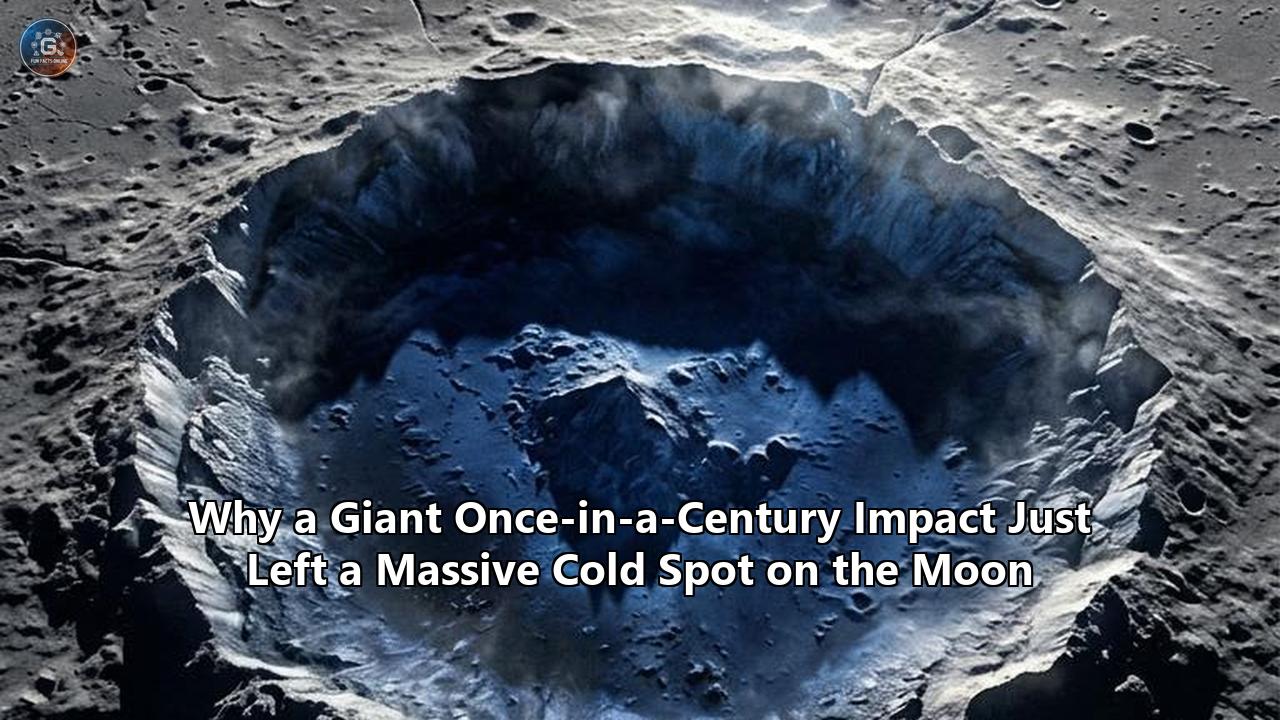
On September 16, 2026, researchers published a pair of studies in the journal Science Advances detailing the single largest newly formed impact crater documented anywhere in the solar system during modern observation. Located on the eastern limb of the Moon, the scar—officially named McGetchin crater—measures 728 feet (222 meters) across and plunges 141 feet (43 meters) into the lunar crust, deep enough to hold three yellow school buses stacked end-to-end. Crater-production models show an impact of this violence occurs on the Moon only once every 132 years.
Yet the structural crater itself is only the central scar of a much broader geological upheaval. Data gathered by NASA’s Lunar Reconnaissance Orbiter (LRO) revealed that the kinetic strike violently destabilized thousands of tons of lunar soil across a 4.3-mile (7-kilometer) radius, leaving behind a massive moon cold spot that has forced mission planners and planetary scientists to confront severe, unmapped hazards facing upcoming human and robotic surface missions.
Instruments aboard the orbiter recorded nighttime temperatures within this four-mile blast halo dropping 14 to 16 degrees Fahrenheit (8 to 9 Kelvin) colder than the surrounding terrain. The crash did not simply scatter boulders; it physically pulverized, decompated, and "fluffed" the lunar regolith, obliterating its density and destroying its ability to retain heat.
The revelation poses an immediate problem-solution crisis for lunar space exploration. First, it demonstrates that hypervelocity strikes degrade the mechanical bearing capacity and thermal profile of the lunar surface across areas dozens of times wider than their visible craters. Second, it exposes a troubling operational gap: the comet or asteroid—an object the size of a three-to-six-story building—slammed into the lunar surface undetected sometime between April 11 and May 22, 2024, yet humanity remained entirely unaware of the planetary collision until image-processing specialist Robert Wagner spotted an anomalous smudge on an orbital mosaic eighteen months later.
Now, as space agencies and private aerospace contractors prepare to deploy long-duration infrastructure under NASA’s Artemis campaign and international lunar base programs, engineers and planetary scientists are scrambling to develop countermeasures. From redesigned rover terramechanics and cryogenic thermal survival systems to autonomous orbital early-warning networks, the discovery of McGetchin’s thermal footprint has shifted how aerospace engineers evaluate the lunar operational environment.
The Anomaly on the Eastern Limb: Anatomy of a Cosmic Strike
The discovery of the McGetchin strike was an accident born of routine orbital surveillance. On October 24, 2025, Robert Wagner, an image-processing specialist at Intuitive Machines who works with the Lunar Reconnaissance Orbiter Camera (LROC) data stream, was performing standard differential analysis of global lunar imagery. Wagner was scanning a large composite map constructed from the spacecraft’s Wide-Angle Camera (WAC) when an unnatural optical signature caught his eye.
“It was by far the most obvious impact debris pattern I’ve ever seen in one of these images,” Wagner said during NASA’s announcement of the discovery. “I just stopped, dropped everything, and started looking into what that spot was.”
+-----------------------------------------------------------------------------+
|                      MCGETCHIN CRATER & THERMAL SIGNATURE                   |
+-----------------------------------------------------------------------------+
|  Metric                     Value                                           |
|  -------------------------  ---------------------------------------------   |
|  Impact Window              April 11 – May 22, 2024                         |
|  Discovery Date             October 24, 2025 (Confirmed late 2025/2026)     |
|  Impactor Estimated Size    3 to 6 stories tall (approx. 10–20 meters)      |
|  Crater Rim Diameter        728 feet (222 meters)                           |
|  Crater Depth               141 feet (43 meters)                            |
|  Recurrence Interval        Statistically once every 132 years              |
|  Cold Spot Extent           4.3 miles (7 kilometers) across                 |
|  Nighttime Thermal Deficit  14°F to 16°F cooler (8 to 9 Kelvin reduction)   |
|  Target Region              Eastern limb of the Moon                        |
+-----------------------------------------------------------------------------+
Follow-up imagery from the orbiter's high-resolution Narrow-Angle Camera (NAC)—capable of resolving surface details down to three feet per pixel—confirmed the presence of a massive, crisp crater ringed by a dark ejecta halo and sprawling, high-albedo rays. But the true scope of the event emerged when the mission team pointed the Diviner Lunar Radiometer Experiment (DLRE) at the coordinates.
Diviner, an infrared radiometer managed by the University of California, Los Angeles (UCLA) and the Johns Hopkins University Applied Physics Laboratory (APL), measures the thermal energy radiated from the lunar surface across nine spectral channels. By observing the Moon during its 14-day-long night, Diviner maps how quickly the surface sheds thermal energy.
The thermal data revealed a stark anomaly. While the exposed rocky interior of McGetchin crater remained relatively warm—boulders and bedrock possess high thermal mass and conduct heat efficiently—the vast expanse encircling the rim showed an intense drop in temperature. Tyler Powell, a planetary researcher at the Johns Hopkins Applied Physics Laboratory and lead author of the thermal study, confirmed that a circular swath measuring over 4 miles in diameter registered temperatures up to 9 Kelvin below the expected nighttime baseline.
This hyper-chilled zone represents the freshest, most clearly delineated example ever observed of an impact-generated thermal depression. While planetary scientists have cataloged more than 2,000 ancient cold spots across the lunar surface since the phenomenon was systematically identified in 2011, McGetchin provides the first opportunity to observe an extreme moon cold spot at the moment of its creation, before solar wind weathering and micrometeorite gardening begin to degrade it.
The Physical Mechanism: Why Massive Impacts Freeze the Surface
To understand why a hypervelocity impact produces a sustained thermal depression, one must examine the physics of lunar regolith in a high-vacuum environment.
On Earth, atmospheric pressure forces air into the microscopic spaces between soil grains, allowing convective and conductive heat transfer through the gas medium itself. On the airless Moon, there is no atmospheric gas to transfer heat. Heat conduction between soil particles depends almost entirely on the microscopic contact points where jagged mineral grains physically touch one another.
PRISTINE LUNAR REGOLITH (High Thermal Inertia)
  O===O===O    Grains tightly compacted by millions of years of micrometeorites
  | X | X |    High bulk density (1.5 - 1.9 g/cm³)
  O===O===O    Maximum physical grain-to-grain contact
  Result: Conducts daylight solar heat deep into subsurface; stays warmer at night.

DECOMPACTED "FLUFFED" COLD SPOT REGOLITH (Low Thermal Inertia)
    O   O      Shockwaves and ballistic ejecta shatter packing structure
      O        Porosity increases; bulk density plummets (< 1.0 g/cm³)
    O   O      Grain-to-grain contact points severed; vast vacuum voids
  Result: Heat cannot penetrate or store; radiates instantly into space at sunset.
Over billions of years, the Moon’s regolith undergoes a process called impact gardening. Constant bombardment by microscopic cosmic dust compacts the soil layers below the immediate top millimeter. At depths below 10 centimeters, the lunar soil is packed into a dense, interlocking matrix with a bulk density ranging between 1.5 and 1.9 grams per cubic centimeter. This dense packing gives undisturbed regolith high thermal inertia: it absorbs solar radiation during the two-week lunar day, conducts that energy into the shallow subsurface, and slowly bleeds it back into space during the two-week night.
The McGetchin impact violently shattered this equilibrium. When the multi-story object slammed into the basaltic crust at a velocity between 15 and 25 kilometers per second, the kinetic energy release was equivalent to hundreds of kilotons of TNT. The impactor and local bedrock instantly vaporized, excavating 43 meters of stratigraphy and hurling an expanding curtain of debris across the terrain.
Crucially, the kinetic energy dissipated via two distinct pathways that created the thermal anomaly:
- Seismic and Shockwave Decompaction: High-amplitude stress waves radiated horizontally through the uppermost layers of the lunar crust. This dynamic shaking broke the mechanical bonds between interlocking soil grains, fluidizing the upper regolith and expanding its volume.
- Low-Angle Ballistic Ejecta Raking: An ultra-fine, turbulent sheet of secondary pulverized ejecta sheared across the surrounding landscape. This low-angle debris curtain scraped the surface, lifting the native soil and redepositing it as an aerated, highly porous blanket.
This dual process "fluffed" the regolith across an area roughly thirty times larger than the physical crater rim. In this aerated state, the void ratio skyrocketed, reducing the bulk density of the upper layers by as much as 40 percent. Because the microscopic mineral particles were no longer held in tight contact under compression, heat conduction pathways were completely severed.
During the daylight hours, solar energy could not penetrate past the topmost few millimeters of this fluffed layer. Instead, it stayed trapped at the absolute surface and radiated back into space. When local sundown occurred, this low-density mantle possessed virtually no stored thermal energy in its subsurface reservoir.
As a result, the region underwent an immediate thermal collapse, shedding what little heat it held and cooling at a much faster rate than the surrounding, undisturbed lunar plains. The result was the formation of a distinct moon cold spot that stands out starkly against Diviner's nighttime infrared mosaics.
Challenge 1: The Terramechanical Sinking Trap
The discovery that a single impact can fluff the regolith across seven kilometers carries immediate operational consequences for surface mobility. For lunar vehicle designers, regolith is not just dust; it is a structural foundation that must support rovers, landers, and heavy habitats.
+-----------------------------------------------------------------------------+
|               REGOLITH PROPERTIES: UNDISTURBED VS. COLD SPOT                |
+-----------------------------------------------------------------------------+
|  Geotechnical Metric       Undisturbed Regolith      Cold Spot Regolith     |
|  ------------------------  ------------------------  ---------------------- |
|  Bulk Density              1.5 to 1.9 g/cm³          0.8 to 1.1 g/cm³       |
|  Porosity                  45% to 50%                65% to 80%             |
|  Internal Friction Angle   35° to 48°                20° to 30°             |
|  Cohesion                  0.5 to 3.0 kPa            < 0.1 kPa              |
|  Bearing Capacity          High (Minimal Sinkage)    Low (Severe Sinkage)   |
|  Thermal Inertia           Moderate to High          Critically Low         |
+-----------------------------------------------------------------------------+
When soil density drops, its shear strength and bearing capacity drop with it. In a freshly formed cold spot, the regolith loses its cohesion and friction angle, shifting from a firm, well-anchored aggregate into an uncompacted, fluid-like powder.
Historical evidence from the Apollo era confirms this physical phenomenon. During Apollo 16 in April 1972, astronauts John Young and Charles Duke landed the Lunar Module Orion in the Cayley Plains near Descartes Crater. The landing site was located within the ancient cold spot surrounding South Ray Crater.
Young and Duke repeatedly documented that their boots sank far deeper into the surface than did those of crews on Apollo 11, 12, or 14. The Lunar Roving Vehicle (LRV) experienced increased wheel slippage and dust entrainment, throwing up rooster tails of fine powder and demanding higher electrical power draw from its drivetrains to maintain forward momentum.
For the modern era of robotic and crewed exploration, the scale of equipment makes this decompaction problem far more severe:
- Heavy Robotic Rovers: Platforms such as the planned Artemis Lunar Terrain Vehicles (LTV) and cargo transports weigh between 1.5 and 5 metric tons. If such a vehicle unwittingly drives from dense regolith into an unmapped cold spot, the sudden loss of bearing capacity can cause immediate wheel entrapment.
- Chassis Grounding: As wheels spin in decompacted dust, they dig themselves down rather than generating traction. Once the rover's undercarriage contacts the regolith, frictional drag halts mobility entirely—a failure mode that permanently ended the operational life of NASA’s Spirit rover on Mars when it broke through a thin crust into loose, uncompacted sulfate sand.
- Dust Lofting and Electrostatic Adhesion: Decompacted regolith is far more susceptible to mechanical lofting. As wheels churn through aerated soil, microscopic, razor-sharp dust grains acquire strong triboelectric charges, adhering to optical lenses, thermal radiators, solar arrays, and astronaut suit fabrics.
Challenge 2: The Cryogenic Shock to Surface Power and Avionics
Beyond mobility, the thermal depression of a moon cold spot introduces a direct threat to spacecraft survival systems. Surviving the lunar night is already one of the most punishing thermal challenges in space engineering, with equatorial temperatures regularly sinking to 100 Kelvin (-173°C / -280°F) and polar microclimates dropping below 40 Kelvin.
Spacecraft systems rely on strictly balanced thermal architectures. When an automated lander or rover enters the 354-hour lunar night, it maintains internal electronics within safe operational temperature envelopes (-40°C to 0°C) through a combination of:
- Multi-Layer Insulation (MLI) blankets,
- Solid-state or variable-conductance heat pipes,
- Radioisotope Heater Units (RHUs) or electrical survival heaters powered by lithium-iron-phosphate or solid-state batteries.
Every milliwatt of heating power is budgeted based on standard thermal inertia maps of the lunar regolith. In undisturbed terrain, the ground beneath a lander acts as a passive thermal buffer, slowly conducting stored daytime heat back into the environment and preventing an immediate thermal free-fall.
SURFACE THERMAL ENERGY BALANCE (LUNAR NIGHT)
Normal Regolith:
  [Subsurface Heat Reservoir] ---> Slow Upward Conduction ---> Ground Temp: ~100 K
  Lander Thermal Budget: Stable within designed margins.

Cold Spot Regolith:
  [Subsurface Reservoir Empty] ---> Conduction Severed ---> Ground Temp: ~91 K (-16°F)
  Lander Thermal Budget: Radiative heat leak to ground accelerates; heaters fail.
Inside a cold spot like the one surrounding McGetchin crater, that thermal buffer does not exist. The ground functions as a hyper-chilled thermal sink. With nighttime surface temperatures plummeting an additional 16°F (8 to 9 Kelvin), the radiative heat loss from lander footpads, chassis undersides, and exposed structural components accelerates dramatically.
This localized plunge has the potential to overwhelm electrical heater circuits:
- Battery Chemistry Failure: Conventional aerospace lithium-ion cells suffer permanent capacity degradation and electrolyte freezing if their core temperatures dip below -20°C. A sustained 9 Kelvin drop in the external thermal sink can drain survival batteries days before lunar dawn.
- Structural Thermal Stress: Rapid temperature differentials induce severe thermal contraction across structural interfaces. Welds between dissimilar metals, optical adhesives, and ceramic semiconductor packagings risk brittle shear fractures.
- Power Margin Depletion: Solar-powered landers engineered to awaken at sunrise may experience complete system death if their primary power bus freezes during the final, ultra-cold hours of the night cycle.
Challenge 3: The Undetected Kinetic Hazard in Cislunar Space
The third challenge exposed by McGetchin crater is architectural: planetary defense and space situational awareness networks completely failed to detect an impactor capable of excavating a 700-foot crater until eighteen months after the collision.
TIMELINE OF THE MCGETCHIN STRIKE
==================================================================================
April 11 – May 22, 2024:
  An undetected comet or asteroid (10–20 meters wide) approaches from a solar
  blind spot and impacts the Moon's eastern edge at hypervelocity. No Earth-based
  optical survey, orbital satellite, or seismic station registers the event.
  --------------------------------------------------------------------------------
October 24, 2025:
  Image specialist Robert Wagner flags an anomalous optical ray pattern while
  manually processing routine Lunar Reconnaissance Orbiter Camera mosaics.
  --------------------------------------------------------------------------------
Late 2025 – Early 2026:
  Targeted observations using LRO's Narrow-Angle Camera and Diviner Radiometer
  confirm a 222-meter-wide crater and a 7-kilometer-wide thermal cold spot.
  --------------------------------------------------------------------------------
September 16, 2026:
  A pair of studies published in Science Advances officially announces the find,
  characterizing the largest newly formed crater discovered in modern history.
==================================================================================
An object three to six stories tall—measuring roughly 10 to 20 meters across—is roughly the same size as the Chelyabinsk meteor that entered Earth’s atmosphere over Russia in February 2013. While Earth's thick atmosphere absorbs the vast majority of such kinetic energy through explosive atmospheric airbursts, the Moon has no atmosphere. Any rock that encounters the lunar orbital plane strikes the ground at full terminal velocity.
Scientists calculate that the strike hurled millions of kilograms of primary and secondary debris on suborbital trajectories across thousands of square kilometers. High-velocity ballistic fragments from an impact of this scale can travel hundreds of miles across the Moon, maintaining sufficient kinetic energy to puncture pressurized habitat modules, destroy communications towers, or compromise thin-skinned propellant tanks located on the lunar surface or in low lunar orbit.
The fact that McGetchin occurred without triggering alarms demonstrates that current cislunar surveillance architectures remain blind to small, dark, high-velocity impactors approaching from the Sun’s glare. Had human crews or modular base assets been deployed within a 50-mile radius of the eastern limb during April or May of 2024, they would have had zero warning of the impending blast, the incoming ballistic hail, or the sudden alteration of their surrounding terrain.
The Engineering Countermeasures: Adapting Rover Mobility
Faced with the reality that large swathes of the lunar surface harbor decompacted regolith traps, mechanical engineers at NASA, the European Space Agency (ESA), and private aerospace institutions are altering surface mobility designs.
Shape-Memory Alloy (SMA) Compliant Wheels
Traditional rigid aluminum wheels—such as those used on the Apollo Lunar Roving Vehicle and the Mars Curiosity and Perseverance rovers—rely on fixed grousers (treads) to generate traction through soil shear. In low-density, fluffed cold spot regolith, these rigid wheels act as augers, rapidly excavating pits and sinking the axle.
To mitigate this, engineers at NASA’s Glenn Research Center have accelerated the development of non-pneumatic, compliant tires made from nickel-titanium shape-memory alloys (Nitinol). These tires consist of an interconnected mesh of radially woven SMA wires that deform elastically at the macroscopic level when contacting the ground:
- Contact Area Expansion: When driving over uncompacted regolith, the Nitinol mesh deflects significantly, increasing the tire’s contact patch by up to 300 percent. This dramatically lowers the ground pressure (force per unit area) exerted by the vehicle.
- Tire Envelopment: Rather than shearing through loose regolith, the compliant tire envelopes terrain irregularities, utilizing friction across a broad surface area rather than mechanical gouging. This preserves the delicate structure of fluffed dust and prevents catastrophic vehicle sinkage.
RIGID ALUMINUM WHEEL (High Ground Pressure)
      |   |
    (-------)   Point load concentrates at wheel base.
     \     /    Shears decompacted soil; digs trenches.
   ---'---'---  Result: High sinkage risk in cold spots.

COMPLIANT NITINOL MESH TIRE (Low Ground Pressure)
      |   |
    (       )   Tire flexes and pancakes upon contact.
   (_________)  Distributes vehicle mass across large footprint.
  ------------  Result: Minimal sinkage; climbs over loose regolith.
Active Terramechanics and Autonomous Slip Detection
Hardware changes are being paired with dynamic software countermeasures. Autonomous driving suites for next-generation lunar vehicles now incorporate real-time terramechanics monitoring:
- Drive-Motor Torque Profiling: By continuously measuring the electrical current drawn by individual in-hub wheel motors alongside high-rate inertial measurement unit (IMU) data, flight computers can calculate wheel slip rates within milliseconds.
- Autonomous Inch-Worming: If slip rates exceed critical thresholds (e.g., >20%), the vehicle halts conventional rotation. Advanced articulated chassis can transition into "wheel-walking" or peristaltic locomotion, moving one axle at a time while the remaining wheels act as fixed ground anchors.
- Ground-Penetrating Radar (GPR) Pre-Scouting: Scout rovers are being equipped with high-frequency GPR systems derived from Mars 2020’s RIMFAX and China’s Chang'e 4/5 subsurface radars. By transmitting microwave pulses into the upper two meters of regolith ahead of the vehicle, the radar can detect sharp density gradients, warning operators of decompacted zones before the rover crosses into a hazard area.
The Thermal Solutions: Defeating the Subsurface Cryogenic Sink
To safeguard long-duration surface infrastructure against the thermal collapse identified within cold spot boundaries, structural engineers are overhauling thermal protection protocols for habitats, power plants, and landers.
+-----------------------------------------------------------------------------+
|                  THERMAL DEFENSE ARCHITECTURES FOR BASES                    |
+-----------------------------------------------------------------------------+
|  Technology             Mechanism                  Engineering Function     |
|  ---------------------  -------------------------  -----------------------  |
|  Aerogel Thermal Pylons Low-conductivity silica    Prevents direct thermal  |
|                         aerogel mechanical breaks  loss into cold regolith  |
|  Microwave In-Situ      Regolith dielectric        Sinters fluffed soil     |
|  Sintering              heating via 2.45 GHz waves into dense ceramic pads  |
|  Variable-Conductance   Two-phase capillary loops  Shuts off heat pipe flow |
|  Heat Pipes (VCHPs)     with non-condensable gas   during thermal dips      |
|  Active Density Maps    Integration of Diviner     Routes navigation around |
|                         radiometer GIS layers      low-inertia terrain      |
+-----------------------------------------------------------------------------+
Structural Thermal Decoupling
Standard lander designs utilize aluminum or titanium footpads that rest directly on the lunar surface. In a cold spot, direct contact with decompacted regolith creates a severe conductive heat leak.
Engineers are implementing structural thermal isolators within lander landing gear assemblies. By inserting high-strength, low-thermal-conductivity silica aerogels or carbon-fiber-reinforced polyether ether ketone (PEEK) mechanical breaks between the footpads and the primary structural struts, spacecraft can choke off the thermal conduit feeding into the freezing ground.
Simultaneously, habitat designs are moving toward elevated foundations. Rather than resting primary pressurized hulls directly on the regolith, habitats are being configured on adjustable telescoping pylons that maintain a 0.5-to-1-meter vacuum gap between the habitat hull and the lunar surface, relying on high-emissivity bottom coatings to control radiative exchange.
In-Situ Microwave Sintering
Rather than simply enduring decompacted regolith, civil engineering programs are developing methods to actively reverse the damage caused by hypervelocity strikes. NASA's Space Technology Mission Directorate and private entities such as Astroport Space Technologies are developing autonomous microwave sintering platforms.
Lunar regolith contains abundant nanophase metallic iron ($Fe^0$) produced by space weathering. When exposed to microwave radiation at frequencies between 2.45 GHz and 5.8 GHz, these microscopic iron particles couple with the electromagnetic field, heating the surrounding silicate minerals past their melting point (roughly 1,100°C to 1,250°C) within minutes.
By deploying mobile rover-mounted microwave emitter horns, surface teams can drive over decompacted, fluffed terrain, melting the porous dust into dense, vitreous basaltic pavers. This process:
- Reconstitutes the mechanical shear strength of the ground to support heavy machinery,
- Restores high thermal mass and density, permanently eliminating the localized cold spot anomaly beneath landing pads and road corridors.
Integration of Diviner High-Resolution GIS into Mission Trajectories
The planetary science community is translating basic Diviner observations into operational navigational constraints. NASA’s Planetary Data System now hosts the Diviner Global High-Resolution Mosaics (GHRM), which map the thermal inertia and nighttime surface temperatures across the lunar globe at resolutions down to 50 meters per pixel.
Flight software for upcoming missions—including the Commercial Lunar Payload Services (CLPS) landers and human landing systems—is incorporating automated "no-land" and "slow-transit" exclusion zones around cataloged cold spots. Any region exhibiting a nighttime temperature deficit exceeding 5 Kelvin is flagged in operational software, forcing automated landing guidance systems to divert landing ellipses away from uncompacted ejecta halos toward geotechnically stable, high-thermal-inertia terrains.
Closing the Detection Gap: Planetary Defense and Orbital Surveillance
The fact that McGetchin crater sat undetected on the Moon for over a year highlights the need for continuous, automated surveillance of cislunar space. Relying on human image processors to manually spot smudges on orbital mosaics is an insufficient strategy for protecting human lives on another celestial body.
THE CISLUNAR EARLY-WARNING ECOSYSTEM
----------------------------------------------------------------------------------
   [NEO SURVEYOR (Infrared)]        [CISLUNAR SDA SATELLITES]
   Detects incoming 10m-class       Tracks high-velocity objects
   dark asteroids via thermal       near Earth-Moon Lagrange points
   emissions from orbit.            (L1, L2, Halo Orbits).
             |                                    |
             +-----------------+------------------+
                               |
                               v
           [AUTOMATED LUNAR SURFACE DETECTION]
           LRO NAC / Wide-Angle Orbital Feeds
           AI Machine Vision Edge Pipelines
           Flags impacts & thermal changes instantly.
                               |
                               v
           [SURFACE BASE & ASSET WARNING NETWORK]
           Triggers immediate alerts:
           - Astronaut shelter-in-place protocols
           - Autonomous rover halt-and-anchor routines
           - Redirection of inbound landing trajectories
----------------------------------------------------------------------------------
AI-Driven Automated Change Detection
NASA and commercial space operators are deploying automated machine vision algorithms directly into the processing pipelines for lunar orbital imagery.
Instead of waiting months for global mosaics to be assembled and reviewed by analysts, convolutional neural networks (CNNs) trained on temporal pairs of LROC Narrow-Angle Camera frames now automatically cross-compare every new orbital strip against baseline terrain models. The software flags subtle optical alterations—such as fresh ray systems, dark ejecta blankets, and localized albedo variations—within minutes of raw telemetry downlinking to ground stations.
Parallel machine-learning models are integrated into Diviner’s incoming thermal data streams, continuously calculating deviations from seasonal nighttime baselines to detect newly developing cold spots in real time.
Cislunar Space Domain Awareness (SDA)
To catch impactors before they collide with the Moon, defense and civil agencies are extending Space Domain Awareness networks beyond geosynchronous Earth orbit (GEO) out into deep cislunar space:
- NEO Surveyor: Scheduled to launch later this decade, NASA’s dedicated infrared space telescope will operate from the Sun-Earth L1 Lagrange point. By observing in the thermal infrared bands (4 to 10 microns), NEO Surveyor can detect small, dark asteroids and comets heated by the Sun, independent of their optical albedo or trajectories relative to solar glare.
- Lagrange Spacecraft Constellations: The U.S. Space Force and international partners are designing cislunar monitoring constellations positioned in halo orbits around the Earth-Moon L1 and L2 Lagrange points. These spacecraft carry wide-field optical sensors designed to track small, high-velocity objects transiting through the cislunar corridor, closing the observational blind spot that allowed the McGetchin impactor to slip through undetected.
Lunar Seismic Sensor Arrays
Orbital optical monitoring is being matched by seismic monitoring on the surface. Under upcoming CLPS deliveries and international science payloads, high-sensitivity broadband seismometers—such as the FARSIDE array and instruments on future Artemis surface missions—are being emplaced across the lunar crust.
When a hypervelocity strike occurs, seismic p-waves and s-waves propagate rapidly through the lunar interior. A network of three or more surface seismometers can instantly triangulate the exact coordinates, kinetic energy release, and approximate excavation diameter of an impact anywhere on the lunar globe within seconds of collision, immediately providing surface personnel with precise location data and hazard assessments for ejecta falloff and decompaction zones.
Long-Term Implications for Solar System Evolution and Human Settlement
The discovery of McGetchin crater and its surrounding four-mile thermal depression changes fundamental assumptions about the rate and nature of planetary surface evolution.
                               COLD SPOT LIFECYCLE

       IMPACT EVENT             10,000 YEARS            500,000 - 1,000,000 YEARS

  (Hypervelocity Strike)   (Micrometeorite Rain)       (Complete Equilibrium)
  - Severe decompaction    - Gradual compaction        - Regolith re-densifies
  - Thermal inertia drops  - Soil grains settle        - Thermal inertia returns
  - 4+ mile cold anomaly   - Cold spot edges fade      - Cold spot vanishes completely
For decades, the prevailing scientific view held that airless planetary bodies like the Moon change at an imperceptibly slow pace, altered only by continuous micrometeorite weathering over millions of years. McGetchin proves that catastrophic physical restructuring happens abruptly in single, high-energy punctuation marks. A single rock the size of a small apartment building can instantaneously rework the geomechanical and thermal properties of more than 50 square kilometers of surface area.
Planetary scientist Rebecca Ghent of the Planetary Science Institute, who has studied lunar thermal anomalies extensively, points out that having real-time, high-precision thermal data from an impact of this magnitude fundamentally refines our understanding of lunar surface ages.
Because cold spots fade over time as subsequent micrometeorite impacts and natural seismic tremors slowly recompact the fluffy regolith back to its original density—a process estimated to take between 500,000 and 1,000,000 years—the temperature deficit of a cold spot acts as a planetary clock. By measuring the precise rate at which McGetchin’s cold spot fades over the coming decades, scientists will finally calibrate the absolute timeline of lunar soil compaction.
For human civilization, the lesson of McGetchin is pragmatic. The Moon is not a passive, static sandbox. It is an active target range exposed to the deep solar system, where the ground itself can be shattered, aerated, and thermally transformed without warning.
As the Artemis program, international space agencies, and commercial ventures move from short-duration footprints to permanent settlements, their success will depend on mastering these hidden dynamics. Navigating the lunar frontier requires recognizing that when an impactor strikes the Moon, the greatest hazard may not be the hole it leaves in the rock, but the invisible, freezing trap it leaves in the soil.
Key Takeaways
- The Event: A building-sized asteroid or comet fragment struck the eastern limb of the Moon between April and May 2024, carving out McGetchin crater—at 728 feet wide and 141 feet deep, it is the largest newly formed crater discovered in the solar system during the space age.
- The Anomaly: Follow-up observations by the Diviner radiometer aboard NASA's Lunar Reconnaissance Orbiter revealed that the impact generated a 4.3-mile-wide (7 km) moon cold spot where nighttime surface temperatures drop up to 16°F (8–9 K) colder than the surrounding terrain.
- The Physics: Shockwaves and low-angle ballistic ejecta violently "fluffed" and decompacted the lunar soil over an area thirty times wider than the crater itself, dropping bulk density, severing thermal conduction contact between grains, and collapsing the regolith's thermal inertia.
- The Engineering Hazards: Decompacted regolith inside cold spots poses severe terramechanical hazards (causing heavy rovers to lose traction, sink, and experience chassis grounding) and thermal survival risks (accelerating radiative heat loss and draining survival batteries during the 14-day lunar night).
- The Operational Blind Spot: The impact went entirely undetected for eighteen months until an analyst manually identified the debris signature in October 2025, revealing significant gaps in cislunar planetary defense and space domain awareness.
- The Solutions: Engineers are rolling out non-pneumatic shape-memory alloy (SMA) mesh tires, autonomous slip-monitoring algorithms, foundation aerogel thermal breaks, in-situ microwave regolith sintering, and AI-driven automated orbital change detection to secure future surface exploration.
Reference:
- https://www.smithsonianmag.com/smart-news/the-moon-just-got-a-massive-new-crater-thats-wider-than-two-end-to-end-football-fields-its-a-once-in-a-lifetime-observation-180989526/
- https://www.space.com/astronomy/moon/nasa-just-found-a-giant-new-crater-on-the-moon-heres-why-everyones-talking-the-once-in-a-century-discovery
- https://science.nasa.gov/solar-system/moon/nasas-moon-orbiter-spots-new-once-in-century-moon-crater/
- https://www.sciencedaily.com/releases/2026/09/260917003715.htm
- https://gizmodo.com/something-crashed-into-the-moon-in-2024-leaving-a-curiously-cold-once-in-a-century-crater-2000813365
- https://www.iflscience.com/the-moon-has-a-massive-new-crater-over-200-meters-wide-thats-larger-than-the-colosseum-84676
- https://en.wikipedia.org/wiki/Cold_spot_(astronomy))
- https://www.sci.news/space/mcgetchin-crater-15076.html
- https://www.forbes.com/sites/jamiecartereurope/2026/09/17/nasa-orbiter-discovers-once-in-a-century-moon-crater/
- https://skyandtelescope.org/astronomy-news/once-in-a-century-impact-made-a-cold-spot-on-the-moon/
- https://earthsky.org/space/newly-formed-moon-crater-mcgetchin/