The damp, dense canopy of the Spała forest, situated within the administrative district of Gmina Inowłódz in central Poland, has long been a repository for the heavy iron relics of modern warfare. For years, local history enthusiasts have combed these woodlands to document the trenches, bunkers, and discarded military hardware of the mid-twentieth century. But a routine sweep by a group of licensed metal detectorists recently yielded a find that has completely bypassed the modern era, plunging researchers into a deep, cross-chronological riddle.
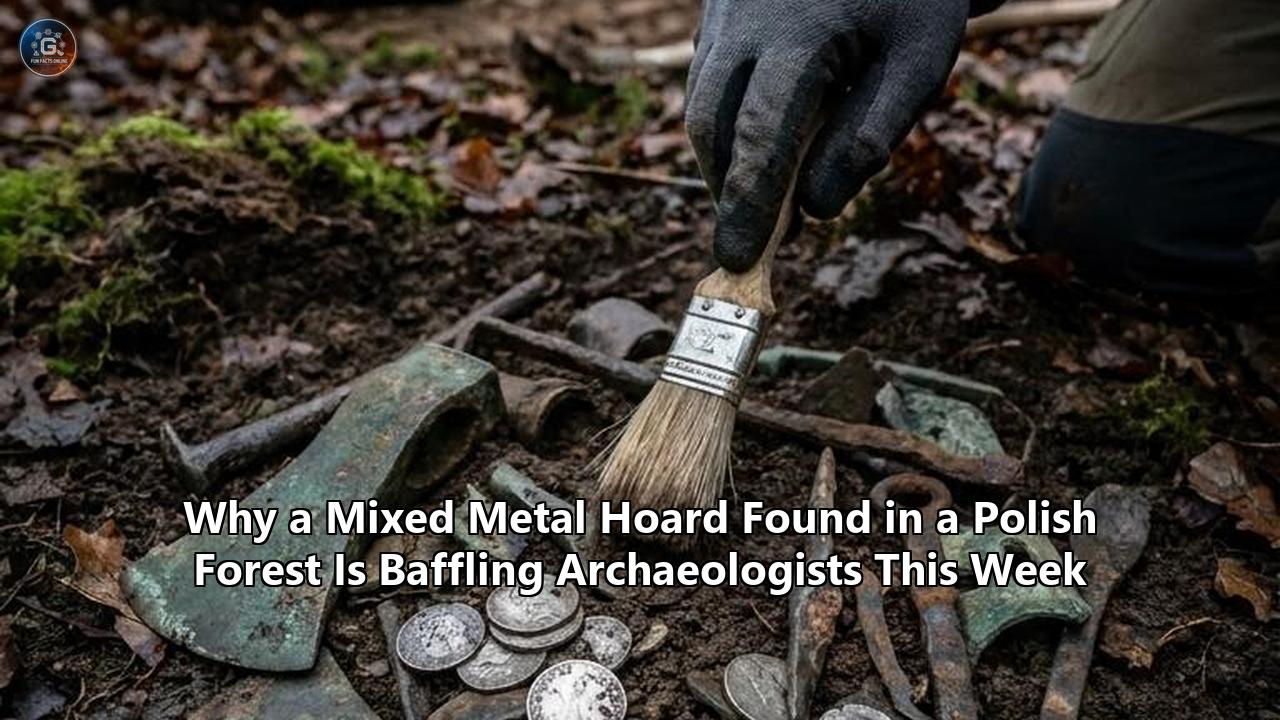
A team from the Pilica Line Fortification Society (Stowarzyszenie Historyczno-Eksploracyjne "Linia Pilicy"), led by Bartosz Koperkiewicz, registered a deep, resonant electromagnetic signal that was far too clean to be the jagged shrapnel of a World War II artillery shell. Digging carefully into the rich forest loam, they uncovered a cached assemblage of ancient personal ornaments, weapons, and defensive armor.
The find includes several massive spiral armlets, a complete metal knife, a heavy bracelet, and fragments of ancient greaves—the specialized armor designed to protect a warrior’s lower legs. Most critically, the assemblage features small, delicate yellow metal pieces that are believed to contain gold.
What has left regional specialists and academic archaeologists intensely puzzled is not merely the pristine preservation of these items, but their composition and chronological implications. The artifacts do not belong to a single, neat technological epoch. Instead, this latest Polish metal hoard discovery presents an unexpected hybrid of bronze and iron, effectively crossing the grand transition between two major prehistoric eras in a single, buried deposit.
The Legal and Bureaucratic Arena of Polish Detectorists
To understand how this Polish metal hoard discovery was saved for scientific analysis—rather than disappearing into the lucrative black market of private antiquities—one must look at the strict, often tense legal environment governing historical exploration in Poland.
Historically, Poland has maintained some of the most stringent antiquities laws in Europe. Under the Act on the Protection and Care of Historical Monuments, any object of historical, artistic, or scientific value buried in the earth is the absolute property of the Polish state. Until recently, using a metal detector to search for such items without a highly specific, hard-to-obtain permit from the regional Wojewódzki Konserwator Zabytków (Provincial Conservator of Monuments) was classified as a crime, carrying potential prison sentences of up to two years.
Even when detectorists operated legally, finding an ancient site required them to immediately halt all excavation, secure the area, and report the coordinates to state authorities. This dynamic created decades of friction, with many hobbyists choosing to hide their finds or sell them abroad out of fear of prosecution, while archaeologists lamented the irreversible loss of stratigraphic context caused by untrained diggers.
The discovery in the Spała forest serves as a textbook example of how the system is designed to work when relations between amateur explorers and state institutions are cooperative. Bartosz Koperkiewicz’s group, though primarily dedicated to twentieth-century military history, held the necessary regional permits to conduct searches in the Gmina Inowłódz area.
[ Electromagnetic Signal Detected by Linia Pilicy Team ]
                       │
                       ▼
         [ Excavation Immediately Halted ]
                       │
                       ▼
 [ GPS Coordinates Logged & Reported to Łódź Conservator ]
                       │
                       ▼
  [ Rapid Permits Issued for Archaeological Excavation ]
                       │
                       ▼
 [ Controlled Recovery of Bronze, Iron, & Potential Gold ]
When Koperkiewicz’s detector registered the distinct signature of the hoard, he resisted the urge to shovel out the entire pit. He knew that the physical arrangement of the items in the soil—the stratigraphy, the presence of organic container remnants, and the precise depth—holds as much scientific value as the metal itself.
Koperkiewicz immediately marked the GPS coordinates, backfilled the shallow test hole to protect the find from nocturnal looters, and contacted the provincial conservation office in Łódź. Regional authorities moved swiftly, issuing emergency excavation permits that allowed a collaborative team of professional archaeologists and the detectorists to systematically uncover the deposit under controlled, scientific conditions.
The Metallurgical Paradox of the Spała Greaves
The central mystery of the Spała hoard lies in the elemental makeup of the defensive armor, particularly the leg greaves. The fragments of these protective plates are made of both bronze and iron. To a modern observer, this might seem like a natural pairing of available metals, but to an archaeometallurgist, it represents a profound technological anomaly.
During the transition from the Late Bronze Age to the Early Iron Age in Central Europe—roughly spanning 800 to 500 BCE—the two metals occupied completely different spheres of production, ritual value, and physical manipulation.
| Feature / Metal | Bronze (Copper-Tin Alloy) | Iron |
|---|---|---|
| Melting Point | Approximately 950°C to 1085°C | 1538°C |
| Production Method | Casting in stone/clay molds | Smelting in bloomeries (spongy bloom), hand-forging |
| Structural Integrity | Rigid, brittle if over-alloyed with tin; highly recyclable | Malleable, tough; prone to rapid oxidation (rust) |
| Socio-Political Status | Well-established elite status; controlled trade networks | Rare, exotic, and highly experimental in the early phase |
For centuries, Central European smiths of the Lusatian culture had mastered the art of bronze casting. They could control the ratio of copper to tin with high precision, creating highly ornate, fluid designs.
Iron, however, introduced an entirely new physical paradigm. Early European ironworkers could not reach the high temperatures required to melt the metal fully. Instead, they produced a spongy mass of iron and slag known as a "bloom," which had to be laboriously hammered, folded, and forge-welded while red-hot.
The Spała greaves show evidence of both casting (bronze components) and forging (iron structural or decorative pieces). Joining these two materials in a single object is incredibly difficult due to their wildly divergent physical properties:
- Thermal Expansion Discrepancy: Bronze expands and contracts at a significantly higher rate than iron when heated and cooled. If a smith attempted to cast bronze elements directly onto an iron base, the cooling bronze would shrink rapidly, placing immense stress on the joint and causing the cast bronze to crack or peel away from the iron.
- The Galvanic Corrosion Trap: When bronze and iron are in direct contact in a damp environment (such as the acidic, water-retaining soils of a Polish pine forest), they create a galvanic couple. The iron acts as an anode and the bronze as a cathode, drastically accelerating the oxidation of the iron. Any ancient smith who designed a hybrid piece of armor was unwittingly creating a self-destructing object unless they utilized specialized insulating materials, such as organic leather or pitch liners, between the metal layers.
- Mechanical vs. Thermal Joining: Archaeologists are currently analyzing the greave fragments to determine how the two metals were joined. Were they held together by cold-hammered bronze rivets driven through punched holes in the forged iron plate? Or did the artisan use a highly sophisticated "cast-on" technique, where the molten bronze was poured into a mold containing a pre-forged iron strip?
The presence of these hybrid greaves suggests that the armor was not a standardized piece of military equipment. It was likely a highly bespoke, experimental creation, possibly commissioned by an elite warrior seeking to harness the novel strength of iron while retaining the glittering, prestigious aesthetic of bronze.
The Chronological Maze of the Coiled Spirals
If the greaves present a metallurgical challenge, the spiral armlets in the hoard present a chronological one. These coiled, spring-like bands of metal, designed to be worn wrapped tightly around the biceps or forearms, are styled in a manner that makes them notoriously difficult to date.
       [======]  <- Coiled "spring" design (highly elastic)
      [========]
     [==========] <- Tapered terminals (sometimes flattened or "foot-like")
      [========]
       [======]  <- Symmetrical geometric incisions (chevron/rhombus motifs)
Double-spiral ornaments and multi-coiled armbands are among the most enduring designs in Central European prehistory. They first appear during the Middle Bronze Age (around 1400 BCE) and continue to be produced in various forms through the Hallstatt period of the Early Iron Age (ending around 450 BCE).
Without closer, destructive laboratory analysis of the metal's trace elements, typological dating based on visual inspection alone is virtually impossible. Some spirals feature simple, undecorated, smooth-drawn wire; others are adorned with incredibly complex geometric incisions, including chevron, herringbone, and nested rhombus motifs.
In the case of this Polish metal hoard discovery, the spirals exhibit a high level of decorative finish that resembles the classic Lusatian culture style, which dominated the Polish landscape for nearly a millennium. However, the inclusion of forged iron in the very same deposit suggests that these spirals may have been curated heirlooms.
It was not uncommon in prehistory for communities to keep bronze ornaments in active circulation for generations, passing them down as ancestral treasures before they were finally committed to the earth. If the spirals are indeed centuries older than the iron greaves, the hoard represents a "multi-generational" accumulation, complicating the efforts of archaeologists to assign a single, clean date to the burial event.
Ritual Deposition or Urgent Panic? The Landscape Mystery
The physical location of the find adds another layer to the puzzle. The Spała woodland is not currently associated with any known prehistoric settlement or cemetery. It is a quiet, relatively isolated stretch of the Pilica River valley.
In Baltic and Slavic archaeology, the context of a hoard's burial is critical to interpreting its original social function. Archaeologists generally divide prehistoric metal hoards into three distinct behavioral categories:
1. The Votive/Ritual Offering
In this scenario, precious metals were permanently taken out of circulation and dedicated to deities, ancestral spirits, or personified forces of nature. These deposits are frequently found in wet, liminal areas of the landscape—marshes, bogs, river bends, or deep, ancient forests.
The choice of personal ornaments (armlets, bracelets) and defensive armor (greaves) strongly supports a ritual interpretation. In many ancient European societies, dedicating a warrior's defensive gear or personal symbols of status was a powerful statement of sacrifice, perhaps marking a treaty, a boundary line, or a transition of tribal leadership.
2. The Merchant/Founder's Cache
During the Bronze and Iron Ages, traveling smiths and traders frequently buried raw ingots, broken tools, foundry waste, and finished objects for safekeeping while they moved between settlements. These hoards are characterized by a high volume of broken or half-finished items (scrap metal) and a lack of clear symbolic organization.
However, the Spała hoard consists of high-status, intact, or near-intact personal and martial items, making it highly unlikely to be a simple scrap pile for a wandering metalworker.
3. The Emergency Cache (Panic Burial)
When war, raiders, or sudden migrations threatened a community, wealthy individuals would bury their most portable and valuable assets in the ground, intending to return and retrieve them once the danger passed. If the owner was killed, captured, or permanently displaced, the treasure remained buried for millennia.
[ Emergency Cache Theory ]
  Threat of War/Invasion -> Elite Warrior buries valuable gear -> Warrior never returns

[ Votive Offering Theory ]
  Treaty or Sacred Event -> Ceremonial burial of elite gear -> Permanent dedication to spirits
Poland's landscape is highly fertile ground for these panic burials. For comparison, in November 2025, archaeologists in the Knyszyńska Forest Landscape Park uncovered a 17th-century hoard of Dutch gold and regional silver coins buried during the chaotic Swedish invasion known as "The Deluge".
While that coin find is separated from the Spała forest hoard by over two thousand years, the human behavior driving the two burials may have been identical: a desperate attempt to hide wealth from an approaching enemy.
The critical difference is that the Spała hoard dates to an era where the Pilica River valley was an active conduit for trade and migration. The river served as a prehistoric highway, linking the amber-rich Baltic coast to the highly developed Hallstatt culture centers of Southern and Central Europe.
An elite traveler moving along this corridor may have found themselves pursued or ambushed, forcing them to bury their heavy, conspicuous armor and valuable gold-accented jewelry in the forest before attempting to escape.
Contrast of Discoveries: Spała vs. Śniatycze
To truly appreciate why the mixed metal nature of the Spała hoard is so baffling, it is useful to contrast it with another major Polish archaeological development: the discovery of the Śniatycze bronze hoard in southeastern Poland.
Uncovered by a licensed detectorist and excavated by a joint team from Zamość and Kraków, the Śniatycze hoard consists of 18 highly ornate bronze ornaments, including matching pairs of heavy spiral anklets and bracelets weighing nearly eight pounds in total. Dated securely to the Hallstatt D period (around 550 to 400 BCE), the Śniatycze find is a classic, pure bronze assemblage of the Lusatian culture.
  [ Śniatycze Hoard ]                  [ Spała Forest Hoard ]
  ──────────────────                  ──────────────────────
  • 100% Bronze Ornaments             • Hybrid Bronze & Iron
  • Homogeneous Style (Lusatian)      • Mixed Typology (Spirals & Greaves)
  • Securely Dated (Hallstatt D)      • Chronological Riddle
  • Heavily Ornamented Jewelry        • Martial Gear + Jewelry + Potential Gold
The Śniatycze find, while spectacular, is culturally "tidy". It fits cleanly into the established understanding of prehistoric trade and ornament styles in eastern Poland, where bronze remained the dominant medium for elite display well into the local transition to the Iron Age.
In contrast, the Spała forest hoard refuses to cooperate with established neat categorizations. It forces archaeologists to grapple with a messy, overlapping world where bronze and iron technologies were being actively experimented with on the very same objects, in a region where such martial and personal items are rarely found together.
Behind the Laboratory Doors at the Count Antoni Ostrowski Museum
Following its careful extraction from the Spała forest floor, the mixed metal hoard was transferred directly to the Count Antoni Ostrowski Museum (Muzeum im. hr. Antoniego Ostrowskiego) in Tomaszów Mazowiecki. Here, far from the public eye, the artifacts are undergoing a high-stakes, multi-phase conservation process that highlights the delicate, technical reality of modern archaeological science.
      [ Unconserved Artifacts from Spała Forest ]
                         │
                         ▼
        [ Micro-X-Ray CT Diagnostic Scanning ]
                         │
                         ▼
          [ Chemical Desalination Baths ]
         (To halt active iron/bronze decay)
                         │
                         ▼
     [ Hand-Cleaned via Stereomicroscopy & Scalpels ]
                         │
                         ▼
    [ X-Ray Fluorescence (XRF) Elemental Analysis ]
 (To map metal alloy ratios and verify gold presence)
The first, and most urgent, challenge facing the museum’s conservation team is the physical stabilization of the metals. The iron fragments are heavily corroded, covered in thick, brittle crusts of iron oxide (rust) and dirt that threaten to flake away, taking crucial surface details with them.
The Diagnostic Phase: X-Ray CT Scanning
Before any physical cleaning begins, the conservators are utilizing high-resolution X-ray micro-computed tomography (micro-CT). This non-destructive scanning technology allows researchers to peer inside the corroded crusts of the greave fragments and the knife.
The CT scans generate three-dimensional digital models of the metal cores beneath the corrosion, revealing:
- The exact thickness of the original iron plates.
- The presence of hidden decorative engravings or makers' marks hidden by rust.
- The internal structure of the joints where the bronze and iron elements meet.
The Chemical Stabilization Phase
Once the internal structures are mapped, the artifacts must be stabilized. Iron and bronze cannot be treated in the same manner.
For the bronze elements, the main threat is "bronze disease"—a highly destructive, self-sustaining chemical reaction that occurs when chlorides in the soil react with copper to form hydrochloric acid, rapidly eating away the metal. Conservators must bath the bronze in solutions of benzotriazole (BTA) or sodium carbonate to neutralize these active chlorides.
For the heavily corroded iron pieces, the museum team is employing complex desalination processes. The fragments are submerged in alkaline sodium hydroxide baths for weeks, with the temperature and chemical concentration meticulously monitored. This process draws out the destructive chloride ions embedded deep within the porous, rusted iron matrix, halting the active decay before the metal is dried and sealed with specialized microcrystalline waxes.
The Micro-Excavation of Ornaments
The spiral armlets and the bracelet are being cleaned under stereomicroscopes using delicate hand tools, including fine scalpels and micro-abrasive air-pencils.
This slow, painstaking work has a secondary purpose: conservators are searching for any microscopic traces of organic materials that may have survived trapped in the tight, interior crevices of the metal coils or the sockets of the greaves. Even a tiny fiber of ancient wool, a fragment of leather lining, or a speck of birch-bark pitch can provide invaluable carbon-14 dating material, allowing scientists to pin a precise calendar date to the hoard.
Verifying the Gold: XRF Analysis
The small, yellow metal fragments found alongside the bronze and iron are undergoing X-Ray Fluorescence (XRF) spectrometry. XRF works by bombarding the sample with high-energy X-rays, causing the atoms in the metal to emit secondary (fluorescent) X-rays that are highly characteristic of the specific elements present.
By analyzing the spectrum of these returning waves, the museum’s scientific partners can determine:
- Purity: Is the metal pure gold, an electrum alloy (gold mixed naturally with silver), or simply highly polished, low-tin bronze that has taken on a deceptive golden hue?
- Provenance: Trace elements within the gold (such as platinum, palladium, copper, and tin) act as a unique geological fingerprint. By comparing the elemental signature of the Spała gold with known prehistoric mining sites in the Carpathian Mountains, the Sudetes, or Transylvania, researchers can trace the exact trade routes that brought this wealth into central Poland thousands of years ago.
Future Milestones: What to Watch For
As the conservation team at the Count Antoni Ostrowski Museum continues their quiet work, several key milestones will dictate how this Polish metal hoard discovery rewrites the history of the region.
Over the coming months, the scientific community will be watching for the release of the formal metallurgical report. If the XRF and SEM (Scanning Electron Microscopy) tests confirm that the iron in the greaves was smelted using local bog iron ore—which is highly abundant in the lowland marshes of Poland—it will prove that local Polish metalworkers were experimenting with iron armor production far earlier than previously believed. Conversely, if the iron matches the chemical signature of southern, Alpine ores, it will point to an extensive, long-distance trade in high-status military gear linking Poland to the Mediterranean and Celtic worlds.
Additionally, archaeologists plan to return to the Spała forest coordinate site to conduct deep-soil core sampling and magnetometry surveys. By analyzing the soil chemistry around the burial pit, researchers hope to detect phytoliths (fossilized plant tissues) or microscopic charcoal deposits. These environmental clues could reveal whether the hoard was buried beneath a sacred, long-lived marker tree, or if it was accompanied by an organic container, such as a leather satchel or a carved wooden box, that has long since decayed into the acidic earth.
For now, the mixed metal hoard remains a brilliant, silent witness to a time of profound cultural transition. By looking beyond the sensational headlines of buried treasure and focusing on the complex chemical, legal, and landscape realities of the find, researchers are slowly uncoiling the secrets of the Spała forest, one microscopic layer at a time.
Reference:
- https://www.heritagedaily.com/2026/04/treasure-hoard-unearthed-in-polish-woodland/157900
- https://publisherspanel.com/api/files/view/20514.pdf
- https://ratuj-zabytki.pl/46_barford_EN.pdf
- https://www.quora.com/Can-you-metal-detect-in-Poland
- https://detectingschool.com/metal-detecting-in-poland/
- https://pressto.amu.edu.pl/index.php/ppuam/article/download/52046/42498/129038
- https://www.popularmechanics.com/science/archaeology/a71308208/poland-bronze-age-hoard/
- https://archaeologymag.com/2026/05/bronze-age-hoard-of-anklets-and-bracelets-poland/
- https://www.zmescience.com/science/archaeology/hoard-iron-age-queens-britain/
- https://www.heritagedaily.com/2026/04/treasure-hoard-unearthed-in-polish-woodland/157900
- https://indiandefencereview.com/2500-year-old-bronze-age-treasure-poland/
- https://www.earth.com/news/the-discovery-of-buried-gold-and-silver-coins-hidden-in-a-polish-forest-leaves-archaeologists-speechless/
- https://tvpworld.com/88969728/poland-metal-detectorists-discover-2900-year-old-treasures
- https://en.clickpetroleoegas.com.br/amateur-archaeologists-were-searching-a-forest-in-poland-with-metal-detectors-when-they-found-a-ceramic-pot-buried-for-over-1500-years-insid-dsca00/
- https://archaeologymag.com/2024/03/bronze-age-artifacts-discovered-in-poland/
- https://indiandefencereview.com/poland-bronze-age-hoard-metal-detectorist/
- https://www.youtube.com/watch?v=cYoWq_ScrOo