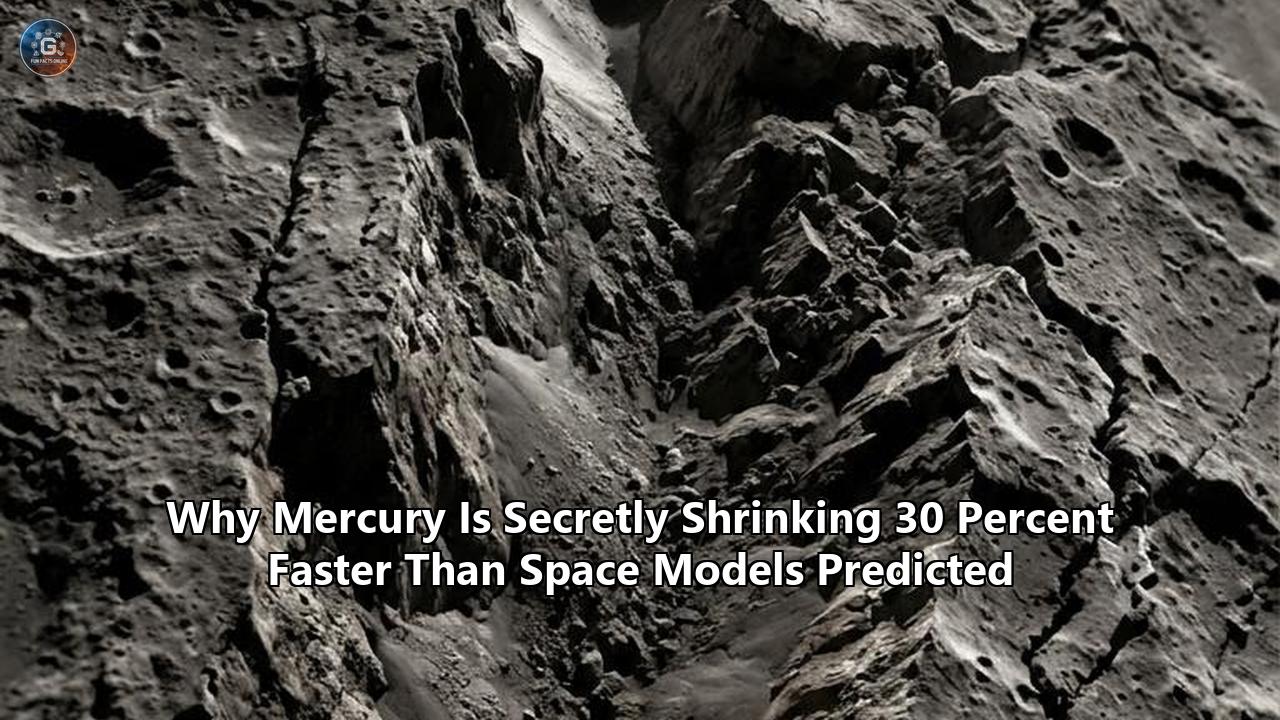
The smallest and innermost world in the solar system has collapsed inward far more aggressively than anyone realized. According to research published in Geophysical Research Letters, the rate and total magnitude of Mercury’s global contraction have been underestimated by 10 to 30 percent. Rather than losing between 2.5 and 10 miles of its diameter across its 4.5-billion-year lifespan, new topographical corrections reveal that the planet has shed up to 14.5 miles (23 kilometers) of its total girth.
The cause of this historical miscalculation is not an error in orbital mechanics, but a planetary cover-up executed by billions of years of cosmic bombardment. Planetary geophysicists at the German Aerospace Center (DLR) Institute of Planetary Research discovered that thick layers of impact debris and shattered rock have systematically masked thousands of compressional tectonic features across the planet's roughest terrains. The missing faults were not absent; they were buried.
"Determining the extent of the shrinking of Mercury is key to investigating the composition of the planet's interior," stated Gaku Nishiyama, a planetary scientist at the DLR Institute of Planetary Research and lead author of the study. "More shrinking means Mercury could have a larger metal core, less light elements like silicon mixed into the metal core, or a higher starting temperature. Thirty percent is a little bit surprising, but the corrected amount of contraction actually makes sense."
The discovery upends decades of thermal models. If Mercury shrank nearly a third more than previously documented, the chemical recipe of its colossal metallic core must be fundamentally reconfigured. The finding arrives at a pivotal juncture: the joint European Space Agency (ESA) and Japan Aerospace Exploration Agency (JAXA) BepiColombo mission is executing its final approach maneuvers toward Mercury, preparing for orbital insertion in late 2026. When BepiColombo begins firing its onboard laser altimeter and deploying its stereo cameras, it will test Nishiyama's calculations directly against the scarred Hermean crust.
The revelation marks the culmination of a fifty-year scientific detective story—a narrative defined by recurring paradoxes, misread topography, and unexpected geodynamic activity on a world long written off as geologically dead.
1974–1975: The Discovery Rupes and the Birth of the Contraction Paradox
The notion that a rocky world could shrivel as it ages originated when NASA’s Mariner 10 executed the first of its three historic flybys of Mercury in March 1974. Up to that moment, ground-based optical telescopes had resolved little more than indistinct albedo markings on the planet's sun-scorched face. Mariner 10 cut past the world at an altitude of just 437 miles, beaming back high-contrast television imagery that shocked mission geologists Robert Strom and Bruce Murray.
The surface was pocked with craters like the Moon, but it displayed a tectonic signature unlike anything seen on Earth or Mars: sinuous, towering cliffs that snaked across the landscape for hundreds of miles.
The most prominent of these structures was Discovery Rupes, an enormous scarp rising over a mile into the black Hermean sky and cutting directly across ancient impact craters. Geologists quickly recognized these features as lobate scarps—the surface expressions of massive thrust faults. Under intense horizontal compression, the planet’s outer brittle crust had fractured, forcing one tract of terrain to slide up and over the adjacent crustal plate.
Because Mariner 10 observed no evidence of extensional tectonics—no rift valleys, spreading centers, or transform boundaries—the scientific inference was stark: Mercury’s lithosphere was trapped in a state of global compressional strain. The entire planet was collapsing inward.
Planetary thermal physicists immediately ran the numbers. Like an iron cannonball cooling in the vacuum of space, Mercury was dissipating the primordial heat trapped during its violent accretion 4.5 billion years ago. As its oversized metallic interior cooled, its volume inevitably shrank. The rigid silicate mantle and crust had to adjust to fit an ever-dwindling interior core, buckling and fracturing in response.
Yet, when the Mariner 10 science team quantified the horizontal displacement visible on those initial scarps, they encountered their first major paradox. The geological features suggested that Mercury had shrunk in radius by only 0.5 to 1.8 miles (1 to 3 kilometers).
Theoretical models of the planet’s thermal evolution told a completely contradictory story. Mercury possessed an abnormally high bulk density, indicating that an iron-rich metallic core accounted for roughly 70 to 80 percent of its total radius—a ratio far exceeding that of Earth, Venus, or Mars. Standard laws of thermodynamics dictated that an iron sphere of that size, losing heat over four billion years, should have generated between 3 and 6 miles (5 to 10 kilometers) of radial shrinkage.
Theory demanded massive contraction; the observed rocks showed only modest wrinkling. For the next three decades, this four-fold discrepancy became known in planetary science circles as the Mercury Contraction Paradox.
1976–2010: The Lithospheric Deadlock and Theoretical Stalemate
The Contraction Paradox left researchers divided into two warring theoretical camps. The observational faction, led by prominent geological cartographers, insisted that Mariner 10 had surveyed 45 percent of the planet, providing a statistically representative sample. If the planet had contracted by 6 miles radially, the remaining 55 percent of the unseen hemisphere would have to be packed with cliffs many miles high—an improbable crustal configuration.
The geophysicists countered that the fault data was being misinterpreted. They posited that much of the compressional strain was accommodated invisibly through ductile flow within the lower crust, or that Mercury possessed an insulating mantle layer that somehow prevented the iron core from cooling and crystallizing efficiently.
Calculations of the brittle-ductile transition in Mercury’s lithosphere were hindered by a catastrophic lack of data. Scientists did not know the exact composition of the crust, the thickness of the mantle, or whether the metallic core was solid, liquid, or stratified.
The debate remained frozen until the turn of the century, when planetary scientist Sean Solomon of the Carnegie Institution of Washington successfully lobbied NASA to fund a dedicated orbital mission to the innermost planet. Christened MESSENGER (MErcury Surface, Space ENvironment, GEochemistry, and Ranging), the spacecraft launched in August 2004 on a complex six-year gravitational trajectory toward its destination.
As MESSENGER swung past Mercury for flybys in 2008 and 2009, its Mercury Dual Imaging System (MDIS) beamed back the first glimpses of the hidden 55 percent of the globe. Tectonic scarps appeared everywhere. Lobate scarps, high-relief ridges, and subtle wrinkle ridges crossed both ancient cratered highlands and smooth volcanic plains. The stage was set for a complete accounting of Mercury's planetary deformation.
2011–2015: MESSENGER Maps the Wrinkled World
In March 2011, MESSENGER fired its main thruster and slipped into a highly eccentric orbit around Mercury, becoming the first artificial satellite to orbit the sun-baked planet. Over four years of orbital operations, the probe's Mercury Laser Altimeter (MLA) and multispectral cameras systematically mapped the planet's topography down to a horizontal resolution of several hundred meters.
In 2014, a research team led by planetary geologist Paul Byrne, then at the Carnegie Institution of Washington, published a global tectonic census in Nature Geoscience. Byrne’s team painstakingly identified and mapped 5,934 individual shortening structures across the Hermean surface, including lobate scarps, arcuate ridges, and wrinkle ridges.
By analyzing the fault geometries, measuring the throw along the thrust surfaces, and assuming typical dip angles between 25 and 35 degrees based on terrestrial fault mechanics, Byrne’s team calculated the true total strain.
The results appeared to finally resolve the forty-year-old paradox. Byrne demonstrated that Mercury had not contracted by a meager 1 to 2 kilometers, but by as much as 4.4 to 7 kilometers (2.7 to 4.3 miles) radially. In terms of total planetary diameter, Mercury had shed up to 8.7 miles (14 kilometers).
The scientific community breathed a collective sigh of relief. The newly derived geological contraction figure finally aligned with the theoretical thermodynamic models of secular planetary cooling. Sean Solomon declared it "wonderfully affirming to see that our theoretical understanding is at last matched by geological evidence."
The prevailing consensus held that:
- Contraction began roughly 3.9 billion years ago, following the tail end of the Late Heavy Bombardment.
- Peak strain occurred between 3.8 and 3.5 billion years ago as the massive core underwent its initial rapid heat loss.
- Contraction had slowed dramatically to an effective halt hundreds of millions of years ago, leaving Mercury a rigid, tectonically frozen world.
Yet, even as the Byrne consensus was cemented in textbooks, anomalous discrepancies lurked within the MESSENGER data. Certain heavily cratered regions showed far fewer scarps than predicted by isotropic contraction models. If thermal contraction is a global, spherically symmetrical phenomenon, why were some of the oldest regions of Mercury nearly devoid of shortening structures?
The Mechanical Trap: How Lobate Scarps Form
To understand why the planetary contraction numbers remained elusive, one must understand the distinct physics of how a single-plate terrestrial world deforms under thermal distress.
Earth dissipates heat primarily through plate tectonics. Convection currents in the liquid asthenosphere drag crustal plates apart at mid-ocean ridges and drive them downward at subduction zones, maintaining an open-system thermal valve.
Mercury operates under a "stagnant lid" tectonic regime. It possesses a single, continuous, planetary-scale lithospheric shell wrapping around its mantle and core. When the interior loses heat and shrinks, the outer shell has nowhere to go. The surface area of the sphere must decrease, putting the lithosphere under crushing horizontal compressional stress.
                     STAGNANT LID COMPRESSIONAL FAILURE

               Extensional Bending Zone (Grabens)
                             |
                             v
   [ Upper Crust ]     /------------\
                      /   Bent Crest \
   ------------------/                \--------------------
   Hanging Wall Block                    Footwall Block
       ▲
        \       Thrust Fault Plane (25°-35°)
         \---------------------------------------
                                                 ▲
   Compressional Stress                          │
   ===================>                  Stable Crust
Under the Mohr-Coulomb failure criterion, when compressive stress exceeds the shear strength of the crustal rock, the lithosphere fails along brittle fracture surfaces. These fractures manifest as reverse faults and thrust faults. A massive wedge of crust—the hanging wall—is forced up the inclined fault plane, overriding the footwall.
At the surface, this displacement produces a lobate scarp: an asymmetrical ridge characterized by a steep, scalloped face where the hanging wall has breached the surface, trailing off into a gentle slope on the back side.
These are not minor geological curiosities. Structures like Enterprise Rupes stretch for more than 620 miles (1,000 kilometers) across the southern hemisphere, towering up to 1.8 miles (3 kilometers) high. The sheer scale of these features proves that the faults penetrate deep through the Hermean crust, reaching all the way to the lithospheric mantle.
Every kilometer of elevation gain on a lobate scarp represents miles of horizontal shortening accommodated by the crust. Therefore, planetary scientists use the physical dimensions of these scarps as a planetary tape measure: sum the displacement across every mapped fault on the surface, integrate that strain over a sphere, and one calculates precisely how much the planet shrank.
The accuracy of that calculation relies on one non-negotiable premise: you must be able to see the faults.
October 2023: The Graben Discovery Shatters the Inactive Planet Paradigm
The next critical turning point emerged not from new missions, but from an aggressive, high-resolution re-examination of archive data left behind by MESSENGER.
In October 2023, Open University doctoral researcher Benjamin Man, working under planetary geoscience professor David Rothery, published a startling discovery in Nature Geoscience. While mapping Mercury’s Neruda (H-13) quadrangle, Man spotted minute geological structures that defied established paradigms: small, pristine grabens running along the upper crests of several major lobate scarps.
A graben is an extensional tectonic feature—a trench formed when a block of crust drops downward between two parallel normal faults. Finding extension on Mercury was immediately counter-intuitive. How could a planet trapped in planetary-scale compression exhibit crustal stretching?
Rothery provided the mechanical answer: bending stresses.
"Stretching may seem surprising on Mercury, where overall the crust is being compressed," Rothery explained, "but Man realised that these grabens would occur if a thrust slice of crust has been bent as it is pushed over the adjacent terrain. If you try to bend a piece of toast, it may crack in a similar way."
As the hanging wall is shoved up and over the fault ramp, the upper layer of rock is forced to curve sharply, placing the localized uppermost surface under extreme tension. The rock snaps, creating shallow, narrow troughs typically less than 0.6 miles (1 kilometer) wide and under 300 feet (100 meters) deep.
The existence of these grabens was interesting, but their pristine morphology was revolutionary.
Because Mercury lacks an atmosphere, its surface is exposed to an unrelenting rain of micrometeorites and charged solar wind particles—a process known as impact gardening. This relentless churning acts as a planetary sandblaster, eroding sharp topography and filling in negative relief landforms.
Calculations of the Hermean impact gardening rate indicate that shallow structures under 100 meters deep cannot survive for billions of years. Had these grabens formed 3.5 billion years ago alongside the primary thrust faults, impact debris would have erased them from view eons ago.
Man surveyed more than 25,000 MESSENGER images and discovered hundreds of these small grabens perched atop compressional scarps across the globe. Modeling the infill rates, the Open University team proved that many of these structures formed within the last 300 million years—and likely within the last few tens of millions of years.
The implication was unmistakable: Mercury was not a dead, petrified world. The engine driving the mercury planet shrinking process was still firing in the contemporary solar system. Faults were still slipping, crust was still buckling, and the core was actively cooling.
Yet, the discovery of ongoing tectonism only heightened the underlying numerical contradiction. If the planet was still contracting today, why did the total observable strain mapped by Byrne in 2014 match thermal models that assumed contraction had largely flatlined billions of years ago?
The ledger was out of balance once again. The geological math was missing something vast.
September 2026: Nishiyama’s Roughness Model Exposes the Hidden 30 Percent
The definitive breakthrough arrived when Gaku Nishiyama and his colleagues at the DLR Institute of Planetary Research approached the MESSENGER global dataset from an entirely different mathematical perspective.
Rather than cataloging visible faults, Nishiyama began investigating where the faults were missing.
Globally, Mercury’s surface is broadly divided into two major geological units: the relatively flat, smooth inter-crater plains (often volcanic in origin) and the chaotic, crater-strewn highlands. If thermal contraction exerts isotropic, uniform compression across a spherical shell, shortening structures should be distributed uniformly per unit area, regardless of terrain type.
The observational reality showed a stark bias. The vast majority of mapped lobate scarps and wrinkle ridges were concentrated in smooth, low-roughness volcanic plains. The rugged, heavily cratered highlands—the oldest crust on the planet—displayed an anomalous deficit of contractional structures.
Nishiyama hypothesized that this spatial disparity was an artifact of observational bias driven by impact crater ejecta.
When a giant impact occurs on Mercury, it does not merely excavate a crater; it violently redistributes millions of cubic miles of pulverized rock across the surrounding landscape. This ballistic ejecta forms thick blankets of rubble that drape across regional topography.
To test this mechanism, the DLR team generated a comprehensive quantitative map of Mercury’s surface roughness using MESSENGER laser altimetry and stereo-photogrammetry, cross-referencing it with the global database of mapped thrust faults.
The statistical correlation was unmistakable:
- In areas of low surface roughness, tectonic shortening structures were ubiquitous and sharply defined.
- As topographical roughness increased, the detected spatial frequency of scarps plummeted dramatically.
- In the immediate vicinity of massive impact structures—such as the 270-mile-wide Rachmaninoff impact basin—lobate scarps abruptly vanished beneath the continuous ejecta blanket, only to re-emerge on the other side of the debris deposit.
                IMPACT CAMOUFLAGE MECHANISM

     [ Impact Event ] ===> Ballistic Ejecta Curtain
           \                      /
            \                    /
             v                  v
     ~~~~~~~~~~~~~~~~~~~~~~~~~~~~~~~~~~~~~~~~   <-- Ejecta Layer Blankets Terrain
     ========================================
             \                  /
              \   Buried Scarp /
               \              /
                \            /
   --------------\----------/----------------   <-- Pre-existing Fault System
                  \        /
                   \      /
"It made us think that there's a process obscuring shortening structures," Nishiyama noted. "Mercury's rough surface, continually reshaped by debris hurled from impact craters, may have hidden the true extent of the loss."
MESSENGER’s optical cameras could only reliably identify tectonic scarps with vertical offsets greater than several tens of meters and horizontal continuity spanning several miles. In rugged highland terrain, where the background topography is inherently chaotic and dominated by crater rims, impact ejecta deposits readily fill the shallow trenches of grabens and smooth over the ramp-like faces of thrust scarps.
The faults had formed, accommodated strain, and shortened the crust—but planetary scientists looking at satellite photography could no longer see them.
Nishiyama and his team developed a mathematical correction matrix. By determining the baseline fault density in pristine, low-roughness terrains and scaling it across the obscured, high-roughness highland units, they calculated the uncounted strain volume.
The results transformed our understanding of the planet:
- Past geological inventories had systematically missed between 10 and 30 percent of all contractional strain.
- Instead of a radial shrinkage of 4.4 to 7 kilometers, Mercury has contracted by up to 11.5 kilometers (7.1 miles) radially.
- The total reduction in planetary diameter stands at up to 14.5 miles (23 kilometers)—a full 1 percent reduction in the planet's total physical dimension since its formation.
The planet was shrinking 30 percent faster and more extensively than theoretical space models had ever calculated.
Inside the Core: The Geochemical Shockwave
A 30 percent acceleration in the cumulative mercury planet shrinking rate is not merely a correction to surface maps; it forces a complete recalibration of the planet's internal thermodynamic engine.
Mercury is anomalous among rocky worlds. Its core has an estimated radius of roughly 1,260 miles (2,020 kilometers), meaning the metallic interior accounts for approximately 85 percent of the planet's total radius and over 60 percent of its total mass. The outer silicate crust and mantle comprise a wafer-thin rocky shell merely 250 miles (400 kilometers) thick.
                    MERCURY'S INTERNAL STRUCTURE

                 [ Silicate Crust / Mantle ] ~400 km
                /
               |     ===============================
               v    /                               \
                   /     [ Liquid Fe-Ni Outer Core ] \
                  |     /                             |
                  |    |     -------------------      |
                  |    |    /                   \     |
                  |    |   |  [ Solid Fe Core ]  |    |
                  |    |    \                   /     |
                  |    |     -------------------      |
                   \    \                             /
                    \    =========================== /
                     \                              /
                      \----------------------------/
Because rock has a significantly lower thermal expansion coefficient than molten metal, the overarching driver of global contraction is the volumetric shrinkage of the iron-nickel core as it freezes.
If Mercury contracted 30 percent more than models predicted, one of three fundamental geodynamic parameters must change:
1. Core Composition and the Light-Element Fraction
Liquid iron shrinks dramatically upon phase change into a solid crystalline lattice. However, pure iron melts at extremely high temperatures. Planetary scientists have long known that Mercury’s core must contain a fraction of light alloying elements that depress the liquidus—most notably sulfur, silicon, and carbon.
If the core is rich in light elements, the density contrast between the liquid and solid phases is muted, resulting in less volumetric contraction during cooling.
Conversely, an extra 30 percent of shrinkage demands a significantly purer iron-nickel interior. The core must contain substantially less silicon and sulfur than previous geochemical inventories suggested. This discovery challenges models derived from MESSENGER’s X-Ray Spectrometer (XRS), which detected high sulfur concentrations on the surface, forcing theorists to reconsider whether surface volatile abundance reflects deep mantle-core partitioning.
2. The Primordial Accretion Energy and Starting Temperature
Contraction is a direct function of total temperature drop ($\Delta T$). For Mercury to have shrunk 14.5 miles in diameter, the temperature differential between its primordial magma ocean state and its present-day interior must have been hundreds of degrees Celsius greater than previously modeled.
A higher starting temperature points toward a more energetic, violent accretionary phase in the early solar system. It provides compelling geodynamic backing to the long-debated Giant Impact Hypothesis for Mercury. Under this scenario, a young proto-Mercury collided with a massive planetesimal, vaporizing and stripping away most of its original silicate mantle and leaving behind an ultra-dense, superheated metallic core.
3. Core Crystallization Regimes and the Dynamo
Mercury exhibits an active, internally generated magnetic field—a feature absent on both Venus and Mars. The Hermean dynamo is weak, roughly 1 percent the strength of Earth’s, but its survival has long puzzled dynamicists.
For a planet that small to maintain a magnetic field after 4.5 billion years, its liquid outer core must undergo continuous thermal or compositional convection.
If Mercury is shrinking 30 percent faster than space models predicted, the rate of core crystallization must be dramatically higher than baseline assumptions. This accelerated solidification would drive intense compositional buoyancy: as solid, purer iron crystallizes onto an inner core, lighter elements are rejected into the remaining liquid shell, powering convective fluid motion.
The new shrinkage data explains how Mercury’s dynamo avoided thermal extinction, but it introduces a critical timeline dilemma: if the core is freezing this rapidly, is the liquid outer shell on the verge of freezing solid, extinguishing the Hermean magnetosphere?
Comparative Planetology: Shrinking Spheres of the Inner Solar System
Mercury is not the only world whose lithosphere has deformed as its interior cooled, but comparing its structural evolution to that of the Moon and Mars highlights why its 30 percent contraction acceleration is unique in the inner solar system.
| Planetary Body | Contraction Mechanism | Estimated Radius Loss | Primary Tectonic Manifestation | Tectonic Status |
|---|---|---|---|---|
| Mercury | Extreme secular core cooling / Fe crystallization | ~7 to 11.5 km (Up to 14.5 mi diameter) | Lobate scarps, high-relief ridges, crestal grabens | Active (Verified recent graben movement) |
| The Moon | Thermal contraction of interior / Late tidal flexure | ~0.1 to 0.2 km (100–200 meters) | Small lobate scarps, grabens, shallow moonquakes | Active (Ongoing seismicity detected by Apollo) |
| Mars | Localized cooling / Tharsis lithospheric loading | ~1 to 2 km (Global equivalent) | Wrinkle ridges, circumferential grabens | Dormant (Localized seismicity detected by InSight) |
| Earth | Plate tectonics / Regulated heat-pipe transition | Negligible net global contraction | Continental collisions, subduction zones, oceanic rifts | Active (Global plate recycling) |
The Moon has experienced modest global contraction. High-resolution imagery from NASA’s Lunar Reconnaissance Orbiter (LRO) identified thousands of small thrust scarps scattered across the lunar maria and highlands. However, total lunar radial contraction amounts to a few hundred meters at most. The Moon lacks a massive metallic core; its interior is dominated by a thick, buoyant silicate mantle that dissipates heat far more slowly, insulating its minuscule iron seed.
Mars features extensive networks of wrinkle ridges across its ancient basaltic plains, but the red planet’s tectonic history was dominated by volcanic loading rather than pure isotropic cooling. The formation of the Tharsis volcanic province imposed immense mass loads on the Martian crust, inducing regional flexure and cracking the lithosphere across thousands of miles.
Earth operates on a completely different geodynamic regime. Subduction constantly recycles thermal boundary layers, while seafloor spreading adds new crust, maintaining a relatively steady planetary surface area over billion-year timescales.
Mercury stands alone as the solar system’s purest natural laboratory for isotropic global contraction. It is a single-plate world dominated by a gargantuan, rapidly chilling iron core. The discovery that this process has been masked by impact rubble proves that our models of stagnant-lid planets have systematically underestimated how violently rocky worlds warp as they die.
The Chronology of Discovery
The fifty-year path to unveiling Mercury's missing strain reveals a clear pattern of escalation: each major leap in imaging and topographic analysis overturned the conservative planetary assumptions of the era before it.
                                  TIMELINE OF ESCALATION

  1974-1975                    2014                       2023                       2026
 [ Mariner 10 ]            [ MESSENGER ]             [ Nature Geosci. ]         [ Geophys. Res. Lett. ]
  3 Flybys                  Global Mapping            High-Res Analysis          Roughness Correction
  Discovers Scarps          5,934 Faults Mapped       Small Grabens Found        Impact Camouflage Exposed
  Contraction: ~1-3 km      Contraction: ~7 km        Proves Modern Tectonism    Contraction: Up to 11.5 km
  (The 40-Yr Paradox)       (Consensus Reached)       (Planet Is Not Dead)       (30% Faster Than Models)
1974–1975: Initial Flybys Reveal First Scarps
Mariner 10 executes three flybys, imaging 45 percent of Mercury's surface. Discovery Rupes and other lobate scarps are observed for the first time. Scientists calculate a radial contraction of just 1 to 3 kilometers, triggering a four-decade conflict with thermal evolution models that demanded 5 to 10 kilometers of radial shrinkage.
2008–2009: MESSENGER Approaching the Planet
NASA’s MESSENGER spacecraft conducts three gravitational flybys, confirming that thrust faulting is globally distributed rather than confined to the Mariner 10 hemisphere. The data confirms that contraction is isotropic.
March 2011: Insertion into Hermean Orbit
MESSENGER achieves orbit, initiating the first comprehensive global survey of Mercury’s surface, chemical composition, and magnetic field. The Mercury Laser Altimeter begins cataloging topographical elevation across thousands of miles of rugged terrain.
March 2014: The 7-Kilometer Compromise
Paul Byrne and his team publish the first comprehensive global catalog of 5,934 tectonic landforms. They determine that Mercury’s radius has shrunk by 4.4 to 7 kilometers, seemingly bringing geological observations into harmony with the thermal models and closing the Contraction Paradox.
October 2023: Discovery of Young Grabens
Benjamin Man and David Rothery discover small, pristine grabens atop major lobate scarps. Modeling impact gardening rates reveals the structures are younger than 300 million years, confirming that tectonic displacement and global contraction are ongoing in the contemporary epoch.
September 2026: The Obscuration Breakthrough
Gaku Nishiyama and colleagues at the German Aerospace Center publish their quantitative analysis of surface roughness versus fault frequency. They reveal that ballistic impact ejecta has masked up to 30 percent of the planet's shortening structures. The total radial contraction is revised upward to as much as 11.5 kilometers (14.5 miles in diameter), proving that the planet shrunk 30 percent faster than space models predicted.
November 2026: The BepiColombo Orbital Rendezvous
The escalation that began with Mariner 10 in 1974 is about to intersect with the most sophisticated instrument suite ever sent to the inner solar system.
Launched in October 2018, the joint ESA/JAXA BepiColombo mission has completed its grueling seven-year cruise through the inner solar system, executing six successive gravity-assist flybys of Mercury. The spacecraft stack—consisting of the European Mercury Planetary Orbiter (MPO) and the Japanese Mercury Magnetospheric Orbiter (MMO, or "Mio")—is scheduled to separate and enter dedicated orbits around Mercury in late 2026.
BepiColombo was built specifically to interrogate the anomalies that MESSENGER left unresolved.
                                BEPICOLOMBO INSTRUMENT TEST

 [ BELA Laser Altimeter ]                [ SIMBIO-SYS Cameras ]              [ MORE Radio Science ]
           |                                       |                                   |
           v                                       v                                   v
 Scans 1-meter vertical scale           Sub-meter spatial resolution           Measures gravity anomalies
 Detects hidden topographic steps       Reveals microscopic grabens            Maps core-mantle boundary
 across ejecta-covered highlands        obscured by regolith churn             and liquid shell thickness
Two specific instruments will serve as the arbiters of Nishiyama's roughness model:
1. The BepiColombo Laser Altimeter (BELA)
MESSENGER’s MLA instrument was heavily constrained by the spacecraft's highly elliptical orbit, which restricted high-resolution laser measurements primarily to the northern hemisphere. BELA will operate from a circularized polar orbit, firing a 1064-nanometer laser at 10 pulses per second to create a seamless, high-precision three-dimensional global elevation model with vertical accuracy down to one meter.
BELA will slice through the visual noise of impact ejecta blankets, mapping the subtle structural steps and flexural bulges of buried thrust faults that optical cameras cannot resolve.
2. SIMBIO-SYS (Spectrometers and Imagers for MPO Integrated Observatory System)
SIMBIO-SYS contains a stereo imaging channel capable of photographing the Hermean surface in color down to a spatial resolution of five meters per pixel, with select targeted passes resolving features under two meters.
Where MESSENGER saw blurry pixels, SIMBIO-SYS will resolve individual boulder tracks, micro-grabens, and subtle tension gashes perched on the shoulders of scarps. It will test whether the graben formations identified by Benjamin Man in 2023 are truly ubiquitous or localized to a few dozen faults.
Beyond imaging the surface, BepiColombo’s Mercury Orbiter Radio-science Experiment (MORE) will work in tandem with the Italian Spring Accelerometer (ISA) to measure the planet’s gravitational field with unprecedented precision. By tracking minute Doppler shifts in radio transmissions, MORE will measure Mercury’s degree-two tidal Love number ($k_2$) and moment of inertia.
These measurements will tell geophysicists the exact thickness of the outer silicate shell, the physical state of the liquid outer core, and the precise size of the solid inner core. If Nishiyama’s 30 percent contraction acceleration is correct, the core-mantle boundary must be shallower, and the solid inner core must be substantially larger than older models assumed.
What Happens to a World That Cannot Stop Shrinking?
The revelation that the mercury planet shrinking process has progressed 30 percent faster than classical thermal evolution models anticipated alters our understanding of how rocky planets live and die.
Mercury is running out of time—on a cosmic scale. The higher rate of contraction proves that its interior is cooling at a much faster pace than once assumed. The heat driving its core convection is hemorrhaging into space, radiating into the vacuum at a rate that cannot sustain a liquid outer shell indefinitely.
As the core freezes toward completion:
- The liquid shell will thin, driving compositional convection down to a halt and eventually terminating the planetary magnetic field.
- Without a protective magnetosphere, the raw solar wind will blast directly against the Hermean regolith, dramatically accelerating space weathering and volatile sputtering.
- Horizontal crustal shortening will continue until the lithosphere thickens to the point where tectonic stresses can no longer overcome the immense friction along fault planes, finally locking the planet into permanent geological silence.
The implications extend far beyond the scorched confines of the inner solar system.
Over the past decade, transit surveys like Kepler and TESS have discovered hundreds of ultra-dense, close-in exoplanets—often termed "super-Mercuries." Worlds like K2-229b and HD 23472b have densities indicating that iron cores make up the vast majority of their planetary volume.
Astrophysicists have routinely applied standard, terrestrial-style thermal models to predict the structural evolution and atmospheric retention of these worlds. The Hermean correction demonstrates that those models are fundamentally flawed.
When a world is dominated by an iron core, its structural contraction trajectory is non-linear, aggressive, and easily masked by planetary surface processes. Terrestrial planet evolution models that do not account for impact-driven obscuration will consistently misread the true strain history of rocky bodies across the galaxy.
As BepiColombo executes its final orbital burns to join Mercury in late 2026, it will find a world fundamentally different from the dead rock envisioned fifty years ago.
Mercury is an active, violently collapsing sphere of metal and rock, carrying miles of hidden tectonic fractures buried beneath billions of years of impact debris. Its scarred crust has served as a silent archive of an interior cooling engine running far hotter, contracting far faster, and shifting far more aggressively than anyone predicted.
Reference:
- https://gvwire.com/2026/09/11/mercury-is-shrinking-and-faster-than-we-thought/
- https://www.fox10phoenix.com/news/mercury-is-shrinking-faster-than-expected-new-study-suggests
- https://www.space.com/astronomy/mercury/mercury-is-shrinking-faster-than-we-thought-whats-going-on-inside-of-it
- https://www.404media.co/mercury-is-shrinking-way-faster-than-we-thought-scientists-discover/
- https://mashable.com/science/mercury-shrinking-planet-explanation
- https://scitechdaily.com/new-study-resolves-decades-old-paradox-thermal-history-models-estimates-mercurys-contraction/
- https://www.youtube.com/watch?v=LDlhMYwjhhk
- https://www.latimes.com/science/story/2026-09-13/mercury-may-be-shrinking-faster-than-scientists-expected
- https://www.cumnockchronicle.com/news/national/23828783.research-suggests-mercury-continues-shrink/
- https://www.thebrighterside.news/post/mercury-has-been-slowly-shrinking-for-billions-of-years-study-finds/
- https://www.salon.com/2023/10/04/shrinking-planet-mercury-is-still-getting-smaller-new-research-finds_partner/
- https://www.kiro7.com/unavailable-location/
- https://phys.org/visualstories/2023-10-mercury-planet-smaller.amp
- https://www.iflscience.com/mercury-appears-to-be-shrinking-70947
- https://communities.springernature.com/posts/young-tectonic-activity-on-mercury
- https://www.hou.usra.edu/meetings/lpsc2016/pdf/1023.pdf