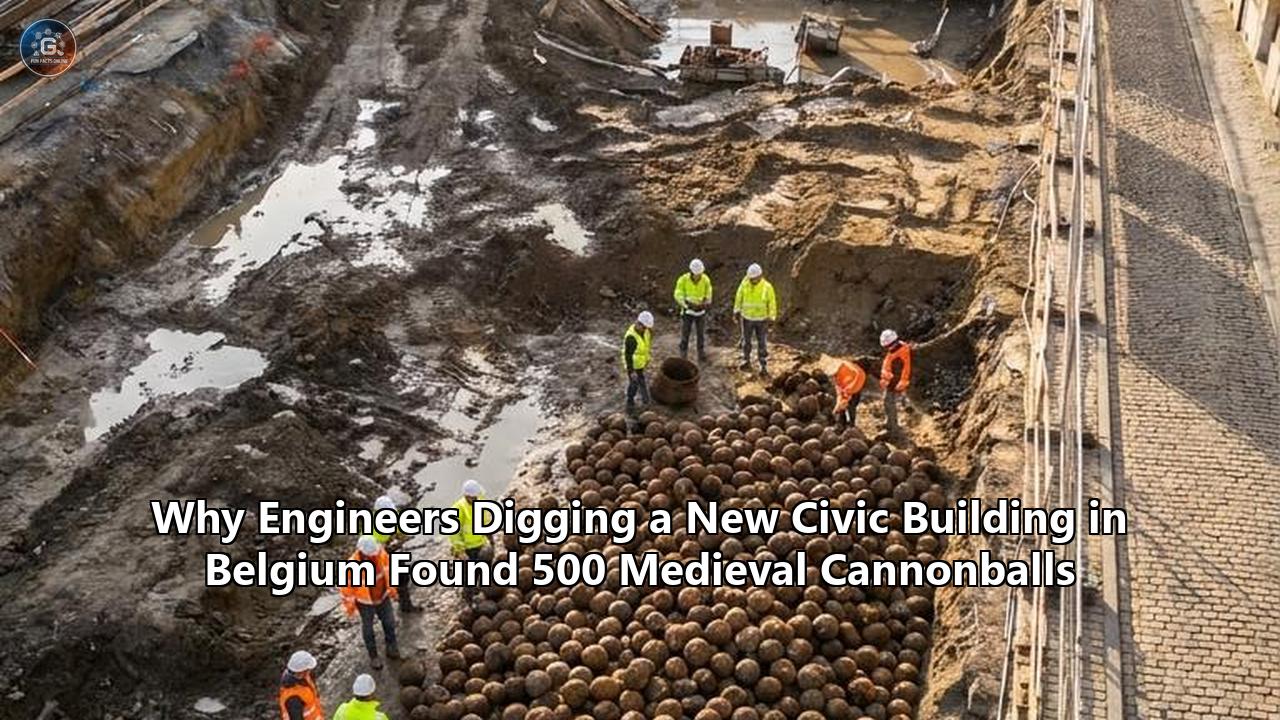
In February 2026, on an unremarkable plot of land nestled between the historic 13th-century Stadshalle (City Hall) and Willem De Roolaan in the Belgian coastal city of Nieuwpoort, an excavator’s bucket scraped against something unusually dense and spherical. Workers preparing the site for the city's new municipal Administrative Centre (Stadskantoor) expected to find the usual detritus of a modern European city. Instead, they halted their heavy machinery when they realized they had punctured a massive, concentrated layer of ancient artillery.
A team of archaeologists led by Ignace Doucet of the Van Vooren Group was quickly brought in to inspect the trench. What they uncovered over the following weeks was a spectacularly preserved, concentrated stockpile of nearly 500 hand-carved, natural stone cannonballs dating between 1350 and 1600 AD.
This medieval cannonballs discovery quickly captured the attention of military historians and the public. To the casual observer, it was a curious collection of weathered stone spheres. To military historians, ballistics engineers, and urban planners, however, the find represents a rare window into the transition of European siege warfare and the complex logistics of medieval municipal defense.
The story of how these stones came to be buried beneath a future civic building involves centuries of geopolitical conflict, the development of early gunpowder technology, and the strict modern laws governing European construction.
The Flemish Heritage Protocol: How Modern Laws Salvage Medieval Secrets
To understand why an engineering crew was digging in this exact spot—and why archaeologists were on-site to immediately halt construction—one must look to the stringent legal framework of Flanders. In Belgium, the intersection of urban development and historical preservation is governed by the Flemish Immovable Heritage Decree (Onroerenderfgoeddecreet), which was enacted to satisfy the principles of the 1992 Valletta Treaty (the European Convention on the Protection of the Archaeological Heritage).
[ Valletta Treaty (1992) ]
          │
          ▼
[ Flemish Immovable Heritage Decree (Onroerenderfgoeddecreet) ]
          │
          ├──► Mandatory Preliminary Desktop Surveys
          │
          └──► High-Probability Zones ──► Mandatory Core Excavation (Before Building Permit)
Under this decree, any major construction project in a designated historic city center must undergo a rigorous, multi-tiered archaeological assessment before a single spade of dirt is permanently moved for foundations. This process is known as developer-led or rescue archaeology. In Nieuwpoort, a coastal town whose roots stretch deep into the Middle Ages, the proposed site of the new Administrative Centre sat directly within the high-probability historical zone.
The Van Vooren Group, an accredited type-1 archaeological contractor in Flanders, was hired to perform preliminary investigations. Early test trenches and trial pits dug across the plot revealed promising stratigraphy: layers of packed earth, medieval floor levels, and brick foundation footings that did not match any modern property records. When full-scale excavations began in mid-February 2026, the team knew they would find medieval building elements. They did not, however, anticipate unearthing a state-level military secret.
           +------------------------------------------+
           |               Modern Asphalt             |
  0.0m ----+------------------------------------------+
           |              Demolition Rubble           |
  0.5m ----+------------------------------------------+ <--- Trench Floor
           |  [WWI UXO]                               |
  1.0m ----+------------+-----------------------------+
           |            |  [Stone Cannonball Cache]   | <--- 1350-1600 AD Stratum
           |            +-----------------------------+
  1.5m ----+------------+-----------------------------+
           |         Medieval Brick Footings          |
           +------------------------------------------+
As the team cleared the upper demolition rubble, they exposed a dense, organized pile of spherical stone projectiles resting less than three feet (approximately one meter) below the modern street level. The balls were piled neatly. This was not battlefield debris—it was an intact, structured military depot.
The Science of Gunstones: Why Stone Preceded Iron in Early Artillery
The medieval cannonballs discovery in Nieuwpoort is particularly significant because of the physical makeup of the projectiles: they are made of shaped natural stone, not cast iron or lead. Modern popular culture often associates historic cannons exclusively with heavy, dark iron balls. In reality, for the first two and a half centuries of European gunpowder warfare (roughly 1350 to 1600 AD), stone was the dominant material for large-caliber artillery.
The transition from stone projectiles—historically referred to in Middle English as "gunstones" or in French as pierriers—to cast iron spheres was not merely a matter of material preference; it was governed by the laws of physics, metallurgy, and chemistry.
The Hoop-and-Stave Metallurgical Limit
Early cannons, developed in the mid-to-late 14th century, were not cast as single, solid pieces of metal. Instead, they were constructed using the "hoop-and-stave" technique, which closely mirrored the craft of cooperage (making wooden barrels).
Long, flat bars of wrought iron were arranged longitudinally around a wooden mandrel to form a cylinder. These longitudinal staves were then heated and hammer-welded together. To reinforce the barrel against the outward force of the gunpowder explosion, heavy, red-hot iron hoops were slipped over the exterior of the staves. As these hoops cooled, they shrank, binding the staves together under immense tension.
        Wrought Iron Staves (arranged longitudinally)
               │
               ▼   ┌───────────────┐
             ░░░░░░│               │░░░░░░
             ░░░░░░│  GUN BARREL   │░░░░░░
             ░░░░░░│               │░░░░░░
               ▲   └───────────────┘
               │
        Shrunk-on Outer Iron Hoops (providing radial reinforcement)
While ingenious, hoop-and-stave barrels possessed low structural integrity compared to later cast bronze or cast iron ordnance. Wrought iron is ductile but soft, and the hammer-welded joints along the seams of the staves were prone to micro-fractures and stress fatigue.
Because iron is approximately three times denser than typical sedimentary or igneous stone (with cast iron weighing about $7.8\text{ g/cm}^3$ compared to limestone's $2.7\text{ g/cm}^3$), an iron cannonball of the same volume as a stone ball is roughly three times heavier.
To launch a dense, heavy iron ball of a given caliber, a gunner had to use a significantly larger charge of gunpowder. This larger charge ignited rapidly, creating a massive wave of internal gas pressure.
In a hoop-and-stave bombard, this sudden chamber pressure easily exceeded the structural limits of the hammer-welded seams. The barrel would burst catastrophically, sending jagged iron shrapnel through the gun crew.
Stone cannonballs solved this engineering bottleneck. Being lighter, they required much smaller, slower-burning powder charges to achieve effective velocity. This kept internal chamber pressures low, allowing early armies to deploy massive, wide-bore siege weapons—such as the famous 20-inch caliber Mons Meg housed at Edinburgh Castle—without risk of self-destruction.
| Projectile Property | Natural Stone (Limestone/Sandstone) | Cast Iron |
|---|---|---|
| Average Density | $\approx 2.5 - 2.7\text{ g/cm}^3$ | $\approx 7.2 - 7.8\text{ g/cm}^3$ |
| Relative Weight | 1.0 (Baseline) | $\approx 3.0 \times$ heavier |
| Required Powder Charge | Light to Moderate | Heavy |
| Internal Barrel Pressure | Low to Moderate | High |
| Primary Failure Mode | Shatters on hard target impact | Punches clean holes; bounces |
| Production Method | Manual carving / Lathe-dressing | Liquid iron casting in sand molds |
Ballistics and the Mechanics of "Windage"
The efficiency of early smoothbore artillery was severely limited by a phenomenon known as "windage"—the difference between the inner diameter (bore) of the gun barrel and the outer diameter of the projectile.
   ┌────────────────────────────────────────────────────────┐
   │                                                        │
   │      ╔══════════════════════════════════════╗          │
   │      ║                                      ║          │
   │======║             STONE BALL               ║==========│ <--- Gun Barrel
   │      ║                                      ║          │
   │      ╚══════════════════════════════════════╝          │
   │                                                        │
   └────────────────────────────────────────────────────────┘
          |◄─────────────── WINDAGE ────────────►|
         (Escape of propulsive gases around the ball)
If a ball fit too tightly, it could easily become jammed in the uneven, hand-beaten interior of a hoop-and-stave barrel, causing an explosion upon firing. If the ball fit too loosely, a significant portion of the high-pressure gas generated by the burning gunpowder would escape around the sides of the projectile rather than pushing it forward. This gas leakage drastically reduced the weapon's muzzle velocity, range, and accuracy.
To minimize windage, medieval stonemasons had to shape stone spheres with high precision. The Nieuwpoort cannonballs exhibit an exceptional, smooth, and highly standardized finish. This indicates that they were not quickly chiseled from battlefield debris, but were instead produced in dedicated municipal workshops.
               [ Rough Quarried Stone Block ]
                            │
                            ▼  (Sledge & Chisel)
               [ Rough Polyhedral Shape ]
                            │
                            ▼  (Manual Lathe-Turning & Dressing)
               [ Spherical Stone Projectile ]
                            │
                            ▼  (Sizing via Ring Gauges / "Pasabala")
               [ Standardized Gunstone Depot ]
Stonemasons used specialized metal circular templates, or ring gauges (similar to the Spanish pasabala), to constantly check the sphericity of the stone during the carving process. The stones were often finished on primitive manual lathes, where they were spun against abrasive grinding wheels to remove flat faces and tool marks.
The Strategic Geography of Nieuwpoort: Why an Arsenal Existed Here
Nieuwpoort was not a quiet, isolated coastal settlement; it was a highly contested, strategically vital stronghold on the North Sea coast of the County of Flanders. Founded in the 12th century by Count Philip of Alsace to serve as a secure port at the mouth of the River Yser, the town quickly became a key defensive node for whoever ruled the Low Countries.
                     NORTH SEA
                         │
                    [Nieuwpoort] ◄─── (Yser River Mouth)
                    /    │     \
                   /     │      \
     [Dunkirk] ◄──┘      │       └──► [Ostend]
                         ▼
                  [Ghent & Bruges]
Its location meant it was constantly caught in the crossfire of major European power struggles:
- The Hundred Years' War: The town stood as a buffer against English designs on mainland Europe.
- The Burgundian Wars: It was a contested asset during the expansion of the Duchy of Burgundy.
- The Eighty Years' War (Dutch Revolt): It was a vital naval outpost for the Spanish Empire.
The chronological span of the Nieuwpoort cannonballs (1350 to 1600 AD) corresponds with several major military crises that required the city to maintain a massive, highly organized defensive arsenal.
The Despenser’s Crusade and the Siege of 1383
In May 1383, during the Western Schism, Henry Spencer, the Bishop of Norwich, launched an English military expedition to Flanders under the banner of a crusade against the Avignon Papacy.
The English forces, allied with Ghent rebels, swept through the coastal towns of West Flanders. They quickly captured Gravelines, Dunkirk, and Veurne, before laying siege to Nieuwpoort.
The assault was brutal. On September 6, 1383, the English forces breached the town's initial defenses, sacking and ruining much of the settlement.
The trauma of this defeat forced the citizens of Nieuwpoort to completely rethink their defensive strategy. Over the following decades, the town invested heavily in constructing thick brick-and-stone city walls, wide water-filled moats, and dedicated artillery towers.
The newly discovered depot of natural stone cannonballs was located directly adjacent to where the southern city wall was built during this post-1383 fortification push.
                             [ Historic Stadshalle ]
                                       │
                              (approx. 50 meters)
                                       │
                                       ▼
  [ Excavation Site ] ◄───────────────────────────────────► [ Willem De Roolaan ]
  (Cache of ~500 Stone Cannonballs,                           (Former Southern City Wall
   buried in a dedicated cellar)                                & Moat System, now demolished)
The Siege of 1489 and the Habsburg Era
By the late 15th century, Nieuwpoort had become one of the most formidable fortresses in Flanders. This defensive capability was put to the test in 1489, when the town found itself caught in a rebellion against the future Holy Roman Emperor, Maximilian I of Austria.
French forces, allied with rebel elements from Bruges, laid siege to Nieuwpoort. The attackers brought heavy siege engines and early gunpowder weapons, bombarding the city walls.
The defenders, however, had spent decades stockpiling artillery and ammunition. Operating from defensive platforms behind the Stadshalle and along the southern walls, Nieuwpoort's garrison repelled multiple assaults. They eventually forced the French and Bruges coalition to lift the siege.
The massive variety of caliber sizes found in the February 2026 discovery—ranging from small hand-held gunstones to large bombard rounds—vividly illustrates the diverse, multi-tiered defensive system that allowed the city to survive these high-intensity sieges.
The Spatial Archaeology of the Find: Connecting Sanderus to the Excavation
What makes this archaeological excavation so compelling is how well the physical evidence aligns with historical cartography. During the post-excavation analysis, researchers matched the coordinates of the trench with historic maps of Nieuwpoort.
The primary lead came from Flandria Illustrata, a landmark cartographic work published between 1641 and 1644 by the Flemish priest, historian, and antiquarian Antonius Sanderus.
               +--------------------------------------+
               |    [ Sanderus Map Legend (1641) ]     |
               |                                      |
               |    [ Belfry ]                        |
               |       │                              |
               |       ▼                              |
               |   (Stadshalle)                       |
               |       │                              |
               |       ▼                              |
               |   [ Excavation Site ]                |
               |       │                              |
               |       ▼                              |
               |   {══╦══} Bastion                    |
               |      ║*║  ◄─── [ Cannon Icon ]       |
               |   {══╩══}                            |
               |                                      |
               +--------------------------------------+
Sanderus’s highly detailed, illustrated plan of Nieuwpoort-Stad depicts the city’s defensive network of bastions, walls, and wet ditches. Crucially, on the southern face of the city walls—positioned exactly in the open space between the Stadshalle and the moat—Sanderus drew an icon of a mounted cannon.
The team's working theory is that the excavation site was once a dedicated military storehouse, or artillery cellar, situated directly beneath or adjacent to this defensive bastion.
When the city’s defense layout was updated in the late 17th and 18th centuries—and when the medieval walls were eventually leveled to make way for modern roads like Willem De Roolaan—the old storage cellar was decommissioned. Rather than moving tons of heavy stone spheres, the builders simply backfilled the cellar with soil and debris, sealing the medieval arsenal in place.
The "Iron Harvest" Collision: Unearthing 1914 Amid the Middle Ages
While digging through the layers of soil containing the 14th-to-16th-century stone cannonballs, the archaeological team faced an abrupt and highly dangerous obstacle: they struck a metal cylinder that was definitely not from the Middle Ages.
The team had uncovered an unexploded World War I chemical or high-explosive artillery shell.
      ─────────────────────────────────────────────────────────────
                             MODERN STREET LEVEL
      ─────────────────────────────────────────────────────────────
         │
         ├──► ~0.8m depth: [ WWI Unexploded Artillery Shell ]
         │                 (Discovered during excavation)
         │
         └──► ~1.2m depth: [ Medieval Stone Cannonball Pile ]
                           (Nearly 500 hand-carved spheres)
      ─────────────────────────────────────────────────────────────
This sudden transition from ancient stone projectiles to highly volatile 20th-century munitions is a common challenge for construction projects in West Flanders. It is part of what Belgians call the "Iron Harvest"—the annual unearthing of tons of unexploded ordnance (UXO) from the fields and towns of the former Western Front.
Nieuwpoort’s World War I Devastation
During the Great War, Nieuwpoort occupied a highly strategic position at the northernmost anchor of the Western Front. In October 1914, during the Battle of the Yser, the Belgian Army faced a crushing German advance.
In a move of desperation, Belgian engineers opened the sluice gates of the Ganzepoot (the Goose Foot), a complex lock system located just outside Nieuwpoort's city center.
                                [ NORTH SEA ]
                                      ▲
                                      │
                         [ Ganzepoot Sluice Complex ]
                               /      |      \
                              /       |       \
                             ▼        ▼        ▼
                      [ Polder 1 ] [ Polder 2 ] [ Polder 3 ]
                      (Flooded with seawater to halt German Army)
By carefully timed openings of the gates during high tide, they flooded the low-lying polders (reclaimed land) between the Yser River and the railway embankment. This created an impassable lake of saltwater that permanently halted the German advance, saving the remaining sliver of Belgian territory from occupation.
The strategic cost was high. Because the front line remained locked at the Yser for the next four years, Nieuwpoort was subjected to continuous, heavy artillery bombardment.
By November 1918, the city was completely flattened. Not a single building, including the historic 13th-century Stadshalle, stood intact.
When the city was rebuilt in the 1920s, workers cleared the ruins, filled the shell craters, and laid new streets directly on top of the compressed remains of both the medieval city and the WWI battleground. This historical layering explains how a 20th-century explosive came to rest directly above a 15th-century medieval arsenal.
  [WWI Shell] ──► Fired 1914-1918 (Failed to detonate in mud)
                       │
                       ▼  (Buried in crater backfill during 1920s rebuild)
  [Stone Balls] ─► Stockpiled 1450 (Forgotten when bastion was demolished)
The DOVO Protocol on Archaeological Sites
When the unexploded shell was exposed, the Van Vooren Group archaeologists immediately enacted the standard safety protocol for UXO encounters. They cleared the excavation zone, halted all machinery, and contacted the local police, who in turn summoned DOVO (Dienst voor Opruiming en Vernietiging van Ontploffingsmiddelen), the Belgian Armed Forces' specialized explosive ordnance disposal unit.
 [ UXO Detected ] ──► [ Evacuate Excavation Site ] ──► [ Notify Local Police ]
                                                             │
                                                             ▼
 [ DOVO Team Arrives ] ◄── [ Establish Exclusion Zone ] ◄── [ Alert DOVO Command ]
          │
          ├──► Option A: Safely Diffuse & Defuse On-Site
          │
          └──► Option B: Transport to Demining Base for Controlled Detonation
DOVO technicians arrived on-site, established a safety perimeter, and carefully assessed the shell. Given the high density of historic brick structures and the proximity of the Town Hall, on-site detonation was not an option.
The technicians identified the fuse type, secured the shell, and transported it to their specialized facility in Poelkapelle for safe defusing and disposal. Only after DOVO issued an official safety clearance was the archaeological team allowed to return to the trench and resume the medieval cannonballs discovery excavation.
Technical Analysis of the Cannonball Collection
Once the site was secured and the fieldwork phase concluded, the focus shifted to scientific analysis and conservation. The collection of nearly 500 stone spheres is currently being processed at a specialized conservation lab. This work aims to extract data about medieval manufacturing, trade routes, and military organization.
          [ Collected Cannonballs ]
                     │
                     ▼
          [ Gentle Cleaning & Soil Removal ]
                     │
                     ▼
          [ Petrographic Sourcing (XRF / Thin-Section) ]
                     ├──► Group A: Tournai Limestone (Local)
                     └──► Group B: Gobertange Limestone (Regional)
                     │
                     ▼
          [ Metrological Calibrations (3D Laser Scanning) ]
                     ├──► Group 1: Large Bombard Caliber (>300mm)
                     └──► Group 2: Medium Demi-Cannon Caliber (150-200mm)
                     └──► Group 3: Small Anti-Personnel Caliber (<100mm)
Petrographic Sourcing: Where Did the Stone Come From?
A primary scientific question is the geological origin of the stone used to carve the cannonballs. West Flanders is dominated by coastal polders, sand dunes, and clay soils, lacking natural stone quarries.
The stone had to be imported. To identify the quarries, geologists are performing petrographic thin-section analysis and X-ray fluorescence (XRF) spectrometry on microscopic scrapings from the spheres.
Initial findings suggest two main sources:
- Tournai Limestone: A dark, dense, carboniferous limestone quarried along the Scheldt River in Tournai. This stone is highly durable and was widely used across medieval Flanders for both high-end gothic architecture and heavy military ordnance.
- Gobertange Limestone: A lighter, calcareous sandstone quarried in the Brabant region. It is softer and easier to shape, making it ideal for standard-caliber defensive gunstones.
Sourcing these stones allows researchers to map the trade networks that supplied the municipal defenses of coastal Flanders, showing how medieval cities managed their military supply lines during times of war.
       [ Tournai Quarries ] ────────► (Scheldt River Route) ──────┐
                                                                 ▼
                                                            [Nieuwpoort]
                                                                 ▲
       [ Gobertange Quarries ] ─────► (Overland & Canal Route) ──┘
Metrological Distribution and Calibration
The team is also using 3D laser scanners to record the exact dimensions, weight, and sphericity of each cannonball. This metrological survey helps classify the projectiles into distinct caliber groups.
If the collection showed only a single, uniform diameter, it would indicate a stockpile for one specific weapon. Instead, the distribution reveals several distinct caliber clusters:
Number of
Projectiles
   ▲
   │             [Cluster A]
   │               (Small)
   │               ┌───┐
   │               │   │
   │               │   │                       [Cluster B]
   │               │   │                        (Medium)
   │               │   │                         ┌───┐
   │               │   │                         │   │                 [Cluster C]
   │             ┌─┴───┴─┐                       │   │                   (Large)
   │             │       │                     ┌─┴───┴─┐                  ┌───┐
   │            ┌┘       └┐                    │       │                  │   │
  ─┴────────────┴─────────┴────────────────────┴───────┴──────────────────┴───┴───►
               80mm - 100mm                   150mm - 180mm              >300mm
           (Anti-personnel guns)             (Demi-cannons)            (Bombards)
This variation in sizes proves that the depot served a diverse municipal arsenal. The small spheres (80–100 mm) were likely intended for light defensive wall-guns, such as veuglaires or craudequins, designed to sweep attacking infantry from the city ditches.
The medium spheres (150–180 mm) fit the standard defensive guns mounted on the bastions.
The massive large-caliber stones (exceeding 300 mm) were reserved for heavy, low-trajectory bombards used to destroy enemy siege towers and counter-batteries.
Political and Urban Planning Realities: Building for the Future on Top of the Past
The medieval cannonballs discovery highlights the ongoing challenge of managing historic heritage within a modern, growing city. In Europe, municipal administrations must constantly balance two competing demands: the need to preserve historical heritage and the need to build modern infrastructure.
                     [ Proposed Civic Center Project ]
                                    │
       ┌────────────────────────────┴────────────────────────────┐
       ▼                                                         ▼
[ Developer / Municipal Needs ]                           [ Heritage Preservation Laws ]
  • Modern administrative offices                           • Document and preserve structures
  • Strict budget constraints                               • Conserve archaeological finds
  • Fixed construction timelines                            • Integrate history into modern design
For the city of Nieuwpoort, this find occurred at a highly sensitive time. The planned Administrative Centre is a major civic project intended to centralize city services, improve municipal efficiency, and revitalize the historic center.
Delays in construction can carry heavy financial penalties, especially when contractors, architects, and engineering teams have already been booked.
Collaborative Mitigation: The Developer-Heritage Partnership
Rather than viewing the archaeological halt as a setback, Nieuwpoort’s municipal leadership chose to embrace the discovery as a key selling point for the new building.
Mayor Kris Vandecasteele and Alderman for Heritage Ann Gheeraert worked closely with the Van Vooren Group to adjust the construction schedule.
The fieldwork phase was accelerated, with archaeologists working extended shifts to ensure all artifacts and medieval walls were fully documented, mapped, and extracted before the heavy structural piling for the new foundations began in late 2026.
   [ Preliminary Phase ] ────► [ Test Trenches ] ────► [ Full Excavation (Feb-Apr 2026) ]
                                                                   │
                                                                   ▼
   [ Foundation Laying (Late 2026) ] ◄── [ Scientific Analysis ] ◄─┘
Furthermore, under the Flemish Civil Code, while archaeological finds technically remain associated with the landowner (which, in this public plot, is the city itself), the Immovable Heritage Decree requires the assemblage to be preserved as an inseparable whole.
The city plans to meet this obligation by integrating the medieval cannonballs discovery directly into the architecture of the new Administrative Centre.
How the Find Will Be Integrated Into the New Administrative Centre
When visitors enter the completed municipal building, they will not just be accessing modern civic services; they will walk directly over and through the city’s defense history.
The city's architectural plans are being modified to feature several key installations designed to showcase the archaeological discoveries:
1. The Glass Floor Portal
A central section of the new lobby's floor will feature reinforced, structural glass panels positioned directly over the preserved footings of the medieval cellar walls.
Visitors looking down will see the exact spatial layout of the ancient storehouse, illuminated by low-heat LED lighting systems designed to prevent moisture buildup and moss growth on the historic masonry.
       +─────────────────────────────────────────────────────────+
       │                  Modern Lobby Floor                     │
       │   ┌─────────────────────────────────────────────────┐   │
       │   │           Reinforced Glass Floor Panel          │   │
       │   │                                                 │   │
       │   │   [ Looking Down: Illuminated Medieval Cellar ] │   │
       │   │   • Preserved original brick foundation footings  │   │
       │   │   • Replica stone cannonballs in original pile  │   │
       │   │                                                 │   │
       │   └─────────────────────────────────────────────────┘   │
       │                                                         │
       +─────────────────────────────────────────────────────────+
2. The Stratigraphic Exhibition Wall
To display the actual stone cannonballs, the lobby will feature a vertical steel-and-glass display wall.
This installation will showcase several dozen of the best-preserved stones, arranged vertically by caliber size to illustrate the diverse range of weapons used in Nieuwpoort's defense.
Interactive digital touchscreens next to the display will allow visitors to explore 3D scans of the stones, trace their geological origins back to the quarries of Tournai or Gobertange, and view details of the 1641 Sanderus map.
               +─────────────────────────────────────────+
               │        Metrological Display Wall        │
               │                                         │
               │   Large Caliber    (●)  (●)  (●)        │
               │                                         │
               │   Medium Caliber   (•)  (•)  (•)  (•)   │
               │                                         │
               │   Small Caliber    (.) (.) (.) (.) (.)  │
               │                                         │
               +─────────────────────────────────────────+
3. The Demining & Conflict Memorial
The unexploded WWI shell, once safely emptied and rendered inert by DOVO, will be returned to the city.
It will be displayed alongside the medieval stone ordnance to tell the broader story of Nieuwpoort as a frontline city.
This contrast between hand-carved stone spheres and industrial steel shells highlights the evolution of military technology and the repeated destruction and rebuilding that shaped the coastal city over seven centuries.
What to Watch For: Upcoming Milestones in the Research
While the active fieldwork phase behind the Stadshalle was completed, the scientific and analytical phase of this medieval cannonballs discovery is just beginning. Over the next year, historians, geologists, and ballistics experts will continue working to resolve several key questions:
  [ Late 2026 ] ────────► Publication of Geochemical Sourcing Results

  [ Mid 2027 ] ─────────► Completion of 3D Digital Reconstruction of Medieval Bastion

[ Late 2027 ] ─────────► Official Opening of the New Administrative Centre- The Geochemical Sourcing Report: Expected in late 2026, the final laboratory results from the XRF and petrographic testing will definitively identify which quarries supplied the stone. This will confirm whether Nieuwpoort relied on domestic regional networks or imported materials from further inland.
- The 3D Reconstruction of the Bastion: Using the combined data from the Sanderus map, the excavated cellar walls, and the metrology of the cannonballs, researchers will build a digital model of the southern city defenses. This model will show how the artillery depot functioned during a siege.
- The Opening of the Administrative Centre: Scheduled for late 2027, the opening of the new civic center will mark the official public debut of the preserved cellar and its artillery exhibition.
This discovery in Nieuwpoort serves as a vivid reminder that modern European cities are built on rich layers of history. By looking closely at the details of this excavation—from the chemistry of the stone to the legal framework of Flemish rescue archaeology—we gain a deeper appreciation for the complex, hidden networks that continue to shape our modern spaces.
Reference:
- https://www.reddit.com/r/InterstellarKinetics/comments/1swl1zk/discovery_construction_workers_in_belgium/
- https://en.clickpetroleoegas.com.br/a-construction-site-hid-500-medieval-cannonballs-near-the-old-town-hall-and-now-exposes-a-past-of-defense-war-and-destruction-that-spans-cen-flpc96/
- https://www.ukr.net/news/details/science/117193131.html
- https://intarch.ac.uk/journal/issue58/7/ia.58.7.pdf
- https://www.researchgate.net/publication/234145547_Rescue_Archaeology_A_European_View
- https://archeologie.culture.gouv.fr/archeo-sous-marine/en/glossary/rescue-archaeology
- https://www.medievalists.net/2026/04/hoard-of-medieval-cannonballs-found-in-belgian-city/
- https://www.vlaanderen.be/en/accreditation-as-an-archaeologist
- https://en.wikipedia.org/wiki/Round_shot
- https://www.quora.com/What-led-to-the-transition-from-stone-to-cast-iron-cannonballs-in-the-1500s-and-what-were-the-advantages-of-iron
- https://portal.ariadne-infrastructure.eu/resource/18fc0e82822ca105ae935d867a1cdedda2b5cdcedf213064724a5c2916d99042
- https://richiebilling.com/fantasy-writing/medieval-cannons
- https://npshistory.com/series/interpretive/3/is3d.htm
- https://www.dekroniekenvandewesthoek.be/de-belegering-van-nieuwpoort/
- https://en.wikipedia.org/wiki/Battle_of_Nieuwpoort
- https://www.eolss.net/sample-chapters/c04/E6-21-04-04.pdf
- https://arkeonews.net/medieval-cannonballs-found-beneath-future-administrative-centre-in-belgiums-nieuwpoort/