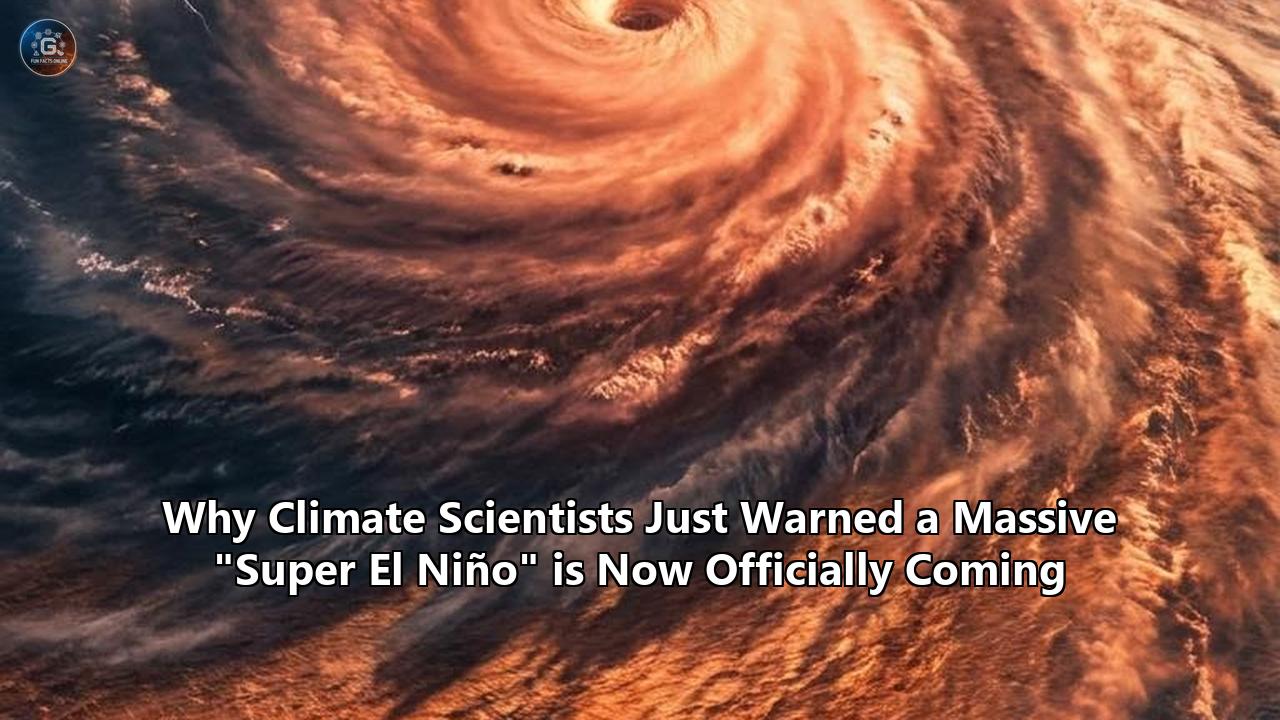
In a series of urgent declarations that have sent shockwaves through the global scientific and humanitarian communities, meteorologists have officially confirmed the return of El Niño, warning that this cycle is rapidly consolidating into a massive "Super El Niño". On June 11, 2026, the U.S. National Oceanic and Atmospheric Administration (NOAA) issued an official El Niño Advisory, revealing that the complex ocean-atmosphere coupled system in the equatorial Pacific has officially transitioned into a warm state. Crucially, NOAA's latest modeling indicates a staggering 63% probability that this event will intensify into a "very strong" or "super" El Niño by the winter of 2026–2027—a classification reserved for events where sea surface temperatures surge more than 2 degrees Celsius (3.6 degrees Fahrenheit) above historical baselines.
This announcement follows closely on the heels of a June 2, 2026, briefing by the United Nations' World Meteorological Organization (WMO), which placed the likelihood of El Niño conditions persisting through the northern hemisphere autumn at 90%. Climatologists are sounding the alarm because this rapid warming is not occurring in a vacuum. It is unfolding across a planet that has already endured consecutive years of unprecedented marine heatwaves, leaving global ocean basins pre-heated and highly volatile.
"El Niño conditions will pour fuel on the fire of a warming world," warned UN Secretary-General António Guterres in a statement addressing the development. "Impacts will hit even harder, travel even farther, and cross borders with devastating speed."
The timing of this climate shock is particularly alarming. Many of the world’s most vulnerable regions are still reeling from the devastating ecological and agricultural scars left behind by the super el nino 2024. That prior event, which was rated as one of the five strongest El Niños in recorded history, propelled 2024 to the status of the hottest year on record, triggering severe droughts across Southern Africa, historic wildfires in the Amazon, and widespread failures in global crop yields. To have a potential successor of equal or greater magnitude develop so rapidly, before global ecosystems and agricultural supply chains have had a chance to recover, presents an unprecedented systemic threat to global stability.
As the planet girds itself for an intense multi-year meteorological disruption, a fundamental question emerges: Why is this El Niño developing with such alarming speed and intensity, what does it mean for our fragile global systems, and how are world leaders and scientists preparing to confront the impending fallout?
The Challenge: The Supercharged Mechanics of ENSO in an Overheated Ocean
To understand the scale of the threat, one must first understand the fundamental physics of the El Niño-Southern Oscillation (ENSO) and how human-driven planetary warming is fundamentally altering its behavior.
The Standard ENSO Cycle vs. The "Super" Variant
Under normal conditions, powerful easterly trade winds blow across the equatorial Pacific Ocean, pushing warm surface waters westward toward Southeast Asia and Australia. This process causes cold, nutrient-rich water from the deep ocean to well up along the western coast of South America, maintaining a cooler eastern Pacific and driving a robust atmospheric circulation loop known as the Walker Circulation.
During an El Niño event, this system breaks down. The trade winds weaken or even reverse direction, allowing the massive pool of warm water that had accumulated in the western Pacific to slosh backward across the ocean toward South America. This suppresses the cold-water upwelling, dramatically raises sea surface temperatures in the eastern and central equatorial Pacific, and shifts the global atmospheric jet streams.
NORMAL CONDITIONS (Neutral / La Niña)
[Australia / Asia] <==== Trade Winds ==== [South America]
   (Warm Water)                              (Cold Upwelling)

EL NIÑO CONDITIONS
[Australia / Asia] === Weak/Reversed ===> [South America]
   (Drought/Cooler)                          (Warm Surface/Rain)
The strength of an El Niño is officially tracked using the Oceanic Niño Index (ONI), which monitors average sea surface temperature anomalies in the critical Niño 3.4 region of the equatorial Pacific.
- Weak El Niño: Anomalies of 0.5°C to 0.9°C
- Moderate El Niño: Anomalies of 1.0°C to 1.4°C
- Strong El Niño: Anomalies of 1.5°C to 1.9°C
- Super El Niño (Very Strong): Anomalies of 2.0°C or greater
What makes the current 2026 forecast so terrifying is that subsurface ocean measurements—which act as a preview of what will soon reach the surface—are showing temperature anomalies exceeding 6°C above average. This massive underground reservoir of heat is fueling the rapid transition and has forced NOAA to predict a high-probability "super" event that could rank among the most powerful since systematic recordkeeping began in 1950.
The Climate Change Multiplier and the Relative Ocean Niño Index
The physical mechanics of ENSO have remained unchanged for millennia, but the backdrop against which they operate has been permanently altered by human activity. The global oceans have absorbed more than 90% of the excess heat trapped by greenhouse gas emissions. As a result, the baseline temperature of the Pacific Ocean is significantly higher today than it was during the major historical El Niños of the 20th century.
This baseline shift has created a profound scientific challenge: how do meteorologists accurately measure an El Niño when the entire ocean is already hot? If the baseline is elevated, a weak El Niño could look like a strong one, or conversely, the localized ocean-atmosphere feedback loops that drive true El Niño weather anomalies might be obscured by uniform global warming.
To address this, NOAA’s Climate Prediction Center recently adopted a highly sophisticated forecasting tool: the Relative Ocean Niño Index (RONI). Unlike the traditional ONI, which compares current temperatures to a fixed, rolling historical average, the RONI subtracts the average warming trend of the global tropical oceans from the localized warming in the Niño 3.4 region. This allows scientists to isolate the true, dynamic ENSO signal from background climate change.
Using this refined metric, scientists have confirmed that the upcoming winter warming is not a mere statistical illusion caused by global warming. It is a genuine, hyper-powered, dynamic Super El Niño that is actively decoupling atmospheric circulation patterns.
Traditional ONI = [Niño 3.4 Temp] - [Historical Baseline]
Relative ONI    = ([Niño 3.4 Temp] - [Historical Baseline]) - [Global Tropical Ocean Warming Trend]
When this dynamic ENSO signal combines with the elevated baseline of greenhouse gas-induced warming, the atmospheric effects are amplified exponentially. A warmer atmosphere holds more moisture—roughly 7% more for every 1 degree Celsius of warming, according to the Clausius-Clapeyron relation. When El Niño shifts atmospheric patterns, it unleashes this supercharged moisture capacity, resulting in far more extreme rainfall and flooding in some areas, while accelerating evaporation and triggering flash droughts in others.
The baseline warming is why the super el nino 2024 was able to drive such unprecedented global temperatures. It wasn't just the natural cycle at work; it was the natural cycle riding a massive wave of human-caused thermal energy. The looming 2026–2027 event is poised to repeat this dynamic, but starting from an even higher thermal baseline.
Why It Matters: The Imminent Threat of Global Disruptions
A Super El Niño is not simply a weather story; it is a profound socio-economic shockwave. Because ENSO governs the distribution of heat and moisture across the globe, a major disruption to this system triggers a cascade of crises that disproportionately affect food security, economic stability, human health, and geopolitical relations.
                     ┌───────────────────────────┐
                     │  Super El Niño Activation  │
                     └─────────────┬─────────────┘
                                   │
         ┌─────────────────────────┼─────────────────────────┐
         ▼                         ▼                         ▼
┌──────────────────┐      ┌──────────────────┐      ┌──────────────────┐
│  Global Drought  │      │ Oceanic Warming  │      │ Torrential Rain  │
└────────┬─────────┘      └────────┬─────────┘      └────────┬─────────┘
         │                         │                         │
         ▼                         ▼                         ▼
┌──────────────────┐      ┌──────────────────┐      ┌──────────────────┐
│  Crop Failures/  │      │ Coral Bleaching/ │      │ Infrastructure   │
│ Wildfires/Famine │      │ Fishery Collapse │      │ Destruction/Mud  │
└──────────────────┘      └──────────────────┘      └──────────────────┘
1. The Threat of Cascading Food Supply Shockwaves
The global food system is highly concentrated, relying heavily on a few "breadbasket" regions for its core caloric output. Four crops—wheat, rice, maize, and soybeans—provide more than 60% of human calorie intake. A Super El Niño directly threatens the yields of these crucial staples in several of the world's most dominant agricultural exporters.
Maize and Soybeans
Southern Africa, Brazil, and parts of the Midwestern United States face severe climate risks during El Niño phases. In Southern Africa, the correlation between El Niño and devastating maize crop failures is nearly absolute. During the super el nino 2024, dry spells decimated the maize harvest across Zimbabwe, Zambia, and Malawi, forcing multiple governments to declare national states of disaster due to widespread famine risks.
In South America, while El Niño typically brings beneficial rain to southern Brazil and Argentina, it brings severe drought to the northern and northeastern agricultural regions of Brazil, heavily disrupting soybean and corn planting cycles.
Rice
Rice is exceptionally sensitive to water availability and temperature. El Niño historically delays and weakens the crucial Asian summer monsoon, which is responsible for watering the vast rice-growing regions of India, Bangladesh, Indonesia, Vietnam, and Thailand. The impending 2026 El Niño is expected to trigger severe droughts in Indonesia and the Mekong Delta.
When rice yields plummet, countries often respond by imposing protectionist export bans to secure domestic supplies—as India did in recent years—which immediately drives up global food prices and triggers acute hunger in import-dependent regions like West Africa and the Middle East.
Wheat
Major wheat exporters, including Australia, Canada, and parts of China, routinely suffer from severe heat stress and moisture deficits during El Niño summers. Australia’s wheat yields are particularly vulnerable; a strong El Niño can slash the country's agricultural export revenues by billions of dollars, instantly tightening the global grain market.
Making matters worse, this agricultural disruption is set to collide with an ongoing, severe global fertilizer crisis sparked by persistent geopolitical tensions and trade route closures, such as shipping bottlenecks in the Strait of Hormuz. When farmers cannot access or afford nitrogen- and phosphate-based fertilizers, their crops are already compromised; adding a historic drought on top of this fertilizer deficit is a recipe for catastrophic crop failures and localized famines.
2. The Fire and Smoke Epidemic: Scorching Key Ecosystems
As global temperatures spike during a Super El Niño, the risk of massive, uncontrollable wildfires rises exponentially across several continents.
- The Amazon Basin: The Amazon rainforest is highly unadapted to fire. Under normal conditions, the forest is too humid for fires to spread naturally. However, El Niño severely reduces wet-season rainfall in northern South America, leaving the forest floor covered in dry leaf litter and highly flammable organic material. The super el nino 2024 led to a record-breaking fire season in Brazil, where more than 2.3 million hectares of forest burned—four times the historical annual average. Because of the lag effect of ENSO, the reduced rainfall from the late 2026 onset will likely leave the Amazon highly vulnerable to a catastrophic dry season in 2027.
- Canada and the Boreal Forests: El Niño typically brings unusually warm, dry winters and diminished snowpack to Canada. This lack of winter moisture dries out the expansive boreal forests early in the spring, setting the stage for massive, smoke-producing wildfires that can blank northern hemisphere cities in toxic haze for months at a time.
- Southeast Asia and Australia: In Indonesia and Malaysia, peatland forests are drained and cleared for palm oil plantations. When El Niño-induced droughts hit, these carbon-rich peatlands dry out and catch fire. Peat fires burn underground, are nearly impossible to extinguish, and release immense quantities of greenhouse gases alongside thick "regional haze" that chokes cities across Singapore, Malaysia, and Indonesia, causing severe public health crises.
3. Geopolitical Instability and the Civil Conflict Nexus
Climatologists and political scientists have long observed a chilling correlation: the risk of new civil conflicts in tropical countries doubles during El Niño years. A landmark study analyzing conflicts since 1950 found that roughly 21% of all civil disputes are linked to ENSO-driven climate shocks.
The pathway from weather to war is driven by resource scarcity. When agricultural yields collapse, food prices soar, and water supplies dry up, rural populations lose their livelihoods. This leads to mass migrations from rural areas to already-strained urban centers, exacerbating social tensions.
In countries with weak governance, ethnic divisions, or existing political instability, the sudden onset of food insecurity and economic desperation acts as a threat multiplier, making armed conflict and civil unrest far more likely.
| El Niño Impact | Immediate Consequence | Downstream Geopolitical Risk |
|---|---|---|
| Severe Crop Failure | Localized food shortages, skyrocketing food prices | Urban food riots, political instability, regime collapse |
| Water Scarcity | Depleted transboundary river basins, dried reservoirs | Transboundary resource wars, localized communal violence |
| Rural Livelihood Loss | Mass displacement, rural-to-urban migration | Overburdened cities, rise in recruitment by extremist groups |
| Coastal Fishery Collapse | Mass mortality of pelagic fish, reduced catch | Rise in maritime piracy, territorial fishing disputes |
4. The Deadly Precedent: The Ghost of 1876–1878
To comprehend the absolute worst-case scenario of a Super El Niño, scientists frequently point to the historical record, specifically the catastrophic El Niño of 1876–1878.
The 1876–1878 event is widely considered by paleoclimatologists to be the strongest El Niño in written history. It triggered an unprecedented global drought that crippled the monsoon systems of Asia, South America, and Africa for nearly three consecutive years. The resulting agricultural collapse led to what historians refer to as the "Late Victorian Holocausts"—a series of devastating, climate-synchronized famines across India, China, Brazil, and Egypt.
The global death toll from the 1876–1878 famine is estimated to have been a staggering 50 million people.
1876-1878 Super El Niño Event
   ├── India: Monsoon failure -> Great Famine of 1876-1878
   ├── China: Northern provinces drought -> Northern Chinese Famine
   ├── Brazil: Northeast drought -> "Grande Seca" (Great Drought)
   └── Global Death Toll: ~50 million people (largely due to imperial trade policies & climate)
While modern agricultural technology, international aid organizations, and global transport networks make a 50-million-person famine highly unlikely today, the 1876–1878 event serves as a stark warning of the absolute physical power of a Super El Niño. If an event of that physical magnitude were to strike today, it would interact with a global population of 8 billion people, severely testing the limits of international humanitarian relief and global food distribution networks.
What Went Wrong: The Structural and Scientific Failures Behind Our Vulnerability
As the world stands on the verge of this major climate disruption, scientists and policy analysts are asking why we remain so vulnerable. Despite decades of warnings and increasingly sophisticated computer models, the global community continues to find itself reacting to ENSO shocks rather than proactively mitigating them. Several critical structural and scientific failures have contributed to this systemic unpreparedness.
1. The Shrinking Window of Recovery
One of the most alarming aspects of modern climate patterns is the rapid, back-to-back sequence of extreme weather events. Historically, strong El Niño events occurred once every decade or two, allowing ecosystems, agricultural soils, and national treasuries ample time to recover and rebuild resilience.
However, the transition window between major events is shrinking. The world barely had time to assess the damage from the super el nino 2024 before entering a brief, weak La Niña phase, only to plunge directly back into a potentially historic El Niño in 2026.
This rapid cycling creates a cumulative deficit:
- Soil Depletion: Agricultural soils parched during 2024 have not had their deep-aquifer moisture replenished, making them highly susceptible to instant, severe desertification when the 2026 drought begins.
- Financial Exhaustion: Developing nations that borrowed heavily to fund emergency food imports and rebuild infrastructure in 2024 and 2025 are facing severe debt crises. They lack the fiscal space to prepare for another major climate shock in 2026.
- Ecosystem Fragility: Forests like the Amazon, weakened by the fires of 2024, have not had the years of uninterrupted wet seasons required to regenerate their canopy cover. A second major drought so soon risks pushing large swaths of the rainforest past a critical tipping point from which they cannot recover, permanently converting them into dry savannas.
2. The Climatological "Black Box" of the 2023–2025 Temperature Jump
A major scientific challenge complicating our preparedness is a sudden, unexplained jump in global average temperatures that began in 2023 and persisted through 2025. Climatologists have observed that the Earth's atmosphere heated up far faster than standard greenhouse gas models predicted, leaving researchers scratching their heads.
GLOBAL TEMPERATURE ANOMALY CHART (Conceptual)
Temp
Anomaly
 ^
 |                                      / (Current 2026 Forecast)
 |                                     /
 |                       * (2024 Peak)
 |                      / \
 |                     /   * (2025 Unexplained Baseline Shift)
 |      ______________/
 |     / (Pre-2023)
 |____/
 --------------------------------------------------> Time
Several competing hypotheses have been proposed to explain this thermal jump:
- The IMO Shipping Fuel Regulations: In 2020, the International Maritime Organization mandated a drastic reduction in the sulfur content of marine shipping fuels. While this greatly improved air quality, it inadvertently removed reflective sulfur aerosols from the atmosphere over the world's shipping lanes, allowing more solar radiation to reach and warm the oceans.
- The Hunga Tonga Volcanic Eruption: The massive underwater eruption of Hunga Tonga-Hunga Ha'apai in January 2022 injected unprecedented volumes of water vapor—a potent greenhouse gas—directly into the stratosphere, trapping additional heat.
- Deep Ocean Heat Release: Cyclical deep-ocean currents may have begun venting centuries of stored thermal energy back into the shallow biosphere.
Because scientists do not yet fully comprehend the exact proportions of these contributing factors, their predictive models for the 2026–2027 Super El Niño are operating under a cloud of scientific uncertainty. If the baseline warming has permanently shifted upward due to an unrecognized feedback loop, the atmospheric consequences of the upcoming El Niño could far exceed even our most pessimistic forecasts.
3. The Failure of International Climate Finance
The international community has repeatedly failed to deliver on its climate finance promises. Under the Paris Agreement, wealthy nations—who are historically responsible for the vast majority of greenhouse gas emissions—committed to providing $100 billion annually to help developing nations adapt to climate change.
Not only has this target been consistently missed or met through misleading loan-based structures, but the funding is heavily weighted toward mitigation (reducing emissions) rather than adaptation (building resilience against immediate shocks like El Niño).
Developing nations in the Global South require billions of dollars in upfront, grant-based capital to:
- Construct regional water storage reservoirs and deep-well irrigation networks.
- Distribute drought-resistant seed varieties to smallholder farmers.
- Harden coastal infrastructure against rising sea levels and storm surges.
- Establish localized early warning and emergency response networks.
Without this capital, vulnerable nations are forced into a cycle of reactive crisis management—borrowing expensive emergency funds to feed their populations after a disaster has already struck, which further degrades their long-term economic resilience.
The Solutions: How Experts and Leaders Are Confronting the Super El Niño
Faced with the prospect of an devastating multi-year meteorological crisis, scientists, humanitarian agencies, and global policymakers are shifting from a posture of passive observation to active, coordinated intervention. A comprehensive suite of solutions is currently being deployed to cushion the blow of the upcoming Super El Niño.
                     ┌───────────────────────────┐
                     │  Super El Niño Solutions  │
                     └─────────────┬─────────────┘
                                   │
         ┌─────────────────────────┼─────────────────────────┐
         ▼                         ▼                         ▼
┌──────────────────┐      ┌──────────────────┐      ┌──────────────────┐
│  Early Warning   │      │ Anticipatory     │      │ Agricultural     │
│   Systems (WMO)  │      │ Action (FAO/WFP) │      │ Adaptations      │
└────────┬─────────┘      └────────┬─────────┘      └────────┬─────────┘
         │                         │                         │
         ▼                         ▼                         ▼
┌──────────────────┐      ┌──────────────────┐      ┌──────────────────┐
│ Satellite-driven │      │ Cash transfers & │      │ Drought-resilient│
│ localized alerts │      │ seeds deployed   │      │ crops & efficient│
│ for farmers      │      │ before drought   │      │ micro-irrigation │
└──────────────────┘      └──────────────────┘      └──────────────────┘
1. Global Deployment of the "Early Warnings for All" Initiative
One of the most effective ways to save lives and protect livelihoods during extreme climate events is to ensure that everyone on Earth has access to timely, actionable weather forecasts. In response to this need, the WMO, in partnership with the United Nations, is rapidly accelerating the deployment of the "Early Warnings for All" (EW4All) initiative.
The EW4All initiative, which aims to protect every person on the planet with early warning systems by the end of 2027, is structured around four essential pillars:
                  THE EW4ALL FOUR-PILLAR FRAMEWORK

  Pillar 1: Disaster Risk Knowledge
  [Systematic data collection, hazard mapping, and vulnerability assessments]
                                │
                                ▼
  Pillar 2: Detection, Monitoring, Analysis, and Forecasting
  [Advanced satellite arrays, ocean buoy networks, and meteorological AI models]
                                │
                                ▼
  Pillar 3: Warning Dissemination and Communication
  [Cellular broadcast networks, community radio, and localized warning sirens]
                                │
                                ▼
  Pillar 4: Preparedness and Response Capabilities
  [Community evacuation drills, pre-positioned emergency supplies, and local training]
To combat the upcoming 2026–2027 Super El Niño, meteorologists are leveraging advanced artificial intelligence models and high-resolution satellite imagery to provide farmers with hyper-local seasonal forecasts. In India and East Africa, this allows agricultural extension services to send SMS text messages directly to smallholder farmers, telling them exactly when to plant, which crops will survive the projected rainfall anomalies, and when to harvest early to avoid crop loss.
2. The Shift to Anticipatory Action and Predictive Financing
Historically, humanitarian aid has operated on a reactive model: a drought occurs, crops fail, famine is declared, and aid agencies raise funds to send food trucks and medical supplies. While life-saving, this approach is incredibly slow, highly inefficient, and exceptionally expensive.
Today, organizations like the UN Food and Agriculture Organization (FAO) and the World Food Programme (WFP) are pioneering a revolutionary approach known as Anticipatory Action (AA).
REACTIVE MODEL (Slow & Costly)
[Disaster Strikes] ──> [Crop Failure] ──> [Famine Declared] ──> [Fundraising] ──> [Aid Arrives]

ANTICIPATORY ACTION (Proactive & Efficient)
[Forecast Trigger] ──> [Funds Released] ──> [Seeds & Cash Distributed] ──> [Disaster Strikes] ──> [Resilience]
Anticipatory Action relies on pre-agreed scientific "triggers"—such as a specific sea surface temperature anomaly in the Pacific or a projected 30-day rainfall deficit. Once a trigger is breached, funds are automatically released before the disaster occurs.
For the upcoming El Niño, FAO and WFP have established early-action protocols across Latin America, East Africa, and Southeast Asia. These protocols include:
- Unconditional Cash Transfers: Giving vulnerable families cash several months before a drought hits allows them to buy and store food when prices are still low, preventing them from selling off their livestock or land to survive.
- Pre-positioning Veterinary Supplies: Distributing vaccines, feed, and water-treatment tablets to pastoralist communities in arid regions ensures their livestock—their primary source of wealth—survives the dry spell.
- Water Harvesting and Infrastructure Maintenance: Financing local communities to desilt water reservoirs, repair boreholes, and construct sand dams before rains fail, maximizing every drop of available water.
Studies have shown that every $1 invested in anticipatory action saves up to $7 in emergency humanitarian response costs, while preserving the dignity and self-reliance of vulnerable families.
3. Agricultural Adaptations and "Climate-Smart" Farming
To withstand a Super El Niño, global agriculture must undergo a rapid transition toward climate-resilient practices. Farmers and agricultural scientists are deploying a variety of innovative techniques to adapt to altered weather patterns:
Drought-Resilient Crop Varieties
Researchers at organizations like the International Maize and Wheat Improvement Center (CIMMYT) and the International Rice Research Institute (IRRI) have spent decades breeding crop varieties that can thrive in extreme conditions.
- Drought-Tolerant Maize (DTM): These varieties feature deeper root systems and a unique genetic ability to slow down their growth during dry spells, preserving water until rain returns. DTM varieties are currently being distributed to millions of farmers across Southern Africa to counter the projected 2026 droughts.
- Submergence-Tolerant Rice ("Scuba Rice"): Conversely, in regions facing extreme El Niño flooding, such as coastal Peru and parts of East Africa, farmers are planting rice varieties that can survive completely submerged underwater for up to two weeks without dying.
Alternate Wetting and Drying (AWD)
In Southeast Asia, rice farmers are adopting AWD—a water-saving management practice that challenges the traditional method of keeping rice paddies continuously flooded.
CONTINUOUS FLOODING (Traditional - High Water Use)
~~~~~~~~~~~~~~~~~~~~~~~~~~~~~~~~~~~~~~~~~~~~~~~~~~ (Water Level)
■■■■■■■■■■■■■■■■■■■■■■■■■■■■■■■■■■■■■■■■■■■■■■■■■■ (Soil Surface)

ALTERNATE WETTING AND DRYING (Climate-Smart - Saves 30% Water)
~~~~~~~~~~~~~~~~         ~~~~~~~~~~~~~~~~         (Water Level)
                \       /                \       /
                 \_____/                  \_____/ (Dries below soil)
■■■■■■■■■■■■■■■■■■■■■■■■■■■■■■■■■■■■■■■─■■■■■■■■■■ (Soil Surface)
By allowing the soil to dry out for a few days before re-flooding, farmers can reduce their water use by up to 30% without sacrificing crop yields. This practice also dramatically reduces the emission of methane—a potent greenhouse gas produced by anaerobic bacteria in flooded paddies.
Micro-Irrigation and Drip Systems
Instead of relying on wasteful flood-irrigation techniques, farmers are installing low-cost drip irrigation systems. These networks deliver water and nutrients directly to the root zone of each plant, minimizing evaporation losses and ensuring that every drop of scarce water is used with maximum efficiency.
4. Hardening National Infrastructure and Urban Centers
National governments are also taking major steps to protect their critical infrastructure and urban populations from El Niño's extreme weather.
- Sponge Cities: In flood-prone regions of China and South America, urban planners are adopting "sponge city" concepts. By replacing impermeable concrete and asphalt with permeable pavements, rain gardens, and constructed wetlands, cities can absorb, filter, and store heavy rainwater, preventing destructive urban flooding while recharging depleted underground aquifers.
- Grid Resilience and Cooling Centers: To protect workers and vulnerable citizens from extreme heat waves, cities like New Delhi and Phoenix are implementing comprehensive Heat Action Plans. These include establishing networks of air-conditioned public cooling centers, retrofitting buildings with reflective "cool roofs," and enforcing mandatory heat-safety protocols—such as halting outdoor construction when temperatures exceed 40°C (104°F).
- Desalination and Water Grid Integration: Countries facing chronic water shortages, such as Chile and Australia, are investing heavily in seawater desalination plants and integrated water pipelines. These systems allow governments to pipe water from regions experiencing excess rainfall directly to drought-stricken agricultural zones and cities.
The Macro Solution: Phasing Out Fossil Fuels to Cap the Baseline Warming
While early warning systems, anticipatory action, and agricultural adaptations are vital tools for managing the immediate impacts of a Super El Niño, scientists agree that these are ultimately temporary band-aids. The fundamental driver of our increasingly volatile climate is the continued accumulation of greenhouse gases in the atmosphere, primarily from the burning of fossil fuels.
If global emissions continue on their current trajectory, the baseline temperature of the oceans will continue to rise. Under such conditions, even a weak, routine El Niño will eventually trigger weather anomalies that exceed the survival limits of modern agriculture and infrastructure.
"The science is clear," stated UN Secretary-General António Guterres. "The only effective response is climate action equal to the crisis – ending our addiction to fossil fuels, accelerating the shift to renewables, protecting the most vulnerable, and delivering early warning systems for all."
               ┌───────────────────────────┐
               │    The Path to Stability  │
               └─────────────┬─────────────┘
                             │
     ┌───────────────────────┴───────────────────────┐
     ▼                                               ▼
┌─────────────────────────┐                     ┌─────────────────────────┐
│ Short-Term Adaptation   │                     │ Long-Term Mitigation    │
├─────────────────────────┤                     ├─────────────────────────┤
│ • Early warning systems │                     │ • Phase out fossil fuels│
│ • Drought-ready crops   │                     │ • Scale up renewables   │
│ • Anticipatory finance  │                     │ • Price carbon emissions│
└─────────────────────────┘                     └─────────────────────────┘
The transition to a clean energy economy is no longer just an environmental goal; it is a hard physical requirement for maintaining a stable biosphere. To prevent future Super El Niños from becoming completely unmanageable, global leaders must commit to:
- Phasing Out Fossil Fuel Subsidies: Governments worldwide continue to spend hundreds of billions of dollars annually subsidizing oil, gas, and coal. Reallocating these funds to renewable energy development and climate adaptation would accelerate the transition while protecting vulnerable communities.
- Rapidly Scaling Renewable Energy Generation: Wind, solar, geothermal, and green hydrogen technologies must be deployed at an unprecedented scale to completely decarbonize global electricity grids and heavy industry.
- Enacting Robust Carbon Pricing Mechanisms: Placing a clear, rising price on carbon emissions would incentivize corporations and consumers to transition to low-carbon alternatives, generating vital tax revenues that can be used to fund international climate adaptation.
Looking Ahead to 2027: The Milestones and Unresolved Variables
As the planet transitions into this new El Niño phase, the coming months will be a critical test of human ingenuity, scientific foresight, and international solidarity. The timeline of a typical El Niño suggests that the atmospheric impacts of the current warm phase will peak during the northern hemisphere winter of 2026–2027 and persist well into the following year.
                     PROJECTED EL NIÑO TIMELINE

  June 2026: El Niño phase officially declared by NOAA & WMO
    │
    ▼
  July - Oct 2026: Weakening trade winds, continued oceanic warming
    │
    ▼
  Nov 2026 - Jan 2027: Peak ocean warming (Potential Super El Niño peak)
    │
    ▼
  Feb - May 2027: Peak atmospheric heating lag (Extreme global temperatures)
    │
    ▼
  June - Dec 2027: Heightened wildfire risk in the Amazon & Southeast Asia
Key Milestones to Watch
Climatologists and policy experts will be monitoring several key indicators over the next year:
- The Winter Peak (November 2026 – January 2027): This is the window when the Oceanic Niño Index is expected to reach its maximum value. If the RONI anomalies exceed 2.0°C during this period, it will officially solidify the event as a historical Super El Niño, setting the stage for extreme global weather anomalies throughout 2027.
- The Atmospheric Heating Lag (Mid-to-Late 2027): Because it takes several months for the heat absorbed by the equatorial Pacific to transfer into the global atmosphere, the warmest global average temperatures typically occur in the second year of an El Niño cycle. Climatologists warn that if the current warming trend continues, 2027 is highly likely to break all-time heat records, potentially pushing the global average surface temperature temporarily above the 1.5°C limit established by the Paris Agreement.
- The Amazon Wet Season (Late 2026): If the upcoming wet season in northern South America is severely suppressed, it will leave the Amazon Basin exceptionally dry heading into the 2027 dry season, dramatically increasing the risk of record-breaking, catastrophic forest fires.
Unresolved Climatological Wildcards
While our understanding of ENSO is highly sophisticated, several critical scientific questions remain unanswered:
- The Indian Ocean Dipole (IOD): The IOD—often referred to as the "Indian Ocean El Niño"—is a cyclical temperature seesaw between the eastern and western Indian Ocean. A positive IOD phase can significantly amplify El Niño's drying effects across Australia and Southeast Asia, while a negative phase can dampen them. How the IOD interacts with the current Super El Niño will determine the severity of droughts and wildfires in those regions.
- The Atlantic Meridional Mode (AMM): Extreme warming in the tropical North Atlantic can alter atmospheric pressure patterns over South America, potentially shifting the path of the Pacific jet streams and modifying El Niño's expected impacts.
- The Durability of Marine Ecosystems: The world's coral reefs have already endured consecutive years of severe thermal stress, triggering widespread marine bleaching events. Whether these fragile ecosystems can survive another massive, prolonged marine heatwave without suffering irreversible, catastrophic collapse is a major concern for marine biologists.
The official confirmation of a developing Super El Niño is a stark reminder that the boundaries of our stable climate are rapidly shifting. The impending weather extremes will test the limits of our global food systems, our public health infrastructure, and our collective political will.
However, unlike our ancestors who faced the devastating droughts of 1876–1878 with little warning and no global coordination, we possess the scientific tools, the communication networks, and the financial resources required to anticipate, prepare for, and survive this crisis. The only question that remains is whether global leaders will deploy these solutions with the speed and scale that this urgent climate warning demands.
Reference:
- https://www.sciencenews.org/article/super-el-nino-high-temperatures-disease
- https://www.youtube.com/watch?v=njJ-Z9Jd5FA
- https://www.cpc.ncep.noaa.gov/products/analysis_monitoring/enso_advisory/ensodisc.shtml
- https://www.downtoearth.org.in/climate-change/el-ni%C3%B1o-amplified-as-a-super-event-looms-in-2026-scientists-warn-impacts-may-last-into-2027
- https://www.theguardian.com/environment/2026/jun/02/prepare-for-imminent-return-of-el-nino-un-warns
- https://wmo.int/news/media-centre/wmo-prepare-el-nino
- https://grist.org/food-and-agriculture/the-super-el-nino-is-here-what-happens-next-could-upend-farming-worldwide/
- https://en.wikipedia.org/wiki/Super_El_Ni%C3%B1o_events
- https://www.wri.org/insights/super-el-nino-impacts-explained
- https://www.theguardian.com/commentisfree/2026/jun/09/super-el-nino-global-economy
- https://news.un.org/en/story/2026/06/1167753