For over four centuries, the physical footprint of the greatest playwright in the English language has eluded the city that made him famous. While Stratford-upon-Avon claims his birth and death, London served as the crucible of his professional life. Yet, beneath the relentless churn of London’s modern development, the exact location of his only known capital residence remained a geographic ghost.
This week, that mystery abruptly ended. A coalition of scholars and spatial archaeologists officially mapped the precise coordinates, dimensions, and floorplan of the Blackfriars gatehouse—the property William Shakespeare purchased in 1613.
The breakthrough stems from the discovery of a heavily detailed, previously unknown 1668 property plan buried in the London Archives. Identified by Lucy Munro, Professor of Shakespeare and Early Modern Literature at King’s College London, the post-Great Fire drawing provided the crucial geospatial data needed to anchor the 17th-century structure to the 21st-century city grid.
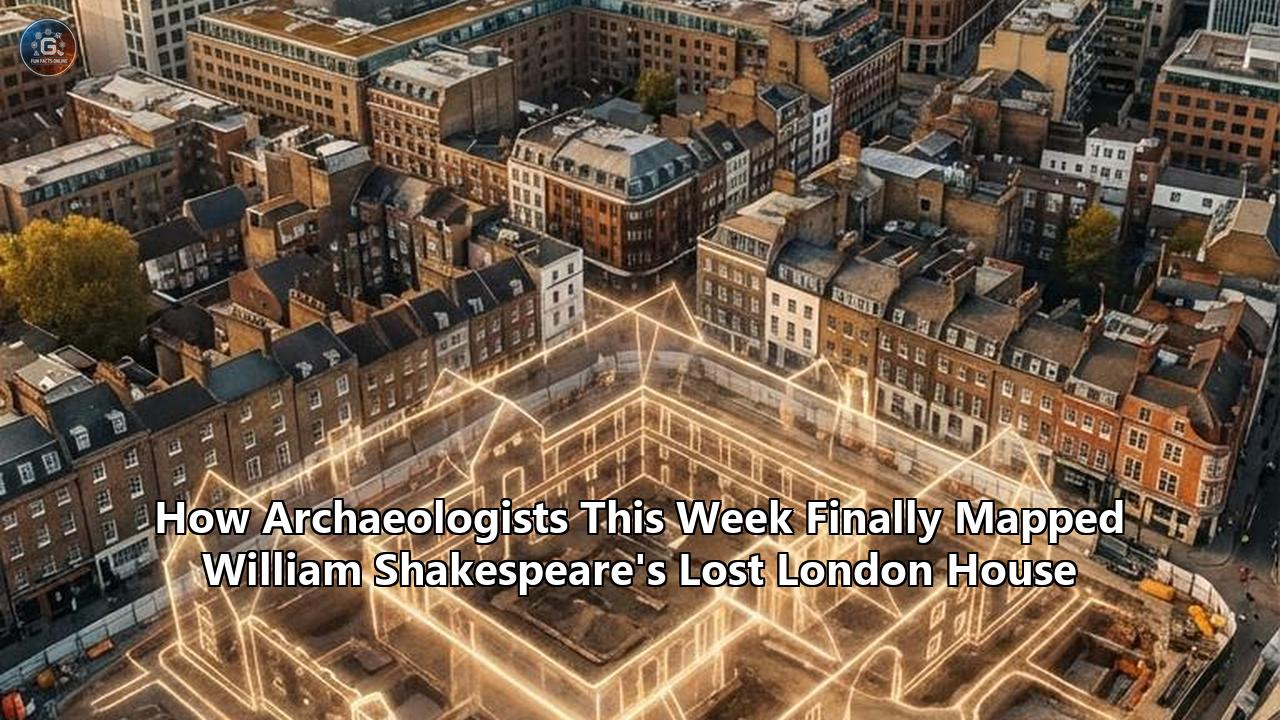
Using advanced georeferencing techniques, researchers have projected the historical floorplan onto the modern topography of the City of London. The property sits exactly at the eastern end of Ireland Yard, stretching down the bottom of Burgon Street, and intersecting with parts of the late-19th-century buildings currently occupying 5 Burgon Street and 5 St. Andrew’s Hill.
For decades, an unassuming blue City of London plaque at 5 St. Andrew’s Hill has vaguely declared that Shakespeare purchased lodgings "near this site." Following this week’s spatial alignment, mapping experts have confirmed that the plaque is not merely near the site—it is fastened directly on top of it.
The identification of this property fundamentally disrupts the accepted historical timeline of Shakespeare’s final years.
"This discovery throws into question the narrative that Shakespeare simply retired to Stratford and spent no more time in the city," Munro said during the announcement of the findings. "It has sometimes been thought that he bought his Blackfriars property merely as an investment, but we don't know that this is true, or that he never used it for himself."
To understand how a centuries-old floorplan transitions from a dusty archival box into a mathematically precise spatial model, we have to look at the intersection of historical cartography and modern urban archaeology. Mapping a house that burned to the ground 360 years ago requires far more than just reading an old map—it requires reverse-engineering the urban development of London itself.
The Archival Dig: Discovering the 1668 Map
The physical excavation of a historical site almost always begins with a paper excavation. In this case, the hunt for the William Shakespeare lost house did not start with a trowel in the dirt, but with a systematic sweep of the London Archives.
Munro was initially researching the urban fabric surrounding the Globe and Blackfriars playhouses—the two primary theaters where Shakespeare held a financial stake. While sifting through a box of seemingly mundane property documents related to the St. Ann Blackfriars parish, she uncovered a survey plan drawn in 1668.
The date is the most critical aspect of the document. In September 1666, the Great Fire of London incinerated approximately 85 percent of the medieval city, consuming over 13,000 houses, including Shakespeare's former property. In the immediate aftermath, the city commissioned highly detailed property surveys to resolve complex land disputes, determine ownership, and orchestrate the rebuilding of the capital.
These post-fire surveys are characterized by an unusual level of geometric precision. The 1668 Blackfriars plan explicitly outlines the boundaries of the local properties, naming the tenants and property owners of the reconstructed plots. By tracing the chain of custody from the people listed in 1668 backward through known deeds and wills to 1613, Munro realized she was staring directly at the exact dimensions of Shakespeare’s property.
The document reveals a substantial L-shaped dwelling measuring exactly 45 feet from east to west. At its eastern end, the property measured 15 feet from north to south, tapering slightly to 13 feet at the western end.
Curiously, the map only shows a portion of the original estate. Because the house was built directly into the medieval gatehouse of the old Dominican priory, a significant section of the home literally bridged the street below. When the Great Fire swept through, this overhanging section—lacking a stone foundation set into the earth—was entirely obliterated. The 1668 surveyors only mapped the footprint of the foundations that remained visible in the ashes.
However, locating a drawing of a property is only the first step. Translating a hand-drawn 17th-century survey into actionable archaeological data requires algorithmic intervention.
The Science of Georeferencing the Past
How do spatial archaeologists take a piece of 350-year-old parchment and lock it onto the GPS coordinates of a modern city street? The answer lies in Geographic Information Systems (GIS) and a complex digital process known as georeferencing.
Seventeenth-century surveyors did not have access to orbital satellites or laser transit levels. They relied on tools like Gunter’s chain—a 66-foot-long physical chain of 100 metal links dragged across the ground—and plane tables to calculate angles. Consequently, historical maps contain localized spatial distortions, uneven scaling, and slight geometric warping. You cannot simply lay a 1668 map over Google Earth and expect the streets to line up.
To map the William Shakespeare lost house, spatial researchers execute a process called "rubber-sheeting."
First, technicians scan the historical map at an ultra-high resolution. They import this raster image into GIS software and begin hunting for Ground Control Points (GCPs). A GCP is a static, immovable architectural or geographic feature that exists precisely in the same location on both the 1668 map and the 2026 digital map.
In a city heavily bombed during the 1940s Blitz and continually redeveloped by modern finance, finding static anchor points is difficult. Fortunately, the Blackfriars precinct contains a few stubborn survivors. Portions of the original medieval Dominican friary wall, constructed in the 13th century, still exist in fragments today. The medieval street patterns—specifically the sharp angle where Ireland Yard meets Burgon Street—also survived the 1666 fire and subsequent rebuilding phases.
By linking these historical pixels to modern GPS coordinates (using the WGS 84 coordinate system), the software calculates a transformation matrix. The computer mathematically stretches, rotates, and warps the 1668 image to forcefully align with the modern topography, mathematically neutralizing the 17th-century surveyor's minute errors.
Once the map is rubber-sheeted into place, the exact geographic coordinates of the lost foundations are suddenly revealed. The footprint of Shakespeare’s home was essentially hiding in plain sight, buried beneath the asphalt of a quiet street just a five-minute walk from where his plays were staged.
The Stratigraphy of Blackfriars: What Lies Beneath
With the exact coordinates now mapped, the obvious question arises: why not simply dig it up?
Urban archaeology in the City of London is an exercise in extreme vertical navigation. If excavators were to hypothetically cut a trench through the pavement of Burgon Street today to expose the physical foundations of the William Shakespeare lost house, they would have to dig through a staggering timeline of human habitation, often referred to as urban stratigraphy.
The vertical slice of earth beneath this specific patch of London contains six distinct chronological layers:
1. The Modern Infrastructure Layer (Surface to 3 feet down):Immediately beneath the asphalt lies a dense, chaotic web of 21st-century fiber-optic telecommunication cables, modern water mains, and high-voltage electrical lines. Digging in the City of London requires navigating a minefield of active utilities.
2. The Victorian Sanitation Layer (3 to 6 feet down):Beneath the modern cables lies the massive brickwork of the 19th-century sewer system, designed by Joseph Bazalgette, alongside the deep concrete foundations of Victorian office buildings that were erected during the height of the British Empire.
3. The Great Fire Ash Layer (approx. 6 to 8 feet down):This is the most critical marker for archaeologists working in Central London. The September 1666 fire burned with such ferocious intensity that it left behind a distinct geological horizon—a compressed band of charred timber, oxidized red brick, melted glass, and scorched pottery. Anything found directly beneath this ash layer dates to the era of Shakespeare.
4. The Early Modern/Jacobean Layer (8 to 10 feet down):If the foundations of Shakespeare's house survive, they reside here. Following the dissolution of the monasteries by King Henry VIII in the 1530s, vast religious estates like the Blackfriars Dominican priory were broken up and sold to private developers. The gatehouse Shakespeare eventually bought was a patchwork structure, retrofitted with timber framing and brick chimneys over the older stone walls.
5. The Medieval Priory Layer (10 to 15 feet down):Beneath the Tudor modifications lie the massive, heavily engineered ragstone foundations of the 13th-century Dominican friary, built by the "Black Friars" (named for their black cloaks).
6. Roman Londinium (15+ feet down):At the deepest level, archaeologists frequently hit the organized tessellated pavements, hypocaust heating systems, and shattered amphorae of the original Roman settlement, established in the first century AD.
Because the William Shakespeare lost house sits beneath an active modern street and heavily protected 19th-century architecture, an open-trench excavation is currently impossible. However, the exact mapping of the site opens the door for non-invasive subsurface imaging.
In the coming months, geophysicists could deploy Ground Penetrating Radar (GPR) across the mapped coordinates. GPR units transmit high-frequency electromagnetic pulses into the ground and record the time it takes for the signals to bounce back from subsurface anomalies. By towing a GPR antenna across the asphalt of Ireland Yard, researchers can generate a 3D subsurface model. While GPR struggles in highly conductive clay soils, the sandy, rubble-filled matrix of urban London often yields sharp contrasts, allowing algorithms to outline the hidden stone foundations without moving a single shovelful of dirt.
The Economics of the 1613 Real Estate Deal
Understanding the exact location and scale of this property fundamentally shifts how historians view Shakespeare’s economic savvy and his integration into London's commercial landscape.
The deed of purchase, which survives today, is dated March 10, 1613. Shakespeare bought the property from a minstrel named Henry Walker for the sum of £140. At the time, this was a massive expenditure. For context, a skilled tradesman in Jacobean London might earn £10 to £15 in a single year.
But the mechanics of the purchase are just as revealing as the price tag. Shakespeare did not pay the full amount upfront. He handed Walker £80 in cash and executed a mortgage for the remaining £60 the very next day. This transaction stands as one of the earliest documented property mortgages involving a major English literary figure.
Furthermore, Shakespeare did not buy the house alone. He utilized a sophisticated legal mechanism akin to a modern corporate trust. He enlisted three co-purchasers to act as trustees: William Johnson (the host of the famous Mermaid Tavern in Cheapside), John Jackson, and John Heminges. Heminges was a fellow actor, a shareholder in the King’s Men playing company, and famously one of the primary architects of the 1623 First Folio, which preserved Shakespeare’s plays for posterity.
Legal historians note that structuring the purchase through these trustees was a deliberate legal maneuver. It effectively prevented his wife, Anne Hathaway, from claiming her traditional "widow's dower"—a common law right that would have automatically granted her a one-third life interest in the property upon his death. Instead, the trust ensured that the property could be cleanly bequeathed to his eldest daughter, Susanna Hall, exactly as he outlined in his will.
The physical mapping of the home also underscores the strategic nature of the location. Blackfriars in 1613 was an unusual, highly coveted neighborhood. Because it had formerly been a religious sanctuary, it existed as a "liberty"—a jurisdictional loophole that placed it outside the strict regulatory control of the City of London’s Lord Mayor and the civic guilds.
This legal immunity made it a magnet for artists, foreign artisans, wealthy aristocrats, and theater makers. The neighborhood was multicultural and dynamic, packed with French and Dutch immigrants who had fled religious persecution on the continent. It boasted indoor tennis courts, bowling alleys, and, most importantly, the Blackfriars Playhouse.
Shakespeare and his syndicate, the King’s Men, had taken over the indoor Blackfriars Theatre in 1608. Unlike the open-air Globe Theatre on the muddy South Bank, which was exposed to the rain and only viable in the summer, the Blackfriars was an enclosed, candle-lit, premium venue. Tickets cost up to six times as much as those at the Globe. It catered to a wealthier, highly educated demographic.
Mapping the new property reveals that Shakespeare’s house was a mere five-minute walk from this theater. It was the ultimate live-work commute. Right across the street from his new front door stood a tavern known as the Sign of the Cock (which survives today, in its modern iteration, as The Cockpit pub). The mapped environment perfectly illustrates a playwright deeply embedded in the social and commercial ecosystem of Jacobean theater.
Rewriting the Bard's Final Act
The most profound impact of this geospatial discovery is how it dismantled a long-held biographical myth.
For centuries, the standard narrative of Shakespeare’s life suggested a clean, three-act structure: he grew up in Stratford-upon-Avon, traveled to London to achieve immense wealth and fame in the theater, and then abruptly retired to Stratford around 1611, turning his back on the stage to live out his days as a quiet country gentleman.
The sheer scale of the mapped London property flatly contradicts this idea. The 1668 floorplan proves that this was not a cramped, single-room lodging. It was a sprawling, multi-story L-shaped house, substantial enough that by 1645 it had been physically subdivided into two separate residences.
"He could have bought an investment property anywhere in London," Munro pointed out. "But this house was close to his workplace at the Blackfriars theater".
When you align the geographic mapping of this massive house with the literary timeline of his final works, a new picture emerges. In the year he bought this house (1613), Shakespeare was not silently pruning roses in Warwickshire. He was actively co-authoring plays. Historical records show he collaborated with the brilliant younger playwright John Fletcher—who would eventually succeed him as the chief dramatist for the King's Men—on at least two plays: Henry VIII (also known as All Is True) and The Two Noble Kinsmen.
The mapped dimensions of the Blackfriars house reveal it had ample space to host collaborative writing sessions. It is highly probable that the drafts of The Two Noble Kinsmen were debated and penned within the walls of this newly identified footprint.
Furthermore, historical legal records show that Shakespeare was physically present in London in November 1614, just 18 months before his death in April 1616. With a sprawling, multi-room estate sitting completely empty five minutes from his theater, it strains credulity to suggest he stayed anywhere else. The identification of the William Shakespeare lost house forces literary scholars to view him not as a retired country squire, but as a bi-coastal executive, maintaining significant domestic operations in both his hometown and the capital until his final days.
The Chain of Custody and the Erasure of History
If the house was so grand, how did its location become so thoroughly lost? The answer is a toxic combination of inheritance, natural disaster, and urban amnesia.
When Shakespeare died in 1616, he left the Blackfriars property to his daughter, Susanna Hall. Following her death, it passed to her daughter, Elizabeth Hall Nash Barnard—Shakespeare's granddaughter and his last direct descendant.
Elizabeth held the property through the turbulent years of the English Civil War. However, in 1665, the year before her death, archival documents show she finally sold the estate, severing the property's connection to the Shakespeare family bloodline.
Just one year later, in September 1666, a spark from a bakery on Pudding Lane ignited the Great Fire of London. Over four days, the inferno consumed the city. The fire jumped the medieval walls, tore through the Blackfriars precinct, and turned Shakespeare’s former home to ash.
When the city was rebuilt, the street grids were subtly shifted, property lines were consolidated, and the towering medieval structures were replaced by brick and stone Georgian terraces. The gatehouse was never rebuilt. Over the next three centuries, as the Victorian financial district expanded and modern office blocks were erected, the physical memory of the Blackfriars house evaporated. By the 20th century, all scholars had to rely on was the vague wording of the 1613 deed, leading to the placement of the ambiguous "near this site" blue plaque.
The survival of the 1668 map is a statistical anomaly. The fact that surveyors meticulously documented the charred footprint of the foundations before they were swallowed by the 1670s rebuilding effort is the only reason spatial archaeologists have a target to aim for today.
What Happens Next?
The successful mapping of the Blackfriars property acts as a critical proof of concept for the future of urban archaeology. It demonstrates that the key to unlocking hidden historical structures does not always require millions of dollars in heavy excavation equipment; often, it requires deploying 21st-century spatial algorithms against 17th-century administrative records.
Looking forward, this interdisciplinary approach—fusing literary archival research with GIS mapping and geophysical subsurface modeling—is likely to be turned against other lost monuments of early modern London.
Currently, archaeologists know the rough areas where the first purpose-built Elizabethan playhouses once stood. The exact layouts of the Red Lion (1567), The Theatre (1576), and the original Globe (1599) have been partially excavated, but dozens of minor theaters, bear-baiting rings, and literary taverns remain lost to the grid.
In the immediate future, local heritage organizations in the City of London are expected to formalize the mapping of the Blackfriars house. The Corporation of London, which manages the historic blue plaque program, will likely have to dispatch stonemasons to St. Andrew’s Hill to physically alter the signage. The word "near" can finally be chiseled away.
Simultaneously, the digital reconstruction of the William Shakespeare lost house offers a blueprint for how urban archaeologists will interface with AI in the coming decade. As institutions like the National Archives digitize millions of post-fire property records, machine learning algorithms can be trained to automatically recognize property boundaries, cross-reference them with surviving deeds, and instantly georeference them against modern satellite imagery.
While the actual stone foundations of Shakespeare's final London sanctuary may remain permanently sealed beneath the concrete of Burgon Street and the tangle of modern fiber-optic wires, the property is no longer lost. By dragging a 1668 floorplan into a 2026 digital matrix, researchers have resurrected the geography of the playwright's world. We now know exactly where he walked, where he wrote, and where he lived as the curtain slowly fell on his final act.
Reference:
- https://archaeology.org/news/2026/04/17/exact-location-of-shakespeares-london-house-found/
- https://www.kcl.ac.uk/news/shakespeares-missing-london-house-mapped-with-new-discovery-1
- https://apnews.com/article/shakespeare-house-london-map-discovery-e51246cb9882037d3731db62255639d3
- https://www.bpr.org/2026-04-17/where-art-thou-mapping-shakespeares-1613-neighborhood
- https://www.kcl.ac.uk/news/shakespeares-missing-london-house-mapped-with-new-discovery-1
- https://apnews.com/article/shakespeare-house-london-map-discovery-e51246cb9882037d3731db62255639d3
- https://www.indulgexpress.com/culture/books/2026/Apr/18/historic-map-uncovers-exact-site-of-shakespeares-london-residence
- https://usaartnews.com/news/shakespeares-london-home-finally-located-after-centuries-of-mystery/amp
- https://historyhit.substack.com/p/shakespeares-lost-london-home-found