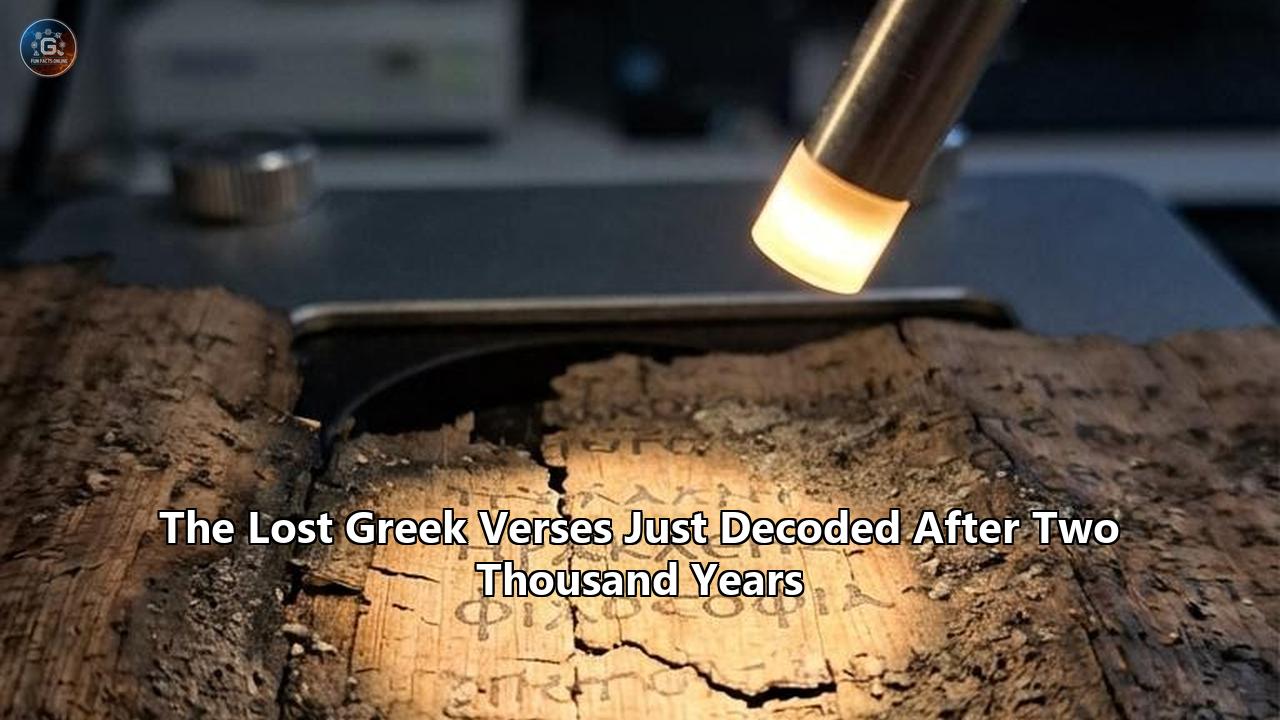
The archives of the French Institute of Oriental Archaeology (IFAO) in Cairo do not look like a battleground for the future of classical humanism. Yet, it is here, alongside the gleaming particle accelerators of Oxfordshire and the open-source coding forums of Silicon Valley, that a decisive victory over time has just been won. In April 2026, researchers announced the recovery of thirty previously unpublished verses by the 5th-century BCE Greek philosopher Empedocles, extracted from a heavily damaged 2,000-year-old papyrus fragment known as P.Fouad inv. 218.
Simultaneously, the Vesuvius Challenge—an international coalition of computer scientists and papyrologists—has successfully utilized machine learning to virtually unroll and read PHerc. 172, a carbonized scroll buried by the eruption of Mount Vesuvius in 79 CE. Within the charred, fused layers of this scroll, algorithms identified hidden ink, revealing terms like διατροπή (disgust), ἀδιάληπτος (foolish), and βίου (life).
This dual triumph marks a structural shift in how we reclaim antiquity. We are no longer limited to the texts that medieval monks chose to painstakingly copy. By combining high-energy physics, machine learning, and advanced philology, researchers are extracting the lost canon directly from the ashes. The recovery of these texts goes far beyond a simple academic update; it provides a direct, unmediated transmission from the minds of the ancient Mediterranean. Seeing ancient greek verses decoded by neural networks fundamentally alters the trajectory of historical preservation, shifting the discipline of archaeology from the physical extraction of artifacts to the digital extraction of data.
The Physics of Invisible Ink: Synchrotrons and Tomography
To understand the magnitude of this week’s announcements, one must first understand the absolute intractability of the raw materials. The Herculaneum scrolls are not simply burned; they are carbonized. When the pyroclastic surge from Mount Vesuvius hit the Villa of the Papyri, the intense heat—estimated at over 500 degrees Celsius—instantly turned the organic papyrus rolls into dense, brittle lumps of charcoal. For over two centuries, physical attempts to unroll them resulted in the destruction of the texts, shattering the carbonized layers into useless flakes.
Worse still is the chemistry of the ink. The scribes of antiquity used a mixture of water, gum arabic, and soot to write. Because the ink is carbon-based, and the papyrus was turned to carbon by the volcano, traditional X-rays see absolutely no difference between the two. X-raying a Herculaneum scroll is like trying to find a drop of water in the ocean using a magnifying glass.
The solution lies in particle physics. To see the invisible, researchers took scroll PHerc. 172 from the Bodleian Libraries in Oxford to the Diamond Light Source, the UK’s national synchrotron science facility. A synchrotron accelerates electrons to near the speed of light, generating X-ray beams billions of times brighter than the sun. When these beams pass through the carbonized scroll, they do not just measure the absorption of the X-rays—they measure the phase shift.
Phase-contrast X-ray tomography exploits the fact that as the ancient water-based ink dried on the papyrus, it subtly altered the cellular structure of the plant fibers beneath it. The ink added microscopic thickness—sometimes only a few microns—and slightly changed the density of the surface. The synchrotron captures this minuscule deviation, creating a massive 3D grid of voxels (three-dimensional pixels). The resulting dataset for a single scroll can exceed several terabytes of structural data, mapping every fold, crush, and warped layer of the charred papyrus.
But having a 3D map of the papyrus does not mean you can read it. The interior of the scroll is a chaotic, crumpled maze. Untangling this physical knot requires algorithms capable of following a single, microscopic layer of papyrus as it spirals and folds through three-dimensional space.
Crackle Patterns and Voxel Grids: The Machine Learning Pipeline
The actual decoding of the texts relies on a pipeline of machine learning models that were largely developed not by tenured classics professors, but by independent tech researchers, competitive coders, and teenagers on Discord. The Vesuvius Challenge, launched by tech entrepreneurs Nat Friedman and Daniel Gross alongside computer scientist Dr. Brent Seales of the University of Kentucky, offered massive cash bounties for anyone who could build open-source software to read the scans.
The technical architecture of this achievement rests on two distinct software challenges: segmentation and ink detection.
Segmentation is the process of virtually unrolling the scroll. Julian Schilliger, a prominent figure in the Vesuvius Challenge, developed 3D segmentation algorithms that track the geometry of the papyrus within the synchrotron data. His tools allow operators to map a continuous surface through the voxel grid, effectively "flattening" a digital sheet of papyrus out of the crushed 3D mass.
Once a segment is flattened, the ink detection models take over. The breakthrough here occurred when independent researcher Casey Handmer noticed a microscopic textural anomaly on the flattened scans—a subtle "crackle pattern" resembling dried mud, left behind by the ancient ink. Luke Farritor, a college student interning at SpaceX, used Handmer’s observation to train a 3D ResNet (Residual Network) machine learning model. Farritor fed the model examples of the crackle pattern, teaching it to recognize the precise voxel arrangements associated with the presence of ink.
The model scans the flattened segments and outputs a probability map: white where it predicts ink, black where it predicts blank papyrus. The result is a surreal, ghost-like rendering of ancient Greek letters blooming onto a digital canvas. When the first fragments of ancient greek verses decoded by these algorithms appeared on the researchers' monitors, the classical world realized that the insurmountable barrier of carbonization had been breached.
The specific findings from PHerc. 172 highlight the efficacy of this pipeline. The Bodleian scroll possesses a uniquely high-density ink compared to other Herculaneum materials, making the machine learning models significantly more confident in their predictions. The extraction of words like διατροπή (disgust) suggests the text is likely a philosophical treatise, potentially by the Epicurean philosopher Philodemus, whose works form the bulk of the recovered Herculaneum library.
P.Fouad Inv. 218: A Window into Pre-Socratic Cosmology
While the algorithms tackle the carbonized scrolls of Italy, traditional papyrology—enhanced by modern imaging—has secured an equally vital victory in Egypt. The identification of thirty unpublished verses by Empedocles in the papyrus fragment P.Fouad inv. 218 provides a rare, unmediated glimpse into Pre-Socratic thought.
Empedocles of Agrigentum (c. 494–434 BCE) is a foundational figure in Western philosophy, famous for originating the cosmogenic theory of the four classical elements: earth, water, air, and fire. He posited that these elements are continually mixed and separated by two opposing cosmic forces: Love (Philia) and Strife (Neikos). Until this discovery, his literary output—written entirely in verse—was known almost exclusively through secondary quotations by later authors like Aristotle, Plutarch, and Plato.
The Cairo fragment, dating to the first century CE, demonstrates that Empedocles’s original text, Physica (On Nature), was still being actively copied and studied nearly five hundred years after his death. The papyrus had sat unidentified in the IFAO archives for decades until papyrologist Nathan Carlig of the University of Liège recognized its significance.
Analyzing P.Fouad inv. 218 required a different suite of techniques than the Herculaneum scrolls. The papyrus was not carbonized, but it was severely degraded, faded, and fragmented. Researchers employed multispectral imaging, capturing photographs of the fragment across various wavelengths of light—from infrared to ultraviolet. Different inks and papyrus substrates react differently to specific wavelengths; infrared light, for instance, can penetrate dirt and surface degradation to reflect off the original carbon ink, making entirely faded letters starkly visible on the monitor.
The newly recovered verses plunge directly into the mechanics of Empedocles’s cosmology. The text details his thoughts on particle effluvia and the mechanics of sensory perception, particularly vision. The verses describe a holistic, cyclical universe where humans, animals, and objects are temporary biological composites assembled by Love and inevitably torn apart by Strife.
Philosophically, these specific lines are heavily debated. Carlig and his European colleagues argue that the detailed mechanics of particle effluvia in these verses cement Empedocles as a direct precursor to the ancient Greek atomists (like Democritus and Leucippus), who argued that the universe consists of indivisible, indestructible components. The text reveals a thinker deeply inspired by Homeric poetics, utilizing epic literary forms to deliver hard, proto-scientific theories about the physical universe.
The Clash of Disciplines: Coders vs. Classicists
Behind the polished press releases detailing these discoveries lies a quiet, structural tension regarding how this work is done, and who gets to do it. The recovery of these texts has forced a sudden marriage between two radically different academic cultures: the slow, meticulous, peer-reviewed world of classical philology, and the fast, iterative, open-source ethos of Silicon Valley.
For centuries, papyrology has been a closed, elite discipline. Access to original manuscripts was tightly controlled by major institutions and museums. Scholars would spend decades working on a single fragment, guarding their transcriptions until a definitive, multi-volume monograph could be published.
The Vesuvius Challenge violently disrupted this model. By openly publishing the multi-terabyte synchrotron scans of the Herculaneum scrolls online and offering cash prizes to anyone who could write code to decipher them, the project bypassed institutional gatekeeping. The initial breakthroughs were not made by tenured professors of Greek literature, but by aerospace interns, cybersecurity researchers, and machine learning engineers.
This methodology initially caused deep anxiety among traditional classicists. An AI model outputting a probability map of ink is not the same as a human reading a text. Machine learning models are prone to "hallucination"—generating patterns that look like Greek letters but are actually statistical noise.
To bridge this gap, a rigorous verification protocol had to be established. When the AI models generate an image of flattened papyrus with predicted ink, the raw images are handed over to a team of expert papyrologists, including scholars from the University of Oxford and specialists like Alain Martin and Oliver Primavesi. These human scholars must verify that the AI's output conforms to the rigid rules of ancient Greek orthography, grammar, and metrical structure.
This collaboration represents a total operational overhaul for the humanities. The engineers cannot train their models without the classicists explaining what ancient handwriting actually looks like, and the classicists cannot read the text without the engineers building the neural networks to find the ink. The technical pipeline that allows these ancient greek verses decoded to emerge from a blackened lump of carbon relies entirely on this uneasy, highly productive alliance.
The Metrical Blueprint: How Prosody Aids the Algorithms
One of the most powerful, yet least discussed, tools in verifying and reconstructing these lost texts is the inherent mathematical structure of the poetry itself. When dealing with fragmented papyri—whether digitally flattened from Herculaneum or physically preserved in Cairo—there are always gaps. Letters are missing, edges are torn, and words are bisected.
In prose, filling a gap is largely a matter of contextual guesswork. But in verse, the text is bound by strict rhythmic laws. Ancient Greek poetry was not based on rhyme, but on meter: the precise arrangement of long and short syllables.
Empedocles composed his Physica in dactylic hexameter, the exact same meter used by Homer in the Iliad and the Odyssey. A line of dactylic hexameter consists of six metrical feet, each typically a dactyl (one long syllable followed by two short syllables) or a spondee (two long syllables).
This rigid prosodic architecture acts as an ancient error-correction code for modern researchers. If a machine learning model outputs an image showing the letters ΠΟΡΦ (PORPH) followed by a physical gap in the papyrus, and the surrounding context demands a specific metrical weight to complete the hexameter, the philologist can mathematically deduce the missing syllables. The gap cannot be filled by just any word meaning "purple"; it must be filled by a word whose vowel quantities exactly match the rhythmic requirements of that specific position in the line.
Researchers are now looking at ways to integrate this metrical data directly into the machine learning pipeline. Future iterations of the Vesuvius Challenge software may include natural language processing (NLP) models trained specifically on the rules of ancient Greek prosody. Instead of merely predicting the presence of ink based on visual voxel data, the AI could evaluate its own visual predictions against the mathematical rules of dactylic hexameter, automatically discarding visual anomalies that result in impossible metrical sequences.
From High Philosophy to Oral Pop Culture
The focus on high-minded philosophical texts by Empedocles and Philodemus can obscure another vital aspect of these recent discoveries: the expansion of the ancient canon to include the voices of everyday people. While synchrotrons and multispectral imaging unlock the libraries of the elite, physical archaeology and fresh philological analysis are revealing the vibrant "pop culture" of the ancient Mediterranean.
Professor Tim Whitmarsh of Cambridge University recently published an analysis of a deeply neglected form of ancient Greek text: anonymous, four-line poems inscribed on gemstones. Unlike the quantitative meter of elite poetry (based on syllable length), these poems represent a "missing link" of stressed poetry—the direct ancestor of modern musical lyrics and song structure.
One such poem, inscribed on a cheap chalcedony gemstone found around the neck of a deceased young woman in modern-day Hungary, dates to the 2nd Century CE. In its shortest form, it reads:
“They say what they like; let them say it; I don't care. Go on, love me; it does you good.”The verse features lines of four syllables with a strong accent on the first and a weaker accent on the third. This rhythmic structure, entirely distinct from the rigid hexameters of Homer or Empedocles, allowed the poem to slot into the oral, musical rhythms of the time—behaving exactly like a modern pop song. The fact that this specific verse has been found inscribed on twenty different gemstones across the Roman Empire, as well as graffito in Spain, proves it was a massive, cross-cultural oral hit.
Whitmarsh’s findings contextualize the highly technical papyrological work happening in Cairo and Oxford. The recovery of texts is not a monolith. While the elite were reading Philodemus’s prose on Disgust in the grand Villa of the Papyri, and scholars in Egypt were painstakingly copying Empedocles’s theories on cosmic particle physics, the middle classes of the Roman Empire were wearing glass-paste medallions inscribed with the lyrics to catchy, rebellious pop songs. Together, these discoveries provide a high-resolution, multi-layered map of ancient cognitive life.
The Cultural Politics of Digital Antiquities
The success of these decoding methods forces a reckoning with the legal and ethical frameworks governing cultural heritage. For centuries, the country that physically held an artifact controlled access to the text written upon it. But the digitization of the Herculaneum scrolls and the Cairo papyri separates the text from the physical object.
When a scroll resting in the Bodleian Library is scanned in an Oxfordshire synchrotron, and the voxel data is uploaded to a server in California, where a teenager in Nebraska trains an AI to detect the ink, and a papyrologist in Liège translates the resulting image—who owns the text?
The Vesuvius Challenge has aggressively championed an open-source model. The machine learning code, the 3D segmentation tools, and the terabytes of raw scan data are made freely available online. This democratization of data is exactly what enabled the rapid breakthroughs of 2023, 2024, and 2025.
However, cultural heritage institutions are historically risk-averse. The Italian authorities overseeing the Herculaneum site, the French Institute in Cairo, and the Bodleian Libraries hold physical custody of priceless, fragile artifacts. Handing over high-resolution data to the public domain strips these institutions of their traditional right to the editio princeps—the prestigious first official publication of a newly discovered ancient text.
The current landscape operates on a fragile truce. The tech sector provides the funding, the hardware, and the algorithms; the institutions provide the physical access; and the traditional academics provide the verification and translation. But as the tools become more efficient, the demand to scan and open-source every readable artifact in the world’s archives will become deafening. The realization that having ancient greek verses decoded at scale will require unprecedented computing power means that large tech platforms and cloud computing providers will increasingly hold the keys to classical antiquity.
The Next Phase of the Virtual Excavation
The discoveries of April 2026 are not an endpoint; they are a proof of concept. The reading of PHerc. 172 and P.Fouad inv. 218 confirm that the hardware is capable and the algorithms are accurate. The immediate challenge facing researchers now is automation and scale.
Currently, the segmentation of the Herculaneum scrolls—tracing the twisted layers of papyrus through the 3D voxel grid—remains incredibly labor-intensive. While Julian Schilliger and others have made massive strides in automating this process, human oversight is still required to correct the algorithms when they accidentally jump from one layer of papyrus to another. To read an entire scroll, the segmentation process must be fully automated.
The stakes for this automation are historic. The scrolls currently held in Naples, Oxford, and Paris represent only a fraction of the library inside the Villa of the Papyri. Archeologists believe that the main section of the villa's library has never been excavated. Most of what has been recovered so far consists of Epicurean philosophy. But standard Roman library design typically featured two distinct sections: one for Greek texts, and one for Latin texts.
If the Latin library—or the broader Greek collection—remains buried under the hardened volcanic mud of Herculaneum, the potential for discovery is staggering. Lost works of Livy, the missing plays of Sophocles and Aeschylus, or the complete poems of Sappho could be sitting in the darkness, perfectly carbonized and waiting for a synchrotron.
Until now, the Italian government has been deeply hesitant to authorize further excavation of the Villa of the Papyri. The reasoning was sound: why spend millions to dig up carbonized scrolls that will instantly crumble into dust if touched, and which cannot be read?
The Vesuvius Challenge and the AI breakthroughs of the last two years have entirely dismantled that argument. We now possess the technology to extract the text without destroying the object. The successful extraction of words like διατροπή (disgust) and the structural recovery of Empedocles’s Physica provide the ultimate justification to resume physical excavations at Herculaneum.
We are entering a period of aggressive textual recovery. The coming years will likely see the deployment of dedicated, specialized scanning hardware placed directly adjacent to archaeological sites and archival vaults. Machine learning models, currently trained on the crackle patterns of carbonized ink, will be generalized to detect iron-gall ink on medieval palimpsests and faded pigments on degraded Egyptian papyri.
The silence of antiquity is breaking. Through the precise manipulation of X-rays, neural networks, and philological rigor, the lost voices of the ancient world are transmitting once again. For the researchers sitting in the glow of their monitors, watching ancient greek verses decoded line by line from the ashes of Vesuvius and the sands of Egypt, the physical limitations of history have permanently dissolved. The texts are there. We just had to learn how to look.
Reference:
- https://www.ancient-origins.net/news-history-archaeology/empedocles-papyrus-00102658
- https://gizmodo.com/30-unpublished-poems-from-iconic-greek-philosopher-discovered-in-cairo-2000741535
- https://www.ox.ac.uk/news/2025-02-07-inside-herculaneum-scroll-seen-first-time-almost-2000-years
- https://archaeologymag.com/2025/02/ai-reveals-first-look-inside-herculaneum-scroll/
- https://the-past.com/news/reading-a-new-herculaneum-scroll/
- https://www.understandingai.org/p/a-volcano-scorched-hundreds-of-roman
- https://www.youtube.com/watch?v=el5ecNkd41k
- https://archaeology.org/news/2026/04/07/ancient-papyrus-reveals-new-lines-of-greek-philosophy/
- https://www.researchgate.net/publication/396544481_Recovering_Ancient_Greek_Poetic_Melodic_Patterns
- https://greekreporter.com/2025/11/18/pop-culture-ancient-greece/