When Swedish construction crews recently began carving out an expansion for the E18 motorway between Köping and Västerås, they expected to move earth and lay asphalt. Instead, they ripped the lid off an 11th-century theatre of political dominance and religious defiance.
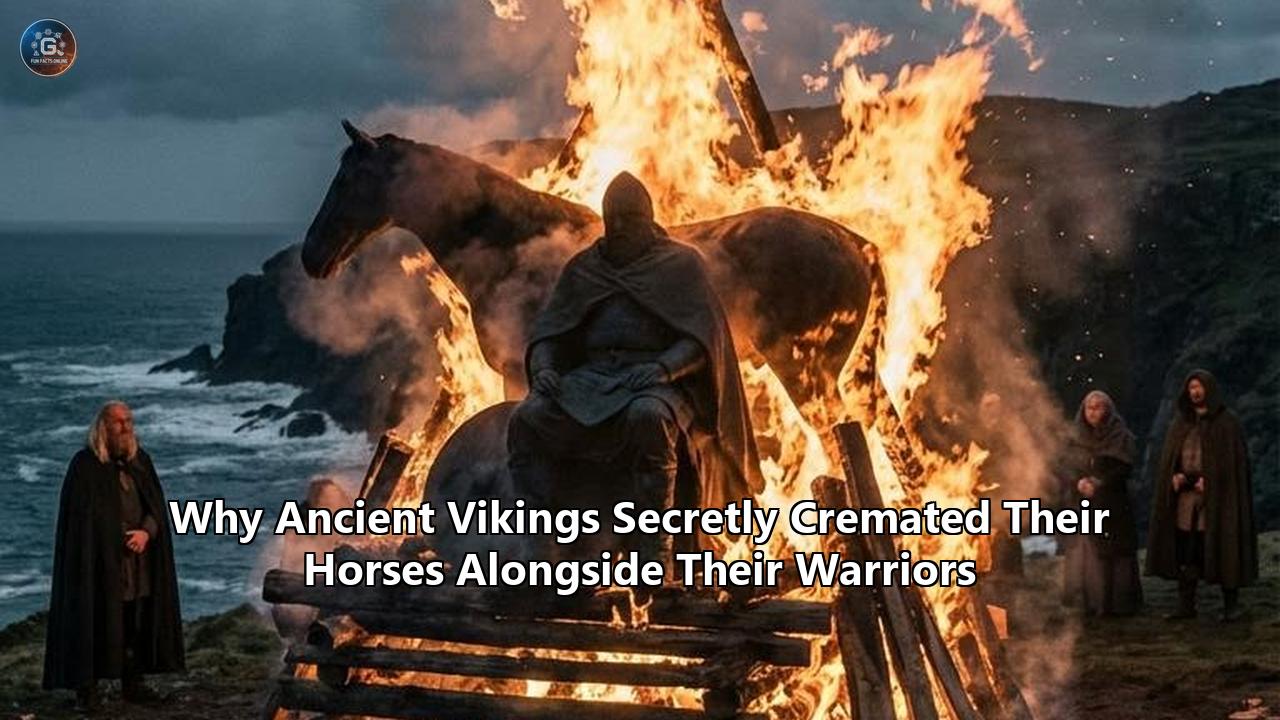
Excavations led by Arkeologerna (the Archaeologists at the Swedish History Museums), which culminated in a major public exhibition opening in April 2026, uncovered a sprawling Viking Age landscape at Sylta and nearby Munktorp Parish. Among the discoveries were over 500 iron artifacts, including intricately decorated fittings, spurs, and jingling harness bells. But the true revelation lay in the soil chemistry and fragmented bone of nearly 30 specific graves. Here, Norse elites were not simply buried. They were subjected to elaborate Viking horse cremation rituals, burned to ash alongside their fully tacked warhorses.
Most mainstream coverage stops at the romanticized headline: the Vikings loved their animals so much they took them to the afterlife. But viewing these graves merely as the resting places of ancient "pets" strips them of their profound technical complexity and geopolitical weight. Behind the charred soil of Västmanland lies a masterclass in massive thermal engineering, forensic chemistry, and psychological warfare.
The Thermodynamics of a Monumental Fire
To comprehend the sheer scale of the findings at the E18 motorway site, one must first understand the physics required to execute these rites. Reducing a human body to bone fragments demands sustained temperatures of approximately 800 to 1,000 degrees Celsius. To simultaneously incinerate a 1,000-pound warhorse alongside that human, while preserving the structural integrity of the iron harness fittings found at Sylta, requires highly specialized structural engineering.
According to forensic archaeological models, a single pyre of this magnitude demands several tons of dry, seasoned timber. This is not a bonfire; it is a temporary, highly calibrated furnace. The timber must be specifically stacked to create an internal drafting effect, utilizing convection to pull surrounding oxygen into the core of the fire, ensuring the heat continuously builds rather than smoldering out under the immense weight of the biological material.
At nearby Rallsta, close to Hallstahammar, the Arkeologerna team uncovered two large pyre settings from the Late Viking Age built directly onto a small, deliberately reshaped hill. This elevation served a dual purpose. Technically, it exposed the pyre to sustained wind currents, acting as a natural bellows to fan the flames to maximum temperature. Politically, it operated as a broadcast mechanism. A fire consuming tons of wood, a human, and a horse would burn fiercely for ten to twelve hours. Perched on a reshaped hill, this nocturnal inferno would have illuminated the Västmanland landscape for miles, serving as a visceral, inescapable display of a local dynasty's wealth, capability, and raw power.
Yet, the archaeological reality of analyzing these sites is notoriously punishing. When the flames finally died down, the Norse did not simply leave the ashes to blow away in the wind. They actively raked through the glowing embers, deliberately shattering the calcined bones, and extracted specific fragments—often called token deposits—to bury beneath earth and stone mounds. Identifying whether a fragmented, thumb-sized piece of burnt bone belongs to a human femur or a horse tibia requires microscopic osteological analysis. The fact that researchers in Sweden could positively identify human and equine remains systematically intertwined in the same ash layers points to a deliberate, ritualized merging of rider and mount in death.
The Strontium Signature: Rewriting Maritime Logistics
To truly grasp the insider-level reality of Viking horse cremation rituals, we must look beyond the soil of Sweden to a sister site in Derbyshire, England, known as Heath Wood. Excavated under the direction of Professor Julian Richards and heavily analyzed in a landmark study led by Tessi Löffelmann of Durham University, Heath Wood is the only known large-scale Viking cremation cemetery in the British Isles. It contains 59 barrows directly associated with the Viking Great Army's winter camp at Repton in 873 to 874 AD.
For decades, the Anglo-Saxon Chronicle—our primary textual source for the era—dictated the historical narrative. The text claimed that when the Viking Great Army landed in East Anglia in 865 AD, they operated as pure raiders, arriving on narrow ships and immediately stealing local English horses to rapidly traverse the countryside. The physical evidence now proves that narrative is fundamentally incomplete.
Löffelmann’s team utilized a highly precise chemical technique called strontium isotope analysis, permanently altering our understanding of Norse maritime logistics. Strontium is a naturally occurring alkaline earth metal found in local rocks and soil. As rocks weather, strontium enters the local water table and food chain, eventually locking into the skeletal structure of animals and humans as they grow. The ratio of two specific isotopes—Strontium-87 to Strontium-86—provides a permanent, geographical fingerprint of where an organism lived and ate.
In unburned burials, extracting accurate strontium data can be fraught with contamination risks. Over centuries, unburned bone acts like a sponge, absorbing environmental strontium from the surrounding burial soil in a process known as diagenesis, which can overwrite the original biological signature. However, bones that have been calcined in the extreme heat of a cremation fire undergo a structural transformation. The immense heat crystallizes the bone's mineral matrix, effectively sealing it. This crystallization locks the original strontium ratios in place, rendering the bone impervious to soil contamination for over a millennium.
To establish a baseline for the Derbyshire area, researchers sampled modern plants and shrubs from six different locations within a 25-kilometer radius of the Heath Wood barrows. They determined the biologically available strontium range for the local English environment. But when they analyzed the calcined bones of a horse, a dog, and a human adult pulled from Mound 50 at Heath Wood, the numbers violently rejected the local baseline.
The animal remains yielded incredibly high isotope ratios, peaking at 0.7158. That specific chemical signature does not exist in the geology of the English Midlands. Instead, it points directly across the North Sea to the Baltic Shield—a massive geological expanse encompassing Norway, central and northern Sweden, and Finland.
The Engineering of the Equine Armada
The implications of the Heath Wood strontium data are staggering when applied to the mechanics of medieval warfare and transportation. The Norse did not just pack seasoned warriors into the shallow hulls of clinker-built longships; they engineered maritime transport for live, 1,000-pound animals across the notoriously treacherous North Sea.
Transporting a warhorse by sea is a logistical nightmare even by modern standards. A horse requires vast stores of fresh water and specialized fodder to survive a multi-day sea crossing. Furthermore, horses possess a high center of gravity and panic easily in unstable environments. To keep a longship from capsizing during North Sea swells, the crew would have had to construct highly specialized stall structures or sling systems within the hull, keeping the animals upright, immobilized, and balanced.
To successfully navigate a prized horse from the Baltic Shield to the English Midlands, only to eventually slaughter and burn it on a massive pyre, elevates the animal from a mere tactical asset to an object of almost incalculable sacrificial value. As Professor Richards noted, while the famous Bayeux Tapestry depicts Norman cavalry disembarking horses from their fleet before the Battle of Hastings in 1066, the chemistry of the Heath Wood pyres proves Viking leaders were executing this exact logistical feat two centuries earlier.
The Economics of Absolute Destruction
Returning to the recent Swedish discoveries along the E18 motorway, the sheer volume of equestrian artifacts forces a brutal re-evaluation of Viking Age economics. The Arkeologerna team recovered over 500 iron objects from the graves at Sylta, specifically linked to horse equipment. Project manager Anton Seiler observed that the sheer variety of jingling bells, hanging fittings, and highly decorated bits functioned almost as a form of localized "horse attire". The intent was multi-sensory dominance: the rider and mount were designed to be both seen and heard long before they engaged in combat.
When these 11th-century elites died, the decision to leave the horse in its full, custom-forged regalia before lighting the pyre was an act of deliberate, conspicuous wealth destruction. In late Viking Age Scandinavia, a trained warhorse was roughly the equivalent of a modern main battle tank. The iron required to forge hundreds of specialized harness pendants, stirrups, and bits represented hundreds of hours of highly skilled blacksmithing, not to mention the immense cost of charcoal and raw bog iron required for the smelting process.
Sacrificing the horse, alongside its mastercrafted ironwork, was a profound economic flex. In anthropological terms, it is the ultimate display of surplus wealth. The chieftain's surviving family was broadcasting a distinct message to their rivals: We are so deeply entrenched in our power and our resources that we can afford to burn our most valuable military assets to ash.
The Resistance in the Flames
The chronological placement of the Västmanland pyres adds a thick layer of political intrigue to the findings. The graves excavated along the E18 date primarily to the 11th century. This was not the peak of the Viking raiding era; it was its twilight. Scandinavia was undergoing a deeply volatile transition, marked by the severe cultural friction between entrenched pagan traditions and the creeping, systemic influence of Christianity.
Christian burial dogma of the era strictly required inhumation—burying the body intact, unburned, typically aligned on an east-west axis, and entirely devoid of grave goods. By choosing to execute massive, highly visible Viking horse cremation rituals, the local chieftains at Sylta and Munktorp were making a defiant, reactionary statement.
They were anchoring themselves violently to the old ways. The towering pyres at Rallsta were a rejection of the new Christian modesty. They broadcast a strict adherence to the Norse pantheon and the mythology of Valhalla, where the sagas dictate that a warrior must arrive fully equipped to join Odin's host. To burn the horse was to ensure the animal crossed the veil alongside its master. In a region slowly being consumed by a new monotheistic order, a multi-ton cremation pyre was the loudest possible form of religious resistance.
Inside the Iron: Forensic Metallurgy
The preservation of the iron artifacts at the Sylta site offers metallurgists and archaeologists a rare forensic dataset that goes far beyond aesthetic appreciation. During a high-temperature cremation, organic materials such as leather strapping, wooden saddle trees, and textile blankets incinerate completely. However, the iron survives, albeit thermally altered by the extreme environment of the pyre.
By actively studying the oxidation patterns, slag inclusions, and structural warping on the 500 recovered bells and harness pendants, researchers can reverse-engineer the exact thermodynamics of the fire. The degree of thermal deformation in the iron indicates where the hottest pockets of the pyre were located. Furthermore, the spatial distribution of the iron artifacts within the ash layer reveals exactly how the bodies were positioned before the fire was lit.
The forensic evidence suggests these horses were not merely slaughtered off-site and dragged onto the timber. They were carefully arranged, often fully tacked in their heavy iron harnesses, implying a ritualized execution directly on the pyre structure just moments before ignition.
This level of ritual precision requires a highly specialized class of individuals. It points to the existence of dedicated religious functionaries or master pyre architects who deeply understood the thermodynamics of wood-to-flesh ratios, the specific draw of the wind over reshaped hills, and the chemical requirements for reducing massive amounts of biological material to workable ash. The construction of a pyre was a specialized trade, blending engineering with theology.
The Upright Swords of Munktorp
The complexity of these burial sites is further amplified by anomalies found in adjacent graves during the same motorway excavation. In Munktorp Parish, just west of the main cremation sites, the archaeological team discovered a monument where two swords were found embedded completely upright in the grave.
This is an exceptionally rare burial practice. Weapons are typically laid flat beside the deceased or intentionally "killed" (bent in half) before deposition. An upright sword serves as a permanent, vertical stake in the earth. Researchers theorize this could signify the presence of a specialized armed class, or it could be a deliberate territorial marker tying a specific dynasty to the land. When combined with the nearby horse cremations, the entire Västmanland site emerges not just as a cemetery, but as a heavily fortified landscape of memory, designed to visually and physically intimidate anyone passing through the region.
The Subtlety of Bone Turnover
The detail extracted from these sites is constantly refined by advancements in biological analysis. Even within the strontium isotope data from Heath Wood, the "behind the scenes" biology reveals fascinating nuances about how these warriors and animals lived.
Bone is not a static material; it is living tissue that constantly remodels itself. Different bones in the body regenerate at different rates. A dense bone like the femur remodels very slowly, taking a decade or more to fully turn over. Therefore, the strontium signature in a femur reflects the environment where the individual lived over the last ten to fifteen years of their life. Conversely, a rib bone remodels much faster, reflecting the diet and environment of the individual in the final few years or even months before death.
When scientists analyzed the adult from Mound 50 at Heath Wood, they found a slight discrepancy between the strontium ratios in the femur and the rib. The femur carried the distinct signature of the Baltic Shield, but the rib showed a slightly lower ratio, trending closer to the local English baseline. This tiny chemical drift tells a profound biographical story. It suggests this specific Viking warrior did not arrive in England and die immediately in battle. Instead, they survived in the British Isles long enough for their fast-remodeling rib bones to begin absorbing the strontium from the local East Anglian food and water supply before they finally perished and were placed on the pyre alongside their imported horse.
What Happens Next in the Field
With the Sylta artifacts now actively under analysis and available to the public in the Swedish Historical Museum's rotating exhibition, the discipline of Viking archaeology is pivoting sharply. The era of simply cataloging swords and bones is over; the future relies on high-resolution material science.
As researchers sift through the data generated by the E18 motorway excavations, the field is looking toward three unresolved, highly technical frontiers:
- Isotopic Mapping of Iron: Just as strontium tracking revolutionized our understanding of biological migration, isotopic analysis of the 500 iron harness fittings could map the medieval industrial complex. By analyzing the trace elements and lead isotopes within the iron, scientists can pinpoint whether the ore was mined locally in the bogs of Västmanland, or if the metal itself was traded across complex European networks before being forged into horse gear.
- The Paleogenetics of Calcined Bone: Historically, the intense heat of a cremation fire was thought to completely obliterate DNA, leaving osteologists with nothing but morphology to identify species. However, emerging techniques in paleogenetics are beginning to extract highly fragmented genetic material from the innermost, petrous structures of slightly less-calcined bone fragments that survived in the cooler outer edges of the pyre. If researchers can successfully sequence the DNA of the Sylta or Heath Wood horses, it could reveal the specific breeds, coat colors, and genetic lineages of the animals the Vikings deemed worthy of sacrifice.
- LiDAR Mapping the Pyre Network: Archaeologists are increasingly utilizing LiDAR (Light Detection and Ranging) from drones to strip away modern forest canopies and map the exact topography of the Scandinavian landscape. By specifically searching for undiscovered, reshaped "pyre hills" similar to the dual mounds at Rallsta, researchers can map the sightlines between these high-elevation cremation sites. This spatial analysis will help us understand how these fiery displays functioned not in isolation, but as an interconnected network of territorial markers, warning beacons, and dynastic boundaries across the region.
The charred bone fragments and rusted harness bells pulled from the Swedish dirt are far more than relics of a bygone, blood-soaked religion. They are the hard data points of a highly sophisticated society that utilized complex maritime logistics, localized chemistry, and the calculated destruction of extreme wealth to project power across the medieval world.
As the technical methodologies for analyzing Viking horse cremation rituals become increasingly advanced, the historical narrative continues to fracture and shift. We are moving away from the Victorian myth of the crude, unthinking barbarian. In its place emerges a portrait of a culture driven by master shipwrights, thermal engineers, and geopolitical strategists, operating with terrifying precision at the very edge of their known world. The fires that burned at Heath Wood and Sylta may have been extinguished a millennium ago, but the chemical and metallurgical signatures they left behind are finally allowing us to read the ashes.
Reference:
- https://www.heritagedaily.com/2026/04/archaeologists-uncover-rare-collection-of-viking-age-horse-equipment/157658
- https://www.popularmechanics.com/science/archaeology/a69289838/viking-village/
- https://economictimes.indiatimes.com/news/international/us/why-vikings-buried-their-horses-with-them-and-what-archaeologists-just-found-is-surprising/articleshow/130165291.cms?from=mdr
- https://archaeologymag.com/2025/11/viking-treasures-in-sweden-reveal-a-society-in-transition/
- https://www.ripleys.com/stories/bones-in-viking-burial-grounds-suggest-they-loved-their-pets
- https://www.researchgate.net/publication/367963537_Sr_analyses_from_only_known_Scandinavian_cremation_cemetery_in_Britain_illuminate_early_Viking_journey_with_horse_and_dog_across_the_North_Sea
- https://www.theguardian.com/science/2023/feb/01/vikings-animals-england-research-derbyshire-cremation-baltic-shield
- https://pmc.ncbi.nlm.nih.gov/articles/PMC9891522/
- https://the-past.com/news/first-evidence-that-vikings-travelled-with-animals-across-the-north-sea/
- https://www.york.ac.uk/news-and-events/news/2023/research/evidence-that-vikings-brought-animals-to-britain/
- https://www.sciencenews.org/article/strontium-isotope-analysis-vikings-animals-england
- https://www.durham.ac.uk/news-events/latest-news/2023/02/evidence-suggests-vikings-brought-animals-to-britain/