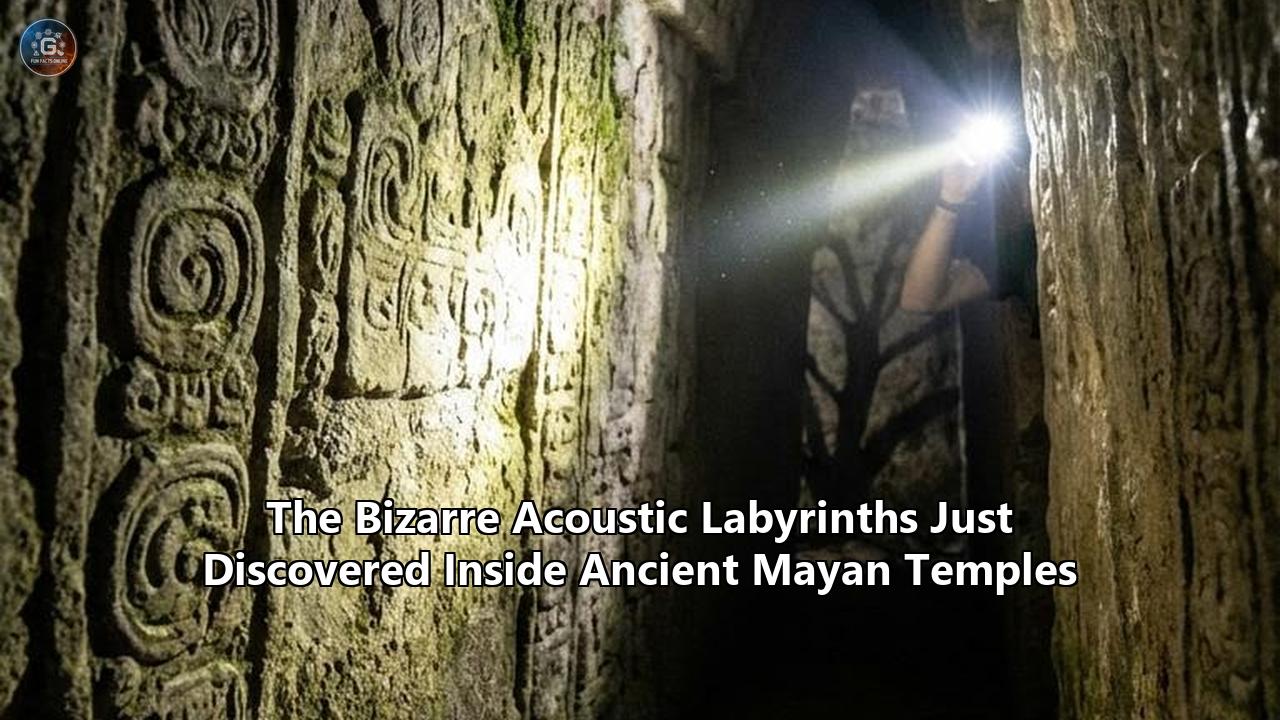
An international consortium of archaeoacousticians and anthropologists published a dataset this week that fundamentally alters our understanding of pre-Columbian engineering. Deep in the dense, ecologically forbidding jungles of Campeche, Mexico—just kilometers from the massive city of Ocomtún mapped via aerial surveys in 2023—researchers utilizing drone-mounted light detection and ranging (LiDAR) and terrestrial robotic rovers breached a sealed chamber beneath a Late Classic pyramid. They anticipated finding a standard royal crypt or a cenote offering cache. Instead, they mapped a 600-meter subterranean labyrinth of twisting, impossibly narrow limestone corridors.
But the physical layout of the tunnels was only the first anomaly. When the team began standard structural diagnostics—bouncing sound waves through the corridors to check for secondary voids—the acoustic sensors returned impossible data. The labyrinth was not merely a physical passageway; it was a highly sophisticated, passive analog synthesizer.
The stone corridors were mathematically pitched to filter out high-frequency tones while artificially amplifying low-frequency ranges. When researchers blew into a replica marine-shell trumpet at the labyrinth's entrance, the architecture stripped away the instrument's natural brassy overtones. By the time the sound reached the central subterranean chamber, it had been distorted into a deep, vibrating acoustic roar, indistinguishable from a territorial jaguar. Furthermore, the labyrinth's blind corners and parabolic curves effectively erased spatial localization. A subject standing in the center of the maze hears the roar coming from everywhere and nowhere simultaneously, while their own voice is deadened into an absolute, suffocating silence by deeply pitted stucco on the immediate walls.
This newly uncovered structure—now tentatively designated the Temple of the Whispering Jaguar—provides an unprecedented case study. It forces a critical re-evaluation of how the ancient Maya weaponized the human sensory experience. By analyzing this specific acoustic labyrinth, we can extract vital principles about how built environments are historically engineered to enforce authority, induce altered psychological states, and manipulate perception.
The Anatomy of a Stone Synthesizer
To extract the engineering principles at play, one must first dissect the mechanics of the discovery. The Campeche labyrinth achieves its acoustic manipulation through a triad of structural choices: material density, geometric diffraction, and acoustic impedance.
When an acoustic signal is generated at the threshold of the labyrinth, it immediately encounters the first architectural filter. The walls are not smooth. Petrographic analysis of the plaster revealed that the walls are lined with highly specialized, deeply pitted stucco laced with angular quartz inclusions. In a modern recording studio, synthetic acoustic foam is used to absorb specific frequencies to prevent reverberation. The Maya achieved the exact same result using porous limestone and plaster. High-frequency sounds—such as the human voice in a normal speaking register, typically between 85 and 255 hertz, but with overtones reaching much higher—are trapped within the pores of the wall and dispersed as trace amounts of thermal energy.
Conversely, the labyrinth's geometry is designed to sustain and amplify low-frequency waves. The corridors feature a series of tightly angled zigzags. A low-frequency sound wave, which can be several meters long, simply bends around these corners through the physical principle of diffraction. High-frequency waves, which possess much shorter wavelengths, smash directly into the angled walls and shatter.
Furthermore, the engineering team identified hollow cavities beneath the floorboards of the maze, connected directly to a subterranean water channel. This mirrors the 2016 discovery of underground water tunnels directly beneath the Temple of Inscriptions in Palenque. However, the Campeche structure uses the water table for acoustic purposes. The subterranean cavities act as Helmholtz resonators—the identical acoustic physics that produce a deep, resonating hum when you blow across the top of an empty glass bottle. The flowing water below alters the volume of the air cavity, creating a pulsating, low-frequency throb that vibrates directly through the limestone and into the soles of the subject's feet. This is not accidental architecture. It represents an intricate understanding of wave mechanics, executed centuries before the formal codification of acoustic physics.
Principle I: Sensory Monopolies and the Architecture of Authority
What does this dataset teach us about the execution of power? In any societal structure, authority requires persistent legitimization. While modern nation-states might utilize constitutional law, mass media, or economic dominance, ancient political centers often relied heavily on the exclusive control of divine intervention. The Campeche acoustic labyrinth serves as a masterclass in the creation of a sensory monopoly.
Consider the psychological reality of a Maya citizen in the 8th century AD. You are led out of the blinding tropical sun into a pitch-black, descending corridor. You cannot see your hands. As you speak, your voice is unnaturally swallowed by the walls, stripping you of your primary physical tool for social agency. Then, a massive, disembodied roar shakes the floor beneath your feet, originating from an invisible source. The sensory deprivation of the absolute darkness is violently contrasted with sudden, targeted sensory overload from the acoustic resonance.
This rapidly induces a state of profound psychological vulnerability. The architects deliberately engineered a space that strips away a subject's localized reality and replaces it with a manufactured, highly controlled sensory environment. The priests or elites operating the labyrinth from concealed side-chambers were not merely performing religious rituals; they were operating a complex piece of psychological machinery. They held an absolute monopoly over the sensory input of the subjects trapped within the maze.
The broader principle here is that architecture is never neutral. Space dictates human behavior. By monopolizing the auditory environment, the ruling class of this city effectively monopolized truth. If the walls themselves roar with the voice of the jaguar god—an apex predator inextricably linked to the underworld and royal lineage—the political authority of the priests who command that space becomes cognitively unassailable.
Contextualizing the Data: The Precedents of Sonic Engineering
To truly grasp the implications of the Campeche labyrinth, we must situate it within the broader history of Mayan temple acoustics. This latest structural discovery is not an isolated architectural anomaly, but rather the apex of a long, calculated lineage of acoustic engineering.
The rigorous study of sound in Mesoamerican archaeology gained severe traction in 1998, when acoustic engineer David Lubman formalized the study of the chirping echo at the Temple of Kukulkan in Chichén Itzá. When a visitor claps their hands at the base of the massive staircase, the acoustic reflection does not mimic a standard handclap. Instead, it produces a downward-gliding, harmonic-rich chirp that accurately matches the call of the Resplendent Quetzal, a bird deeply venerated by the Maya. This acoustic event is generated by the precise height and depth of the limestone steps, which act as a diffraction grating, scattering the sound waves so that higher frequencies reach the listener's ear milliseconds before the lower ones.
Building on this, researchers led by Francisca Zalaquett discovered in 2010 that the public squares and temples at Palenque, constructed around 600 AD, functioned as a massive, unplugged public-address system. The stucco coatings and the exact spatial relationship between the buildings allowed priests to broadcast chants and the sounds of musical instruments across vast distances without electronic amplification. Similarly, researchers analyzing the steps of Maya pyramids discovered a distinct "raindrop effect," where footsteps are transformed by the stone grating into frequencies mimicking rain falling into a bucket—a likely intentional homage to the rain god Chaac.
However, Kukulkan, Palenque, and the raindrop staircases are exclusively exterior, communal acoustic spaces. They were designed for mass broadcasting. The newly discovered Campeche labyrinth represents a stark conceptual pivot: the privatization of sound. Instead of projecting a message outward to the masses across an open plaza, this architecture was designed to pull an individual inward, isolate them entirely, and subject them to a deeply personal, overwhelming auditory manipulation. It marks an evolutionary shift from architecture as a broadcast medium to architecture as an isolation crucible.
The Comparative Case: Chavín de Huántar and the Universal Mechanics of Disorientation
To understand the specific psychological mechanics at play in Campeche, we must look 2,500 miles south to the Peruvian Andes. At the 3,000-year-old ceremonial center of Chavín de Huántar, archaeologists led by John Rick discovered a remarkably similar structural anomaly. Beneath the pre-Inca site lies a half-mile network of subterranean galleries and ventilation ducts.
When researchers blew replica Strombus marine-shell trumpets within these narrow corridors, the sound was distorted into a massive, animalistic roar. More crucially, the acoustic architecture made it virtually impossible for a listener to identify the origin of the sound. The intersecting ducts and delayed echoes perfectly masked the directional cues the human brain subconsciously relies upon to build a spatial map.
The Campeche discovery confirms that this was not a localized Andean phenomenon. The deliberate use of spatial disorientation is a universal architectural technology utilized to subjugate human perception. Disorientation is rarely accidental in ritual architecture. It is a highly effective tool for erasing preconceived mental models and rendering an individual highly receptive to new information or behavioral conditioning.
A standard labyrinth is a puzzle designed to be solved. A puzzle requires logical deduction, which keeps the prefrontal cortex in a state of active, rational problem-solving. But the Campeche corridors are designed to bypass rationality and disrupt the vestibular system. The floors subtly incline and decline at irregular, mathematically irrational angles, making it impossible to establish a reliable physical baseline in the dark. Because the pitted stucco absorbs the high-frequency sounds of footsteps, the brain is deprived of the micro-echolocation data it uses to map spatial dimensions.
When an individual's spatial mapping fails, acute panic rushes in to fill the cognitive void. The mind frantically searches for an anchor. When that anchor is finally provided by the architecture—such as the massive, vibrating roar of the jaguar simulator—the psychological relief forms a powerful trauma bond with the source of the intervention. The architecture was engineered to systematically break down the ego through sensory disruption, only to rebuild it under the strict ideological terms of the ruling class.
Principle II: Environmental Symbiosis and Material Mastery
The case study of the Campeche labyrinth highlights a stark contrast in how ancient and modern engineers approach environmental constraints. Modern architecture routinely seeks to dominate the environment—sealing spaces with heavy glass, pumping in climate-controlled air, and utilizing digital speakers to artificially generate a desired soundscape. The design philosophy observed in this Maya discovery relies entirely on organic, environmental integration.
The engineers utilized the inherent geological properties of the Yucatan landscape to achieve their effects. The resonant chambers were built directly over a natural underground aquifer. By tunneling down to the water table, they co-opted the subterranean river, using its natural fluid dynamics to alter the air pressure within the Helmholtz resonators beneath the floorboards. They did not build a standalone machine to create low-frequency hums; they built a structural interface that allowed the earth itself to generate the hum for them.
Furthermore, the inevitable physical degradation of the limestone itself was factored into the acoustic lifecycle of the structure. The field of Mayan temple acoustics relies entirely on the precise geometry of the stone. At Kukulkan, field measurements indicate that as the limestone stairs erode and become highly porous over centuries of rain, the Quetzal chirp weakens. At the Campeche labyrinth, the builders anticipated this exact material failure. The researchers noted that the most vital acoustic reflection points—the sharp corners of the zigzagging corridors that force the low-frequency waves to bend—were reinforced with imported, highly durable basalt blocks. This specific material substitution ensured the labyrinth's analog synthesizer would not lose its precise tuning as the softer surrounding limestone aged.
The lesson here is one of structural symbiosis. The architecture does not fight the geological reality of the surrounding jungle; it weaponizes it. The water table, the porosity of the native stone, and the physical constraints of the subterranean bedrock were all seamlessly harnessed as active components of the acoustic machinery.
Principle III: The Fallacy of the Silent Ruin
This discovery forces a harsh reckoning within the discipline of archaeology itself, exposing a severe methodological bias: the absolute primacy of the visual. For centuries, our engagement with history has been predominantly ocular. We dig up ceramic artifacts, map the visual footprints of ruined cities, and reconstruct the painted frescoes of ancient walls. We look at the past, assuming it was a tableau.
But the past was incredibly loud. The extraction of the Campeche labyrinth data proves that evaluating a structure solely by its visual aesthetics is the equivalent of trying to understand a Stradivarius violin by only measuring the curvature of its wood, entirely ignoring the music it was built to produce.
The "silent ruin" is a modern, sterilized myth. The ancient Maya lived in a densely engineered soundscape. Their political centers were environments of intense, deliberate auditory design. The failure of the broader scientific community to recognize this until recent decades represents a failure of imagination, as modern researchers projected their own text-and-image-heavy cultural biases onto a society that valued oral, auditory, and experiential transmission just as highly.
The Campeche labyrinth case study demonstrates that historical analysis must immediately transition to a model of sensory archaeology. If a subterranean space was mathematically designed to induce physiological terror through low-frequency sound, mapping its physical dimensions without modeling its acoustic properties is an incomplete excavation. The true artifact is not the stone corridor; the true artifact is the sound that the corridor was built to shape.
Socio-Political Catalysts for Acoustic Theater
To fully extract the value of this case study, we must look at the specific catalyst for the construction. Radiocarbon dating of organic material trapped within the labyrinth's stucco places its construction firmly in the Late Classic period, roughly between 750 and 850 AD. This temporal placement is highly significant.
During this exact window, the Maya lowlands were experiencing severe systemic stress. Decades of prolonged drought, soil depletion, and devastating inter-city warfare were destabilizing the political foundations of major settlements. The divine right of the kings and priests was being actively questioned by a starving, anxious populace.
When political authority wanes, regimes typically respond with an escalation of theater. The construction of the acoustic labyrinth was a massive expenditure of labor and resources at a time when both were dangerously scarce. This suggests that the ruling elite viewed the psychological manipulation provided by the labyrinth not as a luxury, but as an essential tool for regime survival. If the crops were failing and the traditional gods seemed deaf to prayers, the priests needed a mechanism to prove their divine connection with absolute, terrifying certainty.
The labyrinth provided exactly that. A citizen questioning the authority of the elite could be placed into the maze, stripped of their spatial reality, and subjected to the unmistakable, earth-shaking roar of the underworld. The acoustic technology was deployed as a direct countermeasure against societal collapse. It is a historical demonstration of how extreme resource scarcity often accelerates the development of psychological technology.
Unresolved Vectors and the Future of Sensory Archaeology
As the initial shock of the Campeche discovery settles into the academic record, the focus shifts to the immediate implications for future research. The revelation of the Whispering Jaguar labyrinth is not an endpoint; it is a violent catalyst for an entirely new vector of historical inquiry.
First, there is the immediate question of geographic ubiquity. If a relatively remote site contained an acoustic engine of this magnitude, how many previously excavated temples harbor similar subterranean networks that were completely missed because researchers were only looking for visual artifacts or physical tombs? The immediate imperative is the re-evaluation of established sites. Ground-penetrating radar and acoustic mapping drones must be deployed to the foundational plazas of Tikal, Copán, and Calakmul. Modern acoustical engineering can learn heavily from Mayan temple acoustics, particularly in the realm of passive sound filtration without the need for synthetic materials.
Second, the discovery raises complex ethical and practical questions regarding historical preservation. How does one preserve an acoustic artifact? When a ruin is reconstructed for modern tourist visitation, the application of modern cement or the stabilization of shifting walls inevitably destroys the original acoustic tuning. The delicate geometric angles and specific porosity of the stucco that make the labyrinth function can be permanently erased by a well-meaning restoration team focused solely on preventing physical collapse. The preservation framework of the future must protect the invisible physics of a site just as fiercely as its physical stones.
Third, there is the potential for applying these ancient principles to modern architectural challenges. The ability to passively filter out high-frequency noise using only the geometry and texture of natural materials holds massive implications for modern urban design. As cities become increasingly dense and plagued by noise pollution, the organic acoustic dampening techniques pioneered in the jungles of Campeche offer a sustainable, non-electronic blueprint for managing the auditory environments of the future.
The acoustic labyrinth beneath the Yucatan serves as a profound reminder that human ingenuity is not a linear march from primitive to advanced. The Maya of the 8th century possessed an understanding of spatial psychology, wave mechanics, and environmental integration that directly rivals modern architectural design. They did not just build monuments to their gods; they built the very voices of the gods, weaving sound and stone together into a mechanism of absolute awe. The challenge now is to develop the technology, and the humility, required to listen to what they left behind.
Reference:
- https://www.livescience.com/archaeology/mysterious-maya-underground-structure-unearthed-in-mexico
- https://www.cbsnews.com/sanfrancisco/news/water-tunnel-discovered-under-mayan-temple-refutes-ancient-astronaut-theory/
- https://www.iflscience.com/secret-water-tunnel-discovered-under-ancient-mayan-temple-37091
- https://www.bioedonline.org/news/nature-news-archive/mystery-chirping-pyramid-decoded/
- https://acoustics.org/pressroom/httpdocs/136th/lubman.htm
- https://pubs.aip.org/asa/jasa/article/137/4_Supplement/2427/650449/On-the-acoustics-of-Maya-pyramids
- https://www.researchgate.net/publication/253795858_Acoustical_features_of_two_Mayan_monuments_at_Chichen_Itza_Accident_or_design
- https://www.nationalgeographic.com/history/article/101216-maya-acoustics-speakers-audio-sound-archaeology-science
- https://www.researchgate.net/figure/The-floorplan-of-the-Laberintos-Gallery-at-Chavin-de-Huantar-Our-impulse-response_fig1_265595175