The midday sun over the coast of central Florida beats down with relentless intensity, casting a brilliant, undulating grid of light onto the shallow sandy bottom of the Atlantic. In the quiet world beneath the swell, a freediver slips silently through the water, lungs full of air, trailing a massive, dark silhouette.
The silhouette belongs to an adult Atlantic manta ray (Mobula yarae). Spanning nearly fifteen feet from wingtip to wingtip, the ray glides with effortless, prehistoric grace, its pectoral fins beating like the wings of a massive bird in slow motion. Hovering just beneath its broad belly, near the pelvic fins, is a common remora (Remora remora). To any casual observer, this is one of the classic tableaus of marine biology: the giant pelagic beast and its loyal, harmless companion, cruising together in a perfect, ancient partnership.
But as the diver gently drifts closer to document the ray's unique ventral spot patterns, the peaceful scene shatters in a heartbeat.
Startled by the encroaching human presence, the remora does not dart away into the open blue. It does not plaster itself flat against the ray’s tough, sandpaper-like skin. Instead, it panics.
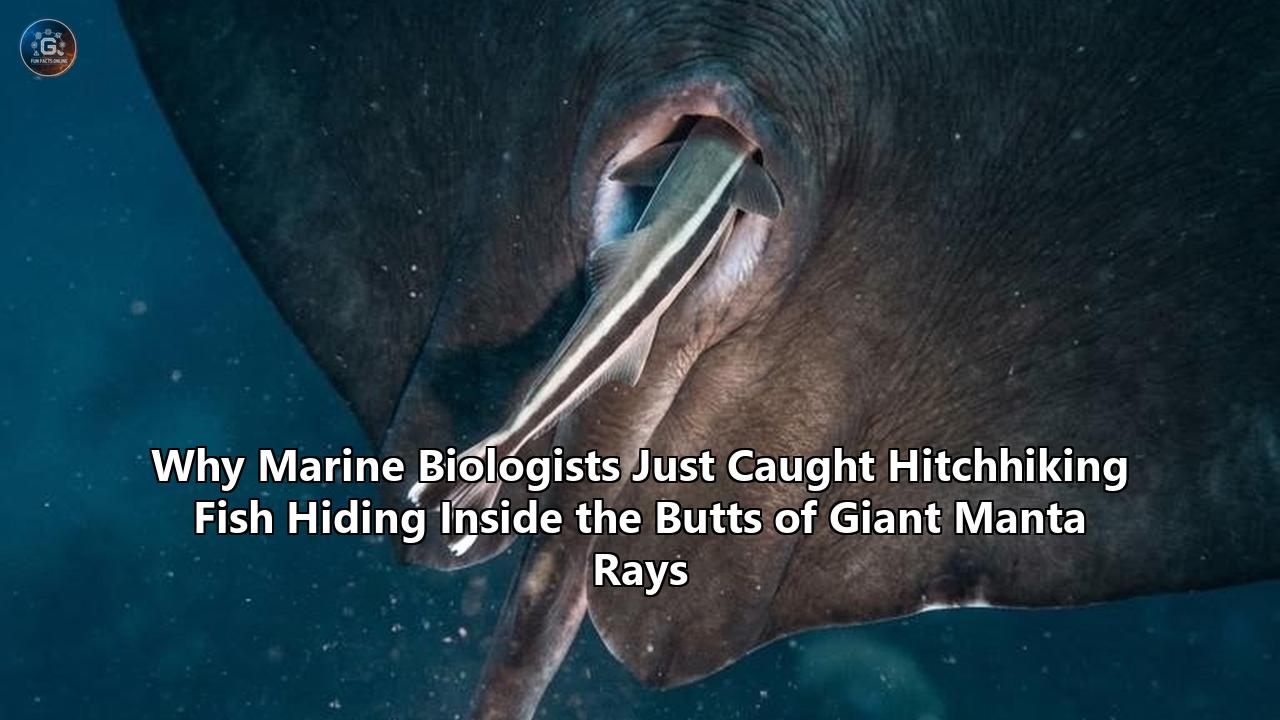
With a frantic wriggle of its slender, grey body, the fish bolts upward. It targets the small, sensitive opening on the underside of the manta ray’s body—the cloaca. In a fraction of a second, the remora rams its head directly into the opening and burrows forward, driving its entire body deep inside.
The manta ray reacts instantly. A violent shudder ripples through its massive body, its wings clenching in a brief, agonizing spasm. For a second, the animal seems suspended in mid-water, visibly unsettled by the invasion. Then, gathering its momentum, it beats its wings and speeds away into the murky distance.
Left behind is a stunned diver—and a bizarre, disturbing question that would soon ignite a global scientific investigation: Why did a hitchhiking fish just seek asylum up a manta ray’s backside?
This startling encounter, captured on high-definition video in July 2023, was not a freak, one-off accident. Instead, it served as the smoking gun for a groundbreaking study published in May 2026 in the journal Ecology and Evolution.
Led by Emily A. Yeager, a Ph.D. candidate at the University of Miami Rosenstiel School of Marine, Atmospheric, and Earth Science, a global team of marine biologists has officially documented a phenomenon they call "cloacal diving". By reviewing fifteen years of underwater footage, photographs, and field logs, the researchers have revealed that these iconic manta ray fish hitchhikers are doing something far more intimate, invasive, and potentially harmful than anyone ever suspected. They are turning the sensitive internal orifices of some of the ocean’s most majestic giants into their personal, private panic rooms.
The Cold Case Dossier: 15 Years of Cryptic Evidence
For decades, marine scientists studying manta rays had been noticing strange anomalies in their field photography, but they usually dismissed them as odd, inexplicable quirks of nature.
"Every two or three years, researchers in the field would come back with a photo and say, 'Hey, look at this. There's a fish tail sticking out of this manta ray's butt,'" says Emily Yeager, lead author of the study. "It was one of those things where people laughed, took note of it, and then went back to their primary research. But when we actually sat down and began talking about it, we realized we might be looking at a widespread, completely undocumented behavior."
                    THE CLOACAL DIVING OBSERVATION DOSSIER (2010–2025)
=====================================================================================
Case  Date         Location       Host Species        Observer / Credit
-------------------------------------------------------------------------------------
01    Mar 2010     Maldives       Mobula birostris    Stefan Bersch
02    Jun 2010     Maldives       Mobula birostris    Lisa Allison
03    Sep 15, 2017 Mozambique     Mobula alfredi      Anna Flam
04    Sep 19, 2017 Mozambique     Mobula alfredi      Anna Flam
05    Jul 2021     Florida, USA   Mobula yarae        Bryant Turffs
06    Jul 2023     Florida, USA   Mobula yarae        MMF (Video Evidence)
07    Oct 2025     Florida, USA   Mobula yarae        Bryant Turffs
=====================================================================================
To find out if these incidents were truly isolated, Yeager volunteered to lead a systematic investigation. She teamed up with senior author Dr. Catherine Macdonald, director of the University of Miami's Shark Research and Conservation Program (SRC), along with veteran researchers from the Marine Megafauna Foundation and the Manta Trust. Together, they launched a massive retrospective analysis, combing through thousands of encounters, aerial drone videos, diver-submitted photographs, and long-term monitoring databases compiled between 2010 and 2025.
The search covered three major manta ray hotspots separated by thousands of miles of open ocean: the coastal waters of southeastern Florida, the pristine atolls of the Maldives in the Indian Ocean, and the current-swept reefs of Tofo Beach in Mozambique.
As they sifted through the mountains of data, a pattern began to emerge. The researchers identified seven distinct, highly detailed cases of remoras wedging themselves inside manta rays. Even more surprising was the taxonomic scope of the behavior. The intrusion was not limited to a single species of ray; it was documented across all three currently recognized manta ray species:
- The reef manta ray (Mobula alfredi),
- The giant oceanic manta ray (Mobula birostris), and
- The recently described Atlantic manta ray (Mobula yarae).
The evidence spanned both sexes, and occurred in both juvenile and fully mature hosts. In several of the photographic cases, the remora had shoved itself so far into the ray's body that only the very tip of its caudal fin was visible, peeking out like an unwelcome grey tongue from the host's underbelly. In smaller juvenile rays, where the remora was nearly as wide as the opening itself, the fish couldn't fit entirely, leaving its lower half dangling limply in the water column like a half-inserted cork.
"When we saw the geographic spread—from the Indian Ocean to the Western Atlantic—we knew this wasn't an isolated accident," Yeager explains. "This is a conserved, functional behavior. The fact that it represents less than one percent of our overall database doesn't mean it's rare. It means it is incredibly difficult to see. These fish are hiding inside the body cavities of highly mobile animals. Unless a diver is positioned at the perfect angle underneath the ray at the exact moment the tail is sticking out, it goes completely unnoticed."
Anatomy of a Freeloader: How the Remora Became the Ultimate Passenger
To understand why a fish would choose such an inhospitable, bizarre sanctuary, one must first understand the bizarre biology of the remora itself.
Remoras, belonging to the family Echeneidae, are a group of eight species of ray-finned fish that have built their entire evolutionary strategy around hitchhiking. They are the ultimate drift-netters of the marine world, clinging to sharks, whales, sea turtles, dugongs, and manta rays to hitch free rides across vast, energy-sapping ocean currents.
The secret to their success lies on the top of their heads. Over millions of years of evolution, the remora’s first spinous dorsal fin migrated forward, flattened out, and transformed into a highly sophisticated, oval suction disc. This disc is a masterpiece of biological engineering. It is lined with a series of pairs of transverse, shelf-like ridges called lamellae, which can be raised and lowered by the fish's cranial muscles.
                     REMORA SUCTION DISC MECHANICS

                    [ Cranial Musculature ]
                              │
                    ( Lamellae Rotation )
                    /                   \
        [ Elevate Lamellae ]       [ Depress Lamellae ]
                 │                          │
       ( Creates Low Pressure )    ( Releases Low Pressure )
                 │                          │
        [ High Vacuum Seal ]       [ Disengages / Slides ]
                 │                          │
         "Locked on Host"           "Free-Swimming / Diving"
When a remora slides backward against the skin of a host, the lamellae rotate upward, creating a powerful series of internal chambers with deep vacuum seals. To release the grip, the remora simply swims forward, flattening the lamellae and breaking the suction. This allow them to slide effortlessly across their host’s body like a wet magnet on a refrigerator door.
For centuries, this relationship was held up as a classic, textbook example of commensalism—a relationship where one party benefits and the other is entirely unaffected. In some cases, it was even categorized as mutualism. The remora gets a high-speed transit pass, protection from predators, and a constant stream of oxygenated water rushing over its gills without having to expend energy swimming. In return, the remora acts as a diligent marine janitor, nibbling away irritating ectoparasites, dead skin, and copepods from the host's body, while occasionally dining on the host’s leftover food scraps and feces.
"It was always framed as this beautiful, harmonious cooperation," says Dr. Brooke Flammang, a leading biomechanics researcher at the New Jersey Institute of Technology, who has spent years studying remora adhesion. "But if you look closer at the mechanics of how these fish attach, the picture becomes a lot darker."
Indeed, recent studies have begun to erode the "friendly helper" narrative. In 2025, researchers tracking sea turtles discovered that individuals carrying multiple remoras spent significantly less time grazing and suffered from localized skin lesions and raw, infected tissue where the suction discs had worn away their protective epidermal layers. Furthermore, carrying large, bulky passengers creates immense hydrodynamic drag, forcing the host to burn significantly more energy just to maintain its swimming speed.
The discovery of cloacal diving in manta ray fish hitchhikers has effectively shattered any lingering notions of a purely benign partnership.
"Oftentimes when we think of nature, we like to put these relationships into neat, discrete boxes so we can define them easier," says Yeager. "But what this has taught us is that these relationships actually exist on a highly dynamic spectrum—one that can swing from helpful to highly invasive and parasitic depending on the context."
Into the "Sewer": Inside the Cloaca of a Manta Ray
To appreciate why scientists reacted to this discovery with a "combination of amazement and horror," one must examine the specific anatomical destination of these diving fish.
The word cloaca comes from the ancient Latin word for "sewer" or "drain". In elasmobranchs (the class of cartilaginous fish that includes sharks, rays, and skates), the cloaca is a singular, highly sensitive chamber located on the ventral underside of the body, just between the pelvic fins. It is a biological multi-tool: the sole exit portal for the digestive tract, the urinary system, and the reproductive organs.
                        THE ELASMOBRANCH CLOACA
               [ Singular Internal Chamber (Vestibule) ]
             ┌─────────────────────┼─────────────────────┐
             ▼                     ▼                     ▼
     [ Digestive Waste ]   [ Urinary Excretion ]   [ Reproductive Tract ]
      - Fecal Matter        - Urea & Salts          - Copulation
                                                    - Sperm Transfer (Males)
                                                    - Live Birth (Females)
In male manta rays, the cloaca is flanked by claspers—the external copulatory organs used to channel sperm. In females, the cloaca leads directly to the uterus, where a single pup develops over a year-long gestation period before being born alive into the open ocean.
Because the cloaca must accommodate delicate reproductive processes and the passage of waste, its internal walls are lined with highly vascularized, extremely sensitive mucosal membranes. Unlike the tough, armor-like dermal denticles that protect the outer skin of a manta ray, the interior of the cloaca is soft, raw, and highly vulnerable to mechanical trauma.
"When a remora dives into the cloaca, it isn't entering an empty, hollow room," says Dr. David Shiffman, an independent marine conservation biologist who was not involved in the study. "It is squeezing itself into a tight, muscular, highly sensitive canal. If that remora decided to engage its suction disc inside that chamber, it could cause really severe internal tearing, inflammation, and permanent scarring."
The sheer physical dimensions of the intrusion make it clear why the manta rays react so strongly. The study's authors noted that the remoras observed engaging in this behavior were often almost exactly as wide as the host ray's cloacal opening.
"It is literally a perfect, tight plug," Yeager says. "The fish is completely filling the canal. If the remora remains lodged inside for any extended period of time, it could physically block the ray's ability to defecate, disrupt the mating process, or even interfere with a female ray's ability to give birth."
The sudden, violent shuddering observed in the 2023 Florida video confirms the immediate distress of the host. The physical sensation of having a coarse, scale-covered teleost fish—complete with sharp, rigid fin spines and a rough, abrasive suction disc—forcibly wedge itself into a highly sensitive reproductive and excretory tract is, by all scientific estimates, incredibly painful.
Soothed by Scraps, or Spurred by Fear? Decoding the Remora’s Motives
The evidence collected by Yeager’s team forced them to confront the central, baffling question: What could possibly drive a remora to abandon its stable, open-water position on the ray’s exterior and launch itself into a dark, muscular digestive canal?
After analyzing the behavioral context of the seven documented cases, the researchers formulated three primary, highly compelling hypotheses:
                     THE THREE DRIVING HYPOTHESES
┌─────────────────────────────────────────────────────────────────────────┐
│ 1. THE PREDATOR ESCAPE HYPOTHESIS (Fear-Driven)                          │
│    - Human divers, sharks, or large teleost predators startle the fish.  │
│    - The cloaca serves as an immediate, impenetrable physical shield.   │
├─────────────────────────────────────────────────────────────────────────┤
│ 2. THE DRAG REDUCTION HYPOTHESIS (Energy-Driven)                        │
│    - Rushing water creates immense hydrodynamic resistance on the host. │
│    - Tucking inside the cloacal vestibule completely eliminates drag.    │
├─────────────────────────────────────────────────────────────────────────┤
│ 3. THE INTERNAL FORAGING HYPOTHESIS (Nutrient-Driven)                    │
│    - The cloacal cavity contains nutrient-rich waste and fecal matter.  │
│    - Remoras feed directly on internal parasites and digestate.         │
└─────────────────────────────────────────────────────────────────────────┘
Hypothesis 1: The Ultimate "Panic Room" (Predator Avoidance)
The strongest evidence gathered by the team points toward immediate fear and predator avoidance. In the wild, remoras are relatively small, slender fish that make easy targets for fast-moving pelagic predators like jacks, barracudas, and reef sharks. Their primary defense is staying close to their massive hosts, relying on the host’s intimidating size to deter attacks.
However, when a threat gets too close, or when a massive predator manages to bypass the host’s perimeter, the remora has very few places to run.
In Case 6—the 2023 Florida encounter—the remora was hovering peacefully on the ray's exterior. The moment the freediver crossed into the ventral plane of the manta ray, entering the remora’s immediate field of vision, the fish appeared visibly startled. It did not swim away into the open water, where it would be completely exposed. Instead, it treated the manta ray's cloaca as a biological bunker, diving inside to put a solid wall of vertebrate muscle between itself and the perceived human threat.
"It's a desperate, high-stakes survival strategy," says Yeager. "When you are a small fish in a massive, open ocean with nowhere to hide, a dark, muscular tunnel suddenly looks like the safest place on earth. The remora is prioritizing its own immediate survival over the comfort of its host."
Hypothesis 2: Taking Shelter from the Storm (Hydrodynamic Drag)
Another compelling explanation involves the complex physics of fluid dynamics. When a giant manta ray cruises through the ocean, it can reach impressive speeds, especially when navigating heavy coastal currents or escaping predators. For a remora clinging to the outside of the ray, the constant rushing of water creates immense shear stress and drag.
Staying attached under these high-velocity conditions requires a massive amount of physical effort. The remora must keep its suction disc locked tight, constantly fighting against the water column trying to peel it off the host.
By sliding into the cloaca, the remora completely bypasses this hydrodynamic struggle. Inside the protected, water-free environment of the cloacal vestibule, the remora can relax its muscles, disengage its suction disc, and rest in a zero-drag environment while the manta ray continues to do all the heavy lifting through the water column.
Hypothesis 3: Deep Internal Foraging
The third, albeit highly unsavory, hypothesis is that the remoras are motivated by food. Remoras are opportunistic, highly uncritical feeders. They are well-documented consumers of their host's fecal matter, which contains partially digested plankton, nutrients, and organic proteins.
By diving directly into the cloaca, a remora gains direct, unrestricted access to the source of this food before it even exits the ray’s body. Furthermore, the internal lining of the cloaca can harbor specialized parasitic worms, copepods, and flukes that are highly attractive to a hungry remora.
"They might literally be going straight to the buffet," says Shiffman. "It's gross to us, but to a fish that has evolved to exploit every possible niche for a free meal, the inside of a cloaca represents a highly concentrated, predator-free source of nutrients."
The Gill Intrusion: A Suffocating Sanctuary
While the discovery of cloacal diving was enough to turn stomachs, the researchers’ retrospective analysis revealed an even more alarming, potentially lethal behavior: gill-diving.
During their review of archival footage from the Maldives, the team uncovered a striking case from February 2011. A mature giant oceanic manta ray (Mobula birostris) was photographed at Fuvahmulah Atoll with a common remora completely embedded deep within one of its primary gill slits. Only the rear portion of the remora's body was visible, wedged tightly inside the delicate respiratory apparatus of the ray.
                     MANTA RAY GILL ANATOMY & INTRUSION

               [ Seawater Inlet: Mouth ]
                          │
                          ▼
            ┌───[ Delicate Gill Rakers ]───┐ <--- [ Remora Wedges Inside ]
            │     - Filters Plankton       │      - Blocks Water Flow
            │     - Vulnerable to Tears    │      - Causes Mechanical Damage
            └───[ Highly Vascular Gills ]──┘ <--- [ Parasitic Attachment ]
                          │                       - Scars Respiratory Tissue
                          ▼
              [ Seawater Outlet: Slits ]
To understand why this is a nightmare scenario for a manta ray, one must look at how these massive animals breathe and feed. Manta rays are obligate ram filter feeders. They must swim forward constantly with their mouths open, forcing a continuous stream of seawater through their oral cavity and out through their five pairs of ventral gill slits.
Inside the gill slits are highly specialized, delicate, comb-like structures called gill rakers. These rakers act as a fine-mesh sieve, trapping tiny pelagic plankton, krill, and small fish from the water before directing them down the esophagus. The gills themselves are packed with micro-thin, highly vascularized lamellae designed to extract dissolved oxygen directly from the water.
If a remora forces its way into a gill slit, the consequences are immediate and severe:
- Mechanical Blockage: A medium-sized remora wedged in a gill slit physically blocks the flow of water, severely reducing the ray's ability to extract oxygen and perform respiration.
- Feeding Impediment: The intrusion disrupts the delicate alignment of the gill rakers, allowing valuable plankton to escape or clogging the filtration system entirely.
- Severe Tissue Trauma: The interior of the gills is incredibly fragile. The scraping of a remora’s rough skin, coupled with its powerful, spiny suction disc, can easily tear the delicate respiratory membranes, leading to internal hemorrhaging, infections, and permanent structural damage.
The researchers also documented several other manta rays in the Maldives database displaying deep, raw scars and localized tissue damage directly inside and around their gill slits—injuries that were highly consistent with previous remora intrusions.
"This is the aspect of the study that really concerns us from a conservation standpoint," says Dr. Catherine Macdonald. "Cloacal diving is incredibly invasive, but gill-diving strikes directly at the animal's life-support systems. A manta ray cannot afford to have its respiratory or feeding systems compromised, especially when these animals are already facing so many external environmental pressures."
The Silent Battleground: How Manta Rays Fight Back
It is abundantly clear that manta rays do not take these invasive, unwanted intrusions sitting down. Despite lacking hands or claws to scratch away their pests, these ocean giants have developed an arsenal of active, highly energetic defensive behaviors designed to rid themselves of intrusive manta ray fish hitchhikers.
1. The High-Speed Breach
One of the most spectacular sights in the marine world is a multi-ton manta ray catapulting itself completely out of the ocean, flying several feet through the air before crashing back down onto the surface with a thunderous slap.
While marine biologists have long debated the purpose of these breaches—ranging from mating displays to acoustic communication—the new study highlights their critical role in pest control. The sheer mechanical force of a 2,000-pound animal hitting the water's surface at high speed creates a massive, explosive shockwave across its skin. This extreme impact is often enough to break the vacuum seal of even the most stubborn remora, physically blasting them off the ray's body.
                        THE BREACHING DYNAMICS

              [ 1. ACCELERATION ]
              Manta ray swims rapidly upward from the depths.
                          │
                          ▼
              [ 2. LAUNCH ]
              Launches completely clear of the surface.
                          │
                          ▼
              [ 3. THE SLAP ]
              Crashes flat on its belly/back against the water.
                          │
                          ▼
              [ 4. DISLODGEMENT ]
              The massive shockwave breaks the remora's suction,
              forcing it to release and slide off.
2. Sand-Scraping and Reef-Rubbing
When breaching fails, or when a manta ray lacks the energy to perform such explosive aerial maneuvers, they turn to the seabed. Divers have frequently documented manta rays descending to sandy bottoms and slowly, deliberately dragging their bellies and cloacal regions through the coarse sand.
They will also seek out hard coral outcroppings, rocky ledges, or underwater boulders, using the rough, abrasive surfaces to scrape off remoras that have attached themselves near their sensitive pelvic regions or gill slits.
3. Pectoral Fin Flicking and Shuddering
On a smaller, more localized scale, manta rays display rapid, highly targeted movements of their pelvic and pectoral fins. When a remora begins to hover too close to the cloaca, the ray will rapidly flick its pelvic fins or clench its lower body in an attempt to swat the fish away.
The sudden, violent "shuddering" behavior captured in the 2023 Florida video is a classic example of this localized defense. It is a physical, involuntary reflex—the elasmobranch equivalent of a horse twitching its skin to drive away a biting fly.
"All of these behaviors are incredibly energetically expensive," notes Yeager. "Breaching, scraping against the bottom, and violent shuddering require a massive amount of metabolic energy. If a manta ray is constantly forced to perform these defensive maneuvers to rid itself of invasive remoras, it is diverting precious energy away from foraging, migrating, and reproducing."
From Mutualism to Parasitism: Redrawing the Spectrum of Symbiosis
The discovery of cloacal and gill diving has forced marine ecologists to entirely reconsider how they define and teach one of the ocean's most fundamental ecological relationships.
For over a century, biology textbooks have presented symbiosis as a collection of neat, rigid categories:
- Mutualism: Both species benefit (+ / +).
- Commensalism: One species benefits, the other is unharmed (+ / 0).
- Parasitism: One species benefits, the other is harmed (+ / -).
                      THE SYMBIOSIS CONTINUUM

   MUTUALISM             COMMENSALISM             PARASITISM
     [ + / + ] ───────────── [ + / 0 ] ───────────── [ + / - ]
        │                       │                       │
   Remora cleans         Remora rides on        Remora dives into
   skin parasites        exterior skin;         sensitive cloaca/gills;
   and waste.            creates minor drag.    blocks bodily functions.
But as Emily Yeager’s research shows, nature is rarely so clean-cut. The relationship between remoras and manta rays is highly plastic, shifting fluidly across this entire spectrum depending on immediate environmental factors, predator presence, and the physical size of the animals involved.
Under normal, low-stress conditions, the relationship leans toward mutualism or commensalism. The remora stays on the outside, cleans off a few copepods, and hitches a ride.
But the moment a threat appears—such as a human diver or a shark—the relationship immediately plunges into parasitism. The remora, driven by an evolutionary self-preservation instinct, transforms from a helpful janitor into an invasive, damaging squatter, forcing its way into the host's most sensitive internal anatomy.
"This study is a beautiful, if slightly horrifying, reminder that we cannot put nature into neat little boxes," says Catherine Macdonald. "A symbiotic relationship is not a static contract signed between two species millions of years ago. It is a dynamic, ongoing negotiation. When the costs of the relationship suddenly outweigh the benefits for the host, the line between partnership and exploitation completely vanishes."
Unveiling the Hidden Costs in a Stressed Ocean
The revelation of this cryptic, parasitic behavior comes at a critical juncture for global manta ray conservation.
Manta rays are exceptionally slow-growing, long-lived animals with incredibly low reproductive rates. Female manta rays typically reach sexual maturity only after a decade of life, and they produce just a single pup every two to five years. This glacial reproductive cycle makes their populations highly vulnerable to decline, and they are currently classified as threatened or endangered on the IUCN Red List of Threatened Species.
Today, manta rays are facing an unprecedented array of anthropogenic threats:
- Commercial Fishing & Bycatch: Targeted for their gill plates, which are highly prized in traditional Asian medicine markets, and frequently entangled as bycatch in commercial drift nets and longlines.
- Boat Strikes & Propeller Trauma: Because they spend a significant amount of time basking and feeding near the surface in shallow coastal waters, they are frequently struck by fast-moving recreational and commercial vessels.
- Habitat Degradation & Climate Change: Warming oceans and localized coral bleaching are decimating the productive coastal reefs and upwelling zones where manta rays feed on concentrated patches of plankton.
               CUMULATIVE STRESSORS ON GLOBAL MANTA RAYS
┌────────────────────────────────────────────────────────────────────────┐
│ ANTHROPOGENIC THREATS                                                  │
│ - Commercial Gill Plate Trade & Bycatch                                │
│ - Boat Strikes & Propeller Lacerations                                  │
│ - Climate-Induced Coral Bleaching (Loss of Feeding Grounds)             │
├────────────────────────────────────────────────────────────────────────┤
│                           ▼ (Adds To)                                  │
├────────────────────────────────────────────────────────────────────────┤
│ CRYPTIC PHYSIOLOGICAL STRESSORS                                        │
│ - Hydrodynamic Drag from Large Remoras                                 │
│ - Energy Exhaustion from Breaching and Scraping                        │
│ - Mechanical Damage & Infections from Cloacal/Gill Diving               │
└────────────────────────────────────────────────────────────────────────┘
When you overlay these massive, human-induced threats with the hidden, localized physical stress caused by invasive remoras, the conservation picture becomes far more complex.
If a manta ray is already struggling to find food due to changing ocean currents, the added hydrodynamic drag of carrying several large remoras represents a significant, hidden energetic drain. If those same remoras are actively damaging the ray's delicate gill structures or impeding its reproductive processes through cloacal diving, they are directly undermining the animal's ability to survive and replenish its vulnerable populations.
"Manta rays are already living on a knife-edge in many parts of the world," says Jessica Pate, founder of the Florida Manta Project and co-author of the study. "Every single calorie matters to these animals. If they are burning vital energy reserves trying to shake off invasive fish, or if they are suffering from internal infections caused by cloacal or gill damage, it makes them that much more vulnerable to the larger, human-induced threats they face every day."
The Unseen Depths: What Lies Ahead for Marine Science
The discovery of cloacal and gill diving in manta ray fish hitchhikers has opened up a vast, uncharted frontier in marine behavioral ecology. It serves as a stark reminder of just how little we still know about the secret lives of the ocean's highly mobile giants, and how much is happening just beneath the surface, completely hidden from human eyes.
To unravel the remaining mysteries of this bizarre relationship, Emily Yeager and her colleagues are already looking toward the future, designing new, non-invasive research methods to monitor these interactions in the wild:
                    FUTURE RESEARCH METHODOLOGIES
┌────────────────────────────────────────────────────────────────────────┐
│ MULTI-SENSOR BIO-LOGGING TAGS                                          │
│ - Deploying micro-cameras and tri-axial accelerometers on rays to      │
│   capture real-time, high-frequency behavior of remoras on the host.   │
├────────────────────────────────────────────────────────────────────────┤
│ HIGH-RESOLUTION AERIAL DRONE SURVEYS                                   │
│ - Tracking wild manta rays from above to document the exact triggers   │
│   and frequencies of breaching and sand-scraping behaviors.             │
├────────────────────────────────────────────────────────────────────────┤
│ ULTRASOUND & ENDOSCOPIC IMAGING                                        │
│ - Utilizing portable, veterinary-grade ultrasound devices at cleaning  │
│   stations to inspect the internal cloacae of wild rays for parasites.  │
└────────────────────────────────────────────────────────────────────────┘- Multi-Sensor Bio-Logging Tags: By temporarily attaching state-of-the-art micro-cameras and tri-axial accelerometers directly to the backs of wild manta rays, researchers hope to capture the exact, second-by-second movements of remoras. These "manta-cams" will allow scientists to witness cloacal and gill-diving behaviors from the host's perspective, revealing exactly how long the fish remain inside, how often they dive, and what specific triggers prompt the behavior in the wild.
- High-Resolution Aerial Drone Surveys: Using advanced, high-definition drones to monitor manta rays at known aggregation and cleaning stations. This will allow researchers to track and quantify the exact frequency of breaching and sand-scraping behaviors, providing a much clearer picture of the energetic costs associated with pest removal.
- Non-Invasive Ultrasound and Endoscopic Imaging: Partnering with veterinary specialists to use portable, high-frequency ultrasound scanners on wild manta rays at cooperative cleaning stations. This cutting-edge, non-invasive technology could allow scientists to peek inside the cloaca of a live, free-swimming ray, mapping out any internal scarring, inflammation, or hidden remoras that are completely concealed from view.
As these advanced technologies are deployed in the coming years, we will undoubtedly uncover even more surprising, complex, and intimate interactions taking place in the vast blue wilderness.
The story of the remora and the manta ray is far from over. It is a narrative that continues to evolve, shifting from a simplistic, romanticized tale of marine companionship into a deeply complex, high-stakes saga of survival, fear, and adaptation in a changing ocean. And for the scientists dedicated to tracking these majestic giants, every new discovery—no matter how bizarre or uncomfortable—is a vital piece of the puzzle, helping us understand, appreciate, and ultimately protect the fragile, wondrous ecosystems of our blue planet.
Reference:
- https://www.livescience.com/animals/fish/a-combination-of-amazement-and-horror-hitchhiker-fish-hide-in-manta-ray-buttholes
- https://www.sciencealert.com/scientists-caught-suckerfish-diving-into-manta-rays-rear-ends
- https://www.smithsonianmag.com/smart-news/this-fish-hitches-rides-in-manta-rays-buttholes-according-to-new-research-180988736/
- https://defector.com/what-are-you-doing-in-there-fish
- https://news.miami.edu/rosenstiel/stories/2026/05/the-oceans-weirdest-pit-stops-scientists-discover-remoras-hiding-inside-manta-rays.html
- https://www.vice.com/en/article/meet-the-fish-that-are-ramming-themselves-up-manta-ray-butts/
- https://www.zmescience.com/science/news-science/suckerfish-mantaray/
- https://www.thecooldown.com/green-tech/manta-rays-remoras-strange-behavior-research/
- https://scholarship.miami.edu/esploro/outputs/journalArticle/Hiding-in-Plain-Sight-Evidence-of/991033077425402976
- https://en.wikipedia.org/wiki/Atlantic_manta_ray
- https://www.smithsonianmag.com/smart-news/this-fish-hitches-rides-in-manta-rays-buttholes-according-to-new-research-180988736/
- https://www.zmescience.com/science/news-science/suckerfish-mantaray/
- https://www.youtube.com/watch?v=l3Ge_uWjrNk
- https://www.researchgate.net/publication/404730476_Hiding_in_Plain_Sight_Evidence_of_Echeneidae_Cloacal_and_Gill_Diving_Behavior_in_Manta_Ray_Hosts
- https://cosmobiota.substack.com/p/cloacal-diving-iridescent-exoskeletons
- https://www.iflscience.com/the-manta-ray-briefly-shuddered-remoras-filmed-entering-manta-rays-butts-for-the-first-time-83476
- https://sciencex.com/news/2026-05-remoras-ocean-weirdest-hitchhikers-suckerfish.html
- https://www.forbes.com/sites/melissacristinamarquez/2026/05/12/remoras-are-diving-into-manta-ray-buttholes-really/
- https://www.mantatrust.org/mobula-yarae
- https://news.mongabay.com/short-article/2025/08/third-manta-ray-species-confirmed-in-western-atlantic/
- https://marinemegafauna.org/news/third-manta-ray-species-mobula-yarae-discovered-in-atlantic-ocean
- https://oceana.org/blog/a-new-manta-in-the-atlantic-meet-mobula-yarae/