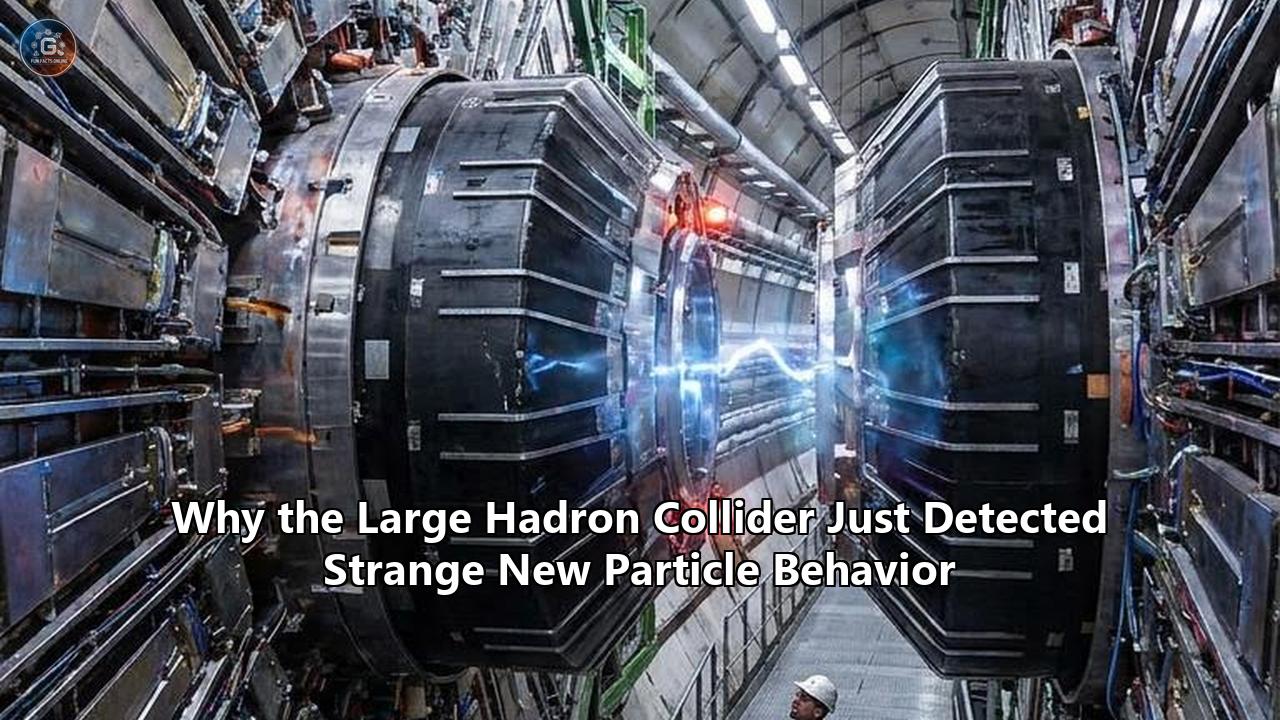
At the edge of Geneva, deep beneath the pastoral French-Swiss border, the world’s most complex machine is whispering secrets that could dismantle half a century of established physics.
In late April and May 2026, physicists working on the Large Hadron Collider beauty (LHCb) experiment at CERN published findings in Physical Review Letters indicating a persistent, anomalous signal in the way certain rare subatomic particles decay. Specifically, the researchers observed highly unusual behavior during an extraordinarily rare process known as an electroweak penguin decay.
According to the data, the rate and the precise angular distribution at which unstable particles called B mesons decay into other subatomic fragments do not match the predictions of the Standard Model—the crown jewel of modern particle physics. Standing at an impressive statistical significance of four standard deviations (4-sigma), the anomaly suggests there is only a 1-in-16,000 probability that this is a random statistical fluke.
What makes this development a major talking point in the scientific community is not merely the LHCb result in isolation. Crucially, the CMS collaboration—an independent detector experiment at the Large Hadron Collider (LHC) operating with a completely different detector geometry—published agreeing data, transforming what might have been a minor instrumental quirk into the most unified, compelling hint of "new physics" seen in decades.
For decades, the Standard Model has reigned supreme, passing every experimental test thrown its way with flying colors. Yet, physicists have long known it is fundamentally incomplete; it fails to explain dark matter, dark energy, gravity, or why the universe is made of matter rather than antimatter. This newly detected particle behavior presents a direct, measurable challenge to this theoretical status quo.
The Challenge: The Mechanics of the "Penguin" and the Beauty-to-Strange Transition
To understand why this particle behavior is causing such a stir, one must look at the specific subatomic pathway where the anomaly was detected: the electroweak penguin decay.
The Flavor-Changing Neutral Current Dilemma
All standard matter is made of the lightest, most stable quarks—the "up" and "down" quarks that form protons and neutrons. However, the universe also contains heavier, highly unstable "flavors" of quarks: the charm, strange, top, and bottom (or "beauty") quarks. In the high-energy collisions of the LHC, protons are smashed together at nearly the speed of light, briefly recreating the hot, dense conditions of the early universe and producing these heavy, exotic quarks in massive quantities.
Among these heavy particles are B mesons, which consist of a heavy bottom quark paired with a lighter antiquark. These mesons are extremely short-lived, decaying in a fraction of a nanosecond into lighter, more stable particles.
Standard Model Tree-Level Decay (Allowed)
[Bottom Quark (b)] --------> (W- Boson) --------> [Leptons / Light Quarks]
        \
         \----------------------------> [Up/Charm Quark (u/c)]
In standard decays, a bottom quark transforms into a charm or up quark by emitting a $W$ boson—a mediator of the weak nuclear force. This is a "tree-level" decay, a direct and common pathway.
However, the LHCb experiment focused on a far more elusive process: a bottom quark ($b$) transforming into a strange quark ($s$). Because both the bottom and strange quarks carry the same electric charge ($-1/3$), this transition is classified as a Flavor-Changing Neutral Current (FCNC).
In the Standard Model, FCNCs are strictly forbidden from occurring via a direct, tree-level pathway. Instead, they can only occur through highly complex, multi-step quantum detours known as loop diagrams.
The Electroweak "Penguin" Loop Diagram (Highly Suppressed)
                  (Virtual W- Boson Loop)
                 /                       \
                /                         \
[b-Quark] ---> [Virtual Top Quark (t)] ---> [s-Quark]
                        \
                         \------> (Z0 / Photon) ------> [Muon Pair (μ+ μ-)]
In this loop, the bottom quark temporarily fluctuates into a virtual top quark and a virtual $W$ boson before reforming into a strange quark. During this brief, intermediate quantum state, the system emits a neutral force carrier—such as a $Z^0$ boson or a photon—which then decays into a pair of leptons, specifically a muon and an antimuon ($\mu^+ \mu^-$).
Why Is It Called a "Penguin" Decay?
The whimsical name "penguin diagram" dates back to a summer evening in 1977 at CERN. Theoretical physicist John Ellis, along with colleagues Mary K. Gaillard and Dimitri Nanopoulos, was studying CP violation and rare flavor-changing decays.
Melissa Franklin, then an undergraduate student at CERN (and later a prominent physics professor at Harvard), engaged Ellis in a game of darts at a local pub. They made a bet: if Ellis lost, he had to write the word "penguin" into his next academic paper.
Ellis lost the bet. That night, as he attempted to draw the Feynman diagram representing the loop-driven flavor transition, he realized that with a bit of artistic license, the loop, the decaying lines, and the incoming quark lines resembled a penguin. The name stuck, and today "penguin decays" are recognized as some of the most critical laboratories for testing the limits of modern physics.
The Scale of the Anomaly
Because these electroweak penguin decays rely on virtual particles popping in and out of existence, they are incredibly suppressed in nature. In the Standard Model, only about one out of every million B mesons will decay through this specific electroweak penguin pathway.
This extreme rarity is precisely why they are so valuable to physicists. Because the Standard Model contribution to this decay is so tiny, even a minuscule influence from an undiscovered particle or force can visibly alter the decay rate or the angles at which the resulting particles are ejected.
When the LHCb team analyzed approximately 650 billion B meson decays recorded between 2011 and 2018, they painstakingly isolated these rare penguin processes. They measured the decay of a neutral B meson ($B^0$) into a kaon ($K$), a pion ($\pi$), and a pair of muons ($\mu^+ \mu^-$).
The results were startling:
- The Decay Rate: The total number of observed penguin decays was significantly lower than the mathematical predictions of the Standard Model.
- Angular Observables: The angles at which the kaon, pion, and muons flew away from the collision point (parameterized by a highly sensitive theoretical variable known as $P_5'$) deviated systematically from the expected symmetric distribution.
To have a single experiment observe such a discrepancy is intriguing. To have the independent CMS detector observe a matching deficit in the closely related $B \to \phi \mu^+ \mu^-$ decay channel makes it a systemic challenge that theoretical physics can no longer ignore.
Why It Matters: The Limits of the Standard Model and the Hadronic Complication
The four-sigma tension revealed by these Large Hadron Collider discoveries exposes a fundamental crisis of interpretation. Broadly, particle physicists are confronted with two stark possibilities: either we have caught our first genuine glimpse of an undiscovered force of nature, or our theoretical calculations of the strong nuclear force are deeply flawed.
The Case for New Physics: "Ghost Players" in the Quantum Field
If the anomaly is real—meaning it is not a statistical fluctuation or a calculation error—it implies that an unknown physical entity is interfering with the decay process. Because quantum mechanics dictates that all forces and fields are mediated by particles, this interference requires a "ghost player" on the subatomic field, pushing and pulling the B meson’s decay products.
Physicists have proposed two primary candidates for this hypothetical particle:
1. The $Z'$ (Z-Prime) Boson
The Standard Model relies on the $Z^0$ boson to mediate weak neutral interactions. A $Z'$ boson is a hypothetical, much heavier cousin of the $Z^0$, originating from an extended gauge symmetry (often denoted as a new $U(1)'$ group).
If a $Z'$ boson exists, it would interact with quarks and leptons differently depending on their generation (a phenomenon known as non-universal lepton coupling). A $Z'$ boson could exchange energy in the penguin loop, suppressing the decay rate into muons while leaving decays into electrons largely untouched, perfectly matching the observed asymmetry.
2. Leptoquarks
In the Standard Model, leptons (such as electrons and muons) and quarks are treated as entirely distinct families of matter that never directly convert into one another. Leptoquarks are hybrid, color-triplet bosons that carry both lepton and baryon quantum numbers.
Leptoquark-Mediated B-Decay (Hypothetical)
[Bottom Quark (b)] ----------------------------> [Strange Quark (s)]
                  \                            /
                   \                          /
                    \----> [Leptoquark] <----/
                                 |
                                 |
                     [Muon Pair (μ+ μ-)]
If leptoquarks exist, they would allow quarks to decay directly into leptons without relying on the multi-step electroweak loop, altering the decay rates and angular signatures of rare B-decays in a way that aligns with the LHCb and CMS anomalies.
The beauty of these loop-level Large Hadron Collider discoveries is that they allow scientists to detect the footprint of particles that are far too heavy to be directly created by the LHC. While the LHC's maximum collision energy of 13.6 TeV might not be enough to materialize a 5 TeV leptoquark or $Z'$ boson, the quantum virtual states inside the penguin loop can still feel their gravitational and gauge influence. It is the subatomic equivalent of seeing the silhouette of a giant before it enters the room.
The "Charming Penguin" Complication
Before writing textbooks about new forces, however, physicists must confront a notorious theoretical obstacle: the charming penguin.
Standard Model "Charming Penguin" Loop
[b-Quark] ---> [Virtual W- Boson] ---> [s-Quark]
        \                             /
         \---> [Virtual Charm Loop] -/  <-- Extremely difficult to calculate
While electroweak penguin decays are mediated by electromagnetic and weak forces, the quarks involved are also bound by the strong nuclear force, governed by Quantum Chromodynamics (QCD). Inside the penguin loop, the virtual top quark is not the only actor; the bottom quark can also fluctuate into a virtual pair of charm quarks.
These charm quarks interact strongly with each other and the surrounding spectator quarks through a dense cloud of virtual gluons. Because the strong force becomes incredibly powerful at low energies (a property known as confinement), calculating these "charming penguin" loop corrections is notoriously difficult.
For years, skeptics argued that the anomalies observed at LHCb were not signs of new physics, but rather a reflection of our inability to calculate these charm-hadron loop corrections with sufficient precision. If the hadronic interactions inside the meson are stronger or more complex than assumed, they could mimic the exact angular deviations and suppressed decay rates attributed to a $Z'$ boson or a leptoquark.
Beyond the Penguins: A Pattern of Anomalous Discoveries
This tension between experimental results and theoretical calculations is not confined to B meson decays. In early 2026, two other major Large Hadron Collider discoveries emerged, further highlighting the growing friction between high-precision data and our mathematical descriptions of the strong force.
1. The Excited $B_c^{+}$ Meson Mass Deviation
On May 21, 2026, physicists from the ATLAS collaboration reported the first observation of a new particle: the $B_c^{+}$ meson*. Consisting of a charm quark and a bottom antiquark, this particle is an excited (higher-energy) state of the ground-state $B_c^+$ meson.
Spin Alignments in Bc Mesons:
Bc+ (Ground State):       [Charm (↑)]  [Bottom Antiquark (↓)]  (Spins Opposed)
Bc*+ (Excited State):     [Charm (↑)]  [Bottom Antiquark (↑)]  (Spins Aligned)
Because it contains two different types of heavy quarks, the $B_c^{+}$ meson is an exceptional laboratory for testing the strong force. Unlike light quarks, which zip around inside protons at relativistic speeds, heavy quarks move relatively slowly, making their interactions easier to model using high-precision techniques like Lattice QCD—a method where spacetime is simulated as a discrete grid of points.
The ATLAS team produced this excited meson in high-energy proton-proton collisions and watched it decay into a ground-state $B_c^+$ meson and a low-energy photon. Because the photon’s energy is so low, it was nearly invisible to standard detector algorithms. The team had to use a highly specialized "track-reconstruction" procedure, searching for instances where the photon converted into an electron-positron pair inside the silicon tracking layers.
When ATLAS measured the mass difference between the excited $B_c^{+}$ state and the ground $B_c^+$ state, they found it to be $64.5 \pm 1.4 \text{ MeV}$.
While this value is close to theoretical expectations, it systematically deviates from the most recent, ultra-high-precision Lattice QCD calculations. It is a subtle discrepancy, but in the world of subatomic precision, a minor deviation in such a clean, heavy-quark system suggests that our mathematical descriptions of how quarks bind together still lack crucial relativistic or non-perturbative elements.
2. The $\Xi_{cc}^+$ Baryon Lifetime Puzzle
Adding to the theoretical intrigue, on March 17, 2026, the LHCb collaboration announced the discovery of another heavy particle: the $\Xi_{cc}^+$ (Xi-cc-plus) baryon. Roughly four times as massive as a standard proton, this particle consists of two heavy charm quarks and one light down quark.
Baryon Structure Comparison:
Proton:            [Up Quark (u)]      [Up Quark (u)]      [Down Quark (d)]
Xi-cc-plus (Ξcc+): [Charm Quark (c)]   [Charm Quark (c)]   [Down Quark (d)]
Ordinary protons are incredibly stable, but the $\Xi_{cc}^+$ is highly unstable.
What surprised physicists was its lifespan. In 2017, LHCb discovered a sister particle, the $\Xi_{cc}^{++}$, which contains two charm quarks and an up quark. Despite being nearly identical in mass and structure, the newly discovered $\Xi_{cc}^+$ has an expected lifetime six times shorter than the $\Xi_{cc}^{++}$.
This massive lifetime disparity is driven by highly complex quantum interference and "spectator" quark effects during decay. Trying to calculate these multi-body strong-force interactions has pushed theoretical models to their breaking points, reminding physicists that our understanding of how composite matter is assembled from fundamental quarks remains remarkably incomplete.
The Solution: How Physicists are Weaponizing Big Data, AI, and the High-Luminosity Upgrade
Faced with these anomalies, the particle physics community has not retreated into passive speculation. Instead, experimentalists and theorists have launched a coordinated, three-pronged strategy to resolve the mystery of these strange particle behaviors.
Phase 1: Unblinding the Run 3 Dataset
The current four-sigma anomaly in the electroweak penguin decays was discovered using data collected during LHC Run 1 and Run 2 (2011–2018). During those years, the LHCb experiment analyzed approximately 650 billion B meson decays to isolate the rare penguin events.
However, since 2018, the LHC has undergone significant upgrades. Run 3 began in July 2022 and successfully concluded its high-energy proton physics phase on May 19, 2026.
Accumulated B-Meson Decays at LHCb (Approximate):
Runs 1 & 2 (2011-2018):  ■■■■■■ (650 Billion Decays - Basis of the 4-Sigma Anomaly)
Run 3 (2022-2026):       ■■■■■■■■■■■■■■■■■■ (An additional ~2 Trillion Decays on Disk)
Thanks to the major upgrade of the LHCb detector completed in 2023, the experiment recorded an unprecedented integrated luminosity of $11.8\text{ fb}^{-1}$ in 2025 alone.
This means that LHCb currently has three times more B meson data sitting on disk than was used to find the original anomaly.
Right now, collaboration teams are working to "unblind" and analyze this colossal Run 3 dataset. In particle physics, analyses are often kept blind—meaning the scientists write their data-filtering algorithms without looking at the actual signal region—to prevent human bias from artificially shaping the results.
By applying their refined selection criteria to the Run 3 data, physicists expect to either:
- Rule out the anomaly: If the new, larger dataset shows decay rates and angles that align perfectly with the Standard Model, the 4-sigma signal will shrink, revealing itself as a rare but natural statistical fluctuation.
- Confirm a discovery: If the anomaly persists in the Run 3 data, the statistical significance will easily clear the legendary 5-sigma threshold (a 1-in-3.5 million chance of a fluke), which is the official scientific gold standard required to declare the discovery of a new particle or force.
Phase 2: Deploying Real-Time AI and Scouting Triggers
As the collision rate at the LHC increases, the sheer volume of data generated is overwhelming. At peak operation, the LHC produces hundreds of terabytes of raw data every second—far more than can be saved to tape. Historically, "trigger" systems filtered out 99.9% of collisions, keeping only the ones that looked like known, interesting physics.
To catch extremely subtle anomalies that might have been discarded by old filtering rules, the CMS and ATLAS collaborations have integrated advanced machine learning and real-time "scouting" systems directly into their hardware.
One of the standout technological solutions is DeepMET, a deep-learning algorithm integrated into the CMS software framework. DeepMET is designed to reconstruct Missing Transverse Energy (MET).
When protons collide, the total momentum perpendicular to the beam line must sum to zero. If the resulting particles fly off in a lopsided direction, it means an invisible, undetected particle—such as a neutrino, a dark matter candidate, or a dark photon—carried away the remaining momentum.
Real-Time AI Anomaly Detection (e.g., DeepMET)
[Collision Point] --------> Visible Jet A (Reconstructed)
        |  \
        |   \------------> Visible Jet B (Reconstructed)
        v
 [Asymmetry Detected] ---> Real-time AI calculates missing momentum vector
                          ---> Triggers instant storage of "invisible" event
Historically, reconstructing MET was incredibly difficult and slow, often plagued by detector noise. DeepMET uses neural networks trained on millions of simulated collisions to calculate the missing energy vector in real-time, allowing the CMS detector to identify and store soft, unclustered energy patterns and displaced muon tracks that would have previously been ignored.
Similarly, CMS has deployed "data scouting," a technique where only a highly compressed, reduced-data format of every collision is recorded. This allows the experiment to bypass standard trigger bottlenecks, record up to ten times more collisions, and perform highly sensitive searches for light, exotic particles (down to a few tens of MeVs) that might be acting as mediators in the B meson decays.
Phase 3: The High-Luminosity LHC (HL-LHC) Transformation
While Run 3 data will provide a near-term answer, the ultimate, definitive solution to these structural anomalies lies in the next major engineering phase of CERN.
Following the conclusion of the Run 3 heavy-ion runs, the LHC will enter a scheduled Long Shutdown 3 (LS3). This shutdown is a massive industrial undertaking designed to prepare the accelerator for its final, high-luminosity incarnation: the High-Luminosity LHC (HL-LHC).
| Parameter | Standard LHC (Run 3) | High-Luminosity LHC (Post-2030) | Impact on Physics |
|---|---|---|---|
| Peak Luminosity | $\sim 2.0 \times 10^{34} \text{ cm}^{-2}\text{s}^{-1}$ | $\sim 7.5 \times 10^{34} \text{ cm}^{-2}\text{s}^{-1}$ | 3.75x increase in collision density |
| Integrated Luminosity | $\sim 500 \text{ fb}^{-1}$ (Total accumulated) | $\sim 3,000 - 4,000 \text{ fb}^{-1}$ | 15x larger dataset for rare decays |
| Pile-up (Collisions per bunch crossing) | $\sim 40 - 60$ | $\sim 140 - 200$ | Requires ultra-fast, radiation-hard tracking detectors |
To achieve this staggering increase in luminosity, engineers are replacing the magnet structures near the interaction points:
- Niobium-Tin ($\text{Nb}_3\text{Sn}$) Quadrupole Magnets: These advanced superconducting magnets produce magnetic fields of up to 12 Tesla (compared to the 8 Tesla of the current Niobium-Titanium magnets), focusing the proton beams into incredibly tight, dense packets just before they collide.
- Superconducting Crab Cavities: These radio-frequency cavities will tilt the proton bunches slightly sideways as they approach the collision points, ensuring they collide head-on rather than at an angle, maximizing the probability of interaction.
Standard Beam Crossing (Angle limit):
------->  \
           \  Collision Point (Partial overlap)
            \  <-------

HL-LHC Beam Crossing with Crab Cavities (Rotated bunches):
-------> [||||]
                [||||] (Full head-on overlap)
                <-------
Scheduled to begin operation in 2030, the HL-LHC will deliver a dataset 15 times larger than the current accumulated total.
For rare processes like the electroweak penguin decay, this means statistical uncertainties will dwindle to practically zero.
If a $Z'$ boson or a leptoquark is hiding in the quantum noise, the HL-LHC will not just hint at its existence—it will provide the raw statistical power to map its properties, mass, and coupling constants with absolute precision.
The Road to 5-Sigma: What Lies Ahead for Modern Physics
The strange particle behavior recently detected at the Large Hadron Collider has brought particle physics to an incredibly delicate crossroads.
For fifty years, the Standard Model has acted as an unyielding fortress. Every time a brief "anomaly" appeared in the data, it eventually dissolved under the weight of higher statistics or cleaner calculations, leaving the Standard Model triumphant.
Yet, the current electroweak penguin anomaly feels different to many in the field. It has persisted across multiple analysis runs. It has been observed in different decay channels. Most importantly, it is being seen by two entirely independent detectors, LHCb and CMS, which use different tracking technologies and analysis methodologies.
The Convergence of Evidence toward 5-Sigma
                                                        [ 5-Sigma Discovery! ]
                                                            ^
                                                           /
                                  [ CMS Confirms Trend ] -/ (Late 2025/2026)
                                      ^
                                     /
             [ LHCb 4-Sigma Anomaly ] (April 2026)
                 ^
                /
[ Decades of Standard Model Dominance ]
What to Watch For Next
Over the next twelve to eighteen months, several critical milestones will determine whether we are on the verge of a historic paradigm shift:
- The Unblinding of Run 3 LHCb Penguin Data: This is the immediate next step. Keep an eye out for preprint servers and major physics conferences where the first analyses of the 2022–2026 data are presented. If the significance climbs from 4-sigma toward the coveted 5-sigma mark, the scientific world will shift into high gear.
- Lattice QCD Breakthroughs: Theoretical groups worldwide are racing to perform even higher-precision simulations of the "charming penguin" loop effects. If these theoretical calculations can definitively prove that Standard Model hadronic effects are too small to explain the observed deficit, the case for new physics will become practically ironclad.
- Direct Searches for $Z'$ and Leptoquarks: While the penguin decays provide indirect evidence, ATLAS and CMS are simultaneously running direct searches for heavy $Z'$ bosons and leptoquarks at high invariant masses. A simultaneous direct detection of a heavy resonance in the TeV range alongside the B-decay anomaly would be the ultimate "smoking gun."
- The 2026 European Strategy Update: Following the conclusion of the Run 3 proton run, the CERN Council decided to officially update the European Strategy for Particle Physics. This strategic roadmap will define the next generation of mega-science projects, including the proposed Future Circular Collider (FCC)—a 91-kilometer ring designed to smash protons at 100 TeV, potentially opening a direct window into the 2070s and beyond.
The current anomalies in the Large Hadron Collider are a healthy reminder that science is at its best when it fails.
If the Standard Model explained everything perfectly, the field of particle physics would be complete, relegated to a historical catalog of known facts. It is the friction of these unexplained behaviors—the minor mass deviations in the $B_c^{+}$ meson, the bizarre lifespans of heavy baryons, and the defiant paths of electroweak penguins—that drives human curiosity forward.
Whether these anomalies ultimately point to an undiscovered force of nature or a deeper, richer understanding of the forces we already know, they prove that the universe still has plenty of secrets left to tell, and we have the machines capable of listening.
Reference:
- https://www.reddit.com/r/InterstellarKinetics/comments/1sr9rcl/breaking_the_large_hadron_collider_has_found_a/
- https://www.sciencedaily.com/releases/2026/05/260526022012.htm
- https://thedebrief.org/large-hadron-collider-experiments-hint-at-undiscovered-physics-that-could-soon-overturn-the-standard-model-physicists-say/
- https://www.youtube.com/watch?v=PPlqoNQEIO8
- https://home.cern/lhcb-collaboration-discovers-new-proton-particle/
- https://www.sciencealert.com/cern-discovers-new-particle-after-upgrading-large-hadron-collider
- https://www.techradar.com/pro/physicists-just-found-a-bizarre-charming-penguin-glitch-at-the-lhc-that-could-prove-everything-weve-ever-known-about-physics-and-reality-itself-is-dead-wrong
- https://www.space.com/science/particle-physics/large-hadron-collider-gives-scientists-their-best-look-yet-at-conditions-right-after-the-big-bang
- https://www.academicjobs.com/research-publication-news/cern-lhc-penguin-decays-new-physics-anomaly-or-academicjobs-15286
- https://www.iflscience.com/an-energetic-version-of-a-particle-made-from-heavy-quarks-has-been-discovered-at-cern-83623
- https://cerncourier.com/a/chasing-new-physics-with-electroweak-penguins/
- https://www.sciencedaily.com/releases/2026/05/260526022012.htm
- https://cms.cern/news/cms-moriond-2026
- https://home.cern/lhc-delivers-record-number-particle-collisions-2025/
- https://www.reddit.com/r/abovethenormnews/comments/1srzpbl/the_lhc_has_detected_something_that_shouldnt/
- https://arxiv.org/abs/2211.11766
- https://www.techradar.com/pro/physicists-just-found-a-bizarre-charming-penguin-glitch-at-the-lhc-that-could-prove-everything-weve-ever-known-about-physics-and-reality-itself-is-dead-wrong
- https://atlas.cern/Updates/Briefing/Observation-New-B-Meson-State
- https://www.sci.news/physics/cern-bc-plus-meson-particle-14793.html
- https://home.cern/atlas-observes-new-composite-particle/
- https://cms.cern/news/cms-lhcp-2025
- https://cms.cern/news/cms-lepton-photon-2025