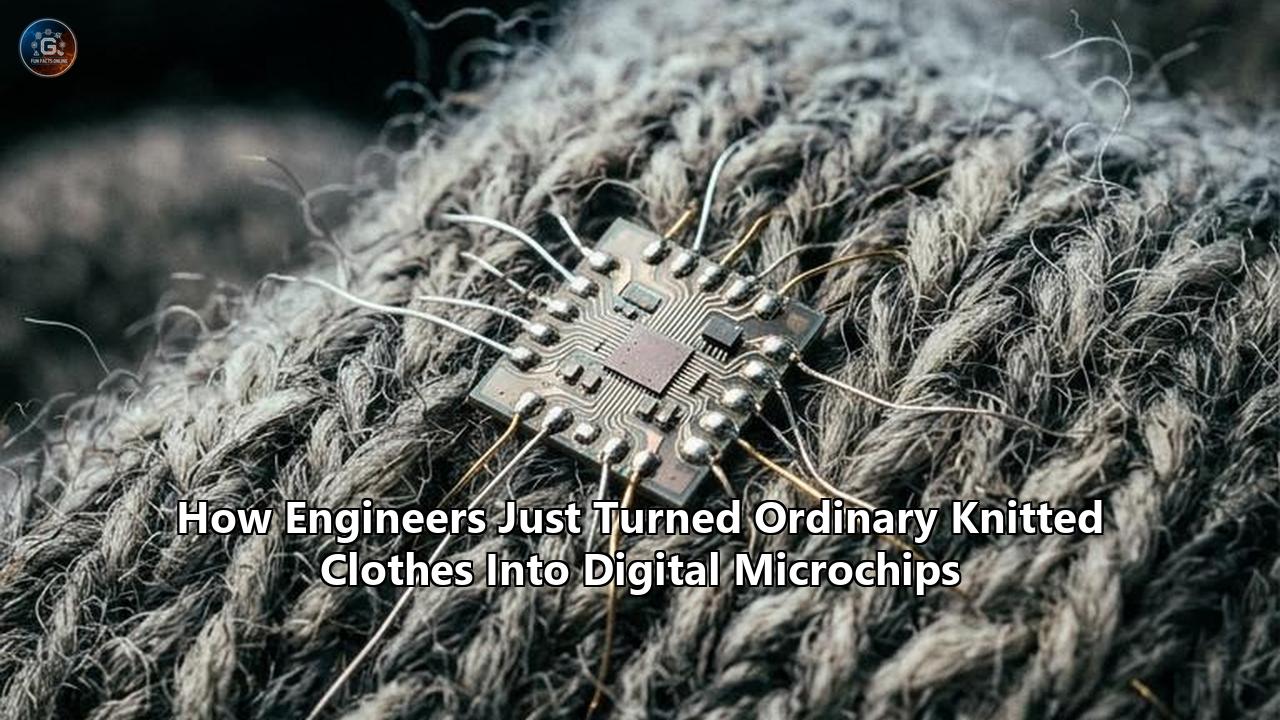
Earlier this year, a research team led by Peng Huisheng and Chen Peining at Fudan University published a study in Nature showing how to build fully functioning integrated circuits inside a flexible polymer thread thinner than a human hair. By rolling ultra-thin silicon membranes into a multi-layered spiral inside an elastic strand, the researchers produced a "fiber chip" capable of processing digital signals, storing memory, and running computational tasks while being bent, twisted, and stretched.
Simultaneously, engineers at Harvard’s John A. Paulson School of Engineering and Applied Sciences (SEAS) revealed in Advanced Functional Materials that standard industrial knitting machines can assemble dense, multistable fabrics that act as physical digital switches and sensors without requiring rigid external circuit boards. These developments build upon ongoing field tests by the Massachusetts Institute of Technology (MIT) and the U.S. Military, where service members on the Musk Ox II Arctic expedition wore merino-wool base layers embedded with elastic digital fiber computers operating in -40°F weather.
The smart clothing sector is undergoing a fundamental structural transition. For decades, "wearable technology" meant sewing rigid printed circuit boards (PCBs) onto fabric, printing fragile conductive inks onto surface layers, or weaving simple metal threads that carried analog signals. Today, material scientists and textile engineers are embedding binary digital logic, memory registers, and micro-scale processing nodes directly into yarn filaments.
By running microchip manufacturing techniques in reverse and mapping circuit topologies onto the mechanical loops of double-bed weft knitting machines, researchers have turned ordinary knitted garments into distributed computing systems.
The Silicon-to-Yarn Metamorphosis
To understand why embedding digital chips into yarn required a complete rethink of solid-state physics, one must look at the mechanical incompatibilities of silicon and fabric. Single-crystal silicon, the foundation of modern microelectronics, has a Young’s modulus of roughly 130 to 180 Gigapascals (GPa)—making it as stiff as steel. Knitted textiles, by contrast, rely on low-modulus elastomeric or natural fibers (0.1 to 3 GPa) that deform, stretch, and bend under minimal strain.
Early attempts to create electronic clothing relied on analog conductive yarns, typically made from silver-coated nylon or stainless-steel filaments. These systems suffered from severe limitations:
- Signal Degradation: Analog signals traversing conductive threads suffer heavy attenuation, high parasitic capacitance, and electromagnetic interference caused by motion artifacts.
- Lack of On-Body Logic: Analog fibers can transmit raw sensor voltage, but they cannot process data, store information, or run noise-filtering algorithms locally.
- Mechanical Delamination: Mounting traditional surface-mount technology (SMT) chips directly onto flexible fabrics creates severe mechanical stress concentrations at the solder joints, causing early fatigue failure after minimal flexing or washing.
TRADITIONAL E-TEXTILES vs. DIGITAL FIBER COMPUTING

Traditional Approach:
[ Rigid Microchip / PCB ] ---> Solder Joint (High Stress) ---> [ Conductive Surface Trace ] ---> [ Fabric ]
* Vulnerable to flexing, mechanical cracking, and water corrosion.

Digital Fiber Approach:
[ Polymer Sheath ]
  ↳ [ Integrated Silicon Micro-Nodes (100–300 µm) ]
      ↳ [ Flexible Micro-Buses (Copper/Gold) ]
* Encapsulated within the yarn core; stress distributed across loop geometry.
To bridge this gap, engineers moved away from mounting pre-packaged chips on top of textiles. Instead, they scaled the microchip down to its microscopic die level and embedded these miniaturized silicon components directly inside the core of the yarn before the fabric is knitted.
At MIT, researchers led by Yoel Fink developed a preform-to-fiber thermal drawing technique. They positioned hundreds of microscopic silicon digital dies—measuring just a few hundred micrometers across—alongside fine copper interconnects inside a macroscopic polymer preform. This preform is heated above its glass transition temperature and drawn in a draw tower, scaling down its diameter while preserving the precise spatial positioning of the embedded microchips. The result is a continuous, flexible fiber containing individually addressable microcontrollers, digital memory cells, and optical transceivers, all communicating across a single digital bus strand.
"Sushi-Roll" Lithography and the Physics of Thread-Based Chips
While MIT’s thermal drawing approach embeds discrete silicon nodes within polymer strands, the Fudan University team solved an even harder problem: how to manufacture continuous, highly complex integrated circuits across the entire surface of a flexible, non-planar thread.
Fabricating microelectronics traditionally requires absolute flatness. Photolithography tools focus ultraviolet light through masks onto photopolymer-coated silicon wafers polished to sub-nanometer smoothness. Attempting photolithography directly on the curved, rough surface of a textile yarn is optical and mechanical madness: light refracts unpredictably, resist thickness varies wildly, and circuit traces short out.
The Fudan team bypassed this by developing a process dubbed "sushi-roll" lithography:
"SUSHI-ROLL" FIBER CHIP MANUFACTURING PROCESS

Step 1: Planar Elastomer Substrate
[ Ultra-Smooth Elastomer Sheet (Nanometer Flatness) ]

Step 2: Photolithography & Passivation
[ Transistors / Capacitors / Interconnects Etched on Flat Sheet ]
[ Chemical Solvent Protective Coating Applied ]

Step 3: High-Tension Roll-Up
[ Sheet Rolled under Controlled Strain into a Tight Multi-Layered Spiral ]
                       ↓
( Fiber Core: < 100 µm )- Ultra-Flat Substrate Preparation: Researchers spin-coat an ultra-smooth elastomer layer onto a rigid carrier, creating a nanometer-flat plain.
- Standard Lithographic Processing: High-density transistor arrays, interconnect lines, capacitors, and resistors are etched onto this flat sheet using conventional semiconductor fabrication equipment.
- Solvent Protection: A thin protective dielectric coating is deposited over the circuits to shield them from chemical exposure and moisture.
- Spiral Assembly: The elastic sheet is peeled from the carrier and rolled under controlled mechanical tension into a dense, multi-layered spiral, forming a cylindrical fiber core thinner than 100 micrometers.
This spiral geometry offers a mechanical advantage: when the fiber is stretched or bent, the strain is distributed across the overlapping layers of the roll rather than concentrating on a single planar interface. The internal logic circuits slide infinitesimally relative to one another, preventing the microscopic copper and silicon traces from snapping.
By turning a two-dimensional circuit board into a three-dimensional roll, scientists successfully crammed thousands of active transistors into a thread that handles the mechanical abuse of industrial textile processing.
Stitch Mechanics as Circuit Topology
Having created digital threads, the next challenge is converting them into wearable clothing without destroying their electronic functionality. This is where advanced industrial knitting comes into play.
In traditional weaving, warp and weft threads cross at rigid 90-degree angles. While weaving provides structural stability, it lacks the elasticity and multidirectional compliance required for comfortable clothing. Knitting, by contrast, creates a network of interlocking loops. As a knitted fabric stretches, the loops deform, slide over one another, and absorb mechanical energy—protecting the yarn inside from tensile strain.
WEFT-KNITTING LOOP GEOMETRY & CONTACT RESISTANCE

       ( Loop Top )
       /          \
  ( Interlocking Contact )  <--- R_contact (Varies with mechanical tension)
      \            /
       ( Loop Base )

* Plating Technique: Conductive digital yarn positioned on outer face;
  elastic synthetic yarn positioned on inner face.
To turn knitted loops into functional circuits, engineers rely on computer-controlled double-bed weft knitting machines (such as those produced by Shima Seiki or Stoll). These machines use thousands of independently controlled latch needles to execute complex stitch patterns at high speed.
Loop Contact Resistance and Circuit Routing
When a digital fiber is knitted into a textile matrix, the point where one loop overlaps another creates a dynamic electrical junction. The electrical resistance across this junction, known as contact resistance ($R_{\text{contact}}$), depends directly on the contact pressure between the yarns:
$$R_{\text{contact}} \propto \frac{\rho}{\sqrt{F_c}}$$
Where $\rho$ is the material resistivity and $F_c$ is the mechanical contact force applied at the loop intersection.
If $F_c$ fluctuates wildly during body movement, the electrical resistance spikes, causing digital signal dropouts or power fluctuations. To eliminate this issue, automated knitting programs use specialized stitch topologies:
- Plating: The machine feeds two separate yarns through a single feeder guide simultaneously. A high-elasticity synthetic yarn (such as elastane or nylon) is positioned on the inner layer facing the skin, while the digital microchip yarn is positioned on the outer layer. The elastic yarn maintains constant mechanical tension on the digital yarn, holding $F_c$ stable even when the garment stretches over joints like knees or elbows.
- Intarsia and Float Stitches: To prevent digital signals from short-circuiting across neighboring courses, computerized knitting machines use intarsia patterns to isolate conductive paths within specific color blocks or float stitches, routing the digital yarn along isolated channels on the reverse side of the fabric.
Mechanical-Digital Logic Gates
Integrating digital microchips into smart knitted textiles is not the only way researchers are embedding intelligence into clothing. At Harvard SEAS, researchers achieved logic switching using the physical geometry of the knit itself.
HARVARD MULTISTABLE KNITTED SWITCH MECHANISM

State A (Unsnapped / Circuit Open):
   ___/ \___   <--- Curved fabric geometry holds conductive yarns apart.
   [OFF STATE]

Applied Mechanical Force (Flexion)
       ↓
State B (Snapped / Circuit Closed):
   ________    <--- Fabric snaps into flat/inverted stable state;
   [ ON STATE]      conductive loops make contact, closing circuit.
By engineering non-linear mechanical stresses into the fabric using specific combinations of knit, tuck, and float stitches, the Harvard team created multistable fabrics that naturally snap between distinct, stable three-dimensional shapes. When conductive yarns are integrated into these multistable loops, the mechanical snap physically closes or opens electrical contacts.
The fabric acts as a mechanical-digital switch: applying strain past a mechanical threshold flips the fabric into a new geometry, holding the electronic circuit in an "ON" or "OFF" state without drawing any standby electrical power.
On-Body Computing and Textile Machine Learning
Moving microprocessors onto fabric changes how biometric data is processed. Traditional wearables collect analog health metrics (such as heart rate, skin temperature, or strain), convert them via an analog-to-digital converter (ADC), and transmit the raw data over Bluetooth to a smartphone or cloud server for analysis.
This model suffers from significant energy costs: radio-frequency (RF) wireless transmission consumes far more milliwatts per bit than local digital computation.
DATA PROCESSING COMPARISON: CONVENTIONAL WEARABLES vs. DIGITAL FABRIC NETWORKS

Conventional Architecture:
[ Sensor ] ---> (Raw Analog Data) ---> [ ADC ] ---> [ Bluetooth RF Transceiver ] ⚡⚡⚡ (High Power) ---> [ Phone / Cloud ]

Digital Textile Network Architecture:
[ Fiber Chip 1 ] ──┐
[ Fiber Chip 2 ] ──┼─> [ Optical / Electrical Bus ] ──> [ On-Fiber Neural Net (1,650 Weights) ] ──> [ In-Fabric Result ]
[ Fiber Chip 3 ] ──┘                                                                             (Low Power Inference)
Digital yarns change this paradigm by running artificial neural networks (ANNs) directly inside the fabric.
Distributed Neural Processing
In experiments conducted by MIT and Rhode Island School of Design (RISD) collaborators, engineers created a digital fiber containing an integrated neural network trained with 1,650 weight parameters stored in its internal non-volatile digital memory.
When sewn into the underarm section of a garment, the digital yarn recorded long-term body surface temperature profiles and continuously analyzed the data locally. By executing real-time mathematical inference on board the yarn, the garment recognized physical activities—such as walking, resting, running, or cycling—with 96% classification accuracy, without sending a single byte of raw data over an external wireless link.
| System Configuration | Architecture Type | Activity Recognition Accuracy | Communication Power Consumption |
|---|---|---|---|
| Single Digital Fiber | Isolated Local Computation | ~70% | Negligible (< 1 mW) |
| Networked Multi-Fiber Garment | Distributed Intra-Fabric Bus | ~95% | Low (< 5 mW Inter-Fiber) |
| Traditional Wearable | Centralized Wireless Streaming | ~90%–95% | High (20–50 mW RF Streaming) |
To reach higher recognition precision, researchers linked multiple digital fibers across different limbs of a garment—sleeves, torso, and leggings—creating a distributed intra-textile network.
Instead of routing signals through copper wires that could snap, the fibers communicate using micro-LEDs and miniature photodetectors built into the thread walls. Pulses of near-infrared light travel through the surrounding optical polymer sheath, allowing different parts of the garment to exchange data at high speeds without electromagnetic interference. When operating independently, individual fibers achieved 70% accuracy; when connected in a distributed optical fabric network, their combined neural network accuracy jumped to 95%.
In-Fabric Non-Volatile Memory
Because these fiber computers feature true digital memory cells, smart knitted textiles can serve as secure physical data storage units.
In lab validation tests, MIT scientists stored a 767-kilobit color short video file and a 0.48-megabyte audio file directly within the digital memory registers of a polymer yarn sewn into a shirt. The data remained uncorrupted without external electrical power for several weeks, demonstrating that clothing can permanently carry encrypted medical histories, access control keys, or military identification profiles embedded in its underlying yarn.
DIGITAL FIBER MEMORY DENSITY & ARCHITECTURE

[ Microscale Silicon Memory Dies ] ──> Spaced along yarn length
Memory Density: ~7.6 × 10⁵ bits per meter
Data Retention: Power-free storage for multiple weeks
File Compatibility: Encrypted audio, video, biometric profiles, machine learning weights
Real-World Deployment: Arctic Trials and Surgical Rehabilitation
The shift from benchtop prototypes to field-ready digital textiles is being driven by high-stress applications in military operations and clinical medicine.
During the joint U.S. Army and Navy Musk Ox II Arctic expedition, service members traversed over 1,000 kilometers across frozen terrain in average temperatures of -40°F. The troops wore base-layer garments made from merino wool mesh integrated with MIT digital fiber computers.
U.S. MILITARY MUSK OX II ARCTIC FIELD TRIAL

Garment Matrix: Merino wool mesh base-layer
Integrated Hardware: 4x networked elastic digital fiber computers
Environmental Stress: -40°F (-40°C) ambient, sub-zero wind chill, 1,000 km trek
Primary Telemetry: Core-to-skin thermal gradients, localized shivering patterns, early hypothermia detection
In extreme cold, traditional smartwatch sensors fail because cold temperatures cause peripheral vasoconstriction—shrinking blood vessels in the wrist and rendering optical heart-rate monitors inaccurate. By contrast, base-layer shirts embedded with digital fibers stay in direct thermal and physical contact with large surface areas of the torso, chest, and vital organs.
The digital yarns monitored the physiological metrics of soldiers in real time:
- Micro-Thermal Gradients: Tracking heat transfer between the skin and external polar garments to predict hypothermia minutes before clinical symptoms appeared.
- Muscular Fatigue Analysis: Localized strain and temperature changes around shoulder and back muscles detected signs of physical exhaustion, allowing commanders to adjust load distributions dynamically.
In clinical settings, these materials offer a non-invasive way to track patient recovery after major joint surgeries or neurological injuries. Patients recovering from anterior cruciate ligament (ACL) reconstruction or stroke rehabilitation often exhibit subtle gait asymmetries that disappear during short visits to a doctor's office.
Knitted leggings containing multistable yarn switches and digital acceleration-sensing fibers continuously monitor knee flexion angles, ground contact forces, and movement smoothness throughout daily routines. The data is processed locally within the legging's knitted structure, generating daily movement summaries for physical therapists while shielding the patient's private biometric data from external interception.
The Industrial Bottlenecks: Connectors, Tensile Stress, and Laundry Cycles
Despite these scientific milestones, bringing digital microchip garments to consumer markets requires solving three persistent engineering challenges: interconnect stress, laundry survival, and manufacturing scaling.
THE THREE INDUSTRIAL BOTTLENECKS

1. Interconnect Transition
   [ Flexible Digital Yarn ] ===> High Strain Point <=== [ Rigid Battery / Power Bus ]
   Solution: Gradient-modulus strain relief collars & conductive magnetic snap buses.

2. Hydrophobic Encapsulation
   Laundry Cycles (Water + Detergent Surfactants + Mechanical Agitation)
   Solution: Multi-layer UV-curable polymer resins & hermetic elastomer seals.

3. Textile Mill Integration
   Standard Spinning Looms (High Tension / Sudden Speeds)
   Solution: Low-friction ceramic yarn guides & tension-compensating feeders.
1. The Interconnect Problem
The weakest point in any electronic garment is the physical junction where a flexible digital yarn meets a rigid power source (such as a lithium-polymer battery or a main external microprocessor). Repeated bending at this junction causes metal fatigue and wire breakage.
Engineers have developed strain-gradient connectors to resolve this issue. Instead of soldering a yarn directly to a rigid board, the yarn passes through a stiffening sleeve made of a polymer whose elasticity gradually decreases from the soft yarn end to the hard connector end. This gradient distributes bending forces across a wide curve rather than focusing stress at a single point.
Additionally, researchers are adopting magnetic snap-terminals plated with gold-nickel alloys. These terminals allow digital garments to connect to power modules via self-aligning magnetic interfaces that disconnect safely when pulled, preventing the internal microchip yarns from snapping if the garment is caught or stretched forcefully.
2. Laundry Resilience
A everyday shirt must survive dozens of washing machine cycles. Washing machines expose garments to severe physical forces: mechanical agitation, thermal shocks (up to 140°F/60°C), ionic chemical immersion from detergents, and high-speed spin drying.
WATER & SURFACTANT PENETRATION BARRIER

  [ Ambient Laundry Water + Surfactants ]
─────────────────────────────────────────────  <-- Outer Hydrophobic Fluoropolymer Coating
  [ UV-Curable Polymer Micro-Pod Resin ]
─────────────────────────────────────────────  <-- Inner Mechanical Elastomer Buffer
  [ Microchip Die (100 µm) + Copper Wires ]
To protect silicon dies and copper interconnects from water ingress and chemical oxidation, digital yarns use multi-stage encapsulation:
- Micro-Pod Encapsulation: Each silicon chip die and its soldered junction are embedded inside a rigid, microscopic resin pod made of UV-curable acrylic or epoxy. These micro-pods measure less than 1 millimeter in length—small enough to bend through a knitting needle without breaking.
- Elastomeric Sheathing: The entire yarn length, including its micro-pods and stranded copper interconnects, is extruded inside a seamless polymer sheath made of thermoplastic polyurethane (TPU) or flexible silicone.
In standardized wash testing, digital fibers built with this dual-layer insulation survived over 10 to 50 machine washing cycles without losing electrical continuity or suffering memory corruption.
3. Textile Mill Compatibility
Textile manufacturing operates at high speeds. Commercial spinning and knitting machines pull yarns through ceramic guides at speeds exceeding 10 meters per second, subjecting threads to sudden spikes in tensile tension.
Traditional SMT-assembled e-textiles break instantly under these conditions. However, because modern digital fibers keep their silicon dies below 300 micrometers in thickness and encapsulate them inside smooth polymer sheaths, they can run through commercial computerized knitting equipment—such as Shima Seiki SWG and Stoll ADF systems—with minimal adjustments.
FACTORY INTEGRATION PIPELINE

[ Silicon Micro-Dies ] ──> [ Thermal Drawing / Sushi-Roll Extrusion ]
                                       ↓
                        [ Digital Fiber Spool ]
                                       ↓
            [ Industrial Double-Bed Weft Knitting Loom ]
              (Shima Seiki / Stoll Standard Factory Floor)
                                       ↓
                     [ Seamless Digital Smart Garment ]
Garment manufacturing centers in Tiruppur (India), Dongguan (China), and Vietnam can load spools of digital microchip fiber directly into their existing knitting infrastructure. This compatibility allows garment factories to produce smart knitted textiles at scale without having to rebuild their production lines.
Geopolitics, Supply Chains, and Biometric Privacy
As smart fabric technology matures, it is moving into the realm of international industrial policy and defense strategy.
The ability to embed computing power, memory, and sensor arrays directly into garments has significant military implications. The U.S. Department of Defense, working through public-private partnerships like Advanced Functional Fabrics of America (AFFOA), views functional fibers as critical equipment for next-generation soldiers. Garments that monitor vital signs locally, detect chemical or biological agents, and transmit tactical data without relying on bulky external battery packs offer a distinct operational advantage.
Concurrently, China’s state-sponsored material science research has prioritized functional fiber innovation. Key state laboratories, including those at Fudan University and Donghua University, receive substantial government backing to lead the global IP landscape in soft electronics, thread lithography, and fiber-based displays.
GEOPOLITICAL INNOVATION ECOSYSTEM

United States:
* Lead Entities: MIT, AFFOA, U.S. Army Natick Soldier Systems Center
* Focus Areas: Thermal preform drawing, on-fiber neural networks, extreme environment military gear

China:
* Lead Entities: Fudan University, Donghua University, Ministry of Science and Technology
* Focus Areas: Thread-level photolithography, high-density fiber-chip spirals, large-scale industrial textile integration
This technological push brings privacy and security challenges that extend far beyond traditional consumer tech:
- Passive Biometric Harvesting: Unlike smartphones or smartwatches, which users can take off, smart clothes sit directly against the body for extended periods. Garments capable of recording long-term body temperature, movement dynamics, and physiological responses harvest sensitive health data continuously.
- Eavesdropping Risks: Unencrypted digital yarn buses could act as passive broadcast antennas, allowing malicious third parties to intercept health telemetry or extract data stored in garment memory using close-range radio frequency tools.
- Supply Chain Provenance: As microchip threads blend into commercial fabric supply chains, verifying the hardware integrity of smart garments becomes challenging. Ensuring that imported digital textiles do not contain undocumented tracking nodes will require specialized scanning standards for global clothing importers.
The Road Ahead: Active Fabrics and Operating Systems
The coming decade will see smart textiles transition from passive sensor systems to active, self-regulating materials.
Researchers are already working to combine digital logic fibers with soft actuators and micro-thermoelectric generators. Future smart knitted textiles will not merely monitor a wearer’s body temperature or physical exertion; they will actively adapt to it in real time:
ACTIVE CLOSE-LOOP TEXTILE ARCHITECTURE

[ Digital Sensing Yarn ] ──> Detects Body Overheating / Exertion
           ↓
[ On-Fabric Neural Net ] ──> Processes Thermal Gradient
           ↓
[ Micro-Actuator Threads ] ──> Contracting Loop Topology ──> Opens Fabric Pores / Triggers Active Cooling- Dynamic Thermal Regulation: When internal neural networks detect rising body heat or sweating, the fabric can send electrical signals to micro-actuator threads made of shape-memory alloys or electro-active polymers. These threads contract, changing the fabric's knit density to open air vents and increase breathability.
- Self-Powered Operation: By integrating flexible triboelectric nanogenerators (TENGs) and flexible thermoelectric elements alongside digital fiber computers, future garments will harvest electrical energy directly from body heat and movement, eliminating external batteries altogether.
- Fabric Operating Systems (FabOS): As garments accumulate dozens of interconnected digital fibers, computer scientists are developing lightweight, open-source software frameworks designed specifically for thread-based computing. These micro-operating systems manage power distribution across yarn networks, prioritize sensor readouts, and secure stored biometric data.
The boundary between clothing and hardware is disappearing. By embedding silicon architecture into the mechanics of knitted yarn, engineers have set the stage for a future where everyday clothes do not just cover the body—they think, learn, and compute right alongside it.
References
- Peng, H., Chen, P., et al. (2026). A flexible, multi-layered spiral fiber chip fabricated via planar-to-cylindrical micro-lithography. Nature.
- Mahadevan, K., & Bertoldi, K. (2026). Multistable machine-knitted textiles for structural shape-shifting, mechanical switching, and integrated sensing. Advanced Functional Materials.
- Fink, Y., Loke, G., Khudiyev, T., et al. (2021–2025). Digital fiber computers with localized memory, neural network inference, and optical inter-fiber communication. Nature Communications / MIT Fibers@MIT Laboratory Reports.
- U.S. Army Cold Regions Research and Engineering Laboratory. (2025). Field Evaluation of Integrated Fiber Computers during Exercise Musk Ox II. U.S. Department of Defense Technical Report.
- Zhang, Z., & Tao, X. (2025). Smart Textile Integrated Microelectronic Systems (STIMES): Modern Fabrication and Industrial Weft-Knitting Integration. Journal of Materials Chemistry C.
- IEEE Flexible Electronics Working Group. (2026). Knitted RFID Yarns and Interstitial Loop Electrodynamics for Distributed Transducers. npj Flexible Electronics.
Reference:
- https://en.qstheory.cn/2026-01/26/c_1156999.htm
- https://apparelresources.com/fashion-news/innovation/harvard-engineers-knit-textiles-switch-sense-change-shape-without-electronics/
- https://parametric-architecture.com/harvard-shape-shifting-knitted-fabric/
- https://specialtyfabricsreview.com/2025/05/02/fiber-computer/
- https://www.materialfuture.com/programmable-fiber-fabrics-that-can-sense-store-analyze/
- https://garmentsmerchandising.com/microchip-technology-textile-materials/
- https://news.mit.edu/2021/programmable-fiber-0603
- https://sustainability-lab.net/2025/03/30/smart-textiles-an-mit-study/?lang=en
- https://ira.lib.polyu.edu.hk/bitstream/10397/88876/2/Shi_Smart_Textile%E2%80%90Integrated_Microelectronic.pdf
- https://textilelearner.net/microchip-technology-in-textile-and-clothing/
- https://www.textiletoday.com.bd/harvard-develops-programmable-knitted-textiles-with-built-in-sensing
- https://materialdistrict.com/article/mits-fibre-computer-a-breakthrough-in-smart-textiles/
- https://scitechdaily.com/harvard-researchers-turn-ordinary-knitting-into-programmable-technology/
- https://pmc.ncbi.nlm.nih.gov/articles/PMC8175338/
- https://www.researchgate.net/publication/334259473_Smart_Textile-Integrated_Microelectronic_Systems_for_Wearable_Applications
- https://bioengineer.org/knitted-rfid-yarns-enable-smart-fabrics-for-motion-sensing-and-identification/