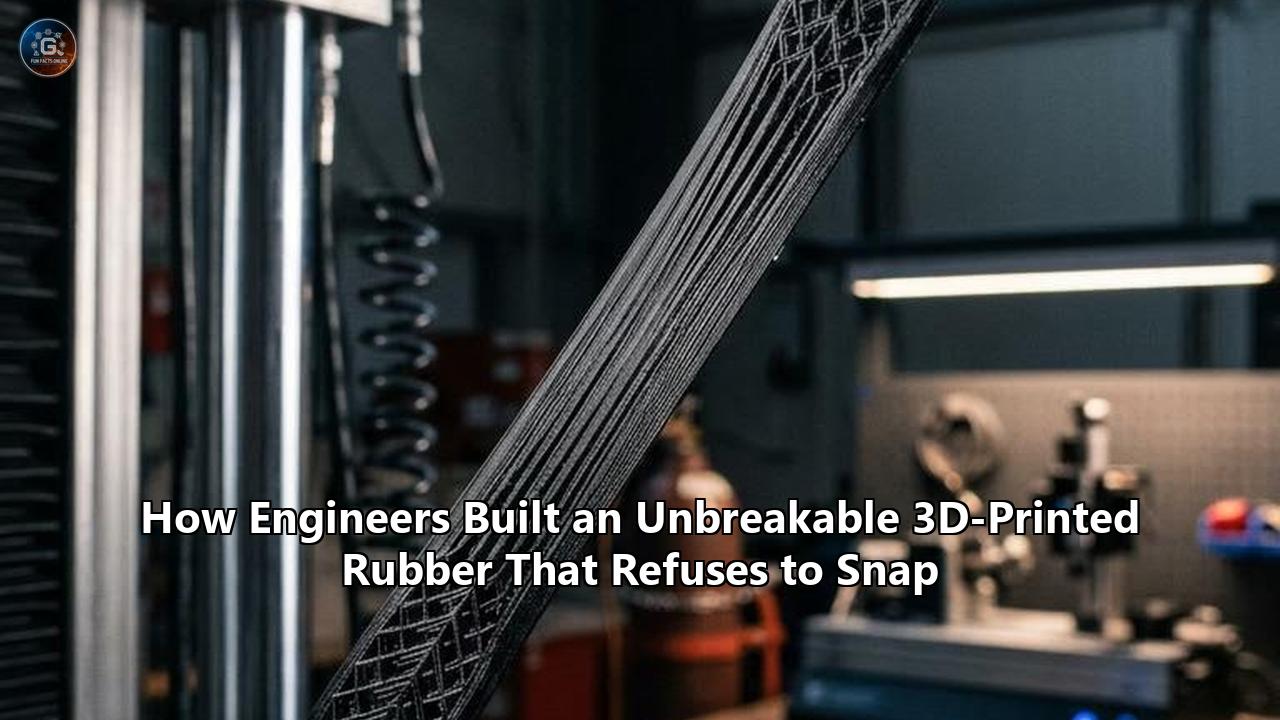
Materials scientists at the Swiss Federal Institute of Technology Lausanne (EPFL) have engineered a double-network granular elastomer that resolves a structural compromise that has limited additive manufacturing for decades. Detailed in a study published in Science Advances, the research team successfully printed dynamic polymer components that withstand extreme physical trauma, sharp punctures, and continuous cyclic stress without tearing or losing their structural memory.
The new material platform delivers up to a fifteen-fold increase in fracture toughness and a three-fold improvement in fatigue threshold compared to standard 3D-printable elastomeric formulations. By decoupling energy dissipation from catastrophic polymer chain scission, the engineering team has produced what functions in practice as an unbreakable 3D printed rubber.
The discovery provides immediate utility for industries attempting to deploy additive manufacturing in high-stress environments. Wearable bio-monitors, dynamic robotic grippers, pneumatic actuators, and long-term prosthetic joints have traditionally suffered from high failure rates when printed using conventional photocurable or thermoplastic resins. By embedding stiff micro-elastomer particles inside an energy-absorbing secondary polymer matrix, the EPFL team created a printable ink that isolates mechanical strain, deflects propagating cracks, and dissipates mechanical energy continuously across millions of cycles.
The Elastomer Trilemma: Why Printed Soft Matter Typically Fails
Elastomers derive their defining properties from long, disordered polymer chains interconnected by sparse chemical crosslinks. When stretched, these molecular strands uncoil and align along the axis of tension; when released, entropic forces pull the chains back into their original, randomized configurations.
Conventional Single Network:
  [Crosslink] —— (Stretched Chain) —— [Crosslink]
  * Stress concentrates at sharp crack tip -> Immediate Bond Scission -> Snapping

EPFL Double-Network Granular Architecture (DNGE):
  [ Stiff Microparticle ]  ~~ (Soft Viscoelastic Matrix) ~~  [ Stiff Microparticle ]
  * Microparticles bear static load
  * Soft matrix flows & redistributes local stress
  * Propagating cracks are forced into tortuous, non-linear paths
In standard single-network elastomers, structural performance is constrained by an inverse relationship between stiffness, ultimate fracture toughness, and fatigue life. Designing a material to optimize one property inevitably degrades the others:
- Stiffness vs. Extensibility: Increasing crosslink density makes the rubber stiffer and more load-bearing, but shortens the average polymer chain length between crosslinks. This limits extensibility and causes the material to fail at lower strain values.
- Fracture Toughness vs. Fatigue Degradation: To prevent sudden, brittle failure under a single severe shock, engineers historically introduce sacrificial bonds or viscoelastic damping mechanisms. While these mechanisms absorb energy during an initial impact, they suffer irreversible molecular damage or high hysteresis under repeated cycling.
- Additive Manufacturing Flaws: Additive manufacturing exacerbates these fundamental mechanical limits. Direct-extrusion and vat-photopolymerization processes create micro-voids, incomplete inter-filament fusion, and distinct layer interfaces. In conventional 3D-printed elastomers, these internal print defects act as immediate stress concentrators. When a microscopic notch forms, mechanical energy concentrates directly at the crack tip, causing covalent bonds to snap in rapid succession and shearing the component apart.
According to the Lake-Thomas model of polymer fracture, the intrinsic fracture energy of an ideal elastomer network is directly dictated by the energy required to rupture the covalent bonds crossing a crack plane. In conventional 3D printing resins, the lack of an efficient, reversible energy-dissipating mechanism ensures that once a crack initiates, the threshold energy required to drive catastrophic tear propagation remains low.
Engineering Granular Double Networks: Architecture Over Chemistry
The EPFL Soft Materials Laboratory (SMaL), led by Esther Amstad, bypassed the classic chemical compromise by shifting focus from molecular synthesis to microstructural architecture. Instead of attempting to invent an entirely new chemical bond, the researchers developed double network granular elastomers (DNGEs).
+-------------------------------------------------------------------------+
|                  DNGE MECHANICAL RECOVERY CYCLE                         |
|                                                                         |
|  1. Rest State       --> Microparticles closely packed in soft matrix   |
|  2. Tensile Strain   --> Load transfers to soft interstitial matrix     |
|  3. Energy Release   --> Viscoelastic polymer chains slide reversibly   |
|  4. Strain Relief    --> Stiff microparticles pull matrix to origin     |
+-------------------------------------------------------------------------+
The DNGE system is synthesized via a two-phase microstructural process:
- Microparticle Fabrication: The researchers first formulate discrete, spherical elastomeric microparticles composed of poly(butyl acrylate) (PBA) crosslinked with 1,4-butanediol diacrylate (BDA) at high crosslink density (1.5 to 5.0 mol%). These microparticles possess high elastic modulus and rapid shape recovery.
- Matrix Infiltration: The microparticles are packed together into a jammed granular paste and swollen with a liquid monomer precursor containing a very low crosslinker concentration (as low as 0.05 mol% BDA).
- Curing: When exposed to ultraviolet light during or immediately after 3D printing, this interstitial precursor polymerizes into an ultra-soft, highly extensible secondary network that physically connects the jammed microparticles.
"Originally, our focus was on improving processibility, but once we had the granular structure, we discovered that these materials are also very tough," stated Esther Amstad. "Then, we realized that a lot of this toughness came from repetitive energy dissipation mechanisms—the material could absorb energy over and over without irreversibly breaking".
Because the load-bearing elements are partitioned into discrete microscale zones, creating an unbreakable 3D printed rubber required abandoning homogenous polymer resins altogether. In the DNGE system, when mechanical tension is applied, stress diverts away from the stiff microparticles into the interstitial soft elastomer network. Within these softer zones, polymer chains slide, rotate, and rearrange via reversible physical friction rather than tearing apart their primary covalent backbones. When the load is removed, the elastic energy stored within the stiff microparticles pulls the soft interstitial matrix back into its original geometric form without permanent plastic deformation.
Defeating Crack Propagation at the Microscale
The standout capability of the DNGE material is its refusal to fail even when notched, slit, or punctured under active tension. In classic elastomers, a surface slit concentrates tension into a singular point, triggering rapid, linear crack propagation.
Crack Propagation Comparison:

Standard 3D Printed Elastomer:
  [Crack Entry] ------------------------------> [Catastrophic Rupture]
  (Straight-line travel through homogeneous network)

DNGE Granular Network:
  [Crack Entry] ---\     /---\     /----------> [Energy Dissipated / Arrested]
                    \---/     \---/
  (Tortuous path around stiff microparticles; stress deconcentrates across matrix)
In DNGE samples, three distinct physical mechanisms arrest crack growth:
1. Crack Tip Blunting and Stress Deconcentration
When a sharp incision is introduced into the material and stretched, the soft interstitial network between the jammed particles stretches locally, distributing incoming force across a wide perimeter rather than concentrating it at a single focal point. This local strain dispersion prevents the stress intensity factor ($K$) from reaching the critical threshold ($K_{IC}$) required for spontaneous bond scission.
2. High Tortuosity Crack Path Diversion
Because the individual microparticles have a significantly higher crosslink density and modulus than the surrounding matrix, a propagating crack lacks the energy to slice directly through them. The fracture is forced to travel around the perimeters of the microparticles, meandering through the soft interstitial spaces. This tortuous path substantially increases the total surface area and effective volume of material involved in the fracture process, drastically amplifying the total energy required to advance the crack.
3. Viscoelastic Friction Without Residual Fatigue
Unlike traditional sacrificial-bond elastomers that rely on broken coordination complexes or mechanophores that require long chemical relaxation windows to heal, the DNGE matrix dissipates kinetic energy through reversible chain entanglement and inter-chain friction. As a result, the energy dissipation is repeatable and functional even under sustained, high-frequency mechanical oscillation.
Direct Ink Writing Rheology: Solving the Printability Problem
A core obstacle in 3D printing high-performance rubbers has been the rheological mismatch between fluid processibility and solid mechanical properties. Liquid photo-resins with low viscosities flow cleanly through printer nozzles but yield brittle, low-molecular-weight polymer networks. Conversely, high-molecular-weight rubbers are too viscous to extrude precisely without high temperatures and pressures that destroy resolution.
+--------------------------------------------------------------------------+
|                       RHEOLOGICAL BEHAVIOR PROFILE                       |
|                                                                          |
|  High Viscosity at Zero Shear (Jammed state prevents slumped geometry)   |
|         |                                                                |
|         | \                                                              |
|         |  \   Shear-Thinning (Particles unjam under extrusion pressure)  |
|         |   \                                                            |
|         +-----\--------------------------> Shear Rate                    |
+--------------------------------------------------------------------------+
The granular microparticle suspension solves this processibility bottleneck by functioning as a yield-stress fluid exhibiting pronounced shear-thinning behavior:
- At Rest (Inside Reservoir / On Print Bed): The high packing fraction of the elastomeric microparticles causes steric jamming. The paste exhibits a high storage modulus ($G'$) and zero-shear viscosity, allowing it to hold its extruded 3D shape, span gaps, and resist gravitational slump without requiring chemical support baths.
- Under Dynamic Shear (Inside Print Nozzle): When the extruder applies mechanical pressure, the shear stress exceeds the ink's yield point. The microparticles unjam and slip past each other, dropping the dynamic viscosity by several orders of magnitude. This enables clean extrusion through micro-nozzles at ambient temperatures with low extrusion pressure.
- Post-Extrusion UV Crosslinking: Once deposited onto the build platform, the material immediately re-jams into a stable filament. A localized ultraviolet LED array initiates free-radical polymerization of the infiltrated liquid precursor, covalently locking the secondary network around the microparticles and forming strong bonds across adjacent printed layers.
Print-Head Extrusion Stage:
  [ Syringe / Extruder ]
           |  (Applied Pressure -> Shear Thinning -> Fluid Flow)
          \ /
       [ Nozzle ]
           |
          \ /
  [ Deposited Filament ] -> (UV Exposure -> Instant Inter-Layer Polymerization)
Because the interstitial liquid precursor permeates across the boundaries of freshly deposited print lines prior to UV activation, the resulting double network forms continuous, covalent connections across layer interfaces. This completely eliminates the structural anisotropy and layer-line delamination that typically cause 3D-printed elastomers to split along horizontal build planes.
Quantitative Performance Benchmarks
In mechanical validation tests, the EPFL research team benchmarked the unbreakable 3D printed rubber against standard commercial photo-elastomers, conventional single-network poly(butyl acrylates), and standard dual-cure polyurethanes. The tests measured fracture energy ($J/m^2$), cycle fatigue endurance, and tensile stress under high extension.
| Material Class | Young's Modulus ($E$) | Ultimate Tensile Strain ($\epsilon_{max}$) | Fracture Energy ($J_c$) | Fatigue Threshold | Primary Failure Mode |
|---|---|---|---|---|---|
| Standard Photopolymer Rubber (e.g., PolyJet/DLP) | $0.5 - 2.5\text{ MPa}$ | $100 - 250\%$ | $200 - 800\text{ J/m}^2$ | $< 50\text{ J/m}^2$ | Rapid brittle fracture along layer interfaces |
| Conventional Silicone / PDMS (Cast/Printed) | $0.8 - 3.0\text{ MPa}$ | $300 - 500\%$ | $1,000 - 3,000\text{ J/m}^2$ | $80 - 150\text{ J/m}^2$ | Notch sensitivity; rapid crack tearing |
| Sacrificial Multi-Network Elastomers | $1.0 - 5.0\text{ MPa}$ | $400 - 700\%$ | $5,000 - 12,000\text{ J/m}^2$ | $100 - 200\text{ J/m}^2$ | Progressive stiffness loss; early cyclic fatigue |
| EPFL DNGE (Granular Double Network) | $0.2 - 4.5\text{ MPa}$ (Tunable) | $> 600\%$ | Up to $15\times$ higher (vs baseline) | Up to $3\times$ higher (vs tough networks) | Controlled crack blunting; non-destructive recovery |
During cyclic fatigue evaluations, DNGE samples were subjected to continuous mechanical loading cycles at strain levels that cause immediate failure in standard single-network rubbers. The granular double networks operated without accumulating unrecoverable strain or microstructural crack growth.
The physical mechanism driving this durability is the high ratio of reversible viscoelastic energy dissipation to covalent bond damage. While standard tough elastomers require covalent bond breakage to dissipate energy (which destroys the material's internal architecture over time), the granular network dissipates large quantities of strain energy through the movement of chains in the soft interstitial regions, preserving the structural network intact.
Spatial Composition Control: Multi-Functional Monolithic Prints
Because direct ink writing allows for dynamic multi-material switching during the printing process, the EPFL team demonstrated the ability to print continuous structures with locally variable stiffness, damping, and elasticity without assembly joints.
+--------------------------------------------------------------------------+
|                  MONOLITHIC MULTI-PROPERTY PRINTING                      |
|                                                                          |
|   +------------------------------------------------------------------+   |
|   | [Rigid Core Component]  | [Compliant Outer Skin]                 |   |
|   | Microparticle Link: 5.0%| Microparticle Link: 1.5%               |   |
|   | Second Matrix: 0.3%     | Second Matrix: 0.05%                   |   |
|   | Modulus: High (Rigid)   | Modulus: Low (Hyper-elastic)           |   |
|   +------------------------------------------------------------------+   |
|                 \                                     /                  |
|                  Seamless, Covalently Integrated Joint                   |
+--------------------------------------------------------------------------+
By altering the crosslink density of the microparticles and the concentration of crosslinker within the secondary matrix on the fly, engineers can manufacture single-pour or single-print components that transition from rigid structural elements to hyper-elastic joints:
- Robotic Actuation Fingers: The researchers printed functional biomimetic finger models featuring rigid internal structural cores (simulating bone) enveloped in soft, stretchable DNGE skins (simulating soft tissue). Because both sections were composed of compatible granular networks cured simultaneously, the components exhibited zero interface delamination under extreme bending and torsional loads.
- Tunable Mechanical Metamaterials: By printing lattice architectures where specific struts contain different granular packing ratios, the team generated mechanical metamaterials that twist, compress, or lock their geometry in direct response to predefined compressive loads.
Direct Ink Writing (DIW) Deposition:
  Nozzle 1 (Stiff Resin DNGE)  -----\
                                     +===> Monolithic Gradient Component
  Nozzle 2 (Compliant Resin DNGE) --/
Real-World Industrial and Biomedical Deployments
The combination of additive manufacturing freedom and high structural durability opens immediate avenues across industrial, medical, and robotics sectors where elastomeric failure has historically stalled deployment.
+--------------------------------------------------------------------------+
|                      TARGET DEPLOYMENT DOMAINS                           |
|                                                                          |
|  [ Soft Robotics ]        --> Tear-proof pneumatic actuators & grippers   |
|  [ Wearable Electronics ] --> Fatigue-resistant stretchable conductors   |
|  [ Medical Implants ]     --> Suturable vascular grafts & heart valves   |
|  [ Dynamic Sealing ]      --> High-cycle industrial gaskets & dampers    |
+--------------------------------------------------------------------------+
1. Soft Robotics and Harsh-Environment Actuators
Soft robotic grippers and fluidic artificial muscles often fail when encountering sharp debris, metal burrs, or unrounded objects. A single puncture typically results in catastrophic explosive depressurization. By utilizing granular double-network elastomers, pneumatic robotic grippers can close around glass shards, razor edges, or abrasive machine parts without tearing. The local stress deconcentration prevents the tip of the sharp foreign object from initiating a self-propagating run-away crack.
2. High-Durability Wearables and Bio-Interfaces
Wearable biosensors and electronic skins require low elastic moduli to match human skin impedance while withstanding millions of joint flexion cycles. Standard conductive silicone formulations degrade rapidly due to micro-crack propagation around conductive filler particles. DNGE networks can incorporate functional fillers or conductive liquid metals into the interstitial soft matrix, preserving electrical pathways across continuous multi-axis strain.
3. Suturable Biomedical Devices and Tissue Scaffolding
In surgical applications, 3D-printed synthetic implants, artificial heart valves, and vascular patches have historically failed at the suture interface. When a surgeon pulls a suture thread through a standard silicone or polyurethane patch, the localized tension creates a high stress concentration that tears through the material like a wire cutting through cheese. The granular double network halts this suture pull-through effect, enabling surgeons to firmly anchor flexible printed implants directly into biological tissue without structural tearing.
Critical Challenges, Scalability, and Next Steps
While double-network granular elastomers represent a substantial step forward in additive manufacturing, transitioning this technology from academic laboratories to industrial production lines presents technical hurdles that researchers are currently addressing.
Current Status vs. Industrial Scale-Up Hurdles:

[ Laboratory Scale (Present) ]
  - Batch emulsion microfluidics for microparticle synthesis
  - Direct Ink Writing speeds (~10-50 mm/s)
  - Controlled solvent extraction & glove-box handling

[ Industrial Target (Next Milestones) ]
  - Continuous high-throughput microparticle spray polymerizers
  - High-speed multi-nozzle industrial DIW and stereolithography adaptation
  - Bio-based, non-toxic acrylates and closed-loop recyclability
1. High-Throughput Microparticle Production
Currently, the fabrication of uniformly sized elastomeric microparticles relies on microfluidic droplet generators or controlled batch emulsion polymerization. While suitable for laboratory-scale prototypes, manufacturing metric tons of printing inks for consumer applications requires continuous-flow spray polymerization or high-shear rotor-stator dispersion reactors capable of producing narrow particle size distributions at high volumetric flow rates.
2. Adaptation to Optical Stereolithography (SLA / DLP)
Direct Ink Writing (DIW) is effective for thick-walled components, gradient structures, and functional gaskets, but it remains slower than high-resolution vat photopolymerization (Stereolithography/Digital Light Processing). Integrating granular networks into DLP resin vats requires fine-tuning the refractive index matching between the microparticles and the interstitial monomer precursor. If the refractive indices differ, UV projection light scatters throughout the vat, degrading lateral print resolution and causing unexposed areas to gel prematurely.
3. Environmental Sustainability and Circularity
The current generation of DNGEs utilizes petrochemically derived acrylates. Moving forward, the research team is directing efforts toward formulating sustainable, bio-based monomers and exploring dynamic covalent chemistries that allow the granular networks to be chemically depolymerized and recycled at end-of-life without loss of mechanical properties.
"Our aim is to implement more sustainable materials without compromising on mechanics," Amstad noted. "By increasing the scope of materials we can use, we can not only reduce the environmental footprint, but also make them accessible to any lab with a commercial 3D printer".
As research teams refine continuous manufacturing processes and adapt these granular dual networks to commercial printing hardware, the quest for an unbreakable 3D printed rubber is shifting from fundamental chemistry to industrial scaling. With the stiffness-toughness-fatigue trade-off resolved at the structural level, additive manufacturing is positioned to transition from rapid prototyping to the production of permanent, mission-critical soft matter components.
Reference:
- https://3dprintingindustry.com/news/epfls-3d-printed-elastomer-resists-both-fracture-and-fatigue-253116/
- https://materialdistrict.com/article/3d-printable-elastic-polymer-combines-toughness-with-fatigue-resistance/
- https://newatlas.com/3d-printing/elastic-polymer-3d-printable-strong/
- https://pubs.rsc.org/sm/article/21/45/8704/912915/Toughening-3D-printed-elastomers-using
- https://par.nsf.gov/servlets/purl/10291876
- https://www.researchgate.net/publication/401725902_Elastomers_Combining_Damping_Efficiency_With_Rapid_Recovery
- http://utw10945.utweb.utexas.edu/Manuscripts/2012/2012-49-Moore.pdf
- https://sovol.eu/blogs/new/why-3d-printed-parts-crack-and-how-to-prevent-breakage
- https://3dprinting.com/news/epfls-3d-printable-elastomer-is-15-times-tougher-than-comparable-materials/
- https://www.researchgate.net/publication/379307800_3D_Printing_of_Double_Network_Granular_Elastomers_with_Locally_Changing_Mechanical_Properties
- https://pubmed.ncbi.nlm.nih.gov/38961297/
- https://newatlas.com/3d-printing/elastic-polymer-3d-printable-strong/