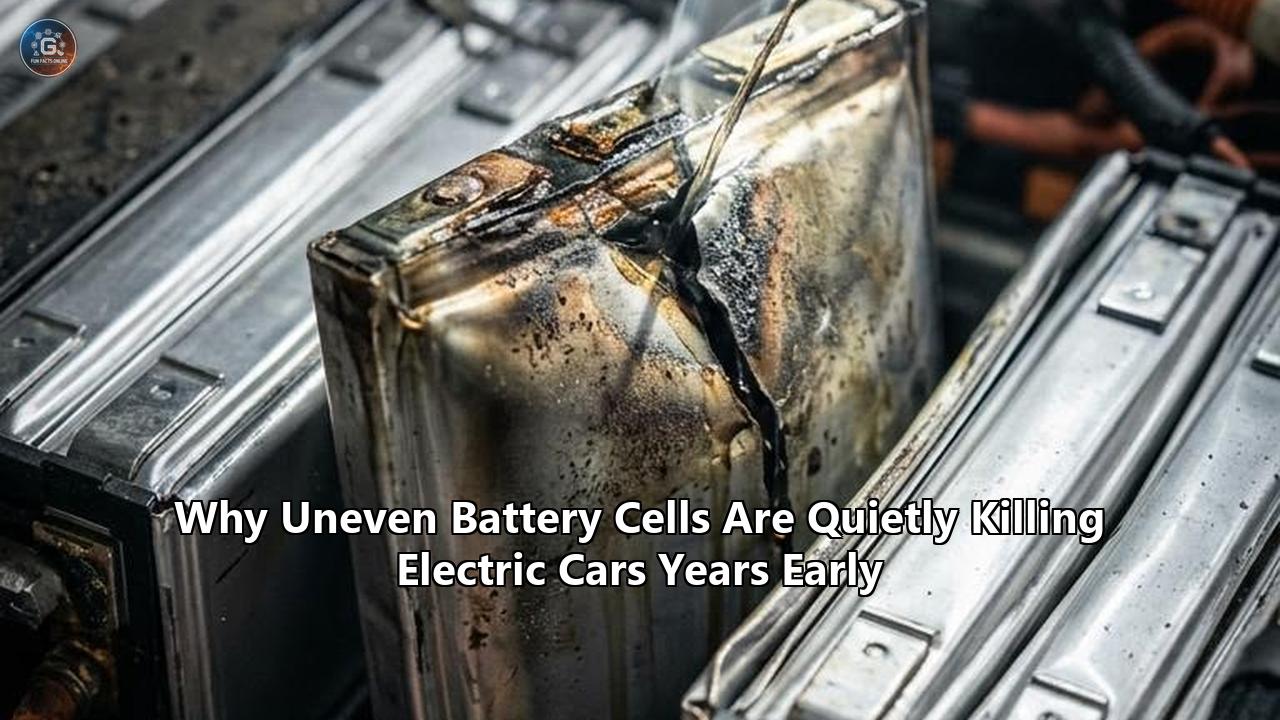
A joint investigation by researchers from Chalmers University of Technology, the Chinese Academy of Sciences, the Beijing Institute of Technology, and Zeekr Technology Europe, published in Nature Energy, has exposed a structural flaw cutting short the operational life of electric vehicles. By tracking 116 nickel-manganese-cobalt (NMC) passenger cars and 17 lithium iron phosphate (LFP) transit buses over three years and up to 300,000 kilometers of real-world driving, the cross-institutional team quantified the damage caused by cell-to-cell inconsistency. The findings show that uneven cell degradation prematurely cuts passenger car battery pack lifespans by 17.7% and electric bus packs by 22.8%.
Because an automotive battery pack is wired in series, its performance is constrained by its single worst-performing cell. When an outlier cell degrades faster than its neighbors, it triggers safety cutoffs long before the rest of the pack is spent. According to the study, this dynamic forces vehicles into premature retirement with 19.3% of passenger car battery energy potential and 27.1% of transit bus energy capacity entirely unutilized.
The academic findings coincide with diagnostic data from the secondary vehicle market. An August audit by British battery analytics company Generational, analyzing approximately 10,000 commercial tests on used electric vehicles across dealer networks, discovered that 1 in 85 vehicles exhibited an internal cell-to-cell voltage spread exceeding 50 millivolts. More critically, 1 in 200 vehicles displayed severe variance exceeding 100 millivolts—a margin wide enough that several automotive manufacturers classify the entire battery pack as defective or failed.
Yet almost none of these troubled vehicles showed an active error code on the dashboard. Standard consumer diagnostics routinely reported general health readings of 90% or higher while a single drifting cell was actively undermining the vehicle's long-term operation.
The revelation that individual rogue cells are shortening EV operational lifespans has exposed deep divisions within automotive engineering. Automakers, battery suppliers, and software developers are locked in a struggle over how to resolve the problem. The responses split into opposing philosophies: cheap passive hardware versus active redistribution, modular repairability versus single-piece structural integration, and silent software throttling versus transparent cell-level edge diagnostics.
The battle lines over these engineering choices will determine whether off-warranty electric cars remain on the road for two decades or become prematurely scrapped assets.
+---------------------------------------------------------------------------------------------------------+
|                                    THE INVISIBLE GAP IN EV LONGEVITY                                    |
+---------------------------------------------------------------------------------------------------------+
| Real-World Impact (Nature Energy Study):                                                                |
| • 17.7% to 22.8% loss in total pack operational lifespan due solely to cell variation     |
| • 19.3% to 27.1% of usable battery energy left permanently stranded at retirement              |
| • ~170,000 km: The critical mileage threshold where cell divergence accelerates sharply        |
|                                                                                                         |
| Used Market Prevalence (Generational Fleet Audit of 10,000 EVs):                                        |
| • 8 mV: Median cell voltage difference across healthy used packs                         |
| • 1 in 85 EVs: Carries a hidden voltage delta > 50 mV (requiring diagnostic intervention)|
| • 1 in 200 EVs: Exhibits severe delta > 100 mV (exceeding OEM failure thresholds)        |
+---------------------------------------------------------------------------------------------------------+
The Physics of the "Weakest Link": How Variance Destroys a Pack
To understand why cell inconsistency is so destructive, one must examine the high-voltage pack architecture. Modern passenger electric cars link hundreds or thousands of individual battery cells in complex series and parallel matrices to deliver between 400 and 800 volts to the electric drive units. While parallel connections naturally equalize voltage between paired cells, series strings are locked into electrical interdependence. In any series circuit, the total current flowing through every cell must be identical.
This electrical reality creates what chemical engineers call the "barrel effect": the volume of water a wooden barrel can hold is dictated solely by its shortest stave.
During discharge, when the weakest cell with the lowest capacity or highest internal resistance hits its minimum safe voltage threshold (typically around 2.8 to 3.0 volts for NMC chemistries), the vehicle’s Battery Management System (BMS) must immediately stop drawing power or severely restrict output. If the BMS allowed discharge to continue, that weak cell would experience copper dissolution, electrode degradation, and permanent internal short circuits. Discharge stops even if the surrounding cells in the string still retain 20% or 30% of their energy.
The inverse occurs during charging. The weak cell, often burdened by a thinner active lithium layer and higher internal impedance, sees its voltage spike rapidly under current. It reaches the upper safety ceiling (typically 4.2 volts) long before its healthier counterparts are full. The BMS cuts the charging current to prevent lithium plating and thermal runaway, leaving the remaining cells underfilled.
The driver experiences this dynamic as mysterious range loss. A 75-kilowatt-hour pack might only yield 55 kilowatt-hours of usable energy, not because all the cells have worn out, but because one damaged cell is choking the entire string at both ends of the charge cycle.
"An electric vehicle battery pack contains many cells that must work together, but these cells do not remain identical as they age," said Changfu Zou, co-author of the Nature Energy study and associate professor at Chalmers University of Technology. "In a series-connected pack, its performance can ultimately be limited by its weakest cell, much like a chain is limited by its weakest link."
The Nature Energy dataset revealed a clear operational pattern: for the first 100,000 to 150,000 kilometers, manufacturing variations between cells remain largely masked by initial design margins. But once vehicles crossed roughly 170,000 kilometers, cell-to-cell variance exploded. At this threshold, minor initial variations in internal impedance, active material loading, and localized pack temperature trigger a compounding degradation feedback loop.
THE CELL DIVERGENCE VICIOUS CYCLE

[Initial Manufacturing & Thermal Gradients]
                  │
                  ▼
   [Higher Internal Resistance in Cell X]
                  │
                  ▼
   [Increased Joule Heating (I²R) in Cell X]
                  │
                  ▼
[Accelerated Solid Electrolyte Interphase (SEI) Growth]
                  │
                  ▼
     [Accelerated Loss of Lithium Inventory]
                  │
                  ▼
   [Cell X Drops Faster in Usable Capacity]
                  │
                  ▼
 [Pack Usable Envelope Constrained to Weakest Cell]
A cell running just two degrees Celsius hotter than its peers due to its position near a coolant manifold will experience accelerated solid electrolyte interphase (SEI) growth. That growth traps active lithium ions and increases internal resistance. The higher resistance generates more localized heat during operation via Joule heating ($I^2R$), accelerating the rate of SEI decomposition and cathode cracking.
What began as an imperceptible 2-millivolt variance at the factory gate widens over time into an unbridgeable electrical chasm.
Competing Engineering Solutions: Passive vs. Active Balancing
Faced with this divergence, automakers use cell balancing to keep the pack aligned. However, the automotive industry is split between two divergent technological approaches: passive bleed resistors and active bidirectional charge shuttles.
The choice between these systems highlights the tension between manufacturing cost and long-term durability.
+------------------------+------------------------------------+------------------------------------+
| Feature                | Passive Cell Balancing             | Active Cell Balancing              |
+------------------------+------------------------------------+------------------------------------+
| Mechanism              | Bleeds excess energy through       | Shuttles energy between cells via  |
|                        | resistors as dissipated heat       | inductors/capacitors/DC-DC     |
| Balancing Current      | 50 mA to 150 mA (very low)         | 1.0 A to 6.0 A (high)             |
| Operational Window     | Only at 95%-100% State of Charge   | Continuous (charging, discharging, |
|                        | during resting phase              | and driving)                      |
| Thermal Load           | Adds localized heat to circuit board| Minimal thermal waste; high        |
|                        | during bleeding                    | electrical efficiency              |
| Bill of Materials Cost | Low ($15 to $40 per vehicle pack)  | High ($150 to $450 per pack)       |
| Circuit Complexity     | Minimal; low component count      | High; complex switching networks,  |
|                        |                                    | transformers, and MOSFET arrays    |
| Impact on Cell Delta   | Can only slow minor drift; unable  | Actively counteracts widening gaps;|
|                        | to recover aging, divergent cells  | recovers stranded capacity        |
+------------------------+------------------------------------+------------------------------------+
The Dominance of Passive Bleed Circuits
The overwhelming majority of modern passenger EVs—including vehicles from Tesla, Volkswagen, Stellantis, and Hyundai-Kia—rely exclusively on passive cell balancing. The mechanism is functionally simple: the BMS monitoring chips incorporate small bypass switches coupled to tiny surface-mount resistors.
When the pack is plugged in and reaches the upper end of its charging curve (typically above 90% or 95% state of charge), the BMS identifies individual cells that are tracking at a higher voltage than the lowest cell in the pack. The system closes the bypass switch for those high cells, bleeding their excess energy off as heat through the resistor until their voltage settles closer to the laggards.
The commercial rationale for passive balancing is cost and packaging simplicity. A passive circuit requires minimal silicon, few trace lines, and virtually no bulky magnetic components.
However, passive balancing has an operational weakness: its current throughput is tiny. To avoid cooking the BMS circuit boards, passive bleed currents are restricted to between 50 and 150 milliamperes.
If a 75-kilowatt-hour battery pack develops a 1.5-amp-hour variance between its healthiest cell group and an outlier, a 75-milliampere passive bleed resistor requires 20 hours of continuous resting at top-of-charge to pull the high cells down into alignment.
Modern driving and charging habits undercut this mechanism. Drivers who follow common advice to keep daily charging between 20% and 80% to protect their pack rarely expose the vehicle to the voltage levels where passive balancing activates. Furthermore, drivers utilizing public DC fast chargers disconnect immediately once charging slows past 80%, giving the resistors zero operational window to bleed off variance.
Under these conditions, passive systems fall behind, allowing minor microscopic imbalances to accumulate over hundreds of charge cycles.
The Active Balancing Alternative
Active balancing takes the opposite approach. Rather than burning off excess electricity as wasted heat through resistors, active balancers employ inductive, capacitive, or isolated bidirectional DC-DC converter circuits to shuttle charge from stronger cells directly into weaker cells.
Instead of pulling the high cells down to the lowest common denominator, active balancing pulls the low cells up.
Because energy is transferred rather than incinerated, active balancing can operate at substantially higher currents—typically between 1.0 and 6.0 amperes. Furthermore, active balancers do not need to wait until the pack is resting at a 100% state of charge. They can balance cells continuously: while driving on the highway, while regenerative braking down a mountain pass, or while fast-charging at an 800-volt charging plaza.
The performance benefits of active balancing are well-documented. Active systems can neutralize the 17.7% to 22.8% premature pack degradation identified by the Nature Energy team by dynamically redistributing load away from high-resistance cells during discharge, effectively flattening out the internal resistance heterogeneity.
Yet automakers resist active balancing for high-volume consumer vehicles due to cost, weight, and component complexity.
Implementing active balancing across an 800-volt pack containing 192 cells in series requires hundreds of power MOSFETs, magnetic transformers, inductive coils, and isolated gate drivers. The bill-of-materials cost can add $300 to $500 per vehicle compared to passive systems.
Moreover, every additional active switching component introduced into the sealed battery pack creates a potential electrical failure point. Automotive tier-one suppliers argue that packing high-frequency inductive switching circuitry into an environment subjected to continuous road vibrations, wide temperature swings, and electromagnetic interference poses reliability risks that outweigh the benefits for the typical warranty window.
Architectural Traps: Modular Serviceability vs. Structural Cell-to-Pack
The internal divergence of battery cells has become complicated by a structural shift in pack design: the transition from serviceable modular architectures to integrated Cell-to-Pack (CTP) and Cell-to-Chassis (CTC) designs.
+------------------------------------+------------------------------------+
| Modular Architecture               | Structural Cell-to-Pack (CTP / CTC)|
| (e.g., VW MEB, GM Ultium, Audi)    | (e.g., BYD Blade, Tesla 4680)      |
+------------------------------------+------------------------------------+
| Pros:                              | Pros:                              |
| • Defective cells/modules can be   | • 15%-25% higher volumetric energy |
|   isolated and swapped     |   density (no intermediate boxes)  |
| • Pack casing is resealable and    | • Simpler manufacturing; eliminates|
|   mechanically serviceable         |   hundreds of internal parts       |
| • Reduces total-loss write-offs    | • Stiffens the vehicle chassis;    |
|   from single-cell faults  |   lowers initial vehicle weight    |
|                                    |                                    |
| Cons:                              | Cons:                              |
| • Lower energy density; complex    | • Entire pack is structurally      |
|   internal wiring and harnesses    |   unserviceable; cells glued down  |
| • Module replacement creates severe| • A single rogue cell renders the  |
|   capacity/impedance mismatch issues|  entire $15,000+ pack scrap |
| • High manufacturing unit cost     | • Massive secondary market and     |
|                                    |   insurance write-off liability    |
+------------------------------------+------------------------------------+
In early-generation electric platforms, such as the Volkswagen MEB platform, General Motors' Ultium architecture, and early Tesla Model S sedans, cells were grouped into distinct, replaceable modules. If an internal short or severe capacity drop developed within a group of cells, an automotive technician could drop the pack, unbolt the affected module, and insert a replacement.
However, field experience has demonstrated that modular repair is difficult in practice. Installing a brand-new battery module into an aged battery pack introduces the "transplant rejection" effect.
If eight modules in an electric SUV have logged 130,000 kilometers and lost 10% of their initial capacity, their internal resistance is significantly higher than a factory-fresh replacement module. When wired back into the series loop, the new module's superior capacity and lower impedance confuse the BMS.
Unless the replacement module is artificially cycled, discharged, and precisely capacity-matched to the aging degradation state of the surrounding modules on a bench tester before installation, the passive balancing system will never be able to bridge the performance gap. Many independent repair shops lack the $40,000 high-voltage battery cyclers required to balance modules before reassembly.
In contrast, modern cost-cutting and energy-density imperatives have pushed the industry toward Cell-to-Pack (CTP) designs. Pioneered at scale by BYD with its Blade Battery and adopted by Tesla with its structural 4680 packs and CATL with its Qilin architecture, these systems ditch the modules altogether. Prismatic or cylindrical cells are bonded directly to the structural bottom tray and integrated cooling plates using high-strength polyurethane structural adhesives and thermosetting foam.
CTP designs reduce vehicle weight, slash assembly costs, and increase pack volumetric efficiency from 40% to over 70%. But from a service perspective, structural integration makes single-cell divergence unfixable.
There are no bolts, no modules, and no accessible busbars. The individual cells are glued into the structure of the car.
If one cell out of several hundred develops an internal micro-short or drifts 100 millivolts away from its neighbors, it cannot be extracted. The entire structural pack—weighing half a ton and costing upwards of $15,000 to $20,000—becomes a total loss. The efficiency gains achieved during factory manufacturing turn into high disposal costs once the car leaves its warranty window.
The Chemistry Dilemma: NMC vs. LFP and the Voltage Blind Spot
The risk of cell divergence is further shaped by the ongoing market transition between cathode chemistries: Nickel-Manganese-Cobalt (NMC) and Lithium Iron Phosphate (LFP). The Nature Energy study evaluated both chemistries, finding that while both suffer severe lifespan hits from cell inconsistency (17.7% for NMC cars versus 22.8% for LFP buses), the fundamental nature of the failure differs due to their underlying electrochemistry.
VOLTAGE VS. STATE OF CHARGE (SOC) CURVE COMPARISON

Cell Voltage (V)
4.2  │                      / (NMC: Steep, linear slope)
4.0  │                    /
3.8  │                  /
3.6  │                /
3.4  │  ┌────────────────────────┐ (LFP: Exceptionally flat plateau)
3.2  │──┘                        └──
3.0  │
2.8  │_________________________________
     0%          20%   40%   60%   80%        100%
                        State of Charge
NMC chemistries feature a sloped open-circuit voltage (OCV) profile. As an NMC cell discharges from 100% to 0%, its voltage drops smoothly and predictably from roughly 4.2 volts down to 3.0 volts.
Because the voltage tracks closely with the state of charge, the vehicle's BMS can easily identify cell divergence. If Cell #42 is sitting at 3.71 volts while the rest of the brick is at 3.79 volts, the system knows that Cell #42 has less energy. The BMS can log the variance, schedule passive balancing, or flag an early warning for service technicians.
However, NMC cells pay for this diagnostic visibility with higher sensitivity to calendar aging, high-temperature degradation, and thermal runaway risks under stress.
LFP chemistry flips this dynamic entirely. LFP has become the dominant cathode choice for standard-range electric vehicles worldwide due to its lower cost, nickel- and cobalt-free supply chain, and chemical resilience.
Yet LFP possesses a physical property that makes it difficult for battery management systems: an exceptionally flat open-circuit voltage curve.
Across roughly 20% to 85% of an LFP cell’s state of charge, its operating voltage barely shifts, hovering stubbornly within a narrow band around 3.20 to 3.25 volts. Inside this broad operating window, an LFP cell containing 30% usable capacity can exhibit virtually the same voltage as an adjacent cell holding 70% capacity.
The BMS cannot see the underlying divergence because the voltage difference is buried under the noise margin of consumer-grade voltage sensors.
This voltage plateau blinds the passive balancing system. A vehicle utilizing an LFP pack can be driven for months without the computer detecting that individual cells are drifting apart.
The divergence only reveals itself when the battery reaches the extreme ends of the charge cycle—the "knees" of the curve below 10% or above 90%, where voltage changes rapidly.
This dynamic explains why automakers with high-volume LFP fleets issue strict operational directives instructing owners to charge their vehicles to 100% at least once a week. This guidance is often misunderstood by consumers as chemistry conditioning; in reality, it is a software crutch.
The vehicle must be charged to 100% because that is the only operational moment the BMS can see past the flat plateau, measure the real cell-to-cell voltage spread at the upper voltage knee, and activate the passive bleed resistors.
If an LFP owner charges strictly to 80% to avoid high-voltage stress, the BMS operates blindly. Over time, cell drift accumulates unnoticed until one day, while the car is cruising on the highway indicating a comfortable 18% charge, an unmonitored weak cell plummets past the lower knee to 2.5 volts. The vehicle instantly triggers an emergency limp mode or shuts down completely in traffic, leaving the driver stranded with no prior warning lights.
Software Countermeasures: Active Masking vs. Predictive Diagnostics
As vehicles age and cell divergence accelerates past the 170,000-kilometer mark, automotive manufacturers face a financial and legal dilemma. If the BMS allows a drifting cell to trigger an unrecoverable voltage fault, the automaker may be on the hook for a battery pack replacement under warranty.
Under federal regulations in the United States and matching standards in the European Union and China, electric vehicle drivetrains and traction batteries must carry a mandatory warranty lasting at least eight years or 100,000 miles (160,000 km).
To minimize warranty payouts, automakers rely on over-the-air (OTA) software updates that alter how the BMS responds to cell inconsistency.
+------------------------------------+------------------------------------+
| OEM Protective Throttling (OTA)    | Predictive Cloud Diagnostics       |
+------------------------------------+------------------------------------+
| Objective:                         | Objective:                         |
| Shield the automaker from warranty | Identify degradation pathways and  |
| payouts and prevent safety claims. | target repairs to preserve packs.  |
|                                    |                                    |
| Methods:                           | Methods:                           |
| • Artificially restrict the upper  | • Ingest granular telemetry into   |
|   and lower pack voltage window    |   cloud-based electrochemical models|
| • Cap DC fast-charge acceptance    | • Track internal resistance rise   |
|   rates across the entire pack     |   and micro-short self-discharge   |
| • Mask cell divergence behind an   | • Provide transparent reporting to |
|   averaged state-of-charge readout |   fleet operators and used buyers  |
|                                    |                                    |
| Tradeoffs:                         | Tradeoffs:                         |
| Extends pack survival, but robs    | Requires deep CAN bus access;      |
| the owner of driving range and     | reveals hidden defects that may    |
| charging convenience without repair.| force expensive early repairs.    |
+------------------------------------+------------------------------------+
When an automaker’s fleet telemetry flags that specific vehicles or production batches are exhibiting wider-than-expected cell variance, the manufacturer pushes an update that quietly shifts the battery's operational boundaries.
The software restricts the usable voltage window, lowering the top charging limit from 4.2 volts per cell to 4.1 or 4.05 volts, while raising the low-voltage cutoff point. Simultaneously, the software flattens the DC fast-charging curve, throttling a vehicle that once charged at 150 kilowatts down to 75 or 50 kilowatts to prevent high currents from triggering lithium plating in high-resistance cells.
This software masking keeps the vehicle safe and rolling down the road, and it prevents the drifting cell from overheating or tripping an immobilizing fault code.
However, it accomplishes this by stripping away the vehicle’s original specifications. The driver suddenly notices that their 300-mile car can only travel 240 miles on a full charge and takes twice as long to charge at public stations.
Automakers have faced intense legal scrutiny over this practice. In 2021, Tesla agreed to pay $1.5 million to settle a class-action lawsuit filed by owners who saw their Model S driving range and fast-charging speeds abruptly curtailed by an over-the-air software update (firmware 2019.16.1 and 2019.16.2), which had been deployed to mitigate battery fire risks in aging packs with divergent cells.
A competing approach is emerging from independent diagnostic and software firms such as Twaice, Accure, and Generational. Rather than blunting pack performance with conservative software limits, these firms advocate for predictive edge diagnostics.
By capturing real-time current, voltage, and temperature data from the vehicle's CAN bus during operation, edge diagnostic software constructs an electrochemical "digital twin" of the battery pack. Advanced algorithms can track subtle variations in high-frequency impedance, identify self-discharge signatures that indicate microscopic internal shorts, and detect lithium plating long before a cell diverges by 50 millivolts.
"Reporting on state of health is essential for used EVs, but it does not tell the full story of battery condition," explains Oliver Phillpott, chief executive officer of Generational. "Cell imbalance problems are often imperceptible, while the battery is developing a fault that could affect range, charging or value later on. The only practical way to see that risk early is to test for it."
The tradeoff for predictive diagnostics lies in proprietary data control and repair infrastructure. Automakers often lock down vehicle telemetry behind encrypted gateways, preventing independent technicians, fleet operators, and used-car buyers from reading raw cell-level data.
Without open access to cell voltages, buyers must rely on the automaker’s dashboard readouts, which often conceal underlying hardware variance.
The Used Vehicle Blind Spot: The Mirage of the 95% SOH
The growing body of evidence regarding uneven cell degradation is challenging the economic assumptions of the second-hand electric car market.
Today, secondary transactions rely almost exclusively on a single metric: State of Health (SoH). Typically expressed as a percentage, SoH compares the battery's current estimated total capacity against its original factory capacity. A car showing a 95% SoH is assumed to have retained almost all its real-world capability.
However, the field findings from Generational demonstrate that State of Health is a dangerously incomplete metric.
Because SoH is calculated by aggregating total energy throughput across the entire pack, it functions as a statistical average. A battery pack can consist of 95 healthy cells operating at 98% capacity alongside one damaged, highly resistive cell operating at 70% capacity. Averaged together, the mathematical State of Health will register around 95%, prompting a used vehicle buyer or appraiser to give the car a clean bill of health.
THE SOH PARADOX: HOW AVERAGE HEALTH MASKS SYSTEMIC FAILURE

Individual Cell Capacities in Series:
Cell 1:  [████████████████████] 98%
Cell 2:  [████████████████████] 97%
Cell 3:  [████████████████████] 98%
Cell 4:  [████████████████████] 96%
Cell 5:  [████████████████████] 97%
Cell 6:  [████████████████████] 98%
Cell 7:  [████████████████████] 97%
Cell 8:  [████████████████████] 98%
Cell 9:  [████████████████████] 96%
Cell 10: [████████████        ] 60%  <-- Rogue Outlier Cell
────────────────────────────────────────────────────────────────
Aggregate Reported State of Health:  93.5% (Appears "Excellent")
Real-World Usable Pack Capacity:     60.0% (Constrained by Cell 10)
In driving conditions, that vehicle will behave erratically.
When the car is called upon to deliver high power—such as accelerating to merge onto an interstate highway—the high internal resistance of the rogue cell causes its individual voltage to plummet. The BMS detects an under-voltage fault on that single cell group and instantly throws the entire vehicle into a safety power reduction mode.
The driver sees their dashboard light up with a "Performance Severely Limited" warning, leaving them stranded with an apparently healthy pack.
This dynamic explains why 1 in 200 used EVs tested by Generational had cell voltage spreads wider than 100 millivolts despite displaying reassuring aggregate SoH percentages.
When Generational guided dealerships through deep diagnostic rebalancing cycles, only about 50% of the flagged packs could be recovered. The remaining half had sustained irreversible internal degradation—lithium plating or active material detachment—that no passive software balancing routine could fix.
Those vehicles were operational time bombs for their subsequent owners, carrying hidden battery defects that would require full pack replacements shortly after purchase.
Evaluating true electric car battery health requires looking beyond top-level state of health figures. To accurately gauge long-term durability, testing protocols must measure cell-to-cell voltage variance at both high and low states of charge, calculate the internal resistance dispersion across every series block, and track self-discharge rates over extended resting periods.
Without this granular visibility, evaluating an electric car battery pack based solely on a single SoH number is like buying a combustion-engine vehicle after checking only its average compression across all cylinders, oblivious to a cracked piston in cylinder four.
Regulatory Pressures, Next-Gen Chemistries, and the Long-Term Outlook
The systemic failure mode documented by researchers and diagnostic firms is starting to attract the attention of international regulatory bodies.
Beginning in 2027, the European Union's Battery Passport directive will mandate that every electric vehicle sold within the trading bloc carry an immutable digital record detailing its manufacturing origin, raw material provenance, and ongoing performance metrics.
However, consumer advocacy groups and independent automotive aftermarket associations are lobbying to expand the directive’s requirements. They argue that reporting high-level pack capacity is insufficient; regulations must mandate open, standardized access to raw cell-to-cell delta metrics through the standardized OBD-II diagnostic port.
Without legally protected access to cell-level diagnostics, independent garages cannot identify rogue cells, leaving vehicle owners at the mercy of franchised dealership networks that default to complete pack replacements.
+---------------------------------------------------------------------------------------------------------+
|                                    LOOKING AHEAD: THE SHIFTING LANDSCAPE                                |
+---------------------------------------------------------------------------------------------------------+
| 1. The EU Battery Passport (2027 Mandate):                                                              |
|    • Pushes for transparent, standardized reporting of pack lifecycle data.                             |
|    • Regulatory battle continues over whether to require open cell-spread reporting or aggregate SoH.   |
|                                                                                                         |
| 2. Next-Generation Silicon & Wireless BMS:                                                              |
|    • Shift toward high-frequency integrated chips capable of measuring impedance per cell.              |
|    • Wireless BMS (wBMS) architectures reduce harness failure points but leave passive limits intact.   |
|                                                                                                         |
| 3. Emerging Chemistries:                                                                                |
|    • Sodium-ion (Na-ion): Offers zero-volt discharge capability, potentially simplifying balancing.    |
|    • Solid-State Batteries: Eliminate liquid SEI formation, but face severe mechanical stress issues    |
|      under uneven pressure gradients.                                                                   |
|                                                                                                         |
| 4. The Structural vs. Modular Reality Check:                                                            |
|    • Secondary market depreciation may force automakers to abandon unserviceable structural glue        |
|      in favor of semi-modular, repairable pack enclosures.                                              |
+---------------------------------------------------------------------------------------------------------+
Technological developments are also underway at the silicon level. Semiconductor manufacturers are rolling out specialized battery management chipsets equipped with onboard microcontrollers capable of running complex electrochemical impedance spectroscopy (EIS) directly on the module circuit boards.
These chips do not just read static voltages; they inject tiny alternating current signals into individual cells to measure their internal electrochemical impedance in real time.
By detecting the impedance changes that precede capacity loss, an active BMS can spot a failing cell years before it drags down its neighbors.
Parallel shifts are occurring in battery chemistry. Emerging sodium-ion (Na-ion) architectures, which are beginning to appear in entry-level urban vehicles in Asia, feature a distinct electrochemical advantage over lithium-ion: they can be discharged to zero volts without damaging their current collectors or triggering copper dissolution.
This enables new balancing routines where packs can be fully discharged to zero volts, safely equalizing every cell in the series string without the localized thermal risks associated with lithium systems.
Solid-state batteries, frequently cited as the eventual successor to conventional liquid-electrolyte cells, present their own balancing hurdles. While solid-state designs eliminate the flammable liquid solvents that make cell runaway dangerous, their reliance on mechanical stack pressure means any localized loss of contact inside the pack will trigger uneven resistance spikes, making active cell balancing just as critical to prevent early failure.
The tension between manufacturing simplicity and long-term durability is reaching a turning point. For the past decade, automakers prioritized reducing factory costs and hitting headline range figures.
To achieve those metrics, they adopted passive bleed balancing circuits that cost pennies, assembled packs with cheap single-piece structural glues, and relied on conservative software updates to quietly mask cell degradation before the warranty expired.
The findings from Chalmers University, the Chinese Academy of Sciences, and commercial field data demonstrate that this short-term approach is unsustainable.
A vehicle that junks 25% of its usable battery capacity simply because one cell out of hundreds fell behind is an operational failure. As the global EV fleet ages and millions of vehicles exit their manufacturer warranty periods, the companies that thrive will not be those that post the highest theoretical range numbers on a showroom window.
Durability will belong to the automakers that design for internal consistency: platforms built with active balancing hardware, repairable pack enclosures, and transparent diagnostic data that preserve electric car battery health down to the very last cell.
Reference:
- https://www.eurekalert.org/news-releases/1143399
- https://www.digitaltrends.com/cars/your-ev-battery-could-be-losing-years-of-life-because-its-cells-age-differently/
- https://www.battermachine.com/post/battery-management-vs-pack-failure-what-ev-owners-need-to-know
- https://www.midtronics.com/blog/early-signs-of-cell-imbalance-in-high-voltage-ev-batteries/
- https://commercialvehiclecontracts.co.uk/used-ev-battery-health-cell-imbalance/
- https://autotrader.co.nz/news/industry/study-finds-more-than-one-per-cent-of-used-evs-hides-a-battery-fault-the-health-figure-cant-see
- https://www.broadwayworld.com/bwwtv/article/Study-1-in-85-Used-EVs-Has-Hidden-Battery-Cell-Imbalance-20260824
- https://www.battermachine.com/post/battery-imbalance-the-hidden-reason-you-re-losing-ev-range
- https://www.rotronicsbms.com/battery-tips/how-do-unbalanced-battery-cells-impact-electric-vehicle-range
- https://www.dalybms.com/news/is-your-lithium-battery-dying-prematurely-how-bms-cell-balancing-can-save-it/
- https://www.large-battery.com/blog/battery-cell-balancing-boosts-performance-safety-lifespan/
- https://elintacharge.com/glossary/passive-balancing/
- https://www.midtronics.com/blog/the-science-behind-ev-battery-degradation-and-how-to-mitigate-it/
- https://msg.equipment/en/blog/articles/top-3-most-common-electric-vehicle-battery-issues
- https://www.recurrentauto.com/research/how-long-do-ev-batteries-last