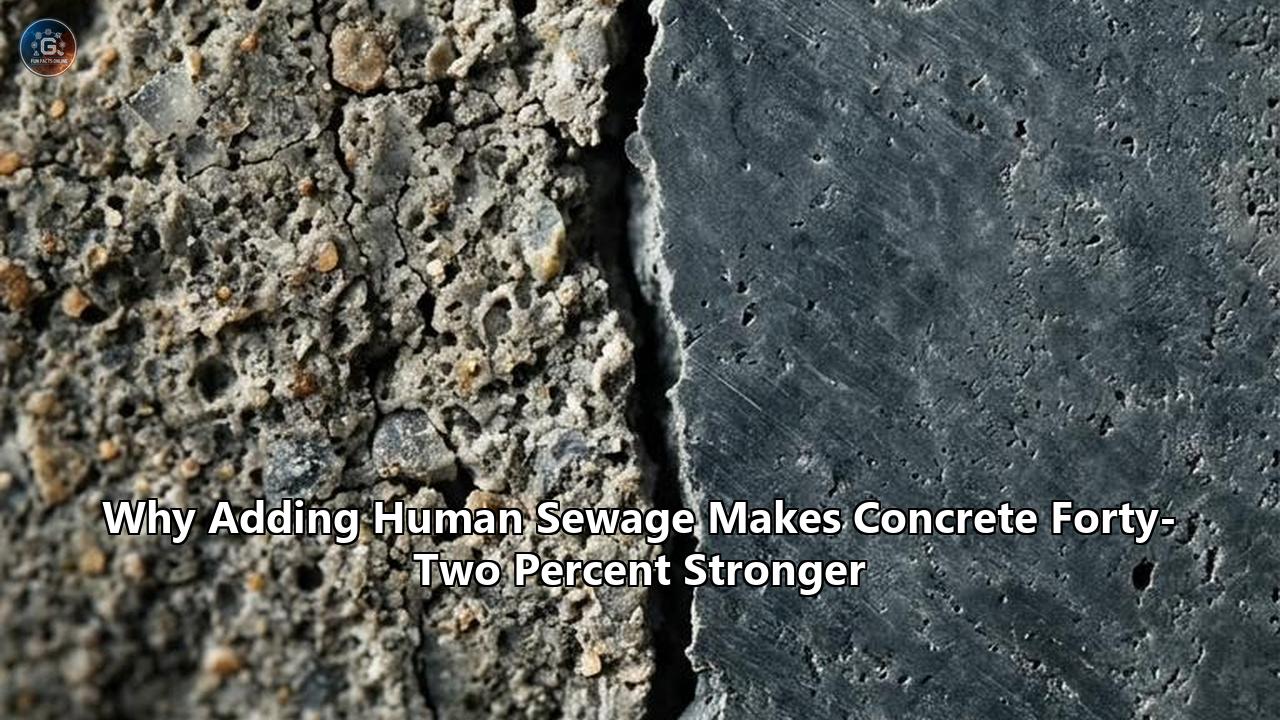
A team of civil engineers at Manipal University Jaipur has demonstrated that replacing 10 percent of Ordinary Portland Cement with biochar derived from human fecal sludge increases the flexural strength of concrete by 42 percent after 91 days of curing. The research, published in Scientific Reports by lead author Raghuvesh Tiwari alongside co-researchers Priyansha Mehra, Shaik Hussain, and Sanchit Anand, documents an unexpected material transformation: pyrolyzed human waste, long treated as an environmental hazard requiring costly disposal, functions at a microscopic level to reinforce the structural spine of concrete.
The testing revealed that at the same 10 percent replacement threshold, the compressive strength of the concrete climbed by 21 percent. Even at a lower 5 percent dosage, the concrete registered a 20 percent gain in compressive capacity and a 36 percent jump in flexural performance.
The findings arrive against a backdrop of mounting ecological pressures on global construction. Cement production accounts for roughly 8 percent of global carbon dioxide emissions, driven by the energy-intensive calcination of limestone at temperatures exceeding 1,400 degrees Celsius. Simultaneously, municipalities across developing and developed nations are buckling under millions of dry metric tons of human sanitation waste that contaminate waterways, fill landfills, or release methane into the atmosphere.
While substituting industrial byproducts like fly ash and blast furnace slag into cement is an established practice, incorporating treated sewage in concrete has historically yielded brittle, substandard results. The Manipal University Jaipur study marks the first time that thermochemically altered human waste has produced such a pronounced mechanical advantage over conventional mixtures. The journey to this 42 percent threshold spans more than two decades of laboratory dead-ends, chemical misfires, and a critical rethinking of how human organic waste must be thermally restructured before it touches water, aggregate, and clinker.
CHRONOLOGY OF ESCALATION: SEWAGE-TO-CONCRETE RESEARCH
┌──────────────┬────────────────────────────────────────────────────────┐
│ 2005–2014    │ The Raw Sludge Impasse: Early attempts to add dried     │
│              │ sewage directly weaken cement by up to 80%.            │
├──────────────┼────────────────────────────────────────────────────────┤
│ 2015–2020    │ Incineration Ash (SSA): Sludge is burnt at 850°C.      │
│              │ Pathogens die, but sintering ruins pozzolanic potency.  │
├──────────────┼────────────────────────────────────────────────────────┤
│ 2021–2024    │ The Pyrolysis Shift: Oxygen-starved baking at 400°C    │
│              │ yields porous biochar; internal curing emerges.         │
├──────────────┼────────────────────────────────────────────────────────┤
│ 2025–2026    │ The Warangal Trials: Tiwari et al. test FSTP-derived   │
│              │ biochar across extended 91-day curing intervals.       │
├──────────────┼────────────────────────────────────────────────────────┤
│ BREAKTHROUGH │ 91-Day Data Reveal: 10% biochar replacement achieves   │
│              │ +42% flexural strength and +21% compressive strength.  │
└──────────────┴────────────────────────────────────────────────────────┘
2005–2014: The Raw Sludge Impasse and the Chemistry of Structural Failure
To understand why a 42 percent surge in strength represents such a decisive break from the past, one must look at the long line of failed attempts that preceded it.
Between 2005 and 2014, civil engineering literature was littered with cautionary tales regarding sewage-derived additives. Rapid urbanization throughout Asia, Africa, and Latin America had generated an unprecedented surplus of sewage sludge—the semi-solid slurry left behind after municipal wastewater undergoes physical settling and biological treatment. Landfilling this material generated volatile organic compounds and leachate that threatened groundwater supplies; agricultural application carried severe risks of heavy-metal accumulation and persistent organic pollutant transfer.
Disposal within concrete seemed, on paper, like the ideal sink. Concrete is poured in colossal volumes—exceeding 30 billion metric tons worldwide every single year. If civil engineers could lock waste slurry into highway foundations or retaining walls, the global sludge crisis would find an infinite repository.
Early researchers attempted the most direct route: drying municipal sewage sludge cake, pulverizing it, and using it as a direct substitute for sand (fine aggregate) or Portland cement. The results were catastrophic for structural integrity.
Concrete derives its strength from the hydration reaction of calcium silicates. When water is added to Ordinary Portland Cement, tricalcium silicate ($\text{C}_3\text{S}$) and dicalcium silicate ($\text{C}_2\text{S}$) dissolve, releasing calcium and hydroxyl ions that precipitate into rigid crystalline networks of calcium silicate hydrate ($\text{C-S-H}$) gel and calcium hydroxide ($\text{Ca(OH)}_2$, also known as portlandite). The dense interlocking needles of $\text{C-S-H}$ form the load-bearing glue of the entire composite.
CONVENTIONAL CEMENT HYDRATION:
2 Ca₃SiO₅ (Alite) + 7 H₂O  ───►  3 CaO · 2 SiO₂ · 4 H₂O (C-S-H Gel) + 3 Ca(OH)₂ (Portlandite)
                                        │                                    │
                                  (Primary Glue)                     (Weak, Soluble Base)
Raw or low-temperature dried sewage sludge violently interrupted this chemistry:
- Organic Poisoning of Hydration: Dried sewage sludge contains complex organic molecules—lipids, polysaccharides, proteins, and volatile fatty acids. These organics adhere to the surfaces of unhydrated cement grains, forming an impermeable organic barrier that prevents water from contacting the clinker phases. Hydration was severely retarded or stopped entirely.
- Massive Capillary Porosity: Unbound organic matter decomposed within the wet, highly alkaline matrix, generating gas pockets and micro-voids.
- Entrained Moisture Imbalances: Biological fibers within the sludge exhibited erratic water absorption, stealing water needed for initial paste workability and releasing it unevenly, leading to severe shrinkage cracks.
Laboratory tests repeatedly showed that adding even 5 percent dried raw sewage in concrete reduced compressive strength by 40 to 60 percent. At replacement rates of 15 to 20 percent, concrete test cylinders frequently crumbled under minor loads or deteriorated when exposed to moisture cycles. By 2014, the general engineering consensus had hardened: untreated organic human waste was an active poison to cementitious materials.
2015–2020: The Incineration Phase and the Limitations of Sludge Ash
Recognizing that organic carbon was the primary culprit behind strength degradation, the research community shifted its attention to thermal destruction. The objective became absolute: incinerate the waste, burn off all organic matter, and work strictly with the non-combustible mineral residue.
Throughout Europe, Japan, and parts of North America, wastewater treatment plants had already begun installing mono-incineration units. Sludge was mechanically dewatered, dried, and blasted inside fluidized bed furnaces at temperatures between 800 and 900 degrees Celsius. What emerged from the exhaust scrubbers was Sewage Sludge Ash (SSA)—a dry, reddish-gray mineral powder.
THERMAL PROCESSING TRAJECTORIES:
┌─────────────────────────┐
│ Raw Dewatered Sludge    │
└────────────┬────────────┘
             │
      ┌──────┴────────────────────────────────────┐
      ▼                                           ▼
[Incineration: 800°C–900°C + O₂]           [Pyrolysis: 350°C–450°C, Zero O₂]
  • Destroys all carbon                      • Retains carbon skeleton
  • Sintered, crystalline minerals           • Preserves ultra-porous honeycombs
  • Highly irregular, jagged ash             • Amorphous reactive silica intact
  • High water penalty; strength drops       • Serves as internal curing reservoir
From 2015 through 2020, materials laboratories aggressively investigated SSA as a supplementary cementitious material (SCM). The chemical assays were tantalizing: SSA consisted predominantly of silicon dioxide ($\text{SiO}_2$), aluminum oxide ($\text{Al}_2\text{O}_3$), iron oxide ($\text{Fe}_2\text{O}_3$), and calcium oxide ($\text{CaO}$). These were the exact chemical building blocks found in conventional pozzolans like coal fly ash and volcanic tuff.
Concurrently, researchers such as Dr. Abbas Mohajerani at RMIT University demonstrated that firing sewage sludge into clay bricks at 1,050 degrees Celsius produced structurally sound masonry, cutting brick-firing energy in half because the residual organics acted as internal fuel.
Yet when engineers attempted to transfer incinerated sludge ash into structural concrete, they hit an intractable physical ceiling.
A battery of studies during this period revealed persistent mechanical penalties:
- Compressive strengths consistently declined as SSA replacement levels rose. A 20 percent replacement of Portland cement with SSA routinely caused an 11 to 20 percent drop in 28-day compressive strength. At 40 percent replacement, strength plummeted by nearly 30 percent.
- The high-temperature combustion process (850°C) sintered the silica and alumina, locking them into crystalline phases like quartz and hematite rather than reactive, amorphous glasses. Because the minerals were crystalline, their pozzolanic reactivity was weak and sluggish.
- Under scanning electron microscopes, SSA particles exhibited jagged, irregularly shaped agglomerations filled with dead-end micropores. These particles consumed enormous amounts of mix water through sheer surface tension, leaving the fresh concrete mix stiff and unworkable. To restore slump, contractors had to add heavy doses of costly superplasticizers or excess water, which diluted the cement paste and weakened the final cured product.
Incineration ash solved the biological hygiene problem and neutralized organic interference, but it could not make concrete stronger. At best, it served as an inert micro-filler that construction teams could tolerate only in non-structural, low-strength applications like curb stones and pavement sub-bases.
2021–2024: The Pyrolysis Realization and the Rise of Biochar
The true escalation of this technology occurred when materials scientists abandoned total combustion and turned toward thermochemical pyrolysis.
Pyrolysis involves heating carbonaceous feedstock at moderate temperatures—typically between 350 and 500 degrees Celsius—in an oxygen-depleted or completely anaerobic environment. Deprived of oxygen, the organic material does not ignite into flames or oxidize into ash. Instead, volatile moisture, organic gases, and lighter tars vaporize, leaving behind a stable, carbon-dense, porous matrix: biochar.
Between 2021 and 2024, researchers in Australia, Europe, and India began testing agricultural and industrial biochars as concrete additives. Teams at RMIT University made international headlines by pyrolyzing spent coffee grounds and wood chips at 350 degrees Celsius. When added as a sand replacement, coffee biochar produced a 29.3 to 30 percent increase in concrete compressive strength.
The RMIT work proved that carbon does not inherently weaken concrete. If carbon is fixed into an engineered, pyrolyzed cellular scaffold, it behaves completely differently than raw organic matter.
Simultaneously, a massive sanitation initiative across India created an unexpected infrastructure for waste processing. Under national cleanliness campaigns and urban faecal sludge management programs, hundreds of dedicated Fecal Sludge Treatment Plants (FSTPs) were constructed across semi-urban clusters. Unlike centralized, water-borne sewage systems in the West, these plants receive concentrated septage pumped directly from residential septic tanks.
To treat this high-solids waste safely without using massive land tracts for open-air drying, municipal authorities in cities like Warangal, Telangana, installed continuous-feed thermal pyrolysis units. These systems dewatered human fecal slurry, passed it through low-temperature thermal dryers, and fed it into anaerobic pyrolysis kilns running between 350°C and 450°C.
The primary goal in Warangal was pathogen destruction: 400-degree heat instantly obliterated enteric viruses, parasitic helminth eggs, and antibiotic-resistant bacteria, yielding an odor-free, safe black carbon powder intended for soil amendment.
TRANSFORMATION FLOW: FROM SEPTIC TANK TO CEMENT MATRIX
┌───────────────────────────────┐
│ Municipal Septic Waste (FSTP) │
└───────────────┬───────────────┘
                │ Dewatering & Solar Thermal Drying
                ▼
┌───────────────────────────────┐
│ Dried Fecal Cake              │
└───────────────┬───────────────┘
                │ Anaerobic Pyrolysis (350°C – 450°C)
                ▼
┌───────────────────────────────┐
│ Raw Fecal Sludge Biochar      │
└───────────────┬───────────────┘
                │ Ball Milling & Precision Sieving (<75 µm)
                ▼
┌───────────────────────────────┐
│ Micro-Engineered Carbon SCM   │
└───────────────┬───────────────┘
                │ 5% to 10% Replacement of Cement Clinker
                ▼
┌────────────────────────────────────────────────────────┐
│ Hydration & Extended Curing (91 Days):                 │
│ • Internal Curing (Microporous Water Release)          │
│ • Secondary Pozzolanic C-S-H Synthesis                 │
│ • Interfacial Transition Zone (ITZ) Densification      │
│ ──► +42% Flexural Strength | +21% Compressive Strength │
└────────────────────────────────────────────────────────┘
At Manipal University Jaipur, civil engineer Raghuvesh Tiwari looked at this material through the lens of structural mechanics. Tiwari and his collaborators observed that human waste biochar carried a unique physicochemical profile: unlike wood biochar, which is largely cellulosic carbon, fecal sludge biochar contains high concentrations of inorganic minerals that humans ingest, excrete, or collect through household water pipes—most notably silica, alumina, calcium, and phosphates.
The stage was set for the experiments that would culminate in the breakthrough findings.
2025–2026: The Warangal Experiments and Tiwari’s Method
Tiwari’s team acquired raw fecal-sludge biochar directly from the Warangal FSTP. The black solid was rough, heterogeneous, and unsuited for direct concrete mixing in its raw state.
Before any water was mixed, the researchers subjected the biochar to rigorous mechanical preparation. The material was placed inside industrial ball mills, pulverized, and sieved down to particle dimensions under 75 micrometers—matching the particle size distribution of Ordinary Portland Cement grains. This mechanical refinement ensured that the biochar could physically integrate into the paste matrix without acting as aggregate defects.
PHYSICOCHEMICAL PROFILE: RAW SEWAGE vs. INCINERATED SSA vs. PYROLYZED BIOCHAR
┌──────────────────┬─────────────────┬──────────────────┬────────────────────┐
│ Property         │ Raw Dried Sludge│ Incinerated SSA  │ Fecal Biochar      │
├──────────────────┼─────────────────┼──────────────────┼────────────────────┤
│ Processing Temp  │ 60°C – 105°C    │ 800°C – 950°C    │ 350°C – 450°C      │
│ Carbon Matrix    │ Unstable Organics│ 0% (All Burnt)   │ Fixed Stable Carbon│
│ Pathogen Status  │ Highly Active   │ Sterile          │ Completely Sterile │
│ Silica State     │ Inactive bound  │ Sintered/Crystal │ Amorphous Reactive │
│ Pore Morphology  │ Fibrous/Swelling│ Jagged/Dead-end  │ Open Microporous   │
│ Cement Hydration │ Severely Inhibits│ Weakly Pozzolanic│ Internal Reservoir │
│ Effect on Slump  │ Erratic Clumping│ High Water Demand│ Controlled Retention│
└──────────────────┴─────────────────┴──────────────────┴────────────────────┘
The team formulated four distinct concrete mix designs based on standard M-grade specifications:
- A control mix utilizing 100 percent Ordinary Portland Cement (OPC 43 grade).
- A 5 percent cement replacement mix using milled biochar.
- A 10 percent cement replacement mix using milled biochar.
- A 15 percent cement replacement mix using milled biochar.
Aggregates were strictly standardized: river sand served as fine aggregate, and crushed stone gravel (nominal sizes of 10 mm and 20 mm) served as coarse aggregate. The water-to-binder ratio was tightly calibrated across all batches.
The fresh concrete was cast into standard steel molds: 150 mm cubes for compressive strength evaluations, 100 mm × 100 mm × 500 mm beams for flexural (four-point bending) evaluations, and cylindrical specimens for split tensile strength.
The early testing stages, however, threatened to reproduce the disappointments of previous decades.
The Turning Point: The Extended 91-Day Hydration Arc
Concrete quality is conventionally audited at 7 days and 28 days. The 28-day curing mark serves as the global structural engineering benchmark for compliance with building codes.
When Tiwari’s team tested their specimens at early curing stages, the biochar mixes yielded modest performances. At 7 days, the 10 percent and 15 percent biochar batches exhibited compressive strengths that were slightly lower than or merely equal to the control concrete. The biochar was substituting for Portland cement clinker, meaning there was less immediate alite ($\text{C}_3\text{S}$) available to trigger rapid initial hardening.
Had the research concluded at 28 days—as many exploratory undergraduate and industrial trials do—the experiment would have appeared unexceptional. At 28 days, the 5 percent and 10 percent mixes showed respectable performance, but nothing that pointed to a fundamental breakthrough.
The real escalation occurred when the specimens were left submerged in curing tanks for extended timeframes. The researchers mapped the mechanical trajectory past 28 days to 56 days, and ultimately to 91 days. As the months progressed, the performance curves of the biochar-modified specimens diverged dramatically from the control.
COMPRESSIVE AND FLEXURAL STRENGTH TRAJECTORIES (91 DAYS)
Compressive Strength (MPa)
 55 ──┐
 50 ──┤                                            ┌─── 10% Biochar (+21%)
 45 ──┤                              ┌─────────────┴─── 5% Biochar (+20%)
 40 ──┤               ┌──────────────┴───────────────── Control (0% Biochar)
 35 ──┤  ─────────────┴──────────────────────────────── 15% Biochar
 30 ──┘
      Day 7          Day 28         Day 56         Day 91

Flexural Strength (Bending Resistance - MPa)
 8.5 ─┐                                            ┌─── 10% Biochar (+42%)
 7.5 ─┤                              ┌─────────────┘
 6.5 ─┤               ┌──────────────┴───────────────── 5% Biochar (+36%)
 5.5 ─┤  ─────────────┴──────────────────────────────── Control (0% Biochar)
 4.5 ─┤                                                15% Biochar (Degrades)
      Day 7          Day 28         Day 56         Day 91
By day 91, the testing machinery revealed unprecedented numbers:
- The 42 Percent Flexural Surge: The 10 percent biochar replacement mix demonstrated a staggering 42 percent higher flexural strength compared to the pure OPC control mix. The beams absorbed dramatically higher bending stress before propagating a single tensile crack.
- Flexural Gains at 5 Percent: Even the conservative 5 percent biochar replacement mix posted a 36 percent gain in flexural strength over standard concrete.
- Compressive Strength Expansion: Compressive capacity did not lag behind. At 91 days, the 10 percent mix showed a 21 percent increase over the control, while the 5 percent mix achieved a 20 percent increase.
- Long-Term Dimensional Stability: Drying shrinkage measurements extended out to 120 days confirmed that the 10 percent biochar mix exhibited shrinkage rates completely comparable to conventional OPC, putting to rest fears that the organic origin of the material would induce excessive volumetric contraction or internal warping.
- Porosity and Water Permeability: Water absorption tests showed that the 5 percent mix had a denser, less permeable pore structure than conventional concrete, while the 10 percent mix remained functionally equal to ordinary formulations.
The critical engineering question immediately shifted: What atomic and microscopic phenomena occur inside a concrete matrix over three months when pyrolyzed human sludge is present?
Microstructural Autopsy: Why Fecal Biochar Changes Concrete Chemistry
Civil engineers and material microscopists analyze concrete through three interlocking dynamics: hydration kinetics, the pozzolanic reaction, and interfacial packing density. Tiwari’s team, utilizing scanning electron microscopy (SEM) and energy-dispersive X-ray spectroscopy (EDS), uncovered a three-part mechanism that explains the strength jump.
THE TRI-FOLD STRENGTH MECHANISM:
┌─────────────────────────────────────────────────────────────────────────┐
│ 1. INTERNAL CURING RESERVOIRS                                           │
│    Micropores soak up mixing water and slowly discharge it over 91 days,│
│    eliminating autogenous shrinkage and feeding late-stage hydration.   │
├─────────────────────────────────────────────────────────────────────────┤
│ 2. SECONDARY POZZOLANIC C-S-H FORMATION                                 │
│    Amorphous silica (SiO₂) in biochar consumes weak Ca(OH)₂ plates and   │
│    converts them into dense, rigid calcium silicate hydrate gel.        │
├─────────────────────────────────────────────────────────────────────────┤
│ 3. ITZ PORE REFINEMENT & CRACK ARREST                                   │
│    Sub-75µm biochar particles pack the Interfacial Transition Zone,     │
│    blunting micro-fissures and deflecting shear loads.                  │
└─────────────────────────────────────────────────────────────────────────┘
1. The Internal Curing Sponge
In conventional concrete, the biggest enemy of long-term strength is self-desiccation. As cement hydrates, it consumes water chemically. In thick structural members, the free water inside the microscopic pores is used up rapidly during the first two weeks. Once relative humidity inside the concrete matrix drops below 80 percent, hydration stalls. Unhydrated cement grains sit dormant, never achieving their structural potential, while internal tensile stresses create sub-microscopic cracks.
Fecal sludge biochar possesses a honeycomb pore network. During batch mixing, these micropores absorb water through capillary action. They do not release this water immediately. Instead, they act as millions of uniformly distributed internal water reservoirs.
As the cement paste hydrates and internal humidity drops between days 28 and 91, capillary suction draws water back out of the biochar pores and into the surrounding paste. This internal curing mechanism allows the hydration of dicalcium silicate ($\text{C}_2\text{S}$)—a slow-reacting mineral responsible for late-age strength—to continue uninterrupted for months.
2. The Ancient Roman Parallel: Pozzolanic Secondary Reactions
The second mechanism is chemical. Standard Portland cement hydration produces an unfortunate byproduct: calcium hydroxide ($\text{Ca(OH)}_2$, or portlandite). Portlandite accounts for up to 20 to 25 percent of the volume of hardened cement paste. It forms large, hexagonal platelet crystals that possess negligible shear strength, dissolve easily in water, and provide natural fault lines along which fractures propagate.
SECONDARY POZZOLANIC REACTION (LATE-STAGE):
Ca(OH)₂ (Weak Portlandite) + SiO₂ (Amorphous Silica in Biochar) + H₂O
                     │
                     ▼
       3 CaO · 2 SiO₂ · 4 H₂O (Secondary C-S-H Gel)
           (Dense, Interlocking Microcrystalline Glue)
Human fecal biochar pyrolyzed at 350°C–450°C retains high concentrations of amorphous (non-crystalline) reactive silica ($\text{SiO}_2$). Because the pyrolysis temperature was kept low, the silica did not fuse into inert crystalline quartz as it does inside an 850°C industrial incinerator.
Over the 91-day curing timeline, this reactive silica dissolves in the highly alkaline pore solution and reacts directly with the weak, brittle portlandite. This secondary reaction converts weak calcium hydroxide into secondary calcium silicate hydrate ($\text{C-S-H}$) gel.
This is the exact chemical reaction that preserved ancient Roman maritime concrete for two millennia: volcanic ash supplied amorphous silica that consumed lime to form interlocking mineral glue. In Tiwari's concrete, pyrolyzed human waste performs the identical chemical function. The SEM micrographs proved it: the large, flat hexagonal plates of portlandite visible in the control mix had been largely dissolved and replaced by a continuous, dense mat of amorphous $\text{C-S-H}$ gel.
3. Densification of the Interfacial Transition Zone (ITZ)
The weak link in any concrete structure is the Interfacial Transition Zone—the microscopic shell of cement paste (typically 10 to 50 micrometers thick) immediately surrounding the coarse gravel aggregates. Due to the wall effect during mixing, cement grains cannot pack tightly against large aggregate surfaces, creating a zone of high initial water content, large pores, and oriented portlandite crystals. Virtually all concrete failures under flexural or tensile loads originate in the ITZ.
Milled biochar particles are smaller than cement clinker grains. They migrate directly into the ITZ, acting as a physical micro-filler that blocks the accumulation of free water around aggregate boundaries.
Furthermore, the biochar's carbon particles act as micro-structural crack arrestors. When bending forces place the bottom of a concrete beam under tension, micro-fissures begin to open across the ITZ. In conventional concrete, these fissures run unimpeded through the brittle paste until the beam snaps. In the biochar mix, propagating cracks encounter the high-surface-area, cellular carbon particles. The crack tip is blunted, forced to divert around the porous carbon boundaries, which dissipates mechanical energy.
This micro-scale fracture deflection is precisely why the flexural strength jumped by 42 percent while compressive strength rose by 21 percent. Compressive strength measures direct crushing resistance, which depends on paste density; flexural strength measures resistance to crack initiation and propagation under tension, where the carbon-filler bridging mechanism excels.
The 15 Percent Cliff: Why More Waste is Not Better
The Manipal University Jaipur research uncovered a rigid performance boundary: concrete cannot tolerate excessive quantities of biochar.
While 5 percent and 10 percent replacement levels yielded massive structural dividends, pushing the substitution to 15 percent triggered an immediate reversal in material performance.
REPLACEMENT THRESHOLD DYNAMICS:
┌─────────────────────────┬──────────────────────────────────────────────┐
│ Substitution Level      │ Microstructural and Mechanical Result        │
├─────────────────────────┼──────────────────────────────────────────────┤
│ 0% (Control)            │ Standard baseline; high early strength,      │
│                         │ standard porosity, brittle failure mode.     │
├─────────────────────────┼──────────────────────────────────────────────┤
│ 5% Biochar              │ Optimized pore refinement; +20% compressive, │
│                         │ +36% flexural; lower water absorption.       │
├─────────────────────────┼──────────────────────────────────────────────┤
│ 10% Biochar             │ Peak mechanical performance; +21% compressive,│
│                         │ +42% flexural; ideal internal curing balance. │
├─────────────────────────┼──────────────────────────────────────────────┤
│ 15% Biochar             │ Structural degradation cliff: excessive      │
│                         │ porosity, particle clumping, binder dilution.│
└─────────────────────────┴──────────────────────────────────────────────┘
At 15 percent cement replacement, the mechanical data deteriorated:
- Compressive and flexural strengths dropped below the gains recorded by the 10 percent mix, trending back toward or below the baseline control.
- Total porosity surged. SEM imaging revealed regions where biochar particles had clumped together, unable to disperse evenly throughout the cement paste. These unbonded agglomerations acted as structural voids rather than micro-fillers.
- Binder Dilution Effect: By removing 15 percent of the Portland cement, the mix lost too much primary tricalcium silicate. The biochar, despite its pozzolanic nature, cannot generate calcium ions on its own. It relies entirely on the calcium hydroxide liberated by cement clinker hydration. Once the cement content falls below a critical threshold, there is not enough free portlandite left for the biochar to consume, leaving excess biochar sitting as unbonded, porous carbon inclusions that weaken the composite under stress.
The discovery established an absolute engineering envelope: fecal sludge biochar is a high-performance additive at small, precise doses (5 to 10 percent), but it cannot serve as a bulk cement replacement without degrading the structural matrix.
Technical and Regulatory Scrutiny: The Hurdles Ahead
Despite the compelling 42 percent flexural increase, deploying treated sewage in concrete across municipal highways, bridges, and high-rise commercial framing faces rigorous technical and institutional hurdles.
Material engineers, structural certifiers, and environmental agencies have raised critical issues that must be addressed through multi-year testing regimes.
1. Steel Reinforcement and Alkaline Passivation
Concrete is rarely used without internal steel reinforcement (rebar). Concrete carries compressive loads, but steel handles tensile loads. Unreinforced concrete is restricted to minor architectural elements, sidewalks, and unreinforced foundation pads.
Steel embedded in concrete does not rust under normal conditions because the pore water within hydrated Portland cement has a highly alkaline pH of 12.5 to 13.5. This intense alkalinity induces the formation of a sub-microscopic passive oxide layer on the steel surface, preventing oxidation.
However, because biochar consumes calcium hydroxide through pozzolanic reactions, it inevitably reduces the matrix's reserve alkalinity. Structural engineers must determine whether biochar-modified mixes compromise the passivation layer over a 50-year structural lifespan. If carbonation fronts penetrate faster, or if residual chlorides from municipal human waste migrate toward the steel, rebar could experience accelerated pitting corrosion, triggering catastrophic spalling. Long-term accelerated chloride migration and carbonation tests are still pending.
DURABILITY AUDIT: ENGINEERING CHALLENGES & STATUS
┌─────────────────────────┬──────────────────────┬─────────────────────────┐
│ Parameter               │ Primary Risk         │ Current Research Status │
├─────────────────────────┼──────────────────────┼─────────────────────────┤
│ Steel Passivation       │ Lower pH inducing    │ Unresolved; needs long- │
│                         │ rebar corrosion      │ term carbonation data   │
├─────────────────────────┼──────────────────────┼─────────────────────────┤
│ Heavy Metal Leaching    │ Trace Zn, Cu, Pb     │ Passed; alkaline matrix │
│                         │ entering groundwater │ locks ions into C-S-H   │
├─────────────────────────┼──────────────────────┼─────────────────────────┤
│ PFAS & Micropollutants  │ Persistent synthetic │ Degraded at >400°C;     │
│                         │ chemical survival    │ higher heat may be safer│
├─────────────────────────┼──────────────────────┼─────────────────────────┤
│ Supply Chain Variance   │ Inconsistent sludge  │ High; requires batch-by-│
│                         │ chemical composition │ batch kiln calibration  │
└─────────────────────────┴──────────────────────┴─────────────────────────┘
2. Heavy Metal Immobilization
Human sewage sludge is a sink for municipal trace metals, including copper, zinc, lead, cadmium, and arsenic, originating from domestic piping, cosmetics, cleaning chemicals, and industrial discharges.
Standard environmental safety protocols demand that any building material utilizing waste must pass the Toxicity Characteristic Leaching Procedure (TCLP). Fortunately, the hydration chemistry of concrete is exceptionally suited for heavy-metal immobilization. The dense, interlocking $\text{C-S-H}$ gel traps heavy-metal cations inside its lattice structure, while the high alkaline environment precipitates metals into insoluble metal hydroxides.
Early leaching tests on biochar concrete indicate that heavy-metal concentrations in runoff leachates remain well below regulatory ceilings established by the US Environmental Protection Agency and European standards. Nevertheless, regional jurisdictions require rigorous, localized testing before approving sewage-modified composites for habitational construction.
3. PFAS and Persistent Organic Pollutants
A major concern in modern wastewater engineering is per- and polyfluoroalkyl substances (PFAS)—the indestructible "forever chemicals" present in consumer products.
Pyrolysis at 350°C to 450°C thermalizes and destroys the vast majority of biological pathogens, hormones, and pharmaceutical residues. However, complete thermal mineralization of tough fluorinated carbon chains in PFAS often requires temperatures exceeding 500°C to 600°C.
If municipal sludge contains high PFAS concentrations, operating pyrolysis reactors at the lower end of the temperature scale (350°C) could allow residual compounds to persist inside the biochar pore network. Biochar-sludge concrete developers will need to pinpoint the exact thermal sweet spot: hot enough to decompose persistent fluorinated organics, yet cool enough to keep the silica amorphous and retain the microporous network needed for internal curing.
4. Feedstock Heterogeneity and Supply Chain Standards
Portland cement is manufactured under extreme, chemically homogeneous conditions. A civil engineering contractor knows that a bag of Type I Portland cement bought in Mumbai, Munich, or Melbourne will behave with mathematical predictability.
Sewage sludge possesses no such consistency. Its mineralogical and chemical makeup fluctuates radically based on seasonal human diets, local water hardness, industrial discharge patterns, and the biological treatment techniques used at the host wastewater plant.
If a wastewater facility processes waste rich in industrial runoff, the silica and calcium balances will swing unpredictably. Establishing ASTM or European Standard (EN) specifications for fecal biochar will require municipal processors to introduce pre-pyrolysis blending and rigorous batch-by-batch chemical normalization.
The Broader Landscape: A Circular Carbon Siphon
The implications of the Manipal University Jaipur study extend far beyond concrete strength metrics. They point toward an intersection of municipal sanitation management and industrial decarbonization.
The cement sector is under intense regulatory pressure to meet net-zero carbon mandates by 2050. Traditional supplementary cementitious materials are drying up: coal-fired power plants are being retired globally, leading to localized shortages of fly ash, while modern blast furnace steelmakers are switching away from processes that yield traditional blast furnace slag. The concrete industry is in urgent need of abundant, renewable, silica-rich supplementary materials that can fill the gap.
Human waste is uniquely decoupled from industrial supply shocks. As long as human urban populations exist, the generation of fecal sludge is continuous, predictable, and geographically ubiquitous.
CIRCULAR DECARBONIZATION BALANCE SHEET:
┌───────────────────────────────────┬───────────────────────────────────┐
│ Conventional Cement Construction  │ Fecal Biochar Concrete Loop       │
├───────────────────────────────────┼───────────────────────────────────┤
│ Limestone calcination emits ~0.8  │ 10% OPC replacement immediately   │
│ tons of CO₂ per ton of cement.    │ reduces clinker emissions by 10%. │
├───────────────────────────────────┼───────────────────────────────────┤
│ Wet sewage sludge produces methane│ Pyrolysis locks organic carbon    │
│ in landfills or open lagoons.     │ into stable elemental state.      │
├───────────────────────────────────┼───────────────────────────────────┤
│ Concrete structures suffer        │ Enhanced flexural capacity (+42%) │
│ micro-fissuring and weathering.   │ allows thinner, lighter pours.    │
├───────────────────────────────────┼───────────────────────────────────┤
│ Net Result: High carbon footprint,│ Net Result: Carbon sequestered for│
│ linear resource consumption.      │ decades; circular waste recovery. │
└───────────────────────────────────┴───────────────────────────────────┘
The environmental ledger operates on two distinct fronts:
- Direct Clinker Displacement: Substituting 10 percent of Ordinary Portland Cement with biochar avoids the extraction, crushing, and high-heat calcination of limestone for that 10 percent fraction. This cuts the direct manufacturing footprint of concrete proportionally.
- Permanent Biogenic Carbon Sequestration: The carbon stored inside the biochar is biogenic carbon originally drawn down from the atmosphere through the agricultural food chain. By converting that organic carbon into recalcitrant biochar and entombing it within concrete buildings and roadways, the material acts as a carbon sink. The carbon is physically locked away from the biological carbon cycle for decades or centuries, preventing it from converting into atmospheric methane or carbon dioxide.
Additionally, because the flexural strength is increased by 42 percent, structural engineers could design precast slabs, highway barriers, and pavement overlays that are significantly thinner than conventional standards demand. Thinner structural sections translate into an immediate reduction in total concrete volume, compounding carbon and cost savings across large-scale civic projects.
What to Watch Next
The breakthrough achieved by Tiwari, Mehra, Hussain, and Anand marks the transition of fecal-derived construction materials from laboratory oddities to viable structural candidates. But several distinct milestones will dictate whether this material ever exits research facilities and makes its way into commercial concrete-mixing trucks.
Engineering observers and municipal stakeholders should monitor four specific development pathways over the coming 24 to 36 months:
- Municipal Footpath and Pavement Field Trials: The logical first step for testing pyrolyzed sewage in concrete outside the laboratory is in non-structural or low-risk civic infrastructure. Watch for municipal pilot programs—similar to RMIT's sidewalk trials in Gisborne, Australia, for coffee concrete—evaluating pedestrian footpaths, curbs, bike lanes, and highway median barriers cast with 5 to 10 percent fecal biochar. These field trials will provide real-world data on freeze-thaw resilience, surface abrasion, weather staining, and public acceptance.
- Rebar Corrosion Testing (Electrochemical Impedance Spectroscopy): The research community must answer structural engineers' concerns regarding steel reinforcement passivation. Independent materials laboratories must publish electrochemical corrosion testing, tracking long-term galvanic currents and chloride threshold limits in rebar embedded in biochar-modified mixes over accelerated 1- to 3-year timelines.
- Standardization and Code Adaptation: Before construction firms can legally specify fecal biochar, the material must secure standardized codification under ASTM C618 (standard specification for coal fly ash and raw or calcined natural pozzolan for use in concrete) or equivalent regional frameworks like the Bureau of Indian Standards (BIS) and European EN 450. Establishing rigorous parameters for particle size, carbon content, loss on ignition, and heavy-metal limits will be the defining bureaucratic hurdle.
- Pyrolysis Scaling at Wastewater Plants: The economic viability of biochar concrete rests entirely on the operational costs of low-temperature pyrolysis kilns installed at wastewater facilities. Municipalities will need to demonstrate that the energy recovered from syngas produced during pyrolysis can sustain the drying phase, keeping production costs low enough to compete directly with commercial Portland cement.
The discovery that human waste can make concrete 42 percent more resistant to bending stresses ends a long-standing engineering assumption. What was once considered an intractable municipal contaminant has, through the precise application of low-temperature thermochemistry, revealed itself as a potent mineral asset. As cities face parallel crises of waste management and carbon-intensive construction, the path forward will depend on whether engineers can turn the physics of this 91-day laboratory transformation into the structural foundations of future infrastructure.
Reference:
- https://www.researchgate.net/publication/263736042_Laboratory_Investigation_of_Biochar-Modified_Asphalt_Mixture
- https://biochartoday.com/news/up-to-ten-percent-sludge-biochar-substitution-boosts-concrete-strength-and-traps-heavy-metals/
- https://www.sciencealert.com/scientists-are-making-concrete-with-human-poop-and-it-gets-42-stronger
- https://www.researchgate.net/publication/354219009_Biochar_from_wood_waste_as_additive_for_structural_concrete
- https://www.sciencealert.com/scientists-are-making-concrete-with-human-poop-and-it-gets-42-stronger
- https://www.mdpi.com/2504-477X/10/3/154
- https://economictimes.indiatimes.com/news/international/us/in-2019-rmit-baked-treated-sewage-sludge-into-fired-clay-bricks-using-25-biosolids-cut-firing-energy-48-6-while-the-bricks-still-passed-strength-tests/articleshow/133608067.cms?from=mdr
- https://pmc.ncbi.nlm.nih.gov/articles/PMC11603199/
- https://www.globalconstructionreview.com/researchers-try-making-conc7rete-hum7an-excr7ement/
- https://www.thepab.org/files/2023/June-2023/PAB-MS-2211-116.pdf
- https://pmc.ncbi.nlm.nih.gov/articles/PMC10003766/
- https://www.expatgo.com/2026/09/08/scientists-are-turning-used-coffee-grounds-into-stronger-concrete/
- https://psecommunity.org/wp-content/plugins/wpor/includes/file/2303/LAPSE-2023.14424-1v1.pdf
- https://www.reddit.com/r/science/comments/1was7t0/scientists_have_created_concrete_using_treated/
- https://www.researchgate.net/publication/370943684_Effect_of_sewage_sludge_concentrations_on_concrete_strength
- https://www.vice.com/en/article/scientists-found-a-way-to-turn-coffee-waste-into-concrete/
- https://www.rmit.edu.au/research/impact/coffee-concrete
- https://www.researchgate.net/publication/414005688_Mechanical_durability_and_microstructural_performance_of_biochar-modified_concrete_using_faecal_sludge-derived_biochar
- https://www.reddit.com/r/Architects/comments/1wb0dra/scientists_have_created_concrete_using_treated/
- https://www.rmit.edu.au/news/all-news/2025/nov/low-carbon-coffee-concrete