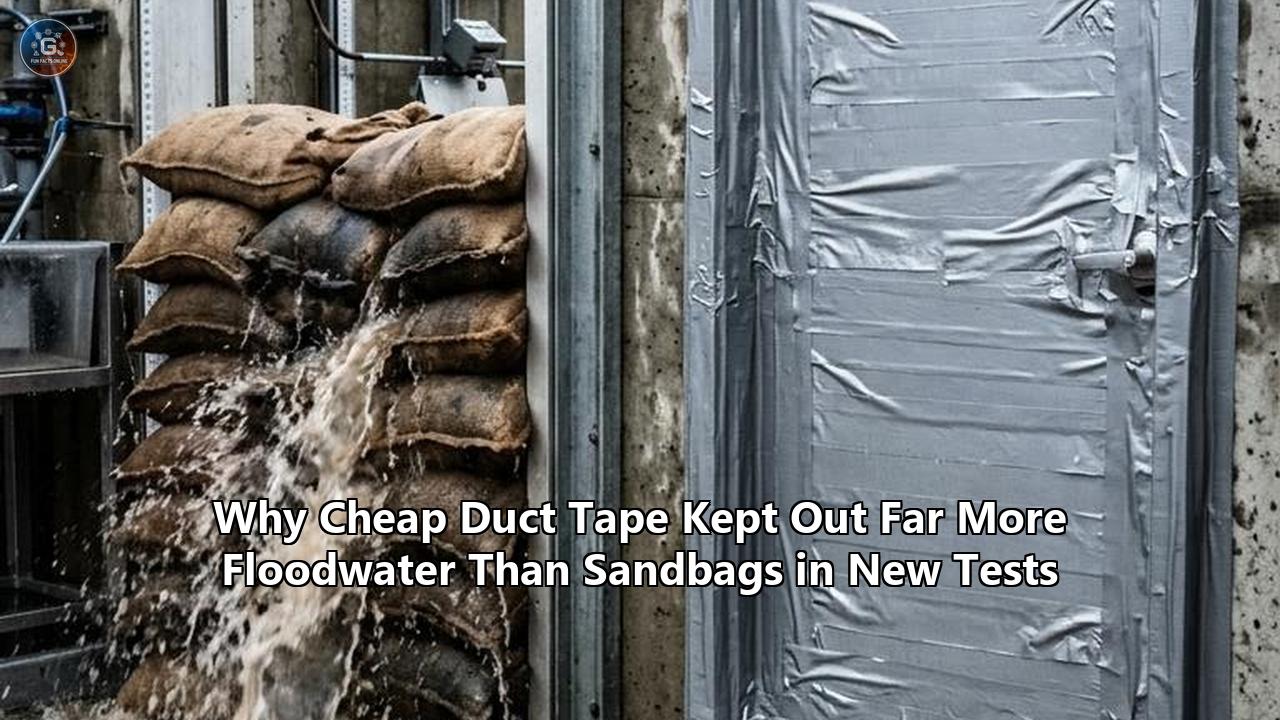
KINGSTON UPON HULL, England — A standard household roll of duct tape applied across an exterior door frame stops up to 98 percent of floodwater during flash inundations, outperforming traditional sandbags by a staggering margin in rigorous hydraulic trials conducted at the University of Hull’s specialist flood laboratory.
The experimental findings, released during national Flood Action Week by the University of Hull and the UK insurance reinsurance body Flood Re, upend more than a century of civilian and municipal flood response conventions. In controlled laboratory tests simulating flash flood depths of up to two feet (600 millimeters), traditional sandbags reduced water influx through a standard residential entryway by roughly 70 percent—allowing nearly a third of the advancing flood volume to pour continuously into the structure. By contrast, heavy-duty duct tape slashed water intrusion by 97 to 98 percent, while specialized synthetic rubber putty tape eliminated 99 percent of leakage.
Even low-cost, unbranded tape purchased from discount hardware retailers reduced water leakage by 80 percent, comfortably surpassing the defensive barrier provided by stacked sandbags.
The data arrives at a critical juncture for flood-prone regions globally. Urban pluvial flooding—rapid surface inundation caused by intense, short-duration convective cloudbursts that overwhelm municipal storm drainage—has become one of the costliest and most frequent weather disasters worldwide. For decades, emergency services and local councils have reflexively deployed sandbags as the default front-line defense for homeowners. The Hull trials demonstrate that this ubiquitous measure is not merely labor-intensive, logistically unwieldy, and environmentally toxic after contact with wastewater; it is hydraulically inferior to adhesive membranes that cost pocket change and sit in a kitchen drawer.
"Through challenging established assumptions, our research can deliver immediate benefits to householders, showing that something as cheap and readily available as tape can significantly reduce the damage that flooding can cause," said Professor Stuart McLelland, Deputy Director of the Energy and Environment Institute and Professor of Water Science at the University of Hull, who led the investigative trials.
While researchers stressed that tape cannot replace comprehensive, professionally installed property-level defenses during sustained or deep flooding, the data demonstrates that for millions of properties confronting the most common type of shallow flash inundation, conventional emergency advice has been pointing civilians toward the wrong tool.
Inside PFRlab: The Anatomy of the Doorway Experiment
The tests were carried out inside the University of Hull’s Property Flood Resilience laboratory (PFRlab), an independent research and testing enclosure located at The Deep aquarium facility on the Humber estuary. Developed in direct partnership with Flood Re and the UK Environment Agency, the PFRlab is certified to assess flood defenses under British Standard BS 851188, utilizing precision laser scanners, hydrostatic pressure transducers, and volumetric catchments capable of measuring fluid passage down to fractions of a liter per minute.
+-----------------------------------------------------------------------------------+
|               LEAKAGE REDUCTION COMPARISON: ENTRYWAY BARRIERS                      |
|                  (Laboratory Head: 600mm / 2.0 ft Hydrostatic Water)              |
+-----------------------------------------------------------------------------------+
| Barrier Type                             | Infiltration Reduction vs. Raw Door    |
+-----------------------------------------------------------------------------------+
| Synthetic Rubber Putty Tape (Butyl)      |  99.0%                                 |
| Premium Branded Duct Tape (73mm width)   |  97.0% - 98.0%                         |
| Engineered Demountable Flood Board*      |  95.0% - 99.0% (High Human Error Spread)|
| Aluminium Foil Barrier Tape              |  88.0% - 92.0%                         |
| Standard PVC / Plastic Film Tape         |  80.0% - 85.0%                         |
| Economy Unbranded Duct Tape              |  80.0%                                 |
| Traditional Stacked Sandbags             |  70.0% (30% continuous bypass seepage) |
| Unprotected Residential Door (Control)   |   0.0% (Full unchecked penetration)    |
+-----------------------------------------------------------------------------------+
*Demountable flood barrier performance varied wildly depending on installation skill,
dropping below 60% effectiveness when frame seals were misaligned.
The laboratory’s hydraulic flume apparatus was configured to recreate a standard residential threshold facing a 600-millimeter wall of standing and slightly agitated water. That depth is not an arbitrary benchmark. Six hundred millimeters represents the approximate watermark of the catastrophic June 2007 floods in Hull, where roughly a month’s worth of precipitation fell in less than 24 hours, inundating more than 8,600 residential homes, 1,300 commercial enterprises, and 91 out of the city’s 99 schools.
In the 2007 catastrophe, as in thousands of pluvial flash floods across Europe and North America since, the bulk of internal damage did not stem from violent river torrents ripping roofs off foundations. Instead, muddy, contaminated surface water collected on asphalt, rose between six inches and two feet above street level, breached door sills, soaked ground-floor carpets, penetrated cavity insulation, and ruined timber floorboards. Once floodwater crosses a door threshold by even an inch, the average domestic insurance claim in the UK surges past £30,000 to £45,000, displacing families from their homes for an average of eight to twelve months while structural drying and mold remediation take place.
To establish comparative performance, the Hull researchers erected a series of standard residential timber, uPVC, and composite entrance assemblies set inside brick and masonry wall apertures. They subjected each setup to low-depth standing water under rigorous test conditions:
- Baseline Control: Standard, unaltered residential doors without supplementary barriers.
- Traditional Sandbag Defense: A standard, properly constructed multi-tier pyramid of tightly packed builder-grade sandbags stacked across the exterior door threshold, tamped into position to mirror official government emergency guidelines.
- Engineered Demountable Barriers: Aluminum and composite flood boards slotted into pre-mounted side-channel wall rails, designed to British Standards.
- Adhesive Membrane Tapes: Four distinct classes of adhesive tapes applied to the exterior jambs, sills, and lower panels of the doors: premium heavy-duty duct tape (73mm width), low-cost unbranded duct tape, self-adhesive butyl/rubber flood putty tape, and heavy-gauge aluminum and PVC tapes.
The resulting data systematically unseated conventional wisdom. The unprotected door leaked immediately and profusely, channeling hundreds of liters of water per hour across the threshold. Sandbags, long treated as the gold standard of emergency community response, arrested some of the momentum of the water but failed entirely to establish an impervious hydraulic seal, reducing inward flow by only 70 percent.
Every single tape tested outperformed the sandbag configuration. The synthetic butyl rubber flood putty tape held back 99 percent of water volume, cutting leakage by a factor of ten compared to the sandbag wall. High-grade 73mm duct tape held back 97 to 98 percent of the liquid volume, transforming an inundating flood into a faint trickle that could be managed easily with a single household towel or small domestic mop.
Fluid Mechanics at the Threshold: Why Sandbags Leak
To understand why the performance gap is so wide, civil engineers point to basic fluid dynamics and soil mechanics. The ongoing contest of duct tape vs sandbags exposes a fundamental misunderstanding of what sandbags were actually engineered to do.
Sandbags were developed in the 18th and 19th centuries by military engineers. Their original design goal was ballistic absorption and earthworks stabilization—absorbing the kinetic impact of artillery shrapnel, rifle rounds, and explosive blasts, or weighing down shifting soil trenches. They were never designed to be impermeable hydraulic seals.
When subjected to water pressure, a sandbag stack functions in accordance with Darcy’s Law, which governs the flow of a fluid through a porous medium:
$$Q = \frac{-k \cdot A \cdot (h_b - h_a)}{L}$$
Where:
- $Q$ is the volumetric flow rate,
- $k$ is the hydraulic conductivity (permeability) of the medium,
- $A$ is the cross-sectional area perpendicular to flow,
- $(h_b - h_a)$ is the hydraulic head difference,
- $L$ is the flow path length through the barrier.
Woven burlap (jute) and woven polypropylene—the two standard textiles used to fabricate sandbags—contain thousands of microscopic interstitial openings between structural threads. More critically, the fill material inside standard sandbags is coarse building sand or granular silt. Clean quartz sand possesses a high hydraulic conductivity ($k \approx 10^{-4}$ to $10^{-2}\text{ m/s}$).
               CROSS-SECTION: FLUID BYPASS MECHANICS

[ OUTSIDE: 600mm WATER ]                [ INSIDE: DRY INTERIOR ]
          |                                       |
          |======> Hydrostatic Pressure           |
          |                                       |
    .---. |                                       |
   (  ~  )| ===> Interstitial Void Leakage        |
  .---'-. ) ===> Woven Polypropylene Pores        |
 (  ~ ~  ) ===> Irregular Threshold Gaps          |
(_________)) ===> Darcy's Law Permeability         |
-----------------------------------------=========|=======> Seepage to
////// CONCRETE / STONE THRESHOLD ///////  DOOR   |         Floorboards
When dry sandbags are piled outside an entrance, water does not bounce off them. The water immediately saturates the granular sand matrix. Once saturated, hydrostatic pressure—which increases linearly with depth according to $P = \rho g h$—drives water directly through the pores between the sand grains. At a depth of 600 millimeters, water exerts a pressure of approximately 5.88 kilopascals (kN/m²) along the base of the door sill. That is more than enough force to push liquid through the permeable weave of the bags.
Furthermore, sandbags create an interface problem. A residential doorway consists of rigid, geometric planes: flat timber or PVC frames meeting vertical brick or stone reveals at crisp 90-degree angles, sitting atop a level concrete or stone threshold sill. Sandbags, by contrast, are irregular, rounded, semi-flexible cylinders.
Even when workers carefully overlap the necks of the bags and tamp them down with boots or tampers, microscopic geometric voids remain along the perimeter:
- The Sill Gap: The bottom bag fails to fill the tiny depressions, weathered dips, and micro-grooves of the stone threshold.
- The Flank Bypass: The curved edges of the bags fail to create continuous contact with the vertical door frame jambs, creating vertical bypass channels through which water rushes under gravity.
- Inter-Bag Chimneys: The seams between stacked bags form an interconnected labyrinth of pathways.
In real-world emergency field settings, manuals from the US Army Corps of Engineers (USACE) and the UK Environment Agency state that sandbag barriers should always be built with an underlying impermeable polyethylene plastic sheet (tarp) wrapped around the exterior of the bags. The sandbags are intended primarily as a gravitational ballast—dead weight to pin down the impervious plastic sheet against water lift.
Yet, in nearly every domestic flooding emergency, homeowners, volunteers, and municipal workers lack the time, materials, or training to execute complex poly-sheeting wraps. Instead, they pile unlined sandbags directly against the door. Without an uninterrupted, non-porous membrane, an unlined sandbag barrier operates as a coarse mechanical filter rather than a water dam. It traps sediment, floating sticks, and street gravel, but lets liquid water pass straight through into the living room.
Polymer Adhesion Science: How Thin Membranes Hold Back Hydrostatic Head
Duct tape behaves in the exact opposite manner. It is a three-layer composite engineered precisely for continuity, non-porosity, and tensile adhesion across irregular seams:
      COMPOSITE CROSS-SECTION: HEAVY-DUTY DUCT TAPE

  +-------------------------------------------------------+
  |  1. Extruded Polyethylene (PE) Top Film               | <- Waterproof, Hydrophobic
  +-------------------------------------------------------+
  |  2. Woven Cotton/Polyester Scrim Matrix               | <- High Tensile Strength
  +-------------------------------------------------------+
  |  3. Thick Viscoelastic Pressure-Sensitive Adhesive    | <- Flows into Surface
  +-------------------------------------------------------+    Micro-Roughness
     |||||||||||||||||||||||||||||||||||||||||||||||||||
  ~~~~~~~~~~~~~~~~~~~~~~~~~~~~~~~~~~~~~~~~~~~~~~~~~~~~~~~~~
DOOR CASING / THRESHOLD / BRICKWORK SUBSTRATE- The Backing Membrane: The external skin of duct tape is extruded low-density polyethylene (LDPE). Polyethylene is completely hydrophobic, chemically inert to water, and features a water vapor transmission rate approaching zero. At a thickness of only a few mils, an intact polyethylene film is utterly impervious to liquid water penetration.
- The Structural Scrim: Embedded directly beneath the polyethylene film is a woven mesh (scrim) made of cotton, rayon, or polyester threads. The scrim gives the tape its high longitudinal tensile strength and tear resistance while allowing it to stretch slightly and conform to contours without rupturing under dynamic fluid pressure.
- The Viscoelastic Adhesive: The bottom layer consists of a heavy coating of pressure-sensitive adhesive (PSA), typically formulated from natural rubber or synthetic block copolymers blended with tackifying hydrocarbon resins.
When a resident firmly presses duct tape across the gap separating a door from its frame, the rubber adhesive undergoes viscoelastic flow. Under physical pressure, the adhesive flows into the microscopic pits, tool marks, and grain irregularities of the wood, composite, metal, or painted masonry substrate. This mechanical interlocking, reinforced by intermolecular van der Waals forces, creates an airtight and watertight bond.
Because the adhesive tape forms a continuous bond along the entire perimeter—sealing the left jamb, the right jamb, and the horizontal threshold without gaps—there are no voids for water to enter.
In fluid dynamics terms, duct tape shifts the failure mode entirely:
- For sandbags, failure is permeation (water flowing through the porous interior).
- For duct tape, the only failure mode is adhesive shear or peeling along the perimeter bond line.
At 600 millimeters of water depth, the hydrostatic lateral pressure on a strip of tape bridging an 8-millimeter door clearance gap is minimal in absolute force terms. The tape is not holding back the ocean by itself; the rigid, heavy door slab absorbs 99 percent of the total water load pushing against the house. The duct tape merely needs to bridge the narrow expansion gap between the stationary frame and the movable door leaf.
                PLAN VIEW: FORCES ON EXTERIOR-TAPED DOOR

                [ OUTSIDE: FLOODWATER ]
                           |
                           |  Hydrostatic Load Vector
                           V
              ===========================  <-- Continuous Duct Tape Seal
            / |                         | \
           /  |                         |  \
          /   +-------------------------+   \
         /    |                         |    \
   FRAME |    |    RIGID DOOR SLAB      |    | FRAME
   JAMB  |    |                         |    | JAMB
         |    | (Carries Primary Force) |    |
         |    +-------------------------+    |
         |                                   |
         \---- Weatherstripping Compression -/
                           |
                           V
                 [ INSIDE: DRY HOUSE ]
Because water cannot find an open path, it presses against the exterior face of the tape. On outward-opening doors, this hydrostatic force pushes the tape membrane down onto the jamb, utilizing the water's own mass to press the adhesive tighter against the doorway substrate.
On inward-opening doors, the water pressure attempts to push the tape into the gap. However, the high tensile strength of the woven scrim resists stretching, preserving the seal as long as the adhesive bond remains anchored to the frame faces.
The Performance Hierarchy: Laboratory Metrics of duct tape vs sandbags
The University of Hull's experimental results provide precise measurements of how various barrier products perform under identical hydrostatic loads.
Analyzing duct tape vs sandbags under laboratory-controlled conditions demonstrates that consumer adhesives are surprisingly resilient against water intrusion:
1. Synthetic Rubber Putty Tape (Butyl Formulation): 99% Leakage Reduction
The top performer in the PFRlab trials was flexible synthetic rubber tape, commonly sold as butyl tape, waterproof sealing mastic, or flood putty tape. Butyl rubber is a synthetic copolymer of isobutylene with a small percentage of isoprene. It does not dry out, remains permanently elastic, and has extremely high tack and cohesive strength.
When compressed into the door margins and threshold sill, the butyl compound deformed to fill every micro-gap, establishing a virtually impenetrable hermetic seal. Throughout extended submersion tests up to 600mm, leakage past the butyl barrier was negligible—reducing water volume entering the facility sump by 99 percent compared to an untreated door. It proved up to ten times more effective than the sandbag control installation.
2. Premium Branded Heavy-Duty Duct Tape: 97% to 98% Leakage Reduction
High-grade, branded duct tape—such as heavy-gauge trade-rated tapes measuring 73 millimeters (2.87 inches) wide—emerged as the most practical all-around solution. The wider 73mm profile gave researchers ample surface area to anchor one half of the tape securely to the masonry/doorframe while anchoring the other half to the door leaf, bridging the gap with wide margins of error.
The heavy woven scrim prevented tearing when technicians worked the tape into sharp 90-degree threshold corners, hinge recesses, and weather-drip profiles. Its aggressive natural rubber adhesive adhered immediately to cold surfaces without heating or chemical primers. In repeated tests, premium duct tape cut water influx by 97 to 98 percent. Over hours of submersion, water passage was limited to minor seepage at deep structural joints where irregular mortar lines met timber framing.
3. Aluminium Foil and Rigid PVC Tapes: 80% to 92% Leakage Reduction
Specialist tapes constructed from dead-soft aluminum foil backing (used in HVAC mechanical installations) and thick unplasticized polyvinyl chloride (PVC) tape performed credibly, cutting water by 80 to 92 percent.
However, these materials revealed distinct human-factor limitations during installation. Aluminum foil lacks elasticity; when researchers tried to mold it around complex door thresholds, sill rebates, and hinge contours, the metallic backing cracked or developed micro-fissures along fold lines. Water under hydrostatic head exploited these small cracks.
PVC tape, while waterproof, demonstrated higher elastic memory—tending to pull away from deep corners over time as the plastic attempted to snap back to its original flat shape, breaking the adhesive bond.
4. Low-Cost Unbranded Duct Tape: 80% Leakage Reduction
Recognizing that consumers in low-income or urgent situations frequently purchase budget products from convenience stores, the Hull team tested cheap, unbranded generic duct tape.
These products typically feature a thinner adhesive layer, lower thread-count scrim, and thin polyethylene coatings. Under test conditions, the unbranded tape proved significantly more frustrating to handle. It tended to split longitudinally upon being peeled from the roll and tore easily when stretched around tight corners or stepped thresholds.
Despite these mechanical weaknesses, once technicians successfully patched torn sections and pressed the adhesive home, it still managed to reduce floodwater penetration by 80 percent. Even cheap, fragile tape stopped 10 percent more floodwater than stacked sandbags.
5. Traditional Sandbags: 70% Leakage Reduction
Piled across the doorway in accordance with standard guidance, the sandbag barrier was soundly beaten by every adhesive product tested. While the mass of sand arrested the velocity of the water, water permeated the porous sand matrix, and interstitial gaps against the frame allowed continuous streams of water to flow around the door. Over the course of the test, roughly 30 percent of the raw water volume bypassed the bags, quickly saturating the test facility floor.
                     BARRIER RUNOFF PROFILE OVER TIME

   Cumulative Leakage (Liters)
     ^
 1000|                                               /  Unprotected Door
     |                                              /
  800|                                             /
     |                                            /
  600|                                           /
     |                                          /
  400|                                         /
     |                          ..............    Sandbags (~30% flow)
  200|                   .....................
     |    ------------------------------------    Budget Duct Tape (~20% flow)
   20|  ______________________________________    Premium Duct Tape (2-3% flow)
    0+---------------------------------------->
     0        15        30        45        60   Time (Minutes)
6. Demountable Engineered Flood Barriers: High Variance
The PFRlab researchers also benchmarked professionally manufactured demountable flood boards—rigid aluminum barriers that slide into permanently fixed vertical wall rails. When installed correctly with immaculate neoprene seals, these barriers achieved between 95 and 99 percent protection.
However, the researchers recorded dramatic swings in performance. Demountable boards require precise mechanical assembly, correct torque on retention clamps, and completely clear, debris-free floor channels. When installed with slight misalignments—simulating an anxious homeowner trying to assemble unfamiliar metal panels in the dark during a storm—leakage skyrocketed, dropping their real-world effectiveness below 60 percent.
Duct tape, by contrast, proved remarkably forgiving of imperfect human application.
The Door Swing Paradox: Inward vs. Outward Hinges
A subtle yet pivotal discovery to emerge from the Hull experiments was the mechanical role played by the door’s opening direction. The tests revealed that outward-opening doors sealed with exterior tape performed substantially better than inward-opening doors.
                DOOR DIRECTIONALITY AND PRESSURE DYNAMICS

OUTWARD-OPENING DOOR                     INWARD-OPENING DOOR
(Self-Reinforcing Hydraulic Seal)        (Tension on Adhesive Seam)

     [ FLOODWATER ]                           [ FLOODWATER ]
            |                                        |
            V Hydrostatic Force                      V Hydrostatic Force
   +-----------------+                      +-----------------+
   |      DOOR       |                      |      DOOR       |
   +-----------------+                      +-----------------+
            |                                        |
            V Pushes into frame                      V Pushes into room
   ===================                      ===================
   Exterior Frame Stop                      Clearance Gap Opens
   Gaskets compress;                        Adhesive pulled in shear;
   Tape pressed onto joint.                 Tape forced into gap.
In the United Kingdom, mainland Europe, and North America, the vast majority of residential exterior entrance doors open inward into the hallway. This configuration is driven by domestic building codes, ease of greeting visitors, and the requirement that emergency services be able to breach doors inward during tactical or medical crises. Outward-opening doors, while common in commercial properties, hurricane zones like South Florida, and Nordic residential architecture, are rare in temperate suburban neighborhoods.
The hydraulic physics of inward vs. outward-opening doors under flood loading are starkly different:
Inward-Opening Doors
When floodwater rises against an inward-opening door, the lateral hydrostatic head presses directly against the broad face of the door slab, pushing it away from the outer frame stops and weatherstripping.
As water depth climbs toward 600 millimeters, the door slab flexes slightly inward under the weight of hundreds of kilograms of water. This structural deflection causes the perimeter clearance gaps along the sides and bottom to widen.
When duct tape is applied to the exterior face of an inward-opening door, the inward movement of the door puts the adhesive tape into peeling shear. As the gap opens, the water pressure forces the tape inward into the opening, creating a convex balloon of tape across the threshold crack. If the tape lacks sufficient tensile scrim strength or adhesive tack, the hydraulic force will blow the tape through the seam or strip it from the frame.
Despite these physical disadvantages, high-quality duct tape held its seal during the Hull inward-opening trials, though it required firmer initial burnishing against the frame to withstand the tension.
Outward-Opening Doors
When an outward-opening door faces rising floodwater, the fluid mechanics work in harmony with the building's defenses. The hydrostatic pressure pushes the entire door slab firmly inward against the solid perimeter rebates (door stops) of the structural frame.
This lateral force compresses the door's integrated acoustic and rubber draft gaskets, instantly creating a tighter primary mechanical seal.
When duct tape is applied across the exterior perimeter of an outward-opening door, the water pressure pushes the tape down flat against the flat outer face of the door and frame. Instead of attempting to pry the tape loose, the hydrostatic head acts as a hydraulic clamping plate, pressing the sticky membrane down against the substrate.
As a result, outward-opening assemblies achieved nearly zero water ingress across multiple testing cycles, illustrating the compounding effect of structural geometry and adhesive barrier mechanics.
Ergonomics, Equity, and Municipal Logistics
The laboratory data directly challenges the logistics and human viability of sandbag deployment during modern urban emergencies. When evaluating duct tape vs sandbags, the issue is not merely hydraulic sealing; it is the physical reality of human ergonomics, community vulnerability, and post-flood toxicity.
+-----------------------------------------------------------------------------------+
|               OPERATIONAL COMPARISON: DUCT TAPE VS. SANDBAGS                      |
+-----------------------------------------------------------------------------------+
| Metric                   | Household Duct Tape         | Traditional Sandbags     |
+-----------------------------------------------------------------------------------+
| Unit Weight              | ~0.45 kg (1 lb) per roll    | 15–20 kg (33–44 lbs) each|
| Weight for 1 Doorway     | ~0.1 kg (applied)           | 150–300 kg (330–660 lbs) |
| Preparation Time         | 5–8 minutes                 | 30–60 minutes            |
| Storage Footprint        | Kitchen drawer / shelf      | Pallet / dry outdoor bay |
| Deployment Capability    | Single individual (any age) | Physically robust crews  |
| Post-Event Waste         | Minimal (peeled and binned) | Tons of hazardous waste  |
| Biohazard Absorption     | Zero (impermeable film)     | High (sponges pathogens) |
| Total Cost per Door      | £3 – £8 ($4 – $10)          | £45 – £120 ($60 – $155)  |
+-----------------------------------------------------------------------------------+
The Physical Burden of Sandbags
A single standard sandbag, filled two-thirds full with building sand to allow proper overlapping, weighs between 15 and 20 kilograms (33 to 44 pounds). To build an effective three-tier pyramid barrier across a standard 900-millimeter residential doorway up to a defensive height of 600 millimeters requires a minimum of 10 to 15 sandbags.
           TYPICAL SANDBAG DOORWAY PYRAMID (600mm Target Height)

                 [===== Layer 3: 2 Bags =====]         ~40 kg
             [===== Layer 2: 4 Bags =============]     ~80 kg
         [===== Layer 1: 6-8 Bags ===================] ~140 kg
       -------------------------------------------------
       Total Weight to Move by Hand: ~260 kg (573 lbs)
To secure just two entrances—a front door and a back door—a household must transport, maneuver, and correctly stack up to 30 sandbags, representing an aggregate dead weight of 450 to 600 kilograms (nearly 1,300 pounds).
This logistical reality turns flood preparation into an impossible physical ordeal for large portions of the population:
- Elderly citizens living independently,
- Individuals with mobility impairments or chronic illnesses,
- Single parents balancing child safety during evacuation warnings,
- Residents who do not own a heavy passenger truck or vehicle capable of transporting a half-ton of wet sand from distant municipal depots.
During acute weather emergencies, local municipal depots and hardware retailers often restrict sandbag collections or place them in centralized parking lots miles away from flood zones. Civilians are forced to stand in lengthy vehicle queues, shovel wet sand into hessian sacks by hand, lift them into personal car trunks (damaging vehicle suspensions), and haul them across waterlogged yards while flood sirens are sounding.
"You need a lot of sandbags to protect your home in a flood and you need to store them somewhere," noted John Bark, a Hull homeowner whose property was inundated during the 2007 floods, in reaction to the University of Hull findings. "You then need to carry them and they can be heavy. It's just not a very practical solution."
His wife, Janet Bark, echoed the relief that cheap roll adhesives could bring to vulnerable neighborhoods: "Gaffer and duct tape is something that is cheap and readily available. You can just have it in your house, just in case."
A roll of industrial duct tape weighs less than 500 grams, costs roughly £5 to £10 ($6 to $13), fits comfortably in a kitchen drawer, and has an ambient shelf life of three to five years. A single roll contains up to 50 meters of tape—enough to seal every doorway, ground-floor French door, and air brick in an average residential home four times over. Any individual capable of using a pair of scissors can completely seal a door threshold in under eight minutes, without heavy lifting, special vehicles, or external municipal assistance.
           RAPID APPLICATION TIMELINE: THE 8-MINUTE RUNTIME

 [00:00] Rapid wipe of door casing with dry microfibre cloth
   |
 [01:30] Cut and apply first horizontal tape anchor along threshold sill
   |
 [03:00] Apply second overlapping horizontal run to seal sill-to-door gap
   |
 [04:30] Run vertical strips up left jamb (frame-to-door leaf)
   |
 [06:00] Run vertical strips up right jamb across hinges and latch line
   |
 [07:15] Thumb-burnish all edges into seams, mortar lines, and rebates
   |
 [08:00] THRESHOLD SEAL COMPLETE (Ready for water rise)
The Hazardous Aftermath: The Sandbag Disposal Crisis
The operational drawbacks of sandbags do not end when the floodwaters recede. In fact, that is when their most dangerous and costly phase begins.
Floodwaters in urban, suburban, and agricultural settings are classified by international water health bodies as Category 3 "black water." They do not consist of clean rainwater.
As stormwater inundates urban streets, it backs up municipal sewer networks, forcing raw, untreated human feces, toilet paper, and domestic sewage out of manholes and into the flood path. It scours highways and parking lots, gathering used engine oil, diesel fuel, tire microplastics, carcinogenic polycyclic aromatic hydrocarbons (PAHs), heavy metals, agricultural pesticides, animal manure, and toxic industrial chemicals.
              CROSS-CONTAMINATION: THE POST-FLOOD BIOHAZARD

   [ URBAN RUNOFF ]        [ SEWER SURGE ]       [ CHEMICAL LEACH ]
    Engine Oils / Heavy     Raw Untreated Human   Pesticides / Industrial
    Metals / PAHs           Sewage & Coliforms    Solvents / Fertilizers
           \                      |                     /
            \                     |                    /
             V                    V                   V
           +---------------------------------------------+
           |        URBAN FLOODWATER (CATEGORY 3)        |
           +---------------------------------------------+
                                  |
                                  V
                   +-----------------------------+
                   |   POROUS SANDBAG BARRIER    |
                   | (Absorbs & Traps Pathogens) |
                   +-----------------------------+
                                  |
               +------------------+------------------+
               |                                     |
               V                                     V
     [ Saturated Biohazard ]             [ Fungal / Bacterial Culturing ]
     Cannot be used for sandboxes        Produces ammonia, hydrogen sulfide,
     Cannot be dumped in gardens         and mold spores during drying
Because sandbags are porous filters, they act as massive sponges for these contaminants. The granular sand inside becomes saturated with raw sewage, Escherichia coli, Salmonella, enteroviruses, and toxic petrochemicals.
Once the waters drain away, the sandbags do not simply dry into clean building materials. As they sit in the sun, the organic matter inside begins to decompose, culturing dangerous bacterial colonies and molds while off-gassing ammonia and volatile organic compounds.
Consequently, environmental protection regulations in the United States (under EPA mandates), the United Kingdom, and the European Union forbid residents from cutting open flood-soaked sandbags to spread the sand over gardens, lawns, or children's sandboxes. They cannot be sent to normal municipal composting facilities or used as construction fill.
Every single saturated sandbag becomes regulated hazardous municipal waste.
Cities hit by floods must deploy fleets of heavy dump trucks, excavators, and workers wearing hazardous-material personal protective equipment (PPE) to manually shovel, lift, transport, and dispose of thousands of tons of biohazardous sand into specialized, lined landfills. The environmental footprint—and municipal disposal cost—runs into millions of dollars per event.
By contrast, duct tape, PVC, and butyl tapes present no such remediation nightmare. The non-porous polyethylene surface does not absorb contaminants.
Once the flood has subsided and the property exterior is hosed down with household disinfectant, the homeowner simply slices the tape along the door edge, peels the strips off the door frame, and discards the compact plastic ball into standard municipal waste. The entire volume of protective material from an entrance weighs less than a pound and fits comfortably in a standard trash can.
Property Flood Resilience: Where Tape Works—and Where It Fails
Despite the impressive results from the University of Hull, both the researchers and flood defense professionals issued strong cautions against viewing duct tape as an all-encompassing floodproofing panacea.
A homeowner who assumes that taping their front door makes their property unsinkable risks catastrophic structural failure if they do not understand the broader dynamics of flood engineering.
       LIMITATIONS OF TAPE: PATHWAYS OF RESIDENTIAL WATER INGRESS

             (2) AIR BRICK SEEPAGE        (3) CAVITY WEEP HOLES
                         \                    /
                          V                  V
  +----------------------------------------------------+
  |                                                    |
  |  [ TAPED FRONT DOOR ]                              |
  |  (Seals Entrance 98%)                              |
  |                                                    |
  |===================== GROUND LEVEL =================|
  |                                                    |
  |     (1) LATERAL MASONRY SEEPAGE                    |
  |     Water penetrates porous Victorian bricks       |
  |                                                    |
  |     (4) SEWER BACKFLOW                             |
  |     Water pushes UP through toilets & ground sinks |
  |                                                    |
  |     (5) HYDROSTATIC UPWELLING                      |
  |     Groundwater rises through timber floorboards   |
  +----------------------------------------------------+
The researchers outlined several critical engineering limitations:
1. The 600-to-900 Millimeter Structural Wall Barrier
There is a fundamental reason why the Hull trials restricted testing to water depths of 600 millimeters (two feet). In civil structural engineering, water is remarkably heavy: one cubic meter weighs precisely 1,000 kilograms (one metric ton).
When water rises against the exterior masonry cavity wall of a standard residential building beyond 600mm to 900mm (roughly three feet), the lateral hydrostatic pressure on the exterior brickwork leaf becomes massive.
Standard residential houses are designed to handle vertical loads (the downward weight of the roof and upper floors). They possess limited structural resistance against lateral inward forces pushing horizontally against the walls.
If a homeowner successfully seals their doors and windows hermetically while water rises to four or five feet on the outside, the house becomes an empty ship hull pinned in dry ground. The differential pressure can crack the brick mortar, buckle exterior walls inward, or cause the concrete floor slab to lift and crack under upward buoyancy pressure.
For water heights exceeding three feet, structural engineers advise letting water enter the home intentionally to equalize internal and external hydrostatic pressures, preventing total structural collapse.
2. Upwelling Through Subfloors and Foundations
Tape applied to an entrance does nothing to counter subsurface groundwater upwelling. In many river valley and coastal flood scenarios, rising water tables force liquid up from the earth beneath the property.
Sarah Bouskill, whose mother’s home in Horncastle, Lincolnshire, was inundated by Storm Babet, observed this physical reality firsthand. While describing the Hull research findings as "hugely interesting," Bouskill noted that adhesive tape on the front door would not have spared her mother's home.
"I doubt tape could have stopped the water that entered through the floor and walls," Bouskill noted.
In houses with suspended timber floors, water often rises into the crawlspace beneath the house, soaking joists and bubbling up through floorboards from underneath. In such cases, a perfectly sealed door simply traps water rising from below.
3. Alternative Ingress Pathways: Air Bricks and Waste Pipes
A typical home has multiple low-level openings besides doorways:
- Air Bricks (Subfloor Vents): Perforated ventilation bricks located just above ground level to ventilate timber floor crawlspaces. If unsealed, an air brick can allow hundreds of liters of water to pour beneath a home every minute. Fortunately, duct tape and butyl rubber tape can be applied directly over air brick grates to seal them off, provided the brick face is clean and dry.
- Weep Holes: Vertical gaps left in the brick masonry mortar above damp-proof courses to allow internal cavity wall moisture to drain out. Rising floodwater will reverse this flow, entering the cavity wall insulation.
- Sanitary Sewer Backflow: When municipal storm drains flood sanitary sewers, water pressure forces wastewater backward through private lateral sewer pipes, erupting inside the home through ground-floor toilets, shower drains, and kitchen sinks. Stopping door ingress does nothing to prevent sewage from geysering out of a ground-floor bathroom.
The True Role of Tape: Tactical Resistance
Tape represents a low-cost, tactical stop-gap for shallow, short-duration pluvial surface flooding—the sudden, intense summer cloudburst or blocked storm drain scenario where street runoff reaches four to twenty inches, pools for two hours, and then drains away once municipal pumps catch up.
It is an emergency tool designed to bridge the gap until permanent Property Flood Resilience (PFR) measures can be installed:
+-----------------------------------------------------------------------------------+
|               HIERARCHY OF PROPERTY FLOOD RESILIENCE (PFR)                        |
+-----------------------------------------------------------------------------------+
| Tier Level         | Defense Measure                                              |
+-----------------------------------------------------------------------------------+
| Tier 1: Emergency  | Quality duct tape / butyl putty tape across door rebates,   |
| Tactical Measures  | sills, and air brick grates. Non-return drain plugs.         |
+-----------------------------------------------------------------------------------+
| Tier 2: Passive /  | Self-closing mechanical air bricks; non-return sewage valves |
| Demountable PFR    | on waste lines; certified BS 851188 demountable flood boards.|
+-----------------------------------------------------------------------------------+
| Tier 3: Permanent  | Purpose-built flood doors with dual-perimeter compression    |
| Resistance         | seals; exterior masonry water-repellent coatings; sump pump  |
|                    | systems with dedicated battery inverters.                    |
+-----------------------------------------------------------------------------------+
| Tier 4: Strategic  | "Build Back Better" interior adaptation: water-resistant     |
| Resilience         | closed-cell wall insulation, tiled floors, raised electrical |
|                    | sockets (1 meter above floor), and lime-based wall plasters. |
+-----------------------------------------------------------------------------------+
"Our research can deliver immediate benefits to householders, but tape is not a substitute for permanent, professionally installed property flood resilience measures," emphasized Professor McLelland.
Disaster Economics and the Bureaucracy of Emergency Response
The University of Hull study carries major policy implications for municipal authorities, disaster management agencies like FEMA and the UK Environment Agency, and the global insurance industry. It exposes an entrenched institutional inertia that continues to waste millions in taxpayer funds on outdated disaster mitigation strategies.
Evaluating institutional procurement of duct tape vs sandbags highlights an enormous disparity in municipal cost-efficiency:
+-----------------------------------------------------------------------------------+
|                     ESTIMATED MUNICIPAL PROCUREMENT & LOGISTICS                   |
|                        (Per 1,000 Homes / Low-Level Flash Flood)                  |
+-----------------------------------------------------------------------------------+
| Expense Category         | Sandbag Distribution Strategy | Tape Deployment Kit    |
+-----------------------------------------------------------------------------------+
| Raw Material Sourcing    | £60,000 (Sand, sacks, pallets)| £8,000 (Bulk tape rolls)|
| Heavy Transport / Fuel   | £35,000 (Flatbeds, loaders)   | £1,500 (Courier vans)  |
| Staging / Labor Crews    | £45,000 (Council overtime)    | £4,000 (Volunteer drop)|
| Post-Flood Toxic Disposal| £90,000 (Hazardous landfill)  | £500 (Standard waste)  |
+-----------------------------------------------------------------------------------+
| TOTAL MUNICIPAL IMPACT   | £230,000 (~$300,000 USD)      | £14,000 (~$18,000 USD) |
+-----------------------------------------------------------------------------------+
Despite decades of engineering literature proving that unlined sandbags perform poorly in shallow household protection, municipal emergency distribution depots continue to stockpile, pack, and distribute hundreds of thousands of sandbags each autumn.
The reasons are largely psychological and political rather than scientific:
- The Optics of Action: For politicians, emergency management directors, and local council leaders, delivering pallets of heavy sandbags provides visible, physical proof of emergency mobilization. News broadcasts favor footage of military personnel and emergency crews stacking sandbags. Distributing cases of duct tape, despite being vastly superior hydraulically, does not carry the same visual gravitas.
- Liability Deflection: Many local authorities hand out sandbags accompanied by fine-print disclaimers stating that the recipient assumes all liability for placement and performance. Because sandbags have been the historical default for over a century, their failure is often treated as an inevitable "act of God" rather than a predictable engineering shortcoming.
- The Insurance Calculus: Flood Re, which co-funded the PFRlab tests, operates on a different economic mandate. As a statutory reinsurance scheme backed by the insurance industry and the UK government, Flood Re exists to keep residential flood insurance affordable and accessible across high-risk postcodes.
In the UK alone, 6.3 million residential properties are located in flood-risk zones—a figure projected to surge past 8 million by 2050 as rainfall patterns intensify. If every home threatened by low-level surface flooding can slash internal water entry by 97 percent using an inexpensive household roll of tape, the savings to national disaster compensation pools and private reinsurers would be immense.
"For decades, the public have been told to stack sandbags outside their doors when flood warnings are issued," said Jonathan Kassian of Flood Re. "These findings turn that assumption completely on its head. Showing that a simple roll of tape can provide vastly better protection gives homeowners an accessible, cheap line of defense that could save thousands from the devastation of having their ground floors ruined by shallow floodwater."
Tactical Protocol: How to Seal an Ingress Point with Tape
The PFRlab researchers observed that while duct tape is forgiving of non-expert handling, application methodology directly impacts the sealing rate.
Based on the laboratory testing setups and materials engineering principles, technicians established a specific sequence for maximizing water resistance on residential entranceways:
               OPTIMAL TAPE SEALING SEQUENCE (EXTERIOR VIEW)

                 =======================================
                 | [4] TOP HEADER SEAL (Run horizontally)
                 =======================================
                 |     |                         |     |
                 |     |                         |     |
                 |     |                         |     |
                 | [3] |                         | [3] |
                 |     |                         |     |
                 | VER-|                         | VER-|
                 | TI- |                         | TI- |
                 | CAL |     RESIDENTIAL         | CAL |
                 |     |     DOOR LEAF           |     |
                 | JAMB|                         | JAMB|
                 |     |                         |     |
                 | RUN |                         | RUN |
                 |     |                         |     |
                 |     |                         |     |
                 |     |                         |     |
                 |=====================================|
                 | [2] OVERLAPPING HORIZONTAL TAPE RUN |
                 |=====================================|
                 | [1] PRIMARY SILL / THRESHOLD SEAL   |
                 =======================================
                 //////////////// MASONRY //////////////
Phase 1: Substrate Preparation
- Dry and Clean the Perimeter: Pressure-sensitive adhesives rely on direct contact with the substrate. Tape will fail instantly if applied to wet, oily, or heavily silted surfaces. When flood warnings sound—before rainfall begins to accumulate—wipe down the exterior door frame, threshold, and bottom 24 inches of the door leaf using a clean, dry cloth or paper towel to eliminate grit, moss, and surface oils.
- Inspect Flaking Paint: If the door jamb has flaking, rotten paint, scrape away loose flakes. The tape’s adhesive bond is only as strong as the layer it adheres to; if the paint detaches under hydraulic pressure, the seal will fail.
Phase 2: Application Order (The Shingle Principle)
Water flows downhill under gravity. To prevent hydrostatic head from peeling back the edges of the tape, layers must be applied using the "shingle technique"—starting at the lowest elevation and overlapping upward:
- The Sill Base Layer: Run a wide continuous strip of duct tape (ideally 73mm width) horizontally across the stone or concrete threshold, pressing the bottom half firmly onto the sill and the top half onto the bottom metal/timber edge of the door leaf.
- The Horizontal Risers: Apply a second and third horizontal strip overlapping the first strip by at least 50 percent, working upward until the tape coverage extends several inches above the projected flood level. The upper strips overlap the lower strips on the outside, creating a downward water-shedding face.
- The Vertical Jambs: Run continuous vertical strips from the sill upward along the left and right door jambs, half on the outer door frame/masonry and half on the face of the door leaf.
- The Top Corners: Form tight, folded hospital corners where the horizontal sill meets the vertical jambs. Use the thumb or a rigid plastic card (such as a credit card or squeegee) to burnish the tape into the 90-degree corner recess, ensuring no tent-like air pockets remain bridged across inner angles.
Phase 3: Hardware and Secondary Breaches
- Air Brick Grates: Place a flat sheet of heavy cardboard, plastic board, or corrugated plastic over the air brick vent, and then wrap multiple overlapping layers of duct tape over the board, extending three inches onto the surrounding dry brickwork on all four sides. Taping directly into the open holes of a vent will result in the tape rupturing under water pressure; the rigid board provides the structural backing required for the tape to seal.
- Letterboxes and Cat Flaps: If low-level letterboxes or pet flaps are installed in the bottom panels of the door, wrap them entirely with tape from the outside, following the same overlapping horizontal shingle pattern.
The Broader Horizon: Modernizing Flash Flood Defense
The revelations from the University of Hull’s PFRlab mark a turning point in practical climate resilience. For decades, disaster risk management has been dominated by multi-million-dollar civil engineering projects—sea walls, tidal barriers, concrete culverts, and upstream retention basins.
Yet, as urban centers expand their impermeable paved footprints and extreme downpours become more localized and intense, large-scale civil infrastructure often gets bypassed entirely. Water falls from the sky directly onto suburban neighborhoods, flooding homes within thirty minutes—long before river banks burst or municipal warning sirens sound.
In this context, resilience must adapt to become hyper-local, decentralized, and immediately accessible to regular citizens. The realization that cheap, widely available commercial adhesive tapes can outperform cumbersome sandbags provides emergency planners with an invaluable tool.
The transition will not happen overnight. Emergency planners must confront deep-rooted cultural habits. The image of the sandbag is deeply embedded in the public consciousness as a symbol of community resilience in times of crisis.
However, as more testing data emerges from facilities like the PFRlab, government guidelines are beginning to evolve. Several local resilience forums in northern England have begun reviewing their emergency guidance, exploring plans to phase out open sandbag distribution sites during localized surface-water warnings in favor of community resilience kits that include heavy-duty duct tape, butyl putty tape, and non-return drain bungs.
The final strategic verdict on duct tape vs sandbags is unambiguous: one is a heavy, porous relic of 19th-century trench warfare that allows nearly a third of floodwater to bypass its perimeter; the other is a modern composite polymer barrier that stops 98 percent of water for a fraction of the cost and effort.
As communities worldwide confront intensifying weather events, household flood protection may no longer be defined by a shovel and a mountain of heavy sand. Instead, the front line of domestic defense may simply come down to keeping a clean cloth, a steady pair of hands, and a heavy roll of duct tape ready in the cupboard.
Reference:
- https://www.femalefirst.co.uk/bizarre/tape-better-sandbags-flood-protection-1452182.html
- https://www.tolerance.ca/ArticleExt.aspx?ID=613489&L=en
- https://www.floodre.co.uk/forget-sandbags-tape-can-keep-out-99-of-flood-water/
- https://bangbizarre.com/index.php/2026/10/15/tape-is-better-than-sandbags-as-flood-protection/
- https://bangbizarre.com/index.php/2026/10/15/tape-is-better-than-sandbags-as-flood-protection/
- https://www.tolerance.ca/Rubrique.aspx?ID=38&L=en
- https://www.hull.ac.uk/collaborate/services-for-business/facilities-and-equipment-hire/pfrlab
- https://www.reddit.com/r/TwoXPreppers/comments/1x7hgod/duct_tape_for_everything_even_flooding/
- https://www.reddit.com/r/interesting/comments/1x7vyn9/duct_tape_kept_out_more_floodwater_than_sandbags/
- https://www.instagram.com/p/DejdShvm8rC/
- https://www.winchester.gov.uk/climate-and-nature/climate-change-and-energy/climate-emergency-what-we-are-doing-now/preparing-for-flooding