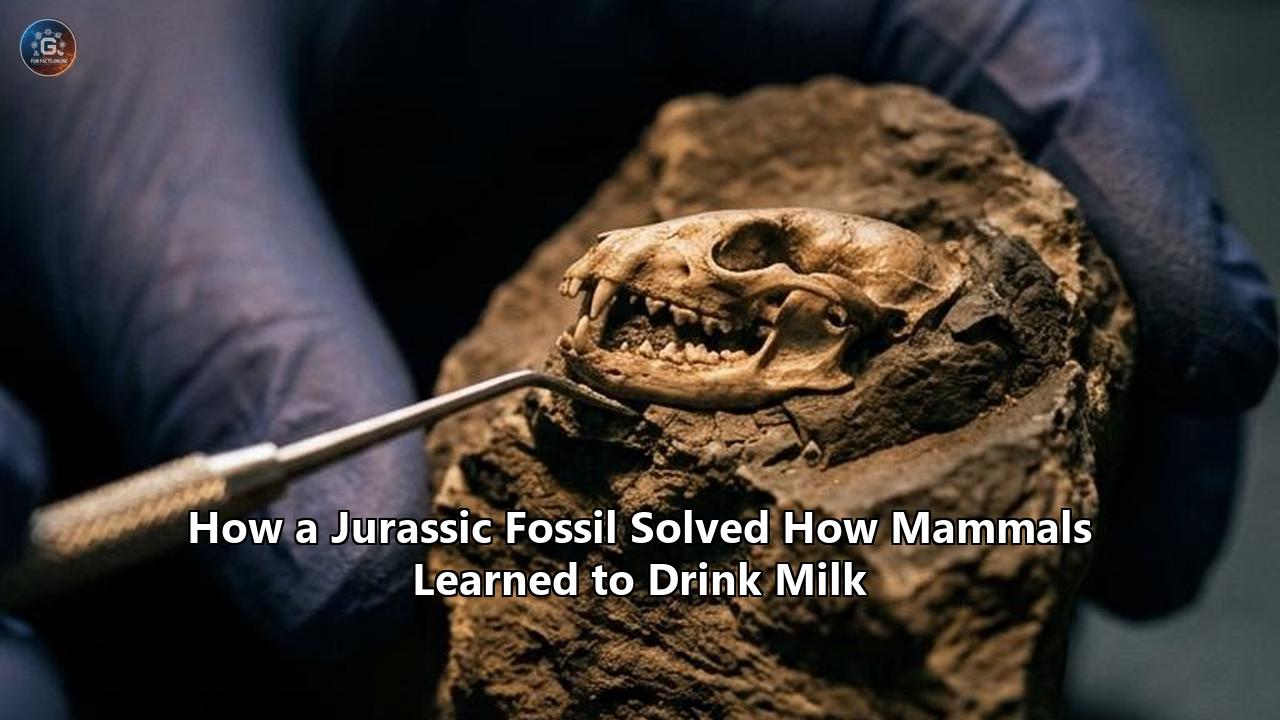
In a shale slab recovered from the Middle Jurassic beds of Inner Mongolia, an international team of paleontologists has identified the structural blueprint that allowed early mammals to perform one of nature’s most intricate mechanical tasks: suckling.
The fossil, unveiled in Nature, belongs to a newly classified 165-million-year-old docodont named Megacauda sungei. Measuring roughly 50 centimeters in length and weighing between one and two kilograms, this semiaquatic swimmer possessed a paddle-like tail, platypus-like hind limbs, and blade-like shearing cheek teeth. Yet its most transformative anatomy lay hidden beneath the base of its skull.
High-resolution micro-computed tomography (micro-CT) and X-ray fluorescence spectroscopy exposed a pair of delicate bony processes on the roof of the mouth and a fully articulated, saddle-shaped hyoid apparatus suspended beneath the pharynx. These minute structures served as mechanical anchors for the tensor and levator veli palatini muscles—the primary drivers of the mammalian soft palate.
Combined with a flexible hyoid suspension, this soft palate allowed Megacauda to generate negative intraoral pressure, seal off the respiratory tract while drawing fluids, and swallow liquids against gravity. In doing so, it provides physical proof that the neuromuscular and skeletal machinery required for infant suckling existed tens of millions of years earlier than previously assumed, deep within the stem lineages of the mammalian family tree.
“The anatomy of Megacauda suggests that structures involved in coordinating swallowing and sucking had already begun to evolve by the Middle Jurassic,” explained senior author Zhe-Xi Luo, professor of organismal biology and anatomy at the University of Chicago. “This discovery helps us better understand the biological foundations of one of the defining characteristics of mammals: feeding young with milk.”
The presence of this feeding apparatus in a stem mammaliaform outside crown Mammalia fundamentally recalibrates scientific models regarding the evolution of lactation. It demonstrates that infant suckling did not emerge alongside the origin of living placental and marsupial mammals, but was instead hardwired into mammalian precursors while dinosaurs still dominated terrestrial ecosystems.
Using Megacauda sungei as a primary lens, this case study examines the systemic principles governing how complex physical behaviors evolve, how soft-tissue mechanics can be deduced from subtle bone scaffolds, and why learning to drink milk served as the physiological cornerstone for the entire mammalian radiation.
The Biomechanical Paradox: The Physics of Milk Consumption
To understand the significance of the Megacauda discovery, one must first confront the severe physical difficulties associated with suckling. Milk ingestion is not a passive process; it is a high-risk hydraulic feat that requires the precise synchronization of suction generation, fluid transit, and respiratory isolation.
Reptilian Ingestion (Inertial/Gravitational):
Prey Capture -> Cranial Kinesis / Jaw Clamping -> Head Elevation -> Inertial Throat Slide (Food & Air Share Open Channel)

Therian Mammalian Suckling (Muscular/Barometric):
Hermetic Oral Seal -> Tongue Retraction (Negative Pressure) -> Soft Palate Closes Oral Cavity -> Epiglottic Protection of Airway -> Fluid Routing to Esophagus
Non-mammalian tetrapods operate under an ancestral swallowing blueprint. Reptiles, amphibians, and birds possess a rigid, largely cartilaginous hyobranchial skeleton. Their oral cavity is an open chamber lacking a secondary muscular soft palate that can separate the back of the mouth from the nasopharynx.
Consequently, an alligator or lizard cannot drink upside down, cannot suck liquids through pursed lips, and cannot chew food into fine pastes without risking tracheal obstruction. To swallow, a crocodile relies on gravitational momentum: it jerks its head upward, throwing unchewed or torn flesh backward toward the esophagus while briefly suspending respiration.
Mammals broke this physical constraint through an anatomical suite that operates like an integrated two-stroke pump:
- Intraoral Hermetic Seal: The orbicularis oris and associated facial expression muscles compress the lips around a fluid source, while the muscular tongue forms a seal against the hard palate.
- Depression and Suction Generation: The tongue is drawn downward and backward by the hyoglossus and genioglossus muscles, anchored by the hyoid apparatus. This increases intraoral volume, creating an internal vacuum that pulls milk from maternal tissue.
- Nasopharyngeal Partitioning: The soft palate descends to rest against the root of the tongue, walling off the oral chamber and allowing continuous breathing through the nasal cavity while milk accumulates in the mouth.
- Deglutition and Epiglottic Shunting: During the swallow reflex, the soft palate elevates to block the internal nostrils, preventing milk from entering the nasal cavity. Simultaneously, the larynx elevates and the epiglottis folds over the glottis, routing the liquid bolus laterally around the airway into the esophagus without pulmonary aspiration.
                +-----------------------------------------+
                |        Nasal Cavity (Respiration)       |
                +-----------------------------------------+
                                   |
                                   v
[Hard Palate] ---> [Muscular Soft Palate (Mobile Valve)]
                                   |
[Oral Suction Chamber] <-----------+-----------> [Esophagus]
(Tongue + Hyoid Piston)                           (Liquid Bolus)
                                   |
                                   v
                     [Epiglottis & Laryngeal Gate]
                     (Prevents Pulmonary Aspiration)
“Many species of animal do not have a soft palate and only have a simple hyoid bone apparatus without a swallowing mechanism,” noted University of Bonn paleontologist Thomas Martin, a co-author of the study. “Crocodiles, for instance, raise their head up and use jerky movements to make their unchewed prey slide down their throat. This is achieved with the aid of gravity. In contrast, mammals, with their complex hyoid structure in the pharynx, are even able to swallow against gravity: as a result, we humans can drink upside down through a straw while breathing.”
For neonates, this mechanism is a life-or-death necessity. Young mammals must ingest considerable quantities of fluid without aspirating liquid into immature lungs.
Yet because muscles, palatal flesh, and epiglottic tissues almost never fossilize, paleontologists had spent decades arguing over when this neuromuscular synchronization emerged. Did it evolve late, restricted only to modern therian lineages (placentals and marsupials)? Or did its origins lie deeper in deep time?
The throat anatomy of Megacauda sungei provides the hard osteological evidence needed to resolve that question.
Anatomy Under the Lens: Deconstructing Megacauda sungei
The fossil specimen was unearthed in the Daohugou beds of the Tiaojishan Formation in Inner Mongolia, a geological lagerstätte celebrated for preserving exquisite skeletal details, soft integument, and impressions of Mesozoic life. The shale surrounding Megacauda was dark and dense, rendering the skeleton nearly indistinguishable to the naked eye under conventional light.
To overcome this, Chang-Fu Zhou of the Shandong University of Science and Technology deployed elemental X-ray fluorescence spectroscopy. The technique made the fossilized bone chemistry light up in distinct elemental hues against the silicate matrix, guiding targeted micro-CT slicing at micrometer resolutions.
+-----------------------------------------------------------------------------+
|              ANATOMICAL CONFIGURATION OF MEGACAUDA SUNGEI                   |
+-----------------------------------------------------------------------------+
| System                 | Morphological State    | Functional Role           |
+------------------------+------------------------+---------------------------+
| Basicranium / Palate   | Paired hamular hooks   | Suspended tensor/levator  |
|                        | and palatal processes  | veli palatini muscles     |
+------------------------+------------------------+---------------------------+
| Hyoid Apparatus        | Mobile, U-shaped saddle| Lowered tongue floor;     |
|                        | with segmented rods    | generated negative suction|
+------------------------+------------------------+---------------------------+
| Caudal Vertebrae       | Flattened, broad       | Semiaquatic sculling and  |
|                        | H-shaped morphology    | aquatic propulsion        |
+------------------------+------------------------+---------------------------+
| Dentition              | Seal-like blade cheek  | Shearing small freshwater |
|                        | teeth; robust canines  | vertebrates/invertebrates |
+------------------------+------------------------+---------------------------+
| Pectoral / Pelvis      | Platypus-like limbs    | Dual terrestrial digging  |
|                        | and splayed girdle     | and swimming locomotion   |
+------------------------+------------------------+---------------------------+
The resulting 3D digital reconstructions uncovered three critical suites of anatomical features:
1. The Palatal Muscle Anchorage
Directly beneath the basicranium and palate, researchers identified a pair of symmetrical, hook-like bony projections. In living therian mammals, these structures—the pterygoid hamuli and associated palatine ridges—act as directional pulleys and insertion sites for the tensor veli palatini and levator veli palatini muscles.
These muscles pull the soft palate taut, raise it during swallowing, and seal the nasopharynx during oral suction. In non-mammalian cynodonts and reptiles, these anchors are absent; their pterygoids form flat plates designed purely to brace the jaw musculature. The presence of these specialized processes in Megacauda shows that the underlying soft tissues of the palate were already differentiated into an active, motor-controlled muscular veil.
2. A Free-Floating, Segmented Hyoid Arch
Reptilian hyoids are stiff, rod-like structures fused to the skull base or suspended tightly within the throat, primarily anchoring muscles that push prey straight down the gullet.
Megacauda, by contrast, preserves an articulated chain of small, delicate ossicles:- A median basihyal
- Paired ceratohyals
- Epihyals
- Stylohyals
- Paired thyrohyals
Together, these bones formed a mobile, U-shaped saddle suspended freely beneath the skull.
This saddle-like arrangement mirrors the hyoid architecture of modern mammals, where the entire assembly acts as an articulated swing. When the muscles contract, this structure moves down and forward, retracting the tongue and expanding the volume of the oral cavity.
When relaxed, it elevates, guiding the food bolus or fluid packet toward the esophagus.
3. Mosaic Palatal Architecture
Intriguingly, Megacauda did not completely shed its ancestral baggage. Alongside the therian-like hamular hooks, the palate retained primitive transverse bony ridges characteristic of early mammaliaforms.
This morphological coexistence demonstrates that the modern mammalian swallowing and suckling complex did not replace ancestral structures in a sudden overhaul. Instead, the soft-palate muscular scaffolding emerged directly alongside primitive palatal architecture, functioning as a physiological intermediate during the Middle Jurassic.
               [Ancestral Cynodont State]
               - Rigid hyobranchial rods
               - Flat pterygoid plates
               - Single open oral-pharyngeal cavity
               - Inertial, gravity-reliant feeding
                                |
                                v
               [Megacauda Intermediate State]
               - Primitive transverse palatal ridges (Retained)
               - Paired basicranial muscle hooks (Novel)
               - Mobile, saddle-shaped hyoid arch (Novel)
               - Coordinated suckling & swallowing capacity
                                |
                                v
               [Crown Therian Mammal State]
               - Complete secondary hard + soft palate
               - Fully specialized pterygoid hamuli
               - Dynamic epiglottic-laryngeal locking mechanism
               - Complete gravity-independent suckling & mastication
Case Study Analysis: Extracting Principles of Evolutionary Innovation
The anatomical evidence from Megacauda sungei provides an empirical foundation for reevaluating broad evolutionary questions. By viewing this fossil not merely as a taxonomic catalog entry, but as a case study in evolutionary development, several macroevolutionary principles come into clear focus.
Principle 1: Deep Stem Assembly of Crown Characteristics
A recurring bias in evolutionary biology is the assumption that traits defining modern organisms—such as suckling, endothermy, or hair—must have originated near the common ancestor of crown groups. Under this view, true mammalian biology was treated as an exclusive possession of Monotremata, Marsupialia, and Placentalia.
Megacauda disrupts this paradigm. Docodonts are stem mammaliaforms; they branched off before the common ancestor of living monotremes and therians arose. Yet here, 165 million years ago, a stem lineage had already developed the complex bony hooks, muscular palate foundations, and mobile hyoid required for milk consumption and advanced deglutition.Mammaliaform Cladogram:
=====================================================
Stem Mammaliaforms (e.g., Morganucodonta)
|
+---> DOCODONTA (Megacauda, Microdocodon)
| * Mobile saddle hyoid present
| * Palatal muscle hooks present
| * Advanced swallowing & suckling mechanics established
|
`---> CROWN MAMMALIA
|
+---> Monotremata (Platypus, Echidna)
| * Secondary loss of suction suckling
| * Milk lap-feeding adaptation
|
`---> Theria (Marsupials & Placentals)
* Retention and elaboration of Jurassic
suckling and swallowing apparatusThis structural assembly demonstrates that major evolutionary innovations rarely emerge in rapid, bundled pulses at crown nodes. Instead, complex functional suites are constructed piecemeal along deep stem branches, often tens of millions of years before the crown group diverges.
The mechanical capability to suckle and swallow was already functional while mammaliaforms were occupying basal ecological branches.
Principle 2: The Primacy of Deglutition in Dietary Diversification
The traditional view of mammalian success emphasizes teeth. Paleontologists have historically relied on dental morphology to map early mammal evolution: tribosphenic molars for grinding insects, shearing blades for carnivory, or flattened cusps for herbivory.
However, Megacauda demonstrates that teeth are biologically useless without the neuromuscular and hyoid machinery needed to process and transport the chewed product.
Before an animal can specialize in cutting meat, crushing beetles, or grinding foliage into small lumps, it must have a mechanism to hold that paste within the mouth, chew it repeatedly without choking, and swallow it as discrete boluses. A crocodile or monitor lizard cannot chew its food because it has no soft palate to prevent food particles from falling directly into the laryngeal opening.
The development of the saddle-shaped hyoid and the muscular soft palate solved the swallowing problem first. Once this swallowing threshold was crossed, the mouth became a versatile processing lab rather than a simple trap.
Adults could evolve distinct dental morphologies, while their young bypassed mechanical chewing entirely by relying on maternal milk. The evolution of lactation and the evolution of specialized adult dentition are two halves of the same integrated physiological system.
“This is an incredibly important evolutionary innovation,” Luo stated regarding the swallowing mechanics. “After mammals chew their food, be it plants or meat, they all swallow it in the same efficient and effortless way. Once early mammals had this apparatus, each group could develop specialized teeth and diversify into a tremendous range of food resources. They could be carnivores, insectivores, herbivores, omnivores, or anywhere in between.”
Principle 3: Mosaic Assembly Over Linear Progression
Macroevolution is frequently misunderstood as a teleological march from "primitive" to "advanced" states. In contrast, Megacauda demonstrates the modular, mosaic nature of phenotypic innovation.
The animal combined:
- Semiaquatic adaptations (paddle tail, seal-like cheek teeth)
- Primitive skeletal holdovers (transverse palatal ridges, archaic pectoral elements)
- Advanced cranial innovations (therian-like pterygoid muscle hooks, mobile hyoid)
Evolution did not wait for the entire skeleton to modernize before installing the mechanics for suckling and complex deglutition. The palate and hyoid evolved under intense selective pressure to maximize juvenile feeding efficiency and adult metabolic transport, even while other postcranial systems remained relatively basal.
Resolving the Monotreme Dilemma: Retraction or Primitive Baseline?
The anatomical revelations of Megacauda sungei directly impact one of the most contentious evolutionary debates: the status of egg-laying monotremes (the platypus and the echidna) as models for ancestral lactation.
+-----------------------------------------------------------------------------+
|                  THE MONOTREME EVOLUTIONARY PARADIGM                        |
+-----------------------------------------------------------------------------+
| Classical Model (Disproven)            | Revised Post-Megacauda Model       |
+----------------------------------------+------------------------------------+
| 1. Stem mammals sweated milk onto skin | 1. Middle Jurassic docodonts have  |
| 2. Young licked milk (no suckling)     |    advanced suckling/hyoid anatomy |
| 3. Monotremes represent this baseline  | 2. Suction-suckling was ancestral   |
| 4. Therians later invented nipples     |    to crown mammals                |
|    and muscular suction mechanics      | 3. Monotremes secondarily lost     |
|                                        |    suction mechanisms due to adult |
|                                        |    keratinous beaks and diet       |
+----------------------------------------+------------------------------------+
Living monotremes lack nipples. When female platypuses or echidnas lactate, milk exudes from modified cutaneous glandular fields directly onto abdominal fur, which the young lap up rather than suckle.
For more than a century, evolutionary textbooks presented monotremes as living fossils showing the primitive baseline of mammalian nursing:
[Classical Baseline Hypothesis]:
Milk Glands Evolve -> Fur Exudation -> Lapping by Young -> Nipples & Suckling (Therians Only)
Under this view, active suction suckling was considered a late-stage specialization developed exclusively within therian mammals (marsupials and placentals), leaving monotremes behind as an early, intermediate stage of milk consumption.
The discovery of Megacauda fundamentally upends this linear assumption.
Docodonts occupy a phylogenetic position outside crown Mammalia. If a stem docodont possessed the precise basicranial hooks and articulated hyoid chain necessary to support a muscular soft palate, generate intraoral vacuum, and swallow against gravity, then the biomechanical capability for suckling was already present before monotremes and therians diverged.
Phylogenetic Realignment:
=============================================================================
Stem Mammaliaforms
  |
  +---> Docodonta (*Megacauda*, *Microdocodon*)
  |     * Trait: Bony hooks & mobile hyoid arch (Suckling capable)
  |
  `---> Crown Mammalia (Common Ancestor: Milk-producing, suckling-capable)
        |
        +---> Monotremata (Platypus, Echidna)
        |     * Modification: Adult beak specialization -> Tooth loss
        |     * Degeneration: Loss of suction-suckling apparatus; lap-feeding
        |
        `---> Theria (Marsupials, Placentals)
              * Conservation: Retention and optimization of nipple suckling
This anatomical distribution yields an unavoidable phylogenetic conclusion: the absence of suckling structures in modern adult and juvenile monotremes is not a primitive condition, but a derived loss.
Living platypuses and echidnas have evolved extreme, highly derived cranial specializations—electro-receptive, toothless leathery beaks in the platypus, and narrow vermiform snouts with elongated tongues in the echidna.
During their evolutionary history, monotremes remodeled their oral and cranial architecture to support these feeding regimes, shedding the ancestral suction apparatus and transitioning from active nipple-suckling to a specialized lap-feeding regime.
This finding shows how relying on living "primitive" species as direct stand-ins for evolutionary ancestors can be misleading. Without the deep-time fossil record, paleobiologists mistook secondary evolutionary reductions in modern monotremes for ancestral prototypes.
The anatomy of Megacauda anchors the evolution of lactation within a much older, structurally sophisticated framework.
The Metabolic Engine: How Suckling Catalyzed the Mammalian Radiations
Why did the evolution of suckling occur with such mechanical precision in the Middle Jurassic? The answer lies in the intense energetic demands that defined early mammal evolution.
Early mammaliaforms were undergoing a profound metabolic transition: the shift from poikilothermic (cold-blooded) reptilian physiologies to high-capacity, endothermic (warm-blooded) homeothermy.
Maintaining constant internal body temperatures and operating enlarged sensory systems—such as refined olfaction and acute, multi-ossicle middle ear hearing—demanded immense baseline caloric intake.
Metabolic Cascade Driven by Lactation:
=============================================================================
Endothermy & Encephalization (High Caloric Baseline)
                    |
                    v
Lactation as Metabolic Bridge (Nutrient-Dense Emulsion to Young)
                    |
                    v
Requirement for Specialized Infant Fluid Ingestion (Suckling & Hyoid Mobility)
                    |
                    v
Delay in Permanent Dentition (Diphyodonty: Deciduous -> Adult Set)
                    |
                    v
Adult Dental Specialization (Precise Occlusion: Tribosphenic, Shearing, Grinding)
                    |
                    v
Explosive Ecological Diversification (Exploiting Every Trophic Level)
For neonates, this metabolic bar was challenging to clear. Young reptiles hatch or are born capable of feeding themselves immediately on small invertebrates, but their metabolic rates are low, and their growth is slow and variable.
A tiny, homeothermic mammal neonate, losing heat rapidly due to its high surface-area-to-volume ratio, could not catch and chew sufficient insects to support its basal metabolism.
Lactation solved this energetic hurdle by establishing a continuous metabolic bridge between mother and offspring. Milk provided an easily absorbed, nutrient-dense emulsion of fats, proteins, sugars, and maternal immunoglobulins:
$$\text{Energy Ingestion} = \Delta \text{Volume} \times \text{Caloric Density} \times \text{Suction Efficiency}$$
By using negative-pressure suckling, a young mammal could consume high volumes of caloric fluid with minimal muscular energy expenditure and virtually zero risk of choking.
This energetic bridge unlocked two secondary evolutionary developments:
1. Diphyodonty and Precise Dental Occlusion
Reptiles exhibit polyphyodonty—the continuous replacement of teeth throughout their lives. Because their teeth are constantly shedding and regrowing, their upper and lower dentition cannot form interlocking, wear-matched chewing surfaces.
Mammals, however, possess diphyodonty: just two sets of teeth (deciduous "milk teeth" followed by a permanent adult set).
Suckling eliminated the need for hatchlings or neonates to have teeth at all. Mammalian young can grow their jaws without relying on teeth for survival, allowing permanent teeth to erupt later in life within a fully formed jaw.
This enables teeth to match their opposing surfaces with microscopic precision, unlocking the shearing, grinding, and crushing chewing styles that helped mammals dominate varied ecological niches.
                +---------------------------------------+
                |         POLYPHYODONT REPTILE          |
                |  - Continuous tooth shedding/growth   |
                |  - Imperfect occlusion                |
                |  - Must feed hatchlings solid prey    |
                +---------------------------------------+
                                   |
                                   v
             [Suckling Eliminates Need for Neonatal Teeth]
                                   |
                                   v
                +---------------------------------------+
                |          DIPHYODONT MAMMAL            |
                |  - Delayed permanent tooth eruption   |
                |  - Microscopic tooth-to-tooth fit     |
                |  - Complex mastication (Chewing)      |
                +---------------------------------------+
2. Neurodevelopment and Encephalization
The human brain, and mammalian brains generally, represent significant metabolic investments. Brain tissue requires constant glucose and lipid availability during early development.
By drinking lipid-rich milk via an efficient suckling apparatus, young mammaliaforms received a secure supply of nutrients to build complex, lipid-rich neural tissues before facing the energetic hazards of foraging on their own.
“It was this adaptation that made brain development, eventually leading to humans, possible,” Martin explained. “The soft palate and the shaping of the oral cavity and pharynx are directly linked to the evolution of mammals.”
Semiaquatic Specialist: The Surprising Ecology of Megacauda
The evolutionary implications of Megacauda sungei are striking because this throat anatomy was found inside a creature that overturned old stereotypes of Mesozoic mammals.
For decades, popular accounts depicted Jurassic mammals as uniform, shrew-like generalists scuttling through leaf litter at night to avoid predatory dinosaurs.
Megacauda breaks that stereotype. Weighing up to two kilograms and stretching half a meter long, it ranks among the largest known Jurassic mammaliaforms.Its postcranial anatomy reveals clear semiaquatic adaptations:
- Broad, flattened H-shaped caudal vertebrae capable of supporting a muscular, sculling tail similar to a modern beaver or river otter
- Elongated outer digits on the hind feet, forming broad paddled feet similar to modern platypuses
- Dense, robust canines and sharp, shearing cheek teeth built to catch and dismember fish, aquatic salamanders, and freshwater invertebrates
                       ___
                     /     \____
  _                 /  (o)      \_______
 / \_______________/                    \_______
(   [ Flattened, Otter-like Tail ]               \====[ Blade-like Seal Teeth ]
 \_/---------------\     [ Platypus-like ]       /    [ Bony Palatal Hooks   ]
                    \____[ Paddling Feet ]______/     [ Mobile Hyoid Saddle  ]
“Megacauda sungei was semiaquatic, swimming and foraging in water, with a lifestyle analogous to the living platypus,” Martin observed. “It is the earliest evidence of an aquatic lifestyle in mammals.”
Peishu Li, an assistant professor at Ohio University and co-author on the study, noted that the fossil reinforces a broader reassessment of the Mesozoic:
“These discoveries continue to reveal that the Age of Dinosaurs was also a time of extraordinary evolutionary innovation among early mammals.”
The co-occurrence of specialized semiaquatic swimming adaptations and an advanced suckling and swallowing apparatus demonstrates that by the Middle Jurassic, mammaliaforms were neither ecologically trapped nor anatomically conservative.
They were already diversifying across broad ecological niches—digging, climbing, gliding, and swimming—powered by an underlying metabolic system supported by milk-fed infant development.
Methodological Lessons for Paleobiology
Beyond its specific anatomical conclusions, the study of Megacauda sungei highlights three methodological principles that are redefining modern paleobiology:
+-----------------------------------------------------------------------------+
|                     MODERN PALEOBIOLOGICAL FRAMEWORKS                       |
+-----------------------------------------------------------------------------+
| 1. High-Resolution Digital Dissection                                       |
|    - Micro-CT and synchrotron imaging reveal internal, uncrushed structures |
|    - Elemental mapping (XRF) separates dark bone from dark shale            |
+-----------------------------------------------------------------------------+
| 2. Osteological Scars as Soft-Tissue Maps                                    |
|    - Muscle attachments (hamular processes) reliably indicate soft palate   |
|    - Articulation geometry reveals range of motion and suction capability   |
+-----------------------------------------------------------------------------+
| 3. Integrated Functional Biomechanics                                       |
|    - Skull, palate, and hyoid modeled as dynamic hydraulic units            |
|    - Decouples static tooth shape from actual ingestion mechanics           |
+-----------------------------------------------------------------------------+
1. High-Resolution Digital Dissection
For nearly a century, paleontologists studying early mammals had to rely on mechanical preparation using pneumatic needles and chemical baths. When dealing with micro-structures like the hyoid arch—where individual bones measure less than a millimeter across and are fragile—traditional preparation often crushed or destroyed the relevant evidence.
The recovery of Megacauda shows how non-destructive, high-resolution imaging can bypass physical limits.
Synchrotron micro-CT scanning and X-ray fluorescence mapping allow paleontologists to digitally dissect specimens in three dimensions, isolating fragile throat structures directly from within dense rock matrices.
Paleontology is no longer limited to what can be cleared with a physical needle; it is increasingly governed by what can be digitally rendered and biomechanically modeled.
2. Muscle Scars and Bone Scaffolds
Soft tissues—such as the soft palate, tongue musculature, and salivary or mammary glands—rarely survive fossilization. However, soft tissues do not operate in a vacuum; they leave direct physical signatures on the skeleton.
By closely mapping the bony processes of Megacauda against the muscular anatomy of living marsupials, placentals, and monotremes, the researchers built an evidence-based reconstruction of soft-tissue mechanics.
The presence of the pterygoid hamular processes, the articulation points of the stylohyal, and the geometry of the basihyal provided clear skeletal evidence for the soft palate and pharyngeal constrictors.
This demonstrates that paleobiologists do not need whole mummified soft tissues to deduce complex behaviors; the skeletal scaffold often preserves the functional footprint of the muscle engine it supported.
3. Functional Biomechanics Over Simple Typology
Historically, paleontology categorized fossil specimens through descriptive anatomical typology: measuring skull lengths, cataloging cusp patterns, and placing species into static evolutionary lineages.
The approach used on Megacauda demonstrates the power of dynamic functional biomechanics.
Rather than viewing the skull as a collection of static bones, the researchers modeled it as a functional machine—a fluid pump operating under the laws of fluid dynamics, negative barometric pressure, and muscular lever mechanics.
By analyzing how these bones rotated and where these muscles exerted tension, the team transformed a slab of Jurassic shale into a dynamic window into Mesozoic animal behavior.
Future Frontiers in the Evolution of Lactation
While Megacauda sungei provides crucial fossil evidence for the mechanics of early mammalian suckling, it also highlights important evolutionary questions that remain open.
+-----------------------------------------------------------------------------+
|                      REMAINING RESEARCH QUESTIONS                           |
+-----------------------------------------------------------------------------+
| Dimension                | Unresolved Status      | Emerging Investigative  |
|                          |                        | Methodology             |
+--------------------------+------------------------+-------------------------+
| Biochemical Composition  | When did casein,       | Paleoproteomics,        |
| of Early Milk            | lactose, and complex   | molecular clock         |
|                          | oligosaccharides       | genomic dating          |
|                          | first emerge?          |                         |
+--------------------------+------------------------+-------------------------+
| Glandular Evolution      | Did mammary tissue     | Micro-dermal scanning,  |
|                          | evolve from apocrine   | comparative synapsid    |
|                          | sweat glands or        | skin analysis           |
|                          | sebaceous glands?      |                         |
+--------------------------+------------------------+-------------------------+
| Triassic Origins         | Did non-mammaliaform   | Synchrotron CT surveys  |
|                          | cynodonts possess an   | of Late Triassic        |
|                          | incipient soft palate? | cynodont basicrania     |
+--------------------------+------------------------+-------------------------+
The Biochemical Timeline of Milk
Anatomy can reveal whether an animal was physically capable of suckling, but it cannot tell us the precise biochemical makeup of the fluid being ingested.
Current biochemical hypotheses suggest that milk originally evolved in synapsids as an antimicrobial, moisture-preserving cutaneous secretion smeared over permeable eggs to prevent desiccation.
Over time, that secretion grew richer in proteins (casein), sugars (lactose), and fats, ultimately converting from an egg-preservative moisture layer into a primary food source.
Bridging the gap between the skeletal mechanics of suckling seen in Megacauda and the biochemical profile of Middle Jurassic milk will require new discoveries in paleoproteomics—the detection and sequencing of preserved ancient protein fragments embedded in fossilized tooth enamel and calcified residues.
Mapping the Triassic-Jurassic Boundary
With the mechanics of suckling now established in Middle Jurassic docodonts, attention turns to earlier horizons.
Did the saddle-shaped hyoid apparatus and muscular soft palate originate among Triassic mammaliaforms like Morganucodon, or even earlier among non-mammaliaform cynodonts like Brasilitherium or Probainognathus?
High-resolution CT surveys of Late Triassic synapsid crania across South America, South Africa, and Europe are underway to examine basicrania for early hints of these pterygoid muscle anchors and articulated hyoid components.
Dynamic Biomechanical Modeling of Infant Skulls
To date, Megacauda provides a clear look at the adult feeding and swallowing apparatus.
The next analytical milestone will be applying finite element analysis (FEA) and dynamic computational fluid dynamics (CFD) to juvenile specimens of Mesozoic mammaliaforms.
Simulating the mechanical stresses generated by negative-pressure suction inside digital reconstructions of juvenile skulls will let researchers test the hydraulic performance of extinct jaws and throats, moving from anatomical observation to direct functional experimentation.
A Foundational Innovation
The discovery of Megacauda sungei shows that the emergence of mammals was not a historical accident sparked solely by the extinction of non-avian dinosaurs at the end of the Cretaceous. The physiological engine that enabled mammalian dominance was constructed during the Middle Jurassic.
By combining blade-like teeth, swimming limbs, a muscular soft palate, and an articulated hyoid into a single body plan, Megacauda shows that the ability to drink milk was part of a broader adaptive radiation.
Suckling was the biological innovation that solved the steep energetic cost of warm-blooded metabolism. It protected fragile neonates, funded the initial growth of complex neural circuits, and cleared the way for the development of precise adult dentition.
This 165-million-year-old fossil from Inner Mongolia reveals that the evolutionary story of all mammals—from water-dwelling platypuses to humans—was written through the delicate, articulated bones of the throat that made milk drinking possible.
Reference:
- https://timesofindia.indiatimes.com/science/archaeology/scientists-examined-a-165-million-year-old-fossil-from-china-and-found-a-broad-swimming-tail-plus-bony-throat-structures-the-jurassic-mammal-predecessor-could-feed-and-swallow-in-ways-seen-in-modern-mammals/articleshow/134789743.cms
- https://www.ohio.edu/news/2026/10/professor-peishu-li-coauthors-nature-study-uncovering-ancient-origins-mammalian
- https://www.sci.news/paleontology/megacauda-sungei-15117.html
- https://www.wvia.org/news/2026-10-07/this-surprising-mammal-fossil-is-giving-scientists-something-to-chew-on
- https://www.iflscience.com/the-largest-early-mammal-relative-alive-in-the-jurassic-looked-like-a-cross-between-an-otter-and-a-platypus-84890
- https://www.revoscience.com/en/early-mammal-relative-sheds-light-on-origins-of-suckling-and-milk-feeding/
- https://www.snexplores.org/article/flexible-bone-aids-mammals-chewing-arose-during-jurassic
- https://www.discoverwildlife.com/prehistoric-life/megacauda-sungei-china
- https://news.uchicago.edu/story/uchicago-scientists-reveal-jurassic-otter-could-chew-and-swallow-modern-mammals
- https://www.facebook.com/physorg/posts/anatomy-needed-for-suckling-appears-to-have-begun-evolving-nearly-165-million-ye/1593945886094127/
- https://www.youtube.com/shorts/MJric4z1h68