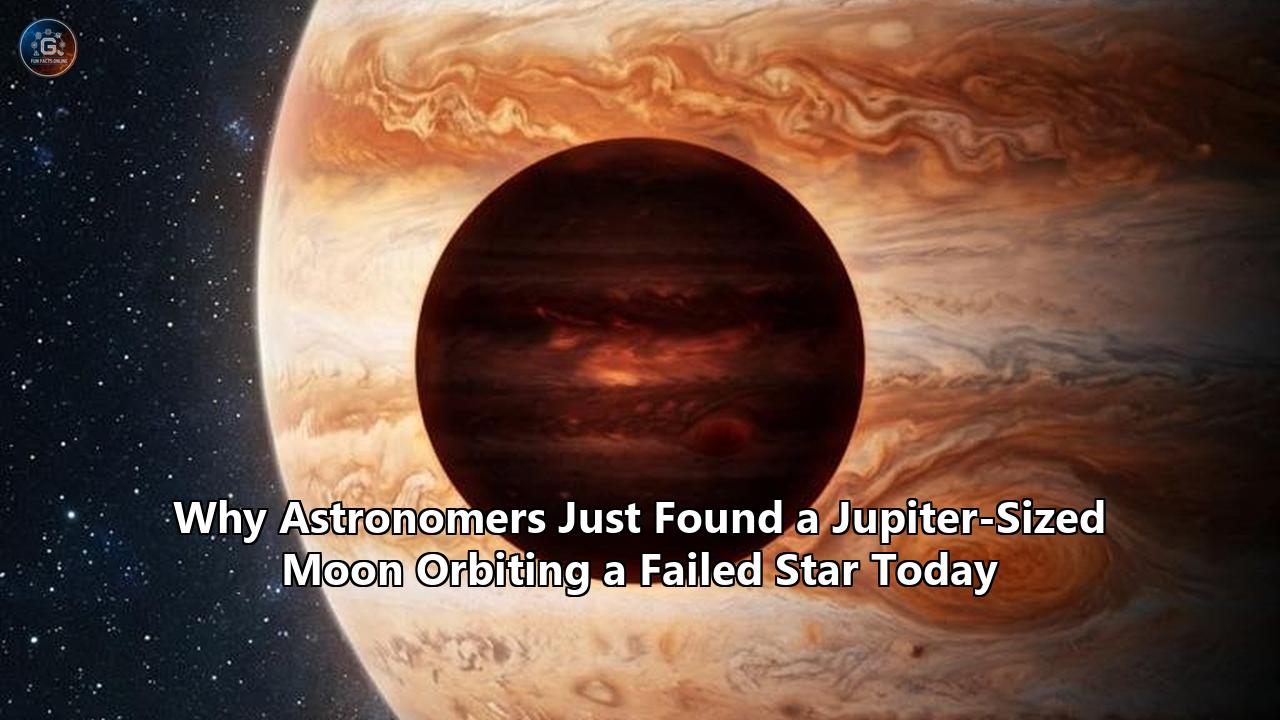
A 170-day gravitational wobble detected 73 light-years from Earth has delivered one of the most perplexing astronomical revelations in recent years. In a paper published July 22, 2026, in Nature, an international research team led by Kevin Hoy, an astrophysicist at the European Southern Observatory (ESO) and Chile's Universidad Diego Portales, confirmed the detection of a gas giant roughly the mass of Jupiter orbiting a brown dwarf in the CD-35 2722 star system.
Because the host brown dwarf is itself in a 5,000-year orbit around a small M-dwarf star, the newly detected object occupies the third tier of a nested cosmic hierarchy. By definition, an object orbiting a body that orbits a star functions as a moon. Yet this object possesses a minimum mass equal to 90% that of Jupiter, making it thousands of times more massive than any satellite in our solar system.
The finding was made using the Cryogenic High-Resolution Infrared Echelle Spectrograph (CRIRES+) mounted on ESO's Very Large Telescope (VLT) at the Paranal Observatory in Chile. Across 23 distinct observation nights spanning more than two years, researchers measured periodic Doppler shifts in the light emitted by the brown dwarf CD-35 2722 B. The periodic subtle velocity shifts revealed that an unseen companion weighing nearly as much as Jupiter was tugging the failed star back and forth every 170 days.
"This system is somewhat hard to define using Solar System-based words like 'planet' and 'moon,'" Hoy noted in a statement released alongside the paper. "The exosatellite is clearly massive enough to be a planet, but it does not orbit a star, though it orbits an object that orbits a star. Being the third wheel in this system makes us want to call it a moon, even if it is nothing like the small, rocky moons we have in our system".
This jupiter-sized moon discovery challenges traditional planetary classifications and stretches existing theories of how celestial bodies form. By presenting an architecture where the lines between star, planet, and satellite blur, the discovery highlights fundamental flaws in astronomical definitions and exposes critical gaps in planetary formation physics.
                     CD-35 2722 SYSTEM HIERARCHY
                     ===========================

                   [ CD-35 2722 A ]  (Red Dwarf Star)
                          |  (~0.5 Solar Mass)
                          |
                          |  5,000-Year Orbit
                          v
                   [ CD-35 2722 B ]  (Brown Dwarf / "Failed Star")
                          |  (~33-37 Jupiter Masses)
                          |
                          |  170-Day Orbit
                          v
                   [ Exosatellite ]  (~0.9-1.0 Jupiter Mass)
The Taxonomic Crisis: When a "Moon" Rivaling Jupiter Breaks Celestial Rules
The primary challenge highlighted by this finding is a breakdown in how astronomers define celestial bodies. For decades, cosmic nomenclature relied on the neat, ordered hierarchy of our own solar system: stars sit at the center, planets orbit stars, and moons orbit planets. The International Astronomical Union (IAU) formalized these categories in 2006, requiring a planet to orbit a star, possess sufficient mass to achieve hydrostatic equilibrium, and clear its orbital neighborhood.
That framework crumbles when applied to CD-35 2722 B and its companion. A brown dwarf is a substellar object often termed a "failed star". With a mass between 13 and 80 times that of Jupiter, a brown dwarf is heavy enough to initiate the nuclear fusion of deuterium (heavy hydrogen) in its core, but lacks the gravitational pressure required to fuse ordinary hydrogen and shine as a true main-sequence star.
Because brown dwarfs bridge the boundary between giant planets and stellar objects, catalogers routinely struggle with where to place them. Some astronomy databases list brown dwarfs as low-mass stars, while others classify them as ultra-massive exoplanets.
+-------------------------------------------------------------------------------+
|                        THE SUBSTELLAR MASS SPECTRUM                           |
+-------------------------------------------------------------------------------+
| Mass Range      | Category            | Physical Core Characteristics          |
+-----------------+---------------------+---------------------------------------+
| < 13 M_Jupiter  | Planet / Exoplanet  | No nuclear fusion                     |
| 13–80 M_Jupiter | Brown Dwarf         | Fuses Deuterium only ("Failed Star")  |
| > 80 M_Jupiter  | Main-Sequence Star  | Fuses Hydrogen (Sustained Stellar)    |
+-------------------------------------------------------------------------------+
If the primary host—a 37-Jupiter-mass brown dwarf—is considered a failed star rather than a planet, then its orbiting companion could technically be defined as a planet orbiting a companion star. However, because the brown dwarf itself orbits a true red dwarf star (CD-35 2722 A) at a wider distance, the Jupiter-mass body occupies a third orbital tier. In classical orbital dynamics, an object occupying a third-tier orbit around a non-stellar host is a satellite.
This creates an operational dilemma:
- Mass perspective: The object has a minimum mass of ~0.9 Jupiter masses, making it undeniably a gas giant planet by compositional standards.
- Orbital hierarchy perspective: The object circles a companion that circles a host star, matching the structural definition of a moon.
- Scale perspective: Saturn’s Titan and Jupiter’s Ganymede—the largest moons in our solar system—have masses roughly 0.02% that of their host planets. In contrast, this newly found companion possesses 2.5% of the total mass of its host brown dwarf.
Mary Anne Limbach, an exoplanet researcher at the University of Michigan who was not involved in the study, noted that existing terminology is increasingly ill-suited for extra-solar discoveries. "Most people in the astronomical community would probably hesitate to call this an exomoon," Limbach observed, pointing out that our taxonomy is rooted in solar system biases that nature frequently ignores.
David Kipping, leader of the Cool Worlds Lab at Columbia University and a pioneer in exomoon searches, echoed this sentiment: "Nature doesn't give a damn about how humans want to neatly bucket things. Even if this isn't a traditional exomoon, we are definitely entering the exomoon regime now". To avoid forcing an inaccurate label onto the discovery, Hoy's team adopted the broader neutral term exosatellite in their Nature paper.
The Astrophysical Dilemma: Straining Formation Models
Beyond the semantic conflict lies a deeper scientific problem: current astrophysical models of planet and moon formation cannot easily explain how a Jupiter-sized object forms in a close 170-day orbit around a brown dwarf.
Within planetary science, giant moons and gas giant planets are understood to form through distinct physical pathways:
1. Core Accretion in Circumstellar Disks
In standard core accretion, dust grains within a protoplanetary disk around a young star collide and stick together, building a rocky core of 10 to 15 Earth masses over millions of years. Once this core reaches critical mass, its gravity rapidly pulls in gas from the surrounding disk, swelling into a gas giant like Jupiter or Saturn.
2. Circumplanetary Disk Accretion
Moons around giant planets typically assemble inside a "circumplanetary disk"—a secondary mini-disk of dust and gas that feeds onto the growing planet. Because circumplanetary disks contain only a tiny fraction of the planet's mass, they produce relatively lightweight, rocky or icy moons like Io, Europa, Ganymede, and Callisto.
3. Gravitational Instability
If a protoplanetary disk is massive and cold enough, a patch of gas can collapse rapidly under its own self-gravity, forming a gas giant planet directly without requiring a solid rocky core first.
+-----------------------------------------------------------------------------------+
|                        THEORETICAL FORMATION PATHWAYS                             |
+-----------------------------------------------------------------------------------+
| Mechanism                | Standard Target Site      | Challenge in CD-35 2722   |
+--------------------------+---------------------------+----------------------------+
| Core Accretion           | Stellar Protoplanetary    | Disk mass around brown     |
|                          | Disks                     | dwarf is too low           |
+--------------------------+---------------------------+----------------------------+
| Circum-Substellar Disk   | Mini-Disks surrounding    | Insufficient material to   |
| Accretion                | Young Brown Dwarfs        | build 1 Jupiter mass       |
+--------------------------+---------------------------+----------------------------+
| Gravitational            | Outer Edges of Massive    | Requires wide orbits       |
| Instability              | Disks (> 50 AU)           | (> 50 AU), not 170 days    |
+--------------------------+---------------------------+----------------------------+
| Binary Fragment Collapse | Molecular Cloud Core      | Explains mass, but tight   |
|                          | Fragmentation             | orbital spacing is rare    |
+-----------------------------------------------------------------------------------+
When applied to the recent jupiter-sized moon discovery, every single one of these traditional mechanisms hits theoretical limits:
- The Circum-Substellar Disk Limit: Brown dwarfs form with tiny protoplanetary disks compared to main-sequence stars. A brown dwarf with 37 Jupiter masses typically anchors a disk containing only a few Earth masses of total gas and dust. Accreting a full Jupiter mass of gas out of such a depleted reservoir inside a 170-day orbit is extremely difficult according to existing disk dynamics models.
- The Gravitational Instability Problem: While gravitational instability can form gas giant bodies quickly, hydrodynamic simulations consistently show that disk fragmentation occurs at wide radial distances—typically 50 to 100 astronomical units (AU) away from the host body. The exosatellite in CD-35 2722, however, orbits closely to its brown dwarf host.
- Comparison with Wide Systems: Astronomers have previously detected planetary-mass companions around isolated brown dwarfs, such as the famous 2M1207 system discovered in 2005. In 2M1207, a 5-Jupiter-mass companion orbits a brown dwarf at a distance of 55 AU on a 20,000-year path. In that wide-separation scenario, the companion likely formed through cloud fragmentation like a binary star system.
"This system is meaningfully different from 2M1207 because of the mass ratios and separations involved," Hoy explained. "In CD-35 2722, the satellite has about 2.5% of the mass of its host brown dwarf and orbits on a tight 170-day period. Furthermore, the host brown dwarf is bound to a primary star on a 5,000-year orbit".
To verify their orbital calculations, Hoy’s research group ran extensive N-body computer simulations. They tested two mathematical models capable of fitting the radial velocity measurements: a single Jupiter-mass object on an eccentric 170-day orbit, or a pair of smaller resonant planets on tighter orbits.
The simulations demonstrated that a two-planet configuration in that environment would destabilize quickly, flinging the bodies out of the system within a few hundred years. The single-companion model—a giant exosatellite locked in a stable 170-day loop—proved to be the only dynamically viable solution over million-year timescales.
Why Spotting Exomoons Has Defied Astronomers for Decades
The discovery highlights a long-standing observational obstacle: extrasolar moons are among the most difficult objects in astrophysics to detect and confirm.
While astronomers have confirmed over 5,600 exoplanets since 1995 using the transit and radial velocity methods, exomoons have remained elusive. The primary techniques used to find exoplanets face severe physical constraints when scaled down to satellites:
1. The Transit Method Barrier
When an exoplanet passes in front of its parent star, it blocks a small fraction of starlight, creating a periodic dip in brightness. Finding a moon requires detecting a tiny "secondary dip" or measuring minuscule variations in the timing of the planet’s transit (Transit Timing Variations, or TTVs) caused by the moon's gravitational tug. Because typical moons are small and rocky, their transit signatures are routinely buried in stellar noise, stellar flaring, and instrument drift.
Past exomoon candidates identified via transits have faced intense scrutiny. In 2018, a potential Neptune-sized exomoon candidate was reported orbiting the giant exoplanet Kepler-1625b. Subsequent re-analyses of the Hubble Space Telescope data by independent teams questioned the signal, attributing it to data processing artifacts and leaving the candidate unconfirmed. Similarly, indirect evidence of a volcanic, Io-like rocky moon around the exoplanet WASP-49b—inferred from sodium gas cloud emissions—remains an unproven hypothesis rather than a direct structural detection.
+------------------------------------------------------------------------------------+
|                         EXOMOON DETECTION METHODS COMPARED                         |
+------------------------------------------------------------------------------------+
| Method               | How It Works                      | Major Limitation       |
+----------------------+-----------------------------------+------------------------+
| Transit Light Curve  | Measures faint secondary dip as   | High false-positive    |
| (Hubble / Kepler)    | moon crosses star                 | rate; stellar noise    |
+----------------------+-----------------------------------+------------------------+
| Transit Timing       | Watches for gravitational wobbles | Requires decades of    |
| Variations (TTV)     | in planet's transit schedule      | continuous light curves|
+----------------------+-----------------------------------+------------------------+
| Volcanic Gas Cloud   | Detects spectroscopic emissions   | Indirect inference;    |
| Tracing (e.g. WASP)  | (e.g., sodium) from active moons  | moon itself unobserved |
+----------------------+-----------------------------------+------------------------+
| High-Resolution      | Tracks Doppler wobbles of host    | Requires wide angular  |
| Radial Velocity      | body via high-precision infrared  | separation from main   |
| (VLT / CRIRES+)      | spectrographs                     | bright star            |
+------------------------------------------------------------------------------------+
2. High-Contrast Spectroscopic Isolation
To find the candidate in the CD-35 2722 system, the team avoided traditional transit monitoring and instead turned to high-precision infrared radial velocity spectroscopy with CRIRES+ on the VLT.
The observation succeeded because of a rare geometric advantage in the system. The primary M-dwarf star (CD-35 2722 A) and the brown dwarf (CD-35 2722 B) are separated by roughly 2.8 arcseconds in the sky. That angular separation was wide enough for the VLT to point CRIRES+ directly at the brown dwarf while blocking out the glaring light of the primary star.
By isolating the infrared light of the brown dwarf, Hoy and his colleagues obtained spectral measurements up to 100 times more precise than previous studies of brown dwarf companions. Over two years, they observed the absorption lines of the brown dwarf shifting back and forth along the line of sight.
The Doppler shifts revealed a maximum orbital velocity change of several dozen meters per second, repeating on a 170-day cycle. That precise velocity variation provided direct evidence of an unseen satellite whose gravitational mass matches Jupiter.
The Solution Strategy: How Researchers Are Rethinking the Cosmos
Faced with structural taxonomies that fail and formation models that struggle to explain gas giant satellites, international astronomical organizations and research teams are executing a multi-part strategy to resolve these scientific challenges.
+------------------------------------------------------------------------------------+
|                         THREE-PRONGED RESEARCH STRATEGY                            |
+------------------------------------------------------------------------------------+
|                                                                                    |
|  [ 1. TAXONOMIC REFORM ] ---> Transition to Quantitative Frameworks                |
|                               Mass Ratios (q = m_sat / m_host) & Binding Energy    |
|                                                                                    |
|  [ 2. ADVANCED OBSERVATIONS ] -> Direct Imaging & Spectroscopy                     |
|                               JWST Phase Curves & ESO ELT Atmospheric Profiling    |
|                                                                                    |
|  [ 3. DISK HYDRODYNAMICS ] -> High-Resolution Simulations                          |
|                               Modeling Gas Capture in Circum-Substellar Disks      |
|                                                                                    |
+------------------------------------------------------------------------------------+
1. Reforming Planetary and Satellite Nomenclature
Rather than relying on solar system labels, planetary scientists are pushing to update IAU definitions by introducing quantitative physical parameters:
- Mass Ratio Classification ($q$): Researchers propose categorizing systems based on the mass ratio $q = m_{\text{satellite}} / m_{\text{primary}}$. In systems where $q < 0.05$ (like CD-35 2722, where $q \approx 0.025$), the companion is formally defined as an exosatellite, regardless of whether its absolute mass is comparable to Earth or Jupiter.
- Formation-Based Classification: Proponents suggest classifying objects by how they formed rather than where they currently orbit. Under this framework, an object formed via core accretion within a host disk is labeled a planet or moon, whereas an object formed via gravitational cloud collapse is classified as a low-mass companion star or brown dwarf, irrespective of its final orbital location.
2. Targeted Follow-Up via Space Telescopes
To test whether the satellite formed via core accretion or gravitational collapse, astronomers are preparing target proposals for the James Webb Space Telescope (JWST) and ground-based facilities:
- JWST Atmospheric Profiling: JWST’s Near-Infrared Spectrograph (NIRSpec) and Mid-Infrared Instrument (MIRI) can analyze the atmospheric composition of both the brown dwarf and its exosatellite. Measuring carbon-to-oxygen (C/O) ratios and metallicity will help identify how the pair formed. High metallicity relative to the primary star would confirm core accretion in a disk, whereas an identical chemical footprint would point to binary cloud collapse.
- ALMA Submillimeter Disk Surveys: Researchers are using the Atacama Large Millimeter/submillimeter Array (ALMA) in Chile to search for active dust and gas disks surrounding young brown dwarfs in nearby star-forming regions like the Orion Nebula and Taurus. Detecting massive circum-substellar disks will help determine whether brown dwarfs can host enough raw material to assemble giant satellites.
3. Next-Generation Hydrodynamic Simulations
Astrophysicists are updating computer models of circum-substellar accretion disks. Early disk models assumed that photoevaporative radiation from nearby stars rapidly stripped gas away from brown dwarf disks, preventing the growth of giant companions.
Newer simulations incorporating disk magnetic fields, dust grain migration, and gas inflow from the outer stellar environment suggest that brown dwarf disks can be replenished over time, providing sufficient material to build gas giant companions in tight orbits.
The breakthrough jupiter-sized moon discovery serves as a primary benchmark for these updated models, offering researchers real-world orbital constraints to calibrate their code.
Implications for Astronomy and What Happens Next
The discovery of a Jupiter-mass satellite orbiting a brown dwarf alters our understanding of planetary systems across the Milky Way. It demonstrates that multi-tiered, hierarchical architectures are not limited to small, rocky solar system moons, but can form at vast gas-giant scales.
"The satellite we report is a giant gaseous body orbiting a highly massive companion, itself several times the mass of Jupiter," explained Alice Zurlo, director of the Millennium Nucleus of Young Exoplanets and their Moons (YEMS) and study co-author. "This system highlights how different planetary systems can be from the familiar structure of the solar system".
+------------------------------------------------------------------------------------+
|                             UPCOMING RESEARCH MILESTONES                           |
+------------------------------------------------------------------------------------+
| Timeline     | Event / Facility              | Research Goal                       |
+--------------+-------------------------------+-------------------------------------+
| Late 2026    | VLT / CRIRES+ Follow-Up       | Refine orbital eccentricity and     |
|              | Long-term Monitoring          | search for additional inner bodies  |
+--------------+-------------------------------+-------------------------------------+
| 2027–2028    | JWST Cycle 6 Observations     | Measure atmospheric composition and |
|              | Spectroscopy                  | determine Carbon-to-Oxygen ratios   |
+--------------+-------------------------------+-------------------------------------+
| Late 2020s   | ALMA Disk Census              | Survey young brown dwarf disks for  |
|              | Submillimeter Mapping         | satellite-forming reserves          |
+--------------+-------------------------------+-------------------------------------+
| 2028+        | Extremely Large Telescope     | Directly image the exosatellite and |
|              | (ESO ELT First Light)         | separate its spectral light         |
+------------------------------------------------------------------------------------+
Several upcoming observational milestones will build on these results:
- Refining Orbital Parameters: Hoy’s team is continuing long-term radial velocity monitoring with CRIRES+ to measure the precise eccentricity of the satellite's 170-day orbit. Determining whether the orbit is circular or highly stretched will reveal whether the companion evolved peacefully in a disk or underwent chaotic dynamical scattering.
- Searching for Additional Satellites: Researchers are analyzing residual Doppler variations in the VLT data to determine if smaller, Earth- or Neptune-mass moons share the brown dwarf's orbital neighborhood.
- Direct Imaging via the Extremely Large Telescope (ELT): When ESO’s 39-meter ELT opens its eyes in Chile later this decade, its high-contrast adaptive optics systems will attempt to directly capture photons from the exosatellite. Direct imaging will allow astronomers to measure the object's thermal glow, radius, and atmospheric cloud structure without relying solely on radial velocity signatures.
By revealing that giant moons can form around substellar hosts in complex star systems, the research opens a new frontier in extrasolar dynamics. As observational precision improves, astronomy is moving past solar system analogies to embrace a universe far more diverse, complex, and unscripted than standard theories ever predicted.
Reference:
- https://www.iflscience.com/super-weird-star-system-has-clearest-evidence-yet-of-a-moon-like-object-beyond-our-solar-system-but-its-nothing-like-the-moons-back-home-84180
- https://www.eso.org/public/news/eso2610/
- https://mashable.com/science/exomoon-candidate-orbiting-brown-dwarf
- https://dailygalaxy.com/2026/07/a-giant-moon-beyond-the-solar-system/
- https://physicsworld.com/a/discovery-of-giant-exosatellite-challenges-our-notion-of-what-makes-a-moon/
- https://www.sciencenews.org/article/exoplanet-object-moon-planet-unknown
- https://skyandtelescope.org/astronomy-news/new-contender-for-exomoon-title-elicits-skepticism/
- https://time.com/article/2026/07/22/astronomers-discover-exomoon/
- https://eos.org/research-and-developments/scientists-might-have-detected-the-first-moon-outside-our-solar-system-it-just-depends-how-you-define-moon