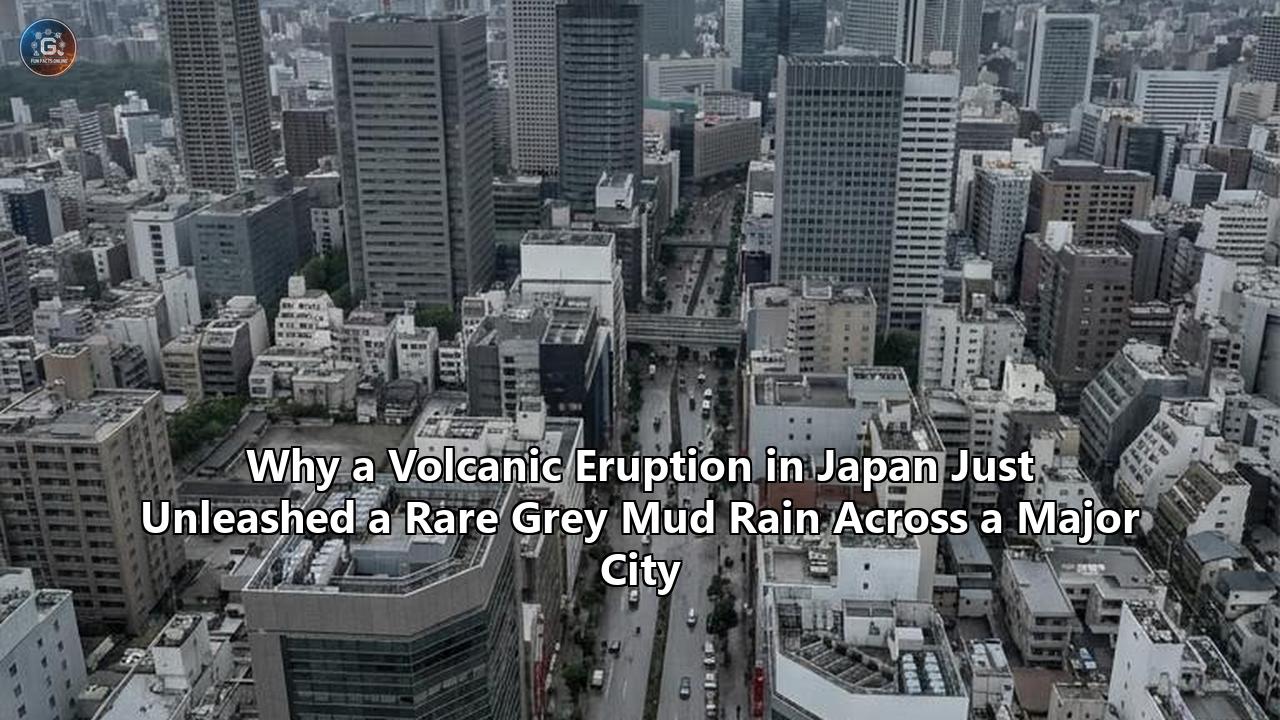
Early in the morning on Sunday, June 7, 2026, residents of Kagoshima, a bustling coastal city of over 600,000 in southern Japan, awoke to a surreal and deeply unsettling sight. The sky, which should have been brightening with the dawn, was replaced by an oppressive, deep-grey twilight. Soon after, it began to rain—but this was no ordinary precipitation. Instead of clear water, the clouds released a thick, sticky, cement-like slurry. Within minutes, streets, windshields, tram tracks, and buildings across the city were coated in a heavy layer of dark grey muck.
This rare and highly disruptive phenomenon, known as volcanic mud rain, was the direct result of a sudden explosive eruption at Mount Sakurajima, one of Japan's most active and closely monitored volcanoes, which perfectly intersected with a passing meteorological low-pressure system.
The Kagoshima Local Meteorological Observatory reported that Mount Sakurajima’s Minamidake summit crater erupted at 6:52 a.m. local time, sending a dense plume of gas and volcanic ash roughly 1,300 meters (4,300 feet) into the atmosphere. While a 1,300-meter plume is considered moderate for Sakurajima—which occasionally hurls ash several kilometers high—the meteorological conditions surrounding the volcano on June 7 were highly unusual.
A low-pressure system moving along the southern coast of Kyushu was simultaneously dragging rain clouds across the region while generating strong, low-altitude easterly winds. These winds acted as a direct conveyor belt, pushing the freshly erupted ash plume westward across the narrow four-kilometer stretch of Kinko Bay and straight into the path of the incoming storm over Kagoshima City.
When the dense, superheated volcanic cloud collided with the cold moisture of the rain system, it triggered a rare atmospheric reaction. Instead of dispersing into the wind or falling as dry, powdery dust, the ash was violently washed out of the sky, falling as a destructive, liquid volcanic mud rain.
The resulting mess brought portions of the city to a standstill. Train and tram services faced immediate delays, visibility on municipal roads plummeted to near-zero, forcing drivers to navigate with their headlights on in the middle of the day, and local authorities issued urgent warnings advising residents to wear goggles and industrial masks to prevent respiratory and eye damage.
While the citizens of Kagoshima are highly resilient and famously accustomed to dealing with dry volcanic ash, this wet, heavy mud rain presented an entirely different set of physical, chemical, and logistical challenges. To understand why this event occurred and why it matters to volcanologists and urban planners worldwide, we must look at the complex atmospheric physics, chemistry, and meteorology behind it.
Anatomy of a Sky-Slurry: How Volcanic Mud Rain Forms
At the heart of the June 7 event is a process known to atmospheric scientists as "wet deposition". To understand how dry volcanic ash transforms into a falling liquid paste in the sky, it is necessary to first understand what volcanic ash actually is.
Despite its name, volcanic ash is not the soft, fluffy byproduct of combustion, like the ash left behind by a campfire or a wood-burning stove. Instead, it consists of microscopic, jagged fragments of pulverized volcanic glass (silica), crystalline minerals (such as feldspar and pyroxene), and rock. Because these particles are essentially tiny shards of rock, they are incredibly dense, hard, and completely insoluble in water.
[Volcanic Eruption] ---> Spews fine silicate ash & acidic gases (SO2, HCl) into troposphere
                                     |
                                     v
[Low-Pressure Storm] --> Delivers highly humid air & low-altitude wind
                                     |
                                     v
[Atmospheric Mixing] --> Ash particles act as Cloud Condensation Nuclei (CCN)
                                     |
                                     v
[Wet Deposition] ------> Ash aggregates with water droplets, falling as Volcanic Mud Rain
When a volcano like Sakurajima erupts, it injects billions of these microscopic glass shards into the air. In dry weather, these particles drift downwind and slowly settle to the earth via dry deposition, covering surfaces in a light, dusty veil that can be easily swept or blown away.
However, when an eruption cloud intersects with a humid, rain-bearing weather front, a highly efficient scavenging process begins:
- Cloud Condensation Nuclei (CCN): Volcanic ash particles are highly hygroscopic—meaning they have a natural affinity for water. In the humid environment of a storm, these microscopic particles act as incredibly effective cloud condensation nuclei. Water vapor in the atmosphere rapidly condenses around the surface of each individual ash grain, forming water droplets.
- Heterogeneous Nucleation: Research published by atmospheric scientists at institutions like Lawrence Livermore National Laboratory (LLNL) highlights that volcanic aerosols serve as primary sites for ice and water crystallization. In a wet storm system, this process, known as heterogeneous nucleation, accelerates the conversion of atmospheric vapor into heavy liquid droplets.
- Accretion and Aggregation: As the newly formed water droplets travel through the dense core of the volcanic plume, they collide with other falling ash particles. Rather than bouncing off, the wet surfaces of the particles cause them to stick together, forming larger, heavier aggregates. This clumping mechanism rapidly increases the settling velocity of the ash.
- The Falling Slurry: Once these ash-and-water aggregates grow too heavy to be supported by atmospheric updrafts, they fall to the ground. Because the ratio of solid ash to liquid water in the column is incredibly high, the precipitation does not fall as muddy water, but rather as a highly concentrated, viscous slurry—the dreaded volcanic mud rain.
Meteorological Collusion: The Perfect Atmospheric Alignment
The reason volcanic mud rain is a relatively rare hazard, even for a city built at the foot of an active volcano, is that it requires a highly precise, simultaneous alignment of volcanic activity and local meteorological conditions. If the eruption occurs hours before or after a rainstorm, or if the wind is blowing in a different direction, the city experiences either dry ashfall or clean rain—never the combined slurry.
On June 7, 2026, the meteorological conditions over Kyushu aligned in a worst-case scenario for Kagoshima City.
The Low-Pressure Conveyor Belt
According to weather maps from the Japan Meteorological Agency (JMA), a prominent low-pressure system was tracking slowly eastward along the southern coastline of Kyushu. This system was responsible for bringing unstable, highly humid air masses from the Pacific Ocean inland over the mountainous prefecture.
At the same time, the counterclockwise rotation of the low-pressure system generated persistent, low-altitude winds blowing from the east. Because Mount Sakurajima sits in Kinko Bay, directly east of Kagoshima's urban center, any low-altitude winds from the east act as a direct conveyor belt, carrying volcanic emissions straight into the city.
The Altitude Intersection
For mud rain to form, the wind must carry the volcanic plume at the exact altitude where rain-producing clouds are actively developing. On this Sunday morning, Sakurajima's plume rose to 1,300 meters—roughly 4,300 feet. This is the classic altitude of low-level nimbostratus and cumulus rain clouds associated with coastal low-pressure systems.
Because the volcanic plume did not have the explosive energy to punch past the weather system into the dry upper stratosphere, its entire mass of fine silicates and volcanic gases was trapped within the active rain-producing boundary layer of the troposphere. The storm clouds and the volcanic cloud essentially merged into a single, cohesive, mud-producing engine directly above the city’s most densely populated districts.
The Chemistry of Sky-Cement: Why Wet Ash is So Dangerous
To the average observer, wet ash might look like ordinary garden mud. However, its chemical and physical properties make it far more dangerous and destructive than organic soil. When volcanic ash mixes with rainwater, it undergoes a transformation that alters its physical behavior, electrical conductivity, and acidity.
1. High Abrasiveness and the "Concrete" Effect
Because volcanic ash is composed of angular, jagged shards of silica glass and rock, it has an incredibly high internal friction coefficient. When dry, these particles slide past one another like fine sand. But when mixed with just enough water to fill the gaps between the particles, the surface tension of the water draws the jagged grains tightly together.
This creates a highly viscous paste that behaves less like mud and more like wet concrete. If left to dry on roads, roofs, or vehicle windshields, it can harden into a dense, solid crust that is incredibly difficult to remove without high-pressure water blasting.
2. Acidic Coating and Chemical Corrosion
Volcanic plumes do not just contain rock fragments; they are also heavily laden with volatile acidic gases, primarily sulfur dioxide ($SO_2$), hydrogen chloride ($HCl$), and hydrogen fluoride ($HF$). As these gases cool within the eruption plume, they undergo adsorption, sticking to the outer surfaces of the falling ash particles.
When rainwater mixes with these gas-coated particles, it dissolves the acids, turning the falling mud rain into a highly corrosive, low-pH liquid.
| Chemical Compound | Source | Effect in Mud Rain |
|---|---|---|
| Silica Glass ($SiO_2$) | Pulverized Magma | Creates high physical abrasiveness; scratches glass and paint |
| Sulfur Dioxide ($SO_2$) | Magmatic Gas | Dissolves in water to form sulfurous and sulfuric acid; corrodes metals |
| Hydrogen Chloride ($HCl$) | Magmatic Gas | Dissolves in water to form hydrochloric acid; highly corrosive to infrastructure |
| Sodium/Potassium Salts | Mineral Ash | Increases electrical conductivity of the wet slurry; causes grid short-circuits |
This high acidity is why municipal authorities in Kagoshima issued immediate notices on June 7 advising car owners to wash their vehicles with fresh water as soon as possible. If left on a car’s exterior, the acidic mud rain can chemically etch the clear coat, permanently ruin paint jobs, and rapidly corrode chrome trim and exposed undercarriage metals.
Municipal Paralysis: The Impact on Kagoshima’s Infrastructure
The arrival of the volcanic mud rain on Sunday morning triggered a rapid, well-coordinated response from Kagoshima’s municipal government, but not before the slurry could cause widespread disruption to the city's vital infrastructure.
               [Volcanic Mud Rain Hits Kagoshima]
                               |
      +------------------------+------------------------+
      |                        |                        |
      v                        v                        v
[Transit Gridlock]    [Electrical Hazard]      [Air Quality Emergency]
 - Poor road visibility   - Conductive wet mud    - Fine silicates suspended
 - Slurry on tram tracks  - Threat of arc flashes   - Goggles/masks ordered
 - Train service delays   - Power grid risks       - Severe hazard to lungs
The Tramway and Rail Gridlock
One of the most immediate casualties of the storm was the city’s public transit network. Kagoshima relies heavily on a historic and highly efficient street-level tramway system. The tram tracks, which are embedded directly into the city's main thoroughfares, quickly acted as catch-basins for the falling mud.
As the steel wheels of the trams compressed the wet, highly abrasive silicate slurry against the rails, it created a severe risk of derailment and rapidly ground down the wheel flanges and track switch mechanisms. Operators were forced to halt or severely slow tram services until specialized cleaning crews could physically clear the tracks.
Similarly, regional JR rail services experienced delays due to near-zero visibility. Because the wet mud coated the windshields of trains, standard wiper systems were ineffective; using wipers on wet silicate ash simply grinds the hard glass shards across the windshield, permanently scratching and clouding the glass. Drivers had to operate at highly reduced speeds, relying on manual safety signals.
The Conductive Threat to the Power Grid
For electrical engineers, wet volcanic ash is one of the most dangerous substances in nature. While dry volcanic ash is an excellent electrical insulator, wet volcanic ash is highly conductive. This is because the water dissolves the soluble sulfate and chloride salts coated onto the surface of the ash particles, turning the slurry into an electrolyte paste.
If this conductive mud rain coats high-voltage ceramic insulators on utility poles and substations, it can bridge the gap between the live electrical wire and the grounded metal support structure. This leads to a phenomenon known as "flashover"—a massive, high-energy short circuit that can blow transformers, melt power lines, and cause widespread blackouts.
To prevent a catastrophic failure of the regional grid, Kyushu Electric Power utility crews were placed on high alert, monitoring key substations and using specialized non-conductive water sprays to flush critical insulators before the mud could dry and form a permanent conductive bridge.
Cleaning Up the Slurry
By Monday morning, June 8, 2026, the wind direction near Sakurajima had fortunately shifted eastward, carrying any remaining volcanic activity away from the city and toward the less populated Tarumizu and Kanoya areas.
Taking advantage of this window, Kagoshima City mobilized an armada of over 60 mechanical street sweepers and high-pressure water-spraying vehicles. Crews worked around the clock to flush the grey slurry off the streets and into the storm drains before the Monday morning rush hour.
However, even this cleaning process is fraught with difficulty. Because volcanic ash is incredibly dense—weighing up to twice as much as normal soil when wet—dumping thousands of tons of this slurry into a city's storm drainage system can quickly clog pipes, leading to severe localized urban flooding if subsequent rainstorms hit. Municipal workers had to manually shovel and dredge the heaviest deposits from roadside gutters, transferring the grey muck to designated volcanic ash reclamation sites.
Living in the Shadow: Responding to a Persistent Neighbor
To understand why Kagoshima is so uniquely prepared for—yet deeply frustrated by—this weekend’s event, one must examine the city’s long, complex relationship with Mount Sakurajima.
Sakurajima is a massive, 1,117-meter stratovolcano that dominates the horizon of Kagoshima Bay. It sits within the Aira Caldera, a colossal 20-kilometer-wide volcanic crater formed by a massive super-eruption roughly 22,000 years ago.
For centuries, Sakurajima was a true island. However, during the cataclysmic Taisho Eruption of 1914—the most powerful volcanic eruption in 20th-century Japanese history—the volcano spewed so much lava that it completely filled the narrow strait separating the island from the mainland to the east, permanently connecting Sakurajima to the Osumi Peninsula.
Today, the volcano is in a state of near-continuous low-level activity. It erupts hundreds of times a year, meaning that the citizens of Kagoshima are arguably the most volcano-resilient population on Earth.
- The Yellow Ash Bags: The city distributes specialized yellow plastic bags specifically designed for volcanic ash disposal. Residents sweep dry ash from their driveways and sidewalks, place it in these bags, and deposit them at thousands of designated "ash collection points" around the city.
- School Helmets: Children attending schools within the immediate fallout zone of the volcano are routinely issued hard hats to wear during their daily commute to protect them from falling volcanic blocks or debris.
- Ash Shelters: Concrete shelters are positioned along roadsides and near schoolyards, providing immediate refuge in the event of a sudden, larger-scale explosive eruption.
Yet, despite this incredible infrastructure of preparedness, the sudden transformation of dry ash into wet mud rain bypasses many of these standard defenses. You cannot easily sweep wet slurry into a standard yellow ash bag; it must be hosed down, shoveled, or vacuumed before it dries. This is why local bloggers and residents described the June 7 event as having a distinct "doomsday feeling". The familiar, manageable nuisance of volcanic ash had suddenly mutated into a heavy, corrosive, and highly invasive liquid mud that coated their lives.
Looking Forward: "The Magma Chamber is Still Pushing"
While the immediate clean-up efforts in Kagoshima City are well underway, volcanologists are keeping a highly anxious eye on Mount Sakurajima's deep plumbing system.
The Japan Meteorological Agency has maintained a Volcanic Alert Level 3 (on a 5-level scale) for the volcano, which strictly prohibits anyone from approaching within two kilometers of the active Minamidake and Showa craters.
More concerning, however, is the long-term data being gathered by JMA’s highly sophisticated network of ground-deformation sensors, tiltmeters, and GPS stations situated around the mountain.
In a press briefing following the eruption, JMA officials warned that the volcano's deep magma chamber—located beneath the Aira Caldera in the bay—is continuing to inflate, causing a slight but steady "swelling" of the mountain's flanks. This continuous crustal deformation indicates that magma is still actively rising from the mantle into the shallow reservoirs beneath the volcano.
"This year's eruptions have shown a notable increase in baseline pressure and volume," noted a local volcanologist monitoring the site. "The swelling we are detecting suggests that the June 7 eruption was merely a pressure-release valve, and it has not fully depleted the energy building up below. We must remain highly vigilant for the possibility of larger, more explosive events in the coming weeks."
[Deep Mantle Source] ---> Feeds Magma into Aira Caldera Reservoir
                                     |
                                     v
[Magma Chamber Inflation] --> Causes measurable crustal swelling (detected by JMA)
                                     |
                                     +---> [Scenario A: Continued small eruptions (Alert Level 3)]
                                     |
                                     +---> [Scenario B: Major pressure buildup (Risk of larger eruption)]
The Threat of Lahars
Beyond the threat of another airborne ash plume, scientists are deeply concerned about the secondary threat of lahars—deadly volcanic mudflows.
With massive volumes of loose, freshly erupted volcanic ash now sitting unstable on the steep upper slopes of Mount Sakurajima, any heavy rainfall from the ongoing summer low-pressure systems could easily liquefy these deposits.
Unlike the relatively thin mud rain that fell on the city, a lahar is a rapid, high-density torrent of boiling water, ash, and large boulders that can tear down the volcano's river valleys at speeds exceeding 60 kilometers per hour, obliterating any infrastructure or settlements in its path. Municipal sensors along the mountain's active drainage channels are being monitored around the clock to provide early warnings to low-lying coastal communities.
The rare and dramatic volcanic mud rain that blanketed Kagoshima on June 7, 2026, serves as a stark reminder of the complex, interconnected nature of our planet's systems. It demonstrates that volcanic hazards do not exist in a vacuum; rather, they interact dynamically with our atmosphere, our weather patterns, and our built environments.
As the citizens of Kagoshima finish washing the grey sludge from their streets and cars, the world’s geologists and meteorologists will continue to study this event. The data gathered from this rare intersection of wind, rain, and shattered earth will help refine predictive models for multi-hazard volcanic events worldwide, ensuring that cities built in the shadow of giants are better prepared for whatever falls from the sky next.
Reference:
- https://www.thestandard.com.hk/world/article/334024/Sakurajima-volcano-erupts-covers-Kagoshima-in-grey-rain
- https://www.youtube.com/watch?v=O-nLR91eLC4
- https://www.jma.go.jp/bosai/map.html#contents=volcano&lang=en
- https://watchers.news/2026/06/07/sakurajima-eruption-sends-heavy-ash-over-kagoshima-city-japan/
- https://www.straitstimes.com/asia/east-asia/japan-volcano-erupts-sending-plumes-of-ash-3-4km-high
- https://www.reddit.com/r/geology/comments/beq5na/by_what_mechanism_do_volcanic_eruptions_cause/
- https://www.sbs.com.au/news/article/clean-up-begins-after-japan-volcano-erupts/dgwq7vrca
- https://qazinform.com/news/japans-sakurajima-volcano-erupts-ash-falls-across-parts-of-kagoshima-9e3b1e
- https://en.wikipedia.org/wiki/Volcanic_ash
- https://pubs.usgs.gov/fs/fs027-00/
- https://www.forbes.com/sites/trevornace/2016/08/15/spectacular-dirty-thunderstorm-surrounds-erupting-japanese-volcano/
- https://www.ingv.it/en/urp-press/Press-office/Press-releases/the-behavior-of-black-rain-of-volcanic-ash
- https://old.wmo.int/aemp/sites/default/files/VASAG-state-of-science-review_2018.10.04.pdf
- https://www.science.gov/topicpages/v/volcanic+ash+dispersal
- https://journals.ametsoc.org/view/journals/eint/aop/EI-D-25-0009.1/EI-D-25-0009.1.pdf
- https://eodg.atm.ox.ac.uk/eodg/project/volcano/ash/index.html
- https://www.llnl.gov/article/52911/volcanic-eruptions-trigger-ice-formation-clouds
- https://volcano.oregonstate.edu/faq/how-do-volcanoes-affect-atmosphere-and-climate
- https://scied.ucar.edu/learning-zone/how-climate-works/how-volcanoes-influence-climate
- https://www.youtube.com/watch?v=08EsMMj0XAU
- https://www.youtube.com/watch?v=SOdm1h9jYts
- https://newsonair.gov.in/japan-volcanic-eruption-at-mount-shinmoe-plumes-rise-to-over-5500-mts/
- https://timesofindia.indiatimes.com/world/rest-of-world/a-volcano-that-grows-taller-in-the-rain-mount-fuji-has-been-hiding-a-geological-secret/articleshow/131455013.cms
- https://www.youtube.com/watch?v=E7gG8r0HRfM
- https://www.aip.org/inside-science/heavy-rains-may-make-volcanoes-rumble