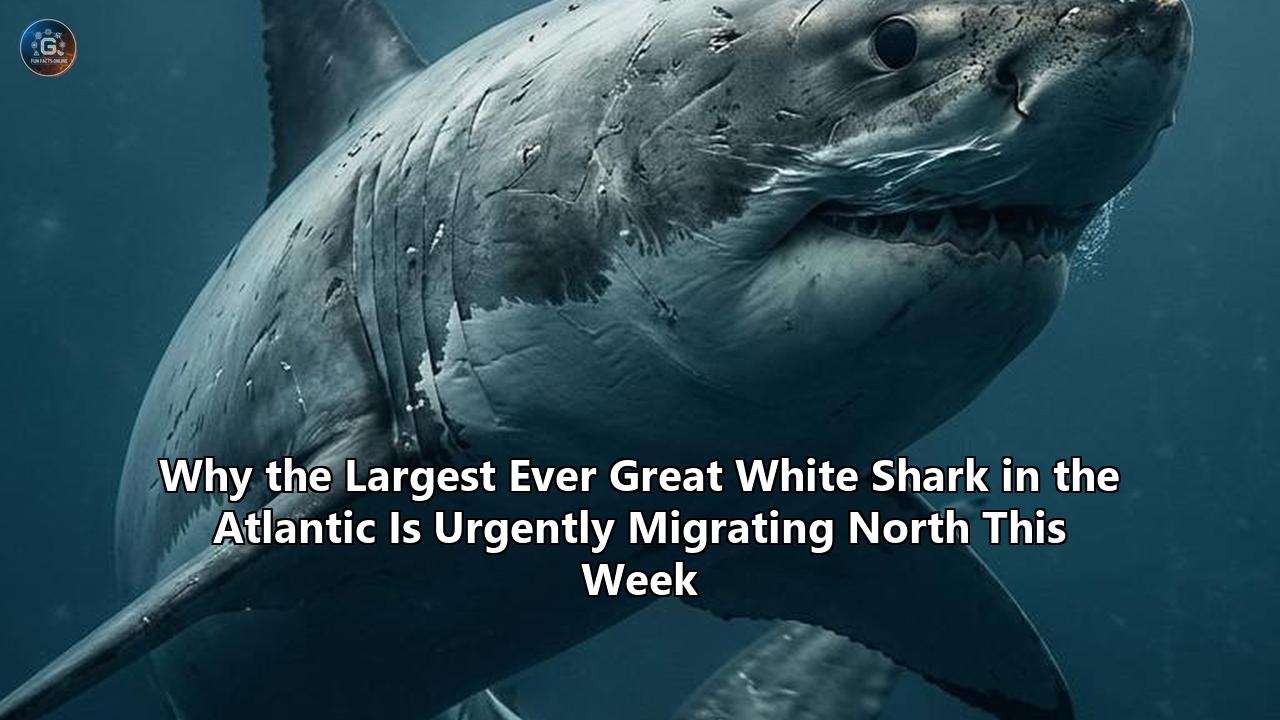
On July 10, 2026, a faint but highly significant signal cut through the satellite networks of the Western North Atlantic. Deep off the coast of North Carolina’s Outer Banks, a satellite tag mounted to the dorsal fin of a massive, 1,700-pound great white shark briefly broke the ocean's surface.
The tracking device registered what marine scientists call a "Z-ping"—a brief, non-locational transmission indicating that the animal had crested the water for only a few seconds before plunging back into the dark. It was the first sign of life from the shark in nearly three months.
The shark is "Contender". At 13 feet, 9 inches long, he is the largest male great white shark ever tagged, sampled, and released by the global ocean research non-profit OCEARCH in the Western North Atlantic.
Estimated to be in his early 30s, Contender is a fully mature apex predator at the height of his physical power. His sudden re-emergence off the Outer Banks confirms that he has begun a rapid, urgent journey northward. Within days, he is expected to reach the cool, prey-rich waters of Cape Cod, Massachusetts, or the coastal shelves of Atlantic Canada.
This sudden movement is not a random patrol; it is the opening salvo of a highly coordinated seasonal sprint. For centuries, the annual great white shark migration has dictated the rhythms of the Eastern Seaboard, but in 2026, the mechanics of this journey are under unprecedented pressure.
An accelerating climate, surging ocean temperatures, and shifting prey distributions are rewriting the biological rulebook for the ocean's most formidable hunters. To understand why a 1,700-pound male great white is sprinting toward Canada, one must look deep into the physiological engine of the shark itself, the unique oceanography of the Atlantic, and a series of newly discovered metabolic boundaries that are squeezing these animals like never before.
Deciphering the "Z-Ping": How We Track a Giant
Tracking a pelagic predator across thousands of miles of open ocean requires a complex integration of marine biology, heavy engineering, and satellite telemetry. When OCEARCH researchers first captured Contender on January 17, 2025, off the Florida-Georgia border, they fitted him with a Smart Position and Temperature (SPOT) tag. This device is bolted directly to his dorsal fin.
    Argos Satellite
         ^
         |  (Transmission sent when fin breaks surface)
         |
    +----o----+  <-- SPOT Tag
    |  \___/  |
    |   \ /   |  <-- Dorsal Fin
    +---------+
The SPOT tag relies on a deceptively simple physical mechanism. Two copper contacts on the tag remain submerged as long as the shark is underwater, completing an electrical circuit. The moment the shark’s dorsal fin breaks the surface, the water drains off, the circuit is broken, and the tag immediately "wakes up" from its low-power standby mode. It then attempts to broadcast a sequence of ultra-high-frequency radio messages to the overhead Argos satellite network.
To calculate an exact geographic location on the globe, the Argos satellite must receive at least three distinct messages during a single pass. If the shark remains at the surface for 20 or 30 seconds, researchers get a highly accurate geographic "ping".
However, if the shark only rolls through the surface wave for a moment, the satellite receives only a single, weak transmission. This is a "Z-ping". It does not provide exact latitude and longitude coordinates, but it acts as an acoustic flare, letting scientists know that the tag is still functioning, the shark is healthy, and its general trajectory is holding true.
Contender’s July 10 Z-ping near the Outer Banks of North Carolina tells us that after months of deep-water cruising, he has returned to the coastal shallows. His trajectory is aimed directly at the northern feeding grounds.
At the same time, other tracked sharks are confirming this mass movement. Just a day prior, on July 9, 2026, a 729-pound sub-adult female white shark named "Bella" pinged off the coast of Percé, Quebec, deep within the Gulf of St. Lawrence. The highway is open, and the Atlantic’s largest male is stepping on the gas.
The Biological Engine: Why Great Whites Can't Stand the Heat
To understand the urgency behind the great white shark migration, we must dispel a common myth: that sharks are cold-blooded creatures entirely at the mercy of their surrounding environment. Great white sharks are among a highly exclusive club of marine animals—comprising less than 0.1% of all fish species—that are classified as "mesothermic".
While most fish have internal temperatures that match the surrounding water exactly, great whites are endothermic poikilotherms. They possess the physiological capability to keep their internal body temperature significantly warmer than the ocean around them.
This is accomplished through a specialized vascular structure known as the rete mirabile (Latin for "wonderful net"). The rete is a dense, interlaced network of closely aligned veins and arteries located near the shark's core swimming muscles, stomach, and brain.
As cool, oxygenated blood flows from the gills toward the body, it passes directly adjacent to warm, deoxygenated blood returning from the working muscles. Through countercurrent heat exchange, the metabolic heat generated by the shark's continuous muscle contractions is transferred to the incoming arterial blood.
                     [ COUNTERCURRENT HEAT EXCHANGE ]

     Cold, oxygen-rich blood                Warm, oxygen-rich blood
          from gills                             to body core
      ==============>======\            /======>==============
                            \          /
                             [  RETE  ]  <-- Heat is transferred
                            /  MIRABILE\      across vessel walls
      ==============<======/            \======<==============
     Cold, oxygen-poor blood                Warm, oxygen-poor blood
          to gills                               from muscles
This anatomical adaptation keeps the shark's core muscles, digestive system, and eyes up to 25°F (14°C) warmer than the ambient water. This warm-blooded engine provides extraordinary evolutionary advantages:
- Enhanced Muscle Power: Warmer muscles contract faster and with greater force, allowing for explosive bursts of speed during hunts.
- Rapid Digestion: A warm stomach processes heavy, fatty meals far more quickly, maximizing nutrient absorption.
- Sharper Vision: Warm eyes and brains process visual stimuli much faster in the dim depths, giving them a distinct advantage over sluggish, cold-blooded prey.
However, this biological superpower comes with an astronomical cost. Maintaining a warm-bodied engine requires immense energy.
Mesothermic sharks burn up to four times as much energy as purely cold-blooded sharks of equivalent size. This creates a razor-thin energy budget. To stay alive and maintain their internal heat, great whites must continuously feed on high-calorie prey, and they must remain within a very specific temperature envelope.
The Rising Threat of Metabolic Overheating
For decades, marine biologists believed that the primary thermal limit for great whites was cold water. Juvenile great whites, lacking the massive body volume needed to trap heat efficiently, are strictly limited to warmer waters. But a landmark study published in the journal Science in April 2026, led by Associate Professor Nick Payne of Trinity College Dublin, revealed a far more urgent physiological threat: the danger of overheating.
The study used high-resolution miniature biotelemetry sensors to measure the real-time heat production and heat loss of large mesothermic fishes, including sharks weighing several tons. The researchers made a startling discovery: as a warm-bodied fish grows larger, its surface-area-to-volume ratio decreases.
It generates metabolic heat far faster than it can dump it through its skin and gills into the surrounding water.
Payne’s team calculated that a one-ton great white shark—precisely the weight class of Contender—struggles to remain in water temperatures above 62.6°F (17°C) for extended periods without experiencing severe thermal stress. If the surrounding water is too warm, the shark cannot shed its internal metabolic heat. Its core temperature begins to climb to dangerous, potentially fatal levels.
This creates a state of "double jeopardy" for large white sharks in the summer. As coastal waters in the Southeast and Mid-Atlantic United States rapidly heat up in June and July, adult great whites like Contender are hit from two sides:
- Surging Metabolic Demand: The warm water drives their internal metabolic rate higher, forcing them to burn energy even faster.
- Heat Trap: They cannot dissipate the heat generated by this hyper-accelerated metabolism, leading to physiological exhaustion.
The only solution is to run. They must migrate north to find the "Goldilocks zone"—waters that are cool enough to act as a heat sink for their massive bodies, yet warm enough to support their seasonal biological needs. For an adult great white, this preferred ambient temperature window is remarkably narrow: between 55°F and 73°F (13°C to 23°C).
The Call of the North: Cape Cod and Atlantic Canada’s Prey Buffet
While temperature acts as the primary physical driver pushing Contender north, the pull factor pulling him there is an abundant, high-calorie food source. Great white sharks are highly strategic opportunistic feeders.
As juveniles, their teeth are slender and pointed, optimized for catching agile fish and squid. But as they mature past 11 feet and their teeth widen into broad, serrated triangles, their dietary requirements shift entirely toward marine mammals.
To sustain a 1,700-pound endothermic body, Contender cannot survive on fish alone. He needs massive amounts of blubber. Animal fat is the most energy-dense substance in the ocean, providing the immense caloric surplus required to fuel his countercurrent heat exchangers.
And in the summer of 2026, the absolute best place in the Western North Atlantic to find blubber is the coast of New England and Atlantic Canada.
               [ NORTH ATLANTIC SUMMER FEEDING GROUNDS ]

       +-------------------------------------------------------+
       |  GULF OF ST. LAWRENCE (Canada)                        |
       |  - High concentration of Grey & Harbor Seals           |
       |  - Cool, stable water temperatures                    |
       +-------------------------------------------------------+
                                  ^
                                  | (Migration Route)
       +-------------------------------------------------------+
       |  CAPE COD, MASSACHUSETTS (USA)                        |
       |  - Over 50,000 Seals (MMPA Protected)                 |
       |  - Shallow, high-energy hunting zones                 |
       +-------------------------------------------------------+
The Seal Population Boom
The northern end of the great white shark migration is anchored by two primary ecological hotspots: Cape Cod, Massachusetts, and the Canadian Maritimes (including Nova Scotia, Prince Edward Island, and the Gulf of St. Lawrence).
The abundance of food in these regions is the direct result of one of the most successful marine conservation laws in history: the United States Marine Mammal Protection Act (MMPA) of 1972. Before the MMPA, gray seals and harbor seals in the Northeast were hunted nearly to extinction, viewed by commercial fishermen as competitors for fish stocks.
Decades of federal protection have allowed seal populations to rebound. Today, Cape Cod alone is home to a permanent summer population of over 50,000 gray seals.
Further north, in the cold waters of Atlantic Canada, grey seal populations are estimated in the hundreds of thousands.
For a mature great white, these seal colonies are an all-you-can-eat buffet. Gray seals, which can weigh up to 800 pounds, are packed with thick layers of energy-rich blubber.
As wildlife biologist Rosie Moore notes, these seals are essentially "nice blubbery sausages". A single successful seal strike can provide an adult great white with enough energy to sustain it for weeks, allowing it to easily cover the vast distances of its migratory route.
The Staging Ground: The Cape Hatteras Bottleneck
The journey from the wintering grounds in the Southeast to the summer feeding grounds in the North is not a continuous, uninhibited swim. It is a journey punctuated by structural bottlenecks, the most critical of which is Cape Hatteras, North Carolina.
                 [ THE CAPE HATTERAS FRONT ]

                      /   Cold Labrador Current
                     /    (Flows South)
                    v
    ==================================== [ Cape Hatteras ]
                    ^
                     \    Warm Gulf Stream
                      \   (Flows North/East)
Cape Hatteras is the geographic collision point of two of the ocean's most powerful current systems: the warm, fast-moving Gulf Stream flowing north from the Caribbean, and the icy, nutrient-rich Labrador Current flowing south from the Arctic. This collision creates a sharp, highly dynamic oceanographic feature known as a "frontal break".
Within the span of just a few miles, sea surface temperatures can drop or climb by as much as 15°F (8°C).
In the late spring (April and May), this frontal break acts as a physical barrier for migrating sharks. While the waters south of Cape Hatteras warm rapidly, the ocean to the north remains locked in winter’s chill.
Because great whites must balance their internal heat budgets, they cannot easily cross this sharp thermal boundary into the cold northern waters before the seasonal transition is complete.
As a result, Cape Hatteras becomes a massive staging area. Dozens of tagged great whites pool in this region for weeks, waiting for the northern corridor to open.
This staging ground is also incredibly productive. The clashing currents stir up deep-sea nutrients, creating massive blooms of plankton that attract schooling fish, bluefin tuna, and marine mammals.
Sharks like Contender use this bottleneck to feed heavily, packing on weight and fuel before the final sprint.
By late June and early July, the thermal gate swings open. As solar radiation heats the waters of the Mid-Atlantic Bight, the cold-water barrier off Cape Hatteras dissipates.
The temperature north of the cape rises into the sharks' preferred 55°F to 73°F (13°C to 23°C) range, signaling that it is time to move. Contender’s Z-ping on July 10 near this exact region confirms that he has just crossed this historical boundary and is now in the high-speed transit phase of his migration.
Inside the Work of OCEARCH: How We Unlocked the Mystery
Prior to the early 2000s, the migratory pathways of Atlantic great whites were almost entirely shrouded in mystery. It was widely assumed that they were rare, solitary roamers with no defined structure to their movements.
This lack of understanding made international conservation efforts nearly impossible, as nations could not coordinate protection for a species whose geographic boundaries were unknown.
The nonprofit organization OCEARCH changed this dynamic by pioneering a highly specialized method of open-ocean tagging and sampling. Operating from the M/V OCEARCH, a 126-foot research vessel equipped with a custom-designed hydraulic lift platform, the team has turned shark tracking into a highly efficient, multi-disciplinary science.
               [ THE M/V OCEARCH RESEARCH WORKUP ]

    +-------------------------------------------------------+
    |                                                       |
    |   [ M/V OCEARCH ]                                      |
    |                                                       |
    |               +------------------+                    |
    |               |  Hydraulic Lift  | <--- Raised out     |
    |               |     Platform     |      of water       |
    |               +--------o---------+                    |
    |                        |                              |
    |             +----------v----------+                   |
    |             |  Contender (Shark)  |                   |
    |             |  - Hoses in mouth   | <-- Fresh water   |
    |             |    over gills       |     and oxygen    |
    |             |  - Scientists taking|                   |
    |             |    samples          |                   |
    |             +---------------------+                   |
    |                                                       |
    +-------------------------------------------------------+
The 15-Minute Scientific "Workup"
When OCEARCH tags a massive adult great white like Contender, they do not merely hook and release the animal. They perform a highly coordinated, high-speed scientific "workup" that mimics a trauma team operating in a hospital.
- The Capture: The shark is gently guided onto the submerged hydraulic lift platform on the side of the vessel.
- The Lift: The platform is raised out of the water, securing the shark.
- Life Support: A continuous flow of fresh, oxygen-rich seawater is pumped through a soft hose directly into the shark's mouth and over its gills, keeping the animal calm and breathing. A wet towel is placed over its eyes to block out light and reduce sensory stress.
- The Sampling: Over the span of exactly 15 minutes, a collaborative team of veterinarians, geneticists, and endocrinologists from multiple global institutions go to work:
Blood Draws: Taken to analyze stress hormones, metabolic health, and nutritional status.
Muscle Biopsies: Collected to study stable isotopes, which reveal what the shark has been eating over the past several years.
Ultrasounds: Performed on mature females to detect pregnancy and locate potential nurseries.
Urogenital Sampling: In males like Contender, researchers collect reproductive material to determine sexual maturity and mating readiness.
- The Tagging: Researchers bolt the SPOT satellite tag to the dorsal fin and insert an acoustic transmitter into the body cavity for localized tracking.
- The Release: The platform is lowered, and the shark is guided back into the ocean, swimming away with minimal stress.
This open-source science has completely changed our understanding of the Atlantic population. OCEARCH senior data scientist John Tyminski and founder Chris Fischer have used this data to establish that 88% of all white sharks tagged in the Southeast United States migrate directly to Atlantic Canada during the summer.
Contender, as the largest mature male ever tagged in this project, is proving to be the key that unlocks one of the most sought-after secrets in shark science: where great whites mate.
Solving the Great Mating Mystery
For decades, the exact location of great white shark mating grounds has been the holy grail of marine biology. Because sharks mate via internal fertilization—a violent and highly physical process that is incredibly difficult to witness in the wild—scientists have had to rely on indirect clues.
                     [ THE REPRODUCTIVE CYCLE ]

    [ LATE WINTER / EARLY SPRING ]   -->   [ SUMMER / FALL ]
    - Carolinas / Georgia            -->   - Cape Cod / Canada
    - Mating occurs                  -->   - Heavy feeding (seals)
    - Adults aggregate               -->   - Gestation / Growth
Adult males like Contender reach sexual maturity at around 26 years of age and a length of 11.5 feet. At nearly 14 feet, Contender is in the prime of his reproductive life.
By analyzing the tracking data of mature males alongside mature females like "Goodall" (a 13-foot, 1,393-pound female tagged by OCEARCH), scientists have noticed a distinct pattern.
During the late winter and early spring, these massive, mature adults converge in the deep, warm waters off the Carolinas and Georgia. Unlike the juveniles who remain close to the coast, these large adults make sudden, rapid offshore movements beyond the Gulf Stream.
"In April, Contender made a sudden, rapid sprint past the Gulf Stream into deep offshore waters," says John Tyminski. "This sudden movement could be to forage, but we cannot rule out the possibility that it is related to reproduction at this time of year".
The theory is that the warm, deep waters off the Southeast serve as an offshore assembly area where mature males and females court and mate. Once mating is complete, the females head off on a multi-year gestation cycle, while the males begin their urgent northward sprint to rebuild the energy reserves they depleted during the mating season.
Contender’s July 10 Z-ping is the absolute proof of this transition: his reproductive duties in the south are complete, and his focus has shifted entirely to survival and feeding in the north.
The Climate Shift: Squeezing the Predator's Range
While the seasonal cycle of the great white shark migration is a natural phenomenon, human-induced climate change is rapidly altering its boundaries, timing, and ecological consequences. The warming of the Atlantic Ocean—which has experienced consecutive years of record-breaking marine heatwaves—is shifting the thermal envelopes that these animals rely on.
                 [ THE POLEWARD HABITAT SHIFT ]

    [ HISTORICAL RANGE ]            [ CURRENT / FUTURE RANGE (2026+) ]

    |                           |   |  Quebec / Labrador (Canada)    | <-- Extended
    |  Nova Scotia (Canada)     |   |  Nova Scotia (Canada)          |     Northward
    |  Cape Cod (USA)           |   |  Cape Cod (USA)                |
    |  Mid-Atlantic (USA)       |   |  Mid-Atlantic (USA)            | <-- Becoming too
    |  Southeast (USA)          |   |  Southeast (USA)               |     hot in summer
To understand the scale of this disruption, we can look to the Pacific Ocean. Between 2014 and 2016, a massive marine heatwave known as "The Blob" struck the Northeast Pacific, raising water temperatures by up to 5.4°F (3°C).
This sudden warming forced juvenile great white sharks to move their range 370 miles (600 km) north, out of their traditional nurseries in Southern California and into Monterey Bay.
The ecological fallout was immediate and severe. The influx of young great whites into Monterey Bay led to an 86% decline in the local sea otter population.
Because juvenile sharks were learning to hunt mammals, they repeatedly bit the otters, disrupting a critical keystone species that protects California’s kelp forests.
The Atlantic Reality
A similar pattern is playing out along the Eastern Seaboard of North America. Over the past several decades, the Atlantic Ocean has warmed significantly, causing great white sharks to migrate north nearly a month earlier than they did in the 1980s.
Furthermore, their northern boundary is expanding. Adult great whites are now regularly tracked deep into the Gulf of St. Lawrence, near Quebec and even the Labrador Peninsula—regions that were historically far too cold for them.
While this expansion gives sharks access to new, untapped seal colonies, it also compresses their suitable thermal habitat.
As the mid-latitudes become too warm during the peak of summer, great whites are squeezed into narrower, more crowded coastal bands in the north. This has profound implications for several critical areas:
- Trophic Cascades: The arrival of apex predators in new northern territories alters the behavior and populations of local species, from seals to commercially important groundfish.
- Human-Shark Interactions: As sharks are forced to hunt closer to shore in highly populated tourist regions like Cape Cod and Maine, the spatial overlap between humans and sharks increases.
- Fisheries Management: Commercial fishing fleets operating in Atlantic Canada are increasingly encountering great whites, raising concerns over bycatch and gear damage.
The Critical Importance of Apex Predators
The sight of a 14-foot, 1,700-pound great white shark heading toward popular coastal waters can easily evoke primal fear, a legacy heavily reinforced by pop culture. But marine ecologists emphasize that the presence of large, healthy adults like Contender is actually a sign of a recovering, balanced ocean ecosystem.
Great white sharks are the ultimate guardians of the marine food web. As apex predators, they play a crucial role in maintaining "trophic balance".
By hunting seals and large fish, they prevent any single species from overpopulating and decimating the lower levels of the food chain.
For example, by keeping seal populations in check, sharks indirectly protect commercial fish stocks like cod and haddock, which seals consume in massive quantities.
Furthermore, sharks perform a vital sanitary function. They actively target the sick, weak, and old among prey populations, ensuring that only the fittest individuals survive to reproduce.
This keeps the overall gene pools of marine mammals healthy and limits the spread of disease within seal colonies.
"Animals of adult size have proven extremely elusive in our tracking efforts," says Harley Newton, OCEARCH’s chief veterinarian. "Contender, at nearly 14 feet, is an adult male probably in his early 30s. He is an essential part of the effective breeding population and will contribute directly to the rebuilding of the Western North Atlantic white shark population".
Comparing the Giants of the Sea
To put Contender’s impressive dimensions into perspective, it helps to compare him to other famous great white sharks tracked by researchers across the globe:
| Shark Name | Region | Gender | Length (ft) | Estimated Weight (lbs) | Notes |
|---|---|---|---|---|---|
| Deep Blue | Pacific | Female | 20.0 | 4,000+ | Widely considered the largest great white ever filmed; spotted in Hawaii and Guadalupe. |
| Nukumi | Atlantic | Female | 17.2 | 3,541 | The "Queen of the Ocean"; tagged by OCEARCH in Nova Scotia in 2020. |
| Contender | Atlantic | Male | 13.9 | 1,700 | The largest male great white ever tagged in the Atlantic; actively migrating north. |
| Goodall | Atlantic | Female | 13.1 | 1,393 | Mature female tracked alongside Contender to study Atlantic mating grounds. |
| Bella | Atlantic | Female | 10.2 | 729 | Sub-adult female tracked in the Gulf of St. Lawrence this week. |
As the table shows, female great whites grow significantly larger than males, a biological phenomenon known as sexual dimorphism.
While a 14-foot female is considered a sub-adult, a 14-foot male like Contender is at the absolute upper limit of size for his gender. He is, for all practical purposes, the male equivalent of a heavyweight champion.
What to Watch For Next
As the third week of July 2026 unfolds, marine scientists and ocean enthusiasts alike are watching the OCEARCH global tracker with bated breath. Contender’s rapid northward trajectory is expected to yield several key milestones in the coming weeks:
1. The Cape Cod Transit
Will Contender bypass the shallow, seal-rich shoals of Cape Cod, or will he make a multi-week stopover to feed?
His movement through this region will provide critical data on how mature males interact with high-density human recreational zones, helping local beach safety officials refine their acoustic receiver networks and public warning systems.
2. The Gulf of St. Lawrence Crossing
If Contender follows his historical 2025 track, he will bypass New England entirely and head straight for the deep, cold channels of the Gulf of St. Lawrence in Canada.
Tracking whether he reaches these cold waters earlier in July than in previous years will help scientists quantify the exact speed of his migration under the influence of 2026’s exceptionally warm summer sea surface temperatures.
3. Collaborative Tracking Discoveries
With other sharks like Bella, Ripple, and Goodall active in the region, researchers are monitoring the data for signs of co-location.
If multiple mature adults are tracked traveling in close proximity, it could confirm the existence of shared migratory corridors, similar to terrestrial highways, used by these apex predators.
The journey of Contender is a testament to the power of modern marine science and collaborative research. By transforming a feared and misunderstood predator into an open-source ambassador for ocean health, researchers are proving that the survival of the great white shark is intimately linked to the survival of the oceans themselves.
As the giant male sprints northward through the deep Atlantic water, he carries with him the hopes of scientists working to restore balance and abundance to our blue planet.
Reference:
- https://www.ocearch.org/tracker/detail/cross
- https://www.unilad.com/news/us-news/great-white-shark-atlantic-biggest-spotted-302694-20260710
- https://www.readers.id/en/great-white-shark-contender-migrates
- https://www.ladbible.com/travel/contender-14ft-shark-ocearch-ping-683390-20260710
- https://www.wral.com/news/local/great-white-shark-spotted-cape-fear-february-2026/
- https://www.ocearch.org/blog/ocearch-updates-the-world-on-contender-the-largest-male-white-shark-in-the-western-north-atlantic/
- https://www.ocearch.org/blog/ocearch-updates-the-world-on-contender-the-largest-male-white-shark-in-the-western-north-atlantic/
- https://www.theinertia.com/surf/largest-great-white-male-ever-recorded-in-the-atlantic-is-making-his-way-down-the-east-coast/
- https://www.livenowfox.com/news/largest-male-great-white-shark-ever-recorded-pinged-off-new-jersey-coast
- https://www.youtube.com/shorts/MEcSQfQqn-0
- https://sharkdivingmosselbay.co.za/sharks-migration-patterns/
- https://storymaps.arcgis.com/stories/52206288b79e4f588f3a31860a714f1e
- https://e360.yale.edu/digest/great-white-sharks-climate
- https://www.ocearch.org/tracker/detail/contender
- https://www.thecooldown.com/green-tech/great-white-shark-north-carolina-movement/
- https://www.timeout.com/montreal/news/a-great-white-shark-weighing-more-than-700-pounds-was-spotted-in-the-st-lawrence-river-this-weekend-070626
- https://www.surfer.com/news/largest-ever-great-white-shark-contender-east-coast
- https://divemagazine.com/scuba-diving-news/warming-waters-driving-great-white-sharks-north
- https://thegoodshark.com/blogs/news/chasing-the-winter-migration-great-white-sharks-off-cape-cod
- https://www.theguardian.com/environment/2021/feb/09/climate-crisis-pushing-great-white-sharks-into-new-waters
- https://academic.oup.com/icesjms/article/82/5/fsaf062/8140451
- https://www.floridamuseum.ufl.edu/science/theres-something-fishy-going-on-with-great-white-sharks-that-scientists-cant-explain/
- https://www.cbsnews.com/tag/nova-scotia/
- https://www.epicdiving.com/why-sharks-migrate/
- https://www.ocearch.org/
- https://www.ocearch.org/tracker/
- https://talker.news/2026/01/21/largest-great-white-shark-in-atlantic-returns-to-florida-coast/
- https://www.mirror.co.uk/news/technology-science/science/largest-great-white-shark-tagged-36974043
- https://www.newsweek.com/biggest-great-white-shark-tracked-atlantic-zigzags-coast-2088288
- https://www.surfer.com/news/largest-great-white-shark-ever-contender
- https://www.ocearch.org/tracker/detail/nukumi
- https://www.mensjournal.com/travel/largest-great-white-contender-tracking
- https://www.researchgate.net/publication/365556308_Quantifying_thermal_cues_that_initiate_mass_emigrations_in_juvenile_white_sharks