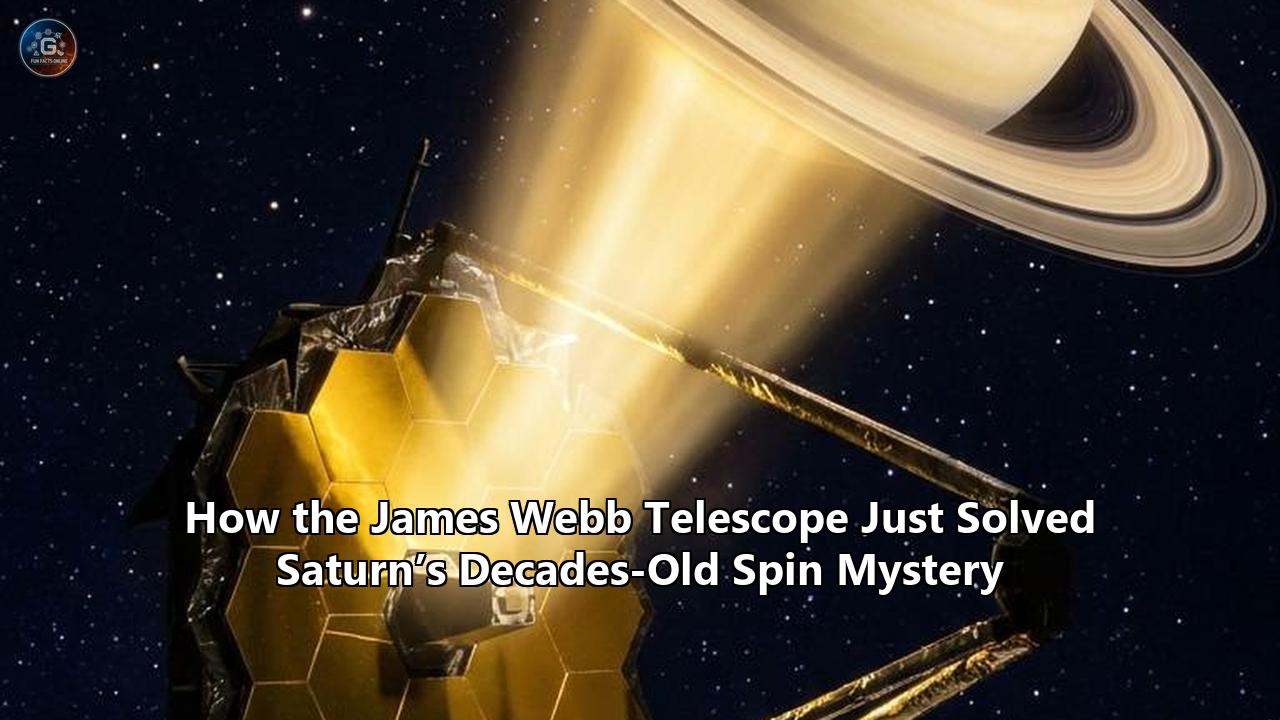
On March 12, 2026, researchers published a study in the Journal of Geophysical Research: Space Physics that finally solved one of the solar system’s most perplexing and long-standing riddles: why Saturn appeared to be constantly changing its rotation rate. Using unprecedented observations from the James Webb Space Telescope (JWST), an international team of astronomers has proven that Saturn is not actually speeding up or slowing down. Instead, the gas giant’s spectacular northern lights are driving a self-sustaining cycle of heat, winds, and electrical currents in its upper atmosphere that has been tricking our measurement instruments for decades.
This breakthrough, headed by Professor Tom Stallard of Northumbria University alongside a team of scientists from institutions across the United Kingdom and the United States, reveals that Saturn behaves like a giant, planet-wide heat engine. The aurora at Saturn's poles heats the upper atmosphere, which generates powerful winds. These winds then drag charged particles through the planet’s intense magnetic field, creating electrical currents that feed back into and power the aurora itself. This closed, positive feedback loop distorts the magnetic and radio signals that scientists have used to track Saturn’s spin since the Voyager era. This groundbreaking observation of a self-sustaining planetary feedback loop has finally cracked open the James Webb Saturn mystery, bringing to an end decades of confusion and rewriting our understanding of how gas giant atmospheres interact with space.
By mapping this complex interaction with unprecedented detail, the study marks the end of a forty-year scientific debate and establishes a new framework for how planetary atmospheres and magnetic fields couple. It proves that the "planetary heartbeat" of Saturn is not the steady, deep ticking of its physical core, but the dynamic, breathing pulse of its upper atmosphere.
The Impossible Clock: How Saturn Seemed to Break the Laws of Physics
To appreciate why solving the James Webb Saturn mystery is such a momentous achievement, one must first look at why Saturn's rotation was so hard to measure in the first place. The puzzle began accumulating in the early 1980s. In November 1980, NASA’s Voyager 1 spacecraft flew past Saturn and recorded a radio signature known as Saturn Kilometric Radiation (SKR). This pulsing radio signal, generated by electrons spiraling along the planet’s magnetic field lines, occurred with a highly regular rhythm. Voyager 1 measured the interval between these pulses at roughly 10 hours, 39 minutes, and 24 seconds. Because gas giants do not have solid surfaces to track, planetary scientists adopted this precise radio pulse as Saturn's definitive rotational period—the length of a Saturnian day.
This standard held for nearly a quarter of a century. However, when the Cassini spacecraft arrived at Saturn in 2004 to begin its thirteen-year orbital mission, its instruments detected a major anomaly. The SKR pulse rate had changed. According to Cassini’s initial measurements, Saturn’s day was now roughly 10 hours, 45 minutes, and 45 seconds long—a full six minutes slower than the time recorded by Voyager.
In the precise world of planetary physics, a six-minute shift in the rotation of a planet over just twenty-four years is not a minor discrepancy; it is a physical impossibility. A planet's rotational period represents the spin of its core, where almost all its massive angular momentum resides. Saturn contains the mass of roughly 764 Earths. To change the rotation rate of such a massive body by six minutes in just two decades would require an external force of unfathomable magnitude. It would be equivalent to a moon-sized object slamming into the planet to either brake or accelerate its spin. Yet, no such catastrophic event had occurred.
The mystery deepened when Cassini continued its observations. Over the years, the SKR signal did not remain stable at its new value. Instead, it continued to drift, fluctuating by several minutes over the course of Saturn’s seasons. Even more bafflingly, Cassini revealed that the northern and southern hemispheres of Saturn appeared to be rotating at different speeds. The northern radio pulse and the southern radio pulse were out of sync, as if the two halves of the planet were slipping past each other.
Astronomers were faced with a profound paradox: they were tracking a real physical signal, but the laws of rotational dynamics dictated that the planet’s physical mass could not possibly be speeding up and slowing down on such short timescales. The measuring stick itself had to be flawed.
The Gas Giant Dilemma: Why Saturn’s Spin is So Hard to Measure
To understand why the James Webb Saturn mystery was such an astronomical headache, one must look at how we measure time on other planets. On solid, terrestrial worlds like Mars or Mercury, tracking rotation is straightforward. You select a surface feature—such as a crater, a mountain, or a distinct volcanic plain—and measure the exact time it takes for that feature to rotate 360 degrees and return to the same position relative to the stars.
Gas giants, however, offer no such luxury. Planets like Jupiter, Saturn, Uranus, and Neptune are massive balls of hydrogen, helium, and trace gases. Their upper atmospheres are a chaotic tapestry of bands, zones, and swirling storms that move at different speeds depending on their latitude. Tracking a cloud deck on Saturn only measures the speed of that specific wind current, not the rotation of the planet’s deep, rocky-and-metallic core where the vast majority of its angular momentum resides.
To peer beneath the clouds, scientists rely on a planet's magnetic field. Deep within gas giants, extreme pressures squeeze hydrogen into a liquid metallic state. This metallic hydrogen is highly conductive. As the planet’s hot core rotates, it stirs this metallic fluid, generating a powerful magnetic field through a process called a planetary dynamo. Because the magnetic field is anchored in the deep interior of the planet, it rotates in perfect lockstep with the core.
On Jupiter and Earth, the magnetic fields are tilted relative to their rotational axes. Earth’s magnetic pole is tilted by about 11 degrees, while Jupiter’s is tilted by about 10 degrees. Because of this tilt, as the planet spins, its magnetic field wobbles like a slightly off-center spinning top. This wobble acts as a cosmic lighthouse, sweeping a beam of charged particles and radio waves across space. By timing the precise arrival of this sweeping beam, scientists can measure Jupiter’s internal day length with an accuracy of milliseconds.
Saturn, however, is a unique outlier in the solar system. When Cassini mapped Saturn's magnetic field, scientists discovered that its magnetic axis is almost perfectly aligned with its rotational axis, with an offset of less than 0.01 degrees. This extreme alignment—known as axisymmetry—means that as Saturn rotates, its magnetic field does not wobble. There is no sweeping lighthouse beam to track.
Without a magnetic wobble, planetary scientists were left with the Saturn Kilometric Radiation (SKR) as their only proxy for the internal spin. But the shifting, hemisphere-clashing nature of the SKR signals proved that whatever was generating the radio pulses was not tied to the deep, stable interior of the planet.
The 2021 Atmospheric Breakthrough
The first major clue to solving this paradox came in 2021. A research team led by Professor Tom Stallard of Northumbria University published a study that shifted the scientific focus away from Saturn’s core and directly into its upper atmosphere.
Stallard and his colleagues demonstrated that the SKR radio signals were not originating from the deep planet at all. Instead, they were being generated by powerful electrical currents flowing in Saturn’s ionosphere—the high-altitude layer of the atmosphere filled with charged particles. Crucially, the researchers showed that these electrical currents were being driven by winds blowing through the polar regions.
Under the laws of electromagnetism, when a conducting fluid (like the ionosphere’s electrically charged plasma) moves through a magnetic field, it acts as a generator, creating electrical currents. Stallard’s team argued that powerful, high-altitude winds in Saturn's polar thermosphere were pushing the charged ionospheric gas across the planet’s vertical magnetic field lines. This motion generated a vast system of electrical currents that looped out into space, shaping the magnetospheric radio emissions that spacecraft like Voyager and Cassini detected.
Because these high-altitude wind systems are subject to atmospheric dynamics, seasonal changes, and solar heating, they do not blow at a constant speed. As the winds speed up or slow down, they alter the frequency of the electrical currents, which in turn shifts the timing of the SKR signal. The "clock" that scientists had been using for forty years was not broken; it was just a clock whose gears were made of wind.
This explanation elegantly resolved why Saturn’s rotation rate appeared to change. The actual planet was spinning at a constant, stable rate, but the wind-driven electrical signals we were measuring were shifting over time.
However, this breakthrough immediately exposed a new scientific problem. To drive winds powerful enough to warp the magnetic signals of a giant planet, an immense amount of energy is required. In Saturn's upper atmosphere—thousands of kilometers above the deep, warm interior and exposed only to weak, distant sunlight—there was no obvious energy source capable of powering such relentless, high-velocity winds. What was acting as the engine for these winds?
Training Webb’s Eye: The November 2024 Campaign
To answer this fundamental question, Stallard and his international team turned to the most powerful observatory ever built. On November 29, 2024, the James Webb Space Telescope trained its highly sensitive Near Infrared Spectrograph (NIRSpec) instrument directly onto Saturn's northern polar region.
Using JWST for planetary observation within our own solar system is a delicate and challenging process. Because the telescope was designed to detect the incredibly faint, redshifted light of the first galaxies at the edge of the observable universe, looking at a bright, close neighbor like Saturn can easily saturate and blind its sensitive infrared detectors. However, the mission planners utilized specialized sub-array configurations on NIRSpec, allowing the instrument to capture rapid, high-resolution snapshots of Saturn’s polar glow without overloading the system.
Webb stared at Saturn's northern auroral zone continuously for nearly ten hours—matching one full Saturnian day. This uninterrupted vigil allowed the telescope to track the entire polar region as it completed a full rotation, capturing how the atmosphere changed in real-time.
The results of this observation campaign, published on March 12, 2026, in the Journal of Geophysical Research: Space Physics, provided data of unprecedented quality. Previous observations of Saturn's upper atmosphere—conducted either by ground-based observatories like the W. M. Keck Observatory in Hawaii or by the Cassini spacecraft’s Visual and Infrared Mapping Spectrometer (VIMS)—were limited by major measurement errors.
"Prior to this study, our temperature measurements of Saturn's polar upper atmosphere had uncertainties of roughly plus or minus 50 degrees Celsius," Stallard explained in a press statement. "When your measurement error is that large, it acts like a thick fog. It completely washes out any small-scale heating or cooling structures you are trying to see. You're left with just a broad, mass-averaged blur."
JWST’s NIRSpec instrument shattered this technological barrier. It reduced the temperature measurement uncertainty by a factor of ten, down to just a few degrees. Suddenly, the fog cleared, revealing a highly detailed, sharp map of Saturn's polar ionosphere with an astonishing spatial resolution of less than 500 kilometers per pixel.
Trihydrogen Cation ($H_3^+$): The Quantum Thermometer of Space
In resolving the James Webb Saturn mystery, the telescope relied on its Near Infrared Spectrograph (NIRSpec) instrument to track a very specific and unusual molecule: the trihydrogen cation ($H_3^+$).
The molecule $H_3^+$ is an ion consisting of three hydrogen nuclei (protons) sharing just two electrons, arranged in a tight equilateral triangle. It is the most abundant molecular ion in the universe, but it cannot exist in the warm, dense conditions of Earth’s troposphere because it is highly reactive and immediately transfers its proton to any neutral molecule it encounters. However, in the cold, near-vacuum of gas giant upper atmospheres, $H_3^+$ thrives.
In Saturn’s polar ionosphere, $H_3^+$ is constantly created through a chain reaction. When high-energy electrons from space (the same particles that cause the auroras) or extreme ultraviolet light from the Sun crash into Saturn's dominant atmospheric gas, molecular hydrogen ($H_2$), they strip away an electron to create $H_2^+$. This highly unstable ion rapidly reacts with a neighboring $H_2$ molecule, stealing a proton to form $H_3^+$ and leaving a free hydrogen atom:
$$H_2^+ + H_2 \rightarrow H_3^+ + H$$
Because $H_3^+$ has no stable electronic ground state, it cannot emit light in visible wavelengths. Instead, it is a pure vibrational emitter. When it is energetically excited by collisions with the surrounding neutral atmospheric gas, it sheds this excess energy by radiating photons in the mid-infrared spectrum, specifically in the 3-to-4-micron wavelength range.
Crucially for astronomers, the intensities of the various emission lines in the $H_3^+$ spectrum are highly dependent on the temperature of the gas. Because $H_3^+$ ions are constantly colliding with the surrounding neutral hydrogen molecules, they quickly reach local thermodynamic equilibrium. This means that the vibrational-rotational temperature of $H_3^+$ is identical to the temperature of the surrounding atmosphere.
By using NIRSpec to split the infrared light coming from Saturn's northern auroral zone into its constituent wavelengths, the research team could measure the precise ratios of these $H_3^+$ emission lines. This allowed them to construct the first-ever fine-scale, highly precise maps of temperature and ion density across the entire polar cap of Saturn.
Inside the Heat Engine: Deconstructing the Feedback Loop
When Stallard’s team analyzed the JWST maps, they discovered a striking lack of symmetry across Saturn's northern polar region. Rather than a uniform, warm glow, the polar ionosphere exhibited a highly organized, rotating structure of extreme temperature differences. One side of the auroral zone was remarkably hot, while the opposite side was significantly colder.
This thermal asymmetry was not static; it rotated in perfect synchronization with Saturn's planetary period. The team immediately recognized that this rotating pattern of hot and cold regions was the missing link they had been searching for. It was the physical driver of the winds that had eluded planetary scientists for decades.
This temperature contrast acts as a massive "planetary heat engine" or "planetary heat pump". The mechanics of this self-sustaining loop operate through five interconnected steps:
[ Magnetospheric Charged Particles ]
               │
               ▼  (Crashes into polar atmosphere)
      [ Asymmetric Auroral Heating ]
               │
               ▼  (Creates steep temperature gradients)
      [ High-Altitude Thermal Winds ]
               │
               ▼  (Drags ionospheric plasma across magnetic fields)
      [ Electrical Currents (Birkeland Currents) ]
               │
               ▼  (Loops back into magnetosphere & atmosphere)
   [ Auroral Energy & Radio Signal Distortion (SKR) ]
1. Localized Auroral Heating
Charged particles (mostly electrons and protons) funneled from Saturn’s vast magnetosphere crash down along magnetic field lines into the polar thermosphere. However, due to the asymmetric shape of Saturn's magnetospheric tail, this particle precipitation is not uniform. It deposits immense amounts of energy into highly localized zones of the upper atmosphere, heating those specific regions.
2. Thermal Wind Generation
This localized heating creates a stark temperature gradient—a boundary where hot gas sits directly adjacent to much colder gas. This gradient generates powerful, high-altitude winds (driven by thermal convection and geostrophic balancing) that blow across the polar cap. These winds form a large-scale, dual-lobed vortex system in the upper atmosphere.
3. Electromagnetic Induction
As these winds blow, they drag the electrically charged ionosphere (including the $H_3^+$ ions) across Saturn's vertical, highly aligned magnetic field lines. This physical motion of a conductor through a magnetic field generates electrical currents through electromagnetic induction.
4. Current Feedback and Auroral Support
These wind-generated electrical currents (known as Birkeland currents) do not simply dissipate. They travel up along the magnetic field lines, out into the magnetosphere, and loop back down into the ionosphere. This influx of electrical current provides the exact energy needed to accelerate more charged particles back down into the atmosphere, directly powering and sustaining the aurora itself.
5. The Radio Signal Distortion
It is this massive, oscillating loop of electrical current that distorts the Saturn Kilometric Radiation (SKR) radio signals. As the high-altitude winds shift seasonally or dynamically, the electric current loops shift with them, changing the radio pulse frequency that spacecraft like Voyager and Cassini detected.
"What we are seeing is essentially a planetary heat pump," said Professor Stallard. "Saturn's aurora heats its atmosphere, the atmosphere drives winds, the winds produce currents that power the aurora, and so it goes on. The system feeds itself."
This elegant cycle explains why the apparent rotation rate of Saturn has remained so stable over months yet changes over years. The positive feedback loop is self-reinforcing, meaning the system naturally maintains a stable state. However, as Saturn orbits the Sun and experiences seasonal changes over its 29-year year, the amount of solar ultraviolet light hitting the poles changes, slightly shifting the balance of the feedback loop and causing the winds—and thus the radio clock—to drift.
Unveiling the James Webb Saturn Mystery: What This Means for Other Worlds
Solving the James Webb Saturn mystery does not just close a forty-year-old case in our own solar system; it provides a new physical framework for understanding planetary atmospheres across the cosmos.
Historically, planetary science modeled planetary atmospheres and magnetospheres as largely independent systems. The atmosphere was viewed as a layer of gas governed by meteorology and solar heating, while the magnetosphere was treated as a magnetic bubble shaped by the solar wind and deep interior dynamos. The JWST observations of Saturn shatter this separation, showing that the upper atmosphere and the space environment are bound together in a dynamic, two-way street.
This discovery has direct implications for our understanding of other gas giants, both near and far.
The Ice Giants: Uranus and Neptune
Uranus and Neptune possess highly unusual, asymmetrical, and off-center magnetic fields that are tilted at extreme angles (59 degrees for Uranus and 47 degrees for Neptune). These magnetic fields are not generated by a deep metallic hydrogen dynamo like Jupiter or Saturn, but likely by a circulating shell of super-pressurized, ionic water-ammonia "ocean."
Because of these highly complex, non-axisymmetric magnetic fields, the interaction between their upper atmospheres and magnetospheres is expected to be even more chaotic than Saturn's. The feedback loops discovered on Saturn provide researchers with a blueprint for interpreting future JWST observations of Uranus and Neptune's ionospheres, where similar, wind-driven electrical currents may be warping our measurements of their spin rates.
Hot Jupiters and Exoplanets
The discovery is also highly relevant to the study of exoplanets—planets orbiting stars outside our solar system. Many of the first discovered exoplanets are "Hot Jupiters"—gas giants that orbit incredibly close to their host stars.
These worlds are subjected to intense stellar wind and radiation, meaning their upper atmospheres are highly ionized and their magnetospheres are severely compressed. The confirmed physical mechanism of an atmosphere-magnetosphere feedback loop on Saturn gives astrophysicists a concrete model to simulate how these extreme exoplanets transfer heat and energy. On Hot Jupiters, the coupling between atmospheric winds and magnetic fields is likely so powerful that it could physically drag and reshape the planet's atmospheric wind patterns, slowing down or redirecting giant equatorial jet streams.
The Future of Deep-Space Planetary Meteorology
The resolution of the James Webb Saturn mystery marks a major milestone in the young history of the James Webb Space Telescope. It demonstrates that the observatory is not just a tool for peerless deep-space cosmology, but a highly capable planetary science mission that can revolutionize our understanding of our own cosmic backyard.
With the Saturn rotation puzzle resolved, the research team is already looking toward the next frontiers of solar system astronomy. The same research group at Northumbria University and their international collaborators have begun a systematic program to map the ionospheres of the other outer planets.
| Target | Scientific Objective |
|---|---|
| Uranus | Map the highly asymmetrical ionosphere to locate the offset magnetic poles. |
| Neptune | Track temporal changes in $H_3^+$ emissions under weak solar illumination. |
| Saturn | Investigate the unexplained structures in the sub-auroral stratosphere. |
Furthermore, these findings will directly shape the design of future space missions. While there are currently no active spacecraft orbiting Saturn following Cassini's dramatic dive into the planet's atmosphere in 2017, planetary scientists are actively drafting proposals for next-generation outer solar system flagships. Any future Saturn orbiter or atmospheric entry probe will now have to account for this highly active, self-sustaining polar heat engine when planning atmospheric drag maneuvers and magnetic field mapping.
Ultimately, the James Webb Space Telescope has shown us that Saturn is far more than a cold, quiet gas giant ringed in ice. It is a world of surprising complexity, where the spectacular glow of its northern lights serves as both a beautiful cosmic light show and the driving engine of a planet-wide thermodynamic system. By resolving this decades-long spin mystery, JWST has reminded us that even the most familiar planets in our solar system still hold profound secrets, waiting for the right instrument to clear the fog.
Complete List of Research Contributors
The landmark study, “JWST/NIRSpec Reveals the Atmospheric Driver of Saturn’s Variable Magnetospheric Rotation Rate,” was made possible by the collaborative efforts of an international team of researchers:
- Tom S. Stallard (Northumbria University) — Lead Author
- Luke Moore (Boston University)
- Henrik Melin (Aberystwyth University)
- Chris G. A. Smith (University College London)
- Omakshi Agiwal (Imperial College London)
- M. Nahid Chowdhury (University of Leicester)
- Rosie E. Johnson (Aberystwyth University)
- Katie L. Knowles (Northumbria University)
- Emma M. Thomas (University of Leicester)
- Paola I. Tiranti (Northumbria University)
- James O'Donoghue (JAXA / Reading University)
- Khalid Mohamed (Northumbria University)
- Ingo Mueller-Wodarg (Imperial College London)
- John C. Coxon (Northumbria University)
- Sarah V. Badman (Lancaster University)
- Joe A. Caggiano (Northumbria University)
Frequently Asked Questions
Why did Saturn appear to change its rotation rate?
Saturn's physical rotation rate was never actually changing. The illusion of a variable spin rate was caused by fluctuating radio signals (Saturn Kilometric Radiation, or SKR) that scientists used as a proxy to measure the planet’s spin. These radio signals are generated by electrical currents in the upper atmosphere, which are pushed and distorted by high-altitude polar winds that speed up and slow down over time.
How did the James Webb Space Telescope solve this mystery?
JWST used its Near Infrared Spectrograph (NIRSpec) to continuously observe Saturn’s northern auroral region for approximately ten hours (one full Saturnian day). By measuring the infrared light emitted by the triatomic hydrogen ion ($H_3^+$), Webb mapped the polar temperatures with ten times greater precision than any previous telescope. These maps revealed a stark, rotating temperature asymmetry that drives the winds responsible for distorting the radio signals.
What is the "planetary heat pump" or "planetary heat engine" feedback loop?
It is a self-sustaining cycle where:
- Saturn's aurora heats specific, localized areas of the polar upper atmosphere.
- This asymmetric heating creates steep temperature gradients that drive powerful, high-altitude winds.
- These winds push charged atmospheric particles across Saturn's magnetic field lines, generating electrical currents.
- These electrical currents flow back along magnetic lines to power the aurora, sustaining the entire cycle.
Why couldn't Cassini or ground-based telescopes solve this?
Previous instruments lacked the required sensitivity and temperature resolution. Ground-based telescopes and Cassini's spectrometers had temperature measurement uncertainties of about $\pm 50^\circ\text{C}$, which washed out the fine-scale hot and cold regions in the atmosphere. JWST's NIRSpec reduced this uncertainty to just a few degrees, allowing scientists to see the detailed thermal structures for the first time.
Why is measuring the spin of a gas giant so difficult?
Unlike rocky planets like Earth or Mars, gas giants have no solid surface features (like craters or mountains) to track. Furthermore, Saturn's magnetic field is almost perfectly aligned with its spin axis, meaning it does not wobble as the planet rotates. Without a wobble to act as a cosmic lighthouse, scientists had to rely on atmospheric radio emissions, which are highly susceptible to wind-driven distortions.
Technical Glossary of Terms
- Axisymmetry: A property of a system that is symmetric about an axis. In Saturn's case, its magnetic field axis is aligned almost perfectly with its rotational axis, leaving no offset wobble.
- Birkeland Currents: A set of electrical currents that flow along geomagnetic field lines connecting the Earth’s magnetosphere to the high-latitude ionosphere (or in this case, Saturn's magnetosphere to its polar ionosphere).
- Dynamo Theory: A geophysical theory that describes the process by which a rotating, convecting, and electrically conducting fluid (like liquid metallic hydrogen) can maintain a magnetic field over astronomical timescales.
- Ionosphere: A region of a planet's upper atmosphere, generally from about 50 km to 1,000 km altitude, where solar radiation and energetic particles ionize atmospheric atoms and molecules, creating a layer of plasma.
- Local Thermodynamic Equilibrium (LTE): A state in which a localized region of a system is in thermodynamic equilibrium with its immediate surroundings, allowing properties like temperature to be defined consistently across different particles (such as gas molecules and ions).
- Magnetosphere: The region of space surrounding a planet in which the planet's magnetic field dominantly governs the behavior of charged particles.
- Near Infrared Spectrograph (NIRSpec): One of the primary instruments on the James Webb Space Telescope, designed to capture the spectra of astronomical objects in the near-infrared wavelength range (0.6 to 5.3 microns).
- Saturn Kilometric Radiation (SKR): Intense, low-frequency radio emissions generated by electrons spiraling along magnetic field lines in Saturn's polar auroral regions, typically peaking in frequency between 100 and 400 kHz.
- Thermosphere: The layer of a planet's atmosphere directly above the mesosphere, characterized by high temperatures caused by the absorption of energetic solar radiation and auroral particle precipitation.
- Triatomic Hydrogen Ion ($H_3^+$): A highly reactive molecular ion consisting of three hydrogen protons and two electrons, widely used as an atmospheric thermometer in outer planet astronomy due to its active vibrational-rotational emission spectrum in the infrared.
- Vibrational-Rotational Transitions: Quantum transitions in molecules where both the vibrational energy state and rotational energy state change simultaneously, resulting in the absorption or emission of electromagnetic radiation (typically in the infrared).
- Vortex: A mass of fluid (such as air or gas) that spins around a central axis, creating a whirlpool-like flow structure. In planetary atmospheres, large-scale vortices are common polar structures.
Historical Timeline of Saturn's Rotation Measurement
  1980  ──  Voyager 1 measures Saturn's radio signal (SKR) rotation period at 10h 39m 24s.
            This becomes the accepted standard for the length of a Saturnian day.

  2004  ──  Cassini arrives at Saturn and records an SKR rotation period of 10h 45m 45s.
            A baffling 6-minute slow-down that defies basic planetary physics.

  2009  ──  Cassini observations show the SKR period actively drifting seasonally and
            differing between the northern and southern hemispheres.

  2017  ──  Cassini's "Grand Finale" gravity measurements suggest a deep internal spin
            rate, but still leave the atmospheric radio signal anomaly unresolved.

  2021  ──  Tom Stallard's team publishes a paper linking the shifting SKR signals to
            powerful, high-altitude winds in Saturn's upper atmosphere.

  2024  ──  On November 29, the James Webb Space Telescope (JWST) trains its NIRSpec
            instrument on Saturn's north pole for a continuous 10-hour campaign.

  2026  ──  On March 12, the JWST data is published in JGR: Space Physics, proving
            the aurora acts as a self-sustaining planetary heat engine driving those winds.
Reference:
- https://www.techtimes.com/articles/317472/20260531/jwst-solves-saturns-40-year-spin-mystery-aurora-drives-self-sustaining-heat-engine.htm
- https://www.sciencedaily.com/releases/2026/05/260529043658.htm
- https://research.aber.ac.uk/files/102098211/Article.pdf
- https://trends.glance.com/story/articles/Auto/US/en/rapid-read/s-c06640630b-25d910f5-6bbf-529a-86bc-06ca7275eb25
- https://scitechdaily.com/astronomers-solve-decades-long-mystery-about-saturns-spin-something-strange-was-happening/
- https://www.techexplorist.com/mystery-saturns-spin-finally-solved/103161/
- https://dailybeirut.com/en/technology-and-science/james-webb-telescope-reveals-saturns-rotation-mystery/
- https://www.thebrighterside.news/post/jwst-just-helped-solve-saturns-mysterious-spin-problem/
- https://www.techtimes.com/articles/317472/20260531/jwst-solves-saturns-40-year-spin-mystery-aurora-drives-self-sustaining-heat-engine.htm
- https://www.eurekalert.org/news-releases/1121699
- https://www.techexplorist.com/mystery-saturns-spin-finally-solved/103161/
- https://timeskuwait.com/james-webb-telescope-cracks-saturns-baffling-rotation-mystery/
- https://baku.ws/en/this-is-interesting/scientists-have-solved-the-mystery-of-saturns-rotation-for-the-first-time-in-decades
- https://www.sciencedaily.com/releases/2026/05/260529043658.htm
- https://www.brlsi.org/talk/the-grand-tour-of-ice-giant-aurorae-professor-tom-stallard/