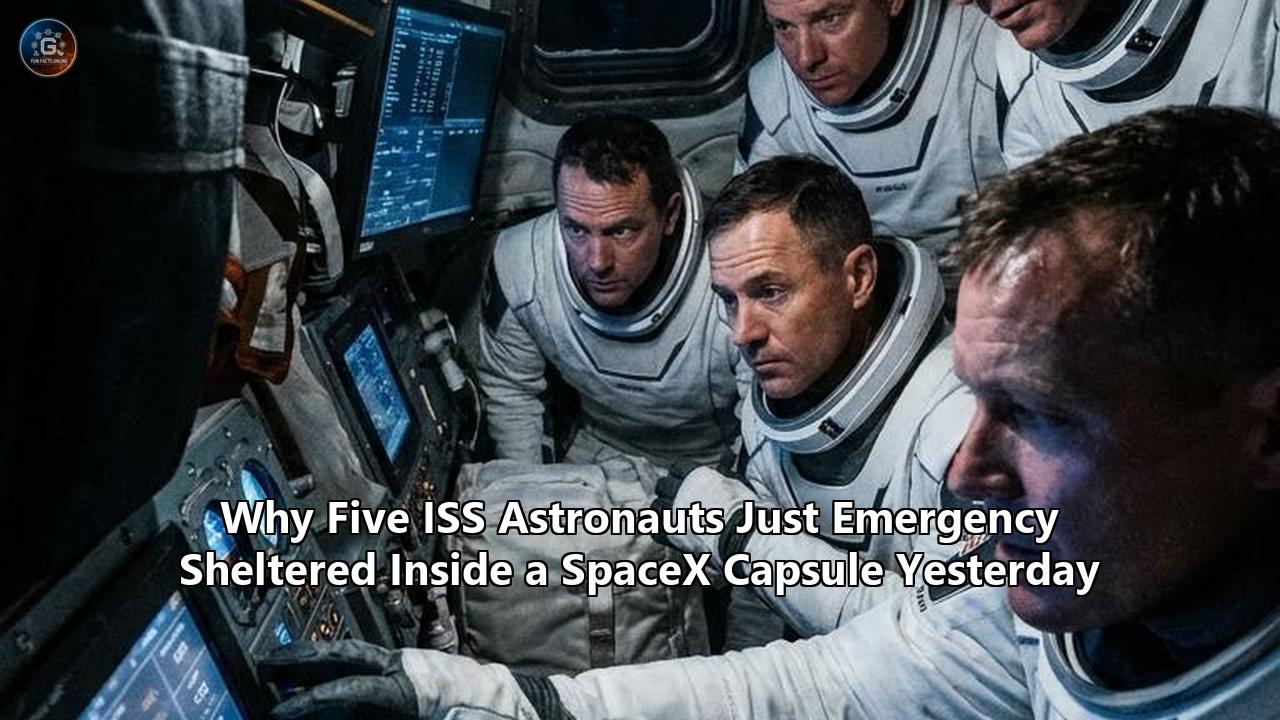
At 9:04 a.m. EDT on Friday, June 5, 2026, a sudden, urgent directive from Mission Control in Houston broke the morning routine aboard the International Space Station (ISS). Five of the seven crew members currently living on the orbital outpost were ordered to halt their science experiments, suspend maintenance tasks, and immediately retreat to the docked SpaceX Crew Dragon spacecraft Freedom. For nearly two hours, three Americans, a French astronaut, and a Russian cosmonaut sat sealed inside the 13-foot-wide commercial capsule, poised to perform an emergency undocking and evacuation of the station if the pressure seals on the aging laboratory failed.
The immediate trigger for the safe-haven activation was a worsening air leak inside the Russian Zvezda service module—specifically in the transfer tunnel known as the PrK. Over the preceding days, the chronic leak rate in this section had suddenly doubled, escalating from a manageable one pound (453 grams) of air loss per day to an alarming two pounds (906 grams) per day. In response, Roscosmos cosmonauts Sergey Kud-Sverchkov and Sergei Mikaev prepared to execute an aggressive, highly invasive repair operation on Friday morning. Their plan involved cutting a metal bracket with a hand saw to access a hidden crack on the hull.
NASA engineers in Houston strongly disagreed with this brute-force approach. Concerned that sawing into structural components of an already compromised, pressurized module could trigger a catastrophic failure or rapid decompression, NASA flight controllers initiated emergency protocols. They directed the crew to isolate the US and Russian segments, forcing five astronauts to utilize the SpaceX Crew Dragon as an ISS emergency shelter.
The standoff was brief but intense. Facing pushback from NASA, Roscosmos agreed to pause the structural repair, opting instead to take additional measurements and assess engineering data before making any irreversible cuts. By 10:57 a.m. EDT, the safe-haven order was rescinded. While the crew returned to normal duties, the incident exposed a widening rift between the US and Russian space agencies over risk tolerance, structural integrity, and the engineering philosophies governing the final years of the world’s most complex orbital cooperative.
The Battle of the Hacksaws: Geopolitical and Engineering Philosophies Collide
The emergency sheltering of five astronauts was not merely a reaction to a leak; it was the physical manifestation of a profound, long-standing disagreement between NASA and Roscosmos. The dispute over how to repair the PrK transfer tunnel highlights the divergent operational philosophies that have characterized the two agencies since the ISS was established in 1998.
On one side is NASA’s highly conservative, model-driven, and risk-averse methodology. In the American spaceflight tradition, every orbital repair must be meticulously modeled, simulated in neutral buoyancy pools or virtual reality environments, and subjected to exhaustive peer reviews before a tool ever touches a spacecraft. From NASA’s perspective, the Zvezda module is a fragile, fatigued pressure vessel that has spent more than a quarter-century enduring extreme thermal cycling and structural stress. The idea of cosmonauts taking a saw to an internal bracket—which might be distributing structural loads across the module's hull—presented an unacceptable risk. A single slip of the blade or an unpredicted redistribution of stress could have transformed a microscopic crack into a structural tear, leading to explosive decompression.
Conversely, Roscosmos operates under a pragmatic, hands-on engineering paradigm developed during the Soviet Salyut and Mir eras. Russian space operations rely heavily on the ingenuity and adaptability of the cosmonauts on the scene. In the Russian view, if a bracket blocks access to a crack, the logical, common-sense solution is to cut the bracket out of the way, seal the hull with a two-part epoxy compound like Germetall-1, and worry about the bracket's secondary structural properties later. Roscosmos has repeatedly downplayed the severity of the Zvezda leaks, asserting that the internal pressure of the station remains stable and that the hull is in no danger of catastrophic failure.
| Feature / Metric | NASA Approach | Roscosmos Approach |
|---|---|---|
| Primary Philosophy | Model-driven, analytical, risk-averse | Empirical, hands-on, highly pragmatic |
| Repair Methodology | Non-invasive sealant, isolating hatches | Structural modifications, mechanical cutting, epoxy |
| Risk Assessment | Warns of potential catastrophic structural failure | Maintains the issue is operational and manageable |
| Operational Control | Relies on ground-based simulation and consensus | Empowers on-orbit crew to execute direct interventions |
This tension is not new. In November 2024, Bob Cabana, chair of NASA’s ISS Advisory Committee, publicly warned that NASA had deep concerns regarding the structural integrity of the PrK and the possibility of a catastrophic hull failure—a position that Roscosmos flatly rejected. The events of June 5, 2026, brought this sub-surface dispute into sharp relief. By ordering their astronauts into the ISS emergency shelter, NASA essentially vetoed the Russian repair plan, using the safety of the crew as leverage to force a pause in operations.
This clash of cultures reveals the trade-offs of the collaborative model. Without Russian pragmatism, the ISS would likely have struggled to survive previous crises, such as the coolant leaks that struck a Soyuz and a Progress vehicle in late 2022 and early 2023. Yet, without American caution, the station’s structural integrity could have been compromised long ago. As the ISS navigates its final years, finding a middle ground between these competing approaches is becoming increasingly difficult.
Inside the PrK Transfer Tunnel: The Anatomy of a Worsening Crack
To understand why a metal bracket inside a transfer tunnel warranted an evacuation standby, one must examine the specific architecture of the Russian Zvezda service module. Launched in July 2000, Zvezda was the third major component of the ISS, serving as the structural and functional core of the Russian Orbital Segment (ROS). It provides vital life support, crew quarters, flight-control computers, and propulsion capabilities.
                     [ RUSSIAN SEGMENT (ROS) ]
+-------------------------------------------------------------+
|                                                             |
|   +------------+     +------------+     +---------------+   |
|   |   ZARYA    | === |   ZVEZDA   | === |  PrK TUNNEL   |   |
|   |  (Control) |     | (Service)  |     |  (Aft Hatch)  |   |
|   +------------+     +------------+     +---------------+   |
|         ||                                      ||          |
|   +------------+                        +---------------+   |
|   |  RASSVET   |                        | PROGRESS/SOYUZ|   |
|   | (Nadir Port|                        | (Visiting Veh)|   |
|   | Soyuz MS28)|                        +---------------+   |
+---|------------|--------------------------------------------+
    ||            \=== [ Hatch Closed During Repair ]
+---|------------+--------------------------------------------+
|   |   UNITY    |     +------------+     +---------------+   |
|   |  (Node 1)  | === |  DESTINY   | === |   HARMONY     |   |
|   |            |     |   (Lab)    |     |   (Node 2)    |   |
|   +------------+     +------------+     | (Crew Dragon) |   |
|                                         +---------------+   |
|                                                             |
|                     [ US SEGMENT (USOS) ]                   |
+-------------------------------------------------------------+
At the far aft end of Zvezda lies the Promezhutochnaya Kamera, or PrK transfer tunnel. This is a pressurized, cylindrical vestibule roughly 1.5 meters in diameter and length. On one end, a hatch opens into the main habitability cabin of Zvezda; on the other, a docking mechanism connects to visiting spacecraft, primarily uncrewed Russian Progress cargo ships or crewed Soyuz vehicles.
The PrK was fabricated in the mid-1980s as part of the "DOS-8" hull, which was originally intended to serve as a structural spare for the Mir space station. Consequently, the metal of the PrK is over 40 years old—making it some of the oldest pressurized hardware currently flying in space. Over its decades in orbit, the PrK has been subjected to severe mechanical stresses:
- Docking Impacts: Every time a 7-metric-ton Progress cargo vehicle or Soyuz crew ship docks at the aft port, the mechanical force of the contact propagates directly through the PrK's thin aluminum-lithium hull.
- Thermal Cycling: As the ISS orbits the Earth every 90 minutes, it transitions from extreme solar heating (up to 250°F / 121°C) to deep-space shadow (-250°F / -157°C). This rapid, continuous expansion and contraction causes thermal fatigue along the weld lines.
- Propulsion Vibration: The attitude control thrusters and the main engines of the Zvezda module are arranged in a ring welded directly around the PrK tunnel. The vibrations from orbital re-boost maneuvers place concentrated, high-frequency stress on this specific area.
Air leaks in the PrK were first identified in September 2019. Initially, the leak rate was negligible, accounting for less than half a kilogram (one pound) of air loss per day. To locate the leaks, cosmonauts have spent years applying various diagnostic techniques, including using ultrasound detectors, thermal cameras, and even releasing tea bag leaves to watch them float toward the escaping air currents.
While several micro-cracks have been identified and sealed with temporary patches, the underlying structural degradation has continued. The recent jump in the leak rate on June 5, 2026, indicated that either a previously sealed crack had reopened, or a new crack had formed due to the structural stress of a recent docking. The complex environment surrounding the PrK—packed with fuel lines, propellant pumps, attitude control thrusters, and communications antennas—makes any attempt to weld or cut inside the chamber a hazardous task.
Lifeboats in Low Earth Orbit: SpaceX Crew Dragon vs. Roscosmos Soyuz
When a "Safe Haven" order is executed, astronauts must immediately retreat to the spacecraft in which they arrived at the station. These vehicles serve as the station's dedicated lifeboats, maintained in a state of constant readiness, with their flight systems primed and their hatches clear for an immediate departure.
The choice of the US-segment spacecraft as the primary ISS emergency shelter on June 5 highlights the stark technical differences between the two primary transport vehicles currently servicing the station: the SpaceX Crew Dragon and the Roscosmos Soyuz.
                     SPACEX CREW DRAGON                       ROSCOSMOS SOYUZ
                 +------------------------+              +------------------------+
                 |       CABIN DOME       |              |    ORBITAL MODULE (BO) |
                 |  [Habitable Volume:    |              |  [Habitable Volume:    |
                 |      9.3 m³ / 328 ft³] |              |      5.0 m³ / 176 ft³] |
                 +------------------------+              +------------------------+
                 |    4 SEATS STANDARD    |              |  3 SEATS MAXIMUM ONLY  |
                 |  (Can be reconfigured  |              |  (Custom-molded        |
                 |   for up to 7 crew)    |              |   Kazbek-UM liners)    |
                 +------------------------+              +------------------------+
                 |   DIGITAL TOUCHSCREEN  |              |    ANALOG CONSOLE      |
                 |   FLIGHT CONTROLS      |              |    & PHYSICAL SWITCHES |
                 +------------------------+              +------------------------+
SpaceX Crew Dragon "Freedom"
The SpaceX Crew Dragon is a modern, highly automated vehicle with a pressurized cabin volume of approximately 9.3 cubic meters (328 cubic feet). While it launched carrying the four members of the Crew-12 mission (NASA’s Jessica Meir and Jack Hathaway, the European Space Agency's Sophie Adenot, and Roscosmos cosmonaut Andrey Fedyaev), it was temporarily reconfigured on Friday to accommodate a fifth occupant: NASA astronaut Chris Williams.
This five-person configuration showcases the inherent versatility of the Dragon’s interior design. Unlike traditional spacecraft, the Dragon was originally designed to carry up to seven passengers. Although NASA operates it with only four seats to make room for cargo, the floor area beneath the standard seating frame remains open. In an emergency, this space can be quickly modified to serve as an auxiliary survival area.
During the Starliner Crew Flight Test saga of 2024, NASA and SpaceX developed and certified a protocol to build "makeshift seats" on the floor of the Dragon. These improvised passenger berths are constructed using structural cargo straps, high-density foam padding (often repurposed from cargo container packing or mattress pads), and heavy-duty tape. While these makeshift seats lack the active shock-absorption struts of the primary carbon-fiber seats, they are fully capable of protecting an astronaut from the high G-forces of reentry. Furthermore, the Dragon’s Environmental Control and Life Support System (ECLSS) utilizes advanced lithium hydroxide (LiOH) scrubbers and automated oxygen dosing that can easily handle the metabolic load of five—or even seven—astronauts during a rapid return to Earth.
Roscosmos Soyuz MS-28
In contrast, the Roscosmos Soyuz is an analog-heritage spacecraft whose basic architecture has remained unchanged since the late 1960s. The Soyuz descent module (SA) is extremely cramped, with a habitable volume of just 3.5 cubic meters (123 cubic feet). It is designed to carry a maximum of three crew members, with absolutely no physical capacity to accommodate a fourth or fifth person.
The Soyuz seating arrangement is rigid and highly customized. Each astronaut or cosmonaut must sit in a custom-molded Kazbek-UM shock-absorbing seat liner. These liners are molded to the exact physical contours of the individual's body in their pressurized spacesuit. Reentry in a Soyuz is a violent, ballistic affair, and returning without a custom-fit seat liner poses a severe risk of spinal injury during touchdown on the Kazakh steppe. Additionally, the Soyuz life support system relies on chemical potassium superoxide ($KO_2$) regenerator cartridges, which have strict physical limits on how much carbon dioxide they can scrub and how much oxygen they can generate over a given timeframe.
| Technical Specification | SpaceX Crew Dragon (Freedom) | Roscosmos Soyuz (MS-28) |
|---|---|---|
| Crew Capacity (Design) | Up to 7 astronauts | 3 crew members maximum |
| Habitable Volume | $9.3\text{ m}^3$ ($328\text{ ft}^3$) | $5.0\text{ m}^3$ (Descent & Orbital modules combined) |
| Control Interface | 3 touchscreen displays, software-defined | Physical switches, Neptune-ME analog console |
| Emergency Adaptability | Can fit makeshift floor seats | Completely rigid; cannot add extra seats |
| CO2 Scrubbing System | Regenerative amine/LiOH cartridges | Non-regenerative Potassium Superoxide ($KO_2$) |
| Docking Interface | IDSS (International Docking System) | SSVP (Russian probe-and-drogue system) |
Because of these differences, the SpaceX Crew Dragon has become the default "universal lifeboat" of the ISS. If a sudden hazard threatens to split the station or if one segment must be permanently evacuated, the Dragon's spacious interior and programmable flight software make it the only vehicle capable of serving as a flexible, multi-passenger ISS emergency shelter.
The Trapped Astronaut: Why Chris Williams Fled to Dragon, Not Soyuz
One of the most intriguing aspects of Friday's emergency shelter event was the movement of NASA astronaut Chris Williams. Williams did not arrive at the ISS aboard the SpaceX Crew Dragon Freedom; he launched on November 27, 2025, alongside cosmonauts Kud-Sverchkov and Mikaev inside the Russian Soyuz MS-28 spacecraft.
Under normal station safety protocols, Williams’ designated emergency lifeboat was the Soyuz MS-28, which was docked at the nadir (Earth-facing) port of the Russian Rassvet module. Yet, when the safe-haven alert was sounded, Williams did not head toward his Soyuz. Instead, he fled to the US segment and climbed inside the Crew Dragon alongside the Crew-12 team.
The reason for this apparent anomaly lies in a fundamental rule of orbital survival: "Never put a closed hatch between yourself and your escape vehicle."
========================================================================================
                                ISS SEGMENT ISOLATION DYNAMICS
========================================================================================

   [ US ORBITAL SEGMENT (USOS) ]                    [ RUSSIAN ORBITAL SEGMENT (ROS) ]
+---------------------------------+              +---------------------------------+
|                                 |              |                                 |
|  * SpaceX Crew Dragon Freedom   |              |  * Soyuz MS-28 (Docked)         |
|    (Crew-12's Lifeboat)         |              |    (Williams' Official Lifeboat)|
|                                 |              |                                 |
|  * Occupants During Emergency:  |              |  * Occupants During Emergency:  |
|    1. Jessica Meir (NASA)       |              |    1. Sergey Kud-Sverchkov (Ros)|
|    2. Jack Hathaway (NASA)      |              |    2. Sergei Mikaev (Roscosmos) |
|    3. Sophie Adenot (ESA)       |              |                                 |
|    4. Andrey Fedyaev (Roscosmos)|              |  * Operational Status:          |
|    5. Chris Williams (NASA)     | <==========> |    - Conducting risky repairs   |
|                                 |  [ CLOSED ]  |      in the Zvezda PrK tunnel   |
|  * Operational Status:          |    HATCH     |    - Active leak site isolated  |
|    - Isolated from leak area    |              |      from the US segment        |
|    - Safe-haven posture active  |              |                                 |
+---------------------------------+              +---------------------------------+

========================================================================================
* KEY LOGISTICAL DILEMMA: If the hatch between segments is closed to protect the USOS,
  Chris Williams is physically cut off from the Soyuz MS-28. Thus, he must use the
  Crew Dragon as his provisional ISS emergency shelter.
========================================================================================
During the Friday morning repairs, the primary objective of the station crew was to isolate the Russian segment from the US segment to prevent the entire ISS from losing pressure if the Zvezda repair went catastrophically wrong. To achieve this, the crew had to close the massive hatch located at Node 1 (Unity), which physically separates the US Orbital Segment (USOS) from the Russian Orbital Segment (ROS).
Because Williams was working in the US segment when the safe-haven order was issued, closing the Unity hatch would have trapped him on the US side, physically separating him from his Soyuz spacecraft docked at the Rassvet module on the Russian side. Had a major decompression occurred while the hatch was closed, Williams would have been stranded in the US segment with no means of escaping to Earth, while his Soyuz capsule sat empty and inaccessible on the other side of the bulkhead.
To avoid this, NASA's contingency planning dictates that any astronaut who is physically separated from their primary spacecraft by a closed hatch must temporarily transfer their safe-haven designation to the spacecraft available on their side of the barrier. Consequently, Williams was directed to enter the Crew Dragon.
This operational flexibility is only possible because of the prior work done to certify the "makeshift seat" configurations on the SpaceX Dragon. Had the situation degraded to the point of a station evacuation, the Dragon Freedom would have undocked with five crew members, leaving the two Russian cosmonauts to return in their Soyuz MS-28. This elegant, if slightly crowded, solution illustrates how commercial crew vehicles have transformed the logistics of emergency management in low Earth orbit.
Technical History of Safe-Haven Activations on the ISS
While safe-haven shelter events are highly publicized, they are actually a well-rehearsed contingency that has been executed several times over the ISS's 25-plus years of operation. These activations fall into three primary categories: orbital debris conjunctions, solar radiation storms, and structural/life-support emergencies.
+------------------+------------------------------+---------------------------------------+
| Date             | Primary Threat               | Shelter Vehicles Utilized             |
+------------------+------------------------------+---------------------------------------+
| March 12, 2009   | Kosmos-2421 Debris           | Soyuz TMA-13 (3 crew members)         |
| June 28, 2011    | Unknown Space Debris         | Soyuz TMA-21, Soyuz TMA-02M           |
| November 15, 2021| Russian ASAT Test Debris     | SpaceX Dragon Endurance, Soyuz MS-19  |
| June 26, 2024    | Resurs-P1 Satellite Breakup  | SpaceX Crew-8 Dragon, Soyuz MS-25     |
| June 5, 2026     | Zvezda Module Air Leak       | SpaceX Dragon Freedom (5 crew)        |
+------------------+------------------------------+---------------------------------------+
The 2009 and 2011 Debris Scares
The first formal safe-haven shelter event occurred on March 12, 2009, when a piece of debris from a defunct Russian satellite, Kosmos-2421, was predicted to pass dangerously close to the station. Because the tracking data was received too late to execute a debris avoidance maneuver (which requires firing the station's thrusters to alter its orbit), the three-person crew of Expedition 18 retreated to their Soyuz TMA-13 spacecraft. The debris passed safely, and the crew returned to the station after about an hour. A similar incident occurred on June 28, 2011, when a piece of space junk passed within 1,100 feet of the ISS, forcing six crew members to shelter in two separate Soyuz capsules.
The November 2021 Russian ASAT Test
A more severe debris event occurred on November 15, 2021, when Russia conducted a direct-ascent anti-satellite (ASAT) missile test, destroying its retired Cosmos-1408 electronic intelligence satellite. The destruction created a massive cloud of more than 1,500 pieces of trackable orbital debris and hundreds of thousands of smaller, lethal fragments that crossed the orbital plane of the ISS every 90 minutes.
The seven-member crew was awakened by flight controllers and ordered to shelter in their respective vehicles. The four newly arrived Crew Dragon Endurance astronauts (Raja Chari, Thomas Marshburn, Kayla Barron, and Matthias Maurer) spent several hours inside their capsule, while the three Soyuz MS-19 crew members (Anton Shkaplerov, Pyotr Dubrov, and Mark Vande Hei) sheltered in their descent module. This event highlighted the growing threat of orbital congestion and militarization, drawing sharp condemnation from NASA and international space agencies.
The June 2024 Resurs-P1 Breakup
In June 2024, the decommissioning of Russia's Resurs-P1 Earth observation satellite resulted in a sudden breakup of the spacecraft in an orbit very close to the ISS. Over nine astronauts were forced to take shelter in their respective docked vehicles—including a SpaceX Crew Dragon and a Soyuz—for approximately an hour while the debris cloud passed through their orbital path.
The June 2026 Zvezda Leak Crisis
Unlike the previous debris-driven safe-haven events, the crisis on June 5, 2026, was driven entirely by internal, structural anomalies on the station itself. It marked a shift from external environmental threats (such as space junk) to internal structural degradation, reminding the international space community that the physical materials of the ISS are rapidly reaching the end of their design life.
The Looming 2030 Deadline: Aging Infrastructure and the Deorbit Horizon
The emergency sheltering incident on June 5 is a stark reminder that the International Space Station is an aging, finite machine. Originally designed for a 15-year operational lifespan, the station has been continuously inhabited for over 25 years. While NASA and its international partners have committed to keeping the station operational through at least 2030, the physical reality of structural fatigue is beginning to conflict with these political timelines.
========================================================================================
                              THE ISS DEORBIT TIMELINE
========================================================================================

   [ 1998 - 2026: Operational Phase ]
   - Assembly, expansion, and continuous human habitation.
   - Growing structural fatigue and hull cracking observed (e.g., Zvezda PrK tunnel).
         |
         v
   [ 2026 - 2030: Terminal Phase ]
   - Focus shifts to leak mitigation and commercial transition.
   - Trade-offs analyzed: permanently sealing Zvezda PrK vs. losing aft cargo access.
         |
         v
   [ Late 2030: Deorbit Execution ]
   - SpaceX U.S. Deorbit Vehicle (USDV) docks at the station.
   - Massive thruster burns drop the station's altitude into a steep reentry trajectory.
         |
         v
   [ Final Reentry ]
   - The 420-metric-ton station breaks up over Point Nemo in the South Pacific.
========================================================================================
The ongoing issues inside the Zvezda module present space planners with a difficult, multi-variable optimization problem. If the leaks in the PrK transfer tunnel continue to worsen, the two space agencies will have to choose between several undesirable operational workarounds:
Option 1: Permanent Isolation of the PrK Tunnel
The simplest way to resolve the leak risk is to shut the hatch connecting the main Zvezda module to the PrK tunnel permanently, keeping it isolated from the rest of the station.
- The Benefit: It immediately eliminates the risk of an unmonitored air leak or a sudden structural failure decompressing the station.
- The Penalty: It would permanently disable the aft docking port of the Russian segment. This port is a critical logistics node used by Progress cargo vehicles to deliver water, fuel, and dry goods to the station. More importantly, the engines of docked Progress ships at this port are frequently used to perform "re-boost" maneuvers to lift the ISS's orbit, which decays over time due to atmospheric drag. Losing this port would complicate cargo planning, reduce the propellant transfer capacity of the Russian segment, and force NASA to rely more heavily on US commercial cargo vehicles (such as Northrop Grumman’s Cygnus) to perform orbital re-boosts.
Option 2: Continued Partial Repairs and Operational Workarounds
This is the current, highly delicate strategy. It involves keeping the PrK hatch closed during normal operations and only opening it when a Progress cargo ship is docked and actively unloading cargo.
- The Benefit: It preserves the utility of the aft docking port while minimizing air loss when the port is not in use.
- The Penalty: It subjects the crew to ongoing operational stress and requires frequent safe-haven standbys whenever repairs or measurements are conducted. It also leaves the station vulnerable to a sudden, catastrophic crack propagation during a high-stress event, such as a visiting vehicle docking.
As these structural challenges mount, the plan for the station's final days is taking shape. In 2024, NASA selected SpaceX to develop the U.S. Deorbit Vehicle (USDV), a highly modified version of the Cargo Dragon equipped with a massive trunk segment containing 46 Draco thrusters and carrying over 16,000 kilograms of propellant.
In late 2030, this specialized vehicle will dock at the station and execute a series of large, reverse-thrust burns to lower the station’s altitude. Eventually, the USDV will drive the 420-metric-ton complex into a steep, controlled reentry trajectory, directing the fiery breakup of the station over "Point Nemo"—the most remote spot in the South Pacific Ocean.
Until that final descent, the ISS must continue to operate as a unified, international laboratory. The emergency shelter event of June 5, 2026, serves as a poignant reminder of the physical limits of our current orbital infrastructure. As the hull of Zvezda continues to age and crack, the relationship between NASA and Roscosmos will continue to be tested, forcing engineers on both sides to balance their competing design philosophies against the uncompromising physics of low Earth orbit.
References
SpacePolicyOnline.com. (2026-06-05). "ISS Crew Briefly Shelters in Dragon Capsule as Russian Team Checks Leak Repairs." URL: https://spacepolicyonline.com/news/iss-crew-briefly-shelters-in-dragon-capsule-as-russian-team-checks-leak-repairs/
CBS News. (2026-06-05). "NASA Directs ISS Crew to Shelter in SpaceX Dragon During Risky Russian Repair." URL: https://www.cbsnews.com/news/iss-crew-shelter-spacex-dragon-russian-module-leak-repair/
Gizmodo. (2026-06-05). "Worsening Russian Module Leak Forces ISS Crew Into SpaceX Lifeboat." URL: https://gizmodo.com/worsening-russian-module-leak-forces-iss-crew-into-spacex-lifeboat-2026/
Spaceflight Now. (2026-06-05). "NASA Crew Briefly Shelters Inside Dragon Capsule as Russia Addresses New Space Station Leaks." URL: https://spaceflightnow.com/2026/06/05/nasa-crew-briefly-shelters-inside-dragon-capsule-as-russia-addresses-new-space-station-leaks/
AirLive.net. (2026-06-05). "Five ISS Astronauts Ordered to Emergency Shelter in SpaceX Capsule." URL: https://www.airlive.net/five-iss-astronauts-ordered-to-emergency-shelter-in-spacex-capsule/
Astronomy.com. (2026-06-05). "ISS Crew Shelters Inside SpaceX Dragon Freedom as Leak Repair Standoff Unfolds." URL: https://astronomy.com/news/iss-crew-shelters-inside-spacex-dragon-freedom-as-leak-repair-standoff-unfolds/
ClickPetroleo e Gas. (2026-06-05). "NASA Activates Safe Haven Protocol After Zvezda Air Leak Spikes." URL: https://clickpetroleoegas.com.br/nasa-activates-safe-haven-protocol-after-zvezda-air-leak-spikes/
Global Banking & Finance. (2026-06-05). "Expedition 74 Crew Profiles and Emergency Roles During Safe Haven Event." URL: https://www.globalbankingandfinance.com/expedition-74-crew-profiles-and-emergency-roles-during-safe-haven-event/
CBC News. (2026-06-05). "The Physics of Orbital Shelters: Why the ISS Crew Retreats During Emergencies." URL: https://www.cbc.ca/news/science/the-physics-of-orbital-shelters-why-the-iss-crew-retreats-during-emergencies/
Space.com. (2026-06-05). "Aging Space Station: How a Fresh Air Leak Triggered Yesterday's Emergency Safe Haven." URL: https://www.space.com/aging-space-station-fresh-air-leak-triggered-yesterday-emergency-safe-haven/
Engadget. (2026-06-05). "Astronauts Resume Normal Duties on ISS After Brief Escape Capsule Standby." URL: https://www.engadget.com/astronauts-resume-normal-duties-on-iss-after-brief-escape-capsule-standby/
CBS News. (2021-11-15). "Russian ASAT Test Generates Dangerous Debris Cloud, Forcing ISS Crew to Shelter." URL: https://www.cbsnews.com/news/russian-asat-test-dangerous-debris-cloud-forcing-iss-crew-to-shelter-2021/
Gulf News. (2026-06-05). "Collaborative Approaches Tested as ISS Deals With Aging Russian Module." URL: https://gulfnews.com/technology/collaborative-approaches-tested-as-iss-deals-with-aging-russian-module/
The Weather Network. (2026-06-05). "Structural Cracks and the Battle of Zvezda: Inside the 2026 Safe Haven Incident." URL: https://www.theweathernetwork.com/news/structural-cracks-and-the-battle-of-zvezda-inside-the-2026-safe-haven-incident/
Seymour Telegraph. (2026-06-05). "Hacksaw Repairs and Closed Hatches: The Mechanics of the June 5 ISS Emergency." URL: https://www.seymourtelegraph.com.au/news/hacksaw-repairs-and-closed-hatches-the-mechanics-of-the-june-5-iss-emergency/
Wikipedia. (2026). "Soyuz MS-28." URL: https://en.wikipedia.org/wiki/Soyuz_MS-28
Russian Space Web. (2025-11-27). "Expedition 74 Launches and Docks Successfully at the Russian Segment." URL: http://www.russianspaceweb.com/soyuz-ms-28.html
New Space Economy. (2026-05-01). "The PrK Tunnel Dispute: Structural, Logistics, and Mission Impacts." URL: https://newspaceeconomy.ca/the-prk-tunnel-dispute-structural-logistics-and-mission-impacts/
Wikipedia. (2026). "Zvezda (ISS module)." URL: https://en.wikipedia.org/wiki/Zvezda_(ISS_module)
Astronomy.com. (2026-06-05). "How the PrK Air Leak Became the Biggest Danger Facing the ISS." URL: https://astronomy.com/news/how-the-prk-air-leak-became-the-biggest-danger-facing-the-iss/
Reddit r/NASA. (2026-06-05). "Structural Layout and Surrounding Systems of the Zvezda PrK Transfer Tunnel." URL: https://www.reddit.com/r/nasa/comments/iss_leak_prk_layout/
Gizmodo. (2024-02-29). "A Timeline of Coolant Leaks and Structural Cracks in the Russian Segment." URL: https://gizmodo.com/a-timeline-of-coolant-leaks-and-structural-cracks-in-the-russian-segment/
Spaceflight Now. (2026-06-05). "How Flight Controllers Configured the Dragon Lifeboat for a Fifth Astronaut." URL: https://spaceflightnow.com/2026/06/05/how-flight-controllers-configured-the-dragon-lifeboat-for-a-fifth-astronaut/
KRDO. (2026-06-05). "NASA and Roscosmos Argue Over Hacksaw Plan to Address Worsening Air Leak." URL: https://krdo.com/news/nasa-and-roscosmos-argue-over-hacksaw-plan-to-address-worsening-air-leak/
USA Herald. (2026-06-06). "An Elevated Safety Posture: Inside the June 5 ISS Emergency Shelter Event." URL: https://usaherald.com/an-elevated-safety-posture-inside-the-june-5-iss-emergency-shelter-event/
Reddit r/Space. (2024-08-30). "The Mechanics of Building Makeshift Reentry Seats Inside SpaceX Crew Dragon." URL: https://www.reddit.com/r/space/comments/makeshift_seats_crew_dragon/
Spaceflight Now. (2025-03-18). "Starliner Emergency Reconfigurations: Reusing Improvised Seating Protocols." URL: https://spaceflightnow.com/2025/03/18/starliner-emergency-reconfigurations-reusing-improvised-seating-protocols/
CBS News. (2024-08-24). "Starliner Crew Flight Test Handover and Crew Dragon Lifeboat Configuration." URL: https://www.cbsnews.com/news/starliner-crew-flight-test-handover-and-crew-dragon-lifeboat-configuration/
Reddit r/NASA. (2026-03-15). "Duct Tape and Mattress Pads: Inside NASA Procedure 71-0750." URL: https://www.reddit.com/r/nasa/comments/duct_tape_and_mattress_pads/
Reference:
- https://gizmodo.com/iss-astronauts-told-to-shelter-in-place-prepare-for-evacuation-due-to-air-leaks-2000768091
- https://www.cbsnews.com/news/space-station-crew-iss-safe-haven-leak-repair/
- https://spaceflightnow.com/2026/06/05/nasa-crew-briefly-shelter-inside-dragon-capsule-as-russia-addresses-new-space-station-leaks/
- https://www.astronomy.com/space-exploration/iss-crew-back-to-normal-after-emergency-shelter-order/
- https://www.globalbankingandfinance.com/factbox-who-aboard-international-space-station-air-leak/
- https://krdo.com/cnn-other/2026/06/05/nasa-directs-its-iss-crew-members-to-board-spacecraft-amid-leak-repair-attempt/
- https://www.seymourtelegraph.com.au/world/iss-astronauts-on-evacuation-alert-as-air-leak-worsens/
- https://www.astronomy.com/space-exploration/iss-crew-back-to-normal-after-emergency-shelter-order/
- https://spacepolicyonline.com/news/five-iss-crew-members-temporarily-take-shelter-due-to-russian-segment-air-leak/
- https://spaceflightnow.com/2026/06/05/nasa-crew-briefly-shelter-inside-dragon-capsule-as-russia-addresses-new-space-station-leaks/
- https://www.space.com/space-exploration/international-space-station/astronauts-on-international-space-station-take-shelter-in-spacex-dragon-as-cosmonauts-try-to-fix-air-leak
- https://en.wikipedia.org/wiki/Zvezda_(ISS_module))
- https://www.reddit.com/r/nasa/comments/1txm11r/international_space_station_astronauts_in/
- https://gulfnews.com/world/americas/iss-leak-prompts-astronauts-to-shelter-in-dragon-capsule-1.500564977
- https://en.clickpetroleoegas.com.br/nasa-astronauts-take-shelter-in-spacex-spacecraft-after-worsening-leaks-on-the-international-space-station-nmb91/
- https://gizmodo.com/2024-iss-zvezda-module-leak-doubles-in-severity-1851297253
- https://www.engadget.com/2188304/iss-astronauts-had-to-shelter-in-place-due-to-air-leak/
- https://newspaceeconomy.ca/2026/05/01/iss-is-a-disaster-waiting-to-happen/
- https://www.theweathernetwork.com/en/news/science/space/astronauts-on-space-station-ordered-to-shelter-possibly-evacuate-due-to-air-leak
- https://airlive.net/space/2026/06/05/five-astronauts-were-ordered-to-take-shelter-inside-4-meter-wide-spacex-capsule-attached-to-the-iss/
- https://www.reddit.com/r/SpaceXLounge/comments/1f57r01/spacexs_crew8_dragon_spacecraft_is_now_officially/
- https://spaceflightnow.com/2025/03/18/nasa-spacex-undock-crew-9-from-space-station-begin-17-hour-journey-to-earth/
- https://www.reddit.com/r/SpaceXLounge/comments/1ru4eml/starliner_crew_built_seats_to_evacuate_on_dragon/
- https://www.russianspaceweb.com/soyuz-ms-28.html
- https://en.wikipedia.org/wiki/Soyuz_MS-28
- https://www.space.com/space-exploration/human-spaceflight/soyuz-rocket-launches-us-russian-crew-to-international-space-station-with-thanksgiving-day-liftoff
- https://spaceflightnow.com/2026/06/05/nasa-crew-briefly-shelter-inside-dragon-capsule-as-russia-addresses-new-space-station-leaks/
- https://www.cbsnews.com/news/satellite-debris-space-station-crew-take-shelter/
- https://usaherald.com/elevated-safety-posture-on-iss/
- https://www.cbsnews.com/news/nasa-boeing-starliner-astronauts-update/