For decades, paleontology has been locked in a quiet but persistent debate over a fossilized scene frozen in the rocks of Mongolia and China: a feathered, bird-like dinosaur sitting directly over a ring of elongated eggs. The posture is strikingly familiar, mimicking the dedicated brooding behavior of a modern bird. Yet, while the visual evidence of parental care was undeniable, a fundamental thermodynamic mystery remained unsolved: Were these ancient creatures actively transferring metabolic body heat to hatch their young, or were they merely sheltering their nests while relying on the warmth of the Cretaceous sun?
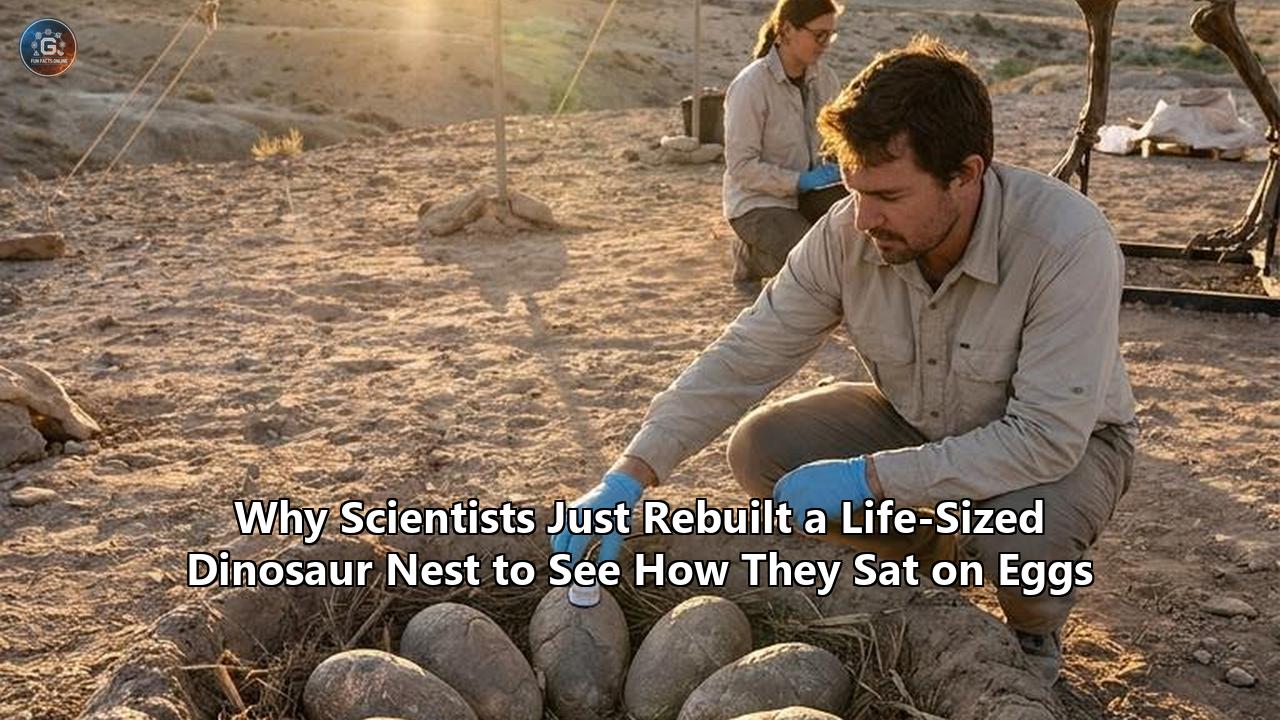
A study published in Frontiers in Ecology and Evolution has approached this mystery from an entirely physical, hands-on perspective. Instead of relying solely on digital reconstructions or fossilized bone structures, a team of researchers in Taiwan constructed a life-sized, scientifically calibrated replica of an oviraptorid dinosaur and its nest. Using everyday materials—including polystyrene foam, wood, cotton, and bubble wrap—coupled with advanced heat-transfer sensors and cast resin eggs, the scientists simulated real-world environmental conditions to analyze how dinosaurs sat on eggs.
The results have shattered long-held assumptions. The experiment revealed that dinosaur incubation was not the highly efficient, uniform process seen in modern birds, but rather an evolutionary halfway point. By physically testing the nest, the researchers proved that a brooding parent could not make uniform contact with its entire clutch. Instead, these prehistoric parents operated as "co-incubators" alongside the sun, relying on a delicate, hybrid balance of parental attendance and ambient solar radiation to bring their offspring into the world.
The Backstory: From "Egg Thief" to Devoted Parent
To understand why scientists built a physical model of a dinosaur nest, it is necessary to trace the tumultuous history of the dinosaurs known as oviraptorids.
In 1923, during an expedition to the Gobi Desert of Mongolia led by the legendary explorer Roy Chapman Andrews, paleontologists discovered the first skeleton of a small, bird-like theropod. The fossil lay directly on top of a nest of eggs that scientists assumed belonged to Protoceratops, a common sheep-sized herbivore of the same region. Believing the theropod had died in the middle of raiding another species’ nest, Henry Fairfield Osborn named the animal Oviraptor philoceratops, which translates literally to "egg thief with a love for ceratopsian eggs".
For seventy years, the "egg thief" moniker blackened the reputation of this group of dinosaurs. However, in the 1990s, new expeditions to the Gobi Desert unearthed spectacularly preserved specimens that flipped this narrative entirely. Paleontologists found multiple oviraptorid skeletons—such as the famous fossil nicknamed "Big Mama"—resting directly on top of nests in a defensive, brooding posture. When scientists analyzed fossilized embryos still tucked inside the eggs, they made a stunning realization: the eggs did not belong to Protoceratops at all. They belonged to the oviraptors themselves. The "egg thief" was actually a dedicated parent that had perished while protecting its unborn offspring.
               [ REPTILIAN INCUBATION ]
             (Eggs buried under sediment;
             heat from soil/decomposition)
                          │
                          ▼
            [ OVIRAPTORID CO-INCUBATION ]
         (Eggs in open concentric rings;
         body heat + direct solar radiation)
                          │
                          ▼
                [ AVIAN BROODING ]
         (Compact clutches in insulated nests;
           100% parental contact heat - TCI)
This discovery sparked a massive paradigm shift, cementing the evolutionary link between non-avian theropods and modern birds. Yet, establishing that oviraptorids sat on their nests was only the first step. A deeper question emerged: how did they sit on them, and did they possess the biological machinery to warm them?
Modern birds incubate their clutches using a process called Thermoregulatory Contact Incubation (TCI). To successfully pull off TCI, three strict conditions must be met:
- The brooding adult must physically touch every egg to transfer heat directly.
- The adult must serve as the primary, dominant source of heat for the nest.
- The parent must keep all eggs within a highly consistent, narrow temperature range to ensure even development.
Whether prehistoric, flightless dinosaurs could achieve these criteria remained a mystery. Oviraptorids were highly diverse, ranging from small, 20-kilogram species to massive giants like Gigantoraptor, which weighed upwards of 1.5 tons. For a 1.5-ton animal, sitting directly on fragile eggshells is a mechanical impossibility. Yet, even for smaller species, the geometry of their nests presented a major thermodynamic challenge.
The Geometry of a Cretaceous Nest
The primary reason why scientists had to reconstruct a physical dinosaur nest lies in its highly peculiar, non-avian architecture.
           TYPICAL OVIRAPTORID CLUTCH LAYOUT
                 (Concentric Rings)

                 .-----------------.
              .-'   Outer Ring of   '-.
            .-'      Elongated Eggs   '-.
           /   .-------------------.     \
          |   /   Inner Ring of     \     |
          |  |    Elongated Eggs     |    |
          |  |      .----------.     |    |
          |  |     /  Empty     \    |    |
          |  |    |   Central    |   |    |
          |  |     \  Space     /    |    |
          |  |      '----------'     |    |
          |   \                     /     |
           \   '-------------------'     /
            '-.                       .-'
              '-.                   .-'
                 '-----------------'
If you look at the nest of a modern ground-nesting bird, like a gull or a duck, the eggs are arranged in a compact, bowl-shaped cluster. This allows the parent to flatten its body over the entire clutch, trapping warmth efficiently with its feathers.
Oviraptorid nests, however, were arranged in a totally different way. Fossil discoveries across Asia show that these dinosaurs laid their elongated eggs in pairs, creating a series of concentric, multi-layered rings. Crucially, the very center of this ring pattern was left entirely empty.
- The Ring Pattern: In a typical mid-sized nest, an outer ring of highly elongated eggs sat partially buried in the dirt, tilted upward at an angle. A second, inner ring of eggs rested slightly below or nested within the outer ring, also separated by sediment.
- The Empty Center: The central clearing was not an accident; it was a deliberate structural design. In larger species, this empty center was where the adult placed its feet and settled its massive body weight. By resting its torso in the clearing, the dinosaur could cover the eggs with its feathered arms and lower abdomen without exerting direct, crushing pressure on the fragile shells.
While this layout solved the mechanical problem of egg-crushing, it created a severe thermodynamic crisis. If the parent’s weight was concentrated in the center, and the eggs were arranged in wide, outward-stretching rings, how did heat actually travel through the nest? Did the outer eggs freeze? Did the inner eggs get cold?
To solve this, Dr. Tzu-Ruei Yang, an associate curator of vertebrate paleontology at Taiwan’s National Museum of Natural Science, and first author Chun-Yu Su turned to experimental paleontology. They decided that instead of guessing with digital calculations, they would physically recreate the Cretaceous microclimate.
Engineering a Dinosaur: The Taiwan Experiment
To build a realistic simulation of a Cretaceous brooding cycle, the Taiwanese research team chose a specific, well-documented species as their guide: ---Heyuannia huangi---.
Heyuannia huangi was a medium-sized, toothless, feathered oviraptorid that lived between 70 and 66 million years ago in what is now southern China. From beak to tail, it measured roughly 1.5 meters (5 feet) and weighed about 20 kilograms (44 pounds). This size made it an ideal subject: it was large enough to require a structured nest, yet small enough that a physical reconstruction was highly manageable in a modern research setting.Furthermore, Heyuannia has one of the most complete nesting fossil records in the world. Its fossilized eggs (Macroolithus yaotunensis) are regularly found in double-ring configurations. Incredibly, chemical analysis of these fossilized shells has revealed the presence of biliverdin and protoporphyrin, the exact same pigments that make the eggs of modern emus and robins blue-green. This coloration strongly indicates that Heyuannia laid its eggs in semi-open nests where camouflage was necessary, implying that the parents spent a great deal of time actively tending to the nest.
With these precise biological dimensions in hand, the team set out to construct their model dinosaur and its clutch.
                 LIFE-SIZED MODEL CONSTRUCTION
             (Heyuannia huangi Rebuilt Torso)

            =================================  <- [Cloth Outer Layer]
           | .-----------------------------. |
           | |     Cotton / Fabric Fill    | | <- [Simulated Fat & Muscle]
           | |  .-----------------------.  | |
           | |  |      Bubble Wrap      |  | | <- [Air-Pocket Insulation]
           | |  |  .-----------------.  |  | |
           | |  |  | Polystyrene Foam|  |  | | <- [Main Torso Volume]
           | |  |  |   Core Block    |  |  | |
           | |  |  |   .-----------. |  |  | |
           | |  |  |  | Wood Frame  ||  |  | | <- [Internal Skeleton]
           | |  |  |   '-----------' |  |  | |
           | |  |  '-----------------'  |  | |
           | |  '-----------------------'  | |
           | '-----------------------------' |
            =================================  <- [Heating Pads (Metabolic Heat)]
Rebuilding the Brooding Adult
To replicate a 20-kilogram Heyuannia, the researchers engineered a headless torso model designed to match the precise heat-retention properties of animal tissue.
- The Skeleton: The core of the model was constructed using a sturdy wooden frame.
- The Flesh and Muscle: Polystyrene foam was carved to match the volume and contours of the dinosaur’s trunk.
- The Skin and Insulation: The team wrapped the foam core in layers of cotton, fabric, and bubble wrap. While bubble wrap and foam sound rudimentary, they were chosen for a highly scientific reason: their thermal resistance (R-value) mimics the insulation provided by fat, skin, and primitive feathers, allowing the model to retain and slow the transfer of heat exactly like a real animal body.
- The Metabolic Engine: Flexible heating pads were attached to the underside of the model. These pads were calibrated to emit a consistent level of warmth that simulated the resting metabolic body heat of a warm-blooded or mesothermic Cretaceous theropod.
Rebuilding the Nest and Eggs
Recreating the eggs presented a unique challenge. Oviraptor eggs are unlike those of any living animal; they are highly elongated, have unique shell porosities, and possess specific thermal conductivities.
To replicate them, the team cast artificial eggs out of specialized casting resin, ensuring they matched the exact dimensions of Macroolithus yaotunensis fossils.
- The Thermal Core: To ensure the eggs responded to heat like a real, embryo-filled egg, the hollow resin shells were filled with water. Water has a high specific heat capacity, making it a perfect stand-in for the organic fluids and developing tissues inside a real dinosaur egg.
- The Sensor Network: Sensitive, high-precision electronic thermometers were inserted deep into the center of each resin egg. Additional sensors were placed in the air gaps between the eggs and in the surrounding soil.
- The Clutch Layout: Following the exact layout found in the Dalangshan Formation fossils, the researchers arranged the resin eggs in double-ring clutches, partially burying them in a substrate of sandy soil that matched the sediment of the original fossil beds.
Inside the Cretaceous Weather Machine: The Three Trials
With the life-sized model assembled, the researchers transported their setup to Wufeng District in Taichung, Taiwan, to run three distinct experiments designed to test how dinosaurs sat on eggs across different seasons and environmental states.
┌────────────────────────────────────────────────────────────────────────┐
│                        THREE EXPERIMENTAL TRIALS                       │
├───────────────────┬────────────────────────────────────────────────────┤
│ TRIAL I:          │ Sunny October Day                                  │
│ Sunlight Only     │ * No parent model present                          │
│                   │ * Measured purely environmental, solar heating     │
├───────────────────┼────────────────────────────────────────────────────┤
│ TRIAL II:         │ Chilly December Night                              │
│ Parent vs. Chilly │ * Brooding parent model placed on top of nest      │
│ Environment       │ * Heat pads activated to simulate metabolic heat   │
├───────────────────┼────────────────────────────────────────────────────┤
│ TRIAL III:        │ Multi-Sensor Thermal Mapping                       │
│ Heat Transfer     │ * Mapped thermal gradients across the nest         │
│ Simulation        │ * Tested how the adult blocked sun during hot days │
└───────────────────┴────────────────────────────────────────────────────┘
Trial I: The Baseline (October Sunlight)
The first experiment was designed to observe how the nest behaved when the parent was completely absent. On a sunny October day, the egg clutch was left in an open-air environment for 11 hours, exposed solely to natural solar radiation and shifting ambient temperatures.
The Finding: Without a parent, the eggs experienced extreme thermal volatility. During peak daylight, the direct solar radiation heated the exposed upper tips of the eggs to dangerous levels. Conversely, as soon as the sun dipped, the temperatures plummeted rapidly, cooled by the surrounding soil and evening drafts. This baseline proved that relying purely on the environment—like modern sea turtles or crocodiles—would have been highly detrimental to oviraptorid embryos, either baking them in the afternoon sun or freezing them overnight.Trial II: The Winter Brood (December Chills)
The second experiment ran for over 15 hours during a cold December night, simulating the cooler, seasonal shifts of the Late Cretaceous. This time, the team introduced their heated dinosaur model, placing it directly over the nest in the classic fossilized brooding posture. A second "control" nest was left nearby without a parent model to compare the difference.
The Finding: The parent model provided a massive shield against the cold, keeping the nest temperatures significantly warmer than the unbrooded control. However, a major problem arose: the parent could not heat the eggs evenly. Because of the wide, double-ring structure, only the eggs directly underneath the dinosaur’s body core received direct contact heat. The outer-ring eggs, positioned further from the torso's center, were exposed to the cold air. The temperature difference between the inner-ring and outer-ring eggs grew to a staggering 6°C (11°F).Trial III: The Microclimate Matrix
The third experiment was the most complex, combining physical data with computer heat-transfer simulations. The researchers monitored how heat moved from the dinosaur's skin through the shell of the resin eggs, the air pockets in the nest, and the surrounding dirt across a full 24-hour cycle of fluctuating temperatures.
The Finding: This trial highlighted the dual role of the brooding parent. While the adult’s primary job at night was to provide metabolic heat, its primary job during hot days was actually to act as a shade provider. By crouching over the nest, the adult blocked the scorching, direct Cretaceous sun, preventing the eggs from overheating, while the ambient warm air kept the entire nest at a stable, intermediate temperature.The Breakthrough: Why Dinosaurs Were "Co-Incubators"
By compiling the data from these three trials, the Taiwanese team unlocked the answers to how dinosaurs sat on eggs, painting a highly nuanced picture of Cretaceous parenting that bridges the gap between reptiles and modern birds.
1. The Contact Conundrum
The most significant revelation of the physical model was the physical limitation of the parent's body. In modern birds, contact incubation is nearly 100% efficient. An incubating bird will shuffle its eggs, press them against a bare patch of skin on its abdomen called a "brood patch," and completely seal them from the cold outside air using its down feathers.
The physical reconstruction proved that Heyuannia could not do this. The rigid, concentric ring architecture of the nest meant that when the 20-kilogram adult settled into the central clearing, its belly only made direct physical contact with the inner edges of the outer ring. The eggs in the lower, inner rings lay entirely out of direct physical reach, insulated from the parent's skin by other eggs and the intervening soil sediment.
As a result, the dinosaur's incubation efficiency was calculated to be only 65%. This is a massive drop-off compared to the near-perfect thermal efficiency of modern avian parents.
2. The Power of "Co-Incubation"
Because the adult’s metabolic warmth was structurally limited, the nest required an assistant: the sun.
                     CREATACEOUS CO-INCUBATION
                     (Hybrid Thermal System)

                     ┌──────────────────────┐
                     │ THE CRETACEOUS SUN   │
                     └──────────┬───────────┘
                                │
                 (Heats outer exposed eggs;
                  warms ambient air/soil)
                                │
                                ▼
                       .-----------------.
                    .-'   Outer Ring of   '-.
                  .-'      Elongated Eggs   '-.
                 /   .-------------------.     \
                |   /                     \     |  <-- [Parent's Torso]
                |  |       Adult Body      |    |      (Direct conductive
                |  |      Contact Heat     |    |       metabolic heat)
                |  |      .----------.     |    |
                |  |     /  Central   \    |    |
                |  |    |   Clearing   |   |    |
                |  |     \            /    |    |
                |  |      '----------'     |    |
                |   \                     /     |
                 \   '-------------------'     /
                  '-.                       .-'
                    '-.                   .-'
                       '-----------------'
When the team simulated a warm, semi-arid Cretaceous climate, they noticed that the 6°C (11°F) temperature gradient between the inner and outer eggs began to shrink. During the day, solar radiation absorbed by the exposed upper tips of the eggs and the surrounding soil helped distribute heat through the nest.
This means that oviraptorid incubation was a collaborative effort between the parent and the ecosystem. On warm days, the parent didn't need to burn valuable metabolic energy to heat the clutch; the sun did the work, while the parent simply provided shade and protection from predators. At night, when temperatures plummeted, the parent's body heat took over, acting as a crucial thermal blanket to keep the embryos from dying of cold.
This "hybrid" or "co-incubation" strategy was perfectly tailored to their semi-open nesting habits. It allowed these non-flying theropods to successfully hatch large clutches of eggs without having to evolve the incredibly high, energy-intensive metabolic rates of modern birds.
The Biological Consequence: Staggered Birthdays
This physical limitation on how dinosaurs sat on eggs had an incredibly fascinating biological side-effect: asynchronous hatching.
In most modern birds, parents want all of their eggs to hatch at the exact same time. To achieve this "synchronous hatching," bird parents will lay their eggs over several days but hold off on sitting on them to initiate incubation until the very last egg is laid. Once incubation begins, the nest is kept at a perfectly uniform temperature, ensuring that all the embryos develop at the exact same rate and hatch within hours of one another. This is crucial for survival, as it allows the parents to feed a single, uniform brood and abandon the nest quickly before predators locate it.
┌────────────────────────────────────────────────────────────────────────┐
│                        SYNCHRONOUS VS. ASYNCHRONOUS                    │
├───────────────────────────────────────┬────────────────────────────────┤
│ AVIAN SYNCHRONOUS HATCHING            │ DINOSAURIAN ASYNCHRONOUS       │
│                                       │ HATCHING                       │
├───────────────────────────────────────┼────────────────────────────────┤
│ * Incubation starts after last egg    │ * Incubation begins gradually  │
│   is laid                             │   during laying                │
├───────────────────────────────────────┼────────────────────────────────┤
│ * Uniform nest temperatures (0°C      │ * Extreme thermal gradients    │
│   variation)                          │   (up to 6°C variation)        │
├───────────────────────────────────────┼────────────────────────────────┤
│ * All chicks hatch within hours       │ * Eggs hatch at staggered      │
│   of each other                       │   intervals over days/weeks    │
├───────────────────────────────────────┼────────────────────────────────┤
│ * Parents care for one uniform,       │ * Siblings vary in age, size,  │
│   single-aged brood                   │   and development              │
└───────────────────────────────────────┴────────────────────────────────┘
The 6°C thermal gradient discovered in the Heyuannia experiment makes synchronous hatching biochemically impossible for oviraptorids.
- The Temperature Effect: In cold or highly seasonal weather, the outer-ring eggs of an oviraptorid clutch developed significantly faster because they were nestled closer to the parent's metabolic heat source. Meanwhile, the inner-ring eggs, which were up to 11°F cooler, had their development slowed down.
- The Result: The eggs in a single nest would have hatched at wildly staggered times—potentially days or even weeks apart.
While asynchronous hatching is rare in modern birds (occurring primarily in certain birds of prey and owls), it was likely the norm for Cretaceous dinosaurs. In fact, real fossil evidence supports this experimental finding. In 2021, paleontologists analyzing an embryo-bearing oviraptorid clutch (Macroolithus) discovered that an egg from the inner ring was at a significantly less advanced stage of embryonic development than an egg from the outer ring, directly matching the thermal mapping generated by the Taiwanese team's physical model.
The Evolutionary Bridge: From Crocodile to Cassowary
By demonstrating that oviraptors were co-incubators, the experiment has provided a crucial missing link in the evolution of avian parenting.
The reproductive strategies of land-dwelling vertebrates exist on a vast evolutionary spectrum. On one far end are primitive reptiles, such as crocodiles and turtles. These animals lay their eggs in buried chambers under soil, sand, or rotting vegetation. They do not sit on their nests, and they transfer zero metabolic body warmth. Instead, they rely 100% on the surrounding environment—geothermal heat, solar radiation, or the heat generated by microbial decomposition—to hatch their eggs. Because of this, reptilian incubation is slow, often taking several months.
On the other far end of the spectrum are modern birds (Neornithes). They build open or semi-enclosed, highly insulated nests made of twigs, moss, and feathers. They use TCI, providing 100% of the required developmental heat from their own bodies, which allows their eggs to hatch incredibly quickly—often in just a few weeks.
================================────────────────==========================
                      THE REPRODUCTIVE SPECTRUM
================================────────────────==========================

  [ REPTILIAN GRADE ]     ===>     [ CO-INCUBATION ]     ===>  [ AVIAN GRADE ]
  * Crocodiles & Turtles            * Oviraptorids              * Modern Birds
  * Eggs fully buried               * Eggs semi-exposed         * Open/sheltered nests
  * 0% Parental Body Heat           * ~65% Thermal Contact      * 100% TCI Contact
  * 100% Environmental Heat         * Parent + Sun Hybrid       * 100% Metabolic Heat
  * Slow development                * Intermediate speed        * Extremely rapid hatch
==========================================================================
Oviraptorids sit directly in the middle of this evolutionary spectrum. They had abandoned the primitive reptilian practice of burying their eggs completely. Instead, they constructed semi-open nests where the eggs were only partially covered by sediment.
However, they had not yet evolved the anatomical or metabolic capability to perform full TCI. Their bodies were too large, their nests were too wide, and their feathers, while present, were likely not yet adapted to create the perfect thermal seal found in modern birds.
Thus, the "co-incubation" strategy discovered by the Taiwanese researchers represents a crucial evolutionary stepping stone. It is the exact midpoint where dinosaurs were beginning to transition from passive, reptile-style egg-layers into active, warm-blooded, avian-style brooders.
The Rise of Experimental Paleontology
The success of the Heyuannia nest experiment highlights a growing, exciting sub-discipline within earth sciences: experimental paleontology.
For over a century, paleontology was a science of observation. Scientists dug up bones, compared them to living animals, and drew artistic reconstructions. In the late 20th and early 21st centuries, the field went digital. Researchers began using CT scans, 3D computer modeling, and finite element analysis to simulate how dinosaurs walked, bit, and ran.
While digital models are incredibly powerful, they have severe limitations when it comes to complex, real-world thermodynamics. Simulating how heat moves through a multi-layered nest involves an overwhelming number of variables: the precise moisture content of the soil, the way air drafts swirl between irregular egg shapes, the insulating properties of decaying organic matter, and the unpredictable shifting of sunlight across a 24-hour cycle.
By building a physical, arts-and-crafts model of a dinosaur out of foam, wood, and bubble wrap, the researchers bypassed the limitations of pure computer programming. They let the physical laws of the universe do the calculating.
               [ DIGITAL THERMAL SIMULATION ]
             (Limited by idealized geometry,
             assumed environmental variables)
                          VS.
              [ EXPERIMENTAL PALEONTOLOGY ]
             (Physical materials, real-world air,
             actual thermodynamic interaction)
The study's author list also highlights a heartening trend of collaboration across different levels of education. The paper's first author, Chun-Yu Su, was actually a student at Washington High School in Taichung, Taiwan, when the initial research was conducted. Working alongside senior university scientists like Dr. Tzu-Ruei Yang, Su helped design and execute the experiment, proving that you do not need multi-million-dollar particle accelerators to make profound scientific discoveries—sometimes, all you need is a creative mind, some casting resin, a roll of bubble wrap, and a rigorous understanding of physics.
Unresolved Mysteries: What We Still Don't Know
While the physical reconstruction of the Heyuannia nest has solved the mystery of thermal distribution, it has raised a series of new, tantalizing questions that paleontologists are eager to investigate next.
1. The Role of Complex Feathers
The model torso built by the Taiwanese team simulated the general thermal resistance of dinosaur soft tissue, but it did not include complex, branching feathers.
We know from spectacular, feather-preserving fossils that many oviraptorids possessed long, vaned feathers on their arms and tails. When sitting on their nests, they likely spread their arms out like a canopy over the outer ring of eggs.
Future physical models will need to incorporate realistic synthetic feathers to see if they acted as a superior thermal blanket, perhaps reducing the 6°C thermal gradient and bringing the dinosaur closer to true avian-style incubation.
2. Who Was Sitting on the Nest?
In modern birds, incubation duties vary wildly. In some species, the female does all the work; in others, the male and female take turns; and in ratites (like emus and ostriches), the male is often the sole protector of the nest.
Who was sitting on the Heyuannia nests?
Interestingly, the blue-green coloration of Heyuannia eggs offers a massive clue. In modern birds, blue-green egg pigmentation is highly correlated with paternal care (where the father does the primary incubation). Because the eggs are colorful and visible in an open nest, the mother lays them and then leaves, while the cryptic, dull-colored father stays behind to guard and incubate them.
Could the fossilized "brooding mothers" we have found actually be devoted dinosaur fathers? To test this, scientists will need to analyze the bone histology of nest-associated adult fossils, looking for medullary bone—a specific type of calcium-rich bone tissue that only egg-laying females produce.
3. Scaling Up: The Giant Oviraptors
Heyuannia was a modest 20-kilogram dinosaur. But what about its giant cousin, ---Gigantoraptor---? Gigantoraptor reached lengths of 8 meters and laid eggs that were up to half a meter long in nests that measured over 3 meters (10 feet) in diameter.How did a 1.5-ton "chicken from hell" sit on its eggs? The empty center of a Gigantoraptor nest was massive, but the eggs in the outer rings were also incredibly far from the center. Did Gigantoraptor have to rely almost entirely on the sun, behaving more like a reptile, or did its massive feathers create a giant, insulated tent that could trap heat over a 3-meter area? Reconstructing a life-sized, 3-meter Gigantoraptor nest will be the ultimate test of experimental paleontology.
A New Picture of the Cretaceous
The image of dinosaur parenthood is no longer one of cold, reptilian detachment, nor is it a carbon copy of a modern nesting bird.
Thanks to a clever, physical reconstruction built from polystyrene, resin, and thermometers, we now have an incredibly clear window into a Cretaceous afternoon. We can envision a 1.5-meter, feathered Heyuannia settling gently into the center of its blue-green, ring-shaped nest. As the afternoon sun beats down, the dinosaur spreads its feathered arms, casting a cooling shadow over its precious clutch, letting the ambient solar heat gently warm the outer shells. As night falls and the chilly Cretaceous air rolls in, the dinosaur's metabolic heating pads—its warm-blooded heart—kick into high gear, pressing its torso down to keep the most vulnerable eggs from freezing.
This elegant, hybrid co-incubation system shows that evolution does not leap overnight from reptiles to birds. It crawls, experimental step by experimental step. And sometimes, to understand those steps, modern scientists have to roll up their sleeves, grab some bubble wrap, and build a dinosaur of their own.
References
- Su, C.-Y., Liao, J.-Y., Wu, H.-J., Chou, K.-Y., Chen, C., Lee, M.-T., & Yang, T.-R. (2026). "Heat transfer in a realistic clutch reveals a lower efficiency in incubation of oviraptorid dinosaurs than of modern birds." Frontiers in Ecology and Evolution.
- Lü, J. (2002). "A new oviraptorosaurid (Theropoda: Oviraptorosauria) from the Late Cretaceous of southern China." Journal of Vertebrate Paleontology.
- Wiemann, J., Yang, T.-R., & Norell, M. A. (2018). "Dinosaur egg colour systematics reveal avian microstructural origins." Nature.
Reference:
- https://timesofindia.indiatimes.com/science/scientists-recreated-a-dinosaur-nest-to-uncover-how-eggs-stayed-warm-70-million-years-ago/articleshow/132136301.cms
- https://blog.everythingdinosaur.com/blog/_archives/2026/03/19/new-research-sheds-light-on-oviraptorosaurian-incubation-and-nesting-behaviour.html
- https://timesofindia.indiatimes.com/science/scientists-recreated-a-dinosaur-nest-to-uncover-how-eggs-stayed-warm-70-million-years-ago/articleshow/132136301.cms
- https://www.sciencedaily.com/releases/2026/06/260621031409.htm
- https://www.techno-science.net/en/news/researchers-replicate-dinosaur-nest-with-its-eggs-N28514.html
- https://www.youtube.com/watch?v=COZkSd5wr2g
- https://scitechdaily.com/scientists-built-a-life-size-dinosaur-nest-and-the-results-were-surprising/
- https://www.vietnam.vn/en/70-trieu-nam-truoc-khung-long-co-the-da-nho-mat-troi-ap-trung
- https://www.eurekalert.org/news-releases/1118716
- https://www.sciencedaily.com/releases/2026/06/260621031409.htm
- https://news.ssbcrack.com/study-reveals-how-oviraptors-incubated-their-eggs-through-combination-of-brooding-and-environmental-heat/
- https://www.sciencenews.org/article/fossil-discoveries-suggest-earliest-dinosaurs-laid-soft-shelled-eggs
- https://www.snexplores.org/article/early-dinosaurs-soft-shelled-eggs-fossil
- https://www.iflscience.com/how-the-3000pound-chicken-from-hell-sat-on-eggs-without-crushing-them-47732
- https://www.cadena3.com/noticia/ciencia/cientificos-recrean-nido-de-dinosaurio-y-resuelven-un-misterio-de-70-millones-de-anos_568802
- https://medium.com/fossils-et-al/did-oviraptorid-dinosaurs-brood-like-birds-new-experiments-finally-have-an-answer-b44d7b579217
- http://prehistoricbeastoftheweek.blogspot.com/2025/04/heyuannia-beast-of-week.html
- https://www.researchgate.net/publication/227812980_Oviraptorosaurian_Eggs_Dinosauria_with_Embryonic_Skeletons_Discovered_for_the_First_Time_in_China
- https://paleocodex.com/species/101146
- https://en.wikipedia.org/wiki/Heyuannia
- https://www.sciencedaily.com/releases/2026/03/260319005102.htm
- https://www.frontiersin.org/journals/ecology-and-evolution/articles/10.3389/fevo.2026.1351288/full
- https://pmc.ncbi.nlm.nih.gov/articles/PMC5255600/
- https://www.researchgate.net/publication/43763168_Turning_Eggs_to_Fossils_A_Natural_Experiment_in_Taphonomy